(Bible Latin)Biblio.com
64 résultats
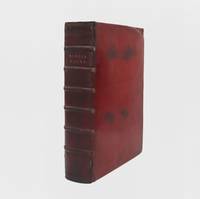
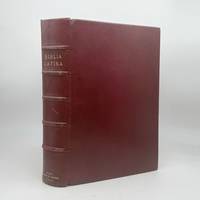
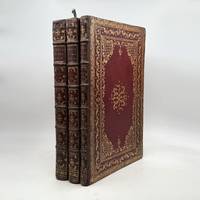
1590371036Rome: Ex Typographia Apostolica Vaticana 1590. First edition of the Sixtine Vulgate Bible large paper copy. Engraved illustrated title-page. Title in red and black text in double columns. 3 vols. Folio. Italian full red morocco binding of the seventeenth or early eighteenth century elaborately gilt with triple floral scrollwork borders stars in cornerpieces about a central motif stencilled paste paper endsheets a.e.g. Boxed. First edition of the Sixtine Vulgate Bible large paper copy. Engraved illustrated title-page. Title in red and black text in double columns. 3 vols. Folio. The engraved title reads: Biblia sacra vulgatae editionis ad concilii Tridentini praescriptum emendata et a Sixto V.P.M. recognata et approbata.<br /> With the preliminary document the Bull of Sixtus V beginning 'Aeternus ille caelestium terrestriumq. rerum omnium conditr ac moderator Deus .". This is often lacking.<br /> <br /> An extraordinary copy of the Sixtine Bible containing the Vulgate text as edited by Pope Sixtus V intended as the first ecclesiastically authorized text to be used throughout Christendom. "In its text it comes closer to R. Stephanus' Bible of 1538-40 than to the Louvain editions" Darlow & Moule who discuss the textual variations. This copy includes examples of the printed overslips required to correct hurried printing. The association with Aldus II suggested by Renouard and lasting long thereafter is spurious.<br /> Pope Sixtus V died soon after the book was printed and was followed by three short-lived popes. The Sixtine Bible had "aroused antagonism among both clergy and laity" and was swiftly condemned; the edition was withdrawn by Pope Clement VIII soon after his elevation to the papal throne in 1592 and many copies were destroyed. Preparations began in 1591 for a new edition of the Vulgate printed in 1592 and known as the Clementine Bible which long remained the standard Vulgate text.<br /> <br /> The ordinary issue of this printing measures 13-3/8 inches tall as in the Brooker copy sold 2024; the present copy measures 15-3/4.<br /> <br /> AN OUTSTANDING LARGE PAPER COPY OF A NOTABLE EDITION. Copinger 521; Darlow & Moule 6181; Adams B1098; BM STC Italian 1465-1600 p. 93; EDIT 16 CNCE 5805. Provenance: Vincenzo Maria Carafa 1739-1814 Prince of Roccella and Duke of Bruzzano engraved bookplates MS shelfmark :H 5; Douglas Maxwell Moffat bought of Quaritch in Dec. 1939; General Theological Seminary Ex Typographia Apostolica Vaticana unknown
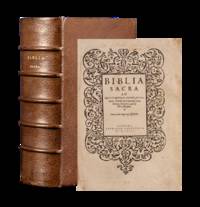
1590372093Rome: Ex Typographia Apostolica Vaticana 1590. First edition of the Sixtine Vulgate Bible. Engraved illustrated title-page. Title in red and black text in double columns. 8 479 1; 5 482-899; 5 902-1141pp. Lacks the 4ff preface i.e. the papal bull of Sixtus V beginning "Aeternus ille caelestium terrestriumq. rerum omnium conditr ac moderator Deus ." as often. Folio 13-1/2 x 9-1/2 inches. Later red morocco spine darkened corners bumped some repairs at head and tail of spine marbled endpapers gilt edges. Engraved title and title page paper-backed. Red quarter morocco clamshell box. First edition of the Sixtine Vulgate Bible. Engraved illustrated title-page. Title in red and black text in double columns. 8 479 1; 5 482-899; 5 902-1141pp. Lacks the 4ff preface i.e. the papal bull of Sixtus V beginning "Aeternus ille caelestium terrestriumq. rerum omnium conditr ac moderator Deus ." as often. Folio 13-1/2 x 9-1/2 inches. The Sixtine Bible containing the Vulgate text as edited by Pope Sixtus V intended as the first ecclesiastically authorized text to be used throughout Christendom. "In its text it comes closer to R. Stephanus' Bible of 1538-40 than to the Louvain editions" Darlow & Moule who discuss the textual variations. <br /> <br /> The association with Aldus II suggested by Renouard and lasting long thereafter is spurious.<br /> Pope Sixtus V died soon after the book was printed and was followed by three short-lived popes. The Sixtine Bible had "aroused antagonism among both clergy and laity" and was swiftly condemned; the edition was withdrawn by Pope Clement VIII soon after his elevation to the papal throne in 1592 and many copies were destroyed. Preparations began in 1591 for a new edition of the Vulgate printed in 1592 and known as the Clementine Bible which long remained the standard Vulgate text.<br /> <br /> As often e.g. the Brooker copy this copy without the preface the Bull of Sixtus declaring the text to be immutable and forbidding any reprint without papal permission. Copinger 521; Darlow & Moule 6181; Adams B1098; BM STC Italian 1465-1600 p. 93; EDIT16 CNCE 5805. Provenance: Henry John Farmer Atkinson his sale Sotheby Wilkinson & Hodge March 1896 lot 2752 sold for £18.15s to; Bernard Quaritch; General Theological Seminary bookplate Ex Typographia Apostolica Vaticana unknown
1527318283Coloniae: Petrus Quentel excudebat 1527. First Protestant Bible printed in Latin. Title-page with large woodcut vignette of arms of Cologne lion and gryphon rampant with and three crowns; numerous illustrations by Anton Woensam and ornamental initials throughout. Ff. 8 CCCXXV 1 LXXXVII i.e. 85 5. 1 vols. Folio. Recent half calf and marbled boards. Title page soiled old remargining tissue repairs on verso; some marginal worming and soiling generally clean with generous margins. Stamps of Cambridge Public Library in ink or in blind on four leaves. First Protestant Bible printed in Latin. Title-page with large woodcut vignette of arms of Cologne lion and gryphon rampant with and three crowns; numerous illustrations by Anton Woensam and ornamental initials throughout. Ff. 8 CCCXXV 1 LXXXVII i.e. 85 5. 1 vols. Folio. The first Protestant Bible in Latin edited by Johan Rüdel Rudelius printed in Cologne by Peter Quentel or Quentell and notable for the wood engraved illustrations by Anton Woensam Anton von Worms particularly those at the head of each of the four gospels. Matthew faces an angle who is touching his stylus; a lion is seated beside Mark; a bull with Luke; and an eagle stands beside John.<br /> <br /> Quentel was the printer of Tyndale's quarto Cologne English New Testament known from a single surviving fragment in the Grenville Collection where this same illustration to Matthew appears. It is a reasonable inference that each of the four gospels would have carried an illustration. The project which had "'got as far as the letter K' the signature that would have taken the work well into Mark" ODNB was unfinished at the time of Tyndale's flight from Cologne in 1525. Quentel's print shop was raided but sheets of the first gospel translated from the original Greek and printed in English soon began to circulate in England. Tyndale settled in Worms where Schöffer completed an octavo printing of the first complete English New Testament in 1526 a facsimile of the Grenville fragment and its illustration were published in 1871.<br /> <br /> The blocks for the illustrations evidently survived the raid on the Quentel's shop and are used here at the head of each of the four gospels.<br /> <br /> A notable edition in the history of the printing of the Bible. Adams 1007; not in Darlow & Moule but see note to 6107; VD16 B2589.OCLC: 22847218 Petrus Quentel excudebat unknown
1557254216Basilaea Basel: Nicolaum Bryling Nicolaus Brylinger 1557. Woodcut border and printer's device on title. INCOMPLETE. 8 479 of 500 8 leaves. Lacking ff. 46-56 & 61-70. 1 vols. 8vo. Bound in contemporary blind panel-stamped pigskin over bevelled wooden boards clasps removed binding worn exposing boards on rear cover title page detached contemporary marginalia by Johannes Weneken throughout. Woodcut border and printer's device on title. INCOMPLETE. 8 479 of 500 8 leaves. Lacking ff. 46-56 & 61-70. 1 vols. 8vo. Brylinger published the only 16th century edition of Luther's Bible in Switzerland published one of the earliest Greek and Latin diglot Bibles and published a series of 8vo editions of the Bible with diglot and Greek-only text which was popular with students. Darlow & Moule makes no mention of this or any other Latin-only edition by Brylinger.<br /> Front paste-down endpaper and front free endpaper display extensive annotations in Greek and Latin presumably by Johannes Weneken. The marginal annotations provide a fascinating insight into how this book was used. Not in Darlow & Moule but cf. 4621; Adams 1056; OCLC: 46973017 6 copies only 3 of which in U.S. Nicolaum Bryling [Nicolaus Brylinger] unknown
15546212Lyon: Jean de Tournes 1554. First edition. Octavo 6 3/4 x 4 3/4 inches; 171 x 121 mm. . 16 1152 76 pp bound without the last two blank leaves as in most copiese.g. Mortimer OCLC. The penultimate leaf had only a fleuron at the foot of the page and the final leaf was blank. Arabesque title border and 198 with 1 repeat woodcuts in the text by Bernard Salomon. Title-page with faint early ink "ex-Libris petri ------ at top blank margin. Title-page expertly cleaned some occasional mainly marginal faint foxing otherwise a superb example of this wonderfully illustrated mid sixteenth-century Latin Bible. Bound ca. 1880 by Chambolle-Duru in full brown crushed levant morocco spine with five raised bands lettered in gilt gilt ruled board edges decorative gilt turn-ins marbled endpapers all edge gilt. Armorial bookplate "In Memori: Weiler Bibliotheca Trautner Falkiana" on verso of front free endpaper.<br /> <br /> First De Tournes Latin Bible based on Robert Estienne's text and beautifully illustrated with 198 woodcuts by Bernard Salomon. "Considerable work could be done on Salomon's sources for these cuts. The Expulsion from Paradise suggests Holbein's version; the New Testament shows some dependence on the set owned by Sébastien Gryphius. the Apocalypse blocks are enlarged copies of the fine Janot Apocalypse. But the cumulative effect of Salomon's carefully detailed scenes is that of an individual contribution to Bible illustration. Particularly interesting from the point of view of technique are the night scenes in Exodus and the storm over Noah's ark. In this 1554 Bible the New Testament blocks are printed with arabesque strip borders at the sides. Arabesque and type ornament headpieces." Mortimer Contents include: Old Testament; Psalms; New Testament Epistles Acts; Index Testimoniorum & Index Epistolarum.<br /> <br /> Robert I Estienne 1503-1559 was a French protestant printer and scholar born into a printmaking family. He would take over his family's Paris firm in 1526 where he printed significant works in Latin Greek Hebrew and other languages. His 1531 Thesaurus linguae latinae is considered a major milestone in lexicography. Despite his many commissions for the King religious tensions forced Estienne to flee to Geneva. <br /> <br /> This bible was illustrated by Bernard Salomon c.1508-1561 a French artist who is known for engravings and illustrations. Although little is known about his life his art reveals stylistic influences from Mannerism and the School of Fontainebleau executed in a detailed and small scale. Salomon is known to have collaborated with the printer Jean de Tournes and produced decoration for emblem books bibles and classic texts. Many of his engravings also appear as source material for art objects such as a Faience plate at the MET featuring the Sacrifice of Noah.<br /> <br /> Brunet I 876 & Supplement I 125; Darlow & Moule 6134 note; Mortimer French no. 81. Jean de Tournes unknown
15847235Salamanca: Gasparem à Portonariis suis & Gulielmi Rouillii Benedictique Boierii expensis 1584. First Edition Primera edición. Hardcover Tapa dura. 297x210mm. 11¾x8¼". Salamanca Gasparem à Portonariis suis & Gulielmi Rouillij Benedictique Boierij expensis 1584-1585. 3 tomos en un volumen. En folio 297 x 210mm. 14 366 1 h.; 72 214 30 138 hojas 42 pp. Importante encuadernación mudéjar de época en piel sobre tabla planos ricamente gofrados lomera restaurada en cabeza y pie sin los broches. La Biblia de Salamanca con la traducción y notas de Francisco Vatablo publicada por primera vez en París en 1545 e impresa en España en 1554 con atribución a fray Domingo de Soto de la revisión del texto prohibida y mandada retirar por la Inquisición entre los años 1554 y 1559 pero que finalmente pudo ser publicada en Salamanca en 1584. Se conoce como <em>Biblia de Vatablo</em> a la edición preparada por Robert Estienne de la versión <em>Vulgata</em> de las Sagradas Escrituras junto con la traducción latina de Sanctes Pagnino y las anotaciones y correcciones de François Vatable profesor de hebreo del Collège de France; fue impresa en París en 1545. Se trata de una Biblia única ya que contiene 2 textos en latín de la Sagrada Escritura y no uno como es común. A la primera traducción se la denomina como la traducción vieja y se trata de la primera traducción de la Biblia realizada al latín desde el hebreo y griego llamada <em>Vulgata</em>; la segunda traducción se la denomina como traducción nueva y contiene las ideas renacentistas. Ambas traducciones confrontan el pensamiento de la <em>Vulgata</em> y las correcciones de ésta entre lo antiguo y lo nuevo. La primera impresión de la Biblia de Vatablo en España fue realizada en 1554 por Andrea de Portonaris en Salamanca; fue considerada ilegal un año más tarde y se dice de ella que no hay ejemplar conocido. Esta segunda impresión de 1584 la única que pudo ver la luz fue publicada después de ser cuidadosamente revisada y expurgada por la Inquisición y un grupo de teólogos de la universidad de Alcalá llamados los <em>hebraizantes</em> a los que le costó la cárcel y la muerte y entre los que se encontraba Fray Luis de León. Esta Biblia editada por Gaspar de Portonaris hermano del impresor de la primera y desconocida primera versión comenzó su andadura en 1569 en un proceso de más de 100 juntas reuniendo a gran número de teólogos y que se extendió por varios años. Contiene para el Antiguo Testamento la versión de San Jerónimo y Pagnini y para el Nuevo Testamento la versión de San Jerónimo y la traducción de Erasmo junco con ciertas revisiones de Teodoro de Beza. Durante los debates hubo momentos de mucha tensión. Especialmente furibundos fueron los enfrentamientos entre Fray Luis de León profesor de Teología Prima y León de Castro profesor de Griego experto acusador de judíos y judaizantes y abiertamente enemigo de todo aquello que tuviera que ver con los textos en hebreo donde las amenazas con denunciarse mutuamente ante el Tribunal del Santo Oficio fueron constantes durante estos años de deliberaciones. En las juntas se enfrentaron dos tendencias irreconciliables lo que iba a desencadenar las persecución de los hebraístas. Finalmente Fray Luis de León y sus otros compañeros hebraístas fueron llevados ante la Inquisición encarcelados y llevados a juicio. Es precisamente durante este largo cautiverio cuando Fray Luis realiza algunas traducciones de libros y escribe varias poesías y una de sus obras más significativas<em> De los nombres de Cristo</em>. Finalmente en 1575 el Tribunal reconociendo el valor y la energía impuesta por Fray Luis en su defensa oral le creyó exento de toda culpa y sospecha. Gasparem à Portonariis suis & Gulielmi Rouillii Benedictique Boierii expensis hardcover
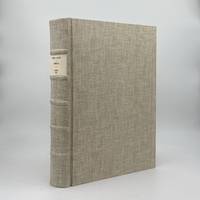
1512372103Paris: Philippe Pigouchet for Simon Vostre 1512. Title page printed in red and black with woodcut device of Simon Vostre; full page woodcuts of St. Jerome crucifixion old coloring. Text in gothic type in two columns ornamental initials some colored text ruled in red throughout. 15 340 28 leaves. Terminal black dd6 present. 1 vols. Folio. Modern linen conservation binding. First leaf toned ownership marks struck out early bibliopole's description in ink at bottom of title. Some minor worming at end. Very good. Title page printed in red and black with woodcut device of Simon Vostre; full page woodcuts of St. Jerome crucifixion old coloring. Text in gothic type in two columns ornamental initials some colored text ruled in red throughout. 15 340 28 leaves. Terminal black dd6 present. 1 vols. Folio. Large folio Bible printed for Simon Vostre by Philippe Pigouchet the famous printer of some of the most beautiful Books of Hours. Uncommon in institutions and in the trade. Renouard ICP II 248; Delaveau & Hillard 778 Philippe Pigouchet for Simon Vostre unknown
1509372247Basel: per Johannem Petri de Langdorff et Johannem Froben de Hammelburg 1509. Printer's device on title hand colored at an early date. Large manuscript initials in red and blue; rubricated throughout. 14 CCCXLVII 28 leaves. Manuscript references and extensive early marginalia in Hebrew in O.T.; citations in Table keyed to N.T. and underlined. Contemporary colored deerskin sectional fore-edge tabs. Folio 13 x 8-1/2 inches. Full burgundy morocco by Zaehnsdorf. Title leaf repaired at gutter and bottom corner; minor staining. Printer's device on title hand colored at an early date. Large manuscript initials in red and blue; rubricated throughout. 14 CCCXLVII 28 leaves. Manuscript references and extensive early marginalia in Hebrew in O.T.; citations in Table keyed to N.T. and underlined. Contemporary colored deerskin sectional fore-edge tabs. Folio 13 x 8-1/2 inches. A scarce Latin bible the first edition of the Vulgate with the printed marginal references to canon law. These 'Concordantiae iuris canonici' according to Masch were compiled by Johannes Niuicellensis an abbot and were printed separately in 1482. This is also the first edition to printed the commendatory hexastich by Matthias Sambucellus on the title page beginning: "Emendata magis scaturit nunc biblia tota."<br /> <br /> A tall copy with generous margins lovely stylish manuscript initials and full rubrication. VD16 B2584. Delaveau & Hillard 771; cf. Darlow & Moule note after 6092. Provenance: Dr. Charles Clay Manchester 19th century inscription on front endpaper sold Sotheby Wilkinson & Hodge May 18 1883; General Theological Seminary bookplate blindstamps; [per Johannem Petri de Langdorff et Johannem Froben de Hammelburg unknown
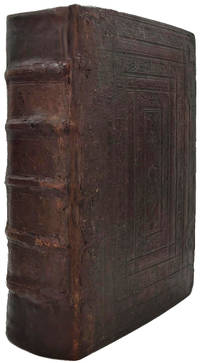
15192682Lyon: Jacques I Mareschal for Simon Vincent 1519. <p>8vo 180 x 126 mm. 30 500 54 pp. with pagination errors. Title and first table printed in red and black text in two columns with printed marginalia indices and summary in 3 columns. Colophon on fol. RR4v. Publisher’s woodcut device Baudrier no. 2 on title and final verso full-page woodcut showing the six days of Creation within ornamental border historiated woodcut initials throughout; red paragraph marks to opening page and red highlighting to the facing woodcut. Mainly faint marginal dampstain in upper margins light discoloration to outer margins. Contemporary Flemish blind-tooled calf over wooden boards sides with leafy roll-tool border enclosing central panel with intersecting triple fillets forming a saltire design the compartments filled with a repeated foliate tool arranged symmetrically one of two fore-edge clasps two catches; many deckle edges preserved worn a few small chips to leather pastedown endpapers renewed. Provenance: early ownership inscriptions on title: Mrr Cornelius Adamus ter Borch; and Siba Lÿken; contemporary marginal notes and some text markings crosses in margins and underlinings in first few books Genesis-Deuteronomy; abundant 17th and/or 18th-century philological annotations in Genesis and Exodus and in the indices including full page of notes on blank page 2E5v.<br /> <br /> A complete portable Bible printed in very small types containing an ample scholarly apparatus and finding aids for the use of theology students and scholars; this copy with contemporary annotations and in a contemporary blind-tooled calf binding probably Flemish. This compact glossed Bible densely and economically printed with no break between the Old and New Testaments is enlivened by hundreds of historiated woodcut initials from woodcut alphabets designed by Guillaume Leroy who also designed the six-part full-page woodcut of the Creation. <br /> <br /> Mareschal’s useful “pocket†Bibles were bestsellers this being the fourth of six octavo editions from his press. They were among the first Bible editions to include a rhyming mnemonic Biblical summary by the minorite friar Franciscus Gothi in which each four-line verse summarizes a Biblical chapter. Occupying here the final two quires and called for in the colophon it is not recorded by Baudrier or Gültlingen. Possibly buyers had the choice of including it or not in their copies. Otherwise the text of Mareschal’s octavo Bibles follows that of the Bible printed in Basel in 1509 by Johann Petri and Froben using the text edited by the Dominican Alberto Castellano and supplying for the first time marginal notes citing canon law. The apparatus includes four tables and a glossary of Hebrew names. As in the Petri editions a six-line commendatory poem by Matthias Sambucellus is printed on the title here with the first word of the last line incorrectly given as “Omne†instead of “Omine.â€<br /> <br /> The publisher Simon Vincent belonged to Lyon’s powerful booksellers' guild the Compagnie des Libraires whose members helped Mareschal during his early years impressed by his skill conscientiousness and sobriety â€a rare trait among printers of this period†notes Baudrier qualities which contrasted markedly with those of the printer Michel Topie whose press Mareschal had acquired in 1512 Baudrier 11:383.<br /> <br /> USTC 145003; Adams B-997; Pettegree & Walsby French Vernacular Books III: 57271. Darlow & Moule II: 6093 note; Baudrier Bibliographie lyonnaise 11: 401 and pp. 380 397 & 448; Gültlingen Bibliographie des livres imprimés à Lyon 2:209 no. 56.</p> Jacques I Mareschal [for Simon Vincent] unknown
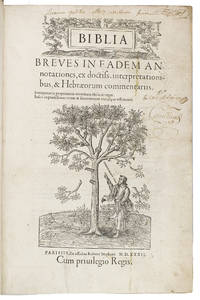
1532ABC_49016Paris: Roberti Stephani = Robert Estienne 1532. Modern gold-tooled brown calf with the title lettered in gold on the spine red sprinkled edges. Folio. With Estienne's large olive-tree device on the general title page and the divisional titles of parts 3 interpretatio and 4 index a woodcut decorative border around the word "Biblia" on the general title page and 79 decorated metalcut criblé initials. 4 parts in 1 volume. Including: - Hebraica Chaldaea Graecáque & Latina nomina virorum .- Index rerum et sentiarum quae in Veteris & novi testamenti libris continentur. Second enlarged and first fully glossed edition of the famed Estienne Bible. The work is "considered the earliest genuine attempt at a critical edition of the Vulgate text. it became practically the foundation of the official Roman Vulgate" Schreiber. The first edition of this Bible was Estienne's first major work and "immediately established him as the most outstanding figure in the Paris book trade at the time" Schreiber. The present copy is complete with the glossary and index which appear as parts 3 and 4. It also includes the beautiful criblé initials by engraver Geoffroy Tory 1480-1533.Robert Estienne 1503-1559 acquired Vulgate manuscripts during his years in Paris and printed numerous editions throughout his career beginning in 1528. Unlike the first edition the present edition includes marginal references concise notes and an extensive index of significant Hebrew words. It also contains Estiennes distinctive typographical symbols indicating words present in the Hebrew text but omitted from the Latin version and vice versa. Notably this edition is the first in which Estienne placed the Acts of the Apostles between the Gospels and the Pauline Epistles rather than at the end of the volume as was then customary.With an annotation at the top of the title page another in the middle of the title page and a signature below. The front and back board are somewhat scratched. The title page has been reinforced in the margins likely with the final blank of the second part which is missing to repair the tear in the bottom half large ink stains in the inner margin of leaves 243-244 and 306-307 of the first part a tear in the outer margin of leaf 7 of part 3 minor ink thumb prints on some of the leaves each leaf has been ruled in reddish-brown ink with manicules on some of the leaves. Otherwise in very good condition.l Darlow & Moule 6112; Renouard p. 35.1; USTC 181366; cf. Schreiber The Estiennes 37 other ed. Roberti Stephani [= Robert Estienne], unknown
1587ST14247Venetiis Venice: Hieronymus Polus 1587. 213 x 146 mm. 8 3/8 x 5 5/8". 12 p.l. 1126 pp. <br/> ESPECIALLY PLEASING CONTEMPORARY CALF covers with gilt French fillet frame and oval wreath of olive branches the center of the wreath in the shape of a cross flat spine ruled in gilt red morocco label. Title page with elaborate wood-engraved frame text profusely illustrated WITH 600 WOOD ENGRAVINGS depicting scenes from scripture after Holbein Bernard Salomon le Petit Bernard and others a handful of these a bit indistinct. Front pastedown with ex-libris of Leonis S. Olschki. Adams B-1093; STC Italian 93. Not in Darlow & Moule. ◆A little wear to joints and extremities spine a bit crackled separation at hinges but no looseness occasional minor browning or foxing otherwise in remarkably fine condition the text clean and crisp and in a still-lustrous entirely solid unsophisticated original binding.<br/> <br/> This is a very well-preserved handsomely bound and lavishly illustrated edition with distinguished provenance of the Louvain Bible first printed in Venice in 1578. Our edition contains 600 wood engravings illustrating the text ranging from portraits of prophets saints and evangelists to dramatic scenes from the histories of the Old Testament and the life of Christ and ending with an imaginative Apocalypse cycle. Many of these are the work of Lyonnaise artist Bernard Salomon 1506-61 known by the sobriquet "Le Petit Bernard" for his small engravings rich with detail. Others are based on the biblical woodcuts of Hans Holbein. The binding here is likely French; the flat spine with just one large gilt-framed panel and the olive branch decoration on the covers is characteristic of late 16th century and early 17th century French work. The exceptional condition here is typical of books from the collection of Leo Samuel Olschki 1861-1940 scion of a family of Prussian Jewish printers whose interest in printing history led to his becoming a celebrated antiquarian bookseller author founder of the journal "The Bibliophile" and publisher of works in the humanities. Hieronymus Polus unknown
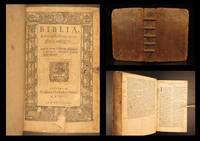
156729347<p>Printed in 1567 by Christopher Plantin in Antwerp this Latin Bible presents the Louvain translation edited by Johann Hentenius. It includes both Old and New Testaments along with the Apocrypha. The layout is in two columns and reflects mid-16th-century Latin biblical scholarship. This edition is an example of Plantin's early Bible production and follows his first Latin Bible of 1559. The volume is bound in blind-stamped leather boards and retains one original brass clasp. Format is octavo 8vo single volume. Collation: 8 303 1 blank; 74 5. No illustrations are mentioned. References include Adams B 1077 and Darlow & Moule 6141 note. Condition: Very Good. Binding is tight and secure with aged boards showing moderate wear. Leaves are complete and show light toning. #29347 PHOTOS AVAILABLE UPON REQUEST.</p> Ex officina Christophori Plantini hardcover
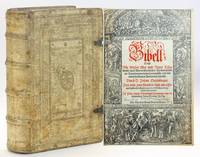
1567512128Gerwinum Calenium und die Erben etwan Johan Quentels Zu CölnGerivinum Calenium und die Erben etwan Johan Quentels Zu CölnGerivinum Calenium und die Erben etwan Johan Quentels 1567. Leather. VERY GOOD. 6 528 OT Apocrypha; 159 NT f. COMPLETE with first five leaves tipped in. General title printed in red and black with woodcut architectural border showing heavenly scene of the Trinity surrounded by angels at head four evangelists with their symbols to center and 12 apostles to the tail; NT title page with the same border. Illustrated with 134 woodcuts by Virgil Solis and others and woodcut dropcaps. NT leaf 82 mis-foliated as 86 Folio contemporary alum-tawed pigskin over bevelled boards elaborately tooled with double border of noble portraits on pedestals surrounding interior border of angelic figures framing center panel emblazoned with Jesuit 'IHS' insignia to front and Virgin with child to rear; in contemporary trim with dark blue edgestain; leather hasps perished but with all four brass fixtures intact hand-written title to upper spine panel both original headbands intact. Tidemark to upper and tail margins of Kings - Ezekiel and small dampstains to tail margin of most of the NT first four leaves tipped-in with some marginal tissue repair to the title page and second leaf; marginal gloss to 22b and a few marginal notes to the prelims text otherwise very clean and sharp with no tears and typical shelfwear to edges. Large color bookplate of Gottfried Ritter von Boehm. A very handsome and uncommonly clean and unrestored binding. Commonly known as the 'Anti-Luther Bibel' Dietenberger's translation was the standard Catholic German translation of the Counter-Reformation and well into the 17th century. 'Johannes Dietenberger ca. 1475–1537 native of Frankfurt am Main university-trained Doctor of Theology and Dominican friar served as prior in Frankfurt and Koblenz during the 1525 Urban Revolt of the German Peasants’ War and the early Protestant Reformation respectively. Like Martin Luther Dietenberger translated the Bible into the vernacular German after consulting recently published Greek and Hebrew biblical texts; however unlike Luther he produced a translation that remained true to the Latin Vulgate and the traditional teachings of the Catholic Church. Dietenberger aimed to counter those parts of Luther’s translation which contradicted Catholic tradition and at the same time to provide a translation whose language was less coarse and offensive.' Roman Fischer and Jourden Travis Moger 'Johannes Dietenberger and his Counter-Reformation German Bible' in Journal of the Bible and Its Reception Feb. 2017. Darlow & Moule 4211; VD16 B 2804. Gerwinum Calenium und die Erben etwan Johan Quentels, Zu CölnGerivinum Calenium und die Erben etwan Johan Quentels, Zu CölnGer unknown
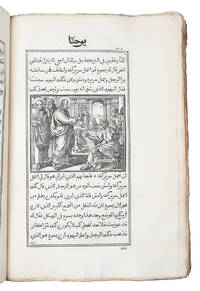
159062507Rome Typographia Medicea 1590 -1591. Folio. Completely uncut in the original blank interim wrappers with slight offsetting to verso of front wrapper. Newer paper backstrip matching the paper of the wrappers. Some leaves browned. Occasional brownspotting. An overall excellent copy. Housed in a old vellum chemise with ties and handwritten title EVANGELIUM to spine. Old amorial vague red stamp to title-page colophon and p. 97 from the Bibliotheque Impériale now Bibliotheque Nationale with a small deaccession-stamp to title-page. Magnificently illustrated with 149 large woodcut engravings in the text. 368 pp. Arabic text within double-frame border througout. Beautifully printed on very heavy paper. <br/><br/><em>The scarce editio princeps of the Arabic translation of the New Testament magnificently printed in Granjon's famous font considered the first satisfactory Arabic printing type appearing here for the first time and beautifully illustrated with 149 woodcut illustrations in the text. This work constitutes the very first printing by the Typographia Medicea-press a printing-house set up by Pope Gregor XIII and Cardinal Ferdinando de Medici in order to promote and distribute Christian scriptures to the East. This splendid work is considered the first successful printing of Arabic. Apart from the Latin part of the title-page and the colophon the book is in Arabic throughout. Two issues of the work were printed almost simultaneously the Arabic-only text which has the year 1590 on the title-page and 1591 on the colophon and the interlenear Arabic-Latin edition which has 1591 on the title-page. The Arab-only edition with 1590 on the title-page is generally considered the first. "Its first great Arabic publication was this edition of the Gospels bearing the date 1590 on the title page and 1591 at the end. Two versions appeared one solely in Arabic and one with an interlinear Latin translation." Library of Congress.The work was edited by Giovanni Battista Raimondi 1536-1614 a renowned Orientalist and professor of mathematics at the College of the Sapienza in Rome. Raimondi had travelled extensively in the Middle East and had thorough knowledge of Arabic Armenian Syrian and Hebrew. He is however most famous for being the editor at the Typographia Medicea-press; together with French engraver Robert Granjon who also created the Arabic typography of the present work "bettered all previous attempts to print in Arabic in Europe and would remain unsurpassed long after the press had closed. Boogert "Medici Oriental Press Rome 1584-1614"."Antonio Tempesta the engraver cutter: Leonardo Parasole had studied under Santi di Tito and Joannes Stradanus at the Accademia del Disegno in Florence later working with Stradanus and Vasari on the interior decoration of the Palazzo Vecchio in Florence before travelling to Rome where he executed various commissions including frescos for Pope Gregory XIII in the Vatican and decorations for the Villa Farnese. Simultaneously with his frescos and panel paintings he executed a large number of engravings. The illustrations for the present work are remarkable examples of Tempesta's work noteworthy for their clear composition and narrative of the episodes depicted. Despite the extremely high quality of the prints the press never became an economic success and it went bankrupt in 1610. Scholars have noticed that presenting a work with beautiful scriptural illustrations as the present to Arabic-speaking Muslims when Islam forbids religious illustration showed little understanding of the culture and almost certainly hindered Pope Gregory XIII's missionary efforts."The press was not only an intellectual enterprise; it was also a commercial one. Raimondi clearly hoped to sell his books in the East rather than the West because the selection of the works he produced showed little consideration with the type of material European scholars in this period needed. While the works failed to sell in the Ottoman Empire however they did significantly stimulate the study of the Middle East in Europe.Ferdinando de' Medici had ordered Raimondi to print 'all available Arabic books on permissible human sciences which had no religious content in order to introduce the art of printing to the Mohamedan community.' Only more than a century after the Medici Press in Rome had closed did it finally have the envisaged impact in the Levant; Ibrahim Müteferrika the first Muslim printer referring to it in his plea to the sultan to allow him to open his own printing house at Istanbul which happened in 1729." Boogert "Medici Oriental Press Rome 1584-1614".The copy was previously in the Bibliothèque Nationale in Paris at the time when it was entitled "Bibliothèque Imperiale" which was its name inbetween from 1849 to 1871. Thus the book entered the library in Napoleonic times and was later deaccessioned. Brunet II 1122-23Schnurrer 318Adams: B:1822 </em> hardcover