9 732 résultats
193938461New York: Viking Press 1939. 1st Edition . Hardcover. Good/No Jacket. Esther Waite. Unmarked copy blue cloth with blue decorative design on front cover and blue titles on spine. Edge rubbing and fading around corners and to spine. End pages with some fading and light soiling. Text in excellent condition. No jacket. 82 pgs. <br/> <br/> Viking Press hardcover
187174060Philadelphia: W.S. Turner 1871. Rare first <span class="glossaryQtip qTip">edition</span> of the first Jewish cookbook published in America with extensive instructions on keeping a kosher household in addition to recipes.<i> </i>Octavo original cloth. In very good condition rebacked. Housed in a custom half morocco clamshell box. First editions are exceptionally scarce of this milestone in American Jewish history. The introductory sections provide an overview of kosher dining household economy and table-setting. Later sections include household tips "to cement broken china" "to revive the color of black silk" lists of seasonable foods by month and a two-page summary of the Jewish calendar. A longer section titled "Hints for Housekeepers" suggests a weekly routine in detail. For Sunday dinner Levy points out that "this is the day the husbands are at home then something good must be prepared in honor of the lords of the household." Most of the book consists of recipes as expected including some classics from Jewish cuisine. Macaroons matzo cleis soup German kouglauff kugel grimslechs chremslachs and "potato souffle for Passover." Some recipes have apparently been adapted from American neighbors such as macaroni hominy fritters and "ochre soup or gumbo" which is reported to be "much used in the South." Throughout Levy's recipes are more impressionistic than scientific pepper pot soup: "in a pint and a half of water put such vegetables as you wish . . . cut them very small and stew them with a couple of pounds of mutton and a piece of nice beef" and the requirements of kashrut are strongly emphasized. "This book offers us a vivid look into the daily lives of the American Jewish community just before the period of its most rapid growth. In the recipes you can see the dynamic between the requirements of keeping kosher the cultural traditions brought over from Europe and the American ingredients at hand but it's also rich in detail on the day-to-day management of a 19th-century Jewish household. It's an interesting and important cultural document" Rick Stattler The New York Jewish Week. Only one copy listed in OCLC. W.S. Turner hardcover books
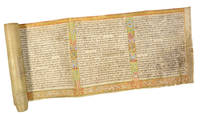
91530Central Italy early 19th century. . Illuminated scroll on parchment 3 spliced sheets 25.5 x 202.7 cm.; hand-coloured decorations possibly later some wear and loss of colour small tears; repairs to the back of first sheet.<br /> Italian Esther scroll beautifully illuminated in colour.<br /><br />Text divided into 11 parshiyot of 28 lines each and a compartment dedicated to the schematic drawing of the hanging of Haman's 10 sons. The decoration is composed of colourful ornamental borders on an ochre-yellow background: upper border with intertwining green branches lower border with a white vine-stem and crowns large flowers and medallions depicting the zodiac signs in the columns that separate the compartments.<br /><br />The Book of Esther is part of the Ketuvim The Writings the third section of the Hebrew Bible. It tells the story of a Jewish girl named Esther who became queen of Persia and thwarted a plan by Haman to commit genocide against her people. Also called The Megillah the book is the basis and an integral part of the Jewish celebration of Purim. Its full text is read aloud twice during the celebration in the evening and again the following morning. Besides Song of Songs it is the only book in the Bible that does not explicitly mention God.<br /><br />'Since the Talmudic period 70-640 AD it has been customary to write the Book of Esther on parchment in the form of a scroll and the rules governing its production and writing are basically the same as those for a traditional Torah scroll. It is not known when and under what circumstances artistic embellishment of Esther scrolls began. The earliest extant illuminated examples emanate from 16th-century Italy<br />commissioned by well-to-do Italian Jews' Encyclopaedia Judaica.<br /> Central Italy, early 19th century. unknown
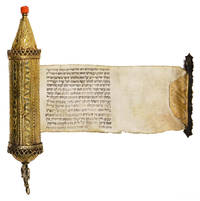
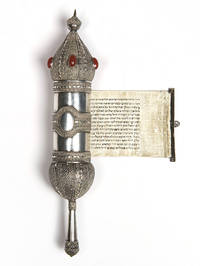
98168Balkan 19th century. . Scroll on parchment housed in a silver gilt case unstamped; scroll height 7 cm. case height 19 cm.<br /> Original manuscript on vellum text arranged in 15 lines in Hebrew Sephardic Script. A red bead decorating the top of the case. <br /><br />The Book of Esther is part of the Ketuvim The Writings the third section of the Hebrew Bible. It tells the story of a Jewish girl named Esther who became queen of Persia and thwarted a plan by Haman to commit genocide against her people. Also called The Megillah the book is the basis and an integral part of the Jewish celebration of Purim. Its full text is read aloud twice during the celebration in the evening and again the following morning. Besides Song of Songs it is the only book in the Bible that does not explicitly mention God.<br /><br />'Since the Talmudic period it has been customary to write the Book of Esther on parchment in the form of a scroll and the rules governing its production and writing are basically the same as those for a traditional Torah scroll. It is not known when and under what circumstances artistic embellishment of Esther scrolls began. The earliest extant illuminated examples emanate from 16th-century Italy<br />commissioned by well-to-do Italian Jews' Encyclopaedia Judaica.<br /> Balkan, 19th century. hardcover
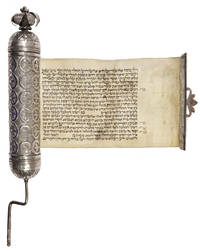
97796Balkan early 19th century. . Scroll on parchment housed in a silver case unstamped cast hammered and engraved with floral decorations and geometric patterns. Scroll height 15 cm case height 34.5 cm; some staining to parchment.<br /> Esther scroll housed in an elaborately decorated silver case.<br /><br />Manuscript on vellum text arranged in 19 lines in Hebrew Sephardic Script. An ornamentation of an attractive multilayered flower to the top of the case. <br /><br />The Book of Esther is part of the Ketuvim The Writings the third section of the Hebrew Bible. It tells the story of a Jewish girl named Esther who became queen of Persia and thwarted a plan by Haman to commit genocide against her people. Also called The Megillah the book is the basis and an integral part of the Jewish celebration of Purim. Its full text is read aloud twice during the celebration in the evening and again the following morning. Besides Song of Songs it is the only book in the Bible that does not explicitly mention God.<br /><br />'Since the Talmudic period it has been customary to write the Book of Esther on parchment in the form of a scroll and the rules governing its production and writing are basically the same as those for a traditional Torah scroll. It is not known when and under what circumstances artistic embellishment of Esther scrolls began. The earliest extant illuminated examples emanate from 16th-century Italy<br />commissioned by well-to-do Italian Jews' Encyclopaedia Judaica.<br /> Balkan, early 19th century. hardcover
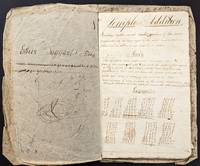
18141160Middletown CT. 1814. <p>Folio. 320 x 200 mm. 12 ½ x 8 inches. 424 leaves. Textblock sewn with original drab paper wrappers. Wrappers with a few tears and folds at the edges some staining and a few ink marks; otherwise a remarkably well preserved manuscript work book.</p> <br /> <p>Fine example of an early American arithmetic work book filled with examples applicable to the mercantile or dry goods trade. Includes exercises in simple addition addition of Federal Money simple subtraction subtraction of Federal Money simple multiplication and the application and use of multiplication in making out bills determining quantity and finding the value of goods. This part includes examples of establishing the cost of paper pairs of men’s shoes bushels of oats and other grains and food commodities. This is followed by exercises in division compound addition Sterling money weights and measures Troy weight Avoirdupois apothecaries cloth wine and the measurement of land.</p> <br /> <p>Of the examples we especially note math problems concerning distances on the East Coast including New York to Philadelphia; a wine merchant’s dwindling quantity of ‘pipe wine’; and a tailor’s bill for materials and making of a silk coat vest and buttons.â€Â   A final question to be solved reads as follows: “The war between England and America commenced April 19 1775 and a general peace took place January 20th 1783 how long did the war continueâ€Â Miss Taggart’s calculations break down the problem into years months and days to arrive at the correct answer. </p> <br /> <p>The contents of the manuscript suggest that Ms. Taggart may have been training to work in a commercial setting selling goods such as the one listed in the fictional Bill of Parcels. Although it is well known that women especially wives of the owners of general stores managed the business side of a mercantile enterprise it is very rare to have an exercise book penned by a woman that documents the method of learning complex mathematics and business practices.</p> <br /> <p>In this case Esther Taggart was very proud of the work she was doing and she signed the book four different time; once on the inside cover; once on p. 9 “Esther Taggart’s Manuscriptâ€; once on p. 45 again signing it “Esther Taggart’s Manuscript†and finally on the inside rear wrapper. </p> <br /> <p>Although we are not sure which New England town named Middletown was Esther’s home we think it was Connecticut. On the sample “Bill of Parcel†that appears on the verso of leaf 11 the example cites New London as the origin of the invoice. </p> . unknown
117059Jerusalem Bezalel Circa 1920. . Original manuscript on vellum text arranged in 14 lines in Hebrew script scroll housed in an elaborately decorated silver filigree case stamped 'Made in Palestine 935' set with five semiprecious stones presumed Carnelian stone; scroll height 600 mm case height 220 mm engraved with 'Jerusalem' signature in Hebrew.<br /> A beautiful example of a Bezalel Megillah housed in a silver case with elaborate filigree and semiprecious stones.<br /><br />The Bezalel school was founded in 1906 in Jerusalem by the artist and professor Boris Schatz and was the first art school to be established in the Holy Land in the 20th century. Schatz who discussed his vision of opening an art school in the Land of Israel with Herzl when the two met in Vienna<br />in 1903 chose to call the school Bezalel after the biblical artist Bezalel ben Uri ben Hur mentioned in the book of Exodus as the artist chosen by God to build the Tabernacle HaMishkan in Hebrew. According to the scripture this artist worked in silver gold copper stone and wood. By founding the school Schatz aimed to establish a national style of art blending classical Jewish European and Middle-Eastern traditions. <br /><br />In addition to traditional sculpture and painting training the school ran craft workshops that produced<br />decorative objects in silver leather wood brass and fabric which were sold at exhibitions in Europe and the United States. Schatz's school was closed in 1929 and then reopened in the mid 1930s as the New Bezalel. In 1955 the school received its official academic acclaim and today the Bezalel Academy of Art and Design is Israel's national school of art as well as its oldest higher education institution. The art created by Bezalel's students and professors in the first decades of the 20th century is considered the stepping stone for Israeli visual arts.<br /><br />The Book of Esther is part of Ketuvim Writings the third section of the Hebrew Bible. It tells the story of a Jewish girl named Esther who became queen of Persia and thwarted a plan by Haman to commit genocide against her people. Also called The Megillah the book is the basis and an integral part of the Jewish celebration of Purim. Its full text is read aloud twice during the celebration in the evening and again the following morning. Besides Song of Songs it is the only book in the Bible that does not explicitly mention God.<br /><br />'Since the Talmudic period it has been customary to write the Book of Esther on parchment in the form of a scroll and the rules governing its production and<br />writing are basically the same as those for a traditional Torah scroll. It is not known when and under what circumstances artistic embellishment of Esther scrolls<br />began. The earliest extant illuminated examples emanate from 16th-century Italy commissioned by well-to-do Italian Jews.' Encyclopaedia Judaica<br /> Jerusalem, Bezalel, [Circa 1920]. hardcover
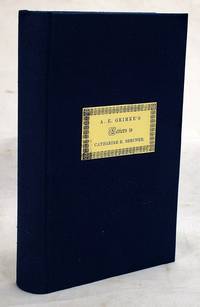
18382006080076Boston Printed by Isaac Knapp 1838-12-31. First Edition. Hardcover. Good. Powerful women and dangerous women: Early Abolitionist works Bound in contemporary boards. Yellow printed title label on front board. Rebacked with renewed spine. Housed in custom clam shell case. Library markings. Intermittent water stain generally faint. 130 pp. <br> "First edition of the third work in a series of literary exchanges between Beecher and Grimke that began in 1836 with Grimke's Appeal to Christian Women of the South. This was followed by Beecher's Essay on Slavery and Abolitionism with Reference to the Duty of American Females 1837 in turn followed by the present work by Grimke. Although born into the Southern elite of South Carolina Angelina Grimke 1805-1879 spent most of her life in the North advocating for the abolition of slavery and women's rights. Catherine Beecher was an educator and shared similar views." - Swann Galleries Sale 2377 Lot 59 March 26 2015. Angela Grimke and her sister Sarah Moore were highly unusual women for their era. They converted to Quakerism and advocated not only the emancipation of slaves but also racial and gender equality. Quite radical for a southern woman in the 1830s. Boston, Printed by Isaac Knapp hardcover
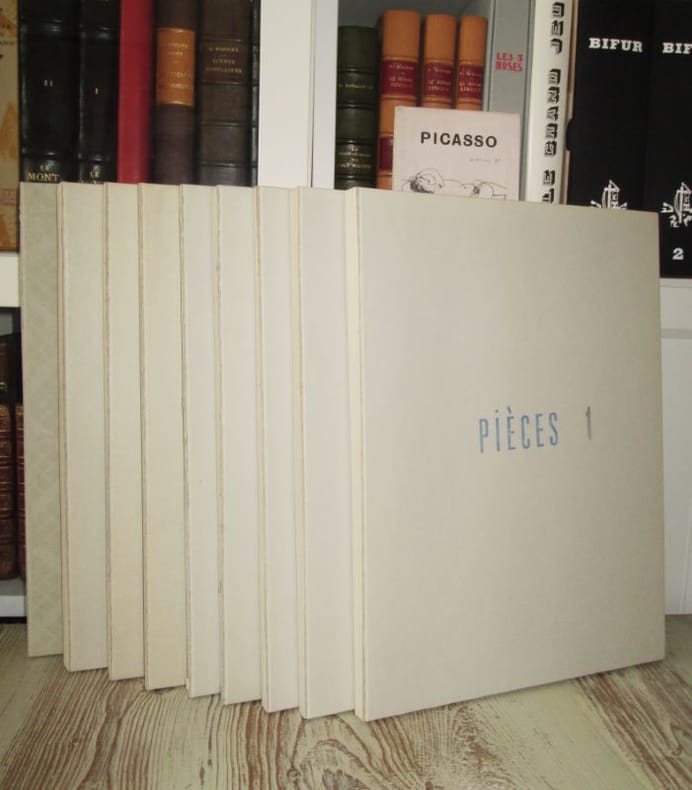
198632296Lille, Alain Buyse / Gérard Duchêne / Gérard Durozoi, 1986-1995. Ensemble de neuf numéros de la revue "Pièces" (qui en a compté dix, regroupant 165 travaux de Sérigraphies) : en feuillets sous coffret cartonné et titré (35 x 25,5 cm).- Le premier numéro de la revue est tirée à 100 exemplaires, le nôtre étant l'un des 10 premiers (signé E. A.), toutes les planches y sont signées de leurs auteurs : Vera Molnar, Marcel Alocco, Arden Quin, René Bonargent, Philippe Boutibonnes, Jean-Luc Coatalem, Danie Deleuze, Pierre Dhainaut, Martine Diemer, Jochem Gerz, Jacques Herold, Joël Hubaut, André Lambotte, Jean-Pierre Le Goff, Ghérasim Luca, Pierre Tual). Les 8 numéros suivants ont chacun une sérigraphie signée. Le second n° est tiré à 130 ex., celui-ci le n° 86 dont seule est signée la planche originale au pochoir de Gérard Duchêne, et comporte 17 sérigraphies des artistes : Pierrette Bloch, Yves Buin, Pierre Buraglio, Max Charvolen, Eddy Devolder, Jean-François Dubreuil, Gérard Duchêne, Gérard Durozoi et Dominique Grisor, Shirley Jaffe, Jean Mazeaufroid, Jean Messagier, Alberto Parres, Gérard Pascual, Jeanpyer Poels, Patrick Saytour, Pierre Tilman, Endre Tot.- Le troisième n° est tiré à 155 exemplaires, celui-ci le n° 113 : Alain MARTIN (signée). Annick Blavier & Pierre Vandrepote / Michel Butor & James GUITET / Marie-Line Debliquy / Eugénie DUBREUIL / Gaspar Hons / Charles Juliet / Jean LE GAC / Baudouin LUQUET / Pascal Mahou / Alain MARTIN / Jean MAS / Georges Merillon / Patrick ROUSSEAU / Gérard TITUS CARMEL / Luc Van Malderen / BEN Vautier.- Le quatrième n° est tiré à 180 ex. : Arthur Aeschbacher, Mireille Andrès, Jean l'Anselme et Ch. Zeimert, Yves Brochard et Claude Darras, Pierre Buraglio et Anne Deguelle, Michel Butor, Stig Dagerman, Noël Dolla, Danièle Gibrat, Bernard Guerbadot, Monique Kissel, François Martin, Bernard Messing, Patrick Raynaud, James Sacré.- Le cinquième n° est tiré à 190 ex., celui-ci le n° 149 : Gilles ARNOULT. ANTOINE / Gilles Arnoult / Philippe Compagnon / Gérard DUCHÊNE et Gérard DUROZOI / Christian Hibon / Gervais Jassaud / Joël KERMARREC / Jean-Clarence Lambert / Jean-Philippe Mattern / Françoise Paressant / Rémy Penard / Yves POPET / Joan RABASCALL et Pierre Restany / Herbert Titz / Jacques VILLEGLÉ / Marie Redonnet.- Le sixième n° est tiré à 180 ex., celui-ci le n° 103 : ARMAN & Lepage / Brochard & Darras / Alain BUYSE / Tom Drahos / Paolo Faber / Bernard Lallemand / Jacques Lizène / Baudouin LUQUET / Paul Marie / Jean Mazeaufroid / Bernard Messing / Vera MOLNAR / Raphaël MONTICELLI / François MORELLET / Christine O'Loughlin / Hervé TÉLÉMAQUE / André Théval.- Le septième n° est tiré à 180 ex. : Jean-Jacques OSTIER. Andreu ALFARO / Alin Anseeuw / Waldo BALART / Jeanne Bresciani / Jean-Pierre Broux / Sara GIBERT / Sonia Guérin / Robert Guillermet / Bernard HEIDSIECK / Carlos KUSNIR / Eugéne LEROY / Daniel NADAUD / Jean-Jacques Ostier / Mehdi QOTBI / Joan RABASCAL / Michel SOHIER / Dirk Verhaegen / Francesc Vidal.- Le huitième n° est tiré à 200 ex. : Ramon Alejandro, Arden-Quin, Octavio Blasi, Louis Bouchard, H. Braun-Vega, Peter Downsbrough, Joachin Ferrer, Ruth Francken, Shirley Jaffe, Fernand Leduc, Jonier Marin, Gregory Masurovsky, Ricardo Mosner, Jean Noël, Antoni Segui, Charles Semser, Hugh Weiss, Zuka.- Le neuvième n° est tiré à 200 ex., celui-ci le n° 87 : Véronique Bigo, Florent Chopin, Chema Cobo, Patrice Delva, Gérard Duchêne, Esther Ferrer, Joël Hubaut, Pascale Lefebvre, Claide pasquer, Rémy Pénard, Philippe Richard, Gérard Serée, Wim Smits, Nancy Sulmont, Léonid Tishkov, Antonio Tocornal, Mateo Vinas-Martin.- /// On joint cinq sérigraphies insérées dans une carte double (24,2 x 16,2 cm), dont l'une, dessinée par Philippe Richard, est écrite par Alain Buyse pour une bonne année 1995.- Superbe état pour les neuf revues sous coffrets, rare.
19701038491970. BULLOCK i.e. EDWARDS Esther. Gordy. Motown Address Book. Detroit Michigan circa 1970. Slim quarto 3-1/2 by 12 inches original full floral-patterned cloth; pp. 68. Housed in a custom clamshell box. $3200.Vintage address book from the 1970s-80s used by Esther Gordy Edwardssister of Motown founder Berry Gordy and executive and founder of the Motown Historical Museumand filled with addresses and phone numbers for many members of her famous family and such celebrities as Stevie Wonder Smokey Robinson Gladys Knight Diana Ross Alex Haley Maya Angelou Coretta King and more.""As Motown and its Detroit headquarters turned into a pop-soul powerhouse"" Esther Gordy Edwards ""served as a company executive who guided a young Stevie Wonder and managed the careers of such era-defining artists as Smokey Robinson Marvin Gaye and the Supremes"" Los Angeles Times. Her book of addresses and telephone numbers includes information for such famous recording artists as Wonder Robinson Gladys Knight Gladys Horton and Diana Ross. Other celebrities whose names appear are Maya Angelou Alex Haley Rev. Jesse Jackson Coretta King and Betty Shabazz. Many members of the Gordy family also appear including Motown founder Berry Gordy Anna Gordy Gaye songwriter record executive and Marvin Gaye's first wife Gwen Gordy Fuqua songwriter best known for such hits as ""Lonely Teardrops"" and ""All I Could Do Was Cry"" and Kennedy Gordy who changed his name to ""Rockwell"" in 1983 and recorded the hit song ""Somebody's Watching Me"". Other noteworthy contacts include Judge Geraldine Ford the first black female elected to a judgeship in the United States and civil rights leader Benjamin Hooks. Most entries in the book are undated; many that are date from the 1970s and 1980s. During that era following Motown's 1972 relocation to Los Angeles Edwards was still in Detroit transforming the company's original offices into the Motown Historical Museum. For whatever reason the name ""E.G. Bullock"" is written at the top of the front pastedown. Esther Gordy's first marriage was to Robert Bullock; in 1951 however she wed George Edwards Michigan state legislator.Index tabs lightly soiled expert joint repairs. An intriguing piece of Motown memorabilia. hardcover
6323-10122<p>Initials WJCS inscribed inside front wrap else Content appears as new unopened unread & unblemished in fine wraps as shown.</p><p>Originally just the day when trees were considered a year older relevant in the ancient world for tithing purposes—Tu Bi'Shevat was transformed by the kabbalists of Safed into a celebration of nature its fruits and the Divine "tree" reaching toward us. At Tu Bi'Shevat seders the four cups of wine borrowed loosely from the Passover seder revitalized in modern times and inspired with an environmental consciousness we drink the fruit of the vine and eat many different kinds of fruit from trees—from the tough hard walnut to the luscious pomegranate—evoking different aspects of the Divine and of humanity.</p><p><strong>Insurance & handling is included free. Extra Charges/Fees apply on Shipments Outside The U.S. and Expedited Shipments. Oversize and/or heavy books may require additional fees. Will advise </strong>Written 11.30.2021SK 4 similar copies #6323-10122 Img.7694 <strong>Updated 8.16.25</strong> </p> Jewish National Fund, Dept. Of Ed. paperback
1995689BASTEI-LÜBBE 09/1995-07/96. 1. softcover. Scandal/Kendar Deutsche Erstveröffentlichung! 202652027420286 BASTEI-LÜBBE paperback
1978L3 box1057 a14Planters and Pioneers Nova Scotia 1749 - 1775. By Esther Clark Wright.<br />Published by Lancelot Press Limited in 1978. Paperback 300 pages. This book was signed by the author Esther Clark Wright. Lancelot Press Limited paperback
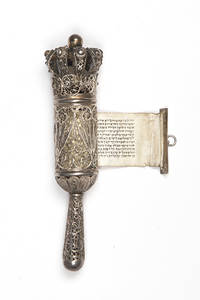
117058Jerusalem Bezalel Circa 1920. . Original manuscript on vellum text arranged in 11 lines in Hebrew script scroll housed in an elaborately decorated silver filigree case unstamped scroll height 310 mm case height 140 mm engraved with 'Bezalel Jerusalem' signature in Hebrew.<br /> A beautiful example of a Bezalel Megillah housed in a silver case with elaborate filigree surmounted by a crown.<br /><br />The Bezalel school was founded in 1906 in Jerusalem by the artist and professor Boris Schatz and was the first art school to be established in the Holy Land in the 20th century. Schatz who discussed his vision of opening an art school in the Land of Israel with Herzl when the two met in Vienna<br />in 1903 chose to call the school Bezalel after the biblical artist Bezalel ben Uri ben Hur mentioned in the book of Exodus as the artist chosen by God to build the Tabernacle HaMishkan in Hebrew. According to the scripture this artist worked in silver gold copper stone and wood. By founding the school Schatz aimed to establish a national style of art blending classical Jewish European and Middle-Eastern traditions. <br /><br />In addition to traditional sculpture and painting training the school ran craft workshops that produced<br />decorative objects in silver leather wood brass and fabric which were sold at exhibitions in Europe and the United States. Schatz's school was closed in 1929 and then reopened in the mid 1930s as the New Bezalel. In 1955 the school received its official academic acclaim and today the Bezalel Academy of Art and Design is Israel's national school of art as well as its oldest higher education institution. The art created by Bezalel's students and professors in the first decades of the 20th century is considered the stepping stone for Israeli visual arts.<br /><br />The Book of Esther is part of Ketuvim Writings the third section of the Hebrew Bible. It tells the story of a Jewish girl named Esther who became queen of Persia and thwarted a plan by Haman to commit genocide against her people. Also called The Megillah the book is the basis and an integral part of the Jewish celebration of Purim. Its full text is read aloud twice during the celebration in the evening and again the following morning. Besides Song of Songs it is the only book in the Bible that does not explicitly mention God.<br /><br />'Since the Talmudic period it has been customary to write the Book of Esther on parchment in the form of a scroll and the rules governing its production and<br />writing are basically the same as those for a traditional Torah scroll. It is not known when and under what circumstances artistic embellishment of Esther scrolls<br />began. The earliest extant illuminated examples emanate from 16th-century Italy commissioned by well-to-do Italian Jews.' Encyclopaedia Judaica<br /> Jerusalem, Bezalel, [Circa 1920]. hardcover
140946263Lexington KY: University of Kentucky Press 1974. First American edition. First American edition. Signed by Jorge Luis Borges on title page and also on the publisher's propsectus which is laid in. x 78 pp. Bound in publisher's tan cloth with red metallic spine lettering. Fine in Fine unclipped dust jacket. Provenance: Matthew Monahan; Gary Oleson. The Argentinian writer traces the development of British literature from the Anglo-Saxon period to the 20th century. University of Kentucky Press unknown
140946261Lexington KY: University of Kentucky Press 1971. First edition. First edition. Signed by Jorge Luis Borges on title page. xii 95 pp. Bound in publisher's brown cloth with gilt spine lettering. Printer's scuff to p. 53 else Fine in Very Good dust jacket with sunned spine panel rubbing. The Argentinian writer traces the development of American literature in this uncommon collection of essays. University of Kentucky Press unknown
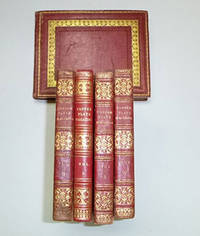
16-5887London: Printed for Harrison and Co. Pater-Noster Row. & John. Walker engraver. No. 16. Rosomans Street. Clerkenwell 1792-1802. Oblong 4to. 27 1x 21 cm. 5 vols. engraved titles and 249 plates only of 250 lacking Hillingdon House plate from vol.1 the odd spot or foxing mark but largely clean internally contemporary red straight-grain morocco blind-stamped and panelled with gilt a little rubbed corners bumped.OCLC Number / Unique Identifier:1009029252:At head of publisher's original part wrappers: New copper-plate magazineEditor and principal engraver: John WalkerEngravings by J. Walker William Walker T. Medland Birrell B.T. Pouncy James Greig James Heath G. Walker William Ellis Fitler Barrett J. Storer Roberts J. Widnell J. Roffe and T. Tagg; after J.M.W. Turner Paul Sandby Thomas Girtin Thomas Hearne and Thomas Malton Esther Acklom Miss Berniers Edward Francis Burney Charles Catton Jr. Richard Corbould George Cuit Edward Dayes Arthur Benoni Evans Thomas Girtin Harraden John Hassell J. Hornsey H. Jeayes Thomas Malton John Meheux Conrad Martin Metz James Moore Francis Nicholson John Nixon Rev. Robert Nixon William Orme Alexander Reid Philip Reinagle Humphry Repton Paul Sandby Thomas Sandby William Watts Francis Wheatley and othersImprints undated; years of publication from monthly issues.Originally issued in 125 parts each consisting of two plates and two letterpress leaves. Each cumulated volume contains 50 plates with associated letterpress an index leaf and engraved title page; vols. 1 4 and 5 have an "Advertisement" leaf; v. 5 also has a general index.Plates include great houses and significant architectural structures from various places in the British Isles. Each plate includes names of engraver and artist but these are not indexed.Title pages are engraved; signed v.1: Milns scrt. Puke sc.Vol. 2 with imprint: London : printed for Harrison and Co. Pater-Noster Row. & J. Walker engraver. No. 16 Rosomans Street Clerkenwell; v. 3-5 with imprint: London : printed for J. Walker engraver. No. 16 Rosomans Street ClerkenwellVol. 4: "Printed by S. Gosnell Little Queen Street Holborn."Vols. 4 & 5 with alternative title: Elegant cabinet. London: Printed for Harrison and Co. Pater-Noster Row. & J[ohn]. Walker, engraver. No. 16. Rosomans Street. Clerkenwell, 1792-1 unknown
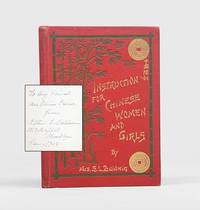
1900173952New York: Eaton & Mains; Jennings & Pye Cincinnati 1900. China's most influential female scholar First edition first printing presentation copy inscribed by the author on the first blank "To my friend Mrs Oliver Crane from Esther E. Baldwin 1218 Pacific St Brooklyn Jan. 1902". Crane was an accomplished musician a keen traveller and a member of several New England societies including the American Oriental Society. Esther E. Baldwin 1840-1910 known to contemporaries as the "Chinese Champion" because of her advocacy for Chinese immigrants in the United States served in Fuzhou as a missionary throughout the 1860s and 1870s. In The Chinese Book of Etiquette she offered the first adaptation into English of the Nu Jie by Ban Zhao c.45-120 CE a leading Han dynasty literatus. The daughter of the court historian Ban Biao Ban enjoyed a privileged education at a time when the majority of Han women were not given formal tutoring in the classics. Her Nu Jie written to prepare her daughters and nieces for life was a cornerstone of Confucian thought for 2000 years. Drawing from ideas contained in the Confucian Li Ji Classic of Rites it stressed the virtues of obedience and self-sacrifice: "All girls everywhere first should learn to cultivate virtue. Of cultivating virtue's methods the most important is to be pure and upright in morals" p. 1. After the death of her brother Ban Gu Ban completed his Han Shu Book of Han the standard official history of the Western Han Dynasty. Sibylla Bailey Crane born Sibylla Adelaide Bailey 1851-1902 was actively involved in many learned societies and co-founded the Castilian Club a women's study group based in Boston. Together with her husband Revd Oliver Crane she collected art and antiquities donating several pieces to the Museum of Fine Arts Boston. She died suddenly in the same month as she received this copy likely having returned from visiting the author at her Pacific Street house in Brooklyn. Octavo. With 12 illustrations after drawings by Pang Sun Yow; title page and text pages framed with green bamboo design. Original red diagonally ribbed cloth front cover elaborately blocked in gilt and green after a design by Pang Sun Yow red endpapers edges gilt. First blank with traces of pencilled gift inscription from Mary B. Safford 1869-1937 to Barbara Badger Hennessey 1910-1992; Hennessey's signature and pressmark on front free endpaper recto and first blank. Spine sunned and rubbed gilt bright light marking on rear covers contents clean: a very good copy. hardcover
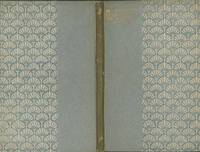
51-3900London: Eragny Press 1899. 8vo. Original boards and decorative paper slight worn on spine. 38 2 pages illustrations some color 20 cm.Sold by Hacon & Ricketts London and Floury Paris. OCLC: 38654052.Bookplates of Crosby Gaige and Albert Sperisen collectors. One of 224 copies of which this is one of 220 copies on paper 3 wood-engraved illustrations border initials and pictorial device by Lucien Pissarro one double-page illustration printed in gold green and black Tomkinson Eragny 5; Le frontispice les bordures les illustrations et les lettres ornees ont ete dessines par Lucien Pissarro et graves sur bois par Esther & Lucien Pissarro et le livre fut acheve d'imprimer sur leurs presses a Londres le 16 Juillet 1899.""Il a ete tire de cet ouvrage 224 exemplaires dont 200 pour la vente."Printer's device Eragny Press on last page.Esther Levi Bensusan 1870–1951 the daughter of a Jewish merchant in London became a leading book illustrator during the height of the Arts and Crafts movement in England. As a teenager studying at the Crystal Palace School of Art she met Lucien Pissarro 1863–1944 son of the French Impressionist painter Camille Pissarro. Married in 1892 she and Lucien Pissarro shared a deep admiration for William Morris and the artistic ideals embodied by his Kelmscott Press books. Following the birth of their daughter Orovida in 1893 the couple established the Eragny Press which specialized in high-quality literary editions illustrated with wood-engravings. London: Eragny Press, 1899 hardcover
2012106493Museum. New. 2012. Hardcover. 0967735955 . FREE UPGRADE to Courier/Priority Shipping Upon Request - IN STOCK AND IMMEDIATELY AVAILABLE FOR SHIPMENT - Flawless copy brand new pristine never opened - -- with a bonus offer-- . Museum hardcover
2015114277Laurence King Publishing. New. 2015. Paperback. 178067483X . FREE UPGRADE to Courier/Priority Shipping Upon Request - IN STOCK AND IMMEDIATELY AVAILABLE FOR SHIPMENT - IN STOCK AND IMMEDIATELY AVAILABLE FOR SHIPMENT - Flawless copy brand new pristine never opened - -- with a bonus offer-- . Laurence King Publishing paperback
2015122913Verlag fur Moderne Kunst. New. 2015. Paperback. 3903004421 . FREE UPGRADE to Courier/Priority Shipping Upon Request - IN STOCK AND IMMEDIATELY AVAILABLE FOR SHIPMENT - Flawless copy brand new pristine never opened. Text in English and German. with a bonus offer-- . Verlag fur Moderne Kunst paperback
2014114214Northwestern University Press. New. 2014. Hardcover. 0810129930 . FREE UPGRADE to Courier/Priority Shipping Upon Request - IN STOCK AND IMMEDIATELY AVAILABLE FOR SHIPMENT - IN STOCK AND IMMEDIATELY AVAILABLE FOR SHIPMENT - Flawless copy brand new pristine never opened - -- with a bonus offer-- . Northwestern University Press hardcover
201088819Kerber. New. 2010. Hardcover. 3866783957 . FREE UPGRADE to Courier/Priority Shipping Upon Request - IN STOCK AND IMMEDIATELY AVAILABLE FOR SHIPMENT - Flawless copy brand new pristine never opened -- Text in German and English. 192 pp. ; 109 illus. -- with a bonus offer-- . Kerber hardcover
2016119082GILES. New. 2016. Hardcover. 1907804730 . FREE UPGRADE to Courier/Priority Shipping Upon Request - IN STOCK AND IMMEDIATELY AVAILABLE FOR SHIPMENT - IN STOCK AND IMMEDIATELY AVAILABLE FOR SHIPMENT - Flawless copy brand new pristine never opened - -- with a bonus offer-- . GILES hardcover