BALDWIN, Esther E, as Mrs S L BaldwinBiblio.com
85 résultats
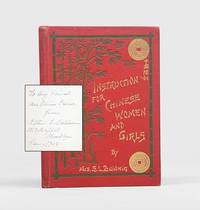
1900173952New York: Eaton & Mains; Jennings & Pye Cincinnati 1900. China's most influential female scholar First edition first printing presentation copy inscribed by the author on the first blank "To my friend Mrs Oliver Crane from Esther E. Baldwin 1218 Pacific St Brooklyn Jan. 1902". Crane was an accomplished musician a keen traveller and a member of several New England societies including the American Oriental Society. Esther E. Baldwin 1840-1910 known to contemporaries as the "Chinese Champion" because of her advocacy for Chinese immigrants in the United States served in Fuzhou as a missionary throughout the 1860s and 1870s. In The Chinese Book of Etiquette she offered the first adaptation into English of the Nu Jie by Ban Zhao c.45-120 CE a leading Han dynasty literatus. The daughter of the court historian Ban Biao Ban enjoyed a privileged education at a time when the majority of Han women were not given formal tutoring in the classics. Her Nu Jie written to prepare her daughters and nieces for life was a cornerstone of Confucian thought for 2000 years. Drawing from ideas contained in the Confucian Li Ji Classic of Rites it stressed the virtues of obedience and self-sacrifice: "All girls everywhere first should learn to cultivate virtue. Of cultivating virtue's methods the most important is to be pure and upright in morals" p. 1. After the death of her brother Ban Gu Ban completed his Han Shu Book of Han the standard official history of the Western Han Dynasty. Sibylla Bailey Crane born Sibylla Adelaide Bailey 1851-1902 was actively involved in many learned societies and co-founded the Castilian Club a women's study group based in Boston. Together with her husband Revd Oliver Crane she collected art and antiquities donating several pieces to the Museum of Fine Arts Boston. She died suddenly in the same month as she received this copy likely having returned from visiting the author at her Pacific Street house in Brooklyn. Octavo. With 12 illustrations after drawings by Pang Sun Yow; title page and text pages framed with green bamboo design. Original red diagonally ribbed cloth front cover elaborately blocked in gilt and green after a design by Pang Sun Yow red endpapers edges gilt. First blank with traces of pencilled gift inscription from Mary B. Safford 1869-1937 to Barbara Badger Hennessey 1910-1992; Hennessey's signature and pressmark on front free endpaper recto and first blank. Spine sunned and rubbed gilt bright light marking on rear covers contents clean: a very good copy. hardcover
188622412Leipzig, Bernhard Tauchnitz 1886. VIII, 100 Seiten, 8° (21,5 x 13,5 cm), Orig.-Halbleineneinband.
188638322Leipzig: Bernhard Tauchnitz 1886. VIII, 100 Seiten. 8° (21,5 x 13,5 cm). Leinenband der Zeit mit goldgeprägtem Rückentitel.
189019000Hitchin: Paternoster & Hales 1890. First Edition. Hardcover. Very good. Small 8vo. Gray gilt-stamped boards. Very good. Mild touches of shelfwear to boards. Endpapers browned a bit but text block bright and clean throughout. Good and sound. 47pp. <br/><br/>Eulogy for the recently-deceased schoolmaster William Dawson for whom a prize in botany was established the recipients of which appear to be the intended audience for this publication. Includes a frontis depicting Dawson. Paternoster & Hales hardcover books
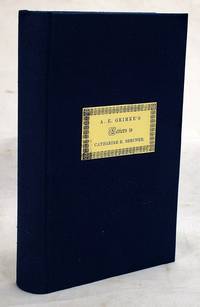
18382006080076Boston Printed by Isaac Knapp 1838-12-31. First Edition. Hardcover. Good. Powerful women and dangerous women: Early Abolitionist works Bound in contemporary boards. Yellow printed title label on front board. Rebacked with renewed spine. Housed in custom clam shell case. Library markings. Intermittent water stain generally faint. 130 pp. <br> "First edition of the third work in a series of literary exchanges between Beecher and Grimke that began in 1836 with Grimke's Appeal to Christian Women of the South. This was followed by Beecher's Essay on Slavery and Abolitionism with Reference to the Duty of American Females 1837 in turn followed by the present work by Grimke. Although born into the Southern elite of South Carolina Angelina Grimke 1805-1879 spent most of her life in the North advocating for the abolition of slavery and women's rights. Catherine Beecher was an educator and shared similar views." - Swann Galleries Sale 2377 Lot 59 March 26 2015. Angela Grimke and her sister Sarah Moore were highly unusual women for their era. They converted to Quakerism and advocated not only the emancipation of slaves but also racial and gender equality. Quite radical for a southern woman in the 1830s. Boston, Printed by Isaac Knapp hardcover
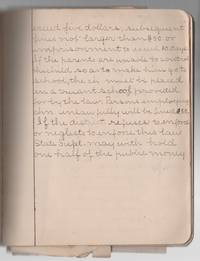
189744152New York State 1897. Very good. Detailed student notes apparently from a teacher's training course on the laws governing education in New York state in the late 1890s with briefer sections of notes on the geology and geography of New York; one page is dated 1897. Includes sections on Corporal Punishment "If a teacher wishes to punish a child she may do it without the parents' consent. Parents or teacher may be arrested for undue severity. Cicero said "Do not punish in anger"; the Compulsory Education Law and the authority of truant officers "The law provides that parents may be fined or imprisoned or both"; and the "Physiology Law" requiring that "physiology relating to alcoholic drinks and other narcotics and their effects on the human system shall be taught yearly in all grades in the public schools". <br /> <br /> In addition to assorted notes practice tests and copied poems a printed page from the December 12 1891 School Journal is laid in including several sample lesson preparations and "Suggestions to Teachers" on narcotics and stimulants: "There is a general feeling on the part of the little ones under your charge that the use of alcoholic liquors is wrong.To prove to them that its use is deleterious to the mind and body is a hard thing for you to do. They must take this on faith and you are to be the faith-builder for the little ones."<br /> <br /> The name of the notebook's author and owner appears in a list of 1900 Normal School graduates in Suffolk County issued as part of the annual New York State Superintendent's Report: Esther Alice Andrews of Patten's Mills successfully completed the English Course. A fascinating look at turn-of-the-century teacher's education. Wraps. 8vo. Cardstock covers cloth taped spine. Edgewear and creasing to covers; cloth tape torn at ends. Author's name and the title "School Law" written in pen on front cover. Commercial ruled notebook about two-thirds filled with handwritten notes in pencil and pen. Approximately 20 loose handwritten sheets folded and laid in along with one printed page. Toning throughout; some blank pages entirely or partially torn out. unknown
182571327hLondon: Printed for Harvey and Darton 55 Gracechurch-Street 1825. Book. Very Good. Hardcover. 12mo - over 6¾ - 7¾" tall. Burgundy quarter-morocco over original printed binder's paper boards with titles in decorative frame-work to front and "Knowledge Promotes Commerce" architectural decorative vignette to rear. Rebacked -- new spine with gilt title-label preserving the 5s price and composition of the original. Original endpapers. Further professional restoration to binding. Six engraved plates with double images. iv228pp. Toning and edge-wear to original boards; top-edge soiled edges and endpapers toned. Old owner's name and later Foyle's shop label to front endpapers. Otherwise clean tight and unmarked. Very neat -- a sound and handsome copy of this rare early issue bearing to publication date of 1825 on the title-page. . Printed for Harvey and Darton, 55, Gracechurch-Street Hardcover
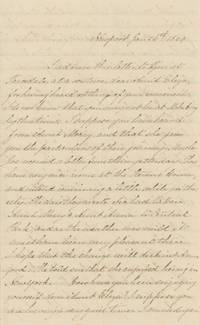
1871List3241Rhode Island Massachusetts and New York 1871. Thirty-two letters two apparently missing final pages; with fifteen pages of incomplete letter material. Excellent to Near Fine. Letters from some of the young ladies of the Hazard family primarily Gertrude Minturn 1843–1877 Anna Peace 1845–1868 and Esther Robinson 1848–d. Hazard with some from other family and friends. The family was descended from Thomas Hazard one of the founding settlers of Newport Rhode Island.1<br /> <br /> The girls were educated and often write from school; Anna and Esther attend the ‘Friends School’ in Providence which is probably the Moses Brown School and Gertrude attends Dr. Dio Lewis’s School for Young Ladies in Lexington Massachusetts. Founded by Diocletian Lewis a temperance and physical culture advocate the school incorporated his exercise system developed to condition weaker individuals. Gertrude describes a regimen of thirty minutes of walking plus an hour and a half of exercise and discusses Dr. Lewis:<br /> <br /> “Dr Lewis gives familiar lectures on any subject which the scholars propose. He is a very pleasant genial man and takes part in the games & dancing with the greatest spirit. There are about 20 scholars. Some of them board in the village but are subject to the rules of the school. This building is very large and is mostly occupied by the patients of Dr Lewis’ ‘Movement Cures’ to whom most of his time is devoted. The scholars and patients associate together. Indeed we are under very little constraint the teachers leaving our actions to be regulated by our own sense of propriety; and they seldom find occasion to reprove the scholars for misdemeanors.†November 23 1864<br /> <br /> Meanwhile Anna and Esther’s education is more on the religious side; Esther writes:<br /> <br /> “We have not been to meeting very often since we returned from our lovely visit to Newport but the first Sunday morning I did think all the time of it as I said I was going to. We were edified this morning by a sermon from Elizabeth Meader or rather a torrent of noise so that I am nearly deafened now. I don’t think I ever heard a more horrible combination of sounds from the mouth of any human being.†January 8 1865<br /> <br /> Though speaking in tongues is most strongly associated with Pentecostalism it is not unheard of in Quakerism. In his book of genealogy and reflections the girls’ father Thomas Hazard 1797–1886 connects the family’s “strong religious tendencies†to his own interest in spiritualism.2 This interest in mediumship comes up several times in the letters first in 1864 when one of the girls reports that “Pa writes us that at a circle which he attended a few days ago a clairvoyant medium described our house at Vaucluse perfectly†February 24 1864 and later when one of the girls attends a circle with their father in Philadelphia:<br /> <br /> “Yesterday morning Pa & I had a sitting with a Mrs. Robinson a trance speaking medium. The communication from mother was the most beautiful I ever heard. She spoke to us just as she used to on earth using the same expressions. It seemed as if I could almost see her – we are going again on Monday.†February 8 1867<br /> <br /> That is the pair spoke to Frances Minturn Hazard who had died in 1854.<br /> <br /> Of interest to researchers of the Hazard family and Rhode Island Quakers.<br /> <br /> 1 Caroline Elizabeth Robinson The Hazard Family of Rhode Island 1635–1894 Printed for the Author 1896.<br /> 2 Thomas R. Hazard Recollections of Olden Times Sanborn 1879 228. unknown
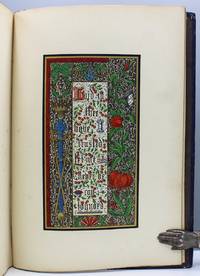
186817465<p>London: Emily Faithfull Victoria Press n.d. 1868 First edition. Original blue cloth stamped in gilt. . Twenty-nine chromolithograph plates each with a blank protective page plus 9 pages of descriptions of the plates. The plates include depictions of the Ark of the Covenant with cherubim enclosed in a 15th century-style border plate #4; the emblems of 12 saints including Saint Peter's keys plate #7; and church windows with the cross anchor and heart symbols worked into the glass plate #10. Some soiling and wear to cloth. All edges gilt. Dark brown endpapers. Contemporary ink ownership signature to front flyleaf. Some foxing to blanks as usual. A very good clean copy of a beautiful book. Emily Faithfull 1835 - 1895 was Queen Victoria's official printer the founder of Victoria Press a founding member of the Society for Promoting the Employment of Women and a popular novelist and memoirist. Upon establishing the Victoria Press in 1860 she provided training for women interested in printing and employed mostly women as typesetters and proofreaders. Other important Victoria Press publications included The Victoria Regia 1861 which earned Faithfull her position as the official printer to Queen Victoria and A Welcome a collection of poetry edited by Isa Craig that included the first appearances of poems by D.G. Rosetti Harriet Martineau and more. Faithfull also published the periodical Victoria Magazine which ran from 1863 to 1880 and often featured Faithfull's own writing on the importance of employment opportunities for women. Esther Faithfull Fleet 1823 - 1908 was also the illustrator of 38 Texts 1872 which was published by her younger sister Emily and included contributions by their father Ferdinand 1789 – 1871; Roses With and Without Thorns 1878; and The Dayspring from on High 1904.</p> Emily Faithfull, Victoria Press, hardcover
1898215287New York: Dodd Mead and Company 1898. First edition. Illustrated. 317 pp. 1 vols. 8vo. Red morocco inlaid spine and marbled boards t.e.g. by MacDonalds NYC. Bookplate of Louise Marie Iselin. Very good. First edition. Illustrated. 317 pp. 1 vols. 8vo. <br/><br/> Dodd, Mead and Company hardcover