139 résultats
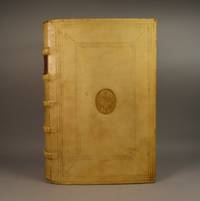
16962447Leipzig: Gross & Fritsch 1696. First edition. vellum marbled boards. Very Good. FIRST PRINTINGS OF THE PAPERS DOCUMENTING THE PROPOSAL AND SOLUTION OF THE "BRACHISTOCHRONE PROBLEM" ONE OF THE MOST FAMOUS MATHEMATICAL CHALLENGES AND ONE OF THE EARLIEST PROBLEMS POSED IN THE CALCULATION OF VARIATIONS. The challenge of the brachistochrone "began in June of 1696 when Johann Bernoulli published a challenge problem in Leibniz's journal Acta Eruditorum. Obviously a legacy of public challenge remained from the days of Fior and Tartaglia. Although contests were now conducted in the sedate pages of scholarly journals they retained their power to make or break reputations as Johann himself observed:<br /> <br /> '. it is known with certainty that there is scarcely anything which more greatly excites noble and ingenious spirits to labors which lead to the increase of knowledge than to propose difficult and at the same time useful problems through the solution of which as by no other means they may attain to fame and build for themselves eternal monuments among posterity.'<br /> <br /> "Johann's particular challenge was a good one. He imagined points A and B at different heights above the ground and not lying one directly above the other. There is certainly an infinitude of different curves connecting these two points from a straight line to an arc of a circle to any number of other wavy undulating paths. Now imagine a ball rolling from A down to B along such a curve. The time it take to complete the trip depends of course on the curve's shape. Bernoulli challenged the mathematical world to find that one particular curve AMB along which the ball will roll the shortest time. He called this curve the 'brachistochrone' from the Greek words for 'shortest' and 'time'.<br /> <br /> "An obvious first guess is to take AMB as the straight line joining A and B. But Johann cautioned against this simplistic approach:<br /> <br /> '. to forestall hasty judgment although the straight line AB is indeed the shortest between the points A and B it nevertheless is not the path traversed in the shortest time. However the curve AMB whose name I shall give if no one else discovered it before the end of this year is one well-known to geometers.'<br /> <br /> "Johann gave the mathematical world until January 1 1697 to come up with a solution. However when his deadline arrived he had received but one solution from the 'celebrated Leibniz' who:<br /> <br /> 'has courteously asked me to extend the time limit to next Easter in order than in the interim the problem might be made public . that no one might have cause to complain of the shortness of the time allotted. I have not only agreed to this commendable request but I have decided to announce myself the prolongation and shall now see who attacks this excellent and difficult question and after so long a time finally masters it.'"<br /> <br /> At this point Johann and others were surprised and perhaps a little delighted that they had not received a solution from their English rival Sir Isaac Newton. Wondering if Newton has not noticed the challenge Johann sent Newton directly a personal letter outlining the problem. When Newton received the letter he did not disappoint. As Newton's niece Catherine Conduitt explained:<br /> <br /> "When the problem in 1697 was sent by Bernoulli - Sir I.N. was in the midst of the hurry of the great recoinage and did not come home till four from the Tower very much tired but did not sleep till he had solved it which was by four in the morning."<br /> <br /> "Even late in life and tired from a hectic day's work Isaac Newton triumphed where most of Europe had failed! It was a remarkable display of the powers of the great British genius. He had clearly felt his reputation and honor were on the line; after all both Bernoulli and Leibniz were waiting in the wings to publish their own solutions. So Newton rose to the occasion and solved the problem in a matter of hours. Somewhat exasperated he is reported at one point to have said 'I do not love . to be . teezed by foreigners about Mathematical things.'<br /> <br /> "Back in Europe as Easter neared a few solutions came into the hands of Johann Bernoulli. The curve that everyone was seeking - one that 'is well-known to geometers' - was none other than an upside-down cycloid. This important curve was studied by Pascal and Huygens but neither of these mathematicians had realized that it would also serve as the curve of quickest descent. Johann wrote with characteristic hyperbole '. you will be petrified with astonishment when I say that precisely this cycloid . of Huygens is our required brachistochrone.'<br /> <br /> "On Easter the challenge period had expired. All together Johann had received five solutions. There was his own and the one from Leibniz. His brother Jakob came through perhaps to Johann's dismay with a third and the Marquis de l'Hospital added a fourth. Finally there was a submission bearing an English postmark. Opening it Johann found the solution correct although anonymous. He clearly had met his match in the person of Isaac Newton. Although unsigned the solution bore the unmistakable signs of supreme genius.<br /> <br /> "There is a legend - probably of dubious authenticity but nonetheless of great charm - that Johann partially chastened partially in awe put down the unsigned document and knowingly remarked 'I recognize the lion by his claw.'" Quoted from William Dunham Journey Through Genius: The Great Theorems of Mathematics Wiley 1990 page 199-202.<br /> <br /> The Brachistochrone Papers - the proposal and the solutions included:<br /> <br /> Johann: Supplementum defectus geometria cartesianae circa inventionem locorum; 2. Leibniz: Communicatio suae pariter duarumque alienarum ad edendum sibi primum a Dn. Joh. Bernoullio; 3. Johann: Curvatura radii in diaphanis non uniformibus . ; 4. Jakob: Solutio problematum fraternorum . ; 5. L'Hospital: Solutio problematis de linea celerrimi descensus; 6. Tschirnhaus: De methodo universalia theoremata eruendi . ; 7. Newton: Epistola missa ad praenobilem virum D. Carolum Mountague .<br /> <br /> Note: Newton's solution original appeared in the Philosophical Transactions.

<br /> <br /> Provenance With stamps and withdrawal markings 7-3-1984 from the famous John Crerar Library Chicago. <br /> <br /> In: Acta Eruditorum vol. 15 and 16: no.1 in 15:264-69 1 plate; no. 2 in 16:201-5 1 plate; no. 3 in 16: 206-11; no. 4 in 16:211-17; no. 5 in 16: 217-20; no. 6 in 16: 220-23; no. 7 in 16: 223-24. Leipzig: Gross & Fritsch 1696-1697. The two entire volumes offered. Quarto 208x170 mm. Two volumes in uniform contemporary three-quarter vellum over marbled boards. pp 2 604 and 9 plates; 8 594 and 8 plates. Some heavy worming to pp 324-42 and plate vi of volume 15 which is not part of any of the above mentioned articles. 1697 volume with repaired gutter tear to plate 8; reinforcement to p.449/50 and minor restoration to binding. Some toning throughout as usual with the Acta. In all a very good set. Gross & Fritsch unknown books
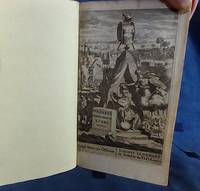
1691V75117Leiden: Jordani Lugtmans & Joann du Justo Vultejo interprete. Pancratius Maasvicius recensuit Isaaci Casauboni nec non suas notas adjecitivie 1691. Hardcover. Very Good. copperplate engraved pictorial title woodcut printer's mark & a few decirated small initials. Octavo modern taupe boards with printed spine label lower corner very sl.bumped All edges rouge 12p=extra engr.title title dedication To reader etc 832pp 40pp=index In Ancient Greek & Latin parallel columns throughout. Work divided into 8 books. First four words of title translated from the Ancient Greek. Recent pages added after endpage and before frontispeice 3 on each side. Five page dedication at beginning mentioning the likley transcriber of this edition Pancratius Maasvicius. Maasvicius is also credited on titlepage alongside Vultejus and Casaubon. Vultejus transcribed the 1549 Basel edition of the work whilst Casaubon the 1589 Lyon version. Overall very clean and tight. A manual of strategy and war taken from the most ancient histories down to his own time. These are sources many of which have since been lost making this an important original source. Polyaenus drew on the Roman-Parthian Wars of the mid 2nd century AD dedicating the work to Marcus Aurelius and his co-emperor Lucius Verus who were engaged in the conflict. This is the 2nd edition of the Greco-Latin work the first published in Lyon in 1589. The first latin editon was published in Basel in 1549. "One of the rarer editions in the "Cum notis variorum" series" Ebert 17681. Jordani Lugtmans & Joann du Justo Vultejo interprete. Pancratius Maasvicius recensuit, Isaaci Casauboni, nec non suas, notas adj hardcover
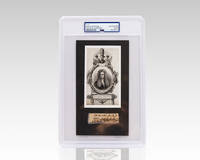
1700151722ca. 1700-1708. Autograph manuscript fragment on the Newton family lineage. England undated. A single leaf bearing autograph text in the hand of Sir Isaac Newton on both sides. 2.25 x 0.75 inches approx. 5.7 x 1.9 cm. Transcription recto: "Of the older family I am . whom I take to be my . of William Newton baptized 1541 whom ." Transcription verso: "for had by a . was next heir at law . infants and to that purpose . of her daughter with his ." A working genealogical note in Newton's hand evidently drawn from a longer document in which he traces a line of descent through one William Newton baptized 1541. The verso references questions of heirship and minor children suggesting the fragment formed part of Newton's private inquiry into the legal and lineal standing of the Newton family. Newton's documented genealogy situates him within the rural gentry of early modern England. He was born at Woolsthorpe Manor Lincolnshire to Isaac Newton a yeoman farmer who died before his son's birth and Hannah Ayscough daughter of a local clergyman. The paternal line can be traced to his grandfather Robert Newton also of Woolsthorpe indicating a family of modest landholding status. The maternal Ayscough line connected Newton to the educated clerical class a milieu that may have shaped his early intellectual formation. The present fragment though brief offers direct testimony of Newton's own engagement with the question of his ancestry and joins the small body of surviving manuscript material in which he records personal and familial concerns rather than scientific or theological matters. Condition: In good condition; minor wear consistent with age. The fragment has been archivally encapsulated by PSA/DNA together with a portrait of Newton and the corresponding authentication with the verso of the autograph remaining visible for examination. Authentication: PSA/DNA. Sir Isaac Newton 1642–1727 widely regarded as one of the most influential scientists in history established the foundational principles of classical mechanics in his Philosophiæ Naturalis Principia Mathematica wherein he articulated the three laws of motion and formulated the law of universal gravitation including the inverse-square relationship governing gravitational force. In addition to these achievements Newton independently developed the mathematical framework of calculus providing essential tools for the advancement of physics and mathematics. His extensive investigations into light and optics grounded in original experimentation significantly advanced contemporary understanding of the nature of light and color. Rejecting the long-standing authority of Aristotelian philosophy Newton instead championed an empirical experiment-based approach to scientific inquiry thereby helping to define the methodological foundations of modern science. unknown
1678055432London: Brabazon Aylmer 1678. First Edition. Hardcover Full Leather. Fair Condition/No Dust Jacket. Small Octavo. Binding edges worn front cover detached back strip & label damaged. Paper a little age toned but not brittle. Six Sermons in the first section with Seventh through the Ninth Sermons separately paginated. Separate title page & pagination dated 1680 for On the Love of God & Our Neighbours Volume three. Armorial book plate of Viscount Palmerston Harry Temple 1673-1757. Size: Small Octavo. 717 pages. Quantity Available: 1. Shipped Weight: 2 pounds or less. Category: Religion & Theology; Renaissance 16thc to 17thc; Pictures of this item not already displayed here available upon request. Brabazon Aylmer hardcover
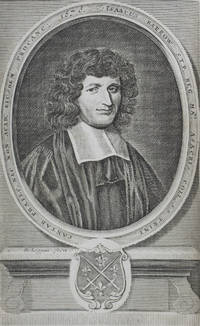
167942302London: Brabazon Aylmer 1679. Second edition. Hardcover. f to vg. Small octavo 7 1/4 x 4 1/2". 14pp. 319 1pp. Original full calf. Raised bands. Engraved frontispiece portrait of Isaac Barrow by D. Loggan. Decorative headpieces. A collection of twelve sermons preached upon several occasions by the celebrated English Christian theologian and mathematician Isaac Barrow 1630-1677. In his sermons considered by many as masterpieces of argumentative eloquence Barrow avoids controversy and preaches morals. However he was also a controversial writer of great weight and that chiefly against the papacy whose followers according to his biographer Abraham Hill he had seen England militant Italy triumphant France diguised. Binding darkened and heavily rubbed along upper margin with some abrasion to leather. Head and tail of spine chipped. Previous owner's name dated Nov. 26 1809 on front free endpaper. Hinges starting. Minor and sporadic foxing to very first and very last leaves. Binding in overall fair interior in good to very good condition. Brabazon Aylmer hardcover
1662J7KG975WH5X7Rotterdam: Floris Willemsen 1662. Disbound. 4to. With a woodcut initial. First edition of a pamphlet on the sentence of the Dutch WIC merchant Isaac Coymans 1622-1673 who was convicted in 1662 to six years imprisonment in the Jan Roodenpoortstoren in Amsterdam. In service of the Dutch West Indian Company WIC Coymans "collaborated with two members of the Amsterdam vroedschap Nicolaes Pancras and Hendrik Carloff to establish a Glückstadter Africa Company. When Coymans schemed to involve the WIC in a war with Denmark in order to benefit this new enterprise and its backers he found himself charged with treason. . His supporters in the vroedschap saved him from the death penalty; he was however condemned to six years in prison and eternal banishment" Lindemann. Slightly browned otherwise in good condition.l Knuttel 8644; Lindemann The merchant republics: Amsterdam Antwerp and Hamburg p. 104; STCN 4 copies. Floris Willemsen, unknown
162711886Basel: Azeleah 1627. First edition. Hardcover. fair. 8vo. 68 leafs. 3/4 leather over black paper covered boards. String ties. Printed on high quality thick cotton rag. Illustrated title page. Early book on Hebrew Grammar and Language. Covers and Spine are worn. Hinges starting. Abrasions on cover. Back slip is chipped. Inscriptions and stamps on inside covers. Minor rippling throughout. Minor foxing throughout not affecting text. Interior in good condition. In Hebrew. Binding in poor inside in good condition. Bet Eked V.3 P.979 #733. Azeleah hardcover
169555262Amsterdam: Be-veit ha-meshutafim Asher Anshil ben Eliezer ve-Yisakhar Ber ben Avraham Eliezer/ Moses Wiesel 1695. First edition. Hardcover. fair. Small folio 29 by 18.5 cm. Collation: aleph-vav4 zayin2 = 26 numbered leaves. Additional engraved title page engraved folding map at rear; main title with woodcut vignette; 14 half-page engraved illustrations in the text. Contemporary quarter calf over dark brown pastepaper boards skilfully rebacked. Images of Moses and Aaron at engraved title excised the seven small engraved vignettes along with letterpress text of engraved title and imprint mounted on old paper. Old marginal repairs at main title resulting in slight loss of initial letters along right margin and several leaves; slight strictly marginal worming and occasional tears. Stained throughout sometimes heavily though not impairing legibility. Map mounted to reinforce tears with virtually no loss of text or engraved imagery apart from printed border at right side. A fair copy at best; despite all defects the half-page engraved illustrations have survived intact with minimal staining. Housed in new maroon buckram slipcase.<br /> <br /> First edition of this gorgeously illustrated work now referred to simply as the Amsterdam Haggadah. The first such work to be illustrated with copperplate engravings it ranks among the most imitated of the Jewish manuals for the Passover seder. The popularity of these illustrations can be attested by the huge number of reprint editions over the centuries. Fourteen finely printed half-page engravings appear throughout the text. Some of these images illustrate the traditional content of the Passover seder or the Exodus story while others reference other biblical tales. Images include: the Rabbis of Bene Brak discussing the Passover story the four sons Abraham smashing the idols of his father Abraham welcoming the three angels Moses slaying the Egyptian overseer the rescuing Moses from the river Moses and Aaron coming to Pharaoh w/ staves turning to snakes the ten plagues the Egyptian army drowning in the Red Sea the Exodus the receiving of the Ten Commandments at Mt. Sinai the eating of the Pascal Lamb King David composing his psalms and finally an exterior view of the Jewish Temple with the cityscape of Jerusalem in the background. All images are captioned with relevant passages in Hebrew. The engravings were all created by Abraham ben Jacob a German convert to Judaism who had moved to Amsterdam although some sources over the years misattributed them to financier Moses Wiesel 6 of which were adaptations and/or modifications of previous images by Swiss artist Matthäus Merian 1593-1650 from his original work "Icones Biblicae" 1625-30.<br /> <br /> In addition to the in text engravings there is famously fold-out engraved biblical map of the Holy Land in a notable format. Measuring a total of 19.5 by 11.5" the map shows the land of Israel the Wilderness of Sinai and Egypt in landscape orientation looking eastward towards the top of the map. It traces the journey of the Israelites starting with the Exodus from Egypt through the Sinai and into the Land of Israel. The map is detailed showing the areas of the twelve tribes important locations and cities as well as geographic features including the Red Sea Mount Sinai the Dead Sea the Sea of Galilee and many others. Additional illustrations appear near the bottom along with a legend. This beautiful work also by Abraham ben Jacob is considered among the earliest if not the first map of its kind to be printed within a Hebrew publication. It is now known to have been heavily based on the previously printed 1620 map in Hebrew by Jacob ben Abraham Zaddiq and Abraham Goos 1590 - ca. 1643 which itself was based on the map of 1590 by Christian Kruik van Adrichom Adrichem printed in Latin.<br /> <br /> Text throughout is printed in Hebrew with smaller text in Rashi script underneath containing famous commentary on the Passover Haggadah by acclaimed Portuguese Rabbi and scholar Isaac ben Judah Abarbanel 1437-1508. The verso of the title page contains the order of the Passover seder with brief instructions in both Ladino Judeo-Spanish and Yiddish Judeo-German a nod to the subtitle which references both the Ashkenazi and Sephardi traditions.<br /> <br /> Provenance and annotations: Full page of text appx. 1500 words in neat Hebrew cursive at front endleaf which discusses aspects of the Haggadah text; inscription in German at front endleaf by Isidor Adler who mentions his friend Hermann Mechlenburg dated March 1906; old annotations throughout in at least two hands. In one notable instance the Hebrew phrase l'shana ha-ba'ah be-hamburg next year in Hamburg! has been added in fine block characters above the traditional phrase l'shana ha-ba'ah bi-yerushalayim next year in Jerusalem. Hebrew title: סדר הגדה של פסח ×›×ž× ×”×’ ××©×›× ×– וספרד <br /> Alternate transliterations: Seder Hagadah shel Pesah Seder Hagadah sel Pesah<br /> <br /> References: Friedberg 278 Fuks HTN II 521; Yudlov Haggadah 93; Vinograd Amsterdam 627; Ya'ari no. 59; Laor 876 Map; Nebenzahl pp.138-1389 Map; Yerushalmi plate 59-62; Rosenau "Vision of the Temple" p.135 146-7. Be-veit ha-meshutafim [Asher Anshil ben Eliezer ve-Yisakhar Ber ben Avraham Eliezer]/ Moses Wiesel hardcover
169555736Amsterdam: Be-veit ha-meshutafim Asher Anshil ben Eliezer ve-Yisakhar Ber ben Avraham Eliezer/ Moses Wiesel 1695. First edition. Hardcover. g to near fine. Small folio 30 by 18.8 cm. Collation: aleph-vav4 zayin2 = 26 numbered leaves. Full period brown paper boards re-backed with a brown leather spine with raised bands.<br /> <br /> Letterpress title-page with ornate floral woodcut device; additional engraved title-page mounted depicting Moses and Aaron along with six small biblical scenes within round borders all against an architectural background. Engraved folding map at rear mounted; main title with woodcut vignette; 14 half-page engraved illustrations in the text.<br /> <br /> This gorgeously illustrated work is the first edition of the famous and highly influential Passover Haggadah printed in Amsterdam in 1695. Simply known as the Amsterdam Haggadah this edition stands as among the most imitated and copied haggadahs in history and was the first to be illustrated with copperplate engravings. Previous illustrated haggadahs had used woodcuts. The popularity of these illustrations can be attested by the huge numbers of reprint editions over the centuries. There are 14 finely printed large in-text engravings plus the full page engraved title page showing Moses Aaron and Adam in the Garden of Eden. Some of these images illustrate the traditional content of the Passover seder and/or the exodus story while some are other biblical stories less directly related. Images include: the Rabbis of Bene Brak discussing the Passover story the four sons Abraham smashing the idols of his father Abraham welcoming the three angels Moses slaying the Egyptian overseer the rescuing Moses from the river Moses and Aaron coming to Pharaoh w/ staves turning to snakes the ten plagues the Egyptian army drowning in the Red Sea the Exodus the receiving of the Ten Commandments at Mt. Sinai the eating of the Pascal Lamb King David composing his psalms and finally an exterior view of the Holy Temple with the cityscape of Jerusalem in the background. All images are captioned underneath with relevant passages in Hebrew. The engravings were all created by Abraham ben Jacob a German convert to Judaism who had moved to Amsterdam although some sources over the years misattributed them to financier Moses Wiesel 6 of which were adaptations and/or modifications of previous images by Swiss artist Matthäus Merian 1593-1650 from his original work "Icones Biblicae" 1625-30.<br /> <br /> In addition to the in text engravings there is famously a phenomenal fold-out engraved biblical map of the holy land. Measuring a total of 19.5x11.5" the map shows the land of Israel the Sinai desert and Egypt in landscape orientation looking eastward towards the top of the map. It traces the journey of the Israelites starting with the Exodus from Egypt through the desert and into the Land of Israel. The map is detailed showing the areas of the twelve tribes important locations and cities as well as geographic features including the Red Sea Mount Sinai the Dead Sea the Sea of Galilee and many others. The map is decorated with additional illustrations near the bottom and includes a key. This beautiful work also by Abraham ben Jacob is considered among the earliest if not the first map of its kind to be printed within a Hebrew publication. It is now known to have been heavily based on the previously printed 1620 map in Hebrew by Jacob ben Abraham Zaddiq and Abraham Goos 1590 - ca. 1643 which itself was based on the map of 1590 by Christian Kruik van Adrichom Adrichem printed in Latin.<br /> <br /> Text throughout is printed in Hebrew with smaller text in Rashi script underneath containing famous commentary on the Passover Haggadah by acclaimed Portuguese Rabbi and scholar Isaac ben Judah Abarbanel 1437-1508. The verso of the title page contains the order of the Passover seder with brief instructions in both Ladino Judeo-Spanish and Yiddish Judeo-German a nod to the subtitle of Haggadah which references the both Ashkenazi and Sephardic traditions.<br /> <br /> This copy with binding in beautiful condition with being professionally restored includining spine re-backed to style. Book block tight. Interior with some staining to pages throughout from use. Binding in very good to near fine inteiror in good condition overall. Hebrew title: סדר הגדה של פסח ×›×ž× ×”×’ ××©×›× ×– וספרד <br /> Alternate transliterations: Seder Hagadah shel Pesah Seder Hagadah sel Pesah<br /> <br /> References: Friedberg 278 Fuks HTN II 521; Yudlov Haggadah 93; Vinograd Amsterdam 627; Ya'ari no. 59; Laor 876 Map; Nebenzahl pp.138-1389 Map; Yerushalmi plate 59-62; Rosenau "Vision of the Temple" p.135 146-7. Be-veit ha-meshutafim [Asher Anshil ben Eliezer ve-Yisakhar Ber ben Avraham Eliezer]/ Moses Wiesel hardcover
1614OB448<p>Paris Pariis Sumptibus Roberti Fouet 1614. In three parts each with special title-page and separate paging. This edition has what is probably the fullest and most elaborate apparatus of any edition of Juvenal. Bertrand Autumnus 1574-1666 and Isaac Le Grange were commentators contemporary with the publication; the commentary of Domizio Calderino 1447-1478 first appeared in 1474. These plus an index made this edition the most scholarly of its era. Hard Cover. Quarto: 16 531 8 273 48 2 8 290 pages; 24 cm. Bound by Dragonfly Bindery in full leather with elaborate gilt spine. The title-page was soiled and stained by the previous perished binding. stock#OB448.</p> Sumptibus Roberti Fouet hardcover
1627181957Oxoniae : Excudebat Iohannes Lichfield Academiae typographus 1627. Second Edition. Hardback. Very good copies both bound in later aniline calf over marble boards; very impressively finished. Spine compartments and borders in blind with gilt vignette 'Bar De Kinderton Sicill Pet Venables' stamped to front and rear panels. Minor generalized wear to the bands and panel edges. Remains uncommonly well-preserved overall; tight bright clean and strong. ; 8vo 8"" - 9"" tall; 238 pages; Physical desc. : 8 238 p 18 p. ; 13 cm. Notes: Historiated initials. Title page vignette; head- and tail- pieces; initials and printed marginalia. Subject: Rainolds John 1549-1607. James I King of England 1566-1625. University of Oxford. Great Britain - History - James I 1603-1625. Language: Latin. Oxoniae : Excudebat Iohannes Lichfield Academiae typographus hardcover
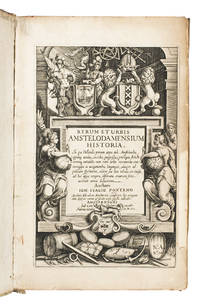
161121770Amsterdam: Jodocus Hondius 1611. Contemporary limp vellum sewn on 4 supports laced through the joints with the manuscript title and author on the spine. Folio. With an engraved title 7 engraved maps and plates 5 folding 2 double-page and 50 engraved maps and views in the text. First edition of the first objective description of Amsterdam and its history with extensive accounts of Dutch East India Company's VOC maritime trade exploration and navigation. It contains the report of Willem Barentsz' voyages to the Arctic region in search of a North-East passage to Asia 1594-1597 the accounts of the two first Dutch voyages to the East Indies including the voyage of Cornelis de Houtman 1595-1597 and the account of the Dutch exploration of Greenland 1594-1596. The work is also important as an Americanum as it gives the results of Henry Hudsons first two voyages to the Arctic 1607-1608 for the Muscovy Company of London. These reports are beautifully illustrated by large maps and views including a famous map of the North Pole region.Johannes Isaac Pontanus 1571-1639 was a physician and historian who was a professor at the University of Harderwijk for most of his life. He wrote several important historical works such as the history of Denmark of the Duchy of Gelre and of Amsterdam. His work on Amsterdam far exceeds the limits of the usual town descriptions elaborately incorporating the history of the voyages of exploration and commerce undertaken by the enterprising citizens of Amsterdam. Pontanus also describes in detail the activities on the Amsterdam stock and commodity markets which were among the earliest of the world and at the time the most important. The extent of the citys trading activities by this time is shown by illustrations of scenes from Indonesia and India to the Arctic.The binding is somewhat stained and soiled with a restoration at the foot of the spine and along the fore and foot edge of the back board. The work is lightly browned and foxed throughout a faint water stain in the margin of the last 11 leaves. Otherwise in good condition.l Alden & Landis II 611/91; V. Gestel-Van het Schip Maps in books of Russia and Poland 218; JCB II p. 78; JFB p. 369; Nijhoff & V. Hattum 252; Sabin 64002; STCN 850336392 19 copies; Tiele Bibl. 876. Jodocus Hondius, hardcover
16633201<p>First edition of the report on Iceland by the French diplomat Isaac de la Peyrère 1596-1676.</p><p>Condition:</p><p>Vellum Binding in Fair Condition. Top right corner with extensive damage but does not affect any of the text block throughout. Paper yellowed uniformly with age. Light marginalia throughout. Previous ownership marks. Map is excellent and in quite clean/bright condition</p><p>Deals in particular with history population geography and trade. With a general map of Iceland by Pierre Duval. - Through his acquaintance with Christina of Sweden and the Danish scientist Ole Worm La Peyrère gained access to numerous old manuscripts and chronicles. From 1644 to 1646 he traveled to Scandinavia on diplomatic mission. He subsequently published in addition to a work on Greenland first edition 1647 the present description of Iceland both of which he wrote in letter form to F. de la Mothe le Vayer.</p><p>BINDING: Contemporary parchment. 16 x 11.5 cm. - ILLUSTRATION: With one folded copperplate map.</p><p>BIBLIOGRAPHY: Chavanne 2138. - Alden/Landis 663/80. - Lerclerc 658. - Klose 571. - Cioranescu 40042.</p><p>Rare first edition of La Peyrère's geographical and historical account of Iceland. With 1 engr. map. Contemp. vellum.</p> Louis Billaine hardcover
168338984Londini: Milonis Flesher pr. for the author sold by Pitt & Aylmer 1683. 4to 23 cm 9.1". 16 450 2 blank pp. Pp. 223/24 Ff3 lacking. <br><br>First edition: erudite translations of eight treatises. Born Jewish the French scholar Louis de Compiègne de Veil studied theology at the Sorbonne after converting to Christianity and set out to translate the whole of Maimonides' Yad ha-Chazakah from Hebrew into Latin. The present work encompasses the Sefer ha-Korbanot the section on sacrifices along with the portion on consecration of new moons and intercalations and Isaac Abravanel's preface to his commentary on Leviticus; the latter gives the => Hebrew and Latin texts on facing pages. Each section has a divisional title-page with continuous pagination. <br>Â Â Â Â <br>Â Â Â Â ESTC R25499; Wing rev. ed. M2854. Contemporary mottled calf framed and panelled in blind with blind-tooled corner fleurons; refurbished and nicely rebacked with speckled calf spine with blind-ruled raised bands and gilt-stamped leather title-label original leather pitted and worn. All page edges speckled red. Front fly-leaf title-page and one other institutionally rubber-stamped; Ff3 either a sectional title or a blank leaf lacking. Pages gently age-toned and cockled with a few corners bumped; small ink smudge in upper outer portions of two facing pages. "Exordium" with intermittent pencilled underlining and two marginal annotations pencilled in English. => Interesting 17th-century Judaica in a strong and decent copy. Milonis Flesher (pr. for the author, sold by Pitt & Aylmer) hardcover books
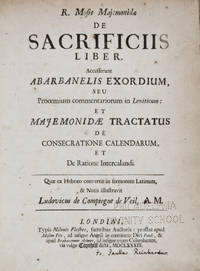
168314061London: Typis Milonis Flesher sumptibus auctoris prostat apud Mosem Pitt & apud Brabazonum Aylmer 1683. First edition. Hardcover. g. 8vo. 10 450pp. 3/4 Vellum over marbled boards with brown lettering and library plate to spine. Age wearing throughout binding.Some tears discoloration scuffing and rubbing to boards and spine. Some browning and foxing to pages not affecting the script. Welling to pages. Ex library. Library card pocket pasted to inside of front board. Perforation to title page: Philadelphia Divinity school. Inscribed by owner with pencil: "to Paullus Reinhardus." This first Latin translation contains texts from Moshe ben Maimon aka Rambam aka Maimonides 1135-1204 and Yitzchak ben Yehuda aka Abravanel Isaac Abrabanel1437-1508. In Latin with some writing in Hebrew. Cover in fair book in good condition. freely translated: Rabbi Moses Maimonides' volountary sacrifice: An approach to Abarbanel's introduction and commentary on Leviticus and Maimonides' Tractate on the consecrated calendar and the rational calendar change R. Moses Maimonides Rambam was a 12th century Jewish philosopher and halachic legal scholar. A highly controversial figure both during his lifetime and after his death but generally acknowledged as the preeminent Jewish thinker of the Middle Ages. He was born in Córdoba Spain but fled as a child from the Almohad persecution. He eventually settled in Egypt where he served as a rabbi physician and philosopher. His fourteen-volume Mishneh Torah his only work not in Arabic still carries canonical authority particularly within the Yemenite Jewish community as the codification of Talmudic law. His other work includes a commentary on the Mishnah entitled Kitab al-Siraj Kitab al-Fara'I a book on precepts and the philosophical work Dalalat al-Ha'irin known in Hebrew as the Moreh Nevukhim The Guide to the Perplexed. The major premise is an attempted philosophical/theological reconciliation of the Hebrew Bible and Greek knowledge. This work came to play a central role in all subsequent major controversies over philosophy within the Jewish community during the Middle Ages. Typis Milonis Flesher, sumptibus auctoris, prostat apud Mosem Pitt, & apud Brabazonum Aylmer hardcover
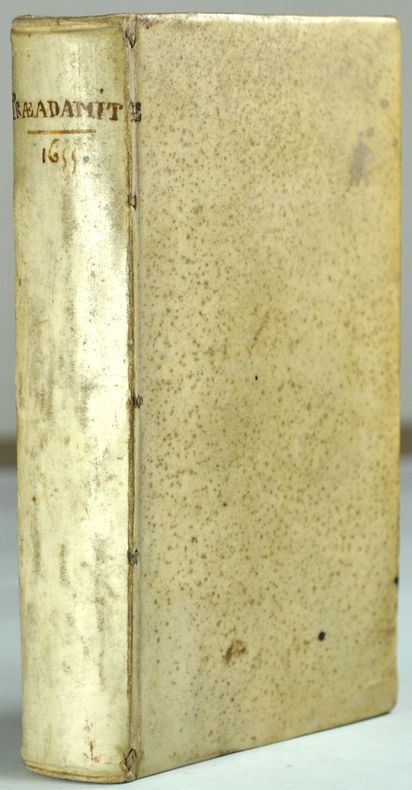
16551262906Amsterdam: Elzevier 1655. First edition. 12mo in vellum with flattened corners; VG; moderate soiling or shelf wear and strong binding; ex-libris plate on second front page; pencil and ink inscriptions on back of front board and first end page; dusty edges; clean text in very tight print; two volumes in one book; scarce; this book was published in English in 1656 as "Men before Adam" and burned in public in Paris before La Peyrere recanted and converted to Catholicism; contains a folded map of the Holy Land in very good condition; shelved in Case # 3; VK consignment. 1262906. Shelved Dupont Bookstore. Elzevier unknown books
165512420Amsterdam, Louis et Daniel Elzevier, 1655. 2 parties en 1 vol. in-12 de 70 pp. (14)-317-(7) pp., 1 carte dépliante, vélin à rabats, titre manuscrit sur le dos (reliure de l'époque).
165563330(No place, Elzevir), 1655. 12mo. In contemporary full vellum. Title in contemporary hand to spine. Binding with light wear and miscolouring. Previous owner's names in contemporary hand to title-page. 317, (7) pp. + 1 folded map.
1655673Amsterdam: Elzevir 1655. First Edition. vellum. Very good. LA PEYRERE Isaac Praeadamitae sive Exercitatio super Versibus <br />duodecimo decimotertio & decimoquarto capitis quinti Epistolae D. Pauli ad Romanos. And 2nd part Systema Theologicum ex Prae-adamitarum Hypothesi. And final section called: Synagogis Iudaeorum universis. Elzevir Amsterdam 1655. TP 1 leaf = Elenchus Capitum 1 52 TP 2 leaves = Prooemium 4 leaves = Argumenta Capitum Systematis & errata 1 297 1 8 1 leave with engraved map of the Terra Sanctae. 4to. First Edition. <br /><br />An anonymous Dutch edition of Philosophia appeared in 1667 and new Latin editions in 1673 and 1674. Evidence for the staying power of the work and the controversies which surrounded it is found in <br /> the fact that it underwent a fourth edition long after Meyer's death in 1776. <br /><br />Rare Quarto edition which preceded the 12mo of the same year. <br /><br />La Peyrere is considered to be the father of Biblical criticism. He asserted in Praeadamitae that there were human beings before Adam. His approach to Biblical scholarship argued that the Bible was just the story of the Jewish people not all of humanity. His book and heretical views were quickly banned. La Peyrere was eventually arrested but offered a half-hearted renunciation of his views to escape punishment. La Peyrere went on to engage in polemics with Richard Simon famous defender of the Bible. A rare and important book in the Radical Enlightenment identified as one of the wicked books of the late 17th century. .the wicked sedition which commenced with La Peyreres Prae-Adamitae gained impetus with the utterly licentious dissipated dictionary of Koerbagh that shameless book the Philosophai S. Scripturae and Hobbes Leviathan and culminated in the Tractatus- Theologico-Politicus and Ethics of Spinoza Israel 367. <br /><br />CONDITION: Very Good in slightly soiled contemporary vellum over boards. Contemporary handwriting on titlepage. Dampstaining in corner of first pages causing ruff edges. Small repair in corner title. Some slight dampstaining in corner map. First edition. Spinoza had a copy of this edition in his library. <br /><br />PHOTOS AVAILABLE UPON REQUEST Elzevir hardcover
165557766BB(S.l., s.n.). 1655. 12°. 294 S., 5 n.n. Bl. Mit einer gestochenen Karte der Arbischen Halbinsel. Pergamentband der Zeit mit handschriftlichem Rückentitel.
1700kb179A.406Apud Leonardum Strickium Franekerae 1700. Engraved. frontis & plates at pages 6 7 46 122 124 125 158 and 268. rubricated title. Clean tight text with marbled edges has been fitted with new enpapers and professionally rebound in full brown leather. Five raised bands. Leather title label. . Hardback. VG/No DW. Apud Leonardum Strickium Franekerae Hardcover
16094708Full ruled contemporary vellum; red morocco label to spine. Gilt armorial 'Martis et artis honos' to boards. 60 1080 32 151 pages. Wear to fore edge of rear board. Dibdin p. 350: "A most excellent edition". Typis Wechelianis apud Claudium Marnium & haeredes Iohannis Aubrii hardcover
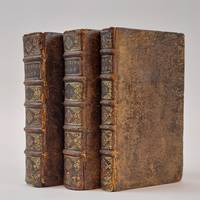
16701395975Amstelodami Amsterdam: Officina Johannis Janssonii à Waesbergen & Johannis van Someren Johannes Janssonius van Waesberge; Joannes van Someren 1670. Hardcover. Octavo three volumes. In Good minus condition. Bound in full brown leather. Spines have gilt ornamentation and lettering and loss of leather along the head/tail edges. Boards have cracking to the joint edges significant rubbing wear and chipping throughout and dents along the edges. Moderate bumping to corners in some cases exposing the boards. Volume 1 has archival repair to front and rear boards with later calf applied to roughly half of each board. Volumes 2 and 3 have archival repairs to the front tail fore corners with later calf applied to corners of boards. <br /> <br> <br /> All textblocks have ink inscriptions from a previous owner on the front pastedowns blue stamps on the title pages mild age toning and minor stains scattered throughout. All volumes contain non contemporary pastedowns presumably added during repairs. <br /> <br> <br /> Textblock of volume 1 has the front free end page engraved title page and typographical title page partially attached together with adhesive glue onto the front pastedown resulting in some obscured text; archival repairs on the fore edges of the front free end page including engraved title page to page 54 and from pages 685-908 not impacting text. Textblock of volume 2 contains engraved title page but backed with new tipped in page; has red ink stains on some pages throughout 1426-1816 impacting text and liquid damage to the fore edges of pages 1426-1816; archival repair to fore edges of pages 1806 1810 1812 and 1816. Text in Greek and Latin. Previously noted repairs appear to be early 19th century. 1395975. Special Collections - Downstairs. Officina Johannis Janssonii à Waesbergen & Johannis van Someren [Johannes Janssonius van Waesberge]; [Joannes van Someren] hardcover
161023208vo contemporary vellum binding with lapped edges and titles on spine. 84 970 102 pp. including index. Printer's device on title page. This is the first edition of the classic Latin text of Casaubon relating to the Greek and Roman military together Aeneas's tactical memoir. Originally published in 1609 in Greek and Latin. Ex reference library which probably explains its survival with 19th century library labels on spine pictorial bookplate on rear pastedown and numbers hand-written in pencil on reverse of title page. Hand-written presentation note in ink on front free endpaper dated 1871. Some loss of paper at front pastedown no rear free endpaper. Some foxing /marking and signs of age in text generally the inner book is clean and in remarkably good condition for its age. Typis Wechelianis apud haeredes Ioannis Aubrij hardcover
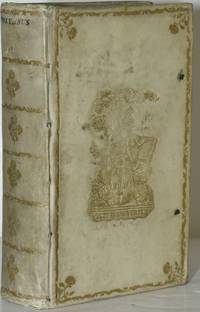
1691285167Lugduni Batavorum: Apud Jordanum Luchtmans & Johannem du Vivie 1691. Third Edition. Full Leather. Very Good binding. The Third Edition or Second Bilingual Edition of Polyaenus' Strategems in War. A second century Macedonian author Polyaenus wrote on the military tactics of the age with unique historical anecdotes; it remains an important historical source. The first printed edition of the text was in Latin only published in 1549; a second edition was published forty years later now in Latin and Greek with a third appearance of the text this edition printed through 1690-91. Additional title page engraved; engraved initials and vignette on the title page. Text in Latin and Greek in opposite columns. Collates complete; 24 832 40 pp. Textblock is bright; previous owner's name on the front endpaper. Full vellum richly decorated in gilt on the spine and boards parts of the gilt now faded; decorative border at the perimeter large device on the front and rear boards with decorative rules and floral devices on the spine and title stamped in black. All edges lightly speckled in blue and red. Very Good binding. Apud Jordanum Luchtmans, & Johannem du Vivie unknown books