47 473 résultats
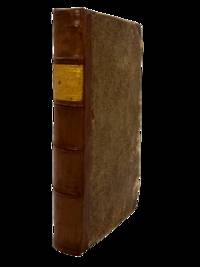
184173260Philadelphia: Hogan & Thompson 1841. Second edition. Twelvemo. 189 1 pp. Publisher's quarter black rain over marbled boards gilt spine lettering. Most of marbled paper gone leaving bare buff boards. Some wear to spine ends. Still a very good copy of the second edition of one of the titles in the first American juvenile series.Together with Rollo at Work and Rollo at Play; both 5th editions and both dated 1841. Both with binding issues but bindings are original. All three books are inscribed to John Elgar Hallowell by either his mother or his father. John Elgar Hallowell was the son of Benjamin Hallowell 1799-1877 renowned Quaker educator and abolitionist. Hogan & Thompson hardcover
1840010948Boston: William Crosby and Company 1840. Book. Good. Hardcover. First Edition. Cloth. First Edition. 16mo - over 5¾" - 6¾" tall. 189p. frontis. 3 plates. A good copy the covers show moderate soil a little wear at the spine ends the former owner's signature and address on the front paste-down endpaper and a piece at the lower forecorner of the free blank back endpaper about the size of a quarter is lacking. Size: 16mo - over 5¾" - 6¾" tall. William Crosby and Company, Hardcover
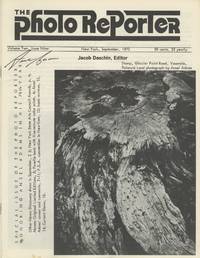
197254471NeW York: Modern Age 1972. First edition. 4to. 16 pp. illustrated from b&w photographs. A few tiny stains on the front wrapper; otherwise fine. Signed on the cover in ink by Ansel Adams. "The purpose of this newsletter a monthly is implicit in its name to report activity in the field of photography primarily in New York City of course and as much as practicable in other parts of the country as well." Jacob Deschin. Modern Age unknown
193552335London: Frederick Muller Ltd. 1935. 12mo. 303 1 pp. Orange cloth gilt lettering on spine map endpapers slight dustsoiling very slight lean to spine w/ d.j. cover art of river crocodiles in purple turquoise & orange slight chipping head & foot of spine minor edgewear still VG/VG copy. First edition stated of this insightful travel memoir of the people and conditions through Liberia Ashanti Ghana Dahomey Benin Nigeria Togo and Cameroon before and through World War I. Scarce in original dustjacket. Frederick Muller Ltd., hardcover
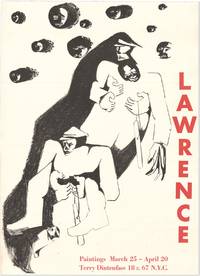
196382862New York: Terry Dintenfass 1963. First Edition. Original lithographed poster with text and illustrations printed in dark red and black on thick cream laid paper measuring 48cm x 66.25cm 18 7/8" x 26 1/8". Mild handling a few faint creases from being rolled with a half-dozen foxed spots; unbacked; Near Fine.<br /> <br /> A striking poster by Lawrence designed to promote his first solo exhibition at Terry Dintenfass Inc. in New York. The illustration was derived from Lawrence's 1963 tempera painting "Two Rebels" "showing four white policemen carrying two black men. The heads of some fifteen witnesses crowd in. In the poster that number was reduced to ten heads that float like moons of light above a protester and his police handlers with their billy clubs dangling from their wrists" Over the Line: The Art and Life of Jacob Lawrence pp.174-175. Paintings like "Two Rebels" "Soldiers and Students" and "Four Students" were almost certainly triggered by news photos and television images of the immediate events of 1960-62 in the South. The poster is not separately listed in OCLC though a signed and numbered lithograph of the image edition of 50 is held at the LC. 82862. Terry Dintenfass unknown
191060857Warren OR: Lovewell-Foto 1910. Two silver gelatin photos sized 8 x 6 in. mounted on 12 x 10 in. gray studio board embossed borders and photographer’s imprint caption location & dating in neat white manuscript ink at lower border below the images minor rubbing to corners some very minor edgewear still two VG photos with bright contrast. These two original images capture the prosperous dairy farming operation of Jacob Hammer 1858-1951 who along with his wife Barbara and eight children ages 7 to 23 were renting a substantial farm and just 5 years later purchased a much larger spread on Deer Island in Columbia County Oregon. The photographs appear to have been shot by John & Sarah Lovewell who worked as a husband & wife traveling photographers from about 1910-1915 along the Columbia & Willamette Rivers. Lovewell-Foto, unknown
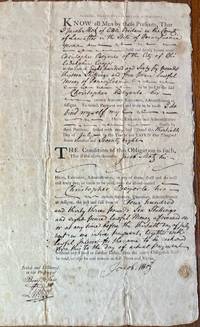
177836668Philadelphia: Printed by Styner and Cist in Second Street 1778. Document. Good. Biofolium paper. Approximately 13.5" x 8.5". Multiple folds. 4 pages. Part printed and part hand manuscript. Contents concern "payment in the Sum of Eight hundred and Sixty six pounds thirteen Shillings and four pence lawful Money of Pennsylvania to be paid Christo Begerle his certain Attorney Executors Administrators or Assigns" from a Jacob Metz. Signed at the bottom left corner by 3 witnesses. Page 2 is blank. Page 3 is more of the printed legal document with no hand writing. Small holes at the fold intersections. Page 4 is mostly blank with exception of hand written note "Jacob Metz's Bond L433 6.8 payl July 30th 1779"<br /> <br /> Styner spelled Steiner in online research and Cist were early German printers in Philadelphia. They formed a printing business in 1779 and dissolved it in 1781. They were responsible for printing the first issue of Philadelphisches Staatsregiste"r published July 21 1779. By then it may have been the only German language paper in America. After 1781 Steiner went on to publish Gemeinnützige. During the American Revolution they published many documents relating to current events including Paine's The American Crisis. After the firm dissolved in 1781 Cist continued in business alone.2 summarized from wikipedia. Printed by Styner and Cist, in Second Street unknown
191861380Portland OR: Shope Brick Co. Columbia Commercial Studio 167 Fourth Ave. ca. 1918. Oblong 4to. 11.5 x 8.25 in. With 41 original linen-backed silver gelatin photographs sized 9.5 x 8 in. nearly all w/ neat type-written captions on versos all w/ photographer’s stamped imprint on verso. Contemporary flexible calf post-binder three nickel-plated screwposts at gutter margin rounded corners yapp edges gilt title stamped on front cover some fraying to the linen-backing at fore-edges minor edgewear some scuffing a few images w/ nearly indistinguishable perforated slices not penetrating linen still an exceptional exemplar w/ former ownership markings of Koch Schmidt on first image margin. An outstanding salesman sample photo album recording the use of Shope’s patented brick facades for homebuilding apartment buildings commercial buildings and interiors in the Pacific Northwest during World War I. The album opens with a 1914 award certificate from the Manufacturers & Land Products Show which remained on permanent exhibit at the Pacific International Exposition Building for over 10 years. This is followed by photographs shot of such buildings as the newly completed Aetna Apartments Printing Office at 21st & Sandy; the Utah-Idaho Motor Co. Maxwell dealership in Pocatello ID; the Golden Rule store in the Morris Block in Lewiston ID; the Miller Wood Fuel Co. in Portland OR with Chief Gasoline pump in front; the King Albert Apartments in Portland OR finished in 1918; together with many splendid examples of PNW Arts & Crafts homes. The featured homes include a stately residence on 49th & Belmont the Dr. Tamiesie House porch piers and tile floor in Laurelhurst now the Sisters of Social Services Home; the Nash home on Sunnyside; Armstrong residence on Council Crest; striking residences in Rose City Park Irvington and Alameda. Also featured are Craftsmen homes in Walla Walla Pocatello Corvallis Spokane and in other areas of Portland. Fourteen of the photographs depict the ornamental Arts & Crafts brick facades for fireplaces with interior shots. The main fireplace in the furnished Dr. Tamiesie home the DeKeater residence the fireplace finished in 1916 for the East Side Business Men’s Club in Portland and others. Founded originally in 1910 in the City of Portland by David Shope 1862-1948 having developed his specialized brick-making machinery for clay & concrete bricks as featured in the final photograph the company’s products quickly proved popular with Arts & Crafts architects in the Pacific Northwest. Shope used a patented process to achieve what he termed the “Red Wire Cut†and “Old Gold Rough Texture†for commercial facades and also used concrete cast stone to achieve special effects and sold his licensed machinery to contractors as well. By 1922 he heavily marketed the fact that the Shope facades were the only ones to mostly survive the 1922 Astoria fire. He also aggressively protected his patents suing competitors on a regular basis. After 1923 he sold out to the Eugene Concrete Pipe Company and returned to Lake City MN where he lived with his daughter Birdie. Gensler 1873-1968 was a German-American photographer in San Francisco CA who operated Columbia Commercial Studio from about 1915 through World War II before moving back to Alameda CA and in two of the photos he has proudly displayed his 1915 Harley-Davidson V-Twin motorcycle in the foreground. We could find no similar album or collection of photographs in any holdings for the Shope Brick Co. Shope Brick Co., [Columbia Commercial Studio, 167 Fourth Ave.], unknown
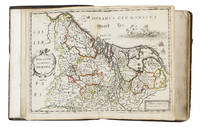
16525476Antwerp 1652. 4to 18 x 14.5 cm. Jan Huyssens Later 17th-century mottled calf sewn on 4 double cords gold-tooled spine and board edges. With a double-page letterpress title-page with a frame built up from typographic ornaments and 39 unnumbered double-page engraved maps of the northern and southern Low Countries by Jacob Aertsz. Colom each map coloured in outline. Interleaved with 38 blank leaves and with a manuscript table of contents 3 3 blank pp. at the end. Double-page title-page and 39 double-page maps. Second known copy of a pocket-atlas published at Antwerp but containing a selection of the maps of the Low Countries originally published by Jacob Aertsz. Colom at Amsterdam in 1635 with the title De Vyerighe Colom the title Colom had first used for his famous pilot guide in 1632 and the name he had given to his Amsterdam printing office where he worked from 1622 to his death in 1673 as a bookseller printer and mapmaker. The only other copy known is at the Royal Library in Brussels. The Vyerighe Colom with 47 maps and 3 plates and with extensive text in Dutch and French went through several editions in the 17th century but it was once thought that all editions before his death in 1673 had been published at Amsterdam by Colom himself. The Royal Library copy like the present one contains 39 maps but each contains one map not in the other so there are forty in total: the present copy includes Drentiae not in the Royal Library copy which includes Le terres entre la Meuse Vahal et Rhin not present here. The maps are also bound in a different order.The present edition is of great interest and gives cause to review Colom's activities. It is printed from Coloms plates so Colom may have licenced the Antwerp publisher to produce a variant edition of his Vyerighe Colom to broaden his market possibly reacting to the signing of the Peace of Münster in 1648 which finally ended the Eighty Years War and opened trade and communication between the northern and southern Low Countries. Jan Huyssens made an entirely new and practical atlas out of Colom's Vyerighe Colom. He omitted all text and the three plates that do not show maps and selected only maps of general interest leaving out the map of the ancient Low Countries and such typical Dutch maps as the separate maps of the polders De Zype Beemster Wormer Purmer Byllemermeer and Waterland also - at least in the present copy - completely rearranging the maps more in order of their geographical sequence. The title suggests that Huyssens originally planned to include a text so the present extremely rare edition may be the only surviving result of an abandoned project.l Koeman & Van der Krogt 365.23 IIIB pp. 644-645 2 copies: the present & Royal Library Brussels; UniCat 99095764 Royal Library Brussels only; cf. Koeman II Col 1 1635 Amsterdam ed.; not in KVK; STCV; WorldCat. unknown
1773822371773. BAEGERT JACOB. Nachrichten von der Amerikanischen Halbinsel Californien. Mannheim: Churfurstl Hof-und Academie-Buchdruckerey 1773. 2nd issue. 12mo. 16 358pp. 2 engraved folding plates and 1 engraved folding map. Three-quarter tan morocco over contemporary paper-covered boards rebacked and recornered in period-style leather morocco spine label stamped in gilt. One leather tab in margin marking the folding map; stain marking where a tab once was at the folding plates. Very good or better. Howes B-29; Hill p. 12; Cowan p. 27; Sabin 4363; Bell B5; Streeter Sale 2442; Barrett 129; Wagner Spanish Southwest 157; Meadows Baja California 1; Graff 137; Pilling Proof Sheets 203. Second printing with some corrections after the first printing of the previous year of an early account of Lower California by the Jesuit Jacob Baegert. Baegert lived in Baja California from 1751 to 1768 and spent most of his time at the Mission of San Luis Gonzaga leaving after the expulsion of the Jesuits in 1767. He provides important details on the culture of the Native Americans of the region including the Pericues Guiacuras and Cochiemes. Wagner states that the German Jesuits were especially dissatisfied toward the end of the Jesuit regime in California and Baegert's bitterness is evident in his book: ".it was a land full of ferocious beasts and even more ferocious Indians the soil was poor the water undrinkable and there was no fuel to be had." The fine and important map was made by a fellow Jesuit Ferdinand Consak and is described by Streeter as "most helpful in giving the location of the many Jesuit missions in Lower California. It also shows the route along the west coast of Mexico followed by Baegert in going to California in 1751 and his route out in 1768 after the expulsion of the Jesuits." The two plates apparently not issued with all copies depict male and female Californian Native Americans. Rare. The National Union Catalogue locates only three copies of the second issue. unknown
186637449New Orleans: Commercial Print. Very Good with no dust jacket. 1866. First Edition; 2nd issue. Hardcover. 248 pages; Original 3/4 black morocco-backed cloth with hinges expertly strengthened. Tinted lithographic portrait frontis . Light wear. Jacob Barker penciled on to title page. This is the expanded Second issue published in same year as the 1st Issue . This includes "An address of the Philadelphia Convention to the People" in the appendix. President Andrew Johnson's laudatory support of the Convention and a Report of the New Orleans Grand Jury on the infamous New Orleans riot that left several dozens of Blacks dead. In the wake of their efforts to secure voting rights. Under the 14th amendment. Barker was a prominent newspaper edition who witnessed Louisiana's Secession from the Union occupation of New Orleans under Benjamin "The Beast" Butler and Nathaniel P. Banks and the humiliation of Reconstruction as a spectre of black citizenship. "Our saves have been rendered valueless and placed in a position not only dangerous but also offensive. The old Constitution and laws or the state are being Ignored by Military Law. " A rare and important political commentary on Louisiana and the lower South ib a national context. Thompson 1187. Howes B139. Very lightly inscribed on front free end sheet "G. F. C. Dolefrom J. B." In pencil- only very faintly visible. Not photographable32716. From the estate of Governor Scranton of Pennsylvania. ; Signed by Author . Commercial Print hardcover
150616433Venice:: Georgius de Rusconibus. 1506. 8 x 11.75 inches. Single leaf. Original single leaf from Bergomensis Supplementum Chronicarum printed in Venice in 1506. Recto p233 with large blue rubricated ÒAÓ at top. Verso with rubricated red ÒAÓ and blue ÒOÓ towards bottom of text. Few contemporary ink notes to outer margin. lower part of verso with old pencil reference notes. An excellent example of early printing and the work that inspired Schedelss Nuremberg Chronicle. 8 x 11.75 inches. The popular world chronicle Supplementum Chronicarum was first published in 1483 and was used by Schedel as the model for the Nuremberg Chronicle. The chronicle records the invention of printing in 1458 and includes a long account of Columbus discovery of America. Adams F:749. Sandler 921. Sabin 25084. [Georgius de Rusconibus]. unknown
68-0465Passau Germany: Schudt 1780. Engraving 10.5 x 9 cm. Very Good. Text In Latin.From the Collection of Hon. Gerald Henry Brabazon Ponsonby 1829 - 1908 Private Secretary to the Lord-Lieutenant of Ireland; son of the 4th Earl of Bessborough. [Passau, Germany: Schudt, 1780]. unknown
87236Zürich H. Mahler 1853. Kl.8° 22 S. Geh. Nur Lage. Min. unfrisch tadellos. Erstausgabe 010 Zürich, H. Mahler, 1853 unknown
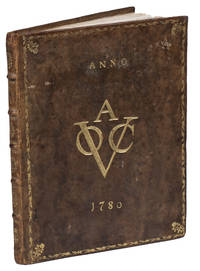
1780ABC_48891The Netherlands 1780. Late 18th-century gold-tooled brown mottled calf sewn on 5 supports bound by the so-called Acorn-and-Foliage Tool Bindery in Amsterdam Storm van Leeuwen. Both boards show the large gold-tooled monogram of the Amsterdam chamber of the VOC as a centre piece sandwiched between the gold-tooled date Anno 1780 all within a gold-tooled floral frame with floral corner pieces in the inside corners spine gold-tooled in six compartments red sprinkled edges. 4to ca. 19 x 15 cm. Manuscript in French written in black ink on paper in a neat cursive script by one hand. With chapter divisions numbered 39-75 and headings. The text is written upside down in relation to the binding. Most leaves show an identical watermark depicting a lion rampant on a pedestal with Vryheyt in a crowned ring with Pro Patria Eiusque Libertate and the letters CR below which is very close to Heawood 3149 date: 1753. Late 18th-century manuscript copy of a French childrens catechism by the Swiss theologian Jacob Vernet 1698-1789 bound in a remarkable late 18th-century binding originally produced for the Amsterdam Chamber of the Dutch East India Company VOC by the so-called Acorn-and-Foliage Tool Bindery which was active between ca. 1760 and ca. 1784 Storm van Leeuwen.It shows the large monogram of the Amsterdam Chamber of the VOC sandwiched between the date "Anno 1780" on both boards. These bindings were usually commissioned as gifts to persons important to the VOC often containing an almanac for the relevant year but possibly also produced as blank notebooks. The present work comprises chapters 39-49 and 58-75 of Vernet's work which form almost the second half of printed editions. The chapters included in the present work are complete and exactly follow the order of the printed text in the Geneva 1742 edition pp. 75-140 checked using a digital copy with a slightly different spelling and replacing some words. For unclear reasons chapters 50-57 dealing with the fourth through tenth commandment have not been copied and several leaves between the end of chapter 49 and the beginning of chapter 58 have been left blank.Vernets religious text was first published in 1741 under the title Instruction chrétienne ou catechisme familier; avec quelques prières a lusage des petits enfans . In 1742 a revised edition appeared with a slightly different title Instruction crhetienne ! ou catechisme familier. Avec quelques passages de lEcriture Sainte & quelques prières à lusage des petits enfans. Nouvelle edition. Revuë corrigée & augmentée. Both works were printed in Geneva for the Swiss bookseller Emanuel Du Villard Emmanuel Duvillard 1693-1776 and subsequently reprinted several more times until 1769. With the book block showing the remnants of 12 removed leaves probably already removed before the manuscript was finished. Both pastedowns partly detached an old annotation Ao. 44305 in black ink on the lower pastedown some foxing. Otherwise in good condition.l For the binding: Landwehr/Van der Krogt VOC pp. XXVII-XXVIII; Storm van Leeuwen I p. 175 p. 196 VOC A-stamp and pp. 612-616 the bindery; for Vernet's work: Google Books digital copy of the 1742 ed. title: Instruction crhetienne ! ou Catechisme familier; physical copy at the Biblioteca Universitaria di Torino; WorldCat 951908419 1 copy 1767 ed.; WorldCat 1040828976 1 copy 1769 ed. no author noted; for the watermark: Heawood 3149. hardcover
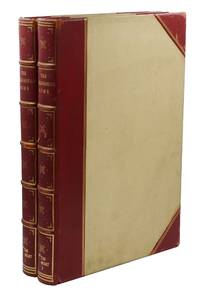
1845140943942London: Jonathan Murray 1845. Second edition. Complete in two large folio volumes. Three quarter red calf lettered and ruled in gilt with vellum sides top edges gilt. Text in English and Latin. Ex-library copies non-circulating with bookplates on paste downs call numbers printed on spines perforations to title with a few penciled notes. Plates unmarked and unperforated. Very Good overall with some chipping and wear to calf. Contents very bright. All 108 plates and two frontispieces present showcasing the fourth Duke of Marlborough's collection of gems. Jonathan Murray unknown
GAST0368Stendal Franzen und Grosse 1790. 8°. Gest. Titel m. Titelvign. 4 Bll. Pränumerantenverz. LXXX 268 S. 8 v. 9 Bll. Register u. Verlagsanz. Mit gest. Frontispiz. Stummer neuer Kunstlederband. Front. unvollst.erhalten u. verso hinterlegt durchgeh. gebräunt u. mit starken Gebrauchsspuren Teil des Buchblocks wasserfleckig vereinz. mit Papierstreifen im Falz verstärkt letzte Bll. m. Eckabriss. Holzmann/Boh. II12247; VD18 10673911; Weiss 546. - Dieses Kochbuch aus dem Jahre 1790 ist eines der frühen Werke zur Ernährungsdiät. Im Vordergrund der Rezeptauswahl stand die Idee Rezepte und Vorschläge für die gesunde Ernährung und für kostengünstige Zutaten zu veröffentlichen. - Johann Jacob Heinrich Bücking 1749-1838 ein Zeitgenosse Samuel Hahnemanns war Arzt in Wolfenbüttel. Durch eine Vielzahl von wissenschaftlichen Veröffentlichungen hat sich B. auch einen Namen als Gelehrter gemacht. Die medizinischen Themen reichen von der Beschreibung des Karbunkels über doppelten Darmbruch Krankheiten vornehmlich mit Rücksicht auf den Landmann bis zu einer Anleitung zum Aderlassen für Wundärzte. Daneben finden sich Schriften über Lackfirnisse und die Kunst des Buchbindens. - Das letzte Blatt Verlagsanzeigen fehlt. Stendal, Franzen und Grosse 1790. unknown
1021050245.Ghardcover. Good. Access codes and supplements are not guaranteed with used items. May be an ex-library book. hardcover
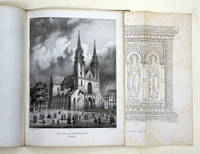
101640Basel Hasler 1842. 4° 22 S. m. lithogr. Umschlagtitel u. 17 lith. Tafeln davon ein gefalteter Grundriss. Privat-Hldr. d. Zeit Besitzerschild a. Vors. eingeklebt etwas fingerfleckig und min. stockfleckig. Mit der oft fehlenden schönen Gesamtansicht des Münsters mit Personenstaffage von J. Rothmüller nach C. Guise.Erste Ausgabe des seltenen Frühwerks Burckhardts noch aus seiner Berliner Studienzeit. "Der Grund warum dieser Text. anonym erschien mag einerseits in der Jugend des Verfassers andererseits in einem gewissen offiziellen Stil und schliesslich in einer Rücksicht auf einen eben Verstorbenen zu suchen sein. Burckhardt's Schrift ist nämlich eine Art Neuausgabe einer älteren "Beschreibung der Münsterkirche zu Basel" die um 1788 ebenfalls anonym erschienen war. Folgt man Burckhardts Beschreibung im einzelnen so findet man neben manchen Irrrtümern die heute leicht festzustellen sind auf Schritt und Tritt scharfe Beobachtung kluge Vermutung und vorsichtige Zurückhaltung." Kaegi I 509; 511. - Siehe Falkeisen Hieronymus Dank an das Antiquariat Libelle in Basel 010 Basel, Hasler, 1842 unknown
1842013836Basle Basel: Hasler 1842. Book. Good Plus. Not Bound. First Edition. Folio. Loose in "folder". Original green paper cover printed in black to the front the contents loosely inserted consisting of 24 pages of letterpress text in French 1 folding plan and 18 fine lithographic plates. Condition is generally very good witha little wear and light creasing to the covers the plates are very good too with some foxing to some mostly confined to the edges the plate of the cloisters has a stain to the left-hand margin but does not nearly affect the image. A good plus set of this scarce work. Hasler unknown
101641Frankfurt Sauer & Auvermann 1968. 4° 30 S. XXVII Bl. m. einigen Holzschnitt-Illustr. HPerg. m. Rückenprägung. tadell. Der erste illustrierte Druck des kaiserlichen Rechtbuches Karls IV aus dem Jahre 1356 Faksimiledruck mit einer Einleitung von Armin Wolf 010 Frankfurt, Sauer & Auvermann, 1968 unknown
192863340Los Angeles CA: Jake Zeitlin Books 567 Hope Street 1928. 12mo. 48 pp unpaginated. Art Deco grasshopper motif logo on front cover light dustsoiling minor shelfwear still a VG bright copy from the library of Anne Bobrow 1916-1996 longtime cataloguer with Zeitlin & Ver Brugge 1948-1986 and then with B & L Rootenberg Rare Books. First edition of this first fine & rare books catalogue from the famed Los Angeles bookseller who issued this just three months after setting up his bookstore in a space designed by Frank Lloyd Wright in April 1928 at 567 Hope Street. Zeitlin 1902-1987. At the time the ever confident Zeitlin had already published his first poetry attracted the friendship of Carl Sandburg and within a short time at the end of the 1920’s attracted a coterie of local writers painters photographers printers graphic designers and architects drawn in by his Grasshopper sign which adorned the store. The Western Americana section in this sports such items as Paul Allen’s Lewis & Clark 1814 No. 2 for $ 40.00; Brooks & Bryant Among the Gold-finders 1849 No. 8 for $ 10.00; Greenhow’s Memoir 1840 No. 22 for $ 32.50; and a superb copy of Manly’s Death Valley in ‘49 1894 No. 29 for 15.00. Also featured wre Frank Harris’s 2 vol. Oscar Wilde 1916 limited edition inscribed with 4 original letters for $ 85.00 and the splendid Nonesuch Press Divine Comedy 1928 for $ 100.00. Jake Zeitlin, Books, 567 Hope Street, unknown
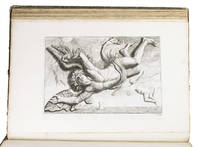
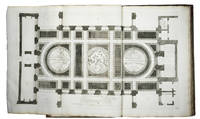
1719ABC_48483Amsterdam: David Mortier 1719. Contemporary quarter brown sheepskin sewn on 5 supports with the corresponding raised bands on the spine the title lettered in gold on the spine sprinkled paper sides red sprinkled edges. Royal folio. With a title-page in red and black with an engraved device a portrait of Erasmus in an elaborate cartouche with allegorical figures and 124 engraved architectural and sculptural illustrations on 109 numbered plates 6 double-page 103 full-page. First French edition of Van Campen's famous description of the Amsterdam City Hall the present day Royal Palace with more than a hundred plates of the architectural features and sculptures of the building including ground plans elevations and sections of the interior and exterior. Particularly impressive are the giant plates of the tympana which are more than 160 cm wide when fully unfolded. The work also includes the famous plate of the extraordinary cartographic mosaic floor of the Burgerzaal which shows the zodiac signs that were originally painted on the celestial map in the middle but are now no longer visible on the floor itself due to fading.The City Hall is the most famous and last major work by Jacob van Campen 1595-1657 the greatest Dutch architect of the 17th century. He began work on the design in 1640 and though the building opened in 1655 it was not actually completed until 1665. It was called "the eighth wonder of the world" at the time and is still considered the most important Dutch monument from the 17th century. It was designed to show off Amsterdam's wealth and magnificence. This is especially visible in the Burgerzaal the heart of the building which depicts Amsterdam as the centre of the world. The impressive mosaic floor with a celestial map in the centre and the two maps of both hemispheres of the world on either side symbolises that the world was at Amsterdam's feet. These maps are the largest ever made. They show Abel Tasman's then recent discoveries in Australia and Tasmania. Many discoveries from his second voyage remained otherwise unpublished until the end of the 17th century.The present work is the French edition of Van Campen's Afbeelding van 't stadt huys van Amsterdam 1664. The plates were drawn by Hubert Quiellinus 1619-1687 and Danckert Danckertsz. 1634-1666 and his father after drawings by Jacob Vennekool 17th century and were first published in Quiellinus' Prima et secunda pars praecipuarum . curiae Amstelrodamenis 1655-1663 and Afbeelding van 't stadt huys van Amsterdam in dartigh coopere plaaten . geteeckent door Jacob Vennekool 1661. As such most of the present engravings were published before the building was completed and may therefore reflect Van Campen's plan more closely than the finished building itself. The edges and corners of the boards are scuffed the spine has been rubbed with loss material old restoration at the head and foot of the spine. The text leaves are lightly browned the plates are very clean.l BAL 132; Berlin Kat. 2235; STCN 182312917 5 copies of which 1 incomplete; cf. Fowler 77 & 274 1661 Danckerts eds.; for the map see also: Schilder Australia Unveiled map 66; Shirley 423. David Mortier, hardcover
1780K6QE3E6Q77WKAmsterdam 1780. Large folio 49.5 x 30 cm. Johannes Covens Cornelis Mortier and Johannes Covens junior Contemporary half red roan sheepskin brown sprinkled paper sides. With the title page printed in red and black with J. Covens & C. Mortiers engraved device by Bernard Picart JCCM cypher monogram in a laurel wreath carried by 6 putti dated 1730; 2 preliminary plates containing portraits of Jacob van Campen by Lutma and Arthus Quellinus by Henricus Quellinus; CIX 109 numbered engraved and etched architectural plates 7 folding 30 double-page and 72 single-page a few printed from 2 or 3 copper plates distinguished by arabic numerals showing plans elevations tympana ceilings floors statues festoons and other ornamentation mostly engraved by Hubertus Quellinus after Arthus Quellinus but some after R.V.H. Rombout Verhulst. All plates have French captions some with laudatory verses below and are described in Dutch in the letterpress text pp. 3-15. 15 pp. A comprehensive collection of plates showing all architectural features and sculpture of the Amsterdam City Hall since 1808 the Royal Palace here in the Covens & Mortier firm's rare ca. 1780 issue with the engravings newly printed from the original copper plates from the years 1655 to 1664 and the text reissued from Leonardus Schenk's 1747 Dutch language edition the whole with a new title-page. ''This version has not been seen'' BAL. At least most of the plates were engraved for and first published in Jacob van Campen's masterpiece Afbeelding van 't stadt huys van Amsterdam Amsterdam Frederick de Wit 1664 Hubert Quiellinus's Prima et secunda pars praecipuarum . curiae Amstelrodamenis Amsterdam Frederick de Wit 1655-1663 and Afbeelding van 't stadt huys van Amsterdam in dartigh coopere plaaten . geteeckent door Jacob Vennekool Amsterdam Dancker Danckerts 1661.It includes the famous plate showing the extraordinary cartographic mosaic floor of the Burgerzaal of the Amsterdam City Hall designed by Jacob van Campen with a celestial map in the centre and the magnificent map of the world in 2 hemispheres on either side. The engraving was first published in 1661 and the map shows Tasman's recent discoveries in Australia and Tasmania and depicts California as an island. Many discoveries from his second voyage remained otherwise unpublished until the end of the 17th century. The drawing of the floor was made by Jacob Vennekool who worked closely with Van Campen and since his drawings were first published even before the building was completed they may reflect Van Campen's plan more closely than the finished building itself. They also of course show it before the alterations made at various times in later years.Binding a little worn untrimmed otherwise in good condition. The Amsterdam city hall in full glory with all its architectural features and sculpture.l BAL 132 note description of 1719 French language ed. but citing Berlin Kat. & Kuyper for unseen "1730" Dutch ed.; Berlin Kat. 2236; Kuyper Dutch Classicist architecture Delft 1980 pp. 212- 215 and note 25 p. 318; STCN 3 copies; cf. for dating the impressum: Van Egmond Covens & Mortier 2005 pp. 66 83-88. ABE CAT Architecture ABE CAT Art History unknown
193559294New York: The Daily Worker 1935. First Edition. First printing. Limited issue; no. 50 of 100 clothbound copies signed by Burck. Quarto; tan buckram with titles and decorations stamped in brown on front and rear covers; 247pp. A lovely fine copy free of soiling or wear. There was a simultaneous trade issue in pictorial wrappers.<br /> <br /> The very scarce limited issue of this compilation of Burck's Depression-era cartoons most originally published in the Daily Worker and The New Masses. Burck trained at the Art Students' League under Boardman Robinson; became the full-time editorial cartoonist for the Daily Worker in 1929 and worked as a political cartoonist for the rest of his life though following a 1936 trip to the Soviet Union he renounced Communism and began working for mainstream periodicals including the St. Louis Post Dispatch and the Chicago Daily Times. He won a Pulitzer Prize in 1941; survived a period of persecution during the 1950s Red Scare and continued to produce new work until shortly before his death in 1982. This volume quite scarce and the few copies we have seen previously were well-worn. The Daily Worker unknown