259 résultats
1852SW1569Braunschweig:: F. Vieweg 1852 1853 1856. 1852. 4 volumes: 3 volumes in 8vo. Atlas in 4to. iv 644 V-VIII; iv 777 1; xv 1 520 pp 1404 woodcut figs. throughout vol. I: 1 table after p.644 6 plates 4 in color; vol. II: 1 color plate. Atlas: 27 plates some in color; some light foxing. Contemporary calf paste-paper marbled boards gilt-stamped raised bands and spine black & red leather labels. Rubberstamps of the Royal Society of Edinburgh. Near fine. RARE WITH ATLAS VOLUME. Fourth edition enlarged the first to include Kosmichen Physik of the famous physics textbook of Mathias Pouillet Elements de physique experimentale et de meteorologie 1827-30 translated and substantially enlarged and revised by Johann Muller a physics and technology professor at the University of Freiburg. Muller's version in turn became a standard physics textbook in the German-speaking world and went through a number of editions remaining in use through the early 20th century. "Muller's most significant textbook the Lehrbuch first appeared as Pouillet's Lehrbuch der Physik und Meteorologie a 'free adaptation' of the 1837 edition of C.S. Pouillet's Elements de Physique experimentale et de Meteorologie. Muller'sinnovations included numerous woodcuts inserted directly into the text. . .The illustrations of the apparatus were particularly useful for the mechanician. The book was initially styled for the nonphysics major. He supplied the derivations of mathematical formulas and stressed mechanical theorems. Muller incorporated Gauss's works on magnetism for the first time and recast the chapters on galvanism light and meteorology. Each of the seven editions that were published during his lifetime underwent considerable emendation. A third volume Lehrbuch der Kosmicschen Physik based upon Muller's own observations was added in 1856." –D.S.B. IX p. 566. F. Vieweg, 1852, 1853, 1856. hardcover books
1839430451839. <p>Einige Blicke auf die Entwicklungsgeschichte des vegetabilischen Organismus bei den Phanerogamen. Offprint from Archiv für Naturgeschichte 3 1837: 289-320. Plate. 206 x 126 mm. Original plain wrappers front wrapper detached; modern bookplate. Inscribed by Schleiden to William Francis on the front wrapper.</p> <p>Botanische Notizen. Offprint from Archiv für Naturgeschichte 4 1838: 49-66. Plate. 205 x 129 mm. Original plain wrappers sun-darkened detached; modern bookplate. Inscribed by Schleiden to William Francis inscription partially lost due to sunning</p> <p>Botanische Notizen. Offprint from Archiv für Naturgeschichte 5 1839: 253-292. Plate. 214 x 128 mm. Original plain wrappers small tear in lower margin; modern bookplate. Inscribed by Schleiden to William Francis on the front wrapper.</p> <p>Botanische Notizen. Offprint from Archiv für Naturgeschichte 5 1839: 211-234. Lacking plate. Original plain wrappers back wrapper lacking; modern bookplate. Inscribed by Schleiden to William Francis on the front wrapper.</p> <p>A collection of four extremely rare offprints on botanical science by Schleiden whose landmark 1838 paper "Beiträge zur Phytogenesis" marks the beginning of cell theory and plant cytology. The first offprint is on the development of organs in phanerogams plants with seeds; "his theory of the flower and fruit is an admirable performance for the time even though we abandon his view of the stalk nature of placentas and some other notions as we obviously must. As Robert Brown founded the history of the development of the ovule so Schleiden founded that of the flower and his example influenced other botanists" Von Sachs History of Botany 1530-1860. Schleiden presented these offprints to British chemist Dr. William Francis who in 1852 joined with publisher Richard Taylor to found the firm of Taylor and Francis. unknown books
1888102057Folio 12" x 15" publisher's leather somewhat crudely rebacked gilt title on front cover illustrated with engraved frontispiece and 119 chromolithographed plates with tissue guards 182 8 pp. Binding shaken top cover and spine and front endpapers partially separated from text block back joint cracked but still attached significant wear to covers around extremities bookplate on front pastedown; contents clean and bright. Published in several editions the plates are extremely attractive. Studer 1840-1904 was born in New York City and would become a printer and lithographer. He was also an ornithologist and seems to have been active in this field in the Columbus Ohio area after the Civil War. However it is believed that the plates were based on drawings by Theodore Jasper. The plates while very attractive are believed to be designed to help with identification. Size of book will require extra postage. online Cornell library website. The Natural Science Association of America, books
18111303022London: Printed for J. Johnson and Co 1811. First Edition. Hardcover. Quarto xiii 1 blank 2 407 1 36 7 1; VG; bound in 3/4 contemporary brown leather marbled boards; paneled spine with black label and gilt lettering; with 13 folding plates; EM consignment; shelved case 9. 1303022. Shelved Dupont Bookstore. Printed for J. Johnson and Co hardcover books
186738307San Francisco: Alta California Printing House 1867. 1st edition Cowan II pp. 375-376; Rocq 9192. Original printed pale green paper wrappers. Some modest wear & soiling to wrappers though spine paper mostly perished. A VG copy. 64 pp. Numerous mss corrections to text. Intratextual lot plans ~ 55 describing by city blocks the property of Jacob C. Beideman. 8vo. 9" x 5-3/4" <br/><br/>Auction of over 100 pieces of property located throughout the city of San Francisco as amassed by Jacob C. Beideman. One of the largest estates of the era neighborhoods include the Tenderloin area of downtown and along Van Ness Ave. Western Addition & Hayes Valley. OCLC records 6 holding institutions. No copies at auction the past 30 years. Rare in the trade. Alta California Printing House unknown books
1811529Ephrata in Pennsylvanien: Gedruckt bey J. Ruth 1811. 12mo. 165 x 105 mm. 6 12/2 x 4 inches. 395 i.e. 400 pp. Illustrated with engraved frontispiece portrait engraved frontispiece image of Christ revealing divine truth 5 engraved plates and one woodcut image of the serpent printed in the text; the portrait and the frontispiece are added and are not usually found with this edition. The book is bound in contemporary calf red leather label which reads "Der weg zu Christo"; some light rubbing to binding; paper stock is brown with age fore edges a bit fragile in places; a very good copy. First American edition originally printed in Goerlitz Germany in 1624. This American edition of Boehme's mystical text was printed at the Ephrata Cloister by Jacob Ruth and is one of only two titles produced by this printer at the Cloister press. K.J.R. Arndt gives Ruth's dates as 1794-1878 but provides no other information about the biography of the printer and his relationship to Ephrata. This question is of interest because the engraved images in this book are all unsigned and are apparently re-engravings of plates form an earlier edition published anonymously in Leiden in 1730 which contains five plates. If Ruth re-engraved these plates it demonstrates a very sophisticated skill with the burin and familiarity with the creation of fine lines tonality and readily recognizable symbols. The engravings are not only fine work but early examples of the art form produced in the Pennsylvania German community of the period. Shaw & Shoemaker 22416. Arndt German Language Printing in the United States 1805. Gedruckt bey J. Ruth unknown books
185962094Wellsburg VA: Jacob & Smith Publishers and Printers 1859. First edition. 12mo. 280 pp. Frontispiece portrait and three plates. The story of the Corps of Discovery and its exploration of Jefferson's Louisiana Purchase seen through the lens of this biography of the last surviving member of the expedition. "The biography of its citizens is the history of a nation and we trust that the reputations of history will not suffer from one departure in permitting the humble biography of a hero of the ranks to stand by those of the great and title" from the preface. Howes J-31. Graff 2183. Wagner-Camp 6:10: "Gass became one of the best-known members of the expedition for several reasons: his key role as sergeant brought his name up frequently in the journals of Lewis and Clark his account was the first to be published he was the first to have a biography written about him and finally he outlived the other members of the Corps of Discovery by decades dying at the age of ninety-nine in 1870." Plates with foxing text toned but a very good copy. 20th-century green three-quarter leather and cloth gilt rules and title on spine. 9761. <br/><br/> Jacob & Smith, Publishers and Printers hardcover books
183022777London: published for the Author by Longman Rees Orme Brown and Green 1830. Imperial octavo. 11 x 7 1/2 inches. Additional title on india paper mounted with etched vignette 49 etched plates by Strutt all on India paper mounted. Original oatmeal-coloured cloth rebacked.<br/> <br/>Provenance: Edward Kynaston Bridger d.1898 armorial bookplate; William Russell Grace 1832-1904 armorial bookplate<br/> <br/>An attractive copy of the first octavo edition of this charming work: the deluxe issue with the plates all printed on india paper.<br/> <br/>Rather than concentrating on generic descriptions of species of trees although these are given Strutt here provides a portrait in words and pictures of 50 of the greatest trees or stands of trees in England and Scotland: a snapshot of the trees as they stood in 1830. "Greatest" is here interpreted by Strutt in various ways: tallest largest girth largest spread oldest etc. The preponderence of the examples given are oaks 21 but he also includes examples of elm 6 beech 2 ash 2 chestnut 4 cedar 3 yew 3 and one each of lime poplar willow plane maple sycamore Scotch fir silver fir and larch. This work was first published by Strutt in 1826 in a folio format and was available by subscription at 9 guineas for the normal issue or for the issue with the plates on india paper 15 guineas a list of the subscribers to this folio edition is included in the present octavo edition. For the present work the folio plates were reduced and the folio text was modified to allow for the re-ordering of the trees into more coherant groupings. As with the folio edition this work was offered in two forms: at £1 11s. 6d. for the normal issue or 3 guineas for the deluxe issue with the plates on india paper as here. The early owner of this copy William Russell Grace the co-founder of W.R Grace and Co. was an American success story who rose from relative poverty to be one of the richest men in the country. He was also a noted philanthropist and served two terms as Mayor of New York.<br/> <br/>Lowndes III p.2534; Nissen BBI 1907. published for the Author by Longman, Rees, Orme, Brown and Green unknown books
184254602Philadelphia: published at the Assay Office of the Mint 1842. First edition 4to pp. 4 iv 1 6-220; inserted half-title printed in silver on glazed paper and 16 composite plates printed on glazed paper; original brown cloth stamped in gilt on the upper cover; small snag at the top of the spine and the cloth binding a little dull; the plates are all bound at the back of the volume in 4 sequential gatherings and the bulk of the plates has caused these gatherings to become extended; otherwise a complete copy with a clean text block and an interesting provenance: on the front free endpaper is the first owner's inscription "Rud. F. Kelker / April 21 1843 / bot. of Eckfeldt & Dubois / United States Mint" and on the top of the title page "Rud. F. Kelker / April 21 1843 / bot. of Eckfeldt & Dubois / United States Mint / paid $5.00." Bookplate of Rudolph F. Kelker Harrisburg Pa. A landmark work in American numismatics. The authors were assayers of the U.S. Mint in Philadelphia. For nearly two decades it was the only practical guide available to American coin collectors. It was also the first work to illustrate the 1804 dollar and was one of the earliest works to combine photography electrotyping and the metal rolling machine for illustrative purposes. Sabin 21787. <br/><br/> published at the Assay Office of the Mint hardcover books
181347139Harrisonburg: Printed for the Author: By Davidson & Bourne 1813. 1st edition American Imprints 28029; Field 199; Harris Collection p. 42; Sabin 8787; Wegelin 889. Period full brown sheep binding with red leather gilt stamped title label to spine with 7 horizontal rules to same speckled edges. General wear to binding. Usual age-toning & foxing to paper; ffep lacking lower quarter. Prior owner signatures one dated 1858 of Jacob and Emeline Ritner. A solid VG copy. 252 12 pp. "List of Subscribers" last 12 pages which lists names in 3 columns per page ~ 60 names / column from 11 states: Virginia 7 pp Kentucky 3 pp Tennessee 1 page Ohio 2/3 page & Pennsylvania Maryland New York South Carolina Connecticut North Carolina & Louisiana comprising the last 1 columns. Of particular interest today is the large number of women so listed throughout this early 19th C. subscriber list providing strong evidence of their literary interests & financial wherewithal easily an academic project to research these women and gather additional demographics for this group. 12mo. 6-1/2" x 4" <br/><br/>From Harris we learn the author was born in Virginia served as a State Senator and subsequently as Postmaster at Georgetown. Captain Jacob Ritner a self-styled "MOUNTAIN MUSE" in his hand under his signature to the front paste-down played a role in "most of the major military events of the Western Theater: Wilson's Creek Vicksburg Chattanooga and Lookout Mountain the Atlanta Campaign including the Battle of Atlanta Sherman's March to the Sea the Occupation of Savannah and the Carolina's Campaign." Perhaps he viewed himself as a mid-19th Century Daniel Boone A nice copy of this heroic poem centered on one of America's frontier icons. Printed for the Author: By Davidson & Bourne hardcover books
1814248076West Bloomfield NY 1814. 1 p. plus integral address leaf. 4to on a folded folio sheet. Old fold lines minor soiling; near fine. In a green half morocco and cloth clamshell case. 1 p. plus integral address leaf. 4to on a folded folio sheet. A hasty note written by Major General Jacob Brown to New York politician Nathan Williams requesting more arms and equipment for the siege of Fort Erie currently underway. The Americans led by Brown captured Fort Erie on July 3 1814. British forces led by Lt. General Gordon Drummond engaged the Americans at the bloody Battle of Lundy's Lane on July 25th where Brown was wounded; the Americans retreated to Fort Erie and Brown was sent off to convalesce. After repeated sorties and engagements the American commander General Gaines was gravely wounded and Brig. General Eleazer Ripley - who thought the whole operation was doomed to failure - took command. Brown though not quite recovered from wounds taken at the battle of Lundy's Lane the previous month was sent to replace the pessimistic Ripley as the commander of the Fort. Brown had made a name for himself at the battles of Sackett's Harbor and Lundy's Lane and his actions at the Siege would cement his position as a national hero winning him the Congressional Gold Medal in November 1814. Brown jotted this note before setting out to command the troops at the Fort. He writes:<br/> <br/>"My dear Sir I am so far on my way towards Buffalo. The militia turn out better than was expected. We shall I fear be deficient in arms. You will jump into your easy carriage and ride to Rome as fast as possible upon the receipt of this and see that the keeper of the arsenal there forwards fifteen hundred stand with equipments compleat with all the rapidity possible. Your attention is of much importance."<br/> <br/>A wonderful letter written by Major General Jacob Brown on his way to the battle that would ensure his lasting fame. unknown books
1859017587Wellsburg VA: Jacob & Smith 1859. Book. Very good condition. Hardcover. First Edition. 12mo - over 6¾" - 7¾" tall. 280 pages of text. Original brown stamped cloth binding with moderate rubbing to the extremities and fraying along the hinges with some edges re-attached and with original backstrip remaining intact; protected in custom stiff archival mylar. Illustrated with a frontisportait of Gass and three plates pg.59 pg.108 pg.248 as well as other vignettes; complete. Minor spotting to the closed page edges scattered light soiling to numerous page edges and a few pages with small spots of staining and a few that have the corners creased. Overall an attractive unrestored example of this memoir of the last survivor of the Lewis & Clark Expedition. Title continues ".Together with Gass' Journal of the Expedition Condensed; and Sketches of Some Events Occurring During the Last Century in the Upper Ohio Country Biographies Reminiscences etc." Previous owner's ink name mostly erased from original colored front endpapers. Retains both front and rear sets of the original colored endpapers as well as two additional white endpapers at the front and three additional white endpapers at the rear. Howes J-31aa. Wagner Camp 6:10. Streeter 3067. Graff 2183. Sergeant Gass lived to age 99 outliving all other members of the Lewis and Clark Expedition. Jacob & Smith Hardcover books
18792558331879. With watercolours photos etc. 4to. Quarter contemporary morocco gilt spine and marbled boards a.e.g. Minor rubbing some pages have been excised. With watercolours photos etc. 4to. Front free endpaper has charming small watercolour of house tipped in with legend in pencil "I believe this is the first dwelling after marriage Rainham Kent. G.T.N. ordained 1806 preached at Romsey.<br/><br/>2. Lumley Lodge Richmond pen and ink drawing. Laid in.<br/><br/>3. Watercolour : "House & chapel built by him of Dr César Malam Prè du Champs- Geneva<br/><br/>4. Pencil drawing "Birthplace of Phillip George de Grand Jacob: Roath Court was left for Somerton in 1808." Signed in picture "Roath Court Frant. July9-39."<br/><br/>5. 2. Lumley Lodge Richmond pencil drawing<br/><br/>6. Crawley Rectory 1832 by A.S.J. Pencil drawing<br/><br/>7. Crawley Rectory and grounds by ASJ<br/><br/>8. Wash drawing of "Abbey Close Winchester" identified lower left<br/><br/>From hence mostly photographs. unknown books
187833773Columbus Oh: Studer 1878. First Edition. 152 16pp. illus. 190 colored plates most with tissue guards. Contemp. half mo. with gold stamped spine and new endpapers. The colored plates represent upwards of seven hundred different species and varities of North American birds including a popular account of their habits and characteristics"-The title page. Studer was a painter lithographer and popular orinthologist in Columbus. He was sometimes referred to as " The poor man's Audubon". The plates are really very nice. Studer unknown books
1847M12984Philadelphia:: American Medical Association 1847/8. 1847. Offprint. Series: Transactions of the American Medical Association. Sm. 8vo. 18 pp. Contemporary plain brown wrappers probably as issued; extracted from a bound volume thus a remnant residue affecting spine. Front cover library withdrawal rubber stamp possibly: "Concord Free Public Library". Very good. First SEPARATE OF BIGELOW ON ANESTHESIA the journal form has an entirely different pagination being pages 197-214 in the 1847 issue. We believe this is the original offprint form of this paper by Bigelow. There are several clear differences between this offprint form and the journal issue is 1 the pagination for the offprint is 1-18 for the journal it is 197-214 and 2 the journal issue has "C.-1. at the head of the paper and foot of the page has no page number – whereas the offprint form adds the line "Extracted. . . raises the title text higher on the page and includes a page number "1" at the bottom left margin. There is no known textual difference. <br /><br /> "The committee considered in detail the various anesthetic agents. According to the report some surgeons were afraid to use anesthesia in their surgical operations feeling that the advantages afforded by the relief of pain might be offset by the risks involved. However even at this early date authors of this report felt that a large group of surgeons were wholly in favor of anesthesia. The authors did however admit that some surgeons would restrict the use of these agents to severe operations after the introduction of ether anesthesia in Boston it was not until several months later that the method became generally popular in other communities in the United States. The favorable reports of its use in Boston and in Europe made for the more extensive use in American communities in 1847 and 1848. The dangers of etherization were also considered. In some cases it was thought that convulsions prolonged stupor intense cerebral excitement alarming depression of the vital powers and asphyxia apparently were caused by the inhalation of ether and chloroform. Secondary effects attributed to inhalation in a few cases were bronchitis pneumonia and inflammation of the brain. Interestingly enough according to this report p. 190 ether was considered to be a safer drug than chloroform" Keys pp. 36-47. <br /><br /> "Dr. Bigelow was the unflinching advocate of sulphuric ether as the only safe anesthetic: and his unshaken opinion had a very wide and lasting influence. Bigelow instituted important and productive experiments in anesthesia. He inhaled new and untried anesthetic agents. He made practical and original studies of asphyxia and thoroughly established the fact that insensibility from the inhalation of nitrous oxide gas is largely due to asphyxia. He was also the first to show that anesthesia by nitrous oxide could be accomplished with certainty only by the use of a large volume of gas; and thus made the way plain to Colton and others for its successful adoption in tooth-pulling and in brief surgical operations" Mayo p. 603. <br /><br /> Bigelow 1818–1890 born in Boston studied at Harvard from 1833 and became a prominent surgeon and Professor of Surgery at Harvard University. "His 1846 article 'Insensibility during Surgical Operations Produced by Inhalation' detailed the discovery of ether anesthesia and was selected by readers of the New England Journal of Medicine as the 'most important article in NEJM history' in commemoration of the journal's 200th anniversary." "He was a vocal opponent of vivisection and was best known for his description of the hip joint and for a technique for treating patients with kidney stones." – Wikip. REFERENCES: Keys Thomas The History of Surgical Anesthesia Park Ridge IL: Wood Library Museum of Anesthesiology 1996; Fulton & Stanton Anesthesia VII p. 191; Mayo William J. "In the Time of Henry Jacob Bigelow." JAMA Vol. 77 No. 8. 1921. 597-603 pp. American Medical Association, [1847/8]. unknown books
189944062Cleburne TX: A.H. Yeager publisher T. L. Saunders printer 1899. 12mo.; 129pp. Original printed gray wrappers some wear to spine; text paper somewhat browned but a very good copy. First edition. Autobiographical story of a Confederate soldier from Washington County Tennessee; Civil War experiences include his capture at Kennesaw Mountain in June 1864 his incarceration as a prisoner of war at Camp Douglas Illinois his journey home and after reflecting on his childhood in east Tennessee how he came to join an infantry company as the war began. Yeager 1842-1940 served with the 29th Tennessee Infantry Confederate until his capture; though not included in this autobiography his post-Civil War years were spent first as a lawyer in Tennessee then as a newspaperman and farmer in Johnson County Texas. Rare. OCLC locates ten copies but only one in Tennessee Knox County Public. Not in Nevins Eicher or Broadfoot. Not in Sam Smith's TENNESSEE HISTORY: A BIBLIOGRAPHY. <br/><br/> A.H. Yeager, publisher (T. L. Saunders, printer) unknown books
18480000156Boston: David Clapp Printer 1848. First edition. Original Wraps. Very Good . 8vo24 cm. Original offprint with printed orange wrapper housed in a cloth clamshell box. Collation: 2 27 1p.; 18p. This is a very good to fine copy in original wrappers. The first article was originally published in the Boston Medical Surgical Journal in 1846. The second article is from the Transactions of the American Medical Association Vol. 1. <br/><br/>Bigelow had great concern for the suffering of surgical patients and was interested in finding an ideal agent which could be used as an anaesthetic. Ether had the potential to be of use though there was concern over its flammability. Bigelow used ether and published his observations on use of vapors from sulphuric ether in the Boston Medical Surgical Journal in 1846. In the present report Bigelow discusses the pros and cons on using ether vapors or chloroform and compares this in the second article with other anaesthetic agents. This clinical research was a major advancement for surgical operations where pain to the patient was greatly minimized or not felt during the surgery. G & M 5730. David Clapp, Printer paperback books
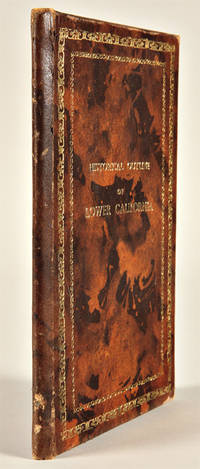
1865WRCAM42696New York 1865. 46pp. Modern mottled calf gilt. Extremities rubbed. Bookplate on front pastedown. Minor soiling. Very good. A scarce work on Baja California. "Jacob Primer Leese was a Santa Fe trader who settled in San Francisco in 1836 and engaged in the hide and tallow trade with Yankee ships. He married a sister of General Vallejo and became very wealthy. In 1863 Leese and other promoters founded the Mexican Mining and Colonization Company and obtained a land grant from the Mexican government of some 46800 square miles between the 24th and 31st parallels of latitude in Baja California. They failed to meet their obligations however and the grant was transferred to another party in 1866. This outline was written 'in the interest of the Mexican Mining and Colonization Company.' In addition to details on the grant it provides material on the discovery early settlements missions minerals and pearl fisheries of Baja California" - Hill. BARRETT 1460. HILL 998. SABIN 39834. unknown books
186564770First Edition in Original Printed Wrappers LEESE Jacob P. Historical Outline of Lower California. New York: E. S. Dodge & Co. 1865. First edition. Octavo 8 3/4 x 5 3/4 inches; 223 x 146 mm.1-46 2 blank pp. Original grey printed wrappers. Wrappers chipped along lower portion of the spine and slightly chipped along edges. Some light foxing throughout. Overall a very good copy. "Jacob Primer Leese was a Santa Fe trader who settled in San Francisco in 1836 and engaged in the hide and tallow trade with Yankee ships. He married a sister of General Vallejo and became very wealthy. In 1863 Leese and other promoters founded the Mexican Mining and Colonization Company and obtained a land grant from the Mexican government of some 46800 square miles between the 24th and 31st parallels of latitude in Baja California. They failed to meet their obligations however and the grant was transferred to another party in 1866. The outline was written "in the interest of the Mexican Mining and Colonization Company." In addition to details on the grant it provides material on the discovery early settlements missions mineral resources and pearl fisheries of Baja California." Hill 998. Hill 998. Sabin 39834. HBS 64770. $2500 E. S. Dodge & Co. unknown books
1826316088Cumberland MD: Printed for the Author by J.M. Buchanan 1826. First edition. 8vo. Contemporary half roan and marbled boards spine lettered in gilt. Covers scuffed and worn small semicircular portion of rear cover fire damaged with loss wear extending into final 25 pages at top margin touching a few letters text foxed and faintly dampstained some contemporary pen annotations 1839 ownership inscription on front free endpaper. First edition. 8vo. First edition of this defense of colonial frontiersman Captain Cresap 1742-1775 whom Jefferson echoing others blamed for the murder of the family of the Mingo war chief James Logan during Lord Dunmore's War. Cresap has since been exonerated and the Virginian Daniel Greathouse is now blamed for the massacre of Logan's family.<br/>"This biography of Cresap was written to refute Jefferson's account in NOTES ON VIRGINIA.The immediate occasion for this now rare book written by the revolutionary officer later clergyman who had married Cresap's widow was the reopening of old sores by Joseph Doddridge in his then recently published NOTES ON THE SETTLEMENT AND INDIAN WARS OF THE WESTERN PARTS OF VIRGINIA & PENNSYLVANIA FROM THE YEAR 1763 UNTIL THE YEAR 1783 INCLUSIVE of 1824. The defense is complete and the biography is of absorbing interest" Streeter. Streeter Sale 1335; Howes J32; Graff 2185; Sabin 35488; Siebert Sale 379 Printed for the Author, by J.M. Buchanan unknown books
18112473New York / Philadelphia: I. Riley and P. Byrne 1811. First American Edition. Full leather. Very good. From the personal library of President James Buchanan The Law Dictionary signed by Buchanan on the title page. Octavo ii 553pp. Full period calf title in gilt on spine over red morocco label. Statement on title page that this is the First American Edition from the Second London Edition. Spine repaired at ends reinforced hinges. Some age toning with foxing on endpapers. This is Volume V from a complete set of 6 volumes. Signed by President James Buchanan on the title page. This law book is from the personal library of President James Buchanan. His library was primarily held at his home in Lancaster PA called Wheatland. The majority of his presidential papers correspondence and books went to Dickinson college his alma mater. After graduating with honors in 1809 James Buchanan moved to Lancaster and became a legal apprentice to James Hopkins. He was admitted to the Pennsylvania Bar in 1812. Buchanan would go on to serve in the House of Representatives from 1821-1831 United States Senator 1834-1845 then as the 17th Secretary of State under President James K. Polk. He was elected President of the United States in 1856 serving one term. He predicted in retirement that "history would vindicate my memory" but his inability to stop the succession of the southern states has sealed his legacy as one of the least successful presidents in history. I. Riley and P. Byrne unknown books
1813WRCAM41998Sackets Harbor N.Y. 1813. 1p. manuscript letter signed docketed on verso. Folio. Old fold lines. Some separation at folds; one tear closed with archival tape. Lightly soiled. Good. An eyewitness account of the second battle of Sackets Harbor on the shores of Lake Ontario from the commander of the American forces there Gen. Jacob Brown to his friend Joshua Hatheway quartermaster general and formerly the commander of the defenses at Sackets Harbor. The town situated near the entrance to the St. Lawrence River at the far eastern end of Lake Ontario and opposite the Canadian town of Kingston was a vital defensive point for the Americans challenging British control of the St. Lawrence and the lake and preventing a British thrust into New York State. If either side could control both sides of the entrance to the St. Lawrence they could control the Upper Great Lakes. Taking advantage of the American action against York which drew troops away to the western end of the Lake the British decided to strike. On May 28 1813 the British Great Lakes squadron under the command of James Yeo appeared off Sackets Harbor carrying troops under the command of the governor-general Lieut. Gen. George Prevost. Having been forewarned by several men who escaped the Battle of Henderson Bay the previous day the Americans had some time to reinforce their defenses before the British could attack. The British landed on the 28th but launched their main attack the next morning. They easily routed the American militia but the regulars under Brown were able to fight off repeated attacks on their fortifications. Prevost fearing the arrival of more American troops ordered a retreat which nearly became a rout. Brown was the hero of the day and was later rewarded with a commission as brigadier general. He must have immediately written this letter describing the action. This appears to be written in a secretarial hand and signed by Brown himself. The letter states: "Dr. Sir I received an order some days since from Genl Dearborn to take comm. at this Post. Comd. Chauncey is up the lake. We were this morning attacked as day dawned by Sir George Prevost in person who made good his landing with at least a thousand picked men. Sir James Yeo commanded the fleet after loosing some distinguished officers and of course some gallant men. Our loss is very severe as to the quality of those who have fallen. The enemy left many of their wounded on the Field - but I have no doubt carried off many more. We shall probably be again attacked as Sir George must feel very sore. All I can say is whatever may be the result we will not be disgraced." A superb battlefield letter reporting on one of the most significant military actions of the War of 1812. unknown books
1817044454Boston: Cummings and Hillard 1817. First Edition. Hardcover Full Leather. Very Good Condition. Three volumes in one bound in contemporary paneled calf with an embossed eagle motif. Wear at corners and spine ends with a bit of loss to leather rehinged with inner joint strengthened with cloth. Old Yale library plate with a note that it was purchased from Yale as a duplicate in 1882. Modest foxing to text and plates heavier in spots fairly clean overall. 60 engraved plates colored a la poupee some finished by hand. In addition to being the first proper US botanical book Bigelow's Botany is the first US book printed in color. Remarkably two decades before the invention of chromolithography a method for printing in color was invented to print the plates for American Medical Botany. Sabin 5294 xi 1 18-197 1 195-197 1; xvi i.e. xiv 15-199 1; x 11-193 1. Pp. 195-198 of volume three bound at the end of volume one. Size: Quarto 4to. Quantity Available: 1. Shipped Weight: 2-3 kilos. Category: Science & Technology; Botany; Americana. Inventory No: 044454. <br/><br/> Cummings and Hillard hardcover books
1826WRCAM36095Cumberland Md.: Printed for the Author by J.M. Buchanan 1826. 1231pp. 12mo. Contemporary three-quarter roan and marbled boards spine gilt. Boards lightly rubbed and shelfworn. Early ownership signature on front free endpaper. Light tanning scattered foxing old light dampstain in lower third of final five leaves of text. About very good. In a burgundy half morocco and cloth slipcase spine gilt and folding cloth chemise. First edition of this biography of Captain Cresap defending him against charges that he slaughtered Indians before the beginning of the Revolutionary War. In particular Cresap became infamous in the case of the Indian Logan and the murder of his defenseless family in 1774. "This biography of Cresap was written to refute Jefferson's account in NOTES ON VIRGINIA.The immediate occasion for this now rare book written by the revolutionary officer later clergyman who had married Cresap's widow was the reopening of old sores by Joseph Doddridge in his then recently published NOTES ON THE SETTLEMENT AND INDIAN WARS OF THE WESTERN PARTS OF VIRGINIA & PENNSYLVANIA FROM THE YEAR 1763 UNTIL THE YEAR 1783 INCLUSIVE of 1824. The defense is complete and the biography is of absorbing interest" - Streeter. <br> <br> The Streeter copy was bought by Sessler for $650 in 1968. HOWES J32 "b." SABIN 35488. STREETER SALE 1335. FIELD 769. THOMSON 640. AMERICAN IMPRINTS 24967. DAB IV p.538 Cresap. Printed for the Author, by J.M. Buchanan hardcover books
1833262<p>Lansing Alfred A. Alexander Anderson Jacob Maas Milton F. Harrison <i>Galaxy of Comicalities</i> Philadelphia: Printed by Lesher & Shelly No. 303 Callowhill St. at $1.25 per annum in advance 1833. Twelve Issues: Volume 1: Nos. 1 – 12. These are twelve issues of only forty printed between October 2 1833 and July 5 1834. Galaxy of Comicalities is said to be the first illustrated comic periodical printed in America. Issue 11 December 11 1833 contains a review of <i>Sketches and Eccentricities of Colonel David Crockett of East </i>sic<i> Tennessee</i>. Crockett 1786 – 1836 a consummate self-promoter was the subject of numerous books. <i>Life and Adventures of Colonel David Crockett of West Tennessee</i> a spurious biography not authorized by Crockett was published in 1833 and reprinted later in the same year under the more accurate title of <i>Sketches and Eccentricities of Colonel David Crockett of West Tennessee</i>. <i>Galaxy of Comicalities</i> was a racist publication characteristic of humor during the Andrew Jackson administration. Mocking people of color during their "days off" writing in racial dialect and making sexist jokes about women this short-lived publication was intended for a semi-literate reader or listener sympathetic to the publishers' racist views. The editorial standard is as execrable as the spelling and views expressed. Illustrated with woodcuts of a similarly pejorative nature. </p><p>Condition of this rare worn and dis-bound surviving set: Issue 1 old repairs to page edges tear repair to page 1 slight text loss on p. 2; issue 2 repair to worn margins; issue 3 old tear repair to title-page margin repairs with text loss repair patch with text from another source p. 10; issue 4 margin repairs significant text loss; issue 5 good condition no repairs; issue 6 good condition no repairs; issue 7 text loss of a few words to three lines of one page; issue 8 good condition; issue 9 good condition; issue 10 margin repairs loss of few words on one page; issue 11 margin repairs text loss of a few letters on one page; issue 12 old tear repair. All twelve copies have browned with some spotting to the laid paper.</p>Housed in a folder with the ownership tag of Richard S. Wormser. Mr. Wormser a former president of the International League of Antiquarian Book Sellers and the Antiquarian Book Sellers Association of America was a member of the Grolier Club the American Antiquarian Society of Worcester Mass. the Club of Odd Volumes of Boston and the Old Book Table of New York. Lesher & Shelly, No. 303 Callowhill St. books