172 résultats
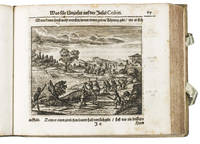
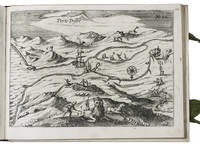
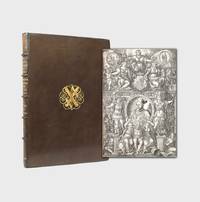
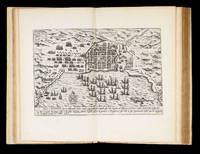
162215084Amsterdam: Chez Emanuel Colin de Thovoyon 1622. Folio 310 by 200mm first French edition second issue title page canncelled with Paris imprint added to that of Amsterdam engraved title with vignettes and map 8 103 1 blank 6 107-254 pp. head- and tail-pieces with decorated initials; 27 engraved plates pictorial title page 17 maps and charts 16 double-page 1 folded 4 city views 5 text engravings scenes from Le Maire voyage portrait of Le Maire not present as usual for the French edition seventeenth century vellum. The first French edition of Herrera'a rare work here extra-illustrated with Boazio's exceedingly rare views of Santo Domingo Dominican Republic; Santiago Cape Verde Islands; Cartagena Columbia; and San Augustine Florida - first known engraving of any locality in the present-day United States. The importance of this French edition of Herrera's 'Description des Indes Occidentales' and the other 1622 editions in Latin and Dutch lies in its engraved pictorial title page with the first map to delineate California as an Island and in the inclusion of the first comprehensive account of Jacob Le Maire's voyage. The 14 maps in the Herrera's section are almost identical to those in the original 1601 'Descripcion' save for some resizing and changes in a few details. The most interesting are probably the 'Description de las Yndias Occidentalis' which depicts the Papal line of demarcation dividing the world between Spain and Portugal and the 'Description de las Indias del Poniente' which depicts a large part of the Pacific with the Moluccas the Philippines and the Ladrones accurately positioned. Le Maire and Cornelis Schouten his second in command left Texel in June 1615 on a mission to find a new route to reach the Spices Islands which would break the trade monopoly of the Dutch East India Company which had been grant a monopoly trade through the Strait of Magellan. The pair succeeded to break the monopoly by rounding south America south of the Straits of Magellan. The new cape was name Horn or Hoorn after Shouten's ship which had been lost due to fire at the Patagonian port Desire. In doing so they also dispelled the myth of a great southern continent joined to South America. They would continue to sail across the Pacific discovering numerous islands along the way and sailing up the northern coast of New Guinea. By September 1616 Le Maire reached Ternate in the Moluccas the headquarters of the Dutch East India Company. Initially well received they were soon accused of having encroached on the rights of the Company and were tried found guilty and shipped home on Spilbergen's ship which was completing its own trip around the world. Le Maire died on the return voyage and his journals were taken by the Company. Schouten and Spibergen published an abreviated version of these journal; and it was not until 1622 after a long trial that Isaac Le Maire was able to regain custody of his son's journals and to publish them in full. The four additional city views Santo Domingo in the Dominican Republic; Santiago in the Cape Verde Islands; Cartagena in Columbia; and San Augustine Florida were drawn and possibly engraved by the Italian artist Baptista Boazio. The Boazio views are "probably the most interesting and important published graphic work pertaining to Drake and his career" Kraus. They are also the first representations of those four cities. Indeed the view of St Augustine is the first known engraving of any locality in the present-day United States. Their history is uncertain. There is no indication that Boazio participated to the voyage but he must have obtained a version of these views from someone who did: "It was undoubtedly in the course of the return voyage that the author of this view-plan of St. Augustine was able to copy the figure of the Dorado fish and of the other creatures decorating the plans from John White's original drawings" Kraus. John White was the Governor of the first English settlement in America who along with the other surviving settlers returned to England from Roanoke Island with Drake's expedition. Two issues of these views were printed in Leiden in 1588 both extremely rare: a large paper issue 16.5 by 22 inches was printed to illustrate Walter Bigges and Master Croftes 'A Summarie and true discourse of Sir Francis Drake's West Indian Voyage' published in London in 1589; the present smaller size 7.5 by 11.25 inches has captions in Latin and French and a numerical instead of alphabetical key and was probably printed to illustrate the Latin and French translations of 'A Summarie and true discourse' published in Leiden in 1588. While the pictures are broadly similar the present examples show greater detail whilst the larger ones include more sea monsters and other embellishments. Priority regarding date of publication between those two issues has not been established with certainty but there are indications that the smaller issue came first: <br /><br />"A close comparison of details however suggests that the smaller engravings come from an earlier set of drawings and that the larger maps represent revisions as well as embellishments probably done by the same artist" Mary Frear Keeler. <br /><br />There were two subsequent issues of the smaller Boazio plates: the first in 1589 published in Cologne used the same plates but with only the Latin text below; the plates themselves are set within the text with printed text to the verso; the second 1590 Nuremberg printing was neither printed from new plates or the plates have been heavily revised. Only two complete sets of the four large views have appeared at auction in the last fifty years each accompanied by an example of a map of Drake's Atlantic voyage: the DuPont sale at Christie s in 1991 for $231000; and bound into the Macclesfield example of Saxton's atlas Sotheby's 2007 for £669600. A large coloured view of Cartagena was sold at Christies in 1996 for $16100. <br /><br />There is no record of any copy of the 1588 smaller size issue having gone through auction. In 1970 Kraus p.156 estimated that they were eight recorded complete sets of the large Boazio plates and seven complete sets of the smaller plates 1588 and 1589. <br /><br />OCLC records eight complete sets of the large plates but only two complete sets of the small 1588 plates: New York Public Library and the Huntington Library. There is an incomplete set lacking San Augustine of the smaller 1588 plates in the Kraus' Sir Francis Drake Collection housed in the Library of Congress. Of the 1589 small plates we were able to trace nine complete examples. <br /><br />A comparison of the Boazio maps in the present book with the plates in the Huntington Library New York Public Library and the Library of Congress confirm that the 4 sets are identical. For the 'Description des Indes Occidentales': Brunet III cols 132-133; Burden 195-198; Cox I: 41n. 'European Americana' 1622/68; Medina 'Biblioteca Hispano-Americana' 455n.; Tooley 'California as an Island' 107; Wagner 'Cartography of the Northwest Coast' pp. 145-146 & No. 291. For the Boazio plates: Burden 65 & 70; in the February 2016 'Addenda for The Mapping of North America' note 71 Burdern refers to this set and the number of known copies; Church 134A 136 138; H.P. Kraus 'Sir Francis Drake A Pictorial Biography' Amsterdam 1970 pp. 121-127 and nos. 20 & 49a; Mary Frear Keeler 'Sir Francis Drake's West Indian Voyage' 1585 86. Hakluyt Society London 1981. Chez Emanuel Colin de Thovoyon, hardcover
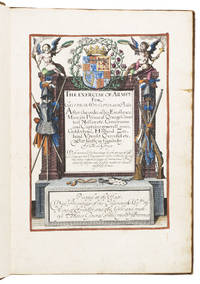
1607ABC_48580The Hague 1607. Folio ca. 37 x 27 cm. Mid-19th-century gold-tooled half faded red morocco and red cloth sides gilt edges marbled endpapers bound in 1840-ca. 1860 by the celebrated British bookbinder Robert Riviere 1808-1882 with his stamp "Bound by Riviere" in the bottom outer corner of the verso of the first flyleaf. With an engraved title page with at the head of the page the coat of arms of the dedicatee Prince Henry Frederick eldest son of King James I of England within a wreath of lilies and roses which - together with the title and the imprint were engraved on 3 separate slips of paper pasted over areas left blank for that purpose; and 117 including one repeat expertly engraved plates ca. 26 x 19 cm: 42 numbered plates in part 1 43 partly-numbered plates in part 2 and 32 numbered plates in part 3. All engravings including the engraved title-page are magnificently coloured and highlighted in gold and silver by a contemporary hand. The plates show exercises with the arquebus part 1 musket part 2 and pike part 3. 3 parts in 1 volume. 4; 2; 3 ll. Splendid copy of this very rare English edition of De Gheyn's illustrated major military manual with the plates in their first state before they were numbered and with some details added during the colouring stage instead of being engraved several puffs of smoke in the illustrations. The present copy is one of the three "presentation copies" of the first English edition New Hollstein The De Gheyn family II p. 159 1b.The history of the publication of the book is complex. It appears that Count Johann II of Nassau-Siegen 1561-1623 commissioned De Gheyn in about 1596 to publish the work together with or with the support of his nephew the great military commander and Stadtholder Prince Maurice who had re-organised the army of the Dutch Republic. Many copies have the engraved date 1607 on the title-page changed to 1608 suggesting that this may have been the true date of issue. The same title-border was used for the various early editions with the engraved texts on slips of paper to be pasted onto the places left blank on the engraved title-page. Different coats-of-arms were used for the different languages. The Dutch issues show for instance the coat-of-arms of Prince Maurice.This work is of the highest interest for military history regarding the early 17th century. It constitutes a simple transparent and well-illustrated manual for the instruction of recruits in the rapid and skilful handling of calivers an obsolete name for the arquebus muskets and pikes which had proven to be essential for the successful and revolutionary way of warfare introduced by Prince Maurice through reforming the Dutch army by introducing exercises and strict discipline in the past years. Fully coloured copies like the present were produced largely for princes and other important persons and were probably coloured by De Gheyn himself who was certainly responsible for the high standard of the colouring. In our copy the title is in the first undated state. All the early editions use the same main plate for the title-page so the text and arms for the editions in various languages and with various dedications were engraved on three separate slips of paper to be pasted over blank spaces: for the coat of arms above the engraved title centre and the imprint and privilege below. The book met immediate success and makes a considerable contribution to our knowledge of military history. The large format editions like the present were followed in 1609 and 1619 by smaller quarto editions with woodcut copies of the original engravings. The present copy varies slightly from other similar copies in that the compiler of this particular copy added plate 34 in part two twice unfortunately omitting part 2 plate 2 in that process and adding 2 plates with minor variants to this copy part 2 plates 29 and 35. Arguably this makes the present copy even rarer.The provenance of the present copy is impressive to say the least. It was most likely the presentation copy from De Gheyn for Robert Cecil first Earl of Salisbury 1563-1612 judging by the paper slip mounted on the recto of the second flyleaf which contains in early 17th-century manuscript the following text: "For my Lord ye Earle of Salisbury". This note is accompanied by a later more extensive annotation below the slip of paper reads: "This appears to have been a presentation copy to Robert Cecil Earl of Salisbury. The above inscription was on the fragment of a flyleaf and is probably the autograph of the author - De Gheyn. signature". Robert Cecil was Secretary of State to Queen Elisabeth I of England and King James I of England. In 1608 around the time the present work was published Cecil was appointed Lord Treasurer. Furthermore the splendour of the expert and strictly contemporary colouring of all engravings including the title-page prove that the present copy was made for a very important person like a nobleman or high statesman. Other bookplates show that the present work was at least part of two other collections. The first of the two is Christopher Turnor 1809-1886 with his bookplate on the front pastedown who was an English Conservative Party politician MP for South Lincolnshire between 1841 and 1847 founder of Stoke Rochford Hall and the son of English antiquarian author and politician Edmund Turnor 1755/56-1829. The second of the two is Hermann Marx 1881-1947 a famous German-born stockbroker and banker and a noted book and print collector. His "very choice and valuable library" was auctioned by Sotheby's in 1948.With the book plate of Christopher Turnor on the front pastedown the book plate of Hermann Marx on the recto of the first flyleaf and the paper slip with the 17th-century dedication to the Earl of Salisbury with the 19th-century note below on the recto of the second flyleaf. The numbers of the plates are added in a contemporary hand since the plates here appear in their first unnumbered state. The first plate of each part also contains Gheyns signature "J. De Gheyn. in." in manuscript instead of as part of the engraving. The binding shows some signs of wear some rubbing along the edges corners and the spine and fading of the leather and cloth on the front board and spine plate 2 in plate in part 2 has been replaced by a duplicate of plate 34 from the same part internally some minor marginal browning or staining but the coloured and highlighted engravings remain fine and clean. Overall in very good condition.l Cockle 79; Keynes New observations on Jacques de Gheyns The Exercise of Arms in: The Print Collectors Newsletter 13 1983 pp. 211-212; Kist Commentary to the facsimile of the Dutch edition 1971; Lipperheide nos. 2057-2060; Meij Jacques de Gheyn II als tekenaar p. 12 nos. 15-20 pp. 45-47; Muller Historieplaten no. 1117 & Suppl.; New Hollstein The De Gheyn family nos. 340-457 descriptions and illustrations of all plates; Regteren Altena Jacques de Gheyn Three generations vol. 2 pp. 64-78 nos. 342-464; Simoni A present for a Prince in: Ten studies in Anglo-Dutch relations 1975; STCN 85107989X 3 copies; cf. Jähns pp. 1005-1007 other eds. ABE CAT Costumes & Uniforms hardcover
167712861Amsterdam: Printed by Jacob and Casparus Loots-man Bookseller upon the Water in the Loots-man 1677. Folio 440 by 280mm engraved title 20 engraved charts numerous woodcut charts and coastal profiles within text seventeenth century speckled calf to style spine in seven compartments separated by raised bands gilt. The Lootsman family a surname adopted by the founder of the firm Anthonie or Theunis Jacobsz are one of the less well-known firms of chart makers and publishers working in Amsterdam specialising in pilot books of European coastal waters but who also published a sea atlas of the world. Their output of charts and chart-books deserves to be better known as much of their work was original rather than the slavish copies some of their better-known rivals produced. Dutch chart publishers dominated the European market and by preparing editions in vernacular languages they were able to achieve wide distribution of their output. Most of the Dutch publishers produced English editions of their atlases and pilots and such was the dominance achieved that the Dutch were effectively able to stifle English competitors such as Joseph Moxon and John Seller. But it was the Lootsmans' misfortune to be overshadowed by the larger established firms or newcomers such as van Keulen and their productions often achieved only limited distribution. For example almost all the English editions published by the Lootsmans are located by Koeman in but a single example. It is interesting to compare Seller's early output with this volume and others like it to see the problems that early English publishers faced breaking the Dutch monopoly. This rare work is the first edition preceding the editions cited by Koeman with the title bearing the joint imprint of the brothers Jacob and Caspar Lootsman; whereas Koeman's earliest edition from 1678 bears the sole imprint of Caspar Lootsman. c.f. Koeman Jac 75 a & b. Printed by Jacob and Casparus Loots-man, Bookseller upon the Water, in the Loots-man, hardcover
1670ABC_48983Amsterdam 1670. Contemporary stiff paper wrappers with a manuscript label pasted upside down on the back wrapper reading: Carta Marinaresca del Mar Mediterraneo. Folio 29 x 45 cm. With 9 double-page engraved charts only each sheet ca. 44 × 55 cm each mounted on stiff paper with maps back-to-back with thick red and black ink borderlines. 8 of 9 maps are by Colom numbered 2-9 in the plates from; plate 1 has been replaced with Johannes de Rams map of the Mediterranean: "Paskaart vande Middelandsche Zee In twee deelen vertoont". Unusual working copy of Coloms rare pilot owned by an Ottoman Turkish mariner with his Osmanli inscriptions transliterating the location names throughout. Coloms charts cover the Straits of Gibraltar the Barbary Coast Mallorca the coastline around Barcelona Nice Corsica Sardinia Southern Italy Sicily and Croatia. Koeman highlights the rarity of all of Coloms pilot books and notes that despite thousands of copies having been circulated . only a score have survived.The wrappers are worn and with significant spotting and browning throughout some cockling and losses to sheets old repaired tears creases and signs of heavy use. A highly uncommon survival.l Cf. Koeman IV 120; Phillips III 53 ff. unknown
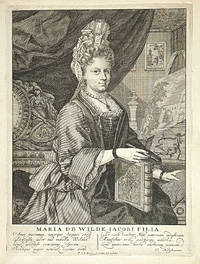
1700103081<p>Amsterdam Maria de Wilde 1700. 4to. 1 1 blank 11 1 blank pp. and 60 numbered engraved plates. = engraved title-page an engraved vignette depicting "virtute" signed "A. Schoonebeek fec." 1 large folding plate showing the interior of "Museum Wildianum" a full-page engraved portrait of Maria de Wilde signed "P. v.d. Berge ad vivum del. et fecit." decorated initials in the text and 60 numbered engraved plates by Maria de Wilde. Contemporary blind-stamped vellum sewn on 4 supports and laced through the joints with the manuscript title and author at the head of the spine red and blue sprinkled edges. With the green and white bookplate of "Collectie Buijnsters-Smets" on the inside of the front board and with the black and white bookplate of "A. Pitlo. Plus est en vous" on the verso of the now loose front paste-down. The binding is slightly browned and the paste-downs have come loose revealing the sowing supports. Internally fine and clean. Overall in very good condition.</p><p>First and only edition of an attractive display of the statues of the Museum Wildeanum once housed on the Keizersgracht in Amsterdam. The Dutch tax collector Jacob de Wilde 1645-1721 began the collection containing gems coins scientific instruments and statues. "This attractive account of a Dutch cabinet of the late seventeenth century is as much a eulogy of Maria de Wilde's gifts as an engraver as of her father's museum" Grinke. The 60 plates by Maria de Wilde 1682-1729 show the ancient Egyptian Greek and Roman statues in the museum including Egyptian figures of Isis Horus etc. some of which are now believed to be Renaissance copies of antique originals. The 6 text leaves include a brief introduction and several laudatory poems directed at Maria de Wilde and her engravings. The collection drew some important visitors including the Russian tsar Peter the Great in 1697. His visit is illustrated on the engraved folding plate where he can be identified by the double-headed eagle at his feet an element of the Russian coat of arms sitting in the museum at a table accompanied by Jacob. After De Wilde's death the collection probably dispersed. The tsar acquired part of it for his "Kunstkamera" the first museum in Russia which was completed in 1727. A catalogue of the gems and coins of the museum was published in 1703 entitled Gemmae selectae antiquae e museo Jacobi de Wilde.<br />From the library of the Dutch professor of civil and notarial law Adriaan Pitlo 1901-1987 and from the collection of Dutch book historian and professor of Dutch literature linguistics and book history Piet J. Buijnsters 1933-2022 and his wife the art historian Leontine M.A. Buijnsters-Smets 1937-2021. A beautiful copy of an art historical work showing a late 17th-century Dutch cabinet with a notable provenance. c.f. Grinke 61; Murray I p. 38 & III p. 272; STCN 842380264; Tavernier Russia and the Low Countries: an international bibliography 3178.</p> Maria de Wilde
1662ABC_49406Nuremberg: printed by Wolfgang Eberhard Felssecker and sold by Johann Tauber 1662. Contemporary vellum with the manuscript title and author on the spine modern mint green closing ties red sprinkled edges. Oblong 8vo. With an engraved title page of a ship engaged in a sea battle an engraved portrait of the author and 15 engraved plates. Further with woodcut tailpieces woodcut decorated initials 2 gothic and 1 roman series and headpieces built up from typographic ornaments. Set in fraktur type with incidental schwabacher roman and italic. First edition of Johann Saar's extensive account of his travels from 1644 to 1659 in the Dutch East Indies the Moluccas and Ceylon present-day Sri Lanka. This account with beautiful plates depicting various aspects of the East Indies Ceylon and their cultures including rare eye-witness depictions of native elephant hunting is a great source of information for the 17th-century exploration of the East Indies and especially Ceylon. The first edition is quite rare as we have only been able to trace two other copies in sales records of the past hundred years.Johann Jacob Saar 1625-1664 was a German seaman. After working in the service of the Dutch East Indian army in Bantam Batavia and the Moluccas Saar moved to Ceylon in 1647 which he describes most extensively though he also covers Java Batavia the Banda islands etc. He describes Ceylons trees and fruits wild animals including the hunting of crocodiles depicted in 1 plate. He also gives more cultural-anthropological and historical information such as how the natives treat their sick and dead people how the king of Ceylon wanted peace with the Dutch and he comprehensively describes the local practice of elephant hunting which is beautifully illustrated in three plates. These illustrations like the others underline the diversity of the narrative. He and his crew then sailed from Ceylon to the coast of Goa. He describes how the Portuguese tried to capture a silver-fleet from the Japanese but he also describes a sea battle off the coast of Goa between the Dutch and the Portuguese. On their way home Saar visited and described Cape Town too including Table Mountain depicted in one of the plates. The vellum is somewhat soiled with brown stains on the front and back the ties and flyleaves have recently been replaced. The work is somewhat foxed throughout with annotations in some of the margins. Otherwise in good condition.l Cat. NHSM p. 174; Landwehr VOC 308; Tiele 952; USTC 2567770 9 copies; VD 17 23:253491D. printed by Wolfgang Eberhard Felssecker and sold by Johann Tauber, hardcover
1621B86DJ001U79OAmsterdam 1621. Oblong 4to 17.5 x 23 cm. Johannes Janssonius printed by Izaak Elzevier Modern vellum sewn on 4 vellum tapes with gold double fillets on the boards gold lettering on the spine gilt edges green cloth ties. With 24 of 25 engraved plates with maps plans views and battle-scenes including 5 double-page and 10 larger folding the large map of the Malayan archipelago with an inset-map of the Strait of Boeton 32 x 45.5 cm. 4 172 pp. First and only edition of the French translation of one of the bestsellers of illustrated 17th-century travel literature describing one of the most famous early voyages around the world by Joris van Spilbergen 1568-1620 a veteran Dutch East Indies naval officer-turned-pirate undertaken from 1614 to 1618. A short survey of another of the most important early voyages around the world by Schouten and Le Maire in the years 1615 to 1617 is added at the end pp. 117-172 with drop-title "Navigationes Australes". It reports Le Maire's proof that Tierra del Fuego is an island and his discovery of what is still called the Strait of Le Maire an alternative route to the Pacific. Rich in ethnographic detail the numerous illustrations in the Miroir include oversized penguins llamas and an Andean condor with a nine-foot wing span. Naval battles beleaguered Spanish settlements and newly discovered islands are also depicted in detail making the work a valuable compendium of adventure on the high seas during the Age of Discovery.With several owner's inscriptions. With a few manuscript annotations in the margin. Lacking the world map. Washed with a brush leaving light brown steaks on most leaves and further with an occasional leaf foxed or smudged and an occasional minor tear. Otherwise a good copy of an extraordinary journal.l Borba de Moraes p. 826 "This French edition is much sought after"; Landwehr & V.d. Krogt VOC 362; Sabin 89451; Tiele Bibl. 1030. hardcover
1669B6290London: Printed by John Macock for the Author Ogilby. c.1669. A fine attractive and handsome copy with text and plates clean and crisp. Edition: First or 1669 Edition in English. Binding: Contemporary mottled full calf rebacked expertly saving the original spine spine with seven raised gilt bands; compartments densely gilt ornamentated; with gilt lettered title on brown morocco label on two and three. Blind dentelle pattern tooled on edges of covers; pasted and free endpapers marbled. <br><br><br> Notes: John or Johann Nieuhof 1618 – 1672 is best known for the account of his journey from "Guangzhou"Canton to Peking in 1655-1657 which enabled him to become an authoritative Western writer on China. The book was first published in Dutch in 1665 by Johan's brother Hendrik and the Amsterdam based publisher and printer Jacob van Meurs. The publication was successful several edited editions followed geared towards commercial interests also translated into French German Latin and eventually into English. The English version was not published by Van Meurs but by John Ogilby instead. The book consists of the notes and illustrations that Nieuhof made in his position as a steward on Peter de Goyer and Jacob de Keizer's embassy to the emperor of China. The work itself is split into two parts. The first part contains the written account of the embassy led by Peter de Goyer and Jacob de Keizer to the emperor of China. It details the entire journey from "Guangzhou"Canton to Peking and back again. This part also contains descriptions and depictions of all that the embassy came to pass on its trip. The second part consists of an overview of China describing bridges mountains temples customs and costumes supported by illustrations. Prior to this period the image of the Chinese in Europe was dominated by fantasy illustrations. Many subsequent artists and architects based their work on Nieuhof's pictures. The present copy John Ogilby’s translation and the first Edition in English. Apart from 'An embassy from the East-India Company…’ Nieuhoff’s account of his journey it also includes ‘A Narrative of the Success of an Embassage sent by John Maatzuyker's de Badem General of Batavia…’ and Kircher’s ‘An Appendix or Special Remarks taken at large out of Athanasius Kircher/ His / Antiquities of China.’<br><br> Size: Folio 418 x 270mm. Illustration: engraved frontispiece portrait of John Ogilby by Lilly and engraved by Lombart; engraved illustrated title signed and dated by ‘W.enceslas Hollar 1668.’; printed title in red and black ink; map of China signed by Hollar double page dedication leaf to King Charles; with 17 full-page and 2 double-page plates. 121 in-text illustrations throughout as well as head-piece vignettes and rubricated historiated initials at openings of dedication and sections; one endpiece.<br>Wide margined large paper copy; main text jumps from 184 to 205 without loss of content. References: Cordier Sinica II 2347; Lust 536; Wing N1153 Transation: John Ogilby’s Englis Pages: PP. illustrated title blank printed title blank map; dedication leaf to King Charles; 327 bl.; 1-18; appendix 1-106 19 ill. Category: Book Voyages General; Book Asia Far East Printed by John Macock for the Author [Ogilby],. unknown
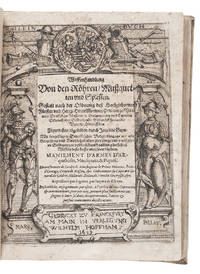
1609791AD6R1MSG6Frankfurt 1609. 4to. Wilhelm Hoffmann Contemporary vellum sewn on 3 vellum tapes rebacked. With the letterpress title within engraved border including the imprint and 3 series of 42 43 and 32 full-page numbered woodcuts showing exercises with the arquebus musket and pike. 3 parts in 1 volume. 3 1 blank 43 1 blank 44 36 ll. Rare first edition published in Germany with woodcuts instead of engravings of a military manual known in English as The exercise of arms it was written and illustrated by Jacques de Gheyn and quickly became a famous pictorial army manual for use of officers to teach the young recruits how to handle their weapons: the arquebus part 1 musket part 2 and pike part 3. The text here in German and French gives a short explanation of the illustrations. It gives an excellent picture of the successful army of the Dutch Republic after its reform by Prince Maurits who reintroduced exercises and discipline. It also immortalizes Prince Maurits as a military thinker and commander of the most disciplined army of his age.Some faint browning throughout slightly more visible on a few leaves and some foxing on title-page. Binding rebacked and a few stains on the sides. Good copy.l VD 17 39:124359A 3 copies; WorldCat 6 copies incl. 2 the same; cf. Cockle 79 other ed.; Jähns pp. 1005-1007 other ed.; Lipperheide 2057-2060 other eds. ABE CAT Costumes & Uniforms hardcover
16441238251644. Paris: Rolet le Duc 1644. <br /> <br /> Two books in one: 8vo 4 leaves 164 pp; 1 leaf Extraict du Privilege du Roy; 10 leaves 717 71 Appendix Table pp. Contemporary limp vellum with hand lettered label on backstrip. Very early illegible ownership inscription on the rear pastedown. Bookplate of A.R.A. Hobson on verso of first title page. <br /> <br /> § Second edition of Naudé's celebrated treatise on library management "reveuë corrigée & augmentée" by Naudé himself a work of the greatest importance in the history of book collecting and libraries complete with the 'Extraict du Privilege du Roi' an unsigned leaf following L2 p. 164 which is said to be missing from most copies. Together with Jacob's treatise the first comprehensive account of libraries ancient and modern and including some on which notices can be found nowhere else. The account of British libraries occupies 65 pages. Since the Hobson sale only one copy has sold at auction the Bergé copy of the Naudé only for 12000 euros. Of the Jacob Hill notes: As is usual when the two parts are bound together the title-page to the second part has been excised. Hobson also notes: "Lacks the inserted title to part II as often." Peignot 33: "la seconde edition est la meilleure". See Breslauer and Folter 53. Tumarkin 1191: "See Balsamo. where Naudé's humanist message is shown to bear the stamp of. Montaigne Charron Descartes and even Giordarno Bruno's Eroicifurori. unknown
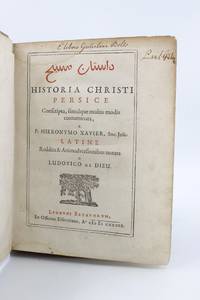
163989174Lugduni Batavorum Leyde Leiden: Ex Officina Elzeviriana 1639. Fine. The very first Persian grammar. Ex Officina Elzeviriana Lugduni Batavorum Leyde Leiden 1639 15.3 x 20.8 cm 2 volumes reliés en 1 Rare first edition. Full vellum binding over boards with flaps smooth spine title inked partly faded at the spine head some blemishes on the boards edges spotted red.A fine and rare copy. Booksellers descriptive labels pasted on an endpaper.Backer & Sommervogel VIII 1339-1340 considers the two parts as separate works. Willems 490 clearly explains that the two parts form a single title published at once and 477 for the Persian grammar which forms a separate title and constitutes the second attempt of its kind for Western use. A most curious composition by the Spanish Jesuit Jeronimo Espeleta 1549-1617 who adopted the name Javier out of deference to his relative the famous Apostle of the Indies presented by a Dutch Protestant Louis Dedieu 1590-1642 with the aim of demonstrating that Catholics in the missions of the East deliberately altered sacred texts and intermixed them with non-canonical fables. Consequently this very first account of the life of Christ and Saint Peter in Persian produced by this devoted missionary at the request of the Mughal emperor Akbar the Great attracted the attention of the Index particularly on account of Dedieus comments. This publication notably offers readers the very first Persian grammar issued ten years before John Greaves together with an excerpt from the first book ever printed in Persian: Jacob Tawuss translation of the Pentateuch. Provenance: William Bolts with his autograph ownership inscription at the head of the title-page: Gulielmi Bolts.William Bolts 1739-1808 a Dutch merchant active in India is best known for his celebrated Etat civil politique et commerçant du Bengale 1775. Ex Officina Elzeviriana hardcover
169555736Amsterdam: Be-veit ha-meshutafim Asher Anshil ben Eliezer ve-Yisakhar Ber ben Avraham Eliezer/ Moses Wiesel 1695. First edition. Hardcover. g to near fine. Small folio 30 by 18.8 cm. Collation: aleph-vav4 zayin2 = 26 numbered leaves. Full period brown paper boards re-backed with a brown leather spine with raised bands.<br /> <br /> Letterpress title-page with ornate floral woodcut device; additional engraved title-page mounted depicting Moses and Aaron along with six small biblical scenes within round borders all against an architectural background. Engraved folding map at rear mounted; main title with woodcut vignette; 14 half-page engraved illustrations in the text.<br /> <br /> This gorgeously illustrated work is the first edition of the famous and highly influential Passover Haggadah printed in Amsterdam in 1695. Simply known as the Amsterdam Haggadah this edition stands as among the most imitated and copied haggadahs in history and was the first to be illustrated with copperplate engravings. Previous illustrated haggadahs had used woodcuts. The popularity of these illustrations can be attested by the huge numbers of reprint editions over the centuries. There are 14 finely printed large in-text engravings plus the full page engraved title page showing Moses Aaron and Adam in the Garden of Eden. Some of these images illustrate the traditional content of the Passover seder and/or the exodus story while some are other biblical stories less directly related. Images include: the Rabbis of Bene Brak discussing the Passover story the four sons Abraham smashing the idols of his father Abraham welcoming the three angels Moses slaying the Egyptian overseer the rescuing Moses from the river Moses and Aaron coming to Pharaoh w/ staves turning to snakes the ten plagues the Egyptian army drowning in the Red Sea the Exodus the receiving of the Ten Commandments at Mt. Sinai the eating of the Pascal Lamb King David composing his psalms and finally an exterior view of the Holy Temple with the cityscape of Jerusalem in the background. All images are captioned underneath with relevant passages in Hebrew. The engravings were all created by Abraham ben Jacob a German convert to Judaism who had moved to Amsterdam although some sources over the years misattributed them to financier Moses Wiesel 6 of which were adaptations and/or modifications of previous images by Swiss artist Matthäus Merian 1593-1650 from his original work "Icones Biblicae" 1625-30.<br /> <br /> In addition to the in text engravings there is famously a phenomenal fold-out engraved biblical map of the holy land. Measuring a total of 19.5x11.5" the map shows the land of Israel the Sinai desert and Egypt in landscape orientation looking eastward towards the top of the map. It traces the journey of the Israelites starting with the Exodus from Egypt through the desert and into the Land of Israel. The map is detailed showing the areas of the twelve tribes important locations and cities as well as geographic features including the Red Sea Mount Sinai the Dead Sea the Sea of Galilee and many others. The map is decorated with additional illustrations near the bottom and includes a key. This beautiful work also by Abraham ben Jacob is considered among the earliest if not the first map of its kind to be printed within a Hebrew publication. It is now known to have been heavily based on the previously printed 1620 map in Hebrew by Jacob ben Abraham Zaddiq and Abraham Goos 1590 - ca. 1643 which itself was based on the map of 1590 by Christian Kruik van Adrichom Adrichem printed in Latin.<br /> <br /> Text throughout is printed in Hebrew with smaller text in Rashi script underneath containing famous commentary on the Passover Haggadah by acclaimed Portuguese Rabbi and scholar Isaac ben Judah Abarbanel 1437-1508. The verso of the title page contains the order of the Passover seder with brief instructions in both Ladino Judeo-Spanish and Yiddish Judeo-German a nod to the subtitle of Haggadah which references the both Ashkenazi and Sephardic traditions.<br /> <br /> This copy with binding in beautiful condition with being professionally restored includining spine re-backed to style. Book block tight. Interior with some staining to pages throughout from use. Binding in very good to near fine inteiror in good condition overall. Hebrew title: סדר הגדה של פסח ×›×ž× ×”×’ ××©×›× ×– וספרד <br /> Alternate transliterations: Seder Hagadah shel Pesah Seder Hagadah sel Pesah<br /> <br /> References: Friedberg 278 Fuks HTN II 521; Yudlov Haggadah 93; Vinograd Amsterdam 627; Ya'ari no. 59; Laor 876 Map; Nebenzahl pp.138-1389 Map; Yerushalmi plate 59-62; Rosenau "Vision of the Temple" p.135 146-7. Be-veit ha-meshutafim [Asher Anshil ben Eliezer ve-Yisakhar Ber ben Avraham Eliezer]/ Moses Wiesel hardcover
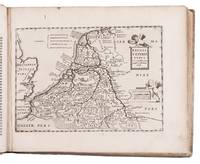
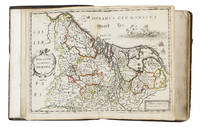
1660KBQE72K0ZFOJAmsterdam 1660. Oblong 4to ca. 23 x 28 cm. Jacob Aertsz. Colom Contemporary vellum sewn on 4 supports laced through the joints with shelf mark labels of the Oudheidkamer Twente mounted on the spine and back board. With an engraved allegorical title page by Experiens Sillemans and 50 full-page numbered engraved plates 47 maps and 3 plates containing 117 portraits of the Counts of Brabant Flanders and Holland. 2 4 14 223 2 1 blank pp. Enlarged Dutch edition of an attractive atlas of the Seventeen Provinces roughly corresponding to present-day the Netherlands and Belgium containing all 50 maps and plates. The work was compiled and published by the ambitious Amsterdam map- and globe maker printer and publisher Jacob Aertsz. Colom 1600-1673. Like Willem Jansz. Blaeu Colom began his career by publishing pilot guides and maritime atlases a field in which few dared to compete with Blaeu before branching out into terrestrial atlases. The maps and portraits in this second Dutch edition were printed from the plates of the first Dutch edition 1635 but the accompanying text has been revised and expanded.The descriptions were derived from the text written by Reinier Telle for Abraham Gooss Nieuw Nederlandtsch Caertboeck 1616 which itself was largely based on Lodovico Guicciardinis classic Beschryvinghe van alle de Nederlanden 1612. In addition to general maps of the Netherlands depicting both the Roman period and the 17th century and of the Seventeen Provinces the work contains numerous detailed maps of individual regions and cities together with their surrounding areas. These include among others the Meierij of s-Hertogenbosch Bergen op Zoom Breda Valkenburg and Dalhem Mechelen the diocese of Liège Namur the Veluwe Zutphen the island of Dordrecht Delfland six maps of newly reclaimed polders Bijlmermeer Purmer Wormer Heerhugowaard Diemermeer and Zijpe the three historic regions of Frisia Eastergoa Westergoa and Zevenwouden and Walcheren.The engraved portrait plates comprise two sheets containing respectively 40 and 38 portraits of the Dukes of Brabant and the Forestiers of Flanders and a third with 39 portraits of the Counts of Holland.With the library stamp of the Oudheidkamer Twente on the front flyleaf. The work has been recased with the endpapers restored the vellum is slightly soiled and stained. Restored tears in the head and foot margins of the title page the maps have not been bound in order the margins of map 31 have been trimmed without affecting the image map 45 with a water stain in the lower outer corner. Otherwise in good condition.l Koeman Col 5; V.d. Krogt Koeman's Atlantes Neerlandici IIIB 365:02 pp. 635-637; Shirley British Library T.COLM-1a; STCN 853365954; Tiele Bibl. 262; USTC 1845771. hardcover
1699ABC_46554Leiden 1699. Folio. Peter van der Aa Contemporary sprinkled quarter calf sewn on 8 supports with the corresponding raised bands on the spine a red morocco title label on the spine lettered in gold sprinkled paper sides red and blue sprinkled edges. With an engraved frontispiece to part 1 2 engraved title vignettes 2 full-page engraved dedicatory plates 1 engraved headpiece vol. 1 with 211 engravings 4 folding maps 1 folding plan 14 folding plates and 192 views in the text; vol. 2 with 1 folding map and 7 engraved illustrations in the text. 2 parts in 1 volume. 6 143 4 108 ll. Enlarged edition of a famous and extensively illustrated work on the duchy of Brabant including Louvain Brussels Antwerp and 's-Hertogenbosch and their surroundings by the historiographer Jacob le Roy 1633-1719. This rare work contains maps plans and fine views of the castles and county seats of the nobility of Brabant including their parks and gardens as well as the main monasteries and abbeys.The engravings are excecuted by several artists such as Jacob Harrewijn 1660-1727 a student of Romeyn de Hooghe Lucas Vorsterman II 1595-1675 who worked with Peter Paul Rubens and Robert Whitehand. Amongst the castles and houses depicted are views of Bonlez Beersel Bois-Seigneur-Isaac Corroy-le-Château Vilvoorde Cleydael Berchem and many others as well as views of monasteries and cloisters such as St Michael's Abbey Corsendonck and the Groenendael Priory. Other than castles and monasteries the work also contains a large view of the city of Turnhout and a folding plate of the St. Rumbold's Tower at Mechelen.It is bound as usual with Le Roy's L'erection de toutes les terres giving extracts of letters of Charles V Phillippe II Charles II and other emperors and kings on conference about titles of barons viscounts and counts and the setting up of lands in baronies marquisates and principalities. It contains a large double-page map of Brabant and 7 engraved illustrations of Héverlé Hoogstraten Walhain Grobbendonck Trazegnies Grimberghen and Westerloo identical to the map and engravings of these country houses in the first work.With the bookplate of Ivan Plissart late 19th-early to mid-20th century mounted on the front pastedown and a round shelfmark label mounted on the back board. The boards and spine are somewhat rubbed the edges and corners of the boards are scuffed the spine ends are slightly worn. The map of Tongerlo is somewhat browned but otherwise internally very clean. Overall in good condition.l Bibl. Belg. III pp. 852-854; Hollstein VII pp. 221; Hollstein LII pp. 56-63; Ad 1: STCN 832271780 6 copies; USTC 1841122 4 copies; ad 2: STCN 832271861 4 copies; USTC 1841121 4 copies. hardcover
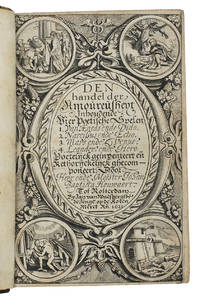
162122956Rotterdam: Jan van Waesberghe III 1621. Contemporary calf spine richly gold-tooled in compartments with red title label lettered in gold gold-tooled board edges. 8vo. With an engraved ornamental title-page with the title in an oval cartouche and 4 roundels in the corners with scenes from the four plays; 4 full-page engraved plates with similar scenes one in the preliminaries of each play. Each of the four parts starts with a letterpress title-page with the publisher's device of Van Waesberghe. Further with woodcut tailpieces woodcut decorated initials 3 series and headpieces built up from arabesque typographic ornaments. 4 parts in one volume. First and only edition of four morality plays or dialogues often wrongly attributed to the famous Antwerp rhetorician Jean Baptiste Houwaert 1533-1599. In fact they were written by Antwerp rhetoricians ca. 1550 when Houwaert was only about seventeen. It has mistakenly been described as a second edition of Houwaert's Den handel der amoureusheyt Brussels 1583 - see Bibl. Belg. III p. 538 H 189 bis but in fact it has nothing to do with that work: if Houwaert wrote anything for the present edition it would be the entr'actes of the third play.After four preliminary poems on 5 pages by a poet calling himself Niet Snel Al-be-recht four plays follow:1. Verscheyden schoone spelen van zinnen van Aeneas ende Dido A1-F3; 43 ll. written by the rhetorician Jacob de Mol of the Chamber of rhetoric De Goudsblom in Antwerp performed for the first time in 1552 cf. Vinck-Van Caeckenberghe in her book on Cornelis van Ghistele 1996 who attributes this play to Van Ghistele.2. Verscheyden schoone spelen van zinnen van Narcissus ende Echo &c. F4-P7; 76 ll.: three separate plays together 2193 verses by Colyn Keyart with entr'actes possibly by Johan Baptiste Houwaert.3. Verscheyden schoone spelen van zinnen van Mars ande Venus &c. Q1-Z1; 57 ll.: three separate plays together 1128 verses probably by Smeecken.4. Vier schoone spelen van zinnen van Leander ende Hero Z2-Gg2; 57 ll.: this play according to Knuttel also by Colyn Keyart is preserved only in this edition.The book is a very important source for the history of the rhetoricians in the Southern Netherlands.One plate shaved otherwise in good condition.l Bibl. Belg. III pp. 538-539 H 26; G. Kalff in: Tijdschrift Ned. letterk. 8 1888 pp. 231-235; STCN 9 copies incl. 1 incompl.; F. van Veerdeghem in: Tijdschr. Ned. letterk. 12 1893 pp. 202-205 320; W. de Vreese in: Tijdschr. Ned. letterk. 12 1893 pp. 206-211; Te Winkel Ontwikkelingsgang 2nd ed. II p. 395; J.A. Worp in: Tijdschr. Ned. letterk. 20 1901 pp. 27-29. Jan van Waesberghe III, unknown
169555262Amsterdam: Be-veit ha-meshutafim Asher Anshil ben Eliezer ve-Yisakhar Ber ben Avraham Eliezer/ Moses Wiesel 1695. First edition. Hardcover. fair. Small folio 29 by 18.5 cm. Collation: aleph-vav4 zayin2 = 26 numbered leaves. Additional engraved title page engraved folding map at rear; main title with woodcut vignette; 14 half-page engraved illustrations in the text. Contemporary quarter calf over dark brown pastepaper boards skilfully rebacked. Images of Moses and Aaron at engraved title excised the seven small engraved vignettes along with letterpress text of engraved title and imprint mounted on old paper. Old marginal repairs at main title resulting in slight loss of initial letters along right margin and several leaves; slight strictly marginal worming and occasional tears. Stained throughout sometimes heavily though not impairing legibility. Map mounted to reinforce tears with virtually no loss of text or engraved imagery apart from printed border at right side. A fair copy at best; despite all defects the half-page engraved illustrations have survived intact with minimal staining. Housed in new maroon buckram slipcase.<br /> <br /> First edition of this gorgeously illustrated work now referred to simply as the Amsterdam Haggadah. The first such work to be illustrated with copperplate engravings it ranks among the most imitated of the Jewish manuals for the Passover seder. The popularity of these illustrations can be attested by the huge number of reprint editions over the centuries. Fourteen finely printed half-page engravings appear throughout the text. Some of these images illustrate the traditional content of the Passover seder or the Exodus story while others reference other biblical tales. Images include: the Rabbis of Bene Brak discussing the Passover story the four sons Abraham smashing the idols of his father Abraham welcoming the three angels Moses slaying the Egyptian overseer the rescuing Moses from the river Moses and Aaron coming to Pharaoh w/ staves turning to snakes the ten plagues the Egyptian army drowning in the Red Sea the Exodus the receiving of the Ten Commandments at Mt. Sinai the eating of the Pascal Lamb King David composing his psalms and finally an exterior view of the Jewish Temple with the cityscape of Jerusalem in the background. All images are captioned with relevant passages in Hebrew. The engravings were all created by Abraham ben Jacob a German convert to Judaism who had moved to Amsterdam although some sources over the years misattributed them to financier Moses Wiesel 6 of which were adaptations and/or modifications of previous images by Swiss artist Matthäus Merian 1593-1650 from his original work "Icones Biblicae" 1625-30.<br /> <br /> In addition to the in text engravings there is famously fold-out engraved biblical map of the Holy Land in a notable format. Measuring a total of 19.5 by 11.5" the map shows the land of Israel the Wilderness of Sinai and Egypt in landscape orientation looking eastward towards the top of the map. It traces the journey of the Israelites starting with the Exodus from Egypt through the Sinai and into the Land of Israel. The map is detailed showing the areas of the twelve tribes important locations and cities as well as geographic features including the Red Sea Mount Sinai the Dead Sea the Sea of Galilee and many others. Additional illustrations appear near the bottom along with a legend. This beautiful work also by Abraham ben Jacob is considered among the earliest if not the first map of its kind to be printed within a Hebrew publication. It is now known to have been heavily based on the previously printed 1620 map in Hebrew by Jacob ben Abraham Zaddiq and Abraham Goos 1590 - ca. 1643 which itself was based on the map of 1590 by Christian Kruik van Adrichom Adrichem printed in Latin.<br /> <br /> Text throughout is printed in Hebrew with smaller text in Rashi script underneath containing famous commentary on the Passover Haggadah by acclaimed Portuguese Rabbi and scholar Isaac ben Judah Abarbanel 1437-1508. The verso of the title page contains the order of the Passover seder with brief instructions in both Ladino Judeo-Spanish and Yiddish Judeo-German a nod to the subtitle which references both the Ashkenazi and Sephardi traditions.<br /> <br /> Provenance and annotations: Full page of text appx. 1500 words in neat Hebrew cursive at front endleaf which discusses aspects of the Haggadah text; inscription in German at front endleaf by Isidor Adler who mentions his friend Hermann Mechlenburg dated March 1906; old annotations throughout in at least two hands. In one notable instance the Hebrew phrase l'shana ha-ba'ah be-hamburg next year in Hamburg! has been added in fine block characters above the traditional phrase l'shana ha-ba'ah bi-yerushalayim next year in Jerusalem. Hebrew title: סדר הגדה של פסח ×›×ž× ×”×’ ××©×›× ×– וספרד <br /> Alternate transliterations: Seder Hagadah shel Pesah Seder Hagadah sel Pesah<br /> <br /> References: Friedberg 278 Fuks HTN II 521; Yudlov Haggadah 93; Vinograd Amsterdam 627; Ya'ari no. 59; Laor 876 Map; Nebenzahl pp.138-1389 Map; Yerushalmi plate 59-62; Rosenau "Vision of the Temple" p.135 146-7. Be-veit ha-meshutafim [Asher Anshil ben Eliezer ve-Yisakhar Ber ben Avraham Eliezer]/ Moses Wiesel hardcover
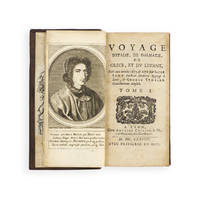
1678T5108<p><strong>Very rare first edition of 'one of the most important accounts of travels in the Levant and the first description of Athens which was systematic detailed and trustworthy' Blackmer. </strong></p><p>'Spon and Wheler met in Italy in 1675; they travelled together with Francis Vernon to Zakynthos where the two groups separated. Spon and Wheler continued by sea to Constantinople and Vernon travelled overland. The great merit of Spon's work is due to its combination of a careful and knowledgeable interest in classical antiquity with an accurate observation of men manners and topography in modern Greece. The whole of vol. II is devoted to Greece and includes a glossary of Modern Greek words and phrases with instruction on pronunciation. Spon's interest in Greece was longstanding. He had already published Babin's description of Athens which had been communicated to him by the Abbé Pecoil of Lyon with his own notes and preface' <em>ibid.</em>.</p><p>From Venice Spon and Wheler's itinerary took them along the Dalmatian coast and the Ionian islands. They set anchor at Zakynthos and later Cythera visited Delos and eventually reached Istanbul where they visited the French ambassador Charles-François Olier Marquis de Nointel who had already visited Athens and was able to give them valuable information about the city. They also visited Bursa and Thyateira in Asia Minor and stayed in Izmir for some time. On their return journey they crossed over to Patras from Zakynthos visited Delphi travelled to Athens and toured the region of Attica.</p><p>Jacob Spon 1647–1685 physician archaeologist and collector was the archetypal French 'curieux' like his father before him. He collected medals manuscripts and inscriptions with immense enthusiasm acquiring an entire coin hoard of seven hundred pieces found at Lyons. George Wheler 1652–1724 who published his own account of their travels in 1682 'was a man of many interests and practical skills. As a boy he had amused himself with woodwork constructing a birdcage and a small harpsichord and had taken an interest in plants; the latter he maintained in Oxford by frequent visits to the physic garden … On his travels he displayed keen curiosity and took the opportunity to collect plant specimens … He gave to his Oxford college more than thirty Greek manuscripts acquired mainly in Athens and Constantinople; they included a priceless illuminated typicon the foundation charter of a convent established in Constantinople about 1300. His plant specimens were given to the Oxford Physic Garden. Wheler occupies a significant position in the history of botany since he introduced to Britain some plants hitherto unknown including St John's wort' ODNB.</p><p><em>Provenance</em>: John Hay second Marquess of Tweeddale 1645–1713 MP and Lord Chancellor of Scotland in 1704-5 with his bookplates Franks 14192/566. The purchase note on the front flyleaf of vol. I 'payd for thes 3 volums 0–12–00' <em>i.e</em>. 12 shillings is probably his.</p><p><em>Physical description:</em><br />Three vols 12mo pp. I: xxiv 405 3 blank II: 417 13 2 blank III: 204 '226' <em>recte </em>228 with a copper-engraved frontispiece portrait in vol. I 30 plates many folding and two folding maps; paperflaws in outer margin of two leaves vol. I C10 and R6 no loss of text some occasional very pale marginal foxing but an excellent set; in contemporary British speckled calf double fillet frames ruled in blind on covers and in compartments of spines small blind-stamped floral tool in corners of covers board-edges ruled in gilt edges speckled red; lightly rubbed one corner bumped headcap of vol. I very slightly chipped.</p><p><em>References:</em><br />Weber 405. Blackmer 1586 records the second edition.</p> Antoine Cellier
1603376588Innsbruck: Daniel Baur 1603. First edition in German after the Latin edition published in 1601. With frontispiece engraved portrait of Archduke Ferdinand II privilege on verso title page two preliminary leaves and 121 of 125 elaborate engraved portraits each with facing biographical notice printed within woodcut border. Lacking 4 leaves portraits 3 24 64 71. Two preliminary leaves printed for William Sterling Maxwell his extensive bibliographical note and index of portraits; a facsimile folding view of Innsbruck inserted after title. Full dark brown morocco spine titled in gilt upper board with Sterling Maxwell arms in gilt a.e.g. by XXXX. Sterling Maxwell's largest bookplate on front pastedown. A few portraits possibly in old facsimile or restrike. 11 leaves loose or slightly sprung a few marginal paper flaws one portrait poorly inked. First edition in German after the Latin edition published in 1601. With frontispiece engraved portrait of Archduke Ferdinand II privilege on verso title page two preliminary leaves and 121 of 125 elaborate engraved portraits each with facing biographical notice printed within woodcut border. Lacking 4 leaves portraits 3 24 64 71. Two preliminary leaves printed for William Sterling Maxwell his extensive bibliographical note and index of portraits; a facsimile folding view of Innsbruck inserted after title. The celebrated portrait gallery of the Archduke Ferdinand II of Austria with portraits of emperors kings nobles and war heroes in historic suits of armor in the Archduke's collection at Schloß Ambras. Compiled by the Archduke's secretary Schrenck von Notzing and translated into German by J.E. Noyse van Campenhouten. With an interesting full page printed bibliographical notice by Sterling Maxwell dated 1870 printed within facimile borders matching the text pages of the portraits. Colas 2691; Brunet V 224; Vinet 2046; Grässe VI 317; Lipperheide 499 Daniel Baur unknown
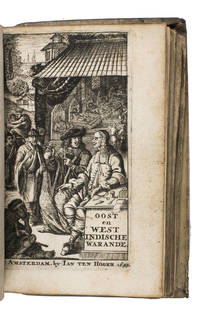
1694ABC_50174Amsterdam 1694. 8vo 14.4 x 9.1 cm. Jan ten Hoorn Contemporary blind-tooled vellum sewn on 3 supports laced through the joints with the title in brown ink on the head of the spine and sprinkled edges. Ad 1 with an engraved title page erroneously mentioning the year 1693 a small fleur-de-lis woodcut vignette on the title page a woodcut decorated initial and a woodcut tail-piece. Ad 2 with a large woodcut vignette on the title page and three woodcut decorated initials. 2 works in 1 volume. 8 304 7 1 blank 96 pp. Very rare work on medicine in the East and West Indies compiled for the use of naval and tropical surgeons including ships doctors on VOC and WIC ships. Dutch physicians Jacobus Bontius or Jacob de Bondt 1592-1631 and Willem Piso or Gulielmus Piso 1611-1678 are both considered to be the founders of the field of tropical medicine. Bontius worked in the East Indies. His chapters contain the first modern descriptions of cholera beriberi tropical dysentery and yaws. Piso worked in Brazil during the Dutch period 1630-1654. He is known for his research on local medicinal plants including the jaborandi and discovered that Brazilian lemons were particularly effective for treating scurvy. The work is very rare. According to WorldCat it is only present in a few libraries worldwide. We have also not been able to trace any other copies in sales records of the past 100 years.The present work is a Dutch translation of De medica Indorum 1642 by Bontius the first Dutch work on tropical medicine and Historia naturalis Brasiliae 1648 by Piso and Georg Markgraf also known as Georg Marcgrave or Marggraf 1610-1644 which is also considered to be a pioneering work in the field. As the present work was meant as a practical guide for surgeons only the most relevant chapters of the Latin editions have been included.This is the first Dutch edition of Piso's work but the second of Bontius'. Although most reference works do not mention this the Dutch translation of Bontius' work had already been published in 1673 as Oost-Indische warande. As a result the present work is the second edition but it is the first to combine these two pioneering works.The last work in this binding written by VOC physician Johannes Verbrugge 17th century is a catalogue of drugs that physicians should carry on their travels to the East and West Indies and includes a list of diseases that are common on those voyages and their cures. It is a logical addition to the other two works and is rarely found separately.With an ownership inscription on the first flyleaf 4 d Verwilghen Van den bussche and another on the second flyleaf Ch. Verwilghen 1829 probably referring to the Verwilghen family a notable and noble Belgian family originating from the Waasland region. Further with a small wormhole in the upper margin not affecting the text very slight browning and foxing throughout and the upper support is slightly loosened for the quires in the second half of the work. Otherwise in good condition.l Krivatsy 1500; Landwehr VOC 829; Sabin 6341; STCN 102642796 3 copies incl. 1 incomplete; USTC 1838762 4 copies; WorldCat 1154809136 9 copies; cf. Borba de Moraes II p. 676 different ed.; Garrison & Morrison 2263 and 2263.1 different eds. hardcover
16162602240004Bey Paul Jacobi in Verlegung des Auctoris Franckfurt 1616. First Edition. Hardcover. Good. First edition of one of the earliest military manuals printed in Europe. Handsomely bound in later vellum. Short 4to; 21 cm. Fine binding and cover. 8 195 32 pages 19 fold out page. Illustrated title-page with engraved border. 19 double-page engravings depicting soldier formations and munitions. Generally clean. Minor spotting. Light dampstain at bottom margin effecting some of the early pages. Marginal loss to p. 80; loss to bottom corner p. 102 partially affecting text. Cockle 622. Klara Andresova 2019 "Military Camps in Military Manuals" in Alexander Samuel Wilkinson; Graeme Kemp eds. Negotiating Conflict and Controversy in the Early Modern Book World Brill pp. 163–177. <br> Johann Jacob served in the army of Maurice Price of Orange and fought in the Eighty Years' War in the Netherlands. He later served as an offer in Danzig and in Hungary and Russia. In 1616 he was appointed by Count John VII of Nassau-Siegen to head up the newly established Kriegsschule the first military academy in the world. The outbreak of the 30 Years War in Germany prematurely caused the school to close. Jacob was one of the most important German military writers before the 30 years war. Bey Paul Jacobi, in Verlegung des Auctoris, Franckfurt hardcover
16525476Antwerp 1652. 4to 18 x 14.5 cm. Jan Huyssens Later 17th-century mottled calf sewn on 4 double cords gold-tooled spine and board edges. With a double-page letterpress title-page with a frame built up from typographic ornaments and 39 unnumbered double-page engraved maps of the northern and southern Low Countries by Jacob Aertsz. Colom each map coloured in outline. Interleaved with 38 blank leaves and with a manuscript table of contents 3 3 blank pp. at the end. Double-page title-page and 39 double-page maps. Second known copy of a pocket-atlas published at Antwerp but containing a selection of the maps of the Low Countries originally published by Jacob Aertsz. Colom at Amsterdam in 1635 with the title De Vyerighe Colom the title Colom had first used for his famous pilot guide in 1632 and the name he had given to his Amsterdam printing office where he worked from 1622 to his death in 1673 as a bookseller printer and mapmaker. The only other copy known is at the Royal Library in Brussels. The Vyerighe Colom with 47 maps and 3 plates and with extensive text in Dutch and French went through several editions in the 17th century but it was once thought that all editions before his death in 1673 had been published at Amsterdam by Colom himself. The Royal Library copy like the present one contains 39 maps but each contains one map not in the other so there are forty in total: the present copy includes Drentiae not in the Royal Library copy which includes Le terres entre la Meuse Vahal et Rhin not present here. The maps are also bound in a different order.The present edition is of great interest and gives cause to review Colom's activities. It is printed from Coloms plates so Colom may have licenced the Antwerp publisher to produce a variant edition of his Vyerighe Colom to broaden his market possibly reacting to the signing of the Peace of Münster in 1648 which finally ended the Eighty Years War and opened trade and communication between the northern and southern Low Countries. Jan Huyssens made an entirely new and practical atlas out of Colom's Vyerighe Colom. He omitted all text and the three plates that do not show maps and selected only maps of general interest leaving out the map of the ancient Low Countries and such typical Dutch maps as the separate maps of the polders De Zype Beemster Wormer Purmer Byllemermeer and Waterland also - at least in the present copy - completely rearranging the maps more in order of their geographical sequence. The title suggests that Huyssens originally planned to include a text so the present extremely rare edition may be the only surviving result of an abandoned project.l Koeman & Van der Krogt 365.23 IIIB pp. 644-645 2 copies: the present & Royal Library Brussels; UniCat 99095764 Royal Library Brussels only; cf. Koeman II Col 1 1635 Amsterdam ed.; not in KVK; STCV; WorldCat. unknown
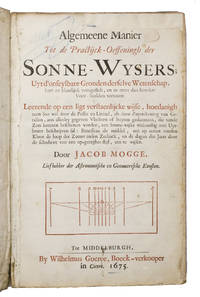
167599PCHI08WBVRMiddelburg 1675. Small folio 28.5 x 18.5 cm. Willem Goeree Early sheepskin parchment over paperboards. With both title-pages printed in red and black about 150 woodcut diagrams in the text including a wide variety of sundials a woodcut headpiece with the Zeeland coat of arms plus 2 repeats and woodcut decorated initials. 2 works in 1 volume. 1 1 blank 2 108 3 1 blank; 1 1 blank 54 2 pp. Re-issues by Willem Goeree in Middelburg of the first editions of Jacob Mogge's extensively illustrated general introduction to the making and use of sundials and of his extensively illustrated translation of Lansberge's further account of various sorts of sundials on flat surfaces. Mogge's own work was first published by Zacharias Roman in Middelburg as Inleydinge der Sonne-Wijsers in 1666. Roman had published the first edition of Lansberge's posthumous Latin work on planar sundials Horologiographia plana in 1663 and Mogge translated it into Dutch and expanded it for publication together with his own work in matching format and style in 1666. Roman apparently died in or soon after 1667 however and Goeree must have acquired the remaining stock of these two books having cancel title-pages printed to re-issue them in 1675. They therefore still include the colophons of the 1666 editions at the end. Mogge opens his work with a general introduction to geometry and astronomy followed by a description of sundials on a flat surfaces and on the surface of the earth. Jacob Mogge ca. 1613-1669 was a surveyor and map draughtsman active in Zeeland from ca. 1649 to ca. 1666 describing himself as surveyor to the water district Vrije van Sluis. Lansberge 1561-1632 worked as physician and pastor in Middelburg Zeeland but devoted his last years to writing and publishing several important works on astronomy.With a faded manuscript inscription on the title-page in blue pencil. The binding is soiled and shows clear signs of wear the bottom half of the spine has been restored. A previous owner's inscription has been torn from the head of the title-page which has been restored but slightly affecting the "M" in the title. The edges of the leaves are somewhat browned slight browning throughout with some occasional light water stains some occasional minor marginal tears. Otherwise in good condition.l Ad 1: Bierens de Haan 3286; Crone Library 283; Houzeau-Lancaster 11524; STCN 822714299 8 copies; Ad 2: Bierens de Haan 2676; Crone Library 281; Houzeau-Lancaster 11499; STCN 822714434 8 copies; cf. for Mogge: Donkersloot-De Vrij p. 205; for Lansberge: NNBW II cols. 775-782. ABE CAT Astronomy & Cosmography hardcover
1699210071699. Ed. secunda. - Genf Chouet & Ritter 1699 Folio 28 124 1072 pp. 2 1233 pp. mit vielen Holzschnitten u. 124 davon 9 doppelseitig u. gefalt ganzseitigen Kupfertafeln Pergamenteinband d.Zt.; etwas gebräunt wie üblich. Second Edition! This edition contains significant additions and revisions to this "extraordinary storehouse of seventeenth century anatomical works" Russell 524 which was first published in 1685. The impressive collection with its striking engraved title and 124 plates based on original sources gathers in a single work the most important discoveries of the seventeenth century the period which laid the foundation for modern anatomy and physiology. ALL THE BST IN SEVENTEENTH CENTURY OF MEDICINE - "Here are Harvey's important embryological work 'De generatione animalium' 1551 as well as his treatise on the circulation of the blood with the four figures and also Malpighi's discovery 1651 of the capillary anastomosis in the lungs which supplied the missing link in Harvey's demonstration; . Olof Rudbeck's work on the lymphatics illustrated with nineteen figures on three folio plates; and the works of Pecquet and Bartholin. Here is given s short list of some of the more important works: Asseli discovery of the lacteal vessels 1617 Thomas Wharton's description of the duct of the submaxillary salivary gland Wharton's duct Zambeccari's proof that the spleen is not essential to life; Borelli's 'De moti animallium' 1680 on the application of mechanics to the motion of the limbs of animals Niels Stensen's papers on the muscular mechanics and his account of the excretory duct of the parotid gland Stensen's duct John Mayow's classic on the physiology of respiration 1674 DuVerney's account of the structure function and diseases of the ear and Schelhammer's account of the physiology of hearing Thomas Willi's on the circle of Willis; Richard lower treatise on the heart 1669 and the first blood transfulsion Francis Glisson's first accurate description of the capsulae of the liver Glisson's capsule Regnier de Graaf's detailed description of the male and female reproductive system including the first account of 'Grafiaan follicle' and his work on pancreatic secretion Malpighi's and Swammerdam's many excellent discoveries whit microscope to name but a few. Jean Jacques Manget 1652-1742 practised in Geneva with great success. In 1699 the Elector of Brandenburg made him his first physician. His literary work in which he was assisted by Daniel Le Clerc 1652-1728 chiefly consisted of collecting and reprinting in large volumes important treatises on medicine anatomy and chemistry. Le Clerc is sometimes called the "Father of the History of Medicine" because he wrote the first large history of medicine. That valuable and still consulted work was first published in 1696. Waller 5663; Haller Bibl. Anatomica I 803-04; Keynes Harvey no.45; Neu 2263; Hahn & Dumaitre 218; Osler 3192; Hahn & Dumaitre 218 describing the Baroque engraved title and reproducing it 226; Parkinson-Lumb 1422 lists complete content unknown
16875601Basel: Mechel 1687. First edition. First edition exceptionally rare of this dissertation which Bernoulli 1655-1705 submitted in order to secure the chair of mathematics at the University of Basel. This was the beginning of a remarkable career in mathematics in which he "greatly advanced algebra the infinitesimal calculus the calculus of variations mechanics the theory of series and the theory of probability and was one of the most significant promoters of the formal methods of higher analysis" DSB. EXCEPTIONALLY RARE DISSERTATION BY JACOB BERNOULLI. <p>First edition exceptionally rare of this dissertation which Bernoulli 1655-1705 submitted in order to secure the chair of mathematics at the University of Basel. This was the beginning of a remarkable career in mathematics in which he "greatly advanced algebra the infinitesimal calculus the calculus of variations mechanics the theory of series and the theory of probability and was one of the most significant promoters of the formal methods of higher analysis" DSB. The dissertation 'The solution of a triplet of problems arithmetical geometrical and astronomical together with corollaries from general mathematics' treats three elementary problems in number theory one arising from arithmetic one from geometry and one from astronomy/navigation. "Jacob Bernoulli's research on elementary mathematics taken as a whole constitutes a work of no mean importance very diverse in content lacking organic unity to be sure but also of exceptional historic interest. Indeed only from very few of the mathematicians who have left a lasting mark do we have the documentation which allows us to examine carefully the process of their scientific education . However in contrast from Jacob Bernoulli we actually possess some 'exercises' that he wrote beginning during the early years of his education. This is how we might characterize some of his Meditationes which he worked on with great diligence and singular ability. The interest of these exercises lies not only in their relationship to the general state of mathematics of the time but also and perhaps more in the way in which they represent an almost complete psychological picture of the formation of a great mathematician - which he certainly was - toward the end of the XVIIth century" Werke 2 p. 15. These Meditationes remained unpublished until the twentieth century except for the three published with much additional detail in the present pamphlet. On the last page of the dissertation is a list of 'Corollaries' one of which concerns the values of expectations in a lottery and is of particular interest in view of Bernoulli's posthumously-published Ars conjectandi 1713 the founding work of mathematical probability. "The academic dissertation Solutionem tergemini problematis arithmetici geometrici et astronomici which was presented at the University of Basel 4.2.1687 secured him the desired teaching post. Therefore this paper has particular biographical interest" ibid. p. 18. OCLC lists only 5 copies worldwide Yale only in US; not on COPAC.</p> <br /> <p>"Let us recall briefly what we know of Jacob Bernoulli's education before he obtained at the age of34 the chair in mathematics in his hometown Basel. Jacob was born in this city on December27th 1654 according to the old calendar in a protestant family of spice traders who had fled theSpanish low lands after the fall of the Duke of Alba. Complying with the wish of his father NicolasBernoulli a state adviser and magistrate Jacob studied philosophy and then theology until 1676. Aswas common at the time he chose a motto. His came from Phaeton who drew the solar carriageInvito patre sidera verso which may be translated by 'Despite my father I am among thestars'. Rather than exaggerated modesty this motto was a proud affirmation of superiority.</p> <br /> <p>"The young Jacob fully benefited from what Daniel Roche calls 'culture de la mobilité' promoted in the second half of the XVII century by new institutions which facilitated the movement of individuals and the spread of knowledge. Starting in August 1676 he traveled by horse to Geneva where he remained for twenty months preaching instructing a blind young girl Elisabeth von Waldkirch and serving as an opponent during the theological disputations. He relates his experience teaching mathematics to the blind in an article published in the Journal des Savants in 1685. This article is probably a reaction to an account by Spon published in the same journal in 1680 in which the author attributes to the father of the blind girl the writing system that was in fact developed by Jacob. It is here that Jacob meets Nicolas Fatio de Duillier a life long friend who recalled in a letter dating from July 22nd 1700 that he had seen Jacob play court tennis in Geneva a game on which Jacob later wrote a famous letter . </p> <br /> <p>"In June 1678 Jacob continues his extensive traveling in France residing in the Limousin in Nède with the marquis de Lostanges where he constructs two sundials in the castle courtyard then in Bordeaux and a few weeks in Paris. During this journey he begins in 1677 to write his mathematical journal Meditationes annotationes animadversiones theologicae et philosophicae which contains 236 articles . The journal is a precious testimony from this early phase of Jacob's scientific training which only really began when he encountered the Cartesian environment initially in France later mainly in the Netherlands Amsterdam and Leiden and in England during a second journey April 1681- October 1682. In August 1682 Jacob attended a meeting of the Royal Society in London. Jacob started out by acquainting himself with the Cartesian philosophy of nature after which he turned to geometry .</p> <br /> <p>"After his return to Basel in 1682 Jacob gave up the idea of a career in the clergy and decided to devote himself to mathematics. At the University of Basel he gave courses in experimental physics as can be gathered by a pamphlet printed in Basel in 1686. From 1682 on he also submitted short articles to the Journal des Savants - reactions to the works of others that he presented or criticized - initially in the area of natural philosophy machines for breathing under water to elevate water to weigh air oscillation center then from 1685 in mathematics .</p> <br /> <p>"Jacob slowly acquired a knowledge of mathematics at first through his readings of the second Latin edition of Descartes' Géométrie 1659-61 later that of Arnauld and his Logique Malebranche and Prestet . Jacob is confronted with precise problems often stemming from the area of applied mathematics. Solving these leads him to discover general methods. He begins by a thorough study of previous works which will serve him as a springboard to make further headway and produce new results. On several occasions Jacob voices the opinion that it is necessary to base one's own progress on the knowledge of what has been done in the past. Accordingly in the memoir entitled Solutionem tergemini problematis arithmetici geometrici et astronomici offered here presented on February 4th 1687 in order to obtain the mathematics chair in Basel he describes his own way of proceeding in the following way: 'In reality he who embraces a career as a mathematician is not the one who copies the inventions of others remembers them and recites them on occasion but the one who is truly innovative and is able to invent by using the divine algebra and thus to revolutionize what has been studied by others'" Peiffer.</p> <br /> <p>"Like other graduates of the University of Basel in the seventeenth century Bernoulli had a broad if not deep knowledge of all the disciplines of the liberal arts - an education he would draw on in writing Ars conjectandi 1713. The university at this time had a small faculty of philosophy including only nine chairs in logic rhetoric eloquence Greek mathematics physics history ethics and Hebrew. So although he had only an elementary education in mathematics as an undergraduate Bernoulli had a knowledge of Greek logic rhetoric and other subjects and was able to write polished Latin.</p> <br /> <p>"It was not uncommon at this time for a man to take a university post in a less desirable discipline if the chair he would have preferred was not available. He would then move if the opportunity arose to the preferred discipline without having to do everything required of a new applicant for a university position such as paying to print lists of theses to be defended in a disputation . The lists of theses that Jacob Bernoulli proposed to defend publicly in the years after his return to Basel in October 1682 reflect this list of open positions. Thus in January 1684 of the 100 theses that Bernoulli proposed to defend 34 were logical and 18 oratorical . Again in September 1685 and in February 1686 Bernoulli's theses were heavily logical. Finally after the death of the professor of mathematics in 1686 Bernoulli applied for disputed and won the chair" Sylla pp. 6-7.</p> <br /> <p>The first of the three problems treated by Bernoulli in his Solutionem tergemini problematis is: 'to find without the aid of algebra with the help of numerical arithmetic alone a number such that if we divide it into the numbers 12 and 36 and then add 8 to each of these numbers the resulting sums are in the ratio of 3 to 5.' The problem is generalized to arbitrary sets of given numbers.</p> <br /> <p>The second problem is more challenging. It "calls for the construction of a quadrilateral inscribed in a semi-circle with sides and diagonals of rational lengths in other words commensurable to the radius" Werke 2 p. 18.</p> <br /> <p>The third problem is one which could arise in navigation: 'It is observed somewhere at the sixth hour of the sun that it has an altitude of 12 degrees above the horizon and that one hour and 12 minutes after the moment of this observation the sun sets. The question is at what latitude and at what time of the year was the observation made'</p> <br /> <p>On the last page of text under 'Corollaria' Bernoulli lists some of his other Meditationes - problems dealing with logic physics meteorology geometry referring to Propositions 55-57 of Euclid Book X stereometry mechanics perpetual motion machines dioptrics perspective referring to Bosse and Desargues gnomonics referring to Münster and Sturm ballistics 'ars conjecturandi' probability and figurate numbers giving the very large example 1580972.</p> <br /> <p>The problem on probability "concerned the slowness with which the values of expectations in a lottery increase as more and more blank slips are drawn out of the urn. In an urn containing 16000 slips if it initially cost 7½ to participate 1000 blank slips in a row would have to be drawn out before the person could sell his expectation to someone else for 8" Sylla p. 27.</p> <br /> <p>Peiffer 'Jacob Bernoulli teacher and rival of his brother Johann' Electronic Journal for History of Probability and Statistics 2 2006. Sylla tr. Jacob Bernoulli. The Art of Conjecturing 2006.</p> <br/> <br/> Small 4to 198 x 156 mm pp. 16 including a full page of geometrical diagrams printed on title verso. Contemporary marbled wrappers. Mechel unknown
1680G1ADMF4MUJWBAmsterdam 1680. Engraved map 30 x 35 cm contemporarily hand-coloured. Matted. A copy of the De Witt map of Arabia with fine cartouches.l Al Ankary 79; Tibbetts 137. unknown