53 252 résultats
1817000359<p>Boston: Cummings and Hilliard 1817. 1st Edition . Half-Leather. Good/None. Oversized. Three volumes in one.This is a nicely rebound copy of the first edition. Half rred/maroon leather and marble boards. Internally there is red library tape to both hinges which are tight. The leather corners are bumped. The boards darkened some. Interior boards are lined with scuffed marble papers that rubbing of some kind. One library stamp oval in red stating this copy belonged to the free library of New Bedford Ma. There is a crudely patched tear to the title page of volume 1. The heaviest foxing occurs between page 147 of vol.1 and page 17 of volume 2. There is foxing of some plates. All plates are present. This was the first American book with color printing and a seminal work in botanical studies. While there is some disagreement about whether the first 10 plates are handcolored most agree that the last 50 plates are aquatint. a rare first edition. <br /><br /></p> Cummings and Hilliard hardcover
162215084Amsterdam: Chez Emanuel Colin de Thovoyon 1622. Folio 310 by 200mm first French edition second issue title page canncelled with Paris imprint added to that of Amsterdam engraved title with vignettes and map 8 103 1 blank 6 107-254 pp. head- and tail-pieces with decorated initials; 27 engraved plates pictorial title page 17 maps and charts 16 double-page 1 folded 4 city views 5 text engravings scenes from Le Maire voyage portrait of Le Maire not present as usual for the French edition seventeenth century vellum. The first French edition of Herrera'a rare work here extra-illustrated with Boazio's exceedingly rare views of Santo Domingo Dominican Republic; Santiago Cape Verde Islands; Cartagena Columbia; and San Augustine Florida - first known engraving of any locality in the present-day United States. The importance of this French edition of Herrera's 'Description des Indes Occidentales' and the other 1622 editions in Latin and Dutch lies in its engraved pictorial title page with the first map to delineate California as an Island and in the inclusion of the first comprehensive account of Jacob Le Maire's voyage. The 14 maps in the Herrera's section are almost identical to those in the original 1601 'Descripcion' save for some resizing and changes in a few details. The most interesting are probably the 'Description de las Yndias Occidentalis' which depicts the Papal line of demarcation dividing the world between Spain and Portugal and the 'Description de las Indias del Poniente' which depicts a large part of the Pacific with the Moluccas the Philippines and the Ladrones accurately positioned. Le Maire and Cornelis Schouten his second in command left Texel in June 1615 on a mission to find a new route to reach the Spices Islands which would break the trade monopoly of the Dutch East India Company which had been grant a monopoly trade through the Strait of Magellan. The pair succeeded to break the monopoly by rounding south America south of the Straits of Magellan. The new cape was name Horn or Hoorn after Shouten's ship which had been lost due to fire at the Patagonian port Desire. In doing so they also dispelled the myth of a great southern continent joined to South America. They would continue to sail across the Pacific discovering numerous islands along the way and sailing up the northern coast of New Guinea. By September 1616 Le Maire reached Ternate in the Moluccas the headquarters of the Dutch East India Company. Initially well received they were soon accused of having encroached on the rights of the Company and were tried found guilty and shipped home on Spilbergen's ship which was completing its own trip around the world. Le Maire died on the return voyage and his journals were taken by the Company. Schouten and Spibergen published an abreviated version of these journal; and it was not until 1622 after a long trial that Isaac Le Maire was able to regain custody of his son's journals and to publish them in full. The four additional city views Santo Domingo in the Dominican Republic; Santiago in the Cape Verde Islands; Cartagena in Columbia; and San Augustine Florida were drawn and possibly engraved by the Italian artist Baptista Boazio. The Boazio views are "probably the most interesting and important published graphic work pertaining to Drake and his career" Kraus. They are also the first representations of those four cities. Indeed the view of St Augustine is the first known engraving of any locality in the present-day United States. Their history is uncertain. There is no indication that Boazio participated to the voyage but he must have obtained a version of these views from someone who did: "It was undoubtedly in the course of the return voyage that the author of this view-plan of St. Augustine was able to copy the figure of the Dorado fish and of the other creatures decorating the plans from John White's original drawings" Kraus. John White was the Governor of the first English settlement in America who along with the other surviving settlers returned to England from Roanoke Island with Drake's expedition. Two issues of these views were printed in Leiden in 1588 both extremely rare: a large paper issue 16.5 by 22 inches was printed to illustrate Walter Bigges and Master Croftes 'A Summarie and true discourse of Sir Francis Drake's West Indian Voyage' published in London in 1589; the present smaller size 7.5 by 11.25 inches has captions in Latin and French and a numerical instead of alphabetical key and was probably printed to illustrate the Latin and French translations of 'A Summarie and true discourse' published in Leiden in 1588. While the pictures are broadly similar the present examples show greater detail whilst the larger ones include more sea monsters and other embellishments. Priority regarding date of publication between those two issues has not been established with certainty but there are indications that the smaller issue came first: <br /><br />"A close comparison of details however suggests that the smaller engravings come from an earlier set of drawings and that the larger maps represent revisions as well as embellishments probably done by the same artist" Mary Frear Keeler. <br /><br />There were two subsequent issues of the smaller Boazio plates: the first in 1589 published in Cologne used the same plates but with only the Latin text below; the plates themselves are set within the text with printed text to the verso; the second 1590 Nuremberg printing was neither printed from new plates or the plates have been heavily revised. Only two complete sets of the four large views have appeared at auction in the last fifty years each accompanied by an example of a map of Drake's Atlantic voyage: the DuPont sale at Christie s in 1991 for $231000; and bound into the Macclesfield example of Saxton's atlas Sotheby's 2007 for £669600. A large coloured view of Cartagena was sold at Christies in 1996 for $16100. <br /><br />There is no record of any copy of the 1588 smaller size issue having gone through auction. In 1970 Kraus p.156 estimated that they were eight recorded complete sets of the large Boazio plates and seven complete sets of the smaller plates 1588 and 1589. <br /><br />OCLC records eight complete sets of the large plates but only two complete sets of the small 1588 plates: New York Public Library and the Huntington Library. There is an incomplete set lacking San Augustine of the smaller 1588 plates in the Kraus' Sir Francis Drake Collection housed in the Library of Congress. Of the 1589 small plates we were able to trace nine complete examples. <br /><br />A comparison of the Boazio maps in the present book with the plates in the Huntington Library New York Public Library and the Library of Congress confirm that the 4 sets are identical. For the 'Description des Indes Occidentales': Brunet III cols 132-133; Burden 195-198; Cox I: 41n. 'European Americana' 1622/68; Medina 'Biblioteca Hispano-Americana' 455n.; Tooley 'California as an Island' 107; Wagner 'Cartography of the Northwest Coast' pp. 145-146 & No. 291. For the Boazio plates: Burden 65 & 70; in the February 2016 'Addenda for The Mapping of North America' note 71 Burdern refers to this set and the number of known copies; Church 134A 136 138; H.P. Kraus 'Sir Francis Drake A Pictorial Biography' Amsterdam 1970 pp. 121-127 and nos. 20 & 49a; Mary Frear Keeler 'Sir Francis Drake's West Indian Voyage' 1585 86. Hakluyt Society London 1981. Chez Emanuel Colin de Thovoyon, hardcover
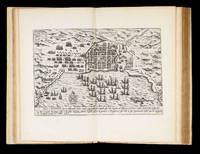
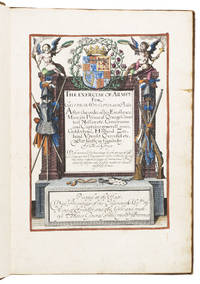
1607ABC_48580The Hague 1607. Folio ca. 37 x 27 cm. Mid-19th-century gold-tooled half faded red morocco and red cloth sides gilt edges marbled endpapers bound in 1840-ca. 1860 by the celebrated British bookbinder Robert Riviere 1808-1882 with his stamp "Bound by Riviere" in the bottom outer corner of the verso of the first flyleaf. With an engraved title page with at the head of the page the coat of arms of the dedicatee Prince Henry Frederick eldest son of King James I of England within a wreath of lilies and roses which - together with the title and the imprint were engraved on 3 separate slips of paper pasted over areas left blank for that purpose; and 117 including one repeat expertly engraved plates ca. 26 x 19 cm: 42 numbered plates in part 1 43 partly-numbered plates in part 2 and 32 numbered plates in part 3. All engravings including the engraved title-page are magnificently coloured and highlighted in gold and silver by a contemporary hand. The plates show exercises with the arquebus part 1 musket part 2 and pike part 3. 3 parts in 1 volume. 4; 2; 3 ll. Splendid copy of this very rare English edition of De Gheyn's illustrated major military manual with the plates in their first state before they were numbered and with some details added during the colouring stage instead of being engraved several puffs of smoke in the illustrations. The present copy is one of the three "presentation copies" of the first English edition New Hollstein The De Gheyn family II p. 159 1b.The history of the publication of the book is complex. It appears that Count Johann II of Nassau-Siegen 1561-1623 commissioned De Gheyn in about 1596 to publish the work together with or with the support of his nephew the great military commander and Stadtholder Prince Maurice who had re-organised the army of the Dutch Republic. Many copies have the engraved date 1607 on the title-page changed to 1608 suggesting that this may have been the true date of issue. The same title-border was used for the various early editions with the engraved texts on slips of paper to be pasted onto the places left blank on the engraved title-page. Different coats-of-arms were used for the different languages. The Dutch issues show for instance the coat-of-arms of Prince Maurice.This work is of the highest interest for military history regarding the early 17th century. It constitutes a simple transparent and well-illustrated manual for the instruction of recruits in the rapid and skilful handling of calivers an obsolete name for the arquebus muskets and pikes which had proven to be essential for the successful and revolutionary way of warfare introduced by Prince Maurice through reforming the Dutch army by introducing exercises and strict discipline in the past years. Fully coloured copies like the present were produced largely for princes and other important persons and were probably coloured by De Gheyn himself who was certainly responsible for the high standard of the colouring. In our copy the title is in the first undated state. All the early editions use the same main plate for the title-page so the text and arms for the editions in various languages and with various dedications were engraved on three separate slips of paper to be pasted over blank spaces: for the coat of arms above the engraved title centre and the imprint and privilege below. The book met immediate success and makes a considerable contribution to our knowledge of military history. The large format editions like the present were followed in 1609 and 1619 by smaller quarto editions with woodcut copies of the original engravings. The present copy varies slightly from other similar copies in that the compiler of this particular copy added plate 34 in part two twice unfortunately omitting part 2 plate 2 in that process and adding 2 plates with minor variants to this copy part 2 plates 29 and 35. Arguably this makes the present copy even rarer.The provenance of the present copy is impressive to say the least. It was most likely the presentation copy from De Gheyn for Robert Cecil first Earl of Salisbury 1563-1612 judging by the paper slip mounted on the recto of the second flyleaf which contains in early 17th-century manuscript the following text: "For my Lord ye Earle of Salisbury". This note is accompanied by a later more extensive annotation below the slip of paper reads: "This appears to have been a presentation copy to Robert Cecil Earl of Salisbury. The above inscription was on the fragment of a flyleaf and is probably the autograph of the author - De Gheyn. signature". Robert Cecil was Secretary of State to Queen Elisabeth I of England and King James I of England. In 1608 around the time the present work was published Cecil was appointed Lord Treasurer. Furthermore the splendour of the expert and strictly contemporary colouring of all engravings including the title-page prove that the present copy was made for a very important person like a nobleman or high statesman. Other bookplates show that the present work was at least part of two other collections. The first of the two is Christopher Turnor 1809-1886 with his bookplate on the front pastedown who was an English Conservative Party politician MP for South Lincolnshire between 1841 and 1847 founder of Stoke Rochford Hall and the son of English antiquarian author and politician Edmund Turnor 1755/56-1829. The second of the two is Hermann Marx 1881-1947 a famous German-born stockbroker and banker and a noted book and print collector. His "very choice and valuable library" was auctioned by Sotheby's in 1948.With the book plate of Christopher Turnor on the front pastedown the book plate of Hermann Marx on the recto of the first flyleaf and the paper slip with the 17th-century dedication to the Earl of Salisbury with the 19th-century note below on the recto of the second flyleaf. The numbers of the plates are added in a contemporary hand since the plates here appear in their first unnumbered state. The first plate of each part also contains Gheyns signature "J. De Gheyn. in." in manuscript instead of as part of the engraving. The binding shows some signs of wear some rubbing along the edges corners and the spine and fading of the leather and cloth on the front board and spine plate 2 in plate in part 2 has been replaced by a duplicate of plate 34 from the same part internally some minor marginal browning or staining but the coloured and highlighted engravings remain fine and clean. Overall in very good condition.l Cockle 79; Keynes New observations on Jacques de Gheyns The Exercise of Arms in: The Print Collectors Newsletter 13 1983 pp. 211-212; Kist Commentary to the facsimile of the Dutch edition 1971; Lipperheide nos. 2057-2060; Meij Jacques de Gheyn II als tekenaar p. 12 nos. 15-20 pp. 45-47; Muller Historieplaten no. 1117 & Suppl.; New Hollstein The De Gheyn family nos. 340-457 descriptions and illustrations of all plates; Regteren Altena Jacques de Gheyn Three generations vol. 2 pp. 64-78 nos. 342-464; Simoni A present for a Prince in: Ten studies in Anglo-Dutch relations 1975; STCN 85107989X 3 copies; cf. Jähns pp. 1005-1007 other eds. ABE CAT Costumes & Uniforms hardcover
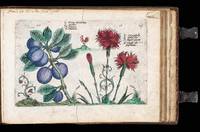
159416352Amsterdam 1594-1635. Oblong quarto 260 by 170mm 176 engraved plates numbered in an early hand 1-46 48-54 57-69 80-189 including 8 title-pages all with fine contemporary hand-colour in full occasionally heightened in silver two plates torn with slight loss to image and with early repairs six plates with slight worming to margins and three plates trimmed to neatline and laid down on old paper front free endpaper with later ownership inscription; mid-seventeenth century English red morocco elaborately gilt silver clasps and catches. A magnificent album of natural history engravings collected and bound for an English patron containing two complete suites of plates: Hoefnagel's 'Diversæ insectarum volatilium'; and Woutneel's 'Cognoscite lilia agri quomodo crescent' often bound as the fifth part 'Altera Pars' to the Crispin de Passes' 'Hortus Floridus' - the "most ambitions if not the first early effort to employ Continental resources to produce a set of botanical engravings designed for the English market" Gerard; and nine near complete or partial suites including an early issue of tulip plates from the 'Hortus Floridus'. All plates have been numbered consecutively in manuscript at the time of binding to a rudimentary scientific rubric: insects first then aquatic animals quadrupeds birds and botanicals last but not least. As a result some plates are bound with like subject rather than with their original publications. The album represents the work of some of the most famous natural history artists of the late sixteenth and early seventeenth centuries. The majority are published by Claes Jansz Visscher 1587-1652 the most important publisher of prints and maps in Amsterdam of his day. Recorded as an engraver in Amsterdam as early as 1608 he built a distinctive inventory of prints after the designs of Flemish artists which proved extremely popular and formed the basis of Visscher's early success as a publisher. INSECTS HOEFNAGEL Jacob. Diversæ insectarum volatilium: icones ad vivum accuratissmè depictæ per celeberrimum pictorem D.I. Hoefnagel typisq. Mandatae a Nicolao Ioannis Visscher anno 1630 Engraved title-page complete with 15 numbered plates of insects misbound including some upside-down bound with plates 11 and 12 from 'Volatilium varii generis effigies' after Nicolaes de Bruyn all with contemporary hand-colour heightened in silver consecutively numbered in an early hand 1-18. North German insects with the exception of the tarantula and scorpion. Engraved by Visscher after those by Jacob Hoefnagel 1573-1632 court painter for Emperor Rudolph from 1607 son of Joris Hoefnagel whose drawings of animals flowers and insects he engraved and published as the 'Archetypa Studiaque Patris Georgii Hoefnagelii' 1592. He also engraved plates for Braun and Hogenburg's 'Civitates Orbis Terrarum' 1512 - 1617. Ebert 798; Hagen I 371f; Hollstein IX 46 1-16; Nissen 1955; Horn-Schenkl. 10473. AQUATIC ANIMALS BRUYN Nicolaes de. Libelius sic varia genera piscium compectens pictoribus sculptoribus etc mire utilis et necessaries Nicolaes de Bruyn inventor Claes Ianss. Visscher excudit. interspersed with: COLLAERT Adrian. Piscium vivae icones inventae ab Adrian Collardo et excusae a Nicolao Ioannis Visscher anno 1634 Engraved allegorical title-page for 'Libillus' 11 of 12 without the sea-horse plates of aquatic animals and sea-monsters; 19 of 20 engraved plates of aquatic animals numbered in an early hand 19-44 followed by the allegorical title-page for 'Piscium' numbered 45 all with contemporary hand-colour all annotated in an early hand with common names in English. An early state of the title-page for de Bruyn's 'Libellus' before correction. Nicolaes de Bruyn 1571-1656 is best known for his large engraved landscapes "after designs by artists such as Gillis van Coninxloo and David Vinckboons from around 1600 his pupil and brother-in-law was Jan van Londerseel" Hollstein online A near complete suite of plates from a later edition of Collaert's famous work on fish first published in about 1598 in which the original engravings included elaborate landscape backgrounds. For his version Claes Visscher has incorporated his harpoon monogram into the dramatic title-page. Collaert 1560-1618 married engraver and publisher Philippe Galle. WEYER Gabriel. Monstra marina dat is verscheydon zee-monsters ge inventeert door Gabriel Weyer gedrucht by Claes Ianss. Visscher a.o 1634 Engraved allegorical title-page 7 of 12 plates of mermaids and mermen all with contemporary hand-colour numbered in an early hand 46 48-54. Berliner 'Ornamentstichkatalog' 4292 I; Nagler XXIV S. 220 I QUADRUPEDS BOLSWERT Boetius Adams after Adrien BLOEMAERT. Natus Dei solius ad servitium cinctis homo per hund creates imperat. Volentibus promisq.e; ut huic puessulo blande Leo Jouisq.e ales submittitur. ABloemaert invent: BA. Bolsuerd: sculp C Visscher excudebat 1632 G. Ryckius interspersed with: BRUYN Nicolaes de. Animalium quadrupedum varii generis effigies Allerley viervuessiger thier eigentliche abbildung den goltschmieden dienlich 1594. 8 of 14 without plates 1 5 and 11 plates 12 13 14 bound below with 'Volatilium' engraved plates of pastoral scenes from 'Natus'; 11 of 12 bound without the title-page engraved plates of animals from 'Animalium' all with contemporary hand-colour numbered in an early hand 57-69 and 80-85 allegorical title-page for 'Natus' numbered 86 annotated with the common names in English. The artistic Bolswert and Bloemaert families of Utrecht seem to have been very close frequently working together. Bloemaert met a grisly death at the hands of one of his students in 1666. 'Animalium' cf Hollstein 303-310; 'Natus' cf Hollstein 406-419 BIRDS BRUYN Nicolaes de. Volatilium varii generis effigies in tyronum praecipue vero aurisabrorum gratiam aeri incisa Claes Ianss. Visscher exu. NB. interspersed with: COLLAERT Adrian. Avium vivae icones Adriano Collardo inventore et excusum apud C Visscher anno 1625. 9 of 13 without plate 13 and plates 11 and 12 bound with 'Diversæ insectarum volatilium' above engraved plates of birds from 'Volatilium'; 12 of 18 without plates 4 9 14 15 18 plate 1 title-page bound separately below engraved plates of birds from 'Avium'; plates 12 13 and 14 from 'Natus' see above all with contemporary hand-colour numbered in an early hand 87-110 allegorical title-page for 'Volatilium' numbered "1" in the plate in manuscript "iii" ie 111 and with "Thretti" in the lower margin. BOTANICAL PASSE Crispin van de the elder and younger. Hortus Floridus Utrecht 1614 12 engraved plates of tulips numbered 32 43-53 all with early hand-colour numbered in an early hand 112-123 one ascribed to Willem de Pass in the plate. An early issue with no text on verso and captions only in Latin of a selection of tulip plates from "the most popular florilegium ever published" 'An Oak Spring Flora'. The work was first issued in a number of states between 1614 and 1617 and is often hailed as "the most important of early examples of botanical illustration" Gerard. It was issued in four sections on for each season with text in Latin and subsequently a selection of vernacular languages. 'An Oak Spring Flora' 12 WOUTNEEL Hans; and possibly Crispin van de PASSE the elder. Cognoscite lilia agri quomodo crescent non laborant neque nent: attamen dico vobis ne salomonem quidem in universa Gloria sua sic amic tum fuisse.ut unum ex his. Matthe: 6 Cap. Formulis Crispiam Passaei et Joannis Waldnelij 1603-1608 Allegorical title-page 61 engraved plates captions in Latin French English and Dutch all with early hand-colour numbered in manuscript 124-185 annotated throughout in two early hands with the months in which they flower and their medicinal properties in the "first" "second" and "third degree" misbound. The "most ambitions if not the first early effort to employ Continental resources to produce a set of botanical engravings designed for the English market" Gerard. Complete a suite of 61 plates depicting 120 plants published as a separate work in its own right but often issued as the fifth part of the de Passe's 'Hortus Floridus' when it appears with an additional letterpress title-page as the 'Altera Pars'. An early issue with no text on verso. "Traditionally the 'Alera Pars' has been considered as an aesthetically inferior appendage to the 'Hortus Floridus' and has received little attention from historians of prints or botanical illustration. However the presence on the title-page of the imprint of Hands Woutneel "Joannis Waldelij" an Antwerp native who was a bookseller and publisher in London from 1576 until his death sometime between 1603 and 1608 implies that the 'Altera pars' had a significant English component. As such it stands as an early example of Anglo-Continental print publishing collaboration. Prior to publication of the 'Altera Pars' the demand in England for botanical illustrations had been met primarily by relatively crude highly schematic collections of woodcuts such as those in Jacques LeMoyne de Morgue's 'La Clef des Champs' 1586 and John Norton's publication of Gerard's 'Herball' 1597. The 'Altera Pars' with its more naturalistic depictions of 120 plants set a new standard and served as the primary source of botanical images for English engravers and publishers from the late years of the reign of James I through the Restoration' Gerard. Hans Woutneel first appears in London on being admitted to the Stationers Company in 1579-80. Cartographer Abraham Ortelius mentions him frequently in his correspondence with his nephew Jacob Cole Gerard and Woutneel appears to have worked as Christopher Plantin's London agent. de Belder 272; Gerard 'Woutneel de Passe and the Anglo-Netherlandish Print Trade' 1996; Hunt 199; Nissen BBI 1494 Avium vivae icons Adriano Collardo inventore et excusum apud C Visscher anno 1625 Engraved allegorical title-page numbered 186 see above for plates. Untitled composite natural history. Claes Janss Visscher excudibat A.o 1625 A suite of 12 numbered engraved plates of composite natural history subjects all with early hand-colour numbered in manuscript 187-198 11 with the joint imprint of Assuerus van Londerseel and Claes Visscher. In the style of Hoefnagel's 'Archetypa Studiaque ' 1592 this is a very scarce suite of plates with only one uncoloured set known in the British Library.
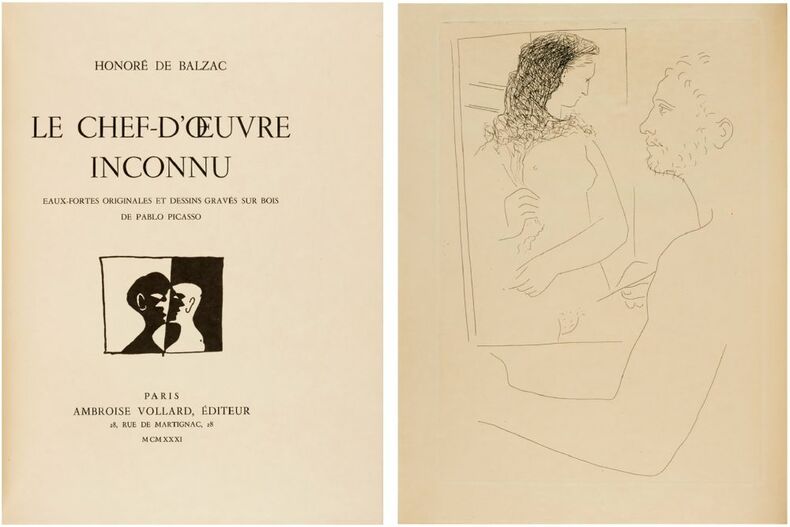
19313114Paris, Ambroise Vollard Éditeur, 1931. Un volume in-4 (32 x 24 cm). Remarquable reliure "sculptéee de Paul Bonet en plein box bleu nuit et décor polychome en relief, chemise et étui (signée et datée de 1944). - 12 EAUX-FORTES ORIGINALES EN HORS-TEXTE et 1 EAU-FORTE pour la "table des eaux-fortes" GRAVÉES PAR PABLO PICASSO. - UNE SUITE COMPLÈTE DES 12 GRAVURES HORS-TEXTE SUR VÉLIN DE RIVES. - Dessins de l'artiste gravés sur bois par Georges Aubert et tirés en in-texte. Une "préface" de 16 pages de dessins composés de points et de traits dessinés par Picasso en 1924 également gravés sur bois par Aubert. Tirage : 340 exemplaires (65 Japon + 240 vélin de Rives + 35 H.C.). Celui-ci 1 DES 65 EXEMPLAIRES SUR JAPON IMPÉRIAL, LES SEULS SIGNÉS AU PINCEAU PAR PICASSO et monogramés à la plume par Vollard, avec UNE SUITE COMPLÈTE DES 12 GRAVURES HORS-TEXTE SUR VÉLIN DE RIVES. - Dans une extraordinaire reliure "sculptée" de Paul Bonet, datée 1944 : "box bleu corbeau, un grand caisson ovale occupe presque chaque plat, encadrant un grand motif abstrait sculpté et couvert de veau de différentes couleurs vives" (Carnets, n°692), couverture conservée, chemise, étui. Bonet n'a réalisé qu'une poignée de ces fameuses reliures sculptées qui sont très recherchées. Celle-ci étant l'une des plus réussies et des plus élégantes. —— ENGLISH DESCRIPTION: Paris, Ambroise Vollard Éditeur, 1931. Illustrated with 12 original etchings by Pablo Picasso (and 1 for the plate "Table des eaux-fortes") and numerous woodcuts by G. Aubert after the drawings by Picasso. One of 65 NUMBERED ON JAPAN PAPER SIGNED BY PICASSO AND VOLLARD with an EXTRA SUITE of the 12 original etchings on Rives paper. Only the 65 numbered on japan paper are signed by Picasso and Vollard. Mint condition. Outstanding "sculptural" binding by Paul Bonet, dated 1944: "raven blue box, a large oval box occupies almost each cover, framing a large abstract motif carved and covered with calfskin in different bright colors" (Carnets, n°692), cover preserved, folder, case.
1601WRCAM38446London: Simon Stafford and Felix Kingston for Cuthbert Burby & John Flasket 1601. 1584 leaves. Woodcut vignette of sailing ship on titlepage. Extra-illustrated with 19 engravings numbered 1-3 19 4-18 from Van Neck's HISTORIALE BESCHRIJVINGHE Amsterdam 1619. Text and plates "inlaid to size" remargined to 9 1/4 x 6 3/4 inches. Quarto. 19th-century mottled calf gilt spine gilt gilt leather label. Boards and spine slightly worn. Titlepage and plates mounted to larger sheets; printed pages of text inlaid in larger sheets. Engraved plates annotated in ink with corresponding "page" leaf recto or verso of text. Lacking the dedication leaf paraph 2 and leaf Q4 blank pages shaved with occasional slight loss of text in lower margin rust hole in leaf P3 affecting a few letters on recto tear in leaf Q3 repaired not affecting text. Overall a very good copy with the 1860 engraved bookplate of the Library of the Earls of Macclesfield on front pastedown shelf marks inscribed on verso of front free endpaper. Embossed stamp of the Earls of Macclesfield in upper extended margins of titlepage leaf and following two leaves of text. The first English edition of Van Neck's account of his 1598 voyage to the East Indies translated from the 1601 Amsterdam edition of the author's HET TWEEDE BOECKE. The Dutch navigator who represented the Verre Company commanded three ships which were part of the first successful Dutch trading voyage to the region. The other two ships were commanded by Wybrand Van Warwijck and Jacob Van Heemskerk. Van Neck's vessel became separated from the other two after rounding the Cape of Good Hope and the three did not reunite again until his arrival in Java in late December 1598. Unlike his Dutch predecessor Cornelis Houtman who three years earlier had seized the port of Bantam Van Neck dealt diplomatically with the natives. "Rather than rejecting the inflated prices asked by the local ruler he offered to pay over the odds in order to cement a lasting relationship.Van Neck's was the most profitable of the pre-VOC Dutch East India Company voyages. Despite the apparently high price paid for spices he netted a profit of 300 per cent on his overall costs. In 1601 fourteen fleets comprising sixty-five ships sailed for the East Indies but by that time competition between rival Dutch operators as well as with the Portuguese had inflated prices and none were as successful as Van Neck's first enterprise" - Howgego. While focused on activity in the East Indies EUROPEAN AMERICANA notes that the text includes references to Brazil and tobacco from the West Indies. <br> <br> Van Neck's account was popular throughout the first half of the 17th century and was reprinted and translated into German and French as well as English. It also appeared in collections of voyages such as those by De Bry Hulsius and Colijn. This extra- illustrated copy includes nineteen engraved plates from the Amsterdam 1619 edition of Van Neck's HISTORIALE BESCHRIJVINGHE published by Michiel Colijn. The images are mounted on separate sheets and bound in the book at the appropriate portion of the text. The engravings are annotated in ink indicating the appropriate page i.e. recto or verso of a specific leaf related to the image. <br> <br> A rare book on the market. Prior to this copy from the Macclesfield sale in March 2007 the last copy previously available was sold at the Boise Penrose sale in 1971. Both EUROPEAN AMERICANA and STC record only two copies in the U.S. at the Huntington and NYPL the latter noted as imperfect. EUROPEAN AMERICANA 601/66. STC 18417 noting quires A-G printed by Stafford paraph 2 and quires H-Q printed by Kingston. TIELE-MULLER p.144. HOWGEGO N13. [Simon Stafford and Felix Kingston] for Cuthbert Burby & John Flasket hardcover books
1990324836New York: The Limited Editions Club 1990. Number 27 of 50 copies. 8 large colour silkscreen studies Signed by the Artist. 2 text leaves. All loose as issued. Printed by George Drexel Osiris Screen Printing New York on Whatman Print Matte paper. Folio 25 x 19 inches. Laid into black cloth clamshell dropbox with red morocco label inset on upper cover. Fine. Number 27 of 50 copies. 8 large colour silkscreen studies Signed by the Artist. 2 text leaves. All loose as issued. Printed by George Drexel Osiris Screen Printing New York on Whatman Print Matte paper. Folio 25 x 19 inches. The prints illustrate the King James version of the Book of Genesis. Bearing captions lithographed from mylars handwritten by the artist this "exhibition portfolio" format is much larger than the regular edition of Eight Studies for the Book of Genesis. <br /> <br /> Each print signed and inscribed "HC" in pencil lower margin. Printed by Stone Press Editions Seattle with the blind stamp lower right. Published by the Limited Editions Club New York. With the title and colophon pages. Superb clean impressions with bright and vibrant colors. Nesbett L90-2 The Limited Editions Club unknown
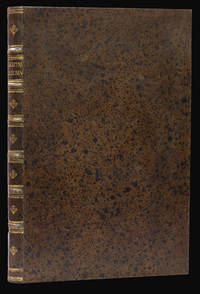
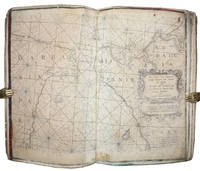
167712861Amsterdam: Printed by Jacob and Casparus Loots-man Bookseller upon the Water in the Loots-man 1677. Folio 440 by 280mm engraved title 20 engraved charts numerous woodcut charts and coastal profiles within text seventeenth century speckled calf to style spine in seven compartments separated by raised bands gilt. The Lootsman family a surname adopted by the founder of the firm Anthonie or Theunis Jacobsz are one of the less well-known firms of chart makers and publishers working in Amsterdam specialising in pilot books of European coastal waters but who also published a sea atlas of the world. Their output of charts and chart-books deserves to be better known as much of their work was original rather than the slavish copies some of their better-known rivals produced. Dutch chart publishers dominated the European market and by preparing editions in vernacular languages they were able to achieve wide distribution of their output. Most of the Dutch publishers produced English editions of their atlases and pilots and such was the dominance achieved that the Dutch were effectively able to stifle English competitors such as Joseph Moxon and John Seller. But it was the Lootsmans' misfortune to be overshadowed by the larger established firms or newcomers such as van Keulen and their productions often achieved only limited distribution. For example almost all the English editions published by the Lootsmans are located by Koeman in but a single example. It is interesting to compare Seller's early output with this volume and others like it to see the problems that early English publishers faced breaking the Dutch monopoly. This rare work is the first edition preceding the editions cited by Koeman with the title bearing the joint imprint of the brothers Jacob and Caspar Lootsman; whereas Koeman's earliest edition from 1678 bears the sole imprint of Caspar Lootsman. c.f. Koeman Jac 75 a & b. Printed by Jacob and Casparus Loots-man, Bookseller upon the Water, in the Loots-man, hardcover
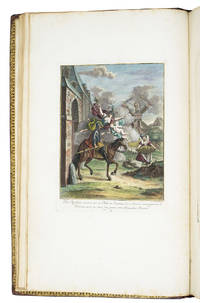
1746M2HB4ES5PXB4The Hague: Pieter de Hondt 1746. Contemporary richly gold-tooled dark red morocco by the so-called Van Damme bindery in Amsterdam sewn on 7 supports each board with Van Dammes typical hourglass- or vase- or flask-shaped central cartouche with a starry sky on a black ground here showing a short-stemmed chalice or goblet with fire or flame-like leaves like a snake plant Dracaena trifasciata in the cartouche and a basket of flowers topping the cartouche the whole in an elaborate frame built up from hundreds of impressions of numerous small tools the spine-title in gold on a black ground in the 2nd of 8 compartments each of the other 7 with flowers other decorations and a small flower in a pot gilt edges. With a tissue guard-leaf before each plate. Large folio 42 x 27 cm. Title in red and black with an engraved vignette Quixote and the windmill and 31 engraved illustration plates all coloured by a contemporary hand heightened with gold and set in in a gilt frame. Further with large woodcut initials and tailpieces and each text page in an ornamental frame built up from typographic ornaments the frames not in the 4to issue. Very rare large-paper copy of the first and only edition of a "free and joyous" Dutch translation of Cervantes's Don Quixote with 31 rococo style plates in spectacular contemporary hand colouring and with gold highlights. The plates have been engraved by leading Dutch artists Bernard Picart 12 Jacob van der Schley 13 Pierre Tanjé 5 and Simon Fokke 1 after paintings by leading French artists Antoine Coypel 25 Charles-Nicolas Cochin 2 Pierre-Charles Trémolières 2 François Boucher 1 and Jacques-Philippe le Bas 1. The impressions are crisp and the hand colouring is bright and of the highest quality with subtly graded tones and highlights in gold. Antoine Coypel 1694-1752 responsible for the design of most of the illustrations was one of the most important French history painters of the early 18th century. His Don Quixote paintings are highlights in his oeuvre and can be found in several museum collections.The Dutch edition was translated by Jacob Campo Weyerman 1677-1747 one of the foremost Dutch authors of the Enlightenment who was known for his merry style. He added to this edition a Dutch translation of the biography of Cervantes by Gregorio Mayans 1737 and explanatory texts to the plates. De Hondt issued the present edition in at least three formats: 4to folio on ordinary paper and folio on large paper. The present copy is the large-paper folio issue which is indeed very rare: several libraries have folio editions on ordinary paper usually about 35 cm tall but we have not located a copy of the large folio issue in any library. The only other large-paper copy we have been able to trace is slightly smaller.Cervantes's Don Quixote first published in Spanish 1605-1615 was first translated into Dutch in the early 17th century and went through several editions until 1732. Engraved prints after Coypel's famous Don Quixote paintings started circulating in 1734. De Hondt took this opportunity to publish a new Dutch translation with the Coypel illustrations and some others. He asked Weyerman who was already a famous writer but was imprisoned for slander to translate the text. He also commissioned new plates after Coypels paintings from the leading Dutch engravers. This came together in what became a masterpiece of rococo book production and the present hand-coloured copy of the large folio issue is the outstanding result.The Van Damme bindery was the "most important Amsterdam workshop of the 18th century" and is praised for the "high quality of its work" Storm van Leeuwen: 89 bindings are attributed to it. Although its earliest dated binding is from 1747 the present work and two others in similar Van Damme bindings in the British Library were printed in 1746 so these bindings may be among Van Dammes earliest work made in or soon after that year. Three of the six Van Damme bindings in the British Library as well as several examples in Storm van Leeuwen have a similar cartouche with a black interior but none includes the present vase or goblet of flames or flame-like leaves: we have not identified the patron.The boards are very slightly rubbed the corners and head and foot of the spine have been reinforced. A few small spots in the foot margin of the title page and slight browning of the paper of 2 quires. Otherwise in very good condition.l Arents Cervantes in het Nederlands 27: "Kneppelhout nr. 2587 gr. fol. rood verg. marok. verg. op sn. Zeer fraai ex. op gr. papier. Het titelvignet en de 30 prtn. allen alleruitmuntendst uit de hand gekl. en met goud afgezet. In oud-Holl. prachtbd. van rood marokyn. De rug verg. in afdeel. De platten met een zeer breed verguldsel randwerk en verg. middenfig. op zwart leder. Verg. op sn. Gekocht door Hr. Elte voor fl. 420."; Cohen & De Ricci 216 "superbes illustrations; livre tres recherche"; Van Gorp pp. 161-162; Mededelingen van de Stichting Jacob Campo Weyerman 18 1995 passim; Rius I 806; STCN 197115810 8 copies; Marleen de Vries Aanzet tot een bibliografie van Jacob Campo Weyerman 1990; cf. for the binding: Storm van Leeuwen I pp. 460-499. Pieter de Hondt, unknown
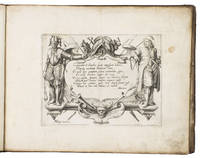
1599ABC_48581Leiden 1599. Oblong folio 25 x 32 cm. workshop of Jacob II de Gheyn Contemporary gold-tooled calf with the large gold-tooled coat-of-arms of the Stuart Princes of Wales Stuart Prince of Wales Henry Frederick 1594-1612 within a gold- and blind-tooled double fillet frame on both boards with small gold-tooled flowers on the spine gold-tooled board edges. With 22 numbered engraved plates varying sizes ca. 15.4-16 x 19.7 x 21.5 cm including the engraved title page. The illustrations are designed by De Gheyn and possibly engraved by him or by Zacharias Dolendo. 22 engraved plates. Very rare first edition of this magnificent series of cavalrymen and lansquentes in various positions bound for Henry Frederick Prince of Wales 1598-1612 with his coat-of-arms on the boards. All plates are signed by Jacob II de Gheyn "IDGheyn in. et ex." and engraved either by De Gheyn himself or by Zacharias Dolendo after De Gheyn. The famous designer engraver publisher and painter Jacob II de Gheyn born in Antwerp in 1565 was an apprentice of Hendrick Goltzius in Haarlem between 1585 and 1587. In 1596 he moved to Leiden where he lived till 1602 working together with many of the professors of the newly founded University amongst whom the "prodigy" Hugo de Groot 1583-1645 who became world famous as a lawyer and humanist. De Groot supplied the eight lines of poetry for the frontispiece of The Riding School engraved within an elaborate border full of military symbols such as a knight in armour holding a horse bridle on the left and a training master to the right a stirrup a currycomb weapons a skull with a laurel wreath symbolising "Death and Glory" and smoking trumpets. During these years in Leiden De Gheyn worked mainly as a designer and publisher leaving most of the engraving to apprentices especially to Zacharias Dolendo 1561-1601. From ca. 1600 till his death in 1629 De Gheyn was active as a painter draughtsman and publisher in The Hague.The series of 22 plates of The Riding School which illustrate the handling of the various arms used by cavalrymen was in all likelihood commissioned by Prince Maurice of Orange 1567-1625 and Count Johann II of Nassau-Siegen 1561-1623 in 1597 or 1598 as the counterpart to their commission of the 117 plates devoted to the infantry in the Wapenhandelinghe van roers musquetten ende spiessen New Hollstein The De Gheyn Family vol. 2 pp. 159-207 nos. 340-457 which was published eventually in 1607 after a deliberate delay to prevent the Spanish enemy from taking advantage of the information it contained.The present cavalry series is directly related to Jos Amman's model book Artliche und Kunstreiche Figuren zu der Reuttery 1584 containing plates of free standing single riders in various positions the first representations of such riders in Germany.The cavalry series was published four times: our edition of 1599 subsequently by Claes Jansz. Visscher in Amsterdam in 1640 then by Clement de Jonghe in Amsterdam after 1652 and lastly by Frederik de Wit in Amsterdam before 1706.The present work ws apparently bound for Henry Frederick Prince of Wales 1598-1612 as his coat-of-arms is stamped in gold on both boards. Henry Frederick was the eldest son of King James VI of Scotland who was also King James I of England who died before succeeding his father leaving the throne for his younger brother: King Charles I of England. Henry Frederick's coat-of-arms is that of the kingdom and thus the same as his father since ascending the English throne and even that of his brother King Charles I. However it is differenced by a label of three points argent at the top of the shield also visible in the armorial stamp on the present binding to differentiate between father King James I and the heir apparent Henry Frederick before his premature death. Because of a 19th-century inscription on the front pastedown we know that a century and a half later this work was part of the collection of Richard Cosway 1742-1822 one of the most fashionable miniaturists of England and a collector of drawings and prints. This collection was sold at auction by Georg Stanley in London between 14 and 21 February 1822 The Cosway Collection. Catalogue of the very numberous collection. London 1822; lot 113. In that same inscription we are told who the next owner of this splendidly bound collection of engravings is namely a certain Lord Harrington. This most likely refers to Charles Stanhope 4th Earl of Harrington 1780-1851 who was a Gentleman of the Bedchamber to both King George III and King George IV between 1812 and 1820.With a small engraved book plate showing a CR monogram of Richard Cosway and a 19th-century inscription "Bought at Mr Cosway's sale 1822 for Lord Harrington" probably referring to Charles Stanhope 4th Earl of Harrington both on the front paste-down. The binding has been re-backed with the original back strip laid down and the leather on the boards is somewhat scratched and rubbed but still leaving the coat-of-arms centrepiece quite clear. All plates show a vertical fold line in the middle the leaves are slightly dust soiled and the upper outer corner of the leaves are somewhat water stained without affecting the plates otherwise the engravings remain fine and clean. Overall in very good condition. The complete collection of De Gheyn's "Riding School" plates in a royal binding.l Biblioth. Hippologica Johan Dejager 2014 pp. 780-781 no. 011; Hollstein VII 263-284; New Hollstein The De Gheyn Family vol. 2 190-211 descriptions and illustrations of all plates; Polman De ruiterserie van Jacob de Gheyn 1998; Rechteren Altena Jacques de Gheyn Three generations 1983 vol. 1 p. 54 vol. 2 pp. 62-64 nos. 200-321; for the coat-of-arms on the binding see: UofT - British Armorial Bindings - Henry Frederick Prince of Wales 1594-1612 Stamp 01 https://armorial.library.utoronto.ca/stamps/IHEN004_s01. ABE CAT Art History hardcover
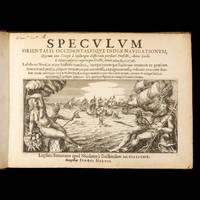
1619WRCAM54737Leiden: Nicolaus a Geelkercken 1619. 1751pp. lacking blank leaf P4 which divides the two narratives but was mistakenly included as pp.119-120 in the continuous pagination; including large engraved vignette on title with twenty-five engraved plates five folding double-page and two large folding maps. Oblong quarto. Contemporary Dutch vellum. Old stains and soiling to boards manuscript "33" in ink on spine edges rubbed boards slightly bowed. Modern bookplate on front pastedown. Minor toning and foxing tiny reinforcement at mounting stub on verso of each large folding map some offsetting. Overall very good. In a blue cloth box gilt leather label. Scarce first Latin edition of one of the bestsellers of illustrated 17th-century travel literature which reports Le Maire's critical DISCOVERY OF TIERRA DEL FUEGO an alternate route to the Pacific and also recounts the Pacific pillaging of the veteran East Indies sailor-turned-pirate Joris van Spilbergen. In addition the work includes valuable early information on ports along the Pacific coast of the Americas and is also of interest for the 17th-century Dutch presence in Brazil. Rich in ethnographic detail the numerous illustrations in the SPECULUM ORIENTALIS. include images of oversized penguins llamas and an Andean condor with a nine-foot wing span. Naval battles beleaguered Spanish settlements and newly discovered islands are also depicted in detail making this a valuable compendium of adventure on the high seas during the Age of Discovery. <br> <br> In 1614 the VOC commissioned Spilbergen to sail to the Moluccas with nearly 700 men. Despite the ostensible commercial nature of his expedition Spilbergen's six vessels were heavily armed anticipating encounters with silver-laden Spanish vessels. Spilbergen spent two years calling at various Spanish and Portuguese ports along both coasts of South America failing to capture any great amounts of silver or silk from Manila but burning several settlements and emerging triumphant from a naval skirmish just south of Lima. <br> <br> By contrast Le Maire's less mercenary expedition resulted in important discoveries; his exploration of Tierra del Fuego and the Tuamotou Archipelago called into doubt the existence of a massive southern continent providing a catalyst for Tasman's discovery of New Zealand and Australia. The two expeditions crossed paths in the Dutch East Indies in 1616. <br> <br> Spilbergen's fleet of six ships was fitted out and armed to combat the Spanish colonies attacking Spanish settlements and shipping along their route. They sailed to Brazil then through the Straits of Magellan and north along the coast of America as far as California. After sailing east to the Philippines they went on to Batavia in search of a Spanish fleet reportedly planning to attack Dutch settlements in the Moluccas but they never found a fleet. On his arrival at Batavia Spilbergen encountered Le Maire and Schouten whose voyage for the newly-formed Compagnie Australe had embarked in 1615 a year after Spilbergen's. Le Maire and Schouten traveled via the newly-discovered Le Maire Strait but on their arrival at Batavia they were arrested for breaching the monopoly granted to the Dutch East India Company of the Strait of Magellan. Spilbergen took Le Maire Schouten and their crews on board and escorted them back to the Netherlands virtually as prisoners. Le Maire grew ill and died en route. <br> <br> This work is remarkable as an early document on Dutch navigation to the Brazilian coasts. Its great value lies in Spilbergen's detailed account of their stay in the Ilha Grande from October 1614 to January 1615 and in São Vicente in 1615. Plate 2 depicting the disordered landing of Dutch vessels in São Vicente clearly documents the way of life of the indigenous peoples under Portuguese occupancy. Colonial religious structures appear alongside typical Native American hammocks and traditional Brazilian costumes and methods of animal husbandry are evident. This illustration with its explanatory text is particularly important as 17th-century ethnographic documents about the future São Paulo are very rare. <br> <br> One of the large folding maps remains important for illustrating Le Maire and Schouten's route across the Pacific. Other maps show the Straits of Magellan and Manila the Moluccas and various ports on the Pacific coast of America. <br> <br> The SPECULUM ORIENTALIS. was originally published in Dutch the same year as this Latin edition with identical plates. Translations in other languages followed rapidly: German in 1620 Frankfurt and French in 1621 Amsterdam. The work was not translated into English until the 1906 Hakluyt Society edition with the title THE EAST AND WEST INDIAN MIRROR. LANDWEHR VOC 361 mistaking the first edition of the Dutch: it is 1619 as his excellent collation obviously attests not 1617. BORBA DE MORAES II:276. HOWGEGO S159. W. Klooster THE DUTCH IN THE AMERICAS 1600- 1800 cat. 24 p.12. BLAIR-ROBERTSON XV pp.328-30; illustrated XVIII p.224. LeCLERC 1994. SABIN 2288. RODRIGUEZ 2288. EUROPEAN AMERICANA 619/133. J. de Villiers THE EAST AND WEST INDIAN MIRROR Hakluyt Society 1906. JCB II:143. Lach ASIA IN THE MAKING OF EUROPE III pp.445-48. Schilder AUSTRALIA UNVEILED Ch. V pp.32-37. TIELE 66. Nicolaus a Geelkercken hardcover books
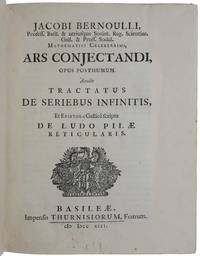
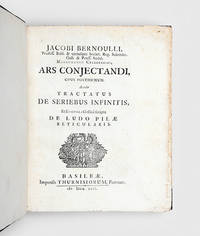
17134063Basel: Impensis Thurnisiorum Fratum 1713. First edition. First edition of the most significant early book on probability theory: it set forth the fundamental principles of the calculus of probabilities and contained the first suggestion that the theory could extend beyond the boundaries of mathematics to apply to civic moral and economic affairs. It also contained the first statement but not the proof of the law of large numbers. Hardcover. EVANS 8 - ESTABLISHED THE FUNDAMENTAL PRINCIPLES OF THE CALCULUS OF PROBABILITIES. <p>First edition an exceptionally fine copy rare in this condition. "Jakob 1 Bernoulli's posthumous treatise edited by his nephew Nicholas I Bernoulli the title literally means "the art of dice throwing" was the first significant book on probability theory: it set forth the fundamental principles of the calculus of probabilities and contained the first suggestion that the theory could extend beyond the boundaries of mathematics to apply to civic moral and economic affairs. The work is divided into four parts the first a commentary on Huygens's De ratiociniis in ludo aleae 1657 the second a treatise on permutations a term Bernoulli invented and combinations containing the Bernoulli numbers and the third an application of the theory of combinations to various games of chance. The fourth and most important part contains Bernoulli's philosophical thoughts on probability: probability as a measurable degree of certainty necessity and chance moral versus mathematical expectation a priori and a posteriori probability etc. It also contains his attempt to prove what is still called Bernoulli's Theorem: that if the number of trials is made large enough then the probability that the result will lie between certain limits will be as great as desired" Norman. This was the first statement of the law of large numbers.</p> <br /> <p>"In the first Part pp. 2-71 Jakob Bernoulli complemented his reprint of Huygens's tract by extensive annotations which contained important modifications and generalisations. Bernoulli's additions to Huygens's tract are about four times as long as the original text. The central concept in Huygens's tract is expectation. The expectation of a player A engaged in a game of chance in a certain situation is identified by Huygens with his share of the stakes if the game is not played or not continued in a 'just' game. For the determination of expectation Huygens had given three propositions which constitute the 'theory' of his calculus of games of chance. Huygens's central proposition III maintains:</p> <br /> <p>"If the number of cases I have for gaining a is p and if the number of cases I have for gaining b is q then assuming that all cases can happen equally easily my expectation is worth pa qb/p q."</p> <br /> <p>"Bernoulli not only gives a new proof for this proposition but also generalizes it in several ways .</p> <br /> <p>"Huygens's propositions IV to VII treat the problem of points also called the problem of the division of stakes for two players; propositions VIII and IX treat three and more players. Bernoulli returns to these problems in Part II of the Ars Conjectandi. In his annotations to Huygens's proposition IV he generalised Huygens's concept of expectation . This is the only instance in the annotations and commentaries to Huygens's tract where Bernoulli uses the word 'probabilitas' or probability as understood in everyday life. Later in Part IV of the Ars Conjectandi Bernoulli replaced Huygens's main concept expectation by the concept of probability for which he introduced the classical measure of favourable to all possible cases. The remaining propositions X to XIV of Huygens's tract deal with dicing problems of the kind: What are the odds to throw a given number of points with two or three dice or: With how many throws of a die can one undertake it to throw a six or a double six . The meaning of Huygens's result of proposition X that the expectation of a player who contends to throw a six with four throws of a die is greater than that of his adversary is explained by Bernoulli in a way which relates to the law of large numbers proved in Part IV of the Ars Conjectandi .</p> <br /> <p>"In the second Part pp. 72-137 Bernoulli deals with combinatorial analysis based on contributions of van Schooten Leibniz Wallis and Jean Prestet . It consists of nine chapters dealing with permutations the number of combinations of all classes the number of combinations of a particular class figurate numbers and their properties especially the multiplicative property sums of powers of integers the hypergeometric distribution the problem of points for two players with equal chances to win a single game combinations with repetitions and with restricted repetitions and variations with repetitions and with restricted repetitions.</p> <br /> <p>"Evidently Bernoulli did not know Blaise Pascal's Triangle arithmétique published posthumously in 1665 though Leibniz had alluded to it in his last letter to him in 1705. Not only does Bernoulli not mention Pascal in the list of authors that he had consulted concerning combinatorial analysis except for Pascal's letter to Fermat of 24 July 1654; it would also be difficult to explain why he repeated results already published by Pascal in the Triangle arithmétique such as the multiplicative property for binomial coefficients for which Bernoulli claims the first proof for himself. His arrangement differs completely from that of Pascal whose proof for the multiplicative property of the binomial coefficients has been judged to be clearer than Bernoulli's. It is fair to add that in the Ars Conjectandi which Bernoulli left as an unpublished manuscript he was much more honest concerning the achievements of his predecessors than Pascal in the Triangle arithmétique. It is also true that Bernoulli was concerned with combinatorial analysis in the Ars Conjectandi first of all because it constituted for him a most useful and indispensable universal instrument for dealing numerically with conjectures since 'every conjecture is founded upon combinations of the effective causes' p. 73 .</p> <br /> <p>"In the third Part pp. 138-209 Bernoulli gives 24 problems concerning the determination of the modified Huygenian concept of expectation in various games. Here he uses extensively conditional expectations without however distinguishing them from unconditional expectations. All the games are games of chance with dice and cards including games en vogue at the French court of the time like Cinque et neuf Trijaques or Basette. He solves these problems mainly by combinatorial methods as introduced in Part II and by recursion .</p> <br /> <p>"The fourth Part pp. 210-239 is the most interesting and original Part; but it is the one that Bernoulli was not able to complete. In the first three of its five chapters it deals with the new central concept of the art of conjecturing probability its relation to certainty necessity and chance and ways of estimating and measuring probability" Schneider pp. 92-100. "The relevant point for our analysis is his introduction in the fourth part of Ars Conjectandi of what has come to be regarded as the first law of large numbers. Bernoulli began the discussion leading up to his theorem by noting that in games employing homogeneous dice with similar faces or urns with equally accessible tickets of different colors the a priori determination of chances was straightforward. One would simply enumerate the possible cases and take the ratio of the number of 'fertile' cases to the total number of cases whether 'fertile' or 'sterile.' But Bernoulli asked what about problems such as those involving disease weather or games of skill where the causes are hidden and the enumeration of equally likely cases impossible In such situations Bernoulli wrote "It would be a sign of insanity to attempt to learn anything in this manner." Instead Bernoulli proposed to determine the probability of a fertile case a posteriori: "For it should be presumed that a particular thing will occur or not occur in the future as many times as it has been observed in similar circumstances to have occurred or not occurred in the past" p. 224. The proportion of favorable or fertile cases could thus be determined empirically. Now this empirical approach to the determination of chances was not new with Bernoulli nor did he consider it to be new. What was new was Bernoulli's attempt to give formal treatment to the vague notion that the greater the accumulation of evidence about the unknown proportion of cases the closer we are to certain knowledge about that proportion.</p> <br /> <p>"Bernoulli took it as commonly known that uncertainty decreased as the number of observations increased: "For even the most stupid of men by some instinct of nature by himself and without any instruction which is a remarkable thing is convinced that the more observations have been made the less danger there is of wandering from one's goal" p. 225. Bernoulli sought both to provide a proof of this principle and to show that there was no natural lower bound to the residual uncertainty: By multiplying the observations 'moral certainty' about the unknown proportion could be approached arbitrarily closely" Stigler pp. 64-5.</p> <br /> <p>The main work concludes with Tractatus de seriebus infinitis earumque summa finite et usu in quadraturis spatiorum & rectificationibus curvarum pp. 241-306 which had first appeared as a series of five extremely rare pamphlets entitled Positiones arithmeticae de seriebus infinitis earumque summa finita. "The five dissertations in the Theory of Series 1682-1704 contain sixty consecutively numbered propositions. These dissertations show how Bernoulli at first in close cooperation with his brother had thoroughly familiarized himself with the appropriate formulations of questions to which he had been led by the conclusions of Leibniz in 1682 series for pi/4 and log 2 and 1683 questions dealing with compound interest. Out of this there also came the treatise in which Bernoulli took into account short-term compound interest and was thus led to the exponential series. He thought that there had been nothing printed concerning the theory of series up until that time but he was mistaken: most conclusions of the first two dissertations 1689 1692 were already to be found in Pietro Mengoli Novae quadraturae arithmeticae seu de additione fractionum 1650 as were the divergence of the harmonic series Prop. 16 and the sum of the reciprocals of infinitely many figurate numbers Props. 17-20 . At the end of the first dissertation Bernoulli acknowledged that he could not yet sum the inverse squares of the integers in closed form Euler succeeded in doing so first in 1737 . Informative theses based on Bernoulli's earlier studies were added to the dissertations: and theses 2 and 3 of the second dissertation are based on the still incomplete classification of curves of the third degree according to their shapes into thirty-three different types.</p> <br /> <p>"The third dissertation was defended by Jakob Hermann who wrote Bernoulli's obituary notice in Acta eruditorum 1706. In the introduction L'Hospital's Analyse is praised. After some introductory propositions there appear the logarithmic series for the hyperbola quadrature Prop. 42 the exponential series as the inverse of the logarithmic series Prop. 43 . and the series for the arc of the circle and the sector of conic sections Props. 45 46. All of these are carefully and completely presented with reference to the pertinent results of Leibniz 1682; 1691. In 1698 previous work was supplemented by Bernoulli's reflections on the catenary Prop. 49 and related problems on the rectification of the parabola Prop. 41 and on the rectification of the logarithmic curve Prop. 52.</p> <br /> <p>"The last dissertation 1704 was defended by Bernoulli's nephew Nikolaus I who helped in the publication of the Ars conjectandi 1713 and the reprint of the dissertation on series 1713 and became a prominent authority in the theory of series. In the dissertation Bernoulli first Prop. 53 praises Wallis' interpolation through incomplete induction. In Proposition 54 the binomial theorem is presented with examples of fractional exponents as an already generally known theorem. Probably for this reason there is no reference to Newton's presentation in his letters to Leibniz of 23 June and 3 November 1676 which were made accessible to Bernoulli when they were published in Wallis' Opera Vol. III 1699" DSB.</p> <br /> <p>The volume concludes with a separately-paginated 35-page Lettre à un Amy sur les Parties du Jeu de Paume in French. "In his Letter to a Friend on the Game of Tennis Bernoulli begins with a summary of his considerations in the Ars Conjectandi on the difference between games of chance and games that depend on the skill of the players on the corresponding determination of probabilities a priori and a posteriori and on the law of large numbers which justifies the use of the relative frequency of winning as a measure of the probability of winning. Apart from this short introduction the letter is really an exercise in probability theory and could well have been included in Part 3 of the Ars Conjectand. "Bernoulli writes that he will not explain the rules of the game because they are well known. The game is more complicated than tennis but with the same scoring rules . Bernoulli analyzes many problems of tennis. There are however no new methods used in his analysis; he keeps strictly to the methods used by Huygens solving most of the problems by recursion between expectations. The letter is an imposing work demonstrating Bernoulli's pedagogical qualities his ability to systematize and his thoroughness" Hald p. 241.</p> <br /> <p>"Important sections of the Ars Conjectandi were sketched out in Jakob Bernoulli's scientific diary the 'Meditationes' from the mid 1680s onwards. When he died in 1705 the Ars Conjectandi was not finished especially lacking good examples for the applications of his 'art of conjecturing' to what he described as civil and moral affairs. Concerning the time that it would have needed to complete it opinions differ from a few weeks to quite a few years depending on assumptions about his own understanding of completeness. His heirs did not want his brother Johann the leading mathematician in Europe at this time to complete and edit the manuscript fearing that Johann would exploit his brother's work. Only after Pierre Rémond de Montmort 1678-1719 himself a pioneer of the theory of probability had sent an offer via Johann to print the manuscript at his own expense in 1710 and after some admonitions that the Ars conjectandi soon would become obsolete if not published Jakob's son a painter agreed to have the unaltered manuscript printed. It appeared in August 1713 . A short preface was contributed by Nikolaus Bernoulli 1687-1759 Jakob's nephew. He had read the manuscript when his uncle was still alive and had made considerable use of it in his thesis of 1709 De usu artis conjectandi in jure and in his correspondence with Montmort. He was asked twice to complete and edit the manuscript. The first time he excused himself by his absence when he travelled in 1712 to Holland England and France. After his return Nikolaus Bernoulli declared himself as too inexperienced to do the job and in his preface he asked Montmort the anonymous author of the Essay sur les jeux de hazard and Abraham de Moivre 1667-1754 to complete his uncle's work" Schneider p. 90.</p> <br /> <p>PMM 179; Dibner 110; Evans 8; Grolier/Horblit 12; Sparrow 21; Norman 216.</p> <br /> <p>Hald History of Probability and Statistics and their Applications before 1750 2003. Schneider 'Jakob Bernoulli Ars Conjectandi 1713' pp. 88-104 in Landmark Writings in Western Mathematics 1640-1940 I. Grattan-Guinness ed. 2005. Stigler The History of Statistics 1986. </p> <br/> <br/> 4to 202 x 155 mm contemporary vellum red spine label with gilt lettering 4 1-306 1-35 1 printed folding tables between pp. 24-25 and 172-173 folding woodcut diagram after p. 306. An outstanding copy in entirely unrestored binding very fresh and crisp internally. Very rare in such fine condition. / Hardcover. Impensis Thurnisiorum Fratum unknown
1713180566Basel: Johann Rudolph & Emanuel Thurneysen 1713. The subject of the first published computer programme First edition of the first systematic treatment of probability theory the source of the law of large numbers binomial distribution and Bernoulli numbers. The Ars Conjectandi was the first work to suggest that probability could be applied in civil moral and economic matters and it remains the foundation of much modern practice in such fields as insurance and statistics. Jacob Bernoulli 1655-1705 was the first of the famed Bernoulli family to study mathematics: Johann 1667-1748 was his brother while Nicolaus 1687-1759 and Daniel 1700-1782 were his nephews. Nicolaus revised his uncle's manuscripts for this publication and provided his own two-page preface. The Bernoulli numbers in the Ars Conjectandi inspired the first published computer programme as devised by Ada Lovelace in 1843. Looking to demonstrate the potential of Babbage's analytical engine Lovelace wrote an algorithm with which the machine could calculate the Bernoulli sequence each generated recursively from previous values. The algorithm was published in Taylor's Scientific Memoirs in August 1843. Amusingly the final section includes several comments on jeu de paume - a ball game having much in common with modern tennis and very little in common with the rest of the work. Quarto 215 x 170 mm pp. iv 35 1; 306. Folding engraved plate 2 folding engraved tables woodcut vignette to title page head- and tailpieces and initials tables in the text. Nineteenth-century marbled boards outer and lower edges uncut. Front free endpaper and initial two leaves remounted on stub. Late 19th-century "Wirtz" signature. Recent pencil annotation to N3. Light rubbing faint sunning to spine minor browning and foxing to content extremities closed tear to outer margin of D1 professionally repaired plates crisp: a very good copy. Dibner 110; Horblit 12; Norman 216; Printing and the Mind of Man 179; Tomash & Williams B143. hardcover
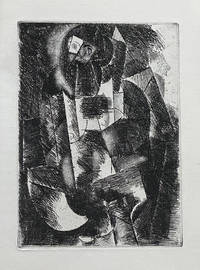
1914N - 2024 - 115<p>Max Jacob. Illustrated with three cubist etchings by Picasso in full page from 1913. Max Jacob three-act play reflect the author mystic quest and his research into the cabala and astrology Picasso completed the illustrations during the winter of 1913/14 making three etchings and dry points one for each act to which he gave the titles: Femme Nue plate 1 Nature Morte au Crâne plate 2 and Femme plate 3. This book is second illustrated book published by Daniel-Henry Kahnweiler created in collaboration with Picasso. Signed by the Picasso and Jacob in the justification page and marked as number "40" of 85 copies on "Holland van Gelder" total edition 106 copies. The book is complete in the original glassine light offsetting is present in the text page near the first illustration. Ref Cramer #3. Very good conditions.</p> Daniel- Henry Kahnweiler, Editeur hardcover
1609WRCAM46859Amsterdam: Cornille Nicolas 1609. Two volumes bound in one. Described in greater detail below. Folio. Contemporary boards rebacked in calf spine gilt leather label. Very good. From the Library of the Earls of Macclesfield with engraved 1860 bookplate on front pastedown and blind pressure stamp on first two printed leaves of first title. Two highly important Dutch voyages both in their second French editions and bound together as issued in 1609. These two voyages represent the initial Dutch exploration and expansion to the East Indies a significant element in a global commercial enterprise which was to develop throughout the 17th century. The two foundation accounts in the present volume originally issued together by Amsterdam printer Cornille Nicolas include: <br> <br> 1 Lodewijcksz Willem: PREMIER LIVRE DE L'HISTOIRE DE LA NAVIGATION AUX INDES ORIENTALES PAR LES HOLLANDOIS. Amsterdam: Cornille Nicolas 1609. 53 leaves. Titlepage with engraved map forty-five in-text engravings including three maps seventeen in-text woodcut illustrations and one plate on separate leaf following printed text. Moderate soiling on titlepage slight edge wear to first few leaves. <br> <br> Second French edition following the first French edition of 1598. Lodewijcksz gives an account of the first Dutch expedition to the East Indies under Cornelis Houtman from 1595 to 1597. The information collected by Houtman on the spice trade convinced the Dutch they could compete with Portugal's monopoly in the East Indies and his narrative served to initiate the explosion of Dutch trading at the turn of the century. <br> <br> "Like the English Houtman's men suffered so severely from scurvy that they had to put in at the Cape of Good Hope and at Antongil Bay in Madagascar to recuperate. But they then sailed straight across the Indian Ocean to the Straits of Sunda and dropped anchor at Bantam in Java without the loss of a ship. At this port the center of the Javanese pepper trade a long time was spent. Both natives and Portuguese showed considerable hostility and Houtman and some of his men were imprisoned. However the Dutch succeeded in making a commercial treaty and departed with a good cargo. They proceeded eastward to Bali and then returned along the south coast of Java thereby acquiring a more correct impression of the width of the island than had prevailed and laid the ghost of Java's being the northern part of the Southern Continent.the Dutch skipper had enough to show for his venture to inspire the merchants of Amsterdam with a determination to exploit the trade" - Penrose. <br> <br> 2 Neck Jacob Cornelissoon van: LE SECOND LIVRE IOURNAL OU COMPTOIR CONTENANT LE VRAY DISCOURS ET NARRATION HISTORIQUE. Amsterdam: Cornille Nicolas 1609. Two parts. 228 leaves. Titlepages with engraved illustrations twenty-two in-text engravings including one map two in-text woodcuts. <br> <br> Second French edition following the first French edition of 1601. Van Neck who represented the Verre Company commanded three ships which were part of the first successful Dutch trading voyage to the region. The other two ships were commanded by Wybrand Van Warwijck and Jacob Van Heemskerk. Van Neck's vessel became separated from the other two after rounding the Cape of Good Hope and the three did not reunite again until his arrival in Java in late December 1598. Unlike his Dutch predecessor Cornelis Houtman who three years earlier had seized the port of Bantam Van Neck dealt diplomatically with the natives. "Rather than rejecting the inflated prices asked by the local ruler he offered to pay over the odds in order to cement a lasting relationship.Van Neck's was the most profitable of the pre-VOC Dutch East India Company voyages. Despite the apparently high price paid for spices he netted a profit of 300 per cent on his overall costs. In 1601 fourteen fleets comprising sixty-five ships sailed for the East Indies but by that time competition between rival Dutch operators as well as with the Portuguese had inflated prices and none were as successful as Van Neck's first enterprise" - Howgego. While focused on activity in the East Indies EUROPEAN AMERICANA notes the text includes references to Brazil and tobacco from the West Indies. The second part of this 1609 French edition an eight-page appendix of words spoken in Java and Malay includes word lists in French printed in roman type Malay in italic type and Javanese in civilité. <br> <br> Two of the most important of the pioneering French voyages to the Far East bound together as probably issued in this edition. Lodewijcksz: EUROPEAN AMERICANA 609/71. TIELE-MULLER 115. JCB 3II:63. HOWGEGO H105 Houtman. Penrose TRAVEL AND DISCOVERY IN THE RENAISSANCE 1952 p.204. Neck: EUROPEAN AMERICANA 609/93. TIELE 786. TIELE-MULLER 129. HOWGEGO N13. Cornille Nicolas hardcover books
1610WRCAM51636Amsterdam: Cornille Nicolas 1610. Three volumes bound in one. Described in greater detail below. Folio. Contemporary vellum over boards rebacked with original spine preserved. Bookplate on front pastedown. Light soiling and repairs to titlepages; minor soiling otherwise. Very good. Three highly important Dutch voyages all in their second French editions and bound together as issued in 1610. These three voyages represent the initial Dutch exploration and expansion to the East Indies a significant element in a global commercial enterprise which was to develop throughout the 17th century. The foundational accounts in the present volume originally issued together by Amsterdam printer Cornille Nicolas include: <br> <br> 1 Lodewijcksz Willem: PREMIER LIVRE DE L'HISTOIRE DE LA NAVIGATION AUX INDES ORIENTALES PAR LES HOLLANDOIS. Amsterdam: Cornille Nicolas 1609. 53 leaves. Titlepage with engraved map forty-five in-text engravings including three maps seventeen in-text woodcut illustrations and one plate on separate leaf following printed text. Moderate soiling on titlepage slight edge wear to first few leaves. <br> <br> Second French edition following the first French edition of 1598. Lodewijcksz gives an account of the first Dutch expedition to the East Indies under Cornelis Houtman from 1595 to 1597. The information collected by Houtman on the spice trade convinced the Dutch they could compete with Portugal's monopoly in the East Indies and his narrative served to initiate the explosion of Dutch trading at the turn of the century. <br> <br> "Like the English Houtman's men suffered so severely from scurvy that they had to put in at the Cape of Good Hope and at Antongil Bay in Madagascar to recuperate. But they then sailed straight across the Indian Ocean to the Straits of Sunda and dropped anchor at Bantam in Java without the loss of a ship. At this port the center of the Javanese pepper trade a long time was spent. Both natives and Portuguese showed considerable hostility and Houtman and some of his men were imprisoned. However the Dutch succeeded in making a commercial treaty and departed with a good cargo. They proceeded eastward to Bali and then returned along the south coast of Java thereby acquiring a more correct impression of the width of the island than had prevailed and laid the ghost of Java's being the northern part of the Southern Continent.the Dutch skipper had enough to show for his venture to inspire the merchants of Amsterdam with a determination to exploit the trade" - Penrose. <br> <br> 2 Neck Jacob Cornelissoon van: LE SECOND LIVRE IOURNAL OU COMPTOIR CONTENANT LE VRAY DISCOURS ET NARRATION HISTORIQUE. Amsterdam: Cornille Nicolas 1609. Two parts. 224 leaves. Titlepages with engraved illustrations twenty-two in-text engravings including one map two in-text woodcuts. Leaves D2 and D3 lacking provided in facsimile. <br> <br> Second French edition following the first French edition of 1601. Van Neck who represented the Verre Company commanded three ships which were part of the first successful Dutch trading voyage to the region. The other two ships were commanded by Wybrand Van Warwijck and Jacob Van Heemskerk. Van Neck's vessel became separated from the other two after rounding the Cape of Good Hope and the three did not reunite again until his arrival in Java in late December 1598. Unlike his Dutch predecessor Cornelis Houtman who three years earlier had seized the port of Bantam Van Neck dealt diplomatically with the natives. "Rather than rejecting the inflated prices asked by the local ruler he offered to pay over the odds in order to cement a lasting relationship.Van Neck's was the most profitable of the pre-VOC Dutch East India Company voyages. Despite the apparently high price paid for spices he netted a profit of 300 per cent on his overall costs. In 1601 fourteen fleets comprising sixty-five ships sailed for the East Indies but by that time competition between rival Dutch operators as well as with the Portuguese had inflated prices and none were as successful as Van Neck's first enterprise" - Howgego. While focused on activity in the East Indies EUROPEAN AMERICANA notes the text includes references to Brazil and tobacco from the West Indies. The second part of this 1609 French edition an eight-page appendix of words spoken in Java and Malay includes word lists in French printed in roman type Malay in italic type and Javanese in civilité. 3 Noort Olivier van: DESCRIPTION DU PENIBLE VOYAGE FAIT ENTOUR DE L'UNIVERS OV GLOBE TERRESTRE. PAR SR. OLIVIER DU NORT D'UTRECHT GENERAL DE QUATRE NAVIRES ASSAVOIR. Amsterdam: Widow of Cornille Nicolas 1610. 2611pp. Engraved titlepage vignette. Twenty-five in-text engravings including three maps. <br> <br> Second French edition following the first French printing of 1602. Van Noort a former innkeeper in Rotterdam sponsored by a group of Dutch merchants accomplished the fourth circumnavigation of the globe after Magellan Drake and Cavendish. He was the first Dutch explorer to do so making the trip from 1598 to 1601. The voyage was particularly arduous. Half the crew mutinied his ships were constantly harassed and most of those that didn't mutiny perished from disease. He returned to Holland "with only one battered ship and eight crew left although some accounts suggest that forty-five crew survived. His voyage contributed little to the geographical knowledge of the time but had some effect in opening the way to the establishment of the Dutch in the East Indies.Van Noort's achievement however captured the imagination of his countrymen and the published accounts sold well the first appearing only eighteen days after his return. A more complete edition appeared later that year followed by two amended editions in 1602" Howgego. <br> <br> Three of the most important pioneering French voyages to the Far East bound together as issued. Lodewijcksz: EUROPEAN AMERICANA 609/71. TIELE-MULLER 115. JCB 3II:63. HOWGEGO H105 Houtman. Penrose TRAVEL AND DISCOVERY IN THE RENAISSANCE 1952 p.204. Neck: EUROPEAN AMERICANA 609/93. TIELE 786. TIELE-MULLER 129. HOWGEGO N13. Noort: EUROPEAN AMERICANA 610/79. SABIN 55438. BORBA DE MORAES p.617. W. Klooster THE DUTCH IN THE AMERICAS 1600- 1800 p.12. TIELE 806. JCB 3II:71. HOWGEGO N37. Cornille Nicolas hardcover books
1670ABC_48983Amsterdam 1670. Contemporary stiff paper wrappers with a manuscript label pasted upside down on the back wrapper reading: Carta Marinaresca del Mar Mediterraneo. Folio 29 x 45 cm. With 9 double-page engraved charts only each sheet ca. 44 × 55 cm each mounted on stiff paper with maps back-to-back with thick red and black ink borderlines. 8 of 9 maps are by Colom numbered 2-9 in the plates from; plate 1 has been replaced with Johannes de Rams map of the Mediterranean: "Paskaart vande Middelandsche Zee In twee deelen vertoont". Unusual working copy of Coloms rare pilot owned by an Ottoman Turkish mariner with his Osmanli inscriptions transliterating the location names throughout. Coloms charts cover the Straits of Gibraltar the Barbary Coast Mallorca the coastline around Barcelona Nice Corsica Sardinia Southern Italy Sicily and Croatia. Koeman highlights the rarity of all of Coloms pilot books and notes that despite thousands of copies having been circulated . only a score have survived.The wrappers are worn and with significant spotting and browning throughout some cockling and losses to sheets old repaired tears creases and signs of heavy use. A highly uncommon survival.l Cf. Koeman IV 120; Phillips III 53 ff. unknown
18385615Paris ; F. G. Levrault, Amsterdam ; Legras Imbert et Comp., 1838 [1820-1839] 1838 7 vol. in-folio (380 x 285 mm) de : vol. 1 (comprend les tomes I et II) [3] ff. (faux titre, titre, dédicace) ; 11 pp. (prospectus) [257] pp. ; vol. 2 (comprend les tomes III et IV) [2] ff. (faux titre, titre); [347] pp. ; vol. 3 (comprend le tome V) [184] pp; 109 pp. (table) ; vol. 4 (planches de 1 à 150) ; vol. 5 (planches de 151 à 300) ; vol. 6 (planches de 301 à 450) ; vol 7. (planches de 451 à 600); un total de 600 planches. Légères et petites rousseurs éparses aux volumes de text e, quelques feuillets jaunis in fine du 3e volume de texte, petite déchirure marginale sans perte aux planches 43, 44 et 45, infime déchirure marginale sans perte aux planches 210 et 211, quelques très petites rousseurs à quelques planches au 3e volume de planches. Reliure dépoque, demi-chagrin vert sapin, plats recouverts de papier marbré bleu, dos à nerfs ornés noir et or, titres et tomaisons dorés. (quelques menus frottements).
42374Lugduni Batavorum i.e. Leiden : Jodocus Hondius for Nicolaus van Geelkercken 1619. Small oblong quarto 190 x 250 mm contemporary limp vellum with early manuscript title and collection number to spine; title with large engraved vignette early ownership signature to upper margin; pp. 4 blank 175 5 blank; with a folding engraved world map and a further 24 engraved maps plans and views including 2 folding maps 2 double-page maps one folding view and one double-page view; one preliminary leaf chipped at fore-edge a few of the plates browned otherwise sound and clean throughout a good example; housed in a custom clamshell box of half morocco over marbled papered boards and cloth spine lettered and decorated in gilt. One of the most significant illustrated travel books of the early 1600s. Spilbergen and Le Maire's ""The East and West Indian Mirror"" which combines two circumnavigation narratives was first published in Leiden in 1619 in simultaneous Dutch and Latin editions. A second issue of each edition was printed in the same year. This is the first Latin edition second issue the same as the first issue in every respect but with the name of Hondius added to the imprint on the title. All of the 1619 editions both Dutch and Latin were issued with the same plates. In 1614 Joris van Spilbergen's Dutch East India Company flotilla comprised of six ships set out for the Moluccas with the intention of reaching the East Indies via the Strait of Magellan and crossing the Pacific from east to west. The expedition sailed first to Brazil then through the Strait of Magellan and northwards along the coasts of Chile and Peru as far as California. Its vessels were armed and carried out attacks on Spanish settlements and shipping en route. Spilbergen then sailed for the Philippines where he arrived at the start of February 1616 and carried out attacks on Manila-bound shipping for almost a month. The section of the account that deals with the Philippines occupies pp. 84-93 and is illustrated with a superb double-page map of the Manila Strait and a full-page woodcut of ships outside the port of Manila. Both of these plates have a key with points of interest and explanations given in the main text. Spilbergen's ships then sailed on by way of Ternate to Batavia. There he failed to locate a Spanish fleet rumoured to be planning attacks against Dutch interests in the Moluccas. Instead he encountered Le Maire and Schouten who had recently arrived from their Pacific crossing on behalf of the Compagnie Australe only to be arrested for breaching the VOC monopoly on the Strait of Magellan passage. Spilbergen was responsible for conducting Le Maire Schouten and their men back to the Netherlands although Le Maire died on the voyage. 'The Mirror is an extremely important book for the history of Dutch navigation' Borba de Moraes. Howgego S159; Landwehr VOC 361; Sabin 89450; Alden & Landis 619/133; Borba de Moraes II:276 hardcover
3545Woodcut device on title two folding printed tables & one folding woodcut plate. 2 p.l. 306 35 1 pp. 4to fine cont. vellum over boards slightly warped. Basel: impensis Thurnisiorum Fratrum 1713. First edition of "the first systematic attempt to place the theory of probability on a firm basis and is still the foundation of much modern practice in all fields where probability is concerned - insurance statistics and mathematical heredity tables."-Printing & the Mind of Man 179. A very fine and large copy preserved in a box. ❧ Dibner Heralds of Science 110. D.S.B. II pp. 46-51. Evans Epochal Achievements 8. Horblit 12. hardcover books
3289Woodcut device on title two folding printed tables & one folding woodcut plate. Diagrams in the text. 2 p.l. 306 35 1 pp. 4to cont. speckled sheep upper joint with short crack bookplate on blank portion of title patched minor foxing spine gilt red leather lettering piece on spine. Basel: impensis Thurnisiorum Fratrum 1713. bound with: BERNOULLI Nicolaus I. Dissertatio Inauguralis Mathematico-Juridica. De Usu Artis Conjectandi in Jure. 56 pp. 4to. Basel: J.C. Mechel 1709. A most attractive sammelband. I. First edition of "the first systematic attempt to place the theory of probability on a firm basis and is still the foundation of much modern practice in all fields where probability is concerned - insurance statistics and mathematical heredity tables."-Printing & the Mind of Man 179. II. First edition. Nicolaus I 1687-1759 nephew of Jacob I and Johann I and editor of the Ars Conjectandi obtained the degree of doctor of jurisprudence with this dissertation on the application of the calculus of probability to questions of law. I believe this to be an important contribution to probability. Very good copies. ❧ I. Dibner Heralds of Science 110. D.S.B. II pp. 46-51. Evans Epochal Achievements 8. Horblit 12. Sparrow Milestones of Science 21. II. D.S.B. II pp. 56-57. Keynes "Bibliography" in A Treatise on Probability p. 435. hardcover books
170932891709. Woodcut device on title two folding printed tables & one folding woodcut plate. Diagrams in the text. 2 p.l. 306 35 1 pp. 4to cont. speckled sheep upper joint with short crack bookplate on blank portion of title patched minor foxing spine gilt red leather lettering piece on spine. Basel: impensis Thurnisiorum Fratrum 1713. <br/> <br/> bound with:<br/> <br/> BERNOULLI Nicolaus I. Dissertatio Inauguralis Mathematico-Juridica. De Usu Artis Conjectandi in Jure. 56 pp. 4to. Basel: J.C. Mechel 1709.<br/> <br/> A most attractive sammelband. <br/> <br/> I. First edition of “the first systematic attempt to place the theory of probability on a firm basis and is still the foundation of much modern practice in all fields where probability is concerned — insurance statistics and mathematical heredity tables.â€â€“Printing & the Mind of Man 179. <br/> <br/> II. First edition. Nicolaus I 1687-1759 nephew of Jacob I and Johann I and editor of the Ars Conjectandi obtained the degree of doctor of jurisprudence with this dissertation on the application of the calculus of probability to questions of law. I believe this to be an important contribution to probability. <br/> <br/> Very good copies. <br/> <br/> â§ I. Dibner Heralds of Science 110. D.S.B. II pp. 46-51. Evans Epochal Achievements 8. Horblit 12. Sparrow Milestones of Science 21. II. D.S.B. II pp. 56-57. Keynes “Bibliography†in A Treatise on Probability p. 435. unknown
352622<p>Elementa ornithologica iconibus vivis coloribus expressis illustrata. 4° 285x220 mm. 44 ff. Title with engraved vignette by J.G. Fridrich and 70 hand-coloured engraved plates after J.J. Rotermundt by J.G. Fridrich J.A. Eisenmann J.S. Leitner and A. Hoffer. Contemporary French red morocco gilt covers with triple fillet border spine in six compartments with raised bands lettering in the second the others decorated with urns gilt turn-ins marbled pastedowns and endpapers all edges gilt. Binding barely rubbed one corner with tiny restoration else an excellent copy. Ratisbonae Typis Weissianis 1774.</p><p>First edition of Elementa Ornithologica by the Sachsen-Anhalt born naturalist who spent most of his working life in Regensburg. It is a detailed beautifully illustrated ornithological study in which birds are divided into two classes: Nudipedes those with naked legs and Plumipedes with feathered legs. Schaeffer who created this classification system also developed and named colours on charts that would imitate as closely as possible the natural hues found in plants and animals. As an inventor Schäffer experimented with electricity and optics manufactured lenses and paper and invented one of the first washing machines.</p><p>A fine copy in a binding by Nicolas-Denis Derome 1731-1790 with his ticket on the front free endpaper with his address at rue Saint-Jacques n° 63 près le Collège de Plessis Hôtel de la Couture where he was active between 1773 and 1790.</p><p>Very rare in this condition.</p><p>Bibliographie: Anker 439 citing the second edition; Fine Bird Books 1990 p.138; Nissen IVB 822.</p> Ratisbonae, Typis Weissianis, 1774
22910Paris ; F. G. Levrault, Amsterdam ; Legras Imbert et Comp., 1838 [1820-1839]. Cinq volumes grand in-4 (37 x 28 cms) illustré de 600 planches en couleurs dont 4 doubles. De petites rousseurs à certains cahiers de texte. Les planches sont en très bel état de fraicheur (pl. 398 légèrement brunie, petit manque de papier en marge d'un feuillet de texte en regard de la pl. 417, petite tâche pl. 570 sans atteinte à la gravure, légère mouillure angulaire au texte du Tableau méthodique se trouvant en fin d'ouvrage ). Demi-veau glacé à coins rouge framboise, dos à nerfs joliment orné de filets dorés et fers à froid. Reliure signée de F. Saulnier, qui a exercé rue de Condé à Paris de 1923 à 1955. (2 coins légèrement choqués).
1700103081<p>Amsterdam Maria de Wilde 1700. 4to. 1 1 blank 11 1 blank pp. and 60 numbered engraved plates. = engraved title-page an engraved vignette depicting "virtute" signed "A. Schoonebeek fec." 1 large folding plate showing the interior of "Museum Wildianum" a full-page engraved portrait of Maria de Wilde signed "P. v.d. Berge ad vivum del. et fecit." decorated initials in the text and 60 numbered engraved plates by Maria de Wilde. Contemporary blind-stamped vellum sewn on 4 supports and laced through the joints with the manuscript title and author at the head of the spine red and blue sprinkled edges. With the green and white bookplate of "Collectie Buijnsters-Smets" on the inside of the front board and with the black and white bookplate of "A. Pitlo. Plus est en vous" on the verso of the now loose front paste-down. The binding is slightly browned and the paste-downs have come loose revealing the sowing supports. Internally fine and clean. Overall in very good condition.</p><p>First and only edition of an attractive display of the statues of the Museum Wildeanum once housed on the Keizersgracht in Amsterdam. The Dutch tax collector Jacob de Wilde 1645-1721 began the collection containing gems coins scientific instruments and statues. "This attractive account of a Dutch cabinet of the late seventeenth century is as much a eulogy of Maria de Wilde's gifts as an engraver as of her father's museum" Grinke. The 60 plates by Maria de Wilde 1682-1729 show the ancient Egyptian Greek and Roman statues in the museum including Egyptian figures of Isis Horus etc. some of which are now believed to be Renaissance copies of antique originals. The 6 text leaves include a brief introduction and several laudatory poems directed at Maria de Wilde and her engravings. The collection drew some important visitors including the Russian tsar Peter the Great in 1697. His visit is illustrated on the engraved folding plate where he can be identified by the double-headed eagle at his feet an element of the Russian coat of arms sitting in the museum at a table accompanied by Jacob. After De Wilde's death the collection probably dispersed. The tsar acquired part of it for his "Kunstkamera" the first museum in Russia which was completed in 1727. A catalogue of the gems and coins of the museum was published in 1703 entitled Gemmae selectae antiquae e museo Jacobi de Wilde.<br />From the library of the Dutch professor of civil and notarial law Adriaan Pitlo 1901-1987 and from the collection of Dutch book historian and professor of Dutch literature linguistics and book history Piet J. Buijnsters 1933-2022 and his wife the art historian Leontine M.A. Buijnsters-Smets 1937-2021. A beautiful copy of an art historical work showing a late 17th-century Dutch cabinet with a notable provenance. c.f. Grinke 61; Murray I p. 38 & III p. 272; STCN 842380264; Tavernier Russia and the Low Countries: an international bibliography 3178.</p> Maria de Wilde