Cats, Jacob (1577-1660)Biblio.com

172 résultats
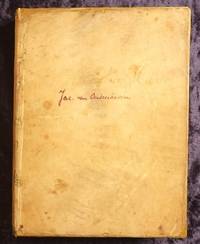
1655E73970Amsterdam: Jan Jacobsz Schipper 1656 1655. Hardcover. Very Good-. Engraved titlepage 3 full-page plates 16 30 23 half-page copperplates by or after Adriaen van de Venne 1589-1662 showing customs family life agriculture trades and dances of death. Quarto vellum laced through with yapp fore-edges and faded manuscript title to spine slightly marked. Half-title and engraved Titlepage dated 1656 to OUDERDOM en BUYTEN-LEVEN xxiv261pp 3pp; HOF-GEDACHTEN with Titlepage dated 1655 and INVALLENDE GEDACHTEN with half-title 1253pp; KONINGKLYKE HERDERIN ASPASIA with Titlepage and extra frontis plate 484pp; HUWELIJCX FUYCK with half-title 32pp; and DOODT-KISTE voor de LEVENDIGE with half-title 224pp. A few tears to margins not affecting printed area some with marginal paper loss and light marginal damp-staining towards the end. Narrative poetry by the foremost writer of the 17th century Dutch Republic with many fine engravings of city and country life by or after van de Venne and a short series of Dances of Death. First editions here of most of the works written near the end of Cats's life at his country estate near The Hague Sorgh-vliet or "escape from care" which is illustrated in the centre of the fine frontis to the whole collection. Jan Jacobsz Schipper hardcover
166112259Coloniæ Busæum 1661-64. Small 8vo. Cont. full vellum. In the middle of back a loss of vellum 2x7 cm. 104064821185757 pp. 2 corners of last Index lost with loss of a few letters. hardcover
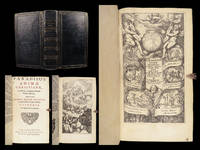
168328479<p><strong>1683 Paradisus Animae by Merlo Horstius German ASCETICISM Illustrated Prayers </strong></p><p>Jacob Merlo Horstius was a 17th-century Cologne priest who was best known for his works on asceticism. One of his more notable works was '<em>Paradisus Animae Christianae</em>' a devotional work originally published in German in 1644.</p><p>This 1683 edition includes prayers hymns and poems scripture verses and references.</p><p>Item number: #28479</p><p>Price: $499</p><p>HORSTIUS Jacob Merlo</p><p><strong><em>Paradisus Animae Christianae Lectissimis omnigenae Pietatis delitiis amoenus</em></strong></p><p>Coloniae : Apud Balthasaris ab Egmont sociorum 1683.</p><p><u>Details</u>:</p><p><!-- if !supportLists-->· <!--endif-->Collation: Complete with all pages</p><p><!-- if !supportLists-->o <!--endif-->32 680 4 93 1</p><p><!-- if !supportLists-->o <!--endif-->Includes 8 full-page engravings</p><p><!-- if !supportLists-->· <!--endif-->Provenance:</p><p><!-- if !supportLists-->o <!--endif-->Armorial Bookplate – Joannis Towneley de Towneley</p><p> <!--endif-->Likely John Towneley 1731–1813 who was a British bibliophile and book collector Trustee of British Museum and elected fellow of the Royal Society of London. Motto: TENEZ LE VRAY</p><p><!-- if !supportLists-->o <!--endif-->Bookplate – Gulielmi O'Brien 1899</p><p><!-- if !supportLists-->· <!--endif-->Language: Latin</p><p><!-- if !supportLists-->· <!--endif-->Binding: Leather; secure</p><p><!-- if !supportLists-->o <!--endif-->Black and gilt Moroccan leather</p><p><!-- if !supportLists-->· <!--endif-->Size: ~8in X 4.75in 20.5cm x 12cm</p><p>Our Guarantee:</p><p>Very Fast. Very Safe. Free Shipping Worldwide.</p><p>Customer satisfaction is our priority! Notify us with 7 days of receiving and we will offer a full refund without reservation!</p><p>28479</p><p>Photos available upon request.</p> Apud Balthasaris ab Egmont sociorum hardcover
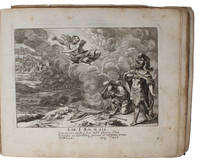
1644SP08-0481-8903Sumpt. Ioannis Kinchii et Sociorum 1644-01-01. Hardcover. Acceptable. In Latin. 1644 first edition Sumpt. Ioannis Kinchii et Sociorum Col. Agrippinae Cologne Germany 3 1/8 x 5 inches tall full leather bound faded gilt dentelles to front cover and gilt lettering and four raised bands to spine elaborately engraved title page eight full-page engravings 22 6 7-522 4 60 pp. Lacking half title page but otherwise complete. Covers rubbed and edgeworn with fraying to the spine caps and tips. Heavy wear along front hinges with chipping to the leather at the upper and lower spine. Holes and marks to the covers especially rear cover where a clasp closure once was. Old one-inch shelf label to spine. Front cover splays open slightly. Prior owner name in period hand to blank front free-endpaper. Cracking along the gutter between the title page and blank front free-endpaper but the binding is quite solid. Burning to the fore margin of six leaves 12 pages pp.408-20 including one of the full-page engravings and the beginning of Chapter 7 not obscuring text or engraving. A few pages with mild creasing or light soiling and a couple of pages with a short edge tear. Otherwise a good to very good copy of this rare first edition of one of the most popular Catholic devotional manuals of the 17th through 19th centuries. OCLC 877150798 and 420229078 locates only five copies at institutions worldwide - one each at the National Library of Scotland in Edinburgh University of Aberdeen Libris in Stockholm Bibliotheque Municipale in Lyon France and the Zentralbibliothek in Zurich Switzerland. ~SSS~ 1.0P Jacob Merlo Horstius 1597-1644 born in Horst Holland from whence he derives his name was a prominent doctor of theology known as an effective preacher at the Lyskirchen in Cologne where he served as pastor. The Paradisus Animae which has gone through many editions in the original Latin since this 1644 first edition was long a favorite prayer book among Catholics. Several English translations appeared one as early as 1670 as 'Paradise of the Christian Soul.' It was translated into French by Nicolaus Fontane under the title 'Heures Chretiennes Tirnes de l'Ecriture et des Saints Peres.' In addition Horstius authored 'Septem Tubae Orbis Christiani' a compilation from the writings of the fathers intended for young Roman Catholic priests. He also edited a commentary of Estius on the Pauline Letters; the works of St. Bernard in two volumes and the works of Thomas a Kempis with Horstius' commentary. Sumpt. Ioannis Kinchii et Sociorum hardcover
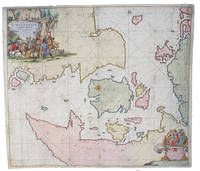
169647333Amsterdam 1696. 52x595 cm. Kobberstukket og håndkoloreret søkort visende Bælterne mellem Østjylland Fyn Sjælland Lolland og Falster Sydsverige Rü Bornholm Nordtyskland m.v. Med det danske rigsvåben i nederste højre hjørne; heri dedikation til Cornelis Tromp den danske og hollandske flådes admiral. Den store kartouche i øverste venstre hjørne viser scener fra folkelivet og brydning af kalksten fra Møn eller Stevns. Fin reparation i højre margin. <br/><br/><em>Sjældent søkort over de indre danske farvande og porten til Østersøen. Kortet "ligger ned" med øst orienteret oppe. Jacob Robyn var kortsælger og kortudgiver. Han købte rettighederne til Pieter Goos's Zee-Spiegel og Zee Atlas fra Goos' enke men han udfærdigede også selv adskillige kort. Hans lager blev overtaget af Johannes Loots i Amsterdam."Alle de anførte hydrografers samtidige kartografer kortarbejder er overordentlig sjældne både herhjemme og i udlandet og noteres betydelig højere i pris end de samtidige landkort" Bo Bramsen p. 112. </em> unknown
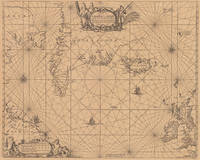
166215989Amsterdam: Jacques & Gasper Anthoine 1662. Other. A strong impression in excellent condition. 426 by 533mm 16¾ by 21 inches. Rare seachart by Jacobsz Theunis of the North Atlantic showing prominent Greenland Iceland and parts of the North American continent. The map is decorated with a large figurative title cartouche in the upper center as well with compass roses ships and an allegoric ornated decorative milage scale. Derived from the Goos 1650 this charts progenitor was actually by his father Theunis Jacobsz c. 1649. Centred on the North Atlantic it concentrated on providing information on the approaches to the North West Passage. Terra Nova is omiited as it was on the Goos. At first Jacob adopted his fathers name being known as Jacob Theunisz. Later with his brother Caspar in association they applied the noun Lootsman to their name to avoid confusion. In 1666 Jacob Lootsman published the first known edition of the Nieuwe Water-Werelt Ofte Zee-Atlas which also encluded this map. -Burden #372. Our copy of the map here can be dated c. 1662 it was bound with a collection of seacharts French text edition of his atlas Le Grand & Nouveau Miroir ou Flambeau De la Mer. by J. Theunis the engraved title was definitly dated 1662. Burden #372 2nd state of 4; Koeman IV pp. 223-4 & 231 Jac. 1.9 & Jac. 19B.25 Jacques & Gasper Anthoine unknown
168860433Norimbergae Nuremberg J.L. Buggelii 1688. 4to-oblong. In contemporary full calf. Wear to extremities boards with scratches upper part of spine missing leather cords showing. Inner hindges partly split. Ex-libris pasted on to pasted down front end-paper. First and last quires detached. Brownspotting throughout. 4 48 28 pp. 51 engraved plates. <br/><br/><em>Rare first and only edition of this illustrated verson of Vergil's Aeneid presumably intended for children. </em> hardcover
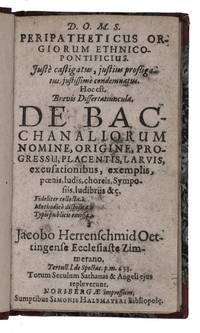
1626145Nuremberg 1626. 12mo. Simon Halbmayer 19th-century red half morocco marbled paper sides. 132 pp. Rare Latin treatise on the Greek Bacchanals with extensive source references. At some points a German translation of a word or sentence is included. At the end is added: "Dissertatiunculae Mantissa. Tentamen-juvenile este quod Autor In Principali-Salana A.D. M.D.C.I. Sub Decanatu D. Petri Piscatoris. Sub censura D. Thomae Sagittarii" on Bacchus in verse. In good condition occasionally foxed and slightly cut short at outer margin.l BMC 704 b 20 1; VD 17 14053903H. unknown
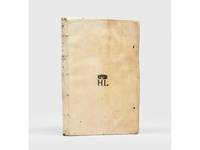
1602177786The Hague: ex officina Bucoldi Cornelii Nieulandii 1602. A portrait gallery of the Reformation First edition a compendium of 50 attractively engraved portraits of famous Protestant theologians each paired with a detailed biography and a list of their works. The illustrator was Henrick Hondius I 1573-1650 one of the most prominent engravers and cartographers in The Hague. This work is uncommon complete with all 50 portraits copies in commerce often lacking gathering "" comprising 2 leaves with the portrait of Berengarius. Hondius's portrait series sometimes referred to in English as "Celebrated Reformers and Men of the Religion" was first published without text in 1599. The artist then collaborated with Verheiden and the printer Nieulandt to include the portraits in this book. The series features all the major Protestant reformers such as Erasmus Luther Melanchthon Zwingli Calvin Theodore Beza John Knox Peter Martyr and Geronimo Savonarola. "The stylistic variation among the portraits may be due to the range of pictorial sources that Hondius seems to have relied upon for depicting each reformer. The portrait of Melanchton for example derives from the well-known portrait engraving by Durer of 1526. thus the entire series seems to have been engraved by Hondius himself during a period in which his style was in the process of transformation" Orenstein p. 64. Other sources of inspiration were the painter Hans Hasper and the engraver Jacques the Gheyn II. Provenance: Henry Yelverton Viscount of Longueville 1664-1704 with his monogram on the covers. Yelverton matriculated at Christ Church Oxford in 1680 but did not graduate and later supported William of Orange during his invasion in 1688. "Yelverton amassed a substantial library whose extent is not known but many volumes are traceable today in libraries around the world in English Latin Italian and Spanish with imprints from the early 16th century to the late 17th. Yelverton's stamp was often applied to books irrespective of their binding when acquired" Book Owners online. A manuscript index of contents was compiled on the final blank leaf of this copy by a late 17th-century hand perhaps by the viscount himself. Folio 302 x 198 mm: 852 A-2C4 2D6 2E4; 122 leaves pp. xvi 226 2. Elaborate engraved architectural frontispiece 50 engraved portraits similar allegorical plate. Contemporary vellum over thin boards flat spine lettered in early manuscript black monogram stamp "HL" surmounted by a viscount's coronet of Henry Yelverton 1664-1704 on both covers yapp fore-edges edges sprinkled red remnants of blue silk ties. Couple of minor near-contemporary marginalia. Head of front joint split but firm a little loss at foot of spine covers slightly bowed tiny rust burn on leaf V2 slightly affecting portrait and a couple of letters small faint damp stain in margin of 3 final leaves. A clean and well-margined copy. Pelc Illustrium Imagines 166; STCN 851224962. Nadine Orenstein Hendrick Hondius and the Business of Prints in Seventeenth-Century Holland 1996. hardcover
168238370Cologne: Demen. Good with no dust jacket. 1682. Hardcover. 790 pp plus index. Full vellum spine bands spine labels. Vellum is chipped away with loss at spine head tear at tail. Board edges worn. Upper spine label chipped with losses. PO names foxing dampstaining. Few instances of underlining. Pin embedded in bottom block edge. ; Large 8vo 9" - 10" tall . Demen hardcover
166139993Cologne: Ioannem Busaeum. Fair. 1661. Hardcover. Contemporary leather. Thick quarto. Front board loose. Edges exposed. Text in Latin. PO names PO blindstamp. Moderate foxing. Spine worn. ; quarto; 790 pages . Ioannem Busaeum hardcover
1690129107Norimbergae Sumptibus Johannis Andreae Endteri Filiorum 1690. First Edition. Hardback. Finely and period sympathetically bound in modern aniline calf over marble boards. Raised bands with a contrasting Morocco gilt-blocked label. An exceptional copy - scans and additional bibliographic detail on request. ; 254 pages; Physical desc. : 1 v various pagings : frontis; coats of arms geneal tables ; 33cm 20 . Subjects: Great Britain - Kings and rulers - Genealogy. Notes: ""Appendix ad Historiam genealogicam regum pariumque Magnae Britanniae anno superiore editam "" inserted at end has special t. P. : 1691. Norimbergae, Sumptibus Johannis Andreae Endteri Filiorum hardcover
16903572Norimbergae: Sumptibus Johannis Andreae Endteri Filiorum 1690. Hardcover. Very Good. Folio engraved allegorical frontispiece by Johann Jacob Sandrart full-page plate of royal arms through the ages; plus three full-page plates of armorial achievements. Numerous genealogical tables throughout. 234 pp. - though last page reads 254. 6 pp. index follows. Full contemporary leather binding worn especially along spine. <br/><br/> Sumptibus Johannis Andreae Endteri Filiorum hardcover
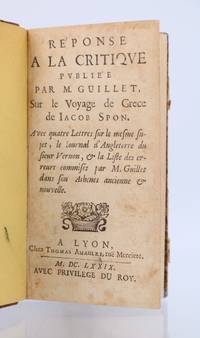
167989345Lyon: Thomas Amaury 1679. Fine. Thomas Amaury Lyon 1679 8.5 x 15 cm Relié Very rare first edition. Some light foxing. Contemporary 19th-century modest half-grained cloth binding spine faded marbled paper boards with surface abrasions yellow endpapers and pastedowns marbled edges. Sole edition uncommon of this vindication by Jacob Spon 1647-1685 concerning his major travel account of the Levant Voyage d'Italie de Dalmatie de Grèce et du Levant fait aux années 1675 & 1676 published in 1678. Georges Guillet de Saint-Georges 1624 or 1625-1705 had a little earlier 1675 produced a description of the contemporary state of the city and monuments of Athens which Spon disputed in his own narrative even going so far as to question whether Guillet had ever travelled in Greece at all. Hence a quarrel of the kind scholars delight in: sharp and somewhat futile. Bookplate of a Greek educational institution affixed to a pastedown. Thomas Amaury hardcover
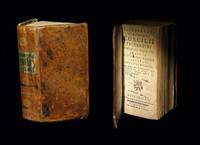
1674228671674. Parisiis Paris apud N. PepinguÂŽ 1674. Un fort vol. au format in-12 154 x 91 mm de 11 ff. n.fol. 298 pp. ; 1 f. n.fol. clix pp. 53 ff. n.fol. et 1 f. bl. Reliure de l'ÂŽpoque de plein veau glacÂŽ et marbrÂŽ havane plats jansÂŽnistes dos ˆ nerfs ornÂŽ de filets gras ˆ froid caissons d'encadrement dorÂŽs fleurons dorÂŽs titre dorÂŽ palette dorÂŽe en queue roulette dorÂŽe sur les coupes tranhes jaunes et mouchetÂŽes. L'ouvrage s'orne de jolis ornements typographiques. ''Le CatÂŽchisme du concile de Trente ou CatÂŽchisme romain date de 1566. Il diffÂre des autres catÂŽchismes catholiques sur deux points : ˆ l'origine il est destinÂŽ aux prÂtres des paroisses ad parochos et il a fait autoritÂŽ au sein de l'ƒglise catholique plus qu'aucun autre jusqu'au CatÂŽchisme de l'ƒglise catholique de 1992. Le besoin dÕun manuel faisant autoritÂŽ ÂŽmergea de l'ignorance gÂŽnÂŽralisÂŽe du clergÂŽ d'avant la RÂŽforme et du manque dÕintÂŽrÂt pour lÕinstruction religieuse des fidÂles qui en dÂŽcoulait. Il est encore ÂŽtudiÂŽ dans le domaine de la thÂŽologie dogmatique. Les pÂres du concile de Trente Çvoulant absolument combattre un mal si grand et si funeste par un remÂde efficace non seulement ont pris soin de bien dÂŽfinir contre les hÂŽrÂŽsies de notre temps les points principaux de la doctrine catholique mais de plus ils se sont fait un devoir de laisser pour lÕinstruction des chrÂŽtiens sur les vÂŽritÂŽs de la Foi une sorte de plan et de mÂŽthode que pourraient suivre en toute sžretÂŽ dans leurs ÂŽglises ceux qui auraient la charge de Docteur et de Pasteur lÂŽgitimeÈ. Le pape Pie IV confia la rÂŽdaction du CatÂŽchisme ˆ quatre thÂŽologiens renommÂŽs : les archevÂques Leonardo Marino de Lanciano Muzio Calini de Zara Egidio Foscarini l'ÂŽvÂque de ModÂne et Francisco Fureiro un dominicain portugais''. Angles ÂŽmoussÂŽs. Quelques frottements affectant dos et plats. Petite dÂŽcoupe en texte du premier feuillet de contre-garde blanc. Rares rousseurs dans le texte. Quelques plissures angulaires. Du reste bonne condition. Rare. b42961 unknown
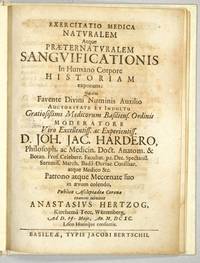
1690446021690. Basileae: Typis Jacobi Bertschii 1690 Kl.4° 16 pp. Pappband. Exercitatio medica naturalem atque praeternaturalem sanguificationis in humano corpore historiam exponens / quam . moderatore . Ioh. Iac. Hardero . publico . examini submittit Anastasius Hertzog Kirchemâ Tecc. Würtenberg. Ad d. . Maii an. M.DCXC. Husner: Verzeichnis bas. med. Univ.Schriften Nr. 1232 unknown
169156230Franckfurt a. M. Verlegung ds Authoris Johan Görlin 1691. Contemp. full vellum. Stamp on title-page. 10388;6301 pp. 12 folded engraved plates. 1 plate repaired in right margin no loss but browning to lower corner. Internally clean. <br/><br/><em>Klaus Jordan 4078. </em> hardcover
169555736Amsterdam: Be-veit ha-meshutafim Asher Anshil ben Eliezer ve-Yisakhar Ber ben Avraham Eliezer/ Moses Wiesel 1695. First edition. Hardcover. g to near fine. Small folio 30 by 18.8 cm. Collation: aleph-vav4 zayin2 = 26 numbered leaves. Full period brown paper boards re-backed with a brown leather spine with raised bands.<br /> <br /> Letterpress title-page with ornate floral woodcut device; additional engraved title-page mounted depicting Moses and Aaron along with six small biblical scenes within round borders all against an architectural background. Engraved folding map at rear mounted; main title with woodcut vignette; 14 half-page engraved illustrations in the text.<br /> <br /> This gorgeously illustrated work is the first edition of the famous and highly influential Passover Haggadah printed in Amsterdam in 1695. Simply known as the Amsterdam Haggadah this edition stands as among the most imitated and copied haggadahs in history and was the first to be illustrated with copperplate engravings. Previous illustrated haggadahs had used woodcuts. The popularity of these illustrations can be attested by the huge numbers of reprint editions over the centuries. There are 14 finely printed large in-text engravings plus the full page engraved title page showing Moses Aaron and Adam in the Garden of Eden. Some of these images illustrate the traditional content of the Passover seder and/or the exodus story while some are other biblical stories less directly related. Images include: the Rabbis of Bene Brak discussing the Passover story the four sons Abraham smashing the idols of his father Abraham welcoming the three angels Moses slaying the Egyptian overseer the rescuing Moses from the river Moses and Aaron coming to Pharaoh w/ staves turning to snakes the ten plagues the Egyptian army drowning in the Red Sea the Exodus the receiving of the Ten Commandments at Mt. Sinai the eating of the Pascal Lamb King David composing his psalms and finally an exterior view of the Holy Temple with the cityscape of Jerusalem in the background. All images are captioned underneath with relevant passages in Hebrew. The engravings were all created by Abraham ben Jacob a German convert to Judaism who had moved to Amsterdam although some sources over the years misattributed them to financier Moses Wiesel 6 of which were adaptations and/or modifications of previous images by Swiss artist Matthäus Merian 1593-1650 from his original work "Icones Biblicae" 1625-30.<br /> <br /> In addition to the in text engravings there is famously a phenomenal fold-out engraved biblical map of the holy land. Measuring a total of 19.5x11.5" the map shows the land of Israel the Sinai desert and Egypt in landscape orientation looking eastward towards the top of the map. It traces the journey of the Israelites starting with the Exodus from Egypt through the desert and into the Land of Israel. The map is detailed showing the areas of the twelve tribes important locations and cities as well as geographic features including the Red Sea Mount Sinai the Dead Sea the Sea of Galilee and many others. The map is decorated with additional illustrations near the bottom and includes a key. This beautiful work also by Abraham ben Jacob is considered among the earliest if not the first map of its kind to be printed within a Hebrew publication. It is now known to have been heavily based on the previously printed 1620 map in Hebrew by Jacob ben Abraham Zaddiq and Abraham Goos 1590 - ca. 1643 which itself was based on the map of 1590 by Christian Kruik van Adrichom Adrichem printed in Latin.<br /> <br /> Text throughout is printed in Hebrew with smaller text in Rashi script underneath containing famous commentary on the Passover Haggadah by acclaimed Portuguese Rabbi and scholar Isaac ben Judah Abarbanel 1437-1508. The verso of the title page contains the order of the Passover seder with brief instructions in both Ladino Judeo-Spanish and Yiddish Judeo-German a nod to the subtitle of Haggadah which references the both Ashkenazi and Sephardic traditions.<br /> <br /> This copy with binding in beautiful condition with being professionally restored includining spine re-backed to style. Book block tight. Interior with some staining to pages throughout from use. Binding in very good to near fine inteiror in good condition overall. Hebrew title: סדר הגדה של פסח ×›×ž× ×”×’ ××©×›× ×– וספרד <br /> Alternate transliterations: Seder Hagadah shel Pesah Seder Hagadah sel Pesah<br /> <br /> References: Friedberg 278 Fuks HTN II 521; Yudlov Haggadah 93; Vinograd Amsterdam 627; Ya'ari no. 59; Laor 876 Map; Nebenzahl pp.138-1389 Map; Yerushalmi plate 59-62; Rosenau "Vision of the Temple" p.135 146-7. Be-veit ha-meshutafim [Asher Anshil ben Eliezer ve-Yisakhar Ber ben Avraham Eliezer]/ Moses Wiesel hardcover
169555262Amsterdam: Be-veit ha-meshutafim Asher Anshil ben Eliezer ve-Yisakhar Ber ben Avraham Eliezer/ Moses Wiesel 1695. First edition. Hardcover. fair. Small folio 29 by 18.5 cm. Collation: aleph-vav4 zayin2 = 26 numbered leaves. Additional engraved title page engraved folding map at rear; main title with woodcut vignette; 14 half-page engraved illustrations in the text. Contemporary quarter calf over dark brown pastepaper boards skilfully rebacked. Images of Moses and Aaron at engraved title excised the seven small engraved vignettes along with letterpress text of engraved title and imprint mounted on old paper. Old marginal repairs at main title resulting in slight loss of initial letters along right margin and several leaves; slight strictly marginal worming and occasional tears. Stained throughout sometimes heavily though not impairing legibility. Map mounted to reinforce tears with virtually no loss of text or engraved imagery apart from printed border at right side. A fair copy at best; despite all defects the half-page engraved illustrations have survived intact with minimal staining. Housed in new maroon buckram slipcase.<br /> <br /> First edition of this gorgeously illustrated work now referred to simply as the Amsterdam Haggadah. The first such work to be illustrated with copperplate engravings it ranks among the most imitated of the Jewish manuals for the Passover seder. The popularity of these illustrations can be attested by the huge number of reprint editions over the centuries. Fourteen finely printed half-page engravings appear throughout the text. Some of these images illustrate the traditional content of the Passover seder or the Exodus story while others reference other biblical tales. Images include: the Rabbis of Bene Brak discussing the Passover story the four sons Abraham smashing the idols of his father Abraham welcoming the three angels Moses slaying the Egyptian overseer the rescuing Moses from the river Moses and Aaron coming to Pharaoh w/ staves turning to snakes the ten plagues the Egyptian army drowning in the Red Sea the Exodus the receiving of the Ten Commandments at Mt. Sinai the eating of the Pascal Lamb King David composing his psalms and finally an exterior view of the Jewish Temple with the cityscape of Jerusalem in the background. All images are captioned with relevant passages in Hebrew. The engravings were all created by Abraham ben Jacob a German convert to Judaism who had moved to Amsterdam although some sources over the years misattributed them to financier Moses Wiesel 6 of which were adaptations and/or modifications of previous images by Swiss artist Matthäus Merian 1593-1650 from his original work "Icones Biblicae" 1625-30.<br /> <br /> In addition to the in text engravings there is famously fold-out engraved biblical map of the Holy Land in a notable format. Measuring a total of 19.5 by 11.5" the map shows the land of Israel the Wilderness of Sinai and Egypt in landscape orientation looking eastward towards the top of the map. It traces the journey of the Israelites starting with the Exodus from Egypt through the Sinai and into the Land of Israel. The map is detailed showing the areas of the twelve tribes important locations and cities as well as geographic features including the Red Sea Mount Sinai the Dead Sea the Sea of Galilee and many others. Additional illustrations appear near the bottom along with a legend. This beautiful work also by Abraham ben Jacob is considered among the earliest if not the first map of its kind to be printed within a Hebrew publication. It is now known to have been heavily based on the previously printed 1620 map in Hebrew by Jacob ben Abraham Zaddiq and Abraham Goos 1590 - ca. 1643 which itself was based on the map of 1590 by Christian Kruik van Adrichom Adrichem printed in Latin.<br /> <br /> Text throughout is printed in Hebrew with smaller text in Rashi script underneath containing famous commentary on the Passover Haggadah by acclaimed Portuguese Rabbi and scholar Isaac ben Judah Abarbanel 1437-1508. The verso of the title page contains the order of the Passover seder with brief instructions in both Ladino Judeo-Spanish and Yiddish Judeo-German a nod to the subtitle which references both the Ashkenazi and Sephardi traditions.<br /> <br /> Provenance and annotations: Full page of text appx. 1500 words in neat Hebrew cursive at front endleaf which discusses aspects of the Haggadah text; inscription in German at front endleaf by Isidor Adler who mentions his friend Hermann Mechlenburg dated March 1906; old annotations throughout in at least two hands. In one notable instance the Hebrew phrase l'shana ha-ba'ah be-hamburg next year in Hamburg! has been added in fine block characters above the traditional phrase l'shana ha-ba'ah bi-yerushalayim next year in Jerusalem. Hebrew title: סדר הגדה של פסח ×›×ž× ×”×’ ××©×›× ×– וספרד <br /> Alternate transliterations: Seder Hagadah shel Pesah Seder Hagadah sel Pesah<br /> <br /> References: Friedberg 278 Fuks HTN II 521; Yudlov Haggadah 93; Vinograd Amsterdam 627; Ya'ari no. 59; Laor 876 Map; Nebenzahl pp.138-1389 Map; Yerushalmi plate 59-62; Rosenau "Vision of the Temple" p.135 146-7. Be-veit ha-meshutafim [Asher Anshil ben Eliezer ve-Yisakhar Ber ben Avraham Eliezer]/ Moses Wiesel hardcover
1699SZEPEBKS005408ILubecae Lubeck: Wiedemeyer 1699. First edition . Hardcover. Fine/not applicable. 8vo. 922.5X17 cm. - 1063 pp. - Wiedemeyer Lubecae 1699. - Leather over wooden boards wood slightly broken on front and back covers leather somewhat worn. Spine with 6 raised bands. Paper partially browned but not affecting plate else fine. - With a folding plate showing both sides of 18 gold coins each with the portrait of a Hungarian king from Ludovicus through Leopoldus 1689. - With some initials and an elaborate endpiece. - In Latin. - Apponyi III 1468. <br/> <br/> Wiedemeyer hardcover
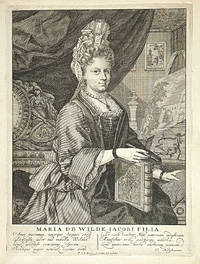
1700103081<p>Amsterdam Maria de Wilde 1700. 4to. 1 1 blank 11 1 blank pp. and 60 numbered engraved plates. = engraved title-page an engraved vignette depicting "virtute" signed "A. Schoonebeek fec." 1 large folding plate showing the interior of "Museum Wildianum" a full-page engraved portrait of Maria de Wilde signed "P. v.d. Berge ad vivum del. et fecit." decorated initials in the text and 60 numbered engraved plates by Maria de Wilde. Contemporary blind-stamped vellum sewn on 4 supports and laced through the joints with the manuscript title and author at the head of the spine red and blue sprinkled edges. With the green and white bookplate of "Collectie Buijnsters-Smets" on the inside of the front board and with the black and white bookplate of "A. Pitlo. Plus est en vous" on the verso of the now loose front paste-down. The binding is slightly browned and the paste-downs have come loose revealing the sowing supports. Internally fine and clean. Overall in very good condition.</p><p>First and only edition of an attractive display of the statues of the Museum Wildeanum once housed on the Keizersgracht in Amsterdam. The Dutch tax collector Jacob de Wilde 1645-1721 began the collection containing gems coins scientific instruments and statues. "This attractive account of a Dutch cabinet of the late seventeenth century is as much a eulogy of Maria de Wilde's gifts as an engraver as of her father's museum" Grinke. The 60 plates by Maria de Wilde 1682-1729 show the ancient Egyptian Greek and Roman statues in the museum including Egyptian figures of Isis Horus etc. some of which are now believed to be Renaissance copies of antique originals. The 6 text leaves include a brief introduction and several laudatory poems directed at Maria de Wilde and her engravings. The collection drew some important visitors including the Russian tsar Peter the Great in 1697. His visit is illustrated on the engraved folding plate where he can be identified by the double-headed eagle at his feet an element of the Russian coat of arms sitting in the museum at a table accompanied by Jacob. After De Wilde's death the collection probably dispersed. The tsar acquired part of it for his "Kunstkamera" the first museum in Russia which was completed in 1727. A catalogue of the gems and coins of the museum was published in 1703 entitled Gemmae selectae antiquae e museo Jacobi de Wilde.<br />From the library of the Dutch professor of civil and notarial law Adriaan Pitlo 1901-1987 and from the collection of Dutch book historian and professor of Dutch literature linguistics and book history Piet J. Buijnsters 1933-2022 and his wife the art historian Leontine M.A. Buijnsters-Smets 1937-2021. A beautiful copy of an art historical work showing a late 17th-century Dutch cabinet with a notable provenance. c.f. Grinke 61; Murray I p. 38 & III p. 272; STCN 842380264; Tavernier Russia and the Low Countries: an international bibliography 3178.</p> Maria de Wilde
165140032London: John Macock for Giles Calvert 1651. 4to. 7 1/8 x 5 3/8 inches. 8 224 pp. Bound to style in half calf marble paper boards spine with raised bands in six compartments with ruled lines and center tool red lettering piece in second compartment.<br/> <br/> Rare first English edition of Jacob Böhme's a groundbreaking work of Christian mysticism translated by J. Ellistone which reveals the hidden connections between the material and spiritual worlds through its exploration of the signatures imprinted on all of creation.<br/> <br/> At once leatherworker mystic and founder of modern theosophy Böhme published little in his lifetime and what was published brought him endless trouble with the Church. Despite this Böhme had a profound influence on later philosophical movements such as German Idealism and German Romanticism with Hegel describing him as "the first German philosopher". Böhme was born in Alt Seidenberg now in present-day Poland. Deemed too weak for husbandry Böhme was sent to Seidenberg as an apprentice to become a shoemaker. While he lived with a family who was not Christian Böhme regularly prayed and read the Bible and consumed the works of visionaries such as Paracelsus Weigel and Schwenckfeld. After leaving his apprenticeship Böhme travelled as far as Görlitz before returning as a master craftsman to set up his own workshop and started a family. Böhme later joined the "Conventicle of God's Real Servants" - a parochial study group organized by poet and mystic Martin Moller. Since his youth Böhme often had spiritual experiences including one that occurred while he was travelling for business where as he later recalled was "surrounded with a divine light and stood in the highest contemplation and kingdom of joys." This title The Signature of All Things written in High Dutch in 1622 following a series of Böhme's mystic experiences appears here in the first English edition. In it Böhme explains systematically the cosmology that lies at the heart of his whole mystical approach and experience revealing his mystical pantheism and his dialectical conception of God in which good and evil are rooted in one and the same being. The book is a highly symbolic work that deals with the nature of God creation and the relationship between the spiritual and physical worlds. In brief Böhme's thesis can be summarised thus: everything in the material world bears the imprint or "signature" of its spiritual counterpart and that by understanding these signatures one can gain insight into the divine. The present work is the title for which Böhme is most famous and it is invoked by James Joyce in the Proteus episode in Ulysses "Ineluctable modality of the visible." Bohme's ideas had a significant influence on later mystics philosophers and theologians including Goethe Nietzsche and Jung. Signatura Rerum remains a classic work of Christian mysticism and esoteric philosophy and is still studied and debated by scholars and practitioners today.<br/> <br/> Wing B3419; Bach "Jacob Boehme" in Protestants and Mysticism in Reformation Europe; Hartman The Life and the Doctrines of Jacob Boehme the God-Taught Philosopher. John Macock for Giles Calvert unknown
167022401670. : 8 Latere schutbladen titelblad verstevigd professioneel gerestaureerd. Binding: Contemporary Full Vellum Octavo 8vo Height cm: 205 CM Width cm: 155 CM Thickness cm: 35 CM hardcover
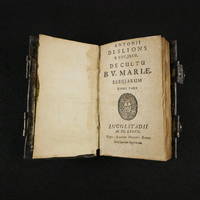
1678733Ingolstodt: Joannis Philippi Zink 1678. Hardcover. Fair. Three poetical works of early 17th century Jesuit poets bound into one binding with beautiful silver decorations covering the front and rear board. About the Literary Works - Three works are bound within: 1. 1672 De Cultu B. V. Mariae Elegiarum in three books not ""book three"" as it is often catalogued; all three ""libri"" are found within the printing by Antoine Deslions. 2. No title page bound in starts at A1 page 1 - Epigrammatum Selectrorum by Bernard Bauhuis 3. 1672 Silvulae Hendecasyllarborum by Jacob Bidermann About the Binding - No maker's mark is readily visible. The book was published in Ingolstadt where the silversmith family of Kienlin see book bindings attributed to Johann Adam Kienlin plied their trade. It was common for bindings of this time to have a silver spine but I see no hinges which indicate one might have been removed and the leather of the spine was decorated. Still a silver spine may have been removed and the board edges cut of their hinges. but removing the hinges seems unlikely. This book was sold in the 1924 Sotheby Sale of the Library of Dr. E Marion Cox. Bibliographic Details - All three works are printed by Joannis Philippi Zinck in Ingelstadt. The first and third work have a printing date of 1672; presumptively the middle work would also have been printed in 1672 the title page is not bound-in but Worldcat doesn't have record of a 1672 edition. The Deslions work is catalogued in Worldcat as OCLC 836616102 among others. The Bauhuis work is catalogued in Worldcat as OCLC 1088278417 with a printing date of 1678. The Bidermann work is catalogued in Worldcat as OCLC 78071635 among others. Physical Attributes - Measures approx. 13 x 8 x 3 cm. Leather binding with blind tooling. Over the front and rear board silver covers have been added; these are likely repousse hammered from the back side and are decorated in the French rococo style each with a proud central medallion. The front medallion is a woman holding a goblet and books the rear medallion is a woman holding her baby and guiding her child. The covers have been turned-in just like a leather binding. The silver clasps work and one clasp depicts a putti holding a spade and the other a lute. The endpapers are dutch-gilt the front one is missing the flyleaf and the rear endpaper shows a wonderful depiction of a lute player in gilt. Three works bound into one binding. The second work is missing its title page and any prefatory printed material it begins at page 1 signed A1. Pages - vi 106 128 title page vi 128 The third work seems like it might not have had a leaf bound-in; the first gathering is fifteen leaves instead of 16 but the catchwords match and nothing seems missing so it was likely a blank the binder chose not to include. Condition - See pictures. Silver tarnished with some bumps around the edges. Leather binding under is dried out. The spine is crazed and chipped from the head and tail; there is evidence of glue repair along the front and rear leather joint. There is a little rubbing noticeable on the leather under the silver covering the boards. Front flyleaf missing. Blank bookbinder endpaper mounted instead; some numbers written on it and the remnants of an auction ticket presumably. Text block has some toning throughout with occasional fox spots page edge bumps etc. A few pages seem slightly proud. The index at the back of the Deslions work insn't included. Also the title page and any intros are not bound in for the Bauhuis it starts on page 1. I see a very occasional annotation. Blank endpaper at rear has notes on which poems apply to different life situations. Rear flyleaf has a white mark at bottom and the fore-edge is a little rough; also several small holes which may be from binding. Joannis Philippi Zink
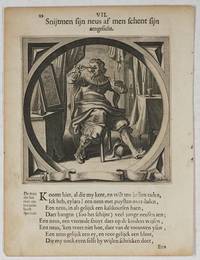
1632635801632. Spiegel van den Ouden ende Nieuwen Tijdt. - Gravenhage Isaac Burchoorn 1632 4° 225 x 170 mm. Emblem from "Spiegel van den ouden ende nieuven tijdt" Mirror of old and new times a book of emblems by Jacob Cats Amsterdam 1632 / Emblem aus "Spiegel van den ouden ende nieuven tijdt" Spiegel der neuen und der alten Zeit einem Emblembuch von Jacob Cats Amsterdam 1632. Snijtmen sijn neus af' men fchent sijn aengeficht. Koomt hier al die my ken en wilten besten raden Ick heb eylaes ! een neus met puysten over-laden Een neus in als gelijck een kalikoutsen haen Daer hangen soo het schijnt veel jonge neusen aen; Een neus een vreemde snuyt daer op de kinders wijsen Een neus 'ken weet niet hoe daer van de vrouwen ysen Een neus gelijck een ey en root gelijck een bloet Die my oock even selfs by wijlen schricken doet . Cut off his nose they say and you'll see his face. Come here all of you who know me and try to guess I have alas! a nose covered with pimples A nose like a cockatoo's beak On which it seems many young noses hang; A nose a strange snout that children point at A nose I don't know how that women ice A nose like an egg and red like blood Which sometimes frightens me as well . Jacob Cats 1577-1660 was a Dutch poet humorist jurist and politician. He is most famous for his emblem books. unknown