7 résultats
151831810Augsburg: S. Grimm and M. Wirsung 1518. Hardcover. Very good. Five parts small quarto 19.5 by 14 cm: a-d4 = 16 leaves. 32 pp. Text in Latin. Title within elaborate woodcut borders; woodcut initials. Modern marbled boards. Lightly toned with occasional faint smudges mostly marginal. Three discreet worm holes 1mm and less throughout sometimes obscuring a letter else a very good copy with crisp text.<br /> <br /> Early printing of the first Latin edition of Maimonides' Fi Tadbir al-Sihha On the Regimen of Health. Like his other medical and philosophical works it was composed in Arabic. The present translation however was likely based upon the 13th-century Hebrew version Sefer Hanhagat ha-Bri'ut attributed to Moses ibn Tibbon. The editio princeps first printed edition of this Latin version appeared at the monastic press of Sanctum Jacobum de Ripoli in Florence under the direction of Fra Domenico da Pistoia in an undated edition sometime between 1477 and 1481. In 1501 it appeared at Pavia as an appendix to a general treatise on the medical arts the Tabula Consiliorum of Giovanni Matteo Ferrari court physician to Francesco Sforza. The later editions of the Tabula which appeared at Venice in 1514 and again at Pavia in 1517 also include this Latin version of On the Regimen of Health. The present edition thus appears to be the first separate printing of this Latin translation to appear after the rare Florentine incunable.<br /> <br /> A philosopher physician rabbinic authority and codifier of Jewish law Maimonides Moses ben Maimon the Rambam; 1135 or 1138-1204 was the most illustrious Jewish scholar of the post-talmudic era. At the age of thirteen he and his family fled Cordoba to escape the Almohad persecutions and later settled in Fustat an ancient district of Cairo. "It was here that Maimonides started to practice and teach medicine. and became the physician of al-Qadi al-Fadil the famous counsellor and secretary to Saladin" Bos.<br /> <br /> On the Regimen of Health was composed at an unknown date for al-Malik al-Afdal Nur al-Din Ali ca.1169-1225 Saladin's eldest son. He was appointed by his father as governor of Damascus while still a youth and ascended to the throne as Sultan of the Ayyubid Empire in the winter of 1198/1199. Maimonides later served him in that capacity as court physician. In the Latin version of On the Regimen of Health al Malik al-Afdal is described as The Great Sultan of Babylon Magnifico Soldano Babylonie. In his preface Maimonides describes his work as divided into four tracts the first and last providing general medical advice suitable for all persons. The second treatise provides a regimen for the sick who are unable to consult a physician. The third is specifically intended for the Sultan who has informed Maimonides about his medical complaints -- constipation indigestion and depression -- through his emissary per suum nuncium significavit. There is a fifth part not mentioned in the preface which appears in the Florentine editio princeps as well in which Maimonides criticizes the treatment of the Sultan by other physicians.<br /> <br /> The "regimen of health" tadbir al-sihha genre has a long history in Islamic medical literature. Rooted in ancient Greek medical theory it was reinforced with the ritualistic hygiene of the Qur'an and the later Hadith traditions. "Maimonides teaches that physical convalescence is dependent on psychological well-being and rest. He stresses the necessity of hygienic conditions in the care of the body physical exercise and proper breathing work family sexual life and diet and suggests that music poetry paintings and walks in pleasant surroundings all have a part to play toward a happy person and the maintenance of good health" EJ.<br /> <br /> "On the Regimen of Health is frequently mentioned consulted and quoted in Hebrew literature; in the thirteenth century by Judah ben Samuel ibn Abbas and Shem Tov ibn Falaquera; in the fourteenth century by Israel ben Joseph Caslari Joseph ben Abba Mari ibn Kaspi Menahem ben Aaron ibn Zerah and Meir Aldabi. The physician Tobias ben Moses Cohn 1652-1729 quotes from Maimonides' On the Regimen of Health in his MaÊ¿aseh Tuviyyah which was 'the most influential Hebrew textbook of the sciences especially medicine'" Bos.<br /> <br /> Provenance: early 20th-century bookplate of Jan Kok at front pastedown. References: G. Bos Maimonides On the Regimen of Health: A New Parallel Arabic-English Translation Brill 2019 preface and intro; Durling NLM 16th 3304; Enc. Jud. 1st ed. 11: 779; Fürst vol. 2 p. 314; Proctor German 1501-1520 10875; Steinschneider 6513.145; VD16 M6423 providing imprint information: Sigmund Grimm and Marx Wirsung. For the first printed edition see British Museum 15th Century part VI Florence p. 623 IA. 27063; Hain 10525.<br /> <br /> Full title and imprint: Tractatus Rabbi Moysi de regimine sanitatis ad Soldanum Regem from colophon: Augustae Vindelicorum. Anno virginei partus. M.D.XVIII. die. ix Iulii.<br /> <br /> Opening line of text: Tractatus Rabbi Moysi quem domino et Magnifico Soldano Babilonie transmisit.<br /> <br /> Uniform titles: ספר ×”× ×”×’×ª הברי×ות Sefer Hanhagat ha-Bri'ut / FÄ« tadbÄ«r al-á¹£iḥḥah. S. Grimm and M. Wirsung hardcover
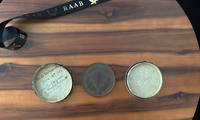
15093366415/09/1866. <blockquote><p>Acquired from the direct descendants of the commander of the vessel that received the medal in Russia it was not known to have survived and has never before been offered for sale</p></blockquote><p>Emperor Alexander II issued the Emancipation Manifesto on March 3 1861 which granted freedom to over 23 million serfs. This reform is known as the Emancipation Edict. The Emancipation Proclamation was issued by President Abraham Lincoln on January 1 1863. It declared that all persons held as slaves within the rebellious Confederate states ""are and henceforward shall be free."" The Union victory in the Civil War finalized in 1865 ensured this would become the law of the land.</p><p>Lincoln and Alexander had something else in common. Lincoln was assassinated in April 1865 by John Wilkes Booth in an act of political violence. The attempted assassination of Alexander II in 1866 was a failed act of political violence by Dmitry Karakozov a young revolutionary. Karakozov's aim was to kill the Tsar and spark a revolution believing the Emperor had betrayed the people's expectations after his emancipation of serfs in 1861. Another attempt around 20 years later would be successful.</p><p>In 1866 President Andrew Johnson sent Assistant Secretary of the Navy Gustavus Vasa Fox who had played a leading role in the expedition to relieve Fort Sumter in April 1861 on a mission to Russia primarily to deliver a resolution from Congress congratulating Emperor Alexander II on his survival of the assassination attempt. The mission also aimed to gather information on European naval capabilities and explore potential trade opportunities including the sale of the ironclad monitor USS Miantonomoh. The mission was a major event marking a high point in Russian-American friendship and was met with grand receptions in St. Petersburg and Moscow.</p><p>In the process Johnson sent the ironclad Miantonomoh itself on a world tour with the destination of Russia - first across the Atlantic and through the North Sea the Baltic and then through the Mediterranean in 1866 and 1867. The commander of this vessel was Moses Stuyvesant graduate of the Naval Academy and hero of the Civil War. He had been on two sunk vessels including one taken down by a Confederate Ironclad.</p><p>But the mission had two messages: to congratulate Russia on the freeing of the serfs and the Tsar on surviving the assassination attempt. The resolution read: “JOINT RESOLUTION relative to the attempted assassination of the Emperor of Russia.</p><p>“Be it resolved by the Senate and House of Representatives of the United States of America in Congress assembled That the Congress of the United States of America has learned with deep regret of the attempt made upon the life of the Emperor of Russia by an enemy of emancipation. The Congress sends greeting to his Imperial Majesty and to the Russian nation and congratulates the twenty millions of serfs upon the providential escape from danger of the sovereign to whose head and heart they owe the blessings of their freedom.</p><p>“Sec. 2. And be it further resolved That the President of the United States be requested to forward a copy of this resolution to the Emperor of Russia.</p><p>“Approved May 16 1866.â€</p><p>In mid Summer the Miantonomoh arrived in the harbor of Cronstadt on the 17th of August and the Tsar sent an address acknowledging the visit of Mr Fox. On Saturday September 15 the fleet went to push off from Russia. Mr. Fox left Petersburg after a farewell breakfast given on Russian yacht Rurik at which the Russian Lieutenant Greig presented the Americans with a symbol of their newly instituted freedoms from slavery in both countries: a medal struck in memory of the enfranchisement of the serfs in Russia. Grieg said ""The friendship of the two nations. among the causes to which is due this mutual spirit is the great event emancipation which has been accomplished almost simultaneously in the two countries - there by a sanguinary struggle here by the path of peace."" He then presents the ""medal struck in memory of the enfranchisement of the peasants.He will see on it the likeness of our sovereign and the effigy of a nobleman and of peasant.""</p><p>This is that very <strong>medal</strong> given by the Russians to the Americans to commemorate the freedom of their former slaves presented to the Americans depicting the scene of Alexander II on one side as Grieg says in a case on the inside of which Stuyvesant as commander of the expedition has signed his name and dated it September 15 1866 the day of the presentation of the medal and Grieg's speech and written <em>""From the Emperor of Russia Alex III""</em> instead of II. The bronze medal reads: <em>""FEBRUARY 19 1861 Cut to N. Kozin from the model of count F. Tolstoy. Engraver: Nikolai Kozin""</em> It is not known how many were made. A small number have reached the market but none akin to this: with the important symbolism of a state gift congratulating a nation on emancipation.</p><p>This was a gift of one slave-freeing nation to another in the immediate aftermath of those actions. This medal was not known to have survived and comes from the direct descendants of Stuyvesant who received it September 5 1866.</p><p><img class=""alignnone wp-image-25018 size-post-window"" src=""https://cdn.raabcollection.com/wp-content/uploads/20231204144051/Folder-site-11-1600x1327.jpg"" alt="""" width=""1600"" height=""1327"" /></p> unknown
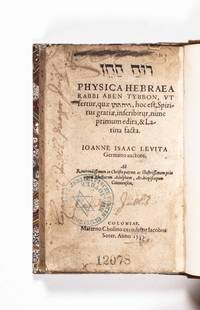
155548871Köln Cologne: Maternus Cholinus and Jakob Soter 1555. First Latin diglot edition. Hardcover. Good. Small octavo. A-L16 = 88 leaves signed on each side e.g. A8 verso is signed A16; H9 missigned G9. 16 157 2 epigram 1 blankpp. Pagination and register run from right to left. Modern quarter sheep over marbled boards gauffered edges endleaves renewed. Library stamps and old owner entries at title; early marginal annotation and underlinings in the “Epistolaâ€; text toned with dampstain affecting bottom quarter of text throughout not impairing legibility; marginal tear at C7. A good complete copy with ample margins.<br /> <br /> Third edition per Steinschneider and the first Latin diglot version of this anonymous introductory work. First published at Venice in 1544 it is notable that a Latin translation appears so soon after a sixteenth-century editio princeps of a Hebrew work. It comprises a commentary on and explanation of difficult terms in Maimonides' Moreh Nevukhim Guide for the Perplexed with an elucidation of terminology in the translations of Arabic to Hebrew as well as the jargon of medieval philosophical literature in general. As the editor of the present edition notes at the title "Ru'ah Hen has been attributed to the renowned translator R. Judah ben Saul ibn Tibbon c. 1120-c. 1190 and to R. Jacob ben Abba Mari ben Samson Anatoli 13th century also a translator of note. Ibn Tibbon known as the 'father of translators' was born in Granada Spain but relocated to Lunel in Provence France to escape the persecution of the Jews in the former location. He supported himself as a physician coming into contact with many sages one of whom R. Meshullam ben Jacob requested that ibn tibbon translate R. Bahya ibn Paquda's Hovot ha-Levavot into Hebrew. In addition to translating that work from Arabic ibn Tibbon also translated several other books into Hebrew among them R. Judah Halevi's Kuzari R. Saadiah Gaon's Emunot ve-De'ot and R. Solomon ibn Gabirol's Middot ha-Nefesh and Mivhar Peninim" Heller. While this is the fourth known printing of the work it is the first to include vowel points and the translation of the formerly Jewish convert to Christianity Johann Isaac Levita 1515-1577 a descendant of Elias Levita the most famous in his time of those Jews who sought scholarly contact with Christians and taught Christians Hebrew. As an added bonus the present edition includes Maimonides' De astrologia epistola elegans. The celebrated English jurist and Hebrew scholar John Selden is known to have had a copy of Ruah ha-Hen in his library Oxford Library note.<br /> <br /> Adams J-403. Cf. Heller The Sixteenth Century Hebrew Book 815 noting the present ed. Steinschneider 1 col. 639; no. 4038. VD 16 I1. Hebrew title: רוח החן. Maternus Cholinus and Jakob Soter hardcover
1587910999CGWittenberg:, Ambrosius Kirchner, 1587. Holzschnitt, 26 x 36 cm, Blattgröße 30,5 x 39 cm. [2 Warenabbildungen]
157715716A Lyon, Par Guillaume Roville, 1577. Un volume in-8 de [1]-4 feuillets-de la page 5 à 172-[4] pages; 311-[8] pages (signatures a8 [manque a1 et a8];b4;c-m8;aa-vv8) Pleine basane brune, dos à nerfs, orné de filets et fleurons dorés, pièce de titre en maroquin bordeaux, tranches mouchetées de rouge, mors fendus, manque à la coiffe supérieure, épidermures, mouillure au second plat et coins inférieurs du corps de l'ouvrage, marqués d'une auréole .
15202401040023xbvkOhne Druckerangabe (gem. VD16 gedruckt in Leipzig bei Melchior Lotter d. Ä., 1520) [MDXX]. (7) Seiten (inkl. der unbedruckten 'Titelblatt'-Rückseite) auf 4 Blättern, mit figürlicher Holzschnitt-Initiale 'N' auf S. (3); in braunem Halbleineneinband der 1. Hälfte des 20. Jahrhundert mit Pappdeckeln (blaues Überzugspapier) und handschriftlichem Papierrückenschild; kl.-4to.(ca. 20 x 15,5 cm).
159619353Würzburg, Fleischmann, 1596. 20 n.n. Bll. Schöne Holzschnitt-Titelbordüre, einige Vignetten und Holzschnitt-Initialen. 8°, späterer, schlichter Papierumschlag.