MOSES SEIXASBiblio.com
88 résultats
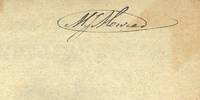
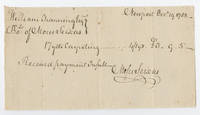
178825418<p>Seixas' 1790 letter of welcome elicited the first president's most compelling statement on religious liberty "to bigotry no sanction." In this 1788 receipt Seixas signs a receipt documenting payment for carpet by William Channing the state's new attorney general.</p><p><strong>MOSES SEIXAS.</strong> Manuscript Document Signed to William Channing December 18 1788. Receipt for carpeting. 1 p. 7¼ x 4 in.</p><p><strong>Complete Transcript</strong></p><p><em>Newport Dec<u>r</u> 19 1788</em></p><p><em>William Channing Esq</em></p><p><em>Bo<u>t</u></em> Bought <em>of Moses Seixas / 17 yds Carpeting . . . . . . . . . . .4/1 yd. £3.9. 5.</em></p><p><em>Received payment In full /</em></p><p><em>Moses Seixas</em></p><p>Docketing on verso in another hand: <em>Moses Seixas</em></p><p><strong>Moses Mendes Seixas</strong> 1744-1809 was born in New York into a Jewish family. His father immigrated from Portugal to New York about 1730 and became a merchant. The family moved to Newport Rhode Island in 1765. Moses Seixas married Jochebed Levy in 1770 and they had eight children. He was one of the organizers and first cashier of the Bank of Rhode Island which conducted business in his house until 1818. After the British occupied Newport during the Revolutionary War Seixas remained in Newport but was among the signers of a document supporting the patriot cause. In 1790 he was the president of the Congregation Yeshuat Israel later Touro Synagogue in Newport. He was also a charter member and first grand master of St. John's Lodge of Free and Accepted Masons in Newport.</p><p><strong>William Channing</strong> 1751-1793 was born in Newport Rhode Island and graduated from the College of New Jersey Princeton in 1769. In 1773 he married Lucy Ellery daughter of William Ellery a Newport lawyer who signed the Declaration of Independence and they had nine children. Channing was elected Attorney General of Rhode Island in 1777 and when Rhode Island ratified the U.S. Constitution in 1790 Channing became the first federal District Attorney. One of his sons was the famous Unitarian preacher William Ellery Channing 1780-1742.</p><p><strong>Historical Background</strong></p><p>From 15 Sephardic families who arrived in 1658 Newport Rhode Island's Jewish community grew to be the largest in the colonies. Many Jews left during the Revolutionary War when Newport was occupied by the British. A significant number returned when the British left in 1779. By the time Rhode Island became a state there were approximately 300 Jews in the thriving Newport community.</p><p>Starting while on his way to New York to assume the presidency in April of 1789 George Washington received many messages from civic fraternal and religious organizations offering congratulations praise of his deeds in war peace and politics prayers on behalf of congregations or constituents. Washington's replies justly count among his most famous pronouncements setting a boldly inclusive tone that helped our new nation survive and expand.</p><p>After the first session of the first Congress Washington set out on a tour of the New England states except for Rhode Island which had yet to ratify the Constitution. It finally did so in May of 1790 and three days after the second session of Congress adjourned Washington Jefferson and others set out to visit Newport. On August 18 Washington and his entourage were greeted with four addresses written as open letters and read in a public ceremony. First the town then from all the Christian clergy then the Masonic order and finally from the Hebrew Congregation.</p><p>Moses Seixas on behalf of the Congregation Kahal Kadosh Yeshuat Israel congratulated Washington on his ascendancy to the Presidency. He invoked the language of the Revolution in arguing that Jews should be entitled to the same privileges as an American of any other religious denomination. Having been previously "deprived…of the invaluable rights of free Citizens" Seixas expressed his hopes for the success of the new "government erected by the majesty of the people a government which to bigotry gives no sanction—to persecution no assistance; but generously affording to all liberty of conscience."</p><p>Seixas' letter moved President Washington who echoed Seixas' words and built on them to make his most celebrated statement on religious freedom. He responded as soon as he returned to the capital New York assuring the Hebrew congregation that "happily the Government of the United States which gives to bigotry no sanction to persecution no assistance requires only that they who live under its protection should demean themselves as good citizens in giving it on all occasions their effectual support. It would be inconsistent with the frankness of my character not to avow that I am pleased with your favorable opinion of my Administration and fervent wishes for my felicity. May the Children of the Stock of Abraham who dwell in this land continue to merit and enjoy the good will of the other Inhabitants; while every one shall sit in safety under his own vine and fig tree and there shall be none to make him afraid."</p><p>Washington's addresses responding to religious congregations included those of Baptist Congregational Dutch Reformed Episcopalian German Lutheran German Reformed Jewish Protestant Presbyterian Quaker Roman Catholic and other denominations.</p><p>Today we understand that Washington and his fellow Founding Fathers were oblivious to the realities of other kinds of oppression. Knowing what we know now how can we still value these slave-owners' declamations on freedom While acknowledging Washington's ownership of his full share of the universal biases of his age we can and should still treasure his "to bigotry no sanction" letter as a powerful testament to the promise of America. In the 218 years since Washington responded to Seixas' address has anyone come up with a better definition of the benefits and responsibilities of American citizenship</p><p>Washington's original letter was acquired by the Morris Morgenstern Foundation in 1948 and is on long-term loan to the National Museum of American Jewish History in Philadelphia. Seixas' letter to Washington is in the Library of Congress and Seixas' retained copy was acquired by the Morgenstern Foundation in 1949 and is with Washington's letter.</p><p><strong>Condition</strong></p><p>Fine condition with intersecting folds and slight bit of foxing.</p>
179553585Erlangen: Printed by Christian Karl Gottlieb Kunstmann 1795. First edition. Hardcover. Very good condition. Elephant Folio. Unpaginated 10pp. Bound in dark half leather over light brown leather with gilt lettering and ruling on spine. Title page with engraved vignette. Engraved headpieces for both first pages in Hebrew and German. Engraved endpieces as above. Text printed in Hebrew and German throughout on facing pages.<br /> <br /> The hymn praises peace and the treaty alongwith the prudence of King Friedrich Wilhelm was sung by Moses Hochheimer Rabbi in Ansbach. It was printed by Christian Karl Gottlieb in Erlangen. This peace treaty between France and Prussia was rectified on April 5 1795 in Basel and was the first of three treaties that established France as the dominant power in Europe in effect breaking up the First Coalition. France was represented by François de Barthélemy Prussia by Karl August von Hardenberg. Minor wear to binding. Pages somewhat age-toned with some creasing small chips along edges and some light foxing. Printed by Christian Karl Gottlieb Kunstmann hardcover
17876593Bern: in der Hallerschen Buchandlung 1787. Soft cover. Good. 8vo 152 x 95mm. 60pp. Modern wrappers margins trimmed close occasional spots lightly browned; front wrap loose but present. A satire on the Berlin academy written jointly by Lessing and Moses Mendelssohn criticizing the philosophical system of Alexander Popeís Essay on Man 1733-1734. Lessing German writer critic and dramatist was one of the most outstanding representatives of the Enlightenment era. His plays and theoretical writings often witty and ironic substantially influenced the development of German literature. In 1755 the collaborative work of Lessing and his friend philosopher Moses Mendelssohn anonymously appeared in the form of this provocative treatise Pope ein Metaphysiker! Pope as a Metaphysician. The controversial treatise dissected the subject of a contest at the Prussian Royal Academy. The two friends wrote it to confirm that there cannot be a true comparison between a poetic and a philosophic conception. <br/><br/> Bern: in der Hallerschen Buchandlung paperback
174948747The map is 10 cm by 12.7 cm. with explanation on right side and title above upper margin The presence of Moses Harris among the first settlers with his draughting abilities resulted in the first outline plan of Halifax being published in 1749 and followed by this very similar map published in the same year. This simple plan of Halifax was then used as an inset in a series of maps by T. Jefferys in 1750 and by numerous cartographers through to Bellin in his "Le Petit Atlas Maritime" of 1764. Kershaw Vol. III-p.119 The Gentleman's Magazine unknown
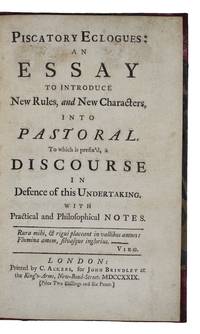
1729AQ26633London: Printed by C. Ackers for John Brindley 1729. 14 129pp 1. Later red straight-grain half-morocco marbled paper boards ruled and lettered in gilt. Lightly rubbed and marked. Marbled endpapers title page browned. The first edition of poet and Church of England clergyman Moses Browne's 1704- 1787 highly naturalistic angling pastorals that include the first avowed imitation of Milton's 'Lycidas'. The didactic portions are adapted from Izaak Walton's Compleat Angler a work which Browne was to edit and republish for the first time since 1676 in 1750 at the suggestion of his friend Samuel Johnson. The nine poems were reprinted under the title Angling Sports in 1773. ESTC records copies at five locations in the British Isles BL Cambridge Leeds NLS and Oxford and a further 11 in North America California Harvard Huntington Illinois NYPL Newberry North Carolina Pennsylvania Princeton Virginia and Yale. ESTC T55150. First edition. 8vo. Printed by C. Ackers, for John Brindley hardcover
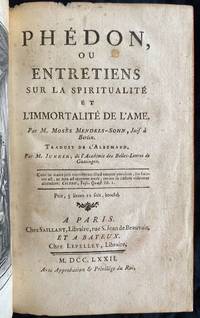
177243257Paris et Bayeux chez Saillant et Lepelley 1772. 1st French-language edition. Period full leather binding with gilt spine and red edges with original marbled endpapers 8vo. Includes frontis copperplate etching. XXIV 342 1 pages. “Traduit de l’Allemand par M. Junker de l’Académie des Belles-Lettres de Goettingen.â€<br> This first French edition appeared 5 years after the first German edition of 1767<br> <br> "Phaedon or On the Immortality of the Soul" Phaedon Oder Ueber Die Unsterblichkeit Der Seele In Drey Gespraechen is one of Mendelssohn's 1729-1786 most famous publications establishing his reputation as the "German Socrates of Berlin." It is a philosophical interpretation of the Platonic dialogue "Phaedo" and is preceded by a biography on "The Life and Character of Socrates." The important German-Jewish philosopher was one of the most important representatives of the Enlightenment in Prussia and throughout Germany.<br> <br> Mendelssohn's Phaedon is a “classic of rational psychology on the immortality of the human soul a defining work by this leading enlightenment philosopher who launched the Jewish thinking of the modern age" with his tribute to Socrates modeled on Plato's dialogue the Phaedo.<br> Mendelssohn used Plato's famous dialogue the Phaedo as a model to publish Phädon oder über die Unsterblichkeit der Seele. With this seminal work "he reached the heights of fame" Wigoder Dictionary of Jewish Biography 342. <br> The work unites Mendelssohn's "paean to Socrates with an elaboration of the dreadful personal moral and political implications if a person's life is her 'highest good'… <br> This 'classic of rational psychology' as Dilthey put it also contains an argument for the simplicity and immortality of the human soul explicitly singled out for criticism by Kant in the 2nd edition of the Critique of Pure Reason. Mendelssohn supports the notion that the soul is simple and thus indestructible by noting that certain features of the soul namely the unifying character of consciousness and the identity of self-consciousness cannot be derived from anything composite whether those composite parts be capable or not of thinking… <br> As for the human soul's fate after death Mendelssohn appeals to divine goodness and providence which perhaps explains why following the publication of the Phaedo he finds himself needing to revisit the proofs for God's existence" Stanford Encyclopedia.<br> According to Mendelssohn’s modern biographer Alexander Altmann “The work that would establish Mendelssohn's world-wide renown and win him the title 'the German Socrates' was the dialogue Phaedon which was published in 1767. In this work he presented Socratic wisdom from the mouth of the ancient philosopher but in the language of the Enlightenment that is in his own words as a modern philosopher. <br> The work drew both praise and criticism but was on the whole popular in intellectual circles. It demonstrates Mendelssohn's unique ability as a Jew to be comfortable in the realm of both classical and enlightened philosophy not to mention languages. David Sorkin remarks ‘What is ironic is that Mendelssohn was known and revered as much for the quality of his prose as for his thought.†<br> Mendelssohn was himself often referred to as the German Plato or the German Socrates. <br> And “As a Jew living in Germany Moses Mendelssohn 1729-1786 stands at a pivotal point in the history of Jewish emancipation in Europe. There were Jews before him who had access to the corridors of power in Germany and elsewhere in Europe but Mendelssohn represents the first to be socially accepted to a significant extent within enlightened German culture without converting. <br> He not only conformed to the culture of the German Enlightenment in many ways but also helped shape the culture through his philosophical contributions. At the same time Mendelssohn refused to turn away from traditional Judaism. He attempted to become a full- fledged member of society during the emergence of modern Europe while remaining a proponent of Judaism as a revealed religion. Moreover he sought to use his place of influence to encourage Jewish acculturation in Germany and to speak on behalf of the emancipation of Jewish people…. <br> The traditional mentality of the European Jews prior to Mendelssohn's time included a kind of resignation to the incompatibility of Jewish learning and 'worldly' philosophy. This resignation contributed to Jewish cultural isolation. Alfred Jospe describes the conundrum in which a Jew found himself if he wished to enter the culture of the non-Jewish world: The Jew could gain access to the culture of the world only by rebelling against the traditional repudiation of all mundane wisdom. <br> It is just at this point that Mendelssohn broke the mold. He not only acquired modern German culture but did so by means of his understanding of and contributions to the philosophy that shaped that culture. In his monumental biographical study Alexander Altmann focuses as much on Mendelssohn's philosophy and his answers to contemporary critics as he does on the details of the events and influences of his life. Altmann states with appropriate admiration that “Considering the state of degradation in which the Jewish population lived in eighteenth-century Germany. Mendelssohn's rise to fame and his acceptance into the republic of letters was an amazing feat of personal achievement.†<br> The amazing feature of Mendelssohn's achievement is that he accomplished it as an avowedly traditional Jew. Mendelssohn has been rightly described as a rabbinic scholar but he made his reputation in non-Jewish intellectual circles as a literary critic and philosopher….with the help of both Gotthold Lessing and the Berlin publisher Friedrich Nicolai he was accepted into the inner circle of the Berlin Aufklärung. <br> His essays reviews and translations earned him tremendous status among German intellectuals. <br> The favorable comparison made by Lessing between the quintessential German poet Goethe and Mendelssohn is a mark of the esteem in which he was held. ‘Lessing told Friedrich Heinrich Jacobi that once Goethe regained his reason he would be hardly more than an ordinary man. At the very same time he said of Mendelssohn that he was the most lucid thinker the most excellent philosopher and the best literary critic of the century’" Clark 2005. P. 57-58. <br> OCLC: 19939219. <br> Very light edgewear to front endpapers touch of spotting a gorgeous copy in the original leather binding with tooled gilt spine with raised bands and leather label. Beautiful and scarce. B KH-10-30-RLB-’e. Paris et Bayeux, chez Saillant et Lepelley unknown
177214851A Paris Saillant 1772. Cont. full mottled calf. Back worn as the golddecoration is nearly gone. Engraved frontisp. XXIV3422 pp. A few lvs. slightly browned otherwise internally fine. <br/><br/><em>Scarce first French edition. </em> unknown
1776190450Frankfurt & Leipzig.: No publisher. 1776. Publisher’s plain wraps paper spine label with handwritten title. . Very good untrimmed in the wraps. 8vo. 19.5x12 cm. German text. Mendelssohn’s musing on the immortality of the soul. weight: 0.4 lb. Engraved frontis. No publisher. paperback
1791PNDädMEN98Carlsruhe: Schmiederischen Buchhandlung 1791. 1791. 8vo. pp. 5 p.l. 52 224. woodcut title vignette. later marbled bds. rubbed front joint & extremities bit chipped light dampstaining throughout. Mendelssohn's dialogue on immortality in imitation of Plato's Phaedo was first published in 1767. Leben und Charakter des Socrates which occupies pp. 52 at the beginning is chiefly based on the Life of Socrates by J.C.Cooper. cfRand I 369. Carlsruhe: Schmiederischen Buchhandlung, 1791. unknown
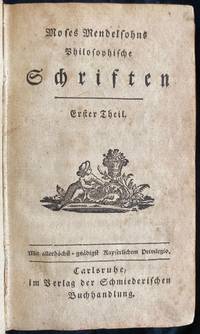
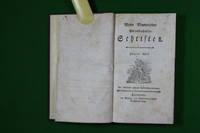
178043258Carlsruhe: im Verlag der Schmiederischen Buchhandlung 1780. No Date 1780s. Period laquered boards with leather spine label. 12mo. XXIV 278; 283 pages. In German. Title translates as “Writings.†Includes 2 different title vignettes 1 on each title page.<br> <br> Goedeke IV 1 488 6. Meyer 108; Dorn 105-107; Holzmann/Bohatta Deutsches Anomymen-Lexikon IV no. 1559. <br> <br> Early printing of Mendelssohn’s second work in which he "began his formulation of a new psychological theory that stressed the autonomy of aesthetics logic and ethics relative to each other." Merriam-Webster's Encyclopedia of World Religions p. 710. <br> <br> Contents:<br> <br> Vol. 1. Vorrede. <br> I. Ueber die Empfindungen.<br> II. Gespräche; <br> <br> Vol. 2. I. Rhapsodie oder Zusätze zu den Briefen über die Empfindungen. <br> II. Ueber die Hauptgrundsätze der schönen Künste und Wissenschaften. <br> III. Ueber das Erhabene und Naive in den schönen Wissenschaften. <br> IV. Ueber die Wahrscheinlichkeit. <br> <br> Also includes bibliographical references.<br> <br> Included within these is a series of writings on aesthetics which influenced Lessing and Schiller with Lessing noting“We have to thank him Mendelssohn for the true theory of mixed sensations.â€<br> <br> Moses Mendelssohn Moses of Dessau; 1729–1786 was a philosopher of the German Enlightenment in the pre-Kantian period early Maskil and a renowned Jewish figure in the 18th century. Mendelssohn was fluent in German and Hebrew and learned Latin Greek English French and Italian. His early teachers were young broadly educated Jews and he met the writer and dramatist G.E. Lessing 1754 and a deep and lifelong friendship developed between them. Throughout his life he worked as a merchant while carrying out his literary activities and widespread correspondence in his free time. In 1754 Mendelssohn began to publish – at first with the assistance of Lessing – philosophical writings and later also literary reviews. <br> He also started a few literary projects for example the short-lived periodical Kohelet Musar in order to enrich and change Jewish culture and took part in the early Haskalah. In 1763 he was awarded the first prize of the Prussian Royal Academy of Sciences for his work Abhandlung über die Evidenz in metaphysischen Wissenschaften "Treatise on Evidence in Metaphysical Knowledge". However when the academy elected him as a member in 1771 King Frederick II refused to ratify its decision. <br> <br> In 1769 he became embroiled in a dispute on the Jewish religion and from then on he confined most of his literary activity to the sphere of Judaism. His most notable and enduring works in this area included the translation into German and commentary on the Pentateuch Sefer Netivot ha-Shalom "Book of the Paths of Peace" 1780–83 and his Jerusalem: oder Ueber religiöse Macht und Judenthum "Jerusalem or On Religious Power and Judaism" 1783 this work the first polemical defense of Judaism in the German language and one of the pioneering works of modern Jewish philosophy. <br> <br> An active intermediary on behalf of his own people in difficult times and a participant in their struggle for equal rights he was at the same time a forceful defender of the Enlightenment against the opposition to it which gained strength toward the end of his life. In the midst of a literary battle against one of the leading figures of the counter-Enlightenment he died in 1786 EJ. <br> <br> SUBJECTS: Philosophy -- Early works to 1800. Philosophie -- Ouvrages avant 1800. Philosophy. OCLC: 1352546328. <br> <br> Light wear to original boards more so at spine but solid and attractive light spotting as expected About Very Good- Condition an attractive 18th Century copy. B KH-10-31. Carlsruhe: im Verlag der Schmiederischen Buchhandlung unknown
1785PNDilMEN56Troppau: Joseph Georg Trassler 1785. 1785. 2 Volumes. 8vo. pp. 268; 167 1. contemporary bds. some scattered foxing. cfRand I 369. Troppau: Joseph Georg Trassler, 1785. unknown
1772N4306Paris: Saillant Librairie 1772. First French Edition . Half Cloth. Very Good. 8vo. XIV342pp1p advertisement. The famous GermanJewish philosopher of the Enlightenment MOSES MENDELSSOHN appears here as author: MENDELS-SOHN. Early 20th century binding. Corners and edge with some wear.Bottom corner with light crack away from edges see photo please. Old name on title page. Otherwise a very good and clean copy. FIRST FRENCH EDITION. <br/> <br/> Saillant Librairie hardcover
1776000046Frankfurt Und Leipzig: 1776 1776 224pp.original cover wrapped.1 illustration at the beginning.foxed. Frankfurt Und Leipzig: , 1776 hardcover
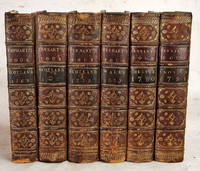
17762307070032London: Printed for Benjamin White; John Monk; Henry Hughes; 1776 - 1782 1776. Hardcover. Very Good. An Illustrated Tour of 18th century Britain 6 volume set. Quartos 24 x 18 cm. Handsomely bound in uniform contemporary polished calf. 6 gilt spine compartments. Minor cracks to joints. Includes fold out map and illustrations. Detailed list of Contents: v.1. A Tour in Scotland. 1769 B. White 1776. Folding engraved map at front engraved title with vignette 42 engraved plates. 4th ed; v.2. A Tour in Scotland. 1772 B. White 1776. Folding engraved map at front engraved title with vignette 47 engraved plates; v.3. A Tour in Scotland and Voyage to the Hebrides. John Monk 1774. Engraved title with vignette 44 engraved plates; v.4. A Tour in Wales. 1773 H. Hughes 1778. Engraved title with vignette 26 engraved plates; v.5. Touring to Snowdon. H. Hughes 1781. Engraved title with vignette 36 engraved plates 2 engraved vignettes in text; v.6. Touring from Chester to London. B. White 1782. Engraved title with vignette 22 engraved plates. <br> Thomas Pennant 1726-1798 was a Welsh naturalist traveler zoologist and antiquarian. Pennant is most known for his works on British Zoology and the History of Quadrupeds. For his contributions to natural science he was admitted to the Royal Society. His travel books predated Samuel Johnson's and influenced his writing. Significantly Pennant's travels helped popularize Scotland to British travelers and provide a valuable insight into the land during this period. <br> "Pennant's travels and natural history are distinguished by his personal energy a keen observational sense and by methodological organization and attention to facts. In such ways and in his friendship and widespread correspondence with others of like interests throughout Britain and Europe he may be said to exemplify those gentleman scholars of nature in the later eighteenth century whose interests in natural knowledge aimed at national improvement through intellectual enquiry." - DNB. In 1771 Pennant published his 'Tour in Scotland' describing the journey made by him in 1769. He says he had 'the hardihood to venture on a journey to the remotest part of North Britain' of which he brought home an account so favourable that 'it has ever since been inondee with southern visitors'. Starting from Chester on 26 June 1769 Pennant visited the Fern Islands off the Northumbrian coast and noted many species of sea-fowl that resorted thither. He made nearly the circuit of the mainland of Scotland observing manners and customs and natural history. On this occasion as on all subsequent tours he journeyed on horseback and kept an elaborate journal. The success of the 'Tour in Scotland' led to his undertaking a second Scottish journey beginning on 18 May 1772. He visited the English lakes proceeded to the Hebrides and was presented with the freedom of Edinburgh. Moses Griffith q. v. the Welsh artist attended him on this journey as also on his later tours making sketches and drawings afterwards reproduced in Pennant's published 'Tours.' Pennant made tours in various parts of England including Northamptonshire 1774 Warwickshire 1776 Kent 1777 Cornwall 1787. As the outcome of several journeys in Wales he published his 'Tour in Wales' the first volume appearing in 1778." - Warwick William Wroth DNB v.44 p. 320-322. London: Printed for Benjamin White; John Monk; Henry Hughes; 1776 - 1782 hardcover
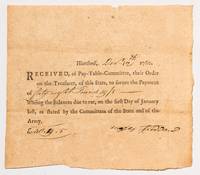
1780423857Hartford Connecticut 1780. Unbound. Near Fine. Approximately 7" x 6. 5" on laid paper with a deckled edge. Old folds near fine. Receipt of payment from the Pay-Table Committee of 48 pounds to Moses Stoddard Signed by Stoddard as received. Docketed as received on the verso. unknown
180011012B1800. In 2 Vol. Parma: Dalla Reale Tipografia Parmense. 1800. CXVI264; 239 p. Later half vellum some rubbing. 1 page with outer corner torn away but no loss of text. Title page slight staining apart from this stainfree. An attractive wide-margined copy on laid paper. hardcover
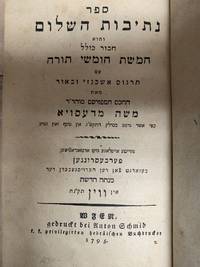
1795RB007Vienna: Anton Schmid 1795. Second. Good. 1795 rare copy of Netivot Ha-shalom The Paths of Peace. A German translation in the Hebrew alphabet of the book of Genesis by Moses Mendelssohn 1729-1786. It includes the Hebrew text of the Bible and a commentary by Mendelssohn. The last 200 pages of the book is the Aramaic text of Onkelos commentary of Rashi and the Haftaroth. This book is a former synagogue copy and in great shape for a book 230 years old. Binding still tight. Although there is wear on the pages it is very readable. Inside front and back covers are 3 off-white blank rectangular stickers one has been torn off leaving residue Markings on both sides of the page preceding the title page. Purple synagogue stamp at top of page prior to the text. That page has a 1-inch tear at the top middle edge. There is another stamp on the bottom right corner of pages 81b and 88b. Light penciled lines about one inch long on 5 pages of the introduction at least one other page of the book has similar marks. About 20 pages with the reverse page's text legible but still readable. Lh Anton Schmid unknown
1780010808Carlsruhe: Im Verlag der Schmiederischen Buchhandlung 1780 Book. Fair. Hardcover. iv 283 1 pages. Vol 2 only - with a series title page - Sammlung der besten deutschen prosaischen Schriftsteller und Dichter Neun und neunzigster Theil - Mendelssohns philosophische Schriften. Undated circa 1780. Pages spotted throughout. In more recent cloth binding which is mottled with damp to the boards. Bookplate removed form the front pastedown. Ink number to the upper outer corner of the title page. Vol 2 only. Im Verlag der Schmiederischen Buchhandlung hardcover
1785SZEPEBKS007095IWien: Sebastian Hartl 1785. First . Soft cover. Very Good/No Jacket. 16mo. 17x10.5 cm. - 79 pp. - Near fine in contemporary strong grey wrappers. - Small ownership stamp on title-page. <br/> <br/> Sebastian Hartl paperback
178928250Berlin: bei Friedrich Vieweg dem álteren 1789.- 3 h. 250 p.; 8º 17 x 11 cm.; buena impresión en letra gótica sobre excelente papel verjurado; Plena Piel valenciana en tonos marrones lomo dorado con filetes y bandas sobre los nervios estuche. Salvo una pequeña marca de humedad en el margen superior de unas 8 hojas que no toca texto su estado es excelente. FILOSOFÃA E HISTORIA DE LA CULTURA Buch auf deutsch bei Friedrich Vieweg, dem álteren hardcover
178677830Berlin 1786. 8vo. Samtidig skinnryggbind med tittelfelt i grønt skinn opphøyde ryggbånd og enkel strekdekor i gull. 14 328 XLII XXIV 87 1 144 s.8vo. Contemporary calfmarbled boards title in green raised bands and simply gilt to spine. 14 328 XLII XXIV 87 1 144 pp. Bey Christian Friedrich Voss und Sohn Tysk. <br/><br/><em>Med Marcus Jacob Monrads navnetrekk på forsatsbladet. Ryggen noe slitt ved nedre kapitél. Medbundet : Moses Mendelsohn an die Freunde Lessings. Ein Anhang zu Herrn Jacobi Briefwechsel über die Lehre des Spinoza. Berlin. 1786.Medbundet : Moses Mendelsohn : Über die Evidenz in metaphysischen Wissenschaften. Eine von der Königlichen Akademie der Wissenschaften in Berlin gekrönte Preisschrift. Neue Auflage.Navn på forsatsbl.Names on front free endpaper. </em> hardcover
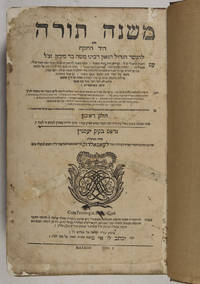
173927896Jessnitz Saxony-Anhalt: Bi-defus Yisrael bar Avraham 1739. Hardcover. Good. Four volumes folio published between 1739 and 1742. Woodcut printer's device at titles; woodcut endpieces in first volume. Hebrew text opens from right to left; leaf numbers in Hebrew characters. Hebrew chronograms yield Jewish dates of publication 5499-5502. Brown library buckram scuffed at extremities spines lettered in gilt. Endleaves renewed. A good set. See foliation and condition notes for each volume below.<br /> <br /> Scarce eighteenth-century edition of this seminal compendium of Jewish law halakhah. Compiled between 1170 and 1180 while Maimonides was living in Egypt the Mishneh Torah is regarded as the author's magnum opus. It is the only Medieval-era work that surveys the full panoply of Jewish observance including those laws that are only applicable when the Jerusalem Temple is in existence. The present edition is the first to contain Judah Rosanes' commentary Mishneh le-melekh. "Mishneh Torah" The Repetition of the Law is an appellation originally applied to the biblical book of Deuteronomy; the subtitle "ha-Yad ha-Hazakah" The Book of the Strong Hand plays on its subdivision into fourteen books: the numerical value fourteen is represented in Hebrew letters as Yud 10 Dalet 4 which forms the word "yad" hand. Maimonides sought to provide a complete statement of the Oral Law so that a person who mastered first the Written Torah and then the Mishneh Torah would be in no need of any other book. Contemporary reaction was mixed with strong and immediate opposition focusing on the absence of sources and the belief that the work appeared to be intended to supersede study of the Talmud itself. Maimonides responded to these criticisms and the Mishneh Torah endures as an influential work in Jewish religious thought. According to several authorities a decision may not be rendered in opposition to a view of Maimonides even where he apparently militated against the sense of a Talmudic passage for in such cases the presumption was that the words of the Talmud were incorrectly interpreted. Likewise: One must follow Maimonides even when the latter opposed his teachers since he surely knew their views and if he decided against them he must have disapproved their interpretation.<br /> <br /> Vol. 1: 1 title 8 234 102 3 ff. Repairs at title page with very slight loss of text at verso following leaf and the final leaf. Text embrowned often heavily in first half with some light marginal dampstains throughout. Old manuscript entries in Hebrew at title in at least three hands.<br /> <br /> Vol. 2: 1 title 148 112 2 ff. Marginal repairs to first and last two leaves no loss of text. Moderately dampstained throughout with some mild embrowning. Old manuscript entries in Hebrew at title in at least two hands; three old stamps at title including at least one censor's approbation.<br /> <br /> Vol. 3: 1 title 221 169 ff. Repairs at bottom margin to title with loss of some text below imprint and at final lines of rabbinic approbations at verso and at bottom margin following leaf with some text loss and obscuration by translucent paper tape. Small marginal repair at final leaf. Light dampstaining in first half; remaining text with mild embrowning. Old manuscript entries in Hebrew at title in at least two hands; two old stamps at title including at least one censor's approbation.<br /> <br /> Vol. 4: 1 title 135 138-154 157 1 ff. Marginal repairs to title and final leaf no loss of text. Sporadic light embrowning and marginal stains. Old manuscript entry in Hebrew at title.<br /> <br /> A complete set with only minimal text loss in a few places -- a very usable scholar's copy. References: Vinograd Jessnitz 46; Fürst 2: p. 295; Zenker p. 583<br /> <br /> Title in Hebrew: ×ž×©× ×” תורה ×”×•× ×”×™×“ החזקה ×œ×”× ×©×¨ הגדול ×”×’×ון ×¨×‘×™× ×• משה בר מימון זצ׳׳ל ×¢× ×”×©×’×ª הר×ב׳׳ד זצ׳׳ל ופירוש הרב מגיד ×ž×©× ×” וכסף ×ž×©× ×” להג×ון המשביר ×¨×‘×™× ×• יוסף ק×רו זצ׳׳ל ומגדל עוז והגהות ×ž×™×ž×•× ×™×™×•×ª ופירוש ×¨×‘×™× ×• עובדי והרב המוסמך מדר׳׳ל ן׳ חביב על הלכות קידוש החדש ×¢× ×›×œ הצורות השייכות להלכות ×לו ולהלכות שבת וסוכה ×•×¢× ×ž×•×¨×” ×ž×§×•× ×¢×œ דברי הרב המגיד וכסף ×ž×©× ×” ×’× ×©×ª×™ מפתחות גדולות ורחבות ×חת על סדר ×”×¤×¨×§×™× ×•×חת על דרך ××œ×¤× ×‘×™×ª×” ×œ× ×—×¡×¨ דבר מכל כפי ×שר × ×“×¤×¡ ב×משטרד×<br /> <br /> Rabbi Moses Maimonides the Rambam was a 12th century Jewish philosopher and halachic legal scholar. A highly controversial figure both during his lifetime and after his death he is generally acknowledged as the preeminent Jewish thinker of the Middle Ages. He was born in Córdoba Spain but fled as a child from the Almohad persecution. He eventually settled in Egypt where he served as a rabbi physician and philosopher. His fourteen-volume Mishneh Torah his only work not in Arabic still carries canonical authority particularly within the Yemenite Jewish community as the codification of Talmudic law. His other works include "Kitab al-Siraj" a commentary on the Mishnah "Kitab al-Fara'I" a book on precepts and the celebrated philosophical work "Dalalat al-Ha'irin" known in Hebrew as the "Moreh Nevukhim" The Guide to the Perplexed. In this latter work Maimonides attempted a philosophical/theological reconciliation of the Hebrew Bible and Greek knowledge. This work came to play a central role in all subsequent major controversies over philosophy within the Jewish community during the Middle Ages. Bi-defus Yisrael bar Avraham hardcover
1765N4664Frankfurt & Berlin: J.J. Speier 1765. First Edition . Half Leather. Very Good. 4to. 1. Theil und 2. Theil bound together. 124pp123pp.First part called "'Ir Heshbon" on Arithmetic and Algebra; the second part : "Berure Middot" on Geometry. MODERN HALF LEATHER BINDING WITH MARBLED BOARDS. Title page with stamp some old handwriting and markings. Upper corner of title page some 3 cm missing and replaced with old repair. Pages with some browning and occasional minor soiling. First pages of the second part trimmrd to text. Last page of the second part with repair to edges End papers with some old writing and minor soiling . OTHERWISE VERY GOOD.AN EXTREMELY RARE AND INTERESTING WORK of MATHEMATICS in HEBREW. this work is mentioned in Zeitlkin Bibliotheca Hebraica.- Elijah ben Moses Gershon Zahalon was a Jewish Talmudist mathematician and physician living in Pinczcow Russian Poland. <br/> <br/> J.J. Speier hardcover
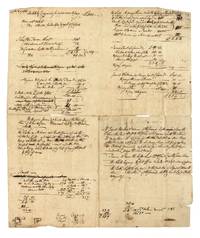
178655770Providence 1786. Folio sheet approx. 15" x 12" docketed on the verso; previous folds with splits no loss; overall toning; good. Brigadier General James Angell 1723-1785 descendant of one of the first settlers of Providence died February 2 1785. This inventory was taken by Moses Brown 1736-1838 executor of the will and both a friend and relative. The Angell's daughter Abigail married a Goddard relatives of the Brown family. Among assets listed are Angell's Johnston farm lot 160 acres of Vermont land a third of an acre lot in North Providence; "we to give James and Jacob a Deed of the Whole of remd of Johnston farm & North Providence lott." James Angell was town clerk of Providence until 1775 and Theodore Foster said of him "I became intimately acquainted with the said James Angell and many of his Family Connexions among whom was the Honorable Stephen Hopkins Esq. whose Sister married the said James Angell." Documentary History of R.I. Angell was also appointed chairman of the committee to revise laws of the state. unknown
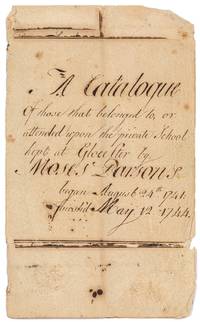
1741560322Gloucester Massachusetts 1741. Softcover. Very Good. Manuscript. 24mo. Three quarter leaves pinned inside two outer full leaves measuring about 3 ½†x 6â€. One quarter leaf is loose laid-in. The full front cover leaf titled in manuscript is trimmed above the title and has one horizontal cut below the title very good. The three-quarter leaves list the names of students 75 boys and 13 girls in ink on the rectos and versos. Born in Gloucester Massachusetts in 1716 Moses Parsons graduated from Harvard in 1736 and while pursuing his theological studies he taught a private school in his native town as noted in the catalogue from 1741-44. In 1744 he accepted a call to Byfield Parish where he was distinguished as a preacher until his death in 1783 having seen the Church through the Great Awakening led by George Whitefield and through the Revolutionary War. At his school Parsons taught a veritable Who’s Who of early Gloucester residents – individual and family names such as Winthrop Sargent whose son was a prominent patriot and Governor of the Mississippi Territory William Ellery Nathaniel Haraden whose son served as the Sailing Master of the U.S.S. Constitution and many others. In addition to his pastoral responsibilities at Byfield Parsons was instrumental in founding Governor Dummer Academy now known as The Governor’s Academy. During his tenure at his private school Parson’s calculates that he taught 75 boys and 28 girls quite a few of whom would go on to be immortalized by Gloucester historians John Babson and James Pringle. An important early manuscript documenting an overlooked piece of Gloucester’s local history.<br /> <br /> Reference: William Cutter. Genealogical and Personal Memoirs Relating to the Families of the State of Massachusetts. unknown