1837-1920, Kuyper, Abraham,Biblio.com
26 503 résultats
46475832like new. unknown
1247480720.Gpaperback. Good. Access codes and supplements are not guaranteed with used items. May be an ex-library book. paperback
1247261484.Gpaperback. Good. Access codes and supplements are not guaranteed with used items. May be an ex-library book. paperback
1024494926.Ghardcover. Good. Access codes and supplements are not guaranteed with used items. May be an ex-library book. hardcover
1313222224.Gpaperback. Good. Access codes and supplements are not guaranteed with used items. May be an ex-library book. paperback
1313019119.Gpaperback. Good. Access codes and supplements are not guaranteed with used items. May be an ex-library book. paperback
1246000024.Gpaperback. Good. Access codes and supplements are not guaranteed with used items. May be an ex-library book. paperback
1020201355.Ghardcover. Good. Access codes and supplements are not guaranteed with used items. May be an ex-library book. hardcover
1290998507.Gpaperback. Good. Access codes and supplements are not guaranteed with used items. May be an ex-library book. paperback
1314673114.Gpaperback. Good. Access codes and supplements are not guaranteed with used items. May be an ex-library book. paperback
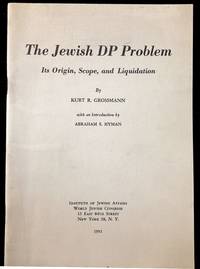
195141424New York: Institute of Jewish Affairs World Jewish Congress 1951. 1st edition. Original paper wrappers. 8vo 43 pages. <br> “No single phenomenon of the postwar period except the struggle for the Jewish Homeland and its miraculous survival in the face of Arab intransigence has proven at once so tragic and so inspiring as that of the more than two hundred thousand Jews from various countries who at one time or another sojourned in camps and towns in Germany Austria and Italy while waiting for new homes and a new life in freedom. For years the two letters ‘DP’ figured prominently on the pages of Jewish publications were a daily topic of conversation the concern of Jewish philanthropy and the preoccupation of all major Jewish organizations the world over. It is for these reasons that the Institute of Jewish Affairs decided to relate the story of the Jewish DPs in the present study…. <br> The purpose of this brochure is to summarize the unique experience in Jewish history which the DPs represented and to give a brief account of what their problem was like and how and by what means it was solved. The full story of the Jewish DPs of course has yet to be written.†from foreword. <br> SUBJECTS: Jewish refugees. Jews -- Europe. World War 1939-1945. <br> OCLC: 21664940. <br> Very Good Condition. B HOLO2-159-59-ALGGR-’p. New York: Institute of Jewish Affairs, World Jewish Congress unknown
197643026Yerushalayim: Yad va-shem rashut ha-zikaron la-Sho'ah vela-gevurah 1976. First edition. Original boards with dust jacket 4to 285 xv pages. Includes illustrations and maps. 28 cm. In Hebrew. Introduction also in English. Title in English as “Pinkhas HaKehilot: Encyclopedia of Jewish Communities: Poland: The Communities of Lodz and its Region.†<br> Encyclopedia of Jewish life in Poland focusing on the regions of Lodz. Includes 42 cm fold out map. Includes bibliographical references. <br> “Encyclopedia of Jewish Communities from Their Foundation till after the Holocaust is the name of each volume of a series presenting collected historical information and demographic data on Eastern European countries' Jewish communities most of which were depopulated and whose populations were exterminated in the Holocaust. Pinkasei haKehillot is one of the most important projects undertaken by Yad Vashem in Jerusalem concisely documenting this aspect of the history of the Holocaust…<br> Each volume of Pinkas Hakehillot is produced geographically with locale names in Yiddish as well as the local language's version. The content is composed of collected documents lists personal memoirs in their original unedited form historical accounts and essays devoted to the life of Jewish communities from antiquity until the present including maps and period photographs. The Pinkas attempts to illustrate ‘the life that once was and is no more.’†Wikipedia.<br> SUBJECTS: Jews -- Poland -- History. Holocaust Jewish 1939-1945 -- Poland. Ethnic relations. Jews. OCLC: 22956042.<br> Slightly worn dust jacket. Very Good Condition in Very Good- Jacket. YIZ-23-52-CCLEX. Yerushalayim: Yad va-shem, rashut ha-zikaron la-Sho'ah vela-gevurah unknown
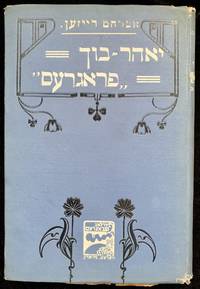
190443110Varsha Warsaw: Ferlag "Progress 1904. First edition. Original illustrated printed boards 8vo 162 32 pages plus 7 unnumbered leaves of plates with illustrations. 22 cm. In Yiddish. Title translates as “Yearbook ‘Progress’: A Journal for Literature Science and Criticism.â€<br> “Abraham Reisen was a Yiddish poet short-story writer playwright and editor…While he was still a teenager his talent was recognized by Shalom Aleichem and I.L. Peretz who arranged for the publication of his earliest poems. After some years in Minsk Warsaw Krakow and Berlin he settled permanently in New York in 1914. Influenced by Heinrich Heine whom he translated into Yiddish he was one of the first Yiddish poets to make use of folksong material. His poetry though mostly written in conventional quatrains is suffused by a refined sensibility that adumbrates the writing of Di Yunge.†Jewish Virtual Library<br> â€In 1900 Yakov Lidski founded "Progress" publishing house. Its name clearly communicated its goal. This publishing company considered to be the first to deal with modern Yiddish literature published a series of original and translated popular science books along with translated European literature and original Yiddish literature. The first editor of the publishing house was poet Avrom Reyzen.†Wikipedia. <br> SUBJECTS: Yiddish literature. Jews -- Poland -- Periodicals. OCLC: 21651882<br> Wear to spine some page separation toning and markings. About Good Condition. YID-46-28-GGLEX-’cc. Varsha [Warsaw]: Ferlag "Progress unknown
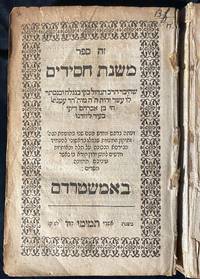
174042573Amsterdam: No Publisher Listed 1740. Hardback. 2nd edition. Period Vellum binding 12mo 132 leaves; 17 cm. In Hebrew. Mayer Sulzberger's copy with his bookplate. Like the Mishnah Mishnat Hasidim is arranged in "Sedarim" which are divided into "massechtot" and subdivided into "perakim." With an introduction entitled: Olam Katan. Includes index. Title-page has ornamental border. <br> Raphael Immanuel ben Abraham Hai Ricchi 1688-1743 was an "Italian rabbi cabalist and poet.After having studied Talmud under Nathan Pinkerle rabbi of Alessandria della Paglia Ricchi became tutor in the houses of several wealthy Jews. He was thus successively employed at Göritz Fiorenzuola Finale in Modena and Venice; in the last-named place he opened a school. He then went to Triest where he was ordained rabbi in 1717 by Hillel Ashkenazi rabbi of Canea after which he was invited to the rabbinate of Görz.<br> Owing to his great love for cabalistic studies and to his ascetic tendencies Ricchi resolved to settle in Palestine. He arrived at Safed in 1718 and during his stay there of two years he occupied himself with the study of the works of Isaac Luria and Hayyim Vital. He was also reordained rabbi by Hayim Abulafia. In 1720 an epidemic broke out in Palestine and Ricchi was compelled to return to Europe. <br> On the voyage he and all his fellow passengers were captured by pirates and brought to Tripolitza whence through the efforts of Abraham Halfon Ricchi and his family were allowed to return to Italy. He then occupied the rabbinate of Florence till 1723 in which year he removed to Leghorn where for twelve years he engaged in business as a merchant. He spent twenty months in travel visiting Smyrna Salonica Constantinople Amsterdam and London and in 1735 set out for Palestine spending two years at Aleppo and three at Jerusalem. In 1741 he returned to Leghorn and in 1743 while traveling in Italy for the purpose of selling his works he was killed by robbers who buried his body by the shore of the Reno. Six days later some Modena Jews discovered the remains and brought them to Cento for burial.<br> Ricchi's most important work is the above-cited 'Mishnat Hasidim' a cabalistic work begun in 1726 at Leghorn. <br> Like the Mishnah it is arranged in orders 'sedarim' which are divided into treatises 'massektot' and subdivided into chapters 'peraim' the names of the six Mishnah orders being taken in a cabalistic sense. But the chief divisions of the work are three termed 'mafteot' besides the introduction entitled ''Olam Kaon' = 'microcosmos' in which Ricchi endeavors to popularize the Cabala. <br> The first main division is the 'Maftea ha-'Olamot' in which the worlds are treated. It contains: 1 the order of Zera'im treating of the cabalistic cosmology and of metaphysics and divided into seven massektot and eighteen chapters; 2 the order Kodashim treating of the realm of emanation 'olam ha-azilut' which is styled 'the holy of holies' and containing twenty massektot and seventy-eight chapters; 3 the order ohorot treating of the three other realms namely those of creative ideas 'beri'ah' creative formations 'yezirah' and creative matter 'asiyah' and divided into nine massektot and twenty-seven chapters; and 4 the order Nezikin treating of the demons and 'kelifot' and divided into six massektot and seventeen chapters. <br> The second main division entitled 'Maftea ha-Neshamot' contains the order Nashim treating of souls in twelve massektot and forty-eight chapters. The third main division entitled 'Mafteah ha-Kawwanot' contains the order Mo'ed divided into fifty-eight massektot and 371 chapters and treating of the Kawwanah. It will be seen that the number of massektot in this work is 112 corresponding to the numerical value of the sacred name ; and the number of chapters 547 equal to the numerical value of Ricchi's name plus twelve the number of its letters. <br> The sources for this work besides the Zohar are mostly Isaac Luria's and Hayyim Vital's writings of which the 'Sefer ha-Gilgulim' 'Kanfe Yonah' and 'Shulhan 'Aruk' may be particularly mentioned. Ricchi drew also from other cabalists" M. Seligsohn in JE 1905.<br> NYU houses their copy in the Mitchell M. Kaplan Collection of Rare Judaica and Hebraica. Aviva Ben-Ur's Ladino catalog list #14. Judge Mayer Sulzberger "was closely associated with Isaac Leeser and assisted that scholar in editing The Occident contributing to it a partial translation of Maimonides' "Moreh Nebukim." After Leeser's death Sulzberger edited vol. xxvi. of The Occident. He was one of the founders of the Young Men's Hebrew Association which he served as president; and he has taken great interest in the Jewish Hospital of Philadelphia of which he has been vice-president since 1880. He was from the beginning in 1888 chairman of the publication committee of the Jewish Publication Society of America; was one of the original trustees of the Baron de Hirsch fund; and interested himself in the establishment of agricultural colonies at Woodbine N. J. and in Connecticut.Sulzberger had one of the best private libraries in America; it contained a very large number of Hebraica and Judaica" WIkipedia. SUBJECTS: Cabala -- Early works to 1800. Siddurim -- Texts. Judaism -- Ari rite -- Liturgy -- Kabbale -- Ouvrages avant 1800. Siddour -- Textes. Cabala. OCLC: 904949349. OCLC lists only 2 copies of this 1740 2nd edition worldwide NYU & Cambridge and only 3 copies of the first edition of 1727.<br> Boards slightly bowed with front hinge starting. Remains of 19th Century paper label on spine. Lacks front blank pastedown. Jewish institutional bookplate in addition to that of Sulzberger. Paper toning but strong. About Very Good- Condition. Attractive copy of early edition of an important cabalistic text. RAB-67-7. Amsterdam: [No Publisher Listed] unknown
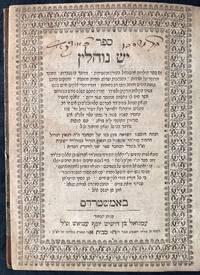
170143446Amsterdam: 'Imanu'el ben Yosef 'Atias 1701. 1st edition. Period Half Leather over Marbled Boards 8vo 2 46 leaves i.e. 4 92 pages 20 cm. In Hebrew.<br> By the father of the Holy Shela'h haKadosh.<br> <br> Ethical teachings and customs by the father of the holy Shelah with the will of his son Rabbi Shabtai Sheftel printed here for the first time<br> Sefer Yesh Nochalin a collection of ethical teachings conduct and laws by the Gaon and Kabbalist Rabbi Avraham HaLevi Horowitz father of the Ba'al Shelah HaKadosh with glosses and additions by his son Rabbi Yaakov Horowitz.<br> At the end of the book the will of Rabbi Shabtai Sheftel Horowitz son of the holy Shelah and grandson of the author was printed for the first time.<br> Rabbi Shabtai Sheftel HaLevi Segal Horowitz 1592-1660 son of Rabbi Yeshayahu HaLevi Horowitz is known for his book "Snei Luchot HaBrit." He was a rabbi and Rosh Yeshiva one of the greatest Ashkenazi Jewish scholars of his generation. He was a preacher in the Prague community and the rabbi of Fürth Frankfurt Poznan and Vienna. He edited his father's book "Snei Luchot HaBrit" and is known by the name of his own book "Vavei HaAmudim."<br> <br> SUBJECTS: Jewish ethics -- Early works to 1800. Morale juive -- Ouvrages avant 1800. Testaments moraux <br> OCLC: 9055147.Light rubbing to boards toning as expected a very attractive copy in original binding Very Good Condition. B Rab-67-15-KKXLB. Amsterdam: 'Imanu'el ben Yosef 'Atias unknown
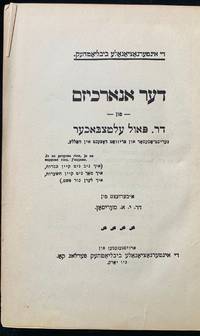
190943139New York: Internatsyonale bibliothek Verlag ko 1909. First edition. Original boards 8vo 347 pages 21 cm. In Yiddish. Title translates as “Anarchism.â€<br> Translation of Paul Eltzbacher’s “Anarchism†into Yiddish. In it he covers seven anarchist figures: Godwin Proudhon Stirner Bakunin Kropotkin Tucker and Tolstoy. Includes bibliographical references.<br> “Jacob Abraham Maryson was a Jewish–American anarchist doctor essayist and Yiddish translator. Maryson was among the few Pioneers of Liberty who could write in English. He was among the Pioneers who launched the Varhayt in 1889 the first American anarchist periodical in Yiddish….Maryson contributed to a variety of other Yiddish publications and became known as ‘the Kropotkin of the Jewish anarchist movement’. During Fraye Arbeter Shtime's hiatus in the late 1890s Maryson assisted in the cultural and literary journal Di Fraye Gezelshaft. Beginning in 1911 he edited the anarchist periodical Dos Fraye Vort. Maryson organized the Kropotkin Literary Society to print Yiddish translations of European thinkers. Maryson handled some of the group's most challenging translations including Marx's Das Kapital Stirner's The Ego and His Own and Thoreau's Civil Disobedience. He also translated John Stuart Mill's On Liberty. Maryson later wrote The Principles of Anarchism in 1935.†Wikipedia.<br> SUBJECTS: Anarchism. OCLC: 19304220<br> Very Good Condition. YID-48-3-. New York: Internatsyonale bibliothek Verlag ko unknown
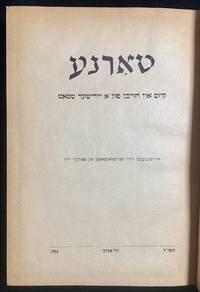
195443017Tel Aviv: Aroysgegeben durkh Landsmanshaftn fun Torner Yidn 1954. First edition. 8vo. Original printed boards. xx 928 pages includes illustrations facsimiles map and portraits. 25 cm. In Yiddish. Title translates as “Tarnow: Existence and Destruction of a Jewish City.†<br> Memorial book for the community of Tarnow in Poland. Includes essays on the religious and political life of Jews in Tarnow and essays on the various diasporic communities where they established landsmanshaftn. Includes bibliographical references and index. <br> “Before World War II about 25000 Jews lived in Tarnow a city in southern Poland 45 miles east of Krakow Cracow. Jews—whose recorded presence in the town went back to the mid-fifteenth century—comprised about half of the town's total population. A large portion of Jewish business in Tarnow was devoted to garment and hat manufacturing. The Jewish community was ideologically diverse and included both religious Hasidim and secular Zionists.†USHMM. <br> SUBJECTS: Jews -- Poland -- Tarnow Wojewo´dztwo Malopolskie -- History. Holocaust Jewish 1939-1945 -- Poland -- Tarnow Wojewo´dztwo Malopolskie Ethnic relations. Jews. OCLC: 19197168.<br> Some tears and discoloration. Good Condition. YIZ-23-58-CCLEX. Tel Aviv: Aroysgegeben durkh Landsmanshaftn fun Torner Yidn unknown
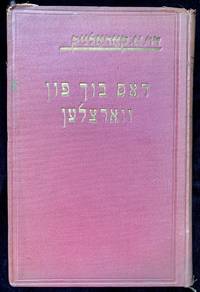
192843187Varshe Warsaw: Ahisefer 1928. First edition. Original printed boards. 8vo 262 pages 22 cm. In Yiddish. Title translates as “The Book of Roots.â€<br> Auto-biography of Jewish-American Yiddish writer Abraham Coralnik. <br> Coralnik 1883-1937 “was born in Uman Kiev district to a father who was a scholar and a follower of the Jewish Enlightenment….<br> His literary activities commenced in 1903 in German as a contributor to Die Welt The world in Vienna the central organ of the Zionist world organization. He later edited German periodicals in Czernowitz Vienna and Zagreb. He placed work in German philosophical journals and major German newspapers. He wrote several dramas in German and Das Russenbuch The Russian book Strassburg 1922 471 pp. an anthology of Russian literature. He also wrote for several Russian newspapers and from 1911 was a correspondent writing from Berlin Copenhagen and Rome for the St. Petersburg newspaper Rech’ Speech. <br> Several of his essays appeared in Haatid The future in Berlin over the years 1908-1913. In 1914 he lived for a short time in Copenhagen and in 1915 he emigrated to New York and became a contributor to Tog Day. His first article in Tog appeared on October 11 1915.†Leksikon Fun Der Nayer Yidisher Literatur. <br> SUBJECTS: Jews -- Biography. OCLC: 19313330.<br> Paper browning some pages loose. Otherwise Good Condition. YID-48-17-LEXCCGG. Varshe [Warsaw]: Ahisefer unknown
1999110195AB1999. Skibbereen Co. Cork Red Barn Publishing 1999. 21 cm. 5 102pages with illustrations by Anthony Ruby. Softcover. Excellent condition with only minor signs of external wear. Rare ! Out-of-Print ! Includes for example the following essays: Abraham Abell's Ancestry / Abraham Abell: Bibliophile and Collector / Abraham Abell as Seanchai / The Arts and Abraham Abell / The Cuvierian Society / Abraham Abell the Ogham Collector / An Excursion to Bantry and Castletown / Abraham Abell's Library etc. paperback
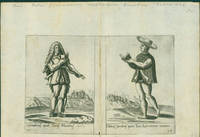
63-7940Padua Italy: Joos de Bosscher 1593. Engravings. 17 x 11.4 cm. Image size. Very Good. Some scribbling in pencil in margins outside image. [Padua, Italy: Joos de Bosscher, 1593]. unknown
26471London Londini: In Aedibus Valpianis Pridie Idus Octobres 1809. A. J. Valpy. Octavo: ii 41 1 pp. A little dogeared on lightly aged paper and with slight damp staining to one corner at rear. In worn and stained original grey wraps repaired with strip of brown paper at spine. Three Latin poems by Valpy: 'Trafalgar' 'Plata Fluvius' and 'Delphi'. COPAC lists only three copies: at the British Library the Bodleian and Durham. [London] Londini: In Aedibus Valpianis, Pridie Idus Octobres, 1809. [A. J. Valpy] paperback
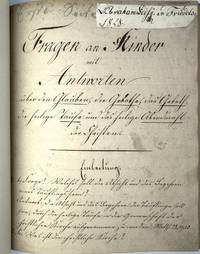
1828512100Self-Published 1828. Hardcover. VERY GOOD. 89 32pp. Two autograph manuscripts in fine longhand by Abraham Leisy. The first is a transcription of the Gerrit Roosen's Mennonite Catechism; the second text is a 32-page collection of pious tales. The books were bound together with a signature inlaid from a letter by Abraham Leisy and pasted to the title page of the first volume. Bound in black finished cloth with 'Biblische Fragen' stamped to the front cover. The FFEP bears a note by Leisy's sister Babette reading 'Babette Leisy. / Cleveland. / Dieses Buch brachte meinen topfchen Diana im Jahr 1895. von Deutschland Friedelsheim das hat alles Bruders Abraham Leisy geschrieben.' 'The Abraham and Katarina Leisy family emi grated to America in 1855 from Friedelsheim Germany. They settled on a farm outside of Donnellson Iowa. The Leisys were members of the West Zion Mennonite Church of Donnellson.' Mennonite Life April 1976. Abraham's sons notably founded the Leisy Brothers' 'Union Brewery' in 1862 in Keokuk Iowa. When the state of Iowa banned manufacture of alcoholic beverages in 1884 the brewery was moved to Peoria Illinois and renamed 'Leisy Brewing Company' a major regional beer producer and known as the last Mennonite-operated brewery in the U.S. Self-Published hardcover
186424901.02<p>"<i>with the same determination to divide the country unless they can secure universal abolition we are exposed to the same dangers every day and God only knows in what unlucky hour our ruin may be consummated. Compare his policy with McClellan's expression of readiness to receive any State when its people offer to submit to the Union.</i>"</p><p>This Democratic Party campaign pamphlet quotes an April 1864 letter to argue that Lincoln gave Lieutenant General Ulysses S. Grant free rein to conduct the war after having interfered with and micromanaged McClellan's Peninsula Campaign in 1862. The publication also declared that Republicans were stained with "<i>The Taint of Disunion</i>" and quoted from Republican speeches and editorials to insist that the Democrats were the party of "<i>UNION AND PEACE</i>."</p> <b>ABRAHAM LINCOLN.</b>Printed Document. Democrat Campaign "<i>Document No. 12</i>" with headings "<i>Lincoln's Treatment of Gen. Grant</i>" "<i>Mr. Lincoln's Treatment of Gen. McClellan</i>" and "<i>The Taint of Disunion</i>." New York 1864. 8 pp. 5¾ x 8â… in.<p><b><br /></b></p><p><b>Excerpts:</b></p><p>Lincoln to Grant April 30 1864</p><p>"<i>I wish to express in this way my entire satisfaction with what you have done up to this time so far as I understand it. The particulars of your plans I neither know nor seek to know. You are vigilant and self-reliant; and pleased with this I wish not to obtrude any restrains or constraints upon you while I am very anxious that any real disaster or capture of our men in great numbers be avoided.</i>" p1/c1</p><p>"<i>Such in brief are some of the most notable instances in which Mr. Lincoln interfered with General McClellan when he occupied a position similar to that held by General Grant. They reflect so severely upon the President that no attempt to gloss them over by his apparent subsequent repentance can disabuse the patriotic portion of the nation of the matured conviction that he is to be held responsible for the lack of decisive victories in Eastern Virginia. The blame must and will rest upon him to whom it belongs.</i>" p5/c2</p><p>"<i>Having shown by copious extracts from the speeches of Abraham Lincoln W. H. Seward Wendell Phillips Wm. Lloyd Garrison and from the editorial writings of the Chicago Tribune and the N. Y. Tribune… that they were all <b>original secessionists and disunion men</b> we propose now to give the evidence that Mr. Lincoln himself has within the last three months been concerned in a movement to make peace with Jeff. Davis on terms involving the direct proposal to divide the Union and let the South go.</i>" p7/c2-p8/c1</p><p>"<i>with the same determination to divide the country unless they can secure universal abolition we are exposed to the same dangers every day and God only knows in what unlucky hour our ruin may be consummated. Mark how Mr. Lincoln constantly keeps up the idea of negotiating only with Jefferson Davis. Why does he never address himself to the people or the States of the South. Compare his policy with McClellan's expression of readiness to receive any State when its people offer to submit to the Union.</i>" p8/c2</p><p><b>Historical Background</b></p><p>The 1864 presidential election pitted President Lincoln against his Democratic challenger General George B. McClellan. Although McClellan had been the commander of the Army of the Potomac and general-in-chief of the Union Army the Peace platform adopted by the Democratic National Convention in Chicago declared the war a failure. The party was bitterly divided between War Democrats who favored continuing the war to restore the Union while leaving slavery alone; moderate Peace Democrats who favored an armistice and a negotiated peace that would likely protect slavery in a reconstructed union and radical Peace Democrats who favored an immediate end to the war without securing Union victory. McClellan was a War Democrat but the platform was written by radical Peace Democrat Clement Vallandigham and Peace Democrat George H. Pendleton was nominated for vice president.</p><p>In 1864 Republicans created the National Union Party to attract War Democrats Unconditional Unionists and Unionist Party members who would not vote for the Republican Party though most state Republican parties did not change their name. President Abraham Lincoln won the nomination of the "National Union Party" at its Baltimore convention and won re-election with new running mate War Democrat Andrew Johnson.</p><p>Although Lincoln was convinced by August 1864 that he would not be reelected General William T. Sherman's capture of Atlanta in early September and General Philip Sheridan's successes in the Shenandoah Valley of Virginia from August to October ensured his victory. Without the participation of the seceded states Lincoln and Johnson won 55 percent of the popular vote and an overwhelming 212-to-21 victory in the Electoral College. McClellan and Pendleton carried only Kentucky Delaware and McClellan's home state of New Jersey.</p>
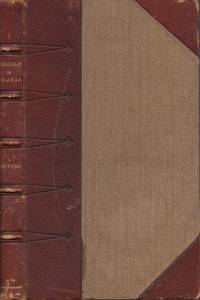
192435526Peoria Illinois: Edward J. Jacob Printer Peoria Illinois 1924. First Edition. Privately Printed. Hardcover. Fair. Octavo. 2 127 pages. 4. Illustrated with frontispiece photograph of Lincoln illustrations and folding facsimiles. Half leather binding with tan cloth covered boards. Tooled leather spine with raised bands and gilt lettered title. Marbled end papers. Leather spine rubbed. Front hinge is broken exposing the spine. Board is secure to the binding. Rear hinge cracked. Inscribed and signed by the printer on the limitations page. Limited to 100 copies printed. Fair. Edward J. Jacob, Printer Peoria, Illinois hardcover
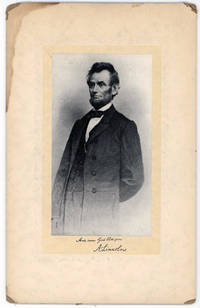
1909000014161Boston: M.T. Sheahan 1909 1909. Cabinet Card. Good. 27.5 cm x 17.5 cm. Photograph measures 17 cm x 9.25 cm. A cabinet card in black and white mounted and inset on a cream-colored paper board. A portrait of Lincoln with the caption "And now God bless you A. Lincoln." A striking image of the sixteenth President of the United States. A dampstain on the left edge of the cabinet card light chipping to the paper and a private namestamp on the verso. M.T. Sheahan [1909] unknown