26 503 résultats
195529685New York, McGraw-Hill, 1955. Royal 8vo. Original cloth with silver lettering on spine. IX,702 pp.
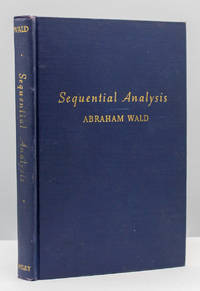
194729690New York, John Wiley & Sons, (1947). Original cloth with gilt spine. No dust jacket. XII,212 pp. Text illustrated.
195029691New York, John Wiley & Sons, (1950). 8vo. Original cloth with gilt spine. No dust jacket. IX,179 pp. Text illustrated.
1955043237Mcgraw-hill Book Company 1955. 1st Edition . Hardcover. Very Good/No Jacket. Well-kept solid copy with clean pages. Sturdy covers have lost some of their navy blue color on the spine. Heavy bulky book. Benefits the Friends of the Albany CA Library. <br/> <br/> Mcgraw-hill Book Company hardcover
195529685New York McGraw-Hill 1955. Royal 8vo. Original cloth with silver lettering on spine. IX702 pp. <br/><br/><em>First edition. </em> hardcover
1957304750Stanford University Press 1957. 2nd Printing . Hardcover. Near Fine/Good-. dustjacket worn and torn previous owners name ffep otherwise unmarked 702pp NF/G-. <br/> <br/> Stanford University Press hardcover
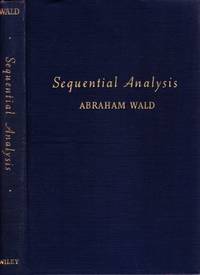
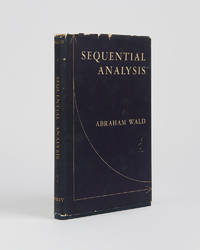
122472New York & London John Wiley & Sons Inc.; Chapman & Hall Ltd. 1947. . First edition; 8vo; diagrams within the text note in blue ink on front free endpaper contents faintly toned in the margins; original blue cloth titles to spine and upper board gilt minor horizontal production flaw to the cloth lightly rubbed along the edges a very good copy in the rubbed and partially toned jacket with a few small chips; 212pp.<br /> First edition of a revolutionary work in mathematics and decision theory. Uncommon in the dust jacket.<br /><br />Abraham Wald 1902-1950 a pioneer in the field of operations research earned his PhD in mathematics at the University of Virginia. He emigrated to the US after the annexation of Austria and worked in econometrics joining the Columbia faculty in 1941. Wald studied wartime statistics problems as a member of the Statistical Research Group making the now-famous counterintuitive determination that it was the damaged parts of military aircraft which returned safely that did not need extra shielding.<br /><br />Wald is considered the founder of the field of sequential analysis in which sample sizes in statistical analysis are not pre-determined but data is analyzed as it is collected lowering the time and financial costs of research. He focused on sequential analysis as a tool for industrial quality control but it has found uses in many other fields most notably pharmaceutical clinical trials.<br /> New York & London, John Wiley & Sons, Inc.; Chapman & Hall, Ltd., 1947. hardcover
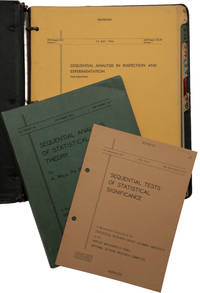
19445180Washington: National Defense Research Committee 1944. First edition. <p>First edition very rare of Wald's seminal invention of 'Sequential analysis' the "notion that in some sense it is economical to observe and analyze data sequentially rather than to observe and analyze a single sample of predetermined fixed size" DSB. It is here offered in the original 'restricted' reports; it was published four years later in his well-known book Sequential Analysis. "It was Wald in 1943 who first formulated mathematically and solved quite generally the problem of sequential tests of statistical hypotheses. He introduced the particular method of the sequential probability ratio test and with Wolfowitz 1948 showed its optimal properties" ibid.</p>. THE INVENTION OF SEQUENTIAL ANALYSIS - THE ORIGINAL RESTRICTED REPORTS. <p>First edition very rare of Wald's seminal invention of 'Sequential analysis' developed while he was in charge of Columbia University's Statistical Research Group in response to the demand for more efficient methods of industrial quality control during World War II. It is here offered in the original 'restricted' reports; it was published four years later in his well-known book of the same title. "Wald's second major achievement in mathematical statistics is sequential analysis. The notion that in some sense it is economical to observe and analyze data sequentially rather than to observe and analyze a single sample of predetermined fixed size was not a new one. Intuitive support for this notion is immediate; if the evidence shown in sequentially unfolding data is sharply one-sided it seems reasonable to believe that the inquiry can be terminated early with lengthier inquiries reserved for those situations in which the issue at hand appears via the sequentially unfolding data to be in greater doubt. This notion and the partial mathematical formulation of it were to be found in the statistical literature; among those who dealt with it before Wald was Walter Bartky of Chicago and among Wald's contemporaries George Barnard working in England. But again it was Wald in 1943 who first formulated mathematically and solved quite generally the problem of sequential tests of statistical hypotheses. He introduced the particular method of the sequential probability ratio test and with Wolfowitz 1948 showed its optimal properties. He found operating characteristic and average sample number functions; he introduced if he did not completely solve the problem of sequential tests of composite hypotheses utilizing weight functions; and he began vital discussions of such basic topics as multivalued decisions and optimal sequential estimation. All this plus many special problems were gathered together in Sequential Analysis 1947 a book surprisingly easy to read less formal and more elementary in structure than his work on decision functions" DSB. No copies listed on ABPC/RBH.</p> <br /> <br /> <p>"Sequential analysis is the branch of statistics concerned with investigations in which the decision whether or not to stop at any stage depends on the observations previously made. The motivation for most sequential investigations is that when the ends achieved are measured against the costs incurred including the cost of making observations sequential designs are typically more efficient than non-sequential designs .</p> <br /> <br /> <p>"The term 'sequential' is occasionally extended to cover also investigations in which various aspects of the design may be changed according to the observations made. For example preliminary experience in an experiment may suggest changes in the treatments being compared; in a social survey a small pilot survey may lead to modifications in the design of the main investigation . In a sequential investigation observations must be examined either one by one as they are collected or at certain stages during collection. A sequential procedure might be desirable for various reasons. The investigator might wish to have an up-to-date record at any stage either for general information or because the appropriate sample size depends on quantities that he can estimate only from the data themselves. Alternatively he may have no intrinsic interest in the intermediate results but may be able to achieve economy in sample size by taking them into account. Three examples will illustrate these points:</p> <br /> <br /> <p>1 An investigator may wish to estimate to within 10 per cent the mean weekly expenditure on tobacco per household. In order to determine the sample size he would need an estimate of the variability of the expenditure from household to household and this might be obtainable only from the survey itself.</p> <br /> <br /> <p>2 A physician wishing to compare the effects of two drugs in the treatment of some disease may wish to stop the investigation if at some stage a convincing difference can already be demonstrated using the available data.</p> <br /> <br /> <p>3 A manufacturer carrying out inspection of batches of some product may be able to pass most of his batches with little inspection but may carryout further inspection of batches of doubtful quality. A given degree of discrimination between good and bad batches could be achieved in various ways but a sequential scheme will often be more economical than one in which a sample of constant size is taken from each batch </p> <br /> <br /> <p>"The most appropriate design and method of analysis of a sequential investigation depend on the purpose of the investigation. The statistical formulation of that purpose may take one of a number of forms usually either estimation of some quantity to a given degree of precision or testing a hypothesis with given size and given power against a given alternative hypothesis. Economy in number of observations is typically important for sequential design" International Encyclopedia of the Social Sciences.</p> <br /> <br /> <p>"The problem of sequential analysis arose in the Statistical Research Group of Columbia University in connection with some comments made by Captain G. L. Schuyler of the Bureau of Ordnance Navy Department. Milton Friedman and W. Allen Wallis recognized the great potentialities and the far-reaching consequences that sequential analysis might have for the further development of theoretical statistics. In particular they conjectured that a sequential test procedure might be constructed which would control the possible errors committed by wrong decisions exactly to the same extent as the best current procedure based on a predetermined number of observations and at the same time would require on the average a substantially smaller number of observations than the fixed number of observations needed for the current procedure. Friedman and Wallis also exhibited a few examples of sequential modifications of current test procedures resulting in some cases in an increase of efficiency. It was at this stage that they proposed the problem of sequential analysis to the author i.e. Wald. This gave the incentive for the author's investigations which then led to the development of the sequential probability ratio test. </p> <br /> <br /> <p>"Because of the usefulness of the sequential probability ratio test in development work on military and naval equipment it was classified Restricted within the meaning of the Espionage Act. The author was requested to submit his findings in a restricted report dated September 1943. In this report the sequential probability ratio test and the basic theory is given. To facilitate the use of this new technique by the Army and the Navy the Statistical Research Group issued a second report in July 1944 which gives an elementary non-mathematical exposition of the applications of the sequential probability ratio test and contains a considerable number of tables charts and computational simplifications to facilitate applications" Wald pp. 2-3.</p> <br /> <br /> <p>The 10 parts are as follows:</p> <br /> <br /> <p>Sequential analysis of statistical data: Theory September 1943.</p> <br /> <br /> <p>Sequential tests of statistical significance April 1944.</p> <br /> <br /> <p>Applications 15 July 1944:</p> <br /> <br /> <p>Sequential analysis in inspection and experimentation Introduction Section 1;</p> <br /> <br /> <p>Sequential analysis when the result of a single observation is a classification as good or bad and when the result of the test is acceptance or rejection Section 2;</p> <br /> <br /> <p>Sequential analysis when the result of a single observation is a classification as good or bad and when the result of the test is a decision between two methods or products Section 3;</p> <br/> <br/> First report: Small 4to 230 x 180 mm original printed wrappers. Upper right corner with a slight bump. Previous owners initials to front wrapper W.L.D. Stamped RESTRICTED. IX 1179 3: blank pp. Second report: 8vo 244 x 153 mm. Original printed wrappers fine. 10 2: blank pp. Third report: Large 4to 285 x 220 mm. Original ring binder containing the six sections in original printed wrappers together with the two appendicies aslo in wrappers: S1:VIII16; S2:II22; S3:II22; S4:II22; S5:II18; S6:II18; A1:II14; A2:II22 pp. In very good condition. Also included is the mimiographed distribution list of the third report: 1 sheet typescript printed on both sides. All three reports are in the rare original issue with the text: "This document contains information affecting the national defense of the United States within the meaning of the Espionage Act 50 U.S.C. 31 and 32 as amended. Its transmission or the revelation of its contents in any manner to an unauthorized person is prohibited by law". OCLC lists 8 copies of the first report 1 of the second National Institute of Standards and Technology and the third report is not located in any library. National Defense Research Committee unknown
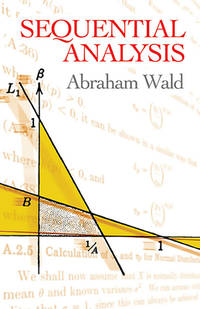
2013Q-0486615790Dover Publications 2013-11-21. Paperback. New. In shrink wrap. Looks like an interesting title! Dover Publications paperback
0471918067.Ghardcover. Good. Access codes and supplements are not guaranteed with used items. May be an ex-library book. hardcover
194729690New York John Wiley & Sons 1947. Original cloth with gilt spine. No dust jacket. XII212 pp. Text illustrated. <br/><br/><em>First edition. Wald is considered the founder of statistical sequential analysis and the theory of decision functions. DSB XIV:121. </em> hardcover
1966BOOKS020379INew York: John Wiley & Sons. Good/No Dj. 1966. 8th Edition. Hardback. 8vo Ex-Library Later printing of the extremely scarce 1947 keystone book. This is an excellent reference copy/clean and crisp pages . John Wiley & Sons hardcover
10-1336New York: John Wiley & Sons 1948 212pp navy cloth slight shelfwear to cover a bit of pencil underlining & margin notes. Buckram. Very Good -/Good . John Wiley & Sons Hardcover
19477020<p>New York: Wiley & Sons 1947 First edition. Original navy cloth. Octavo. Sixteen figures seven tables. A very good copy. Abraham Wald pioneered the science of decision analysis and in particular that of sequential decision making. Before Wald the traditional style of statistical decision was to posit a hypothesis make a predetermined number of measurements then make a decision whether to accept or reject the hypothesis. Wald realized that this procedure is quite wasteful and that many measurements could be saved if given the option to decide at every step whether to continue or stop the measurement process. This idea revolutionized the art of statistical testing and was later developed in the hands of computer scientists into a field known as on-line algorithms. "Most although not all of Wald's results were summed up in Sequential Analysis 1974. With minor exceptions the entire contents of this book were obtained by him. Such a phenomenon is rare in mathematical books and indicates the extent to which he founded and dominated the field of sequential analysis" DSB.</p> Wiley & Sons, hardcover
195029691New York John Wiley & Sons 1950. 8vo. Original cloth with gilt spine. No dust jacket. IX179 pp. Text illustrated. <br/><br/><em>First edition. Wald is considered the founder of statistical sequential analysis and the theory of decision functions. DSB XIV:121. </em> hardcover
1966R240095947JOHN WILEY & SONS INC.. 1966. In-8. Relié. Bon état, Couv. convenable, Dos satisfaisant, Intérieur frais. XII + 212 pages - ouvrage en anglais - quelques figures en noir et blanc dans le texte.. . . . Classification Dewey : 420-Langue anglaise. Anglo-saxon
1965R240095917JOHN WILEY & SONS INC.. 1965. In-8. Relié. Bon état, Couv. convenable, Dos satisfaisant, Intérieur frais. 212 pages - ouvrage essentiellement en anglais - quelques figures en noir et blanc dans le texte.. . . . Classification Dewey : 420-Langue anglaise. Anglo-saxon
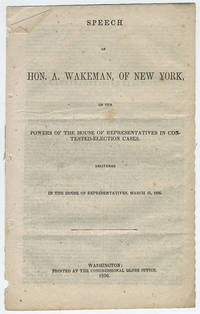
18568964Washington: Pr. at the Congressional Globe Office 1856. 8vo. 8 pp. <br><br>Uncommon. <br>Â Â Â Â <br>Â Â Â Â NSTC 2W1460. Removed from a nonce volume. Fold marks across width of pamphlet. Top left corner of title-page folded. Foxed. Now in a mylar folder. Pr. at the Congressional Globe Office unknown books
2011DADAX3639358864VDM Verlag 2011-09-13. paperback. New. 5.91x0.35x8.66. Buy with confidence. Excellent Customer Service & Return policy. VDM Verlag paperback
3639358864.Gpaperback. Good. Access codes and supplements are not guaranteed with used items. May be an ex-library book. paperback
1020701587.Ghardcover. Good. Access codes and supplements are not guaranteed with used items. May be an ex-library book. hardcover
1022819461.Gpaperback. Good. Access codes and supplements are not guaranteed with used items. May be an ex-library book. paperback
1270881973.Gpaperback. Good. Access codes and supplements are not guaranteed with used items. May be an ex-library book. paperback
127123758X.Gpaperback. Good. Access codes and supplements are not guaranteed with used items. May be an ex-library book. paperback
1248146131.Gpaperback. Good. Access codes and supplements are not guaranteed with used items. May be an ex-library book. paperback