ABRAHAM LINCOLNABAA

189 résultats
186522935<p><b>ABRAHAM LINCOLN.</b>Print. <i>Abraham Lincoln. The Nations Martyr. Assassinated April 14th. 1865.</i> Currier & Ives New York N.Y. 1865. 1 p. 13½ x 18 in. Light toning. </p>By recycling stock images Currier & Ives could issue "rush" prints of important 19th century events thus providing Americans with graphic depictions of current events. Based on Anthony Berger's famed photograph taken in February 1864 this is a fine example of a "rush" print of Lincoln following his assassination to hang in the homes of Americans mourning the loss of their president.<br /> books
1866238120Washington D.C.: John H. Littlefield; Wm. Terry Printer 1866. Photograph by John Goldin of Littlefield's painting on printed mount. 1 vols. Image 11 1/2 x 18 3/4 in.; mounted to 19 x 24 in. Soiling to image vertical crease large chips to bottom of mount not affecting image or legend; good. Photograph by John Goldin of Littlefield's painting on printed mount. 1 vols. Image 11 1/2 x 18 3/4 in.; mounted to 19 x 24 in. A published photograph of Littlefield's hyper-realistic Lincoln death-bed painting each figure meticulously rendered from photographs. Littlefield studied law under Lincoln in 1858 stumped for him in his Presidential bid and was rewarded with a position in the Treasury Department. After Lincoln's death Littlefield invented this tableau of twenty-five people ranged around the death-bed including Vice-President Johnson Surgeon Chalres Leale and Mrs. Lincoln. "The artist used photographs as models for the twenty-five people gathered in the death room but his profile of the dying Lincoln shows a first-hand acquaintance" Ostendorf LINCOLN'S PHOTOGRAPHS p. 279. Provenance: Harper Family John H. Littlefield; Wm. Terry, Printer unknown books
1866238011Washington D.C.: John H. Littlefield; Wm. Terry Printer 1866. Photograph by John Goldin of Littlefield's painting on printed mount. Image 8 1/2 x 13 3/4 in.; mounted to 13 x 17 in. Faint toning to mount; fine. Photograph by John Goldin of Littlefield's painting on printed mount. Image 8 1/2 x 13 3/4 in.; mounted to 13 x 17 in. A published photograph of Littlefield's hyper-realistic Lincoln death-bed painting each figure meticulously rendered from photographs. <br/>Littlefield studied law under Lincoln in 1858 stumped for him in his Presidential bid and was rewarded with a position in the Treasury Department. After Lincoln's death Littlefield invented this tableau of twenty-five people ranged around the death-bed including Vice-President Johnson Surgeon Charles Leale and Mrs. Lincoln.<br/>"The artist used photographs as models for the twenty-five people gathered in the death room but his profile of the dying Lincoln shows a first-hand acquaintance" Ostendorf LINCOLN'S PHOTOGRAPHS p. 279. John H. Littlefield; Wm. Terry, Printer unknown books
18841562Various places in South Africa Botswana 1884. Overall very good. 295pp. plus five additional letters totaling 60pp. altogether more than 38000 words. Composed mostly on small octavo sheets. Some wear to edges of initial and final few leaves slightly affecting text. Light even tanning. Written in a consistent legible script. An extensive and outstanding manuscript account of travel and exploration in southern Africa during late 1883 and early 1884 by Abraham Anscher a Polish Jewish immigrant to Chicago. The manuscript is composed in the form of a letter addressed to Edith Delia Rogalski but really comprises a travelogue or diary with entries written from September 1883 to mid-January 1884. Five additional letters accompany this account addressed to Edith's later husband Israel Jackson Roe; her parents Samuel and Sarah Rogalski; and her brother Benny. <br/><br/>Anscher's descriptions of his experiences in Africa cover a wide variety of topics including big game hunting; interactions with local indigenous peoples and their rulers; encounters with white missionaries traders and other hunters; ethnographic botanical geological and zoological observations and much more. His account is by turns dramatic and amusing interspersed with personal recollections of family and home cultural and religious notes his addressee was also a Polish-speaking Jewish immigrant to Chicago and reminiscences of earlier adventures in Colorado Utah the California gold fields and elsewhere.<br/><br/>Little can be readily discerned of the details of Anscher's biography beyond the pages of this manuscript. He was born in Mariampol then a part of Poland and today in Lithuania but clearly came to the United States at an early age and was well-educated. He was an adventurer at heart and spent several years in the West perhaps in the U.S. Army for part of this time and partly as a solo fortune seeker. At some point during the mid- to late-1870s he decided to take his adventuring talents to South Africa in order to satisfy his own wanderlust and to create a business of organizing guided African exploration and hunting. The stakes of his chosen profession are mentioned several times throughout his narrative such as when a party member dies of an unspecified illness "My lot is a very hard one just now and my position as promoter and chief adventurer is anything but enviable". From the additional letters present it is apparent that the young Ms. Rogalski was a former love interest of Anscher who spurned his affections and became engaged to a mutual friend. Indeed a letter here addressed to the fiancé offers an apology for presumption of writing to Edith in such a lengthy and cordial manner; at one time all of the individuals addressed by Anscher were a part of the same immigrant community in Chicago.<br/><br/>This absorbing account follows a lengthy excursion organized and led by Anscher across the Transvaal through Bechuanaland Matabeleland and beyond to a settlement he calls Tatti probably Francistown on the Tati River traveling through parts of modern-day South Africa and Botswana. They contain many details of great interest and his vignettes are well-written and dramatically delivered. An immense boa constrictor drops out of the treetops strangling a springbok before his eyes. He finds a five-year-old girl with a broken leg the only survivor of a village massacre; he sets her leg nurses her for a month and eventually conveys her to a missionary station. A young zebra joins the traveling party incurring the jealousy of the team's dogs. A large lizard is trained to sleep in a tent but only after his teeth are removed for safety. <br/><br/>His missive begins in medias res with his party already underway in South Africa near the Orange River in what he calls the "Tarka bush" during mid-September 1883. Anscher decides having missed his last opportunity to send mail "Now to put myself on guard against mischance and not be like the traditional foolish virgins who did not keep their lamps properly trimmed.to have a so-called running letter always open and ready" for his recipient. The group first traveled northeast near and along the Orange allowing Anscher to wax discursive concerning the river's wildlife:<br/><br/>"The wanderings of the river sometimes flowed through immense chasms over hung with stupendous precipices and then like a translucent lake with beautiful towering mimosas and willows reflected from its bosom and a rich variety of fine plumage though without a song; wild geese ducks snipes flamingoes in perfect security feeding on the banks beneath the green shade or basking in the sun's rays on the verdant islands far from the fowler's snare. The swallows also mounting aloft or skimming the surface of the mirror of the stream; while the ravens with their hoarse note might be seen seeking their daily food among the watery tribe or cawing on the bending tops of the weeping willows."<br/><br/>The party leaves the river and skirts the southern edge of the Kalahari to reach Lattakoo modern-day Dithakong a traditional departure point for excursions deeper into the interior of Africa during the 19th century. Thence they headed north again stopping often to hunt for food and sport:<br/><br/>"When on the Kama plains I went one night accompanied by Tytler and Winsloe and one native to a pool of water about two miles from camp. We did not wait more than about half an hour when we heard loud lapping at the water. The natives told me 'Ronimala ' be silent 'There is a lion.' Our next visitors were two buffaloes but we did not fire lest we attract the attention of the lions. Next came three giraffes and one we knocked over on the spot and wounded another but who got away. I have seen plenty of game in my time. I saw and hunted antelope and elk on the Laramie plains and in the Meek Mountains in America before the Union Pacific RR was built. I saw quite enough of buffalo in the Smokey Hills and Montana as well as south of the Green Horn Mountains between California and Arizona but such a variety of game big game and in such number as I saw some years ago in the Transvaal & Swaziland and hereabouts now I never saw anywhere."<br/><br/>As the excursion proceeds further into the interior their encounters with native tribes increases and Anscher observes them keenly and reports with a detailed if somewhat jaded 19th-century eye:<br/><br/>"The town of Kalabeg is already in the Matabele country. Of course they have no religion of any kind for there is no such thing as natural religion. Men acquire knowledge good or bad from instruction of men with more fertile brains. This holds good all the world over. The rainmakers here hold the position of prophets and divines of the so-called civilized countries. These rainmakers who are also the doctors and sextons have great influence over the minds of the people and are held in great estimation by them superior to that of their king who is likewise compelled to yield to the dictates of this personage the rainmaker. Nothing can exceed the freaks of fancy and the adroitness with which the rainmaker can awe the public mind and lead thousands captive at his will. Each tribe has one or more of them and they generally come from other countries for a prophet is seldom honored in his own country."<br/><br/>Arriving in Shoshong in what is now central Botswana Anscher meets some missionaries and witnesses a tribal gathering which leads him to remember the religious theories of a familial acquaintance back home:<br/><br/>"Was present at a Pitsoh or native congress this forenoon held by the natives about some tribe affairs. About 12000 natives present and wound up the proceedings with a war dance. As these tribes are considered by some religious enthusiasts to be of the lost tribes of Israel not your own but ours and as your uncle once spoke to me about them while at Chicago I would therefore request you to kindly tell him to disabuse his mind on this point and that the only peg whereon the so-called lost tribe maniacs hang their argument in favor of their hobby is that the natives practice a certain custom which history attributes to our father Abraham. But this ceremony takes place instead of at the age of 7 days old when they are about fourteen years old and even when older. But they have no tradition as to why it is done. If this simple custom entitles them to be call Jews why for my part they are quite welcome to the honor. But this is about all there is to build the theory on." <br/><br/>Despite his occasionally sarcastic and somewhat disparaging demeanor toward the natives he encounters Anchser seems overall to have a decent connection with them at a personal level and to understand a basic sense of shared humanity. In one particularly poignant episode Anscher meets a mother and father who have walked 300 miles to ransom their two teenaged sons enslaved by a local chief: <br/><br/>"Neither the man's looks nor ornaments excited the smallest emotion in the bosom of the chief and when he was solicited by one who felt something of a father's love to pity the old man who had walked so far and brought his all to purchase his own children he at last replied with a sneer that one of the boys died last year and for the other he wants an ox at least. 'But I have not even a goat' pleaded the old man 'the Matabele have taken all I had and destroyed my hut.' A sigh it was a heavy sigh burst from his bosom one dead and the other not permitted to see anymore. The chief walked off while the man sat leaning his head on the palm of his hand and his eye fixed on the ground apparently lost to everything but his grief. On taking up his trinkets to retire I told him to keep up a good heart that I would try to get him his boy. He started at the sound of my voice kneeled before me and laid down his trinket saying 'take all this but get me back my boy.' I got him his boy for a colored blanket and 1 lb. of tobacco."<br/><br/>When sad and homesick Anscher recalls his time in Chicago and in the West but it is often insufficient comfort. After departing Shoshong for Tatti Anscher must leave his group to "pioneer" a trail to the settlement:<br/><br/>"On the evening of my first day's journey I had to off-saddle a term used here on a waterless plain picketed my horse and went to bed minus my supper or dinner. I awoke suddenly by something touching me on my forehead like the cold nose of a dog but I could see nothing in the dark except my horse who was laying down poor fellow. After this occurrence I could sleep no longer. My head was hot my lips parched and had no taste even for a cigarette. I daresay some of you have experienced waiting for a train early in the morning in some out of the way small RR station where moments appear like days. Well waiting there is not a patch to lying in the dark in Africa's solitude waiting for daylight to come. I tried to divert my mind and think of anything but water but I could not do it! I tried to cool myself by thinking of Chicago in the month of Feb. but that only led me to snow and from snow to water. One may as well try Ovid's 'Remedia Amoris' to cure him from hankering after the girl he loves as to try Chicago in my case as a remedy when thirsty." <br/><br/>The difficulties of obtaining food and water establishing safe camp and finding routes through minimally charted territory evident in this final passage are an ever-present theme of the expedition but Anscher eventually guided his group to their destination where they intended to stay for a month or two before heading further north to Victoria Falls on the Zambezi River. The final entries describe life at the settlement and how a Portuguese colonial explorer and administrator Alexandre de Serpo Pinto whom they met in camp would be entrusted with the present manuscript as he traveled to Namaqualand on the west coast of Africa in the hopes that it would eventually find its way aboard a ship bound for America. Pinto was a fascinating figure in his own right -- he explored the interior of Africa for Portugal in the 1860s and 1870s and after this meeting with our author became the Portuguese Consul in Zanzibar.<br/><br/>Anscher's trail goes somewhat cold after January 1884 when he relinquished control of this massive "running letter." An additional fragment of a later letter to Edith Rogalski included here forwarded via a mining acquaintance in Kimberly contains a few tantalizing details of his onward expedition including an attack on their party near Victoria Falls by a group of slavers led by "an American Negro." He was also working on a journal and taking photographs which are mentioned several times throughout this account but the survival of this other material as well as the ultimate conclusion of this expedition are not known. A wonderful unpublished account of African exploration by a seemingly unlikely and apparently otherwise unknown American character. A complete transcription of the manuscript is available upon request. unknown books
18843195451884. 295pp. plus five additional letters totaling 60pp. altogether more than 38000 words. Composed mostly on small octavo sheets. Some wear to edges of initial and final few leaves slightly affecting text. Light even tanning. Written in a consistent legible script. Overall very good. 295pp. plus five additional letters totaling 60pp. altogether more than 38000 words. Composed mostly on small octavo sheets. An extensive and outstanding manuscript account of travel and exploration in southern Africa during late 1883 and early 1884 by Abraham Anscher a Polish Jewish immigrant to Chicago. The manuscript is composed in the form of a letter addressed to Edith Delia Rogalski but really comprises a travelogue or diary with entries written from September 1883 to mid-January 1884. Five additional letters accompany this account addressed to Edith's later husband Israel Jackson Roe; her parents Samuel and Sarah Rogalski; and her brother Benny. <br/> <br/>Anscher's descriptions of his experiences in Africa cover a wide variety of topics including big game hunting; interactions with local indigenous peoples and their rulers; encounters with white missionaries traders and other hunters; ethnographic botanical geological and zoological observations and much more. His account is by turns dramatic and amusing interspersed with personal recollections of family and home cultural and religious notes his addressee was also a Polish-speaking Jewish immigrant to Chicago and reminiscences of earlier adventures in Colorado Utah the California gold fields and elsewhere.<br/> <br/>Little can be readily discerned of the details of Anscher's biography beyond the pages of this manuscript. He was born in Mariampol then a part of Poland and today in Lithuania but clearly came to the United States at an early age and was well-educated. He was an adventurer at heart and spent several years in the West perhaps in the U.S. Army for part of this time and partly as a solo fortune seeker. At some point during the mid- to late-1870s he decided to take his adventuring talents to South Africa in order to satisfy his own wanderlust and to create a business of organizing guided African exploration and hunting. The stakes of his chosen profession are mentioned several times throughout his narrative such as when a party member dies of an unspecified illness "My lot is a very hard one just now and my position as promoter and chief adventurer is anything but enviable". From the additional letters present it is apparent that the young Ms. Rogalski was a former love interest of Anscher who spurned his affections and became engaged to a mutual friend. Indeed a letter here addressed to the fiancé offers an apology for the presumption of writing to Edith in such a lengthy and cordial manner; at one time all of the individuals addressed by Anscher were a part of the same immigrant community in Chicago.<br/> <br/>This absorbing account follows a lengthy excursion organized and led by Anscher across the Transvaal through Bechuanaland Matabeleland and beyond to a settlement he calls Tatti probably Francistown on the Tati River traveling through parts of modern-day South Africa and Botswana. They contain many details of great interest and his vignettes are well-written and dramatically delivered. An immense boa constrictor drops out of the treetops strangling a springbok before his eyes. He finds a five-year-old girl with a broken leg the only survivor of a village massacre; he sets her leg nurses her for a month and eventually conveys her to a missionary station. A young zebra joins the traveling party incurring the jealousy of the team's dogs. A large lizard is trained to sleep in a tent but only after his teeth are removed for safety. <br/> <br/>His missive begins in medias res with his party already underway in South Africa near the Orange River in what he calls the "Tarka bush" during mid-September 1883. Anscher decides having missed his last opportunity to send mail "Now to put myself on guard against mischance and not be like the traditional foolish virgins who did not keep their lamps properly trimmed.to have a so-called running letter always open and ready" for his recipient. The group first traveled northeast near and along the Orange allowing Anscher to wax discursive concerning the river's wildlife:<br/> <br/>"The wanderings of the river sometimes flowed through immense chasms over hung with stupendous precipices and then like a translucent lake with beautiful towering mimosas and willows reflected from its bosom and a rich variety of fine plumage though without a song; wild geese ducks snipes flamingoes in perfect security feeding on the banks beneath the green shade or basking in the sun's rays on the verdant islands far from the fowler's snare. The swallows also mounting aloft or skimming the surface of the mirror of the stream; while the ravens with their hoarse note might be seen seeking their daily food among the watery tribe or cawing on the bending tops of the weeping willows."<br/> <br/>The party leaves the river and skirts the southern edge of the Kalahari to reach Lattakoo modern-day Dithakong a traditional departure point for excursions deeper into the interior of Africa during the 19th century. Thence they headed north again stopping often to hunt for food and sport:<br/> <br/>"When on the Kama plains I went one night accompanied by Tytler and Winsloe and one native to a pool of water about two miles from camp. We did not wait more than about half an hour when we heard loud lapping at the water. The natives told me 'Ronimala ' be silent 'There is a lion." Our next visitors were two buffaloes but we did not fire lest we attract the attention of the lions. Next came three giraffes and one we knocked over on the spot and wounded another but who got away. I have seen plenty of game in my time. I saw and hunted antelope and elk on the Laramie plains and in the Meek Mountains in America before the Union Pacific RR was built. I saw quite enough of buffalo in the Smokey Hills and Montana as well as south of the Green Horn Mountains between California and Arizona but such a variety of game big game and in such number as I saw some years ago in the Transvaal & Swaziland and hereabouts now I never saw anywhere."<br/> <br/>As the excursion proceeds further into the interior their encounters with native tribes increases and Anscher observes them keenly and reports with a detailed if somewhat jaded 19th-century eye:<br/> <br/>"The town of Kalabeg is already in the Matabele country. Of course they have no religion of any kind for there is no such thing as natural religion. Men acquire knowledge good or bad from instruction of men with more fertile brains. This holds good all the world over. The rainmakers here hold the position of prophets and divines of the so-called civilized countries. These rainmakers who are also the doctors and sextons have great influence over the minds of the people and are held in great estimation by them superior to that of their king who is likewise compelled to yield to the dictates of this personage the rainmaker. Nothing can exceed the freaks of fancy and the adroitness with which the rainmaker can awe the public mind and lead thousands captive at his will. Each tribe has one or more of them and they generally come from other countries for a prophet is seldom honored in his own country."<br/> <br/>Arriving in Shoshong in what is now central Botswana Anscher meets some missionaries and witnesses a tribal gathering which leads him to remember the religious theories of a familial acquaintance back home:<br/> <br/>"Was present at a Pitsoh or native congress this forenoon held by the natives about some tribe affairs. About 12000 natives present and wound up the proceedings with a war dance. As these tribes are considered by some religious enthusiasts to be of the lost tribes of Israel not your own but ours and as your uncle once spoke to me about them while at Chicago I would therefore request you to kindly tell him to disabuse his mind on this point and that the only peg whereon the so-called lost tribe maniacs hang their argument in favor of their hobby is that the natives practice a certain custom which history attributes to our father Abraham. But this ceremony takes place instead of at the age of 7 days old when they are about fourteen years old and even when older. But they have no tradition as to why it is done. If this simple custom entitles them to be call Jews why for my part they are quite welcome to the honor. But this is about all there is to build the theory on." <br/> <br/>Despite his occasionally sarcastic and somewhat disparaging demeanor toward the natives he encounters Anchser seems overall to have a decent connection with them at a personal level and to understand a basic sense of shared humanity. In one particularly poignant episode Anscher meets a mother and father who have walked 300 miles to ransom their two teenaged sons enslaved by a local chief: <br/> <br/>"Neither the man's looks nor ornaments excited the smallest emotion in the bosom of the chief and when he was solicited by one who felt something of a father's love to pity the old man who had walked so far and brought his all to purchase his own children he at last replied with a sneer that one of the boys died last year and for the other he wants an ox at least. 'But I have not even a goat' pleaded the old man 'the Matabele have taken all I had and destroyed my hut.' A sigh it was a heavy sigh burst from his bosom one dead and the other not permitted to see anymore. The chief walked off while the man sat leaning his head on the palm of his hand and his eye fixed on the ground apparently lost to everything but his grief. On taking up his trinkets to retire I told him to keep up a good heart that I would try to get him his boy. He started at the sound of my voice kneeled before me and laid down his trinket saying 'take all this but get me back my boy.' I got him his boy for a colored blanket and 1 lb. of tobacco."<br/> <br/>When sad and homesick Anscher recalls his time in Chicago and in the West but it is often insufficient comfort. After departing Shoshong for Tatti Anscher must leave his group to "pioneer" a trail to the settlement:<br/> <br/>"On the evening of my first day's journey I had to off-saddle a term used here on a waterless plain picketed my horse and went to bed minus my supper or dinner. I awoke suddenly by something touching me on my forehead like the cold nose of a dog but I could see nothing in the dark except my horse who was laying down poor fellow. After this occurrence I could sleep no longer. My head was hot my lips parched and had no taste even for a cigarette. I daresay some of you have experienced waiting for a train early in the morning in some out of the way small RR station where moments appear like days. Well waiting there is not a patch to lying in the dark in Africa's solitude waiting for daylight to come. I tried to divert my mind and think of anything but water but I could not do it! I tried to cool myself by thinking of Chicago in the month of Feb. but that only led me to snow and from snow to water. One may as well try Ovid's 'Remedia Amoris' to cure him from hankering after the girl he loves as to try Chicago in my case as a remedy when thirsty." <br/> <br/>The difficulties of obtaining food and water establishing safe camp and finding routes through minimally charted territory evident in this final passage are an ever-present theme of the expedition but Anscher eventually guided his group to their destination where they intended to stay for a month or two before heading further north to Victoria Falls on the Zambezi River. The final entries describe life at the settlement and how a Portuguese colonial explorer and administrator Alexandre de Serpo Pinto whom they met in camp would be entrusted with the present manuscript as he traveled to Namaqualand on the west coast of Africa in the hopes that it would eventually find its way aboard a ship bound for America. Pinto was a fascinating figure in his own right -- he explored the interior of Africa for Portugal in the 1860s and 1870s and after this meeting with our author became the Portuguese Consul in Zanzibar.<br/> <br/>Anscher's trail goes somewhat cold after January 1884 when he relinquished control of this massive "running letter." An additional fragment of a later letter to Edith Rogalski included here forwarded via a mining acquaintance in Kimberly contains a few tantalizing details of his onward expedition including an attack on their party near Victoria Falls by a group of slavers led by "an American Negro." He was also working on a journal and taking photographs which are mentioned several times throughout this account but the survival of this other material as well as the ultimate conclusion of this expedition are not known. A wonderful unpublished account of African exploration by a seemingly unlikely and apparently otherwise unknown American character. unknown books
186536081Philadelphia: Jas. B. Rodgers Printer 52 & 54 North Sixth Street 1865. 1st printing Monaghan 757. Limited to 750 cc. INSCRIBED by the author at the top of the front wrapper. Printed grey paper wrappers. Age-toning to wrappers. A VG copy. 19 1 blank. 9-1/16" x 5-7/8" <br/><br/> Jas. B. Rodgers, Printer, 52 & 54 North Sixth Street unknown books
1862100336Newspaper folio unbound 8pp. Dampstained browned at edges with some foxing early owner's ink stamp on top margin some small tears and chips along edges and a little creasing. Still in decent shape overall. This is one of the earliest printings of the Emancipation Proclamation which was issued on September 22 1862. The Emancipation Proclamation declared freedom for all slaves in any Confederate state that didn't return to the Union by January 1 1863. Although this executive order did not actually free a large number of slaves it set the stage for the freedom of all slaves. Coverage of the Emancipation in this newspaper begins in the middle of the first page. This newspaper article represents important coverage of a very significant event in American History. archives government exhibits emancipation website books
1865863261865. BROADSIDE - Lithograph LINCOLN Abraham. EMANCIPATIONS PROKLAMATION. Davenport Iowa: W.H. Pratt 1865. August Hageboeck lithographer. This is the second German-language version of the Emancipation Proclamation. It is printed in cursive within an oval border. The weight of the individual letters is varied so that when viewed from a distance a portrait of Lincoln emerges from the text. Originally printed on a rectangular sheet but here trimmed to an oval that surrounds the image the sheet is 37 x 29.5 cm. The image is 32 x 23 cm. The paper is browned and dampstained at the bottom center at the copyright information. It is matted and housed in a custom archival portfolio. A rare print. unknown books
18806045011880. gazing at a bust of George Washington after the painting by Alonzo Chappel. 7 1/2" x 10". Very good. ca. 1880. No Binding. Very Good/No Jacket. unknown books
18806045021880. 3 3/4" x 5" on paper 6 1/2" x 9 3/4". Very good. ca. 1880. No Binding. Very Good/No Jacket. unknown books
182718472Stockholm: Johan Horberg 1827. First edition. leather_bound. Contemporary half polished russet calf and marbled boards. All edges yellow. Fine. 137 pages. 27 1/2 x 22 cm. Forty-seven hand-colored engraved plates with tissue guards plus hand-colored vignette title and two engraved plates of music. Grafstrom poet and historian wrote the text and Forssell made the engravings. Index. List of Plates and errata. Costumes from Dalarna Helsingland Lappland Sodermanland Westergothland Smaland Blekinge and Skane. Lovely copy plates and text clean fresh and bright; bookplate raised bands spine panels richly guilt in floral motifs marbled endpapers maroon morocco spine label printed in gilt. Johan Horberg unknown books
1865235590Boston: Oliver Ditson & Co 1865. First edition front wrapper without portrait of Lincoln appearing in later issues. Engraved title and piano score; 5 pp. 1 vols. Folio. Loose as issued; split along spine with some chipping to extremities. First edition front wrapper without portrait of Lincoln appearing in later issues. Engraved title and piano score; 5 pp. 1 vols. Folio. Donizetti died 17 years before Lincoln having gone mad from syphilis. His Funeral March gained a measure of recognition in America after it was performed during Lincoln's funeral ceremonies. It is a heavy solemn piece in a minor with droning octaves in the bass a haunting chromatic figure in the middle register and a lyrical upper voice. see Barret Sale Lot 693; Stern Collection of Lincolniana Oliver Ditson & Co unknown books
1862WRCAM11943Washington 1862. Small broadside 5 x 7 1/2 inches. Very good. Lincoln appoints Henry Halleck as general-in- chief of all of the Union armies. unknown books
1862WRCAM54585Washington D.C.: War Department Adjutant General's Office 1862. Three volumes with over 300 individual imprints. 12mo. Uniformly bound in contemporary three- quarter roan and marbled boards gilt leather labels. Wear to leather and edges boards somewhat rubbed front hinges tender. Contemporary ownership inscriptions and binder's tickets on front endpapers of second and third volumes; later bookplate on front pastedown of first volume. Light toning in places otherwise internally clean. Very good. A uniformly-bound set of General Orders issued by the Adjutant General's Office of the War Department in Washington D.C. previously owned by Brig. Gen. John Pope Cook. The orders cover 1861 and 1862 and comprise a nearly complete run of orders for the Union Army during the first two years of the Civil War. Undoubtedly the most significant General Order in this collection is a preliminary printing of the Emancipation Proclamation. <br> <br> A handful of the orders are signed in ink by the various adjutant generals. The Emancipation Proclamation bound in the third volume is as follows: <br> <br> GENERAL ORDERS No. 139. THE FOLLOWING PROCLAMATION BY THE PRESIDENT IS PUBLISHED FOR THE INFORMATION AND GOVERNMENT OF THE ARMY AND ALL CONCERNED: BY THE PRESIDENT OF THE UNITED STATES OF AMERICA A PROCLAMATION caption title. Washington D.C.: War Department Adjutant General's Office ca. September 24 1862. 3pp. This work is one of the earliest printings of the Preliminary Emancipation Proclamation issued to regimental commanders in the field during the Civil War in the week after President Lincoln's official manuscript version was finished. Here the third paragraph rings out with Lincoln's timeless words: "That on the first day of January in the year of our Lord one thousand eight hundred and sixty- three all persons held as slaves within any State or designated area of a State the people whereof shall then be in rebellion against the United States shall be then thenceforward and forever free." <br> <br> Following the Seven Days Battle and Gen. McClellan's retreat from the Peninsula at the end of June 1862 President Lincoln realized that there would be no early end to the war and found himself "as inconsolable as it was possible for a human to be and yet live." Anxious for news from the army and needing to escape the constant interruptions at the White House he frequently visited the telegraph office in the War Department building to await dispatches. It was during one such visit early in July that he asked the chief of the telegraph staff Maj. Thomas Thompson Eckert for some paper to "write something special" and began the first draft of the Emancipation Proclamation completing it in a few weeks. <br> <br> Lincoln had long hoped to resolve the slavery issue through a congressional act of emancipation compensating slave owners for their loss of "property" but that approach was roundly rejected by representatives from the border states leaving the President who had decided upon the necessity of emancipation with a presidential proclamation as the only option. The extraordinary document he conceived would announce the liberation on January 1 1863 of all slaves in those states still in rebellion against the Union and promised compensation to slave owners in those states that returned to the fold before that time if they adopted "immediate or gradual abolishment of slavery." This proclamation would be followed by a final proclamation issued on the 1st of January identifying those states still in rebellion and confirming the liberation of all slaves therein. <br> <br> On Tuesday July 22 Lincoln presented his draft to the Cabinet telling them that he had resolved firmly upon the course of action it specified and asking them not for advice but suggestions. The only observation he had not anticipated came from Secretary of State Seward who proposed that it might be best to wait for a military victory before issuing the Proclamation as it could otherwise seem like "the last measure of an exhausted government." Immediately recognizing the wisdom of the suggestion Lincoln held back. On September 17 after an anxious wait of nearly two months he received the victory he needed at the bloody Battle of Antietam. Completing his final draft Lincoln presented it to his cabinet for refinement on September 22. Following the meeting Seward took the amended draft with him to the State Department where a formal manuscript copy was made then signed by Lincoln and Seward. <br> <br> The first edition of the Preliminary Emancipation Proclamation Eberstadt #1 a small three-page circular intended for distribution within the government and to the local press was likely printed on September 22. At the time that Charles Eberstadt published his study of the Proclamation 1950 he was able to locate only one copy which he himself owned and as nearly as we have been able to determine no other copies have come to light since then. <br> <br> Eberstadt #2 is a supposed second edition no copy of which Charles Eberstadt was able to locate whose existence he inferred from the standard State Department practice of printing a folio edition consisting solely of the text of the proclamation followed by another printing consisting of the text of a letter of transmittal from the Secretary of State as well as the text of the proclamation. While there may be a copy of Eberstadt #2 in the National Archives as he speculated it is not recorded in their online catalogue nor have we been able to find a copy in any other online catalogue including OCLC the Library of Congress and the Abraham Lincoln Library. <br> <br> Eberstadt's third printing of the Preliminary Emancipation Proclamation is without a doubt the earliest obtainable printing. It consists of Secretary of State Seward's one-page letter of transmittal addressed "To the Diplomatic and Consular Officers of the United States in foreign countries" and the text of the proclamation. Eberstadt located a total of only five copies in institutions at the Library of Congress the National Archives Yale the Clements Library and Brown. OCLC does not record any additional copies nor is it recorded in Monaghan. This firm sold a copy several years ago. <br> <br> The present copy of GENERAL ORDERS No. 139 is Eberstadt's fourth printing of the Preliminary Emancipation Proclamation dated in print on September 24. Charles Eberstadt surmises that this field order printing could have been accomplished as late as September 29 or 30 and produced in as many as 15000 copies. It is however rather uncommon in the market and this is the first copy of this printing of the Preliminary Emancipation Proclamation offered by this firm. <br> <br> "From the first days of the Civil War slaves had acted to secure their own liberty. The Emancipation Proclamation confirmed their insistence that the war for the Union must become a war for freedom. It added moral force to the Union cause and strengthened the Union both militarily and politically. As a milestone along the road to slavery's final destruction the Emancipation Proclamation has assumed a place among the great documents of human freedom" - National Archives. "The proclamation has been called by responsible persons one of the three great documents of world history ranking with Magna Carta and the Declaration of Independence" - Eberstadt. <br> <br> Besides including about 300 orders on all manner of Union military activity at the outset of the Civil War the present collection also contains the 1861 printing of REGULATIONS FOR THE UNIFORM AND DRESS FOR THE ARMY OF THE UNITED STATES. Set out in GENERAL ORDERS No. 6 this twenty-four-page printing of the Army dress regulations was the first to set out uniform requirements for the Union during the conflict. The first sentence of the first section requires officers to "wear a frock coat of dark blue cloth." Thus the Blue and the Gray begins. <br> <br> This set was collected and bound by John Pope Cook who began the Civil War as a colonel in command of the 7th Illinois Volunteer Regiment. He was promoted to brigadier general after his troops played a key role in the Union victory at Fort Donelson early in 1862. After his promotion he was transferred to a command in the Department of Iowa and Dakota Territory where he remained until early 1863 conducting campaigns against the Sioux from his base in Sioux City Iowa. These orders must have been bound near the end of this period since contemporary labels note the binder one William F. Kiter as being from relatively close by Council Bluffs. <br> <br> A very early printing of one of the most important political acts in the Civil War and indeed in American history contained in a set of General Orders contemporaneously assembled by a significant Union Army commander. EBERSTADT LINCOLN'S EMANCIPATION PROCLAMATION 4. War Department, Adjutant General's Office hardcover books
18661009808vo one sheet printed on both sides. Even toning and aging small closed tear to the upper margin; otherwise very good. This is a rather scarce government document that informs the military that the "Thirteenth Amendment" has passed and slavery is officially abolished. Article XIII states "Neither slavery nor involuntary servitude except as a punishment for a crime whereby the party shall have been duly convicted shall exist within the United States or any place subject to their jurisdiction." This document is signed in type by William H. Seward 1801-1872 as the Secretary of State. Congress would follow with a Civil Rights Act of 1866 to give African Americans the same rights as all citizens but this small printed document presenting the essence of the "Thirteenth Amendment" is an important piece of history. ANB. books
186521167Washington: War Department Adjutant General's Office 1865. Very good. Single leaf 5 1/4 x 7 1/8 inches possibly originally issued with two leaves the second being blank. 1.5 pages of text signed in print by Lincoln William Seward and E.D. Townsend. Faint folding creases; near fine. Issued March 11 1865 this was the second of two general amnesties issued by the President during the Civil War. These proclamations were intended to bring deserters and draft evaders back into the fold and encourage loyalty to the Union. The first issued on March 10 1863 gave all deserters a full pardon with no consequences if they returned to their units by April 1. Those who did not would have their citizenship revoked and were subject to court-martial with penalties as severe as death. This second proclamation offered the same basic terms but allowed deserters 60 days to return to duty. War Department, Adjutant General's Office unknown books
186423516Boston: Wright & Potter 1864. First Thus. Octavo 23.5cm.; publisher's drab printed wrappers; 88cxpp.; large folding map of Gettysburg bound in. Some shallow chipping and small losses to wrapper extremities none approaching text dampstaining most heavily so to rear cover title page and preliminary leaves else Near Very Good. Includes the third or fourth earliest appearance in book-form of Lincoln's Gettysburg Address printed here on p. lxxii simply as "Dedicatory Speech." See MONAGHAN p. 48. Wright & Potter unknown books
1863021633New York City: New York Daily Tribune. Good with no dust jacket. 1863. Newspaper. Original issue of the New York Daily Tribune November 21 1863 featuring a very early printing of Abraham Lincoln's Gettysburg Address. Paper measures 15 5/8 x 19 7/8 inches. Typical disbound tears to spine not intruding into text save for a couple tears to final leaf but no loss of text. Uneven trimming to bottom edge with loss of a line of text on several pages. Front page headlines include "Entire Success of the Rio Grande Expedition" "Siege of Charleston" and "From the Army of the Ohio". The report from the Gettysburg Ceremonies and Consecration of the National Cemetery fill three columns on page 2. Lincoln's short speech was preceded by several other orators including Edward Everett's ninety minute speech. Lincoln's 271 word speech remains one of America's best known and memorable speeches soon to be published in newspapers throughout the United States. Some Eastern papers published the speech on November 20th. Versions printed on the 20th are the Addresss first appearance and are highly desirable as are other early printings such as this copy. ; 12 pp . New York Daily Tribune unknown books
18345037Half brown morocco; ruled raised bands marbled boards. Mouradgea d'Ohsson was a Swedish historian and diplomat of Armenian descent. This important work is a large expansion of his 1824 publication which was the first serious study of Genghis Khan. Kenneth Meyer Setton A History of the Crusades notes "among the general histories of the Mongols d'Ohsson remains unequaled. Avowedly or tacitly most later works rely on it." Two folding genealogical charts; large 1824 folding map of Asia in the thirteenth century to rear of volume four. Previous owner's bookplates removed from front pastedowns. A nice wide-margined set many pages yet uncut in a sound period binding.; lxviii452; 651; 6241; 774.; 8vo 22 x 15 cm; All shipments through USPS insured Priority Mail. Freres van Cleff hardcover books
1817619331817. Appeals of murder were abolished after this Case. Appeals of murder were abolished after this Case. "Diabolically Ravished Murdered And Thrown Into a Pit" Trial. Thornton Abraham c.1793-1860 Defendant. Horrible Rape and Murder!! The Affecting Case of Mary Ashford A Beautiful Young Virgin Who was Diabolically Ravished Murdered And Thrown Into a Pit As She Was Returning From a Dance; Including the Trial of Abraham Thornton For the Wilful Murder of the Said Mary Ashford; With the Whole of the Evidence Charge to the Jury &c. Tried at Warwick Assizes Before Mr. Justice Holroyd On the 8th of August 1817. Taken in Short Hand. To Which is Added Copious Elucidations of this Extraordinary Case; And a Correct Plan of the Spot Where the Rape and Murder were Committed &c. &c. London: Published by John Fairburn 1817. ii 60 columns 34 pp 64 1 pp. Several contemporary newspaper clippings concerning this case pasted to final leaf rear wrapper and verso of title page. Woodcut folding map of crime scene. Octavo 8-3/4" x 5-1/2". Stab-stitched pamphlet in printed wrappers untrimmed edges. Some soiling and edgewear spine and fold-lines of table reinforced fore-edge mended some toning to text. Early owner signatures and annotation to front wrapper and map not the image side interior otherwise clean. $950. "Third Edition." Abraham Thornton a bricklayer "was accused of rape and murder after attending a dance where he became intimate with a gardener's daughter named Mary Ashford. They left the dance together and her body was found the next morning in a deep pool of water near a local footpath. Thornton was tried at the Warwick assizes on 8 August 1817. Since the marks on Mary's body were not necessarily inconsistent with Thornton's claim that she had consented to sexual intercourse and since the times on the morning in question when Thornton was seen walking home to Bromwich suggested he could not have been with her when she met her death the jury found him not guilty. The case aroused much interest and reminded people of a similar murder of a local woman a year earlier. Many were convinced of Thornton's guilt and he was assailed in local and London newspapers. A group collected around the Birmingham solicitor William Bedford invoked the old legal process of 'appeal of murder' by which a person acquitted of murder could be tried again for the same offense. This process was generally regarded as obsolet. unknown books
186525618<p>Frank Leslie published this print as a premium for his new family magazine <i>Frank Leslie's Chimney Corner</i> and copyrighted it on April 8 1865 just a week before Lincoln's death. The image created by engraver Henry B. Major and lithographer Joseph Knapp portrays Lincoln flanked by the First Lady and Vice President Andrew Johnson greeting Julia Dent Grant wife of Lieutenant General Ulysses S. Grant who stands nearby.</p><p>According to a notice printed at the bottom right corner "<i>Every Person who pays Ten Cents each for numbers 1 and 2 of Frank Leslie's Chimney Corner The New Family Paper is entitled to a copy of this PLATE without extra charge</i>" or individuals could purchase the print for $3.</p> <b>ABRAHAM LINCOLN.</b>Lithograph. "Grand Reception of the Notabilities of the Nation at the White House 1865" New York: Frank Leslie April 1865. 1 p. 19 x 23¾ in.<p><br /></p><p>In the first issue of <i>The Chimney Corner</i> Leslie described the "Grand Reception" image as "the most costly gift plate ever presented by any publisher in the United States having been produced at an expense of $10000."</p><p>"Every family should possess this truly national picture and carefully preserve it" Leslie continued "as it will transmit to future generations the men who have restored our great national unity. It is especially valuable as it contains an excellent likeness of our late lamented President introducing General Grant and his wife to Mrs. Lincoln." The picture contains "nearly 100 portraits of our most celebrated Generals Statesmen and Civilians also of many of our most distinguished American ladies. The likenesses are admirable having been taken from photographs by Brady."</p><p>The key giving the names of each individual portrait was published in issue number 4 of the <i>Chimney Corner</i> on June 24.</p><p>Included in the image are Generals Ulysses S. Grant John G. Foster William T. Sherman Hugh J. Kilpatrick Nathaniel P. Banks Philip H. Sheridan Winfield S. Hancock John A. Logan Joseph Hooker Benjamin F. Butler Oliver O. Howard John A. Dix and Henry W. Slocum. Admirals David Farragut and David Dixon Porter represent the Navy. Members of the cabinet include Secretary of War Edwin M. Stanton Secretary of State William H. Seward and Secretary of the Navy Gideon Welles. Members of Congress include Senator Henry B. Anthony of Rhode Island Senator William P. Fessenden of Maine Senator Charles Sumner of Massachusetts and Speaker of the House Schuyler Colfax of Indiana. Chief Justice Salmon P. Chase represents the U.S. Supreme Court. New York newspaper editors Horace Greeley Henry J. Raymond and James Gordon Bennett are also present. Prominent women include First Lady Mary Lincoln Ann S. Stephens dime novelist and magazine editor Miriam Folline Squier wife of Leslie's former editor-in-chief and Leslie's future wife Julia Dent Grant wife of Ulysses S. Grant Kate Chase Sprague daughter of Chief Justice and wife of Rhode Island Senator and Adele Cutts Douglas widow of Stephen A. Douglas. Others identified in the key include Ephraim G. Squier Leslie's former editor-in-chief archaeologist and U.S. commissioner to Peru Governor Andrew G. Curtin of Pennsylvania and Ambassador to Russia Cassius M. Clay of Kentucky.</p><p>Despite Leslie's copyright Anton Hohenstein created a very similar image entitled "Lincoln's Last Reception" which also featured Lincoln's meeting General Ulysses S. Grant's wife Julia. Published by John Smith in Philadelphia in 1865 and hand-colored "Lincoln's Last Reception" also included more than thirty military and political leaders and a few prominent women among the onlookers in the ballroom.</p><p><b><i>Frank Leslie's Chimney Corner</i></b> 1865-1884 was a weekly family newspaper published "every Tuesday" in New York by Frank Leslie. Each illustrated issue of sixteen pages contained serial fiction short stories poetry biographies history travel sketches natural history anecdotes and other subjects. According to the prospectus the newspaper would be "a welcome messenger of instruction and amusement to the young and old in the family and by the fireside—that altar around which cluster our holiest and most cherished recollections." Leslie had copyrighted the title in 1861 but "the great Rebellion now happily closing intervened to put a stop to the enterprise."</p><p><b>Frank Leslie</b> 1821-1880 was born in England as Henry Carter but he adopted the pseudonym of Frank Leslie to keep his artistic activities a secret from his relatives who disapproved. He came to the United States in 1848 and settled in New York in 1853 to engrave woodcuts for P. T. Barnum's <i>Illustrated News</i>. When that publication failed Leslie began work on his own series of illustrated publications including <i>Frank Leslie's Illustrated Newspaper</i> <i>The Budget of Fun</i> <i>Frank Leslie's Chimney Corner</i> and others. At his death he was deeply in debt but his second wife Miriam Folline Squier 1836-1914 continued his publications and again made them profitable even legally changing her name to Frank Leslie in 1881.</p><p><b>Condition</b></p><p>Spot-mounted to modern board mat toning moderate foxing minor edge wear. Would benefit from conservation.</p> Frank Leslie books
1895TB28062New York: G. P. Putnam's Sons 1895. First Edition. Very good in light green buckram cloth covered boards with gilt text on the spine and on the front board. A small octavo measuring 7 1/2 by 5 inches with very light rubbing to the cloth at the ends of the spine and foxing to the end sheets. Without a dust jacket. Written in pencil on the title page beneath the pseudonym Heclawa the following inscription appears: "From the author A. Lincoln Himmelwright" The upper edge of the title page bears the name of a previous owner in pencil. Also of interest facing page 172 is a photograph titled "The Return to Kendrick" of six horsemen surrounded by many men standing in front of a building. Someone has drawn in pencil an arrow connected to one of the horsemen to the author's name also written in pencil. Given how obscure the faces of anyone are in this photograph it would have been the author or someone with first hand knowledge to make this identification. 259 pages of text and appendices followed by a fold-out map of the "Clearwater Basin and adjoining Territory" of what is now Idaho and western Montana. Illustrated with a frontispiece eleven engravings eleven photographs and one line drawing. The author published this book using a pseudonym due to the controversy surrounding the discovery of this lost hunting party for leaving their cook George Colegate behind unable to walk and thinking he was close to death. The cook's body was located year later six miles from where he had been left to die. G. P. Putnam's Sons hardcover books
18871002385New York City 1887. Invitation to Walt Whitman's private reception after his celebrated lecture "The Death of Abraham Lincoln" at Madison Square Theatre on April 14 1887. Whitman had given public readings of his Lincoln lecture variously edited since 1879; one version was published in Specimen Days in 1882-1883. Scheduled on the twenty-second anniversary of Lincoln's assassination the 1887 event was staged as a benefit for the ailing Whitman who remained seated throughout his sold-out tribute to the Union's "Martyr Chief": "there is a cement to the whole people subtler more underlying than any thing in written constitution or courts or armies - namely the cement of a death identified thoroughly with that people at its head and for its sake." As William Pannapacker notes Whitman's passionate public identification with Lincoln was central to his emergence as "The Good Gray Poet" a national treasure: "Whitman's experiments in self-creation finally succeeded with a major segment of the public when he enclosed his persona within the halo encircling the martyred President" Revised Lives 22. The New York audience for Whitman's performance included Mark Twain John Hay Augustus St. Gaudens James Russell Lowell and Charles Eliot Norton; Andrew Carnegie could not make it but purchased a box for $350. At the end of his performance Whitman was surprised by a gift of lilacs from poet E.C. Stedman's young granddaughter a reference to his great elegy for Lincoln "When Lilacs Last in the Dooryard Bloom'd." In New York City for a single night Whitman hosted a reception in his rooms at the Westminster Hotel after the lecture; this invitation was printed for the occasion. The evening was an important one for New York literary society a celebration "at least as spectacular as the event itself" according to the New York Sun. Looking "like a painting of Jove" Whitman entertained a constant stream of admirers relieved only by the performance of the Afro-Cuban violinist Claudio Brindis de Salas Garrido "El Paganini Negro" who serenaded Whitman on a seventeenth-century Ruggeri violin: "Walt was mightily pleased with the music." A surprising survival a near-fine artifact of the nineteenth-century American literary scene. Ivory card measuring 2.75 x 3.75 inches printed recto only: "Walt Whitman / At Home -- Thursday Evening / April 14th 1887 / Westminster Hotel Irving Place and 16th St. New York." Penciled bookseller note to verso: "April 14 1887 for his most famous lecture Lincoln / WW in NY for only one 1 night." Card lightly toned; half-inch closed tear to head expertly repaired. Housed in envelope fragment with penciled inventory number bookseller note and collector's note: "Whitman card / gift from Capt. Cohn -- / House of Books / Aug 7 1950.". unknown books
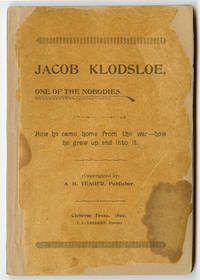
1899WRCAM52883Cleburne Tx.: T.L. Sanders 1899. 129pp. Original printed wrappers. Small chip to top corner of front wrapper and spine tail small stain to top corner of first few leaves last few leaves and rear wrapper chipped at lower corner not affecting text. Contents tanned as usual. Good plus. The autobiographical story of a Confederate soldier from an area described as having "Carolina's tallest peaks" on its southeastern horizon. Most names in the story appear to be fictional. Includes his capture at Kennesaw Mountain in June 1864 as a prisoner of war at Camp Douglas Illinois journey home and how he came to join an infantry company. Yeager 1842-1940 served with the 29th Tennessee Infantry Confederate until his capture. After the war he was a lawyer in Tennessee then a newspaperman and farmer in Johnson County Texas. Rare. Not in any of the standard reference works on the Civil War or Tennessee. T.L. Sanders unknown books
189944062Cleburne TX: A.H. Yeager publisher T. L. Saunders printer 1899. 12mo.; 129pp. Original printed gray wrappers some wear to spine; text paper somewhat browned but a very good copy. First edition. Autobiographical story of a Confederate soldier from Washington County Tennessee; Civil War experiences include his capture at Kennesaw Mountain in June 1864 his incarceration as a prisoner of war at Camp Douglas Illinois his journey home and after reflecting on his childhood in east Tennessee how he came to join an infantry company as the war began. Yeager 1842-1940 served with the 29th Tennessee Infantry Confederate until his capture; though not included in this autobiography his post-Civil War years were spent first as a lawyer in Tennessee then as a newspaperman and farmer in Johnson County Texas. Rare. OCLC locates ten copies but only one in Tennessee Knox County Public. Not in Nevins Eicher or Broadfoot. Not in Sam Smith's TENNESSEE HISTORY: A BIBLIOGRAPHY. <br/><br/> A.H. Yeager, publisher (T. L. Saunders, printer) unknown books