Smith, AdamBiblio.com

336 résultats
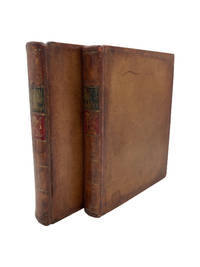
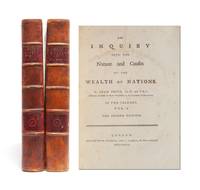
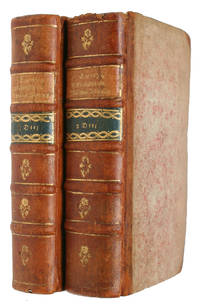
1776144265London: Printed for W. Strahan; and T. Cadell 1776. First edition of Adam Smith's magnum opus and cornerstone of economic thought. Quarto 2 volumes bound in full brown calf elaborately gilt-decorated spines front and rear panels red morocco spine labels marbled endpapers. In near fine condition. Remarkably clean throughout with some light toning. Housed in a custom half morocco calf clamshell box elaborately gilt decorated spines. An exceptional example of this landmark work. First published in 1776 Adam Smith's masterpiece The Wealth of Nations is the foundation of modern economic thought and remains the single most important account of the rise of and the principles behind modern capitalism. It took Smith ten years to produce An Inquiry into the Wealth of Nations. His commentary during such an incremental time the first years of the Industrial Revolution sought to reform outdated theories of mercantilist and physiocratic economic thought with broader concepts that we are all familiar with today such as the division of labor productivity and free markets. An important theme that persists throughout the work is the idea that the economic system is automatic and when left with substantial freedom able to regulate itself. This is often referred to as the “invisible hand.†The ability to self-regulate and to ensure maximum efficiency however is limited by a number of external forces and “privileges†extended to certain members of the economy at the expense of others. The 1776 publication of An Inquiry into The Wealth of Nations was the first of only five editions that were published in Adam Smith’s lifetime and greatly influenced a number of economists and philosophers of his time and those that followed including Jean-Baptiste Say Alexander Hamilton Thomas Malthus and Ludwig von Mises. "The history of economic theory up to the end of the nineteenth century consists of two parts: the mercantilist phase which was based not so much on a doctrine as on a system of practice which grew out of social conditions; and the second phase which saw the development of the theory that the individual had the right to be unimpeded in the exercise of economic activity. While it cannot be said that Smith invented the latter theory.his work is the first major expression of it. He begins with the thought that labour is the source from which a nation derives what is necessary to it. The improvement of the division of labour is the measure of productivity and in it lies the human propensity to barter and exchange.Labour represents the three essential elements-wages profit and rent-and these three also constitute income. From the working of the economy Smith passes to its matter -'stock'- which encompasses all that man owns either for his own consumption or for the return which it brings him. The Wealth of Nations ends with a history of economic development a definitive onslaught on the mercantile system and some prophetic speculations on the limits of economic control.The Wealth of Nations is not a system but as a provisional analysis it is complete convincing. The certainty of its criticism and its grasp of human nature have made it the first and greatest classic of modern economic thought" PMM. Printed for W. Strahan; and T. Cadell unknown
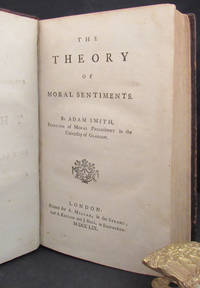
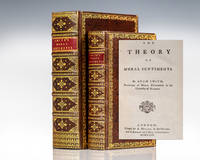
175931208London: Printed for A. Millar in the Strand and A. Kincaid and J. Bell in Edinburgh 1759 1759. First Edition. Thick 8vo 202 x 123 mm. bound in its original contemporary binding of full calf neatly and very sympathetically and skillfully restored at the back with the original spine panel laid down preserving all but ca. 2cm at the foot a nearly invisible sophistication the original morocco label replaced free endleaves renewed sympathetically with antique paper. xii 551 1 errata uncorrected in the text with an error: 412 should read 413; pp. 317-336 omitted from pagination as usual; complete with the half-title pp. A very handsome copy crisp and unpressed clean throughout the binding strong and in good order the occasional spot as to be expected but truly a pleasing copy of this monumental work. THE ESPECIALLY RARE FIRST EDITION IN ORIGINAL CONTEMPORARY BINDING OF ADAM SMITH'S FIRST BOOK PUBLISHED IN 1759. A TRULY RARE BOOK AND ONE OF THE MOST IMPORTANT WORKS IN ALL OF ENGLISH PHILOSOPHY. <br> 'THE THEORY OF MORAL SENTIMENTS was a true scientific breakthrough. It shows that our moral ideas and actions are a product of our very nature as social creatures. It argues that this social psychology is a better guide to moral action than is reason. It identifies the basic rules of prudence and justice that are needed for society to survive and explains the additional beneficent actions that enable it to flourish.<br> As individuals we have a natural tendency to look after ourselves. That is merely prudence. And yet as social creatures explains Smith we are also endowed with a natural sympathy – today we would say empathy – towards others. When we see others distressed or happy we feel for them – albeit less strongly. Likewise others seek our empathy and feel for us. When their feelings are particularly strong empathy prompts them to restrain their emotions so as to bring them into line with our less intense reactions. Gradually as we grow from childhood to adulthood we each learn what is and is not acceptable to other people. Morality stems from our social nature.<br> So does justice. Though we are self-interested we again have to work out how to live alongside others without doing them harm. That is an essential minimum for the survival of society. If people go further and do positive good – beneficence – we welcome it but cannot demand such action as we demand justice.<br>Virtue. Prudence justice and beneficence are important. However the ideal must be that any impartial person real or imaginary – what Smith calls an impartial spectator – would fully empathize with our emotions and actions. That requires self-command and in this lies true virtue.<br> Morality says Smith is not something we have to calculate. It is natural built into us as social beings. When we see people happy or sad we feel happy or sad too. We derive pleasure when people do things we approve of and distress when we believe they are doing harm.<br> Of course we do not feel others’ emotions as strongly as they do. And through our natural empathy with others we learn that an excess of anger or grief or other emotions distresses them. So we try to curb our emotions to bring them into line with those of others. In fact we aim to temper them to the point where any typical disinterested person – an impartial spectator says Smith – would empathise with us.<br> Likewise when we show concern for other people we know that an impartial spectator would approve and we take pleasure from it. The impartial spectator is only imaginary but still guides us: and through experience we gradually build up a system of behavioural rules – morality.<br> Punishments and rewards have an important social function. We approve and reward acts that benefit society and disapprove and punish acts that harm it. Nature has equipped us with appetites and aversions that promote the continued existence of our species and our society. It is almost as if an invisible hand were guiding what we do.<br> For society to survive there must be rules to present its individual members harming each other. As Smith comments it is possible for a society of robbers and murderers to exist – but only insofar as they abstain from robbing and murdering each other. These are the rules we call justice.<br> If people do not help others when they could or fail to return a good deed we may call them uncharitable or ungrateful. But we do not punish people to force them to do good: only for acts of real or intended harm. We force them only to obey the rules of justice because society could not otherwise survive.<br> But nature has given us something even more immediate than punishment namely our own self-criticism. We are impartial spectators not only of other people’s actions thanks to conscience. It is nature’s way of reminding us that other people are important too.<br> In the process of making such judgments on a countless number of actions we gradually formulate rules of conduct. We do not then have to think out each new situation afresh: we now have moral standards to guide us.<br> This constancy is beneficial to the social order. By following our conscience we end up surely but unintentionally promoting the happiness of mankind. Human laws with their punishments and rewards may aim at the same results; but they can never be as consistent immediate or effective as conscience and the rules of morality engineered by nature.<br> Smith ends THE THEORY OF MORAL SENTIMENTS by defining the character of a truly virtuous person. Such a person he suggests would embody the qualities of prudence justice beneficence and self-command.<br> Prudence moderates the individual’s excesses and as such is important for society. It is respectable if not endearing. Justice limits the harm we do to others. It is essential for the continuation of social life. Beneficence improves social life by prompting us to promote the happiness of others. It cannot be demanded from anyone but it is always appreciated. And self-command moderates our passions and reins in our destructive actions.<br> Freedom and nature Smith concludes are a surer guide to the creation of a harmonious functioning society than the supposed reason of philosophers and visionaries.' The Adam Smith Institute <br> The phrase that he is especially known for is first used here and would be repeated in THE WEALTH OF NATIONS: that the rich ".led by an invisible hand to make nearly the same distribution of the necessities of life which would have been made had the earth been divided into equal portions among all its inhabitants and thus without intending it without knowing it advance the interest of the society and afford means to the multiplication of the species." Part IV Section 1 pp. 350.<br> Both THE THEORY OF MORAL SENTIMENTS Adam Smith's first book and his later WEALTH OF NATIONS demonstrate "a great unifying principle.Smith's ethics and his economics are integrated by the same principle of self-command or self-reliance which manifests itself in economics in laissez faire" Spiegel.<br> "The fruit of his Glasgow years The Theory of Moral Sentiments would be enough to assure the author a respected place among Scottish moral philosophers and Smith himself ranked it above the Wealth of Nations. Its central idea is the concept closely related to conscience of the impartial spectator who helps man to distinguish right from wrong. For the same purpose Immanuel Kant invented the categorical imperative and Sigmund Freud the superego" Niehans 62 Printed for A. Millar, in the Strand and A. Kincaid and J. Bell, in Edinburgh, 1759 unknown
1759150275London: For A. Milar and A. Kincaid and J. Bell 1759. Rare first edition of Adam Smith's first book with a recorded “print run of 1000 copies†Sher “Editions of Adam’s Smith’s Books†13. Octavo bound in full calf gilt titles and tooling to the spine front and rear panels morocco spine label marbled endpapers. In near fine condition. Housed in a custom full calf clamshell box. Rare. Adam Smith's Theory of Moral Sentiments his first book is "one of the truly outstanding books in the intellectual history of the world" Amartya Sen. First published in 1759 it laid the foundation for Wealth of Nations and proposed the theory repeated in the later work: that self-seeking men are often "led by an invisible hand… without knowing it without intending it to advance the interest of the society." "The fruit of his Glasgow years… Moral Sentiments would be enough to assure the author a respected place among Scottish moral philosophers and Smith himself ranked it above the Wealth of Nations… Its central idea is the concept closely related to conscience of the impartial spectator who helps man to distinguish right from wrong. For the same purpose Immanuel Kant invented the categorical imperative and Sigmund Freud the superego" Niehans 62. Basing moral sentiment on "the power one man has of putting himself in the place of another" in contrast to Hume's idea of self-interest "Smith was henceforth recognized as one of the first authors of the day" DNB. With Moral Sentiments and Wealth of Nations Smith created "not merely a treatise on moral philosophy and a treatise on economics but a complete moral and political philosophy in which the two elements of history and theory were to be closely conjoined" Palgrave III:412-13. To Smith when man pursues "his own private interests the original and selfish sentiments of Moral Sentiments he will in the economic realm choose those endeavors which will best serve society. Herein lies the connection between the two great works which make them the work of a single and largely consistent theorist" Paul "Adam Smith" 293. In his Theory of Moral Sentiments Smith develops an ethics based on a “unifying principle—in this case of sympathy—which would shed light on the harmonious and beneficial order of the moral world. As such it was of considerable interest to Smith’s contemporaries who were groping for an ethics that would flow from man’s impulses or sentiments rather than from his reason from ‘innate ideas’ or from theological precepts. If Smith had written only The Theory of Moral Sentiments he would enjoy in the philosophers hall of fame a niche not unlike that reserved for Shaftesbury or Hutcheson.†Both Moral Sentiments and Wealth of Nations reflect Smith’s “attempt to anchor the new science of political economy in a Newtonian universe mechanical albeit harmonious and beneficial in which society is shown to benefit from the unintended consequences of the pursuit of individual self-interest. There is thus a considerable affinity between the structure of The Theory of Moral Sentiments and that of The Wealth of Nations. Each work is integrated by a great unifying principle. What sympathy accomplishes in the moral world self-interest does in the economic one. Either principle in its respective realm is shown to produce a harmony such as the one that characterizes Newton’s order of nature… Smith’s ethics is one of self-command or self-reliance just as is his laissez faire economics…. Smith’s ethics and his economics are integrated by the same principle of self-command or self-reliance which manifests itself in economics in laissez faire†Spiegel Growth of Economic Thought 229-231. For A. Milar, and A. Kincaid and J. Bell unknown
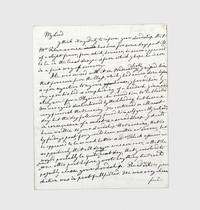
1760167445Glasgow: 10 March 1760. Smith nurses his student One of very few remaining Adam Smith autograph letters in private hands written to the Earl of Shelburne to detail the sickness of his son Thomas Petty-Fitzmaurice Smith's student and lodger. Mossner & Ross's census counts 232 letters written by Smith 53 of which could not be traced p. vii. Virtually all are in public collections. While serving as professor of logic and moral philosophy at Glasgow University Smith shared his residence with his more prominent students giving direct tutoring and scholastic supervision. Smith's renown was such that he attracted members of notable and aristocratic families to Glasgow: the 1st Earl of Shelburne sent his son there rather than Oxford on Lord Minto's recommendation. Thomas Petty-Fitzmaurice 1742-1793 the earl's youngest son lodged and studied with Smith from 1759 to 1761. Petty-Fitzmaurice later served as MP from 1762 to 1780; his brother William served as prime minister from 1782 to 1783. "In a series of letters to Fitzmaurice's father Smith went into great detail regarding the boy's studies and behaviour providing a number of insights into both the rigour of Smith's approach and the subjects he considered suitable for the education of a young noble . . . Fitzmaurice would spend two to three hours a day with Smith going over 'very regularly' the subjects he had covered in his lecture . . . It's clear from Smith's correspondence that the overall rigour and intensity of this schedule was an important part of his approach to teaching" Bonnyman p. 46. Here Smith writes to reassure Shelburne of his son's welfare in his care. "I think it my Duty to inform your Lordship that Mr. Fitzmaurice has been for some days past ill of a slight fever from which however he never appeared to be in the least danger and from which I hope he is now in a fair way of recovery. He was seized with it on Wednesday last. I missed him that forenoon from the Class which I had never done before and upon my return to my own house I found him lying upon his bed and complaining of a headache. I immediately sent for a Physician who ordered him to be blooded. He was a good deal relieved by the bleeding but became very feverish that evening. He continued so all next day but the day following found himself greatly relieved in consequence of a sweat and a sound Sleep. I should have written to your Lordship that evening that is by Fridays post for I could have written no sooner but he appeared to be so much better and Dr. Black assured me positively that all danger was now over and that he would probably be quite well next day that I resolved to wait one other post before I wrote anything that could possibly alarm your Lordship". Smith then gives a day-by-day account of Petty-Fitzmaurice's fluctuating health. He continues "Your Lordship perhaps may think that as I ventured to delay writing to you by last post I ought not to have written by this: and I shall readily acknowledge that my behaviour in this respect is not very consistent. But when Mr. Fitzmaurice had a slight relapse on Saturday evening I felt so much uneasiness for not having written to your Lordship the day before that I resolved never to expose myself to the like; your Lordship may depend upon his being treated with the utmost care and attention". Smith writes of his faith in the two doctors who attended him who are both with him at least five times a day; they did not deem the illness serious enough to alarm Shelburne. He signs himself "My Lord your Lordship's most obedient obliged servant Adam Smith". The letter dates less than a year after the publication of his classic work of sentiment and sympathy The Theory of Moral Sentiments. The letter is published in The Correspondence of Adam Smith pp. 62-3 where the editors note Smith's solicitude parallels that shown for his later pupils the Duke of Buccleuch and Hew Campbell Scott when they were struck with illness. Provenance: Bowood House in Wiltshire the estate of the Earls of Shelburne since 1754; the letter was part of the family's historic archive sold by the current Earl of Shelburne in 1994 to pay for the upkeep of the house; since then in private hands. Bifolium folded to 228 x 186 mm manuscript on 3 pages comprising 568 words entirely in Smith's hand fourth page with note in hand of recipient on the letter's contents. Housed in a black cloth flat-back box by the Chelsea Bindery. Central fold with 10 cm split at foot a few words a little smudged at time of writing; in very good condition. Brian Bonnyman Third Duke of Buccleuch and Adam Smith 2014; Ernest Campbell Mossner & Ian Simpson Ross The Correspondence of Adam Smith 1987. hardcover
17992080502106912477Not Available 1799. Soft Cover. Fine. The book is in fine condition. Not Available paperback
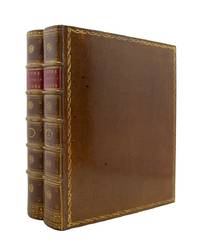
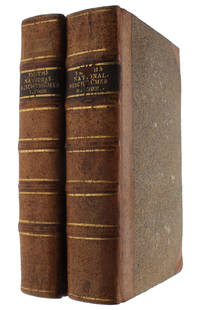
1778001569London: W. Strahan and T. Cadell 1778. Two volumes complete - Volume One - 9 2-510pp and Volume Two - 9 2-589pp 1. Full contemporary calf smooth back divided into six panels by gilt rule title label to second panel contrasting volume label to third. Rebacked with original back strips laid on volume label of first volume chipped with some loss some wear to outer joints with a couple of minor splits corners bumped. Closed tear to fore edge margin of G1 in volume one O-P2 lightly foxed a few notes in pencil to margins former owner's name and address in ink to ffep William Philip Haslewood. Signature N in the second volume is lightly foxed the bottom corner of 3U4 is torn away not affecting text and there is a minor worm trail to lower pastedown and rear free endpapers. Half title to volume two only as called for but both volumes lack the final blank. With a modern cloth slipcase. An attractive copy one of five hundred printed of the second edition of Smith's magnum opus the only other quarto edition after the first of 1776. Smith did slightly revise this edition with Todd noting "a number of alterations large and small some providing new information some correcting matters of fact some perfecting the idiom and a large number now documenting references in footnotes" Todd 'The Text and Apparatus' in volume one of the 1976 edition of the 'Wealth of Nations' page 62. Einaudi 5329; Goldsmith's 11663; Kress B.154; see PMM 221 for the first edition. Second Edition. Hardback. Good. 4to. W. Strahan and T. Cadell Hardcover
173045983Edinburgh / London.: Printed for Adam Black and J. & J. Robertson . T. Underwood and J. Taylor &c. 1730. c.1730 - 1740 / 1762 / 1811. Contemporary calf-backed marbled paper boards later protective box. Large folio. 550 x 384 mm. Printed title two leaves with 'List of the Plans &c.' in double columns listing 160 plates and 180 engraved plates numbered 1 - 160 including the unnumbered plates 71 and 148 and 20 'bis' plates with duplicate numbers 20 double-page and one large folding plate on two sheets; plates mounted on paper tabs from sheets of the same work throughout the title and text leaves on wove paper with the watermark '1809' the plates on laid paper with the watermark 'LLAR' and a fleur-de-lys countermark and others as per RIBA the sheets retaining deckle edges throughout. Sheet size: c. 534 x 356 mm; double-page plates: c. 534 x 712 mm; title and text: 518 x 358 mm. An excellent unsophisticated copy of the notoriously rare Vitruvius Scoticus.What was to become William Adam's 1689 - 1748 magisterially-intentioned yet still mysterious Vitruvius Scoticus was first mentioned in a letter in 1726 and by late 1727 Adam was issuing subscription receipts for a book of 'My Designs for Buildings &c. in 150 Plates'. Initially proposed as a book in the manner of James Gibbs' 'Book of Architecture' 'the first book in England to be devoted entirely to the designs of a living architect' Adam intended clearly to rival Gibbs to publicise his own work and to seek promotion and patronage from the new King George II. By 1733 Adam had found an Edinburgh-based engraver suitable for the task and one who may have shouldered some of the cost in Richard Cooper a student of John 'Friar' Pine and 'an acknowledged teacher and connoisseur of the fine arts'. Indeed it may have been Cooper who was the first to suggest a generalisation of the work and the assumption of a distinct Scottish character with the new title Vitruvius Scoticus. Cooper worked solely from the limited resource of Adam's own designs and under the stricture that there would be no theoretical work in the publication and was therefore limited and slow in what he was able to achieve. It is clear that Cooper's engravings were finished by the early 1740s but the reasons the work was then abandoned - not for the last time - are rather less so.It has been suggested that William Adam hesitated to publish for a number of reasons: financial pressure and the inherent costs of paper printing and publication; the curtailment of opportunities for promotion and patronage; a conflict of copyright; the 1745 Jacobite rising; Adam's advancing age; and finally the possibility of unflattering comparisons to Colen Campbell's Vitruvius Britannicus. At William's death in 1748 his son John revised the project adding additional plates including several taken from designs by his brothers Robert and James and it seemed at least briefly that the book would finally appear. At the time of the crash of the Fairholme brothers' bank in 1764 all was in readiness but the added financial burden on all of the brothers led John to sell the publishing rights to the London-based Andrew Millar and his partner Thomas Cadell; they issued subscription proposals in 1766. The agreement between John and the Londoners stipulated that of the existing sheets adequate for 950 copies they would require material for 750 and would allow the remainder to be retained by John for the existing subscribers. No copies were issued - it has been suggested that the reason was related to copyright although Robert and James Adam's opposition to a family association with 'outmoded taste' has been offered as more compelling - and on Millar's retirement in 1767 the sheets were in storage where they remained for 40 years.In 1804 Thomas Cadell's son wrote to John Adam's son another William that he was no longer able to store the sheets but that a scrap-paper merchant had offered £100 for them. Cadell's advice was to accept and it has been assumed subsequently that William did not: a story likely to be apocryphal states that the unused sheets were returned to Edinburgh and stored in a garret at the Royal Infirmary. It seems rather likelier that William did accept the £100 for the paper and his ongoing negotiations to have Vitruvius Scoticus published in 1808 - 1810 involved only those sheets that remained in Scotland. That the eventual publisher Adam Black issued only 120 copies - a very small run for a book of more than limited appeal - supports very strongly the idea that the remaining sheets were pulped an idea that the present copy with the plates mounted on paper guards composed of sections of those same plates corroborates. The final word on the mystery and indeed on the publication belongs to Eileen Harris: 'It is ironical that to be commercially viable Vitruvius Scoticus clearly the grandest of any architectural book published in Scotland had to be sold in the end as a remainder … '.'A resounding silence greeted Adam Black's announcement in the 'Edinburgh Weekly Chronicle' on 29 May 1811 that 'Vitruvius Scoticus' was 'this day . completed in fifteen numbers'. Not only was William Adam's book Vitruvius Scoticus a century too late to have the bearing on Scottish architecture that its title promised; but with no preface explanatory text or date of publication it was silent also about itself about the intentions of its author and above all about its complicatred past.' Eileen Harris.'The best and most jinxed of all the great 18th century British architectural books William Adam's Vitruvius Scoticus was three times abandoned by successive generations of the Adam family before finally in 1811 a young Edinburgh bookseller named Adam Black . published an edition of 'only 120 complete sets' hastily assembled from sheets printed nearly 50 years before . Ill-planned and muddled as the book was from its inception it was a sad irony that Vitruvius Scoticus should end up as an obscure bookseller's remainder totally unremarked upon at the time and only quite recently recognised as the paramount source document for the history of classical architecture in Scotland.' Weinreb. 'We are left therefore with the virtually inescapable conclusion that a decision to publish 'Vitruvius Scoticus' was definitely made almost certainly in the early 1760s; that this decision was modified after the Fairholme crash to the extent that a London publisher agreed to buy the unsubscribed portion of the edition; and finally that the entire edition was deliberately withheld under the pretence that the work was undergoing revision by the engraver. Such an extraordinary fiasco might seem more far-fetched were it not possible to detect behind the scenes as it were the influence of Robert and James Adam's rising star south of the border where any publication connected with the family name might do more harm than good if it failed to evince the most advanced and novel taste of the day.' BAL RIBA.Of the utmost scarcity on the market we can trace very few copies at auction or in institutions and of those copies that can be traced many appear to be incomplete; it is worth noting that Weinreb priced the example in his catalogue 2 'Books and Drawings Before 1800' at £285 in contrast the 1485 first edition of Alberti's De Re Aedificatoria was £845 and in catalogue 58 'Fine Architectural Books Part 2' in 1988 at £28000.BAL RIBA 30 incomplete; Millard 3 disbound and mounted; Harris 8; Weinreb 2:4 & 58:1; see 'British Architectural Books and Writers 1556 - 1785' by Eileen Harris Cambridge 1990 pp. 94 - 104. Printed for Adam Black, and J. & J. Robertson ... T. Underwood, and J. Taylor &c. hardcover
17785444London: for W. Strahan and T. Cadell 1778. Second edition. Very Good. 2 volumes quarto 282 × 225 mm half title in volume 2 as called for bound without the final blanks in each volume: 8 510; 8 589 1 blank. Contemporary tree calf rebacked preserving original red morocco spine labels plain endpapers. Engraved armorial bookplate of the Leigh family of Stoneleigh Abbey "Tout Vient de Dieu" and two Japanese bookseller's tickets to the front paste-down. Some insect damage to the leather boards corners worn light to moderate foxing throughout mostly in volume 1 a few tears or blemishes one or two signs of a contemporary reader's engagement with the text; a very good copy overall.<br /> <br /> Second edition first published in 1776 of this classic of economic thought the only other edition to be published in quarto format one of 500 copies. Long considered a straight reprint this edition in fact contains "a number of alterations large and small some providing new information some correcting matters of fact some perfecting the idiom and a large number now documenting references in footnotes" Todd. <br /> <br /> Published in the same year as the American Declaration of Independence Adam Smith's The Wealth of Nations was a magnum opus that shaped not only the future of a new republic but that also urged longstanding sovereign governments to reconsider how and when they regulated markets. Arguing that economic growth comes not from government planning "but as the natural outcome of many people pursuing their own self-interest in the confines of an ordered polity" Smith encouraged economists and political policy-makers to leave free markets to their own operations and focus instead on fulfilling the duties of peace keeping education and public infrastructure that they owed their citizenry The Wall Street Journal. <br /> <br /> ESTC T95117. Einaudi 5329; Goldsmiths' 11663; Kress B.154; Tribe 15; Vanderblue 3; see also PMM 221. Very Good. for W. Strahan and T. Cadell unknown
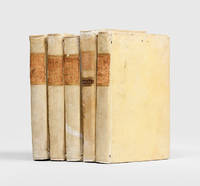
1790189815Naples: Giuseppe Policarpo Merande 1790-91. Adam Smith in the birthplace of political economy First edition in Italian of the Wealth of Nations among the scarcest of the 18th-century translations. Barring certain insubstantial references in journals "Smith's ideas did not reach Italy until 1790" Gioli p. 153. The translation was a quintessential product of the Neapolitan Enlightenment which had seen the development of political economy itself by Galiani and Genovesi in the 1750s. According to the preface the anonymous translator had corresponded with Smith and had received advice as to his translation. The edition takes its wider lead from Blavet's French translation which appeared from 1779 to 1780 while adapting various phrases and concepts to an Italian context. The second edition in Italian was not published until 1851. 5 vols octavo 173 x 114 mm. Complete with all half-titles and index leaves; vols. I III and V lacking rear free endpaper final leaf of vol. II fixed as rear pastedown. Contemporary vellum spines with orange calf label vol. IV with additional brown calf label edges sprinkled blue and red. Light soiling slight foxing and damp staining to contents paper flaw to leaf E2 of vol. III touching several words: a very good copy. Einaudi 5343; Goldsmiths' 14107; Kress B.1987; Tribe 39; Vanderblue p. 29 but lacking the fifth volume. Gabriella Gioli "The Knowledge of Adam Smith's Wealth of Nations in Italy in the Eighteenth Century shortened and translated by the author" in Cheng-chung Lai ed. Adam Smith Across Nations: Translations and Receptions of The Wealth of Nations 2000. hardcover
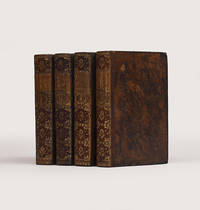
1778184198A La Haye though Zweibrücken: no publisher stated though the ducal French press of Deux-Ponts 1778-79. The first foreign-language appearance of a milestone in economics Very rare first edition in French of the Wealth of Nations the first translation following its publication in English in 1776. "This translation of the 1776 English edition of WN has remained a mystery. Was it printed in The Hague If not where was it printed Who was M identified on the title pages as the translator Copies are rare within French libraries" Carpenter p. 20. Carpenter & Sabbagh's recent scholarship identifies the printer as the ducal press of Deux-Ponts now Zweibrücken. Though a commercial venture the press used a fictitious imprint to avoid problems when printing French-language works that risked running afoul of the censor. The translator was Jean-Louis Carra 1742-1793 an active contributor to the Encyclopédie d'Yverdon later in the French Revolution to join the Jacobins where he was appointed joint head of the Bibliothèque nationale but clashed with Robespierre and was guillotined in 1793. The text follows the original closely omitting a section on religious instruction alongside other minor religious changes. The edition was preceded in French translation only by an extract Fragment sur les colonies en général et sur celles des anglois en particulier translated by Reverdil which had been published in Lausanne and Basel earlier in 1778 to test public demand for the work. 4 vols duodecimo in 4s and 8s 162 x 95 mm collates complete with half-titles and blank "table des matieres" bound following title pages rather than at rear. Contemporary calf twin brown and green labels smooth spines with gilt floral decoration marbled endpapers red edges. Contemporary ownership signature of Mats Zachrisson to front free endpaper. Light rubbing and insect abrasion with some loss to lettering on labels bindings otherwise with little wear and without repair staining to Vol. IV and a few leaves in Vol. I else fresh. A very good copy. Goldsmiths' 11664; Kress B155; Tribe 16; Vanderblue 24. Kenneth E. Carpenter The Dissemination of the Wealth of Nations in French and in France 2002; Kenneth Carpenter & Gabriel Sabbagh "Unveiling the First French Translation of Adam Smith's Wealth of Nations" in Oeconomia vol. 14 no. 1 2024. unknown
177867993London: Printed for W. Strahan; and T. Cadell 1778. Full Description:<br> <br> SMITH Adam. An Inquiry into the Nature and Causes of the Wealth of Nations. In two volumes. The second edition. London: Printed for W. Strahan; and T. Cadell 1778.<br> <br> Second edition first published in 1776 and the only other edition to be published in quarto format. One of 500 copies printed. Two quarto volumes 10 3/4 x 8 7/8 inches; 273 x 225 mm. 8 510; 8 589 1 blank pp. With half-title in Volume II no half-title called for in Volume I.<br> <br> Full newer speckled calf. Boards tooled in gilt. Spines with red morocco spine labels lettered in gilt. Spines stamped and numbered in gilt. Gilt board edges. Gilt dentelles. Newer endpapers. Volume one with some newly invisible repairs to the title-page at gutter along top margin and to a tiny hole not affecting text. Text of volume I with some foxing throughout. Volume II with some neat pencil marginalia and a pin-sized wormhole to outer blank margin from signature 3A through the end. Still volume II internally very clean. Overall a very good copy.<br> <br> The second edition is the rarest of the early editions of The Wealth of Nations. Only 500 copies were printed. The third edition consisted of 1000 copies and the fourth 1250 copies. It is unknown how many copies of the more common first edition were published. "The second edition exhibits a number of alterations large and small some providing new information some correcting matters of fact some perfecting the idiom and large number now documenting references in footnotes" William B. Todd in the 1976 Oxford edition of The Wealth of Nations.<br> <br> Adam Smith 1723-1790 spent ten years in the writing and perfecting of The Wealth of Nations. "The book succeeded at once and the first edition was exhausted in six months.Whether it be true or not as Buckle said that the 'Wealth of Nations' was 'in its ultimate results probably the most important that had ever been written'.it is probable that no book can be mentioned which so rapidly became an authority both with statesmen and philosophers" D.N.B.<br> <br> "The history of economic theory up to the end of the nineteenth century consists of two parts: the mercantilist phase which was based not so much on a doctrine as on a system of practice which grew out of social conditions; and the second phase which saw the development of the theory that the individual had the right to be unimpeded in the exercise of economic activity. While it cannot be said that Smith invented the latter theory. his work is the first major expression of it. He begins with the thought that labour is the source from which a nation derives what is necessary to it. The improvement of the division of labour is the measure of productivity and in it lies the human propensity to barter and exchange. Labour represents the three essential elements- wages profit and rent- and these three also constitute income. From the working of the economy Smith passes to its matter- 'stock'- which compasses all that man owns either for his own consumption or for the return which it brings him. The Wealth of Nations ends with a history of economic development a definitive onslaught on the mercantile system and some prophetic speculations on the limits of economic control.The Wealth of Nations is not a system but as a provisional analysis it is complete convincing. The certainty of its criticism and its grasp of human nature have made it the first and greatest classic of modern economic thought" Printing and the Mind of Man 221 describing the 1776 first edition.<br> <br> Kress B.154. Goldsmiths' 11663. Printing and the Mind of Man 221. Sabin 82303. Grolier 100 English 57 describing the 1776 first edition.<br> <br> HBS 67993.<br> <br> $28500. Printed for W. Strahan; and T. Cadell unknown
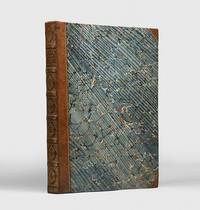
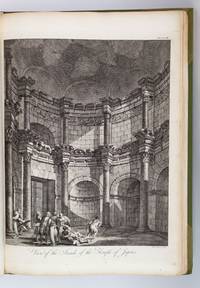
1764145764London: for the author 1764 . Robert Adam's magnificent folio on the ruins of ancient Spalatro First and only contemporary edition of this superb work "one of the pioneering archaeological studies of the period" Thom which describes the villa - or rather fortress-palace - of the Emperor Diocletian built at Split the ancient Aspalathos on his abdication in 305 CE. During a five week detour from his Grand Tour Adam joined by the renowned French draughtsman Charles-Louis Clérisseau set about studying measuring and recording the grand ruins at Spalatro the plates finely rendered by a team of the best engravers are a mixture of plans sections and elevations 14 plates and views 47 plates. Self-published to promote the author's career the influence these designs had upon their author is evident throughout Adam's hugely successful and influential career. This folio represents the author's primary exposure to the inspirations that would define his own pervasively influential neo-classical "Adam Style". Provenance: gilt leather armorial book label of Granville Hastings Wheler 1780-1827 grandson of the experimental philosopher Granville Wheler 1701-1770; his label dated 1725 the year that his grandfather purchased Otterden Place Kent a house that was remodeled and enlarged by Granville Hastings who commissioned the architect William Pilkington. "It is said that the designs were based on Wheler's sketches of the 16th century house made from memory but it is far from clear that his influence extended beyond mandating the choice of the Tudor style for the new elevations" landedfamilies blog retrieved 4 January 2021. Folio 525 x 360 mm. 61 engraved plates complete 14 double-page or folding on 54 sheets including the pictorial title page by Francesco Bartolozzi Antonio Zucchi Edward Rooker and others after Charles-Louis Clérisseau. Early 19th-century half russia flat spine with six low raised bands decorated with gilt fillets closed by foliate finials gilt lettered direct in the second compartment others richly gilt with foliate and geometrical decoration sides and corners trimmed with a pretty gilt foliate roll Spanish on Turkish pattern marbled sides edges and endpapers. Binding professionally and judiciously refurbished. A very good copy handsomely bound with strong impressions of the plates. Colin Thom "'This Knoty Business': The making of Robert Adam's Ruins of the Palace of the Emperor Diocletian 1764 revealed in the Adam brothers' Grand Tour correspondece". hardcover
1767324743London: A Millar 1767. Third. hardcover. good/no dustjacket. 8vo. pp.478 half title page missing boards starting to detach A Millar hardcover
17641721551764. ADAM Robert. Ruins of the Palace of the Emperor Diocletian at Spalatro in Dalmatia. vi 8 33 1 pp. with 61 engraved plates on 54 sheets some double-page. Folio 525 x 370 mm. bound in full contemporary calf. London: For the author 1764. First edition. "The book incorporated the first encyclical of Britain's most popular architect of the day who had now been in practice for several years with an immense patronage. Adam makes it quite plain that the great palace of Diocletian forms the source of his ideas upon domestic building and he modestly claims that it is the first private dwelling-house of the Romans to have been illustrated and described." Adam's account was based on his five-week visit to Spalatro in Croatia now known as Split; the sixty-one superb plates were executed after Clerisseau Zucchi and others some of the drawings survive at the Hermitage St. Petersburg. In his introduction Adam expresses his conviction that Diocletian had revived a taste in Architecture superior to that of his own times. Adam's "observance on unusual detail throughout is remarkable. Nothing is too minute to escape his notice. A careful reading of the descriptions shows whence Robert Adam derived his theories for the planning of his domestic buildings on a monumental scale like Syon and Kedleston" James Lees-Milne The Age of Adam pp. 67-69. A fine copy of this landmark book. Millard British 1. Harris British Architectural Books 4. Fowler 2. Berlin Katalog 1893. Cicognara 3567. John Fleming Robert Adam and His Circle 1962 pp. 235-240. Georg Kowalczyk Denkmäler der Kunst in Dalmatien 1910 reproducing 22 plates. unknown
17951169901795. First Edition. SMITH Adam. Essays on Philosophical Subjects To Which Is Prefixed an Account of the Life and Writings of the Author by Dugald Stewart. London: for T. Cadell Jun. and W. Davies et al. 1795. Large quarto 9 by 11-1/4 inches period-style full speckled brown calf raised bands red morocco spine label; pp. i-iii iv v-vi vii-ix x-xcv blank 1-3 4-93 94-97 98-111 112-115 116-129 130-133 134-184 185-187 188-194 195-197 198-244; slipcase. $13800.First edition of this core volume of Smith's essays issued posthumously featuring the important first publication of History of Astronomy that seeks ""to explain what drives 'philosophers' to ask the questions they do"" an impressive wide-margined volume handsomely bound.Though Essays on Philosophical Subjects appeared five years after Smith's death most were likely written before the publication of his Theory of Moral Sentiments in 1759. Essays was compiled by his literary executors physicist Joseph Black and geologist James Hutton. Prior to his death Smith ""instructed them to destroy his manuscripts but allowed them at their discretion to publish a set of essays"" Berry Cambridge Companion 116. As noted herein Smith had begun work early in his career on ""a connected history of the liberal sciences and elegant arts"" but ""found it necessary to abandon that plan as far too extensive."" These writings thus represent Smith's longstanding attempts at such a ""connected history"" and range over philosophy aesthetics and the history of science. A biographical Account of Smith and his work is followed by the extensive History of Astronomy which was the only writing Smith did not want destroyed; indeed he specifically arranged for its posthumous publication. Black and Hutton used their authority to incorporate its momentous first publication into this collection. Astronomy ""was probably begun decades before Smith's death perhaps as early as 1746 and was at one time intended to form a chapter of a much larger work Astronomy purports to explain what drives 'philosophers' to ask the questions they do and to seek explanations for the things they observe"" Otteson Adam Smith 22-3. Astronomy ""has occasioned much scholarship Just as The Wealth of Nations was titled an enquiry into its 'natures and causes' so Smith says at the end of the preliminary section of Astronomy that the design of the essay is to consider the 'nature and causes of the three sentiments""identified by him as ""Wonder Surprise and Admiration."" Citing Galileo Copernicus Kepler Newton Descartes and others Astronomy aims ""to illustrate how philosophy is an activity that addresses itself to the imagination"" Berry 116-117 123. Also included in this volume are his essays on ""Ancient Physics"" ""Ancient Logics and Metaphysics"" and the ""Imitative Arts"" along with a concluding essay on perception in the five ""External Senses."" One of 1000 copies. Containing the first publication in book form of Dugald Stewart's Account of the Life and Writings of Adam Smith which had appeared in the Transactions of the Royal Society of Edinburgh in 1794. Stewart's Account ""formed the basis upon which everyone drew for biographies of Smith that began to appear in the early 19th century"" Tribe 55. Without initial blank. Goldsmith 16218. Kress B3038. Rothschild 1902. Trace of early owner signature above title page.Interior very fresh period-style calf fine. An elemental Adam Smith work. hardcover
1756163096Amsterdam & Leipzig: Arkstée and Merkus 1756. We grow weary of the grave pedantic and long-sentenced love of Cowley and Petrarca. but the gaiety of Ovid and the gallantry of Horace are always agreeable" TMS I. ii. 2.1. A hitherto unrecorded volume from Adam Smith's library with his bookplate centrally positioned on the front pastedown volume 3 of an 8-volume set of Horace's poems the text in French and Latin on facing pages with the extensive remarks and critical notes of Noël-Étienne Sanadon of the Society of Jesus. Horace was clearly a favourite author of Smith's with thirteen different editions listed by Mizuta in his Catalogue of Smith's library 81-823 all but one of which are in Latin the only other entry being a ten-volume set in French of Horace's works equally with parallel Latin and French texts and notes and commentaries by Dacier. This single volume was purchased by its previous owner in the basement of Holleyman and Treacher booksellers of Brighton several decades ago. Duodecimo 168 x 95 mm. Woodcut vignettes and tailpieces title printed in red and black. Contemporary calf spine with five raised bands ruled in gilt black morocco label numbered direct in gilt. Housed in a dark brown quarter morocco solander box by the Chelsea Bindery. Spine ends chipped and corners worn spine label with slight loss free endpapers with burn marks from the leather turn-ins around the edges somewhat browned and brittle contents crisp and clean; a very good copy. Not listed in Mizuta or Yanaihara. hardcover
1779158759Copenhagen: Gyldendal 1779-80. Adam Smith in Danish First edition in Danish of The Wealth of Nations translated from the first edition of 1776 by Frants Draebye published together with a translation of Thomas Pownall's critical Letter. to Adam Smith of the same year. Draebye had been in England in 1776 as part of his role of tutor on a continental tour to two sons of a Norwegian merchant James Collett. Smith acknowledged the translation in two letters of 1780 the first written to Andreas Holt Commissioner of the Danish Board of Trade and Economy to whom he wrote "it gives me great pleasure to hear that Mr Dreby has done me the distinguished honour of translating my book into the Danish language." the second to Peter Anker Consul General of Denmark in Great Britain sending him three copies of the second edition of 1778 and asking him to forward them to Draebye and Holt. 2 vols octavo 192 x 114 mm pp. xii 575 1; viii 775 3. Contemporary sprinkled sheep spines decorated in gilt between five raised bands yellow paper labels lettered in gilt marbled paper pastedowns red edges. Joints of vol. I strengthened head and tail of both vols repaired gilt decoration to vol. II largely eroded; marginal tear to one leaf occasional light spotting; a very good set. Tribe 19: Vanderblue p. 23. Mossner & Ross The Correspondence of Adam Smith 1987. hardcover
1764ST17496-042London: Printed for the Author 1764. FIRST EDITION. 520 x 365 mm. 20 3/4 x 14 1/4". iv 8 subscribers list 33 pp. <br/> Attractive modern light green half morocco gilt by J. F. Newman of Dublin his ticket on front pastedown raised bands spine panels with central patera ornament two darker green morocco labels reinforced hinges edges untrimmed. WITH 61 SPLENDID ENGRAVINGS 14 plans and elevations 47 views ON 54 PLATES eight double-page six folding by Bartolozzi and others. Front flyleaf with ink signature of Francis D. Bedford dated October 1886. Cicognara 3567; Fowler 2. Spine sunned to a light olive shade one corner bumped one plate with a little browning along the fold occasional mild marginal foxing or trivial smudges but A FINE COPY--fresh bright and clean internally with deep impressions of the type rich impressions of the plates and generous margins in a binding with few signs of wear.<br/> <br/> This is an extremely appealing copy of one of the great architectural books of the 18th century described by Cicognara as a "magnificent and grandiose work." Scottish architect Robert Adam 1728-92 was a product of the Scottish Enlightenment and moved in intellectual circles that included historian William Robertson who wrote the introduction here David Hume and Adam Smith. His interest in architectural drawing was stimulated by books in his father's extensive library which DNB tells us contained "a working collection of illustrated architectural books in English French and Italian and a series of manuals on architectural draughtsmanship." This curiosity developed into a passion during his 1755-57 tour of Italy which "was in every way a period of intense professional training during which the skills learned in Scotland were tested and given an international gloss by the Roman circle in which he now moved." DNB At the center of this circle was French architect antiquarian and artist Charles-Louis Clérisseau 1721-1820 the leading authority on Roman antiquities and architecture who introduced Adams to among others the great Piranesi. With Clérisseau as guide and tutor he explored and sketched various sites before arriving at the un-surveyed fortress palace built by the former emperor Diocletian at Spalatro the modern-day Croatian city of Split. Adam undertook a survey of the building and drew the architectural plans and elevations for this work while Clérisseau sketched views of the ruins. Adam planned this book as a way of promoting his career as an architect and worked with Clérisseau to have engravings made for it. According to Thom "while the traditional plans elevations and sections--what Robert Adam called the 'Geometricals'--were generally supplied by English engravers like Rooker Patton and Walker the all-important picturesque views and perspectives which Adam thought were essential to convey the emotional impact of the remains of Diocletian's Palace were engraved in Italy mostly by Bartolozzi Paolo Santini and Zucchi." Adams also wrote the architectural commentary. The publication was a success praised by the "Critical Review" in October 1864 as possessing "a taste and execution that has never been equalled in England." As DNB observes "during these two Roman years Adam succeeded in transforming himself from a provincial and rather green Scottish architect into a cosmopolitan figure ready indeed to put into effect 'the Antique the Noble & Stupendous.'" Now based in London he embarked on a distinguished career specializing in country houses and townhomes that reflected the deep influence classical architecture and his Italian sojourn had on his work. Our copy was once owned by another artist Francis Donkin Bedford 1864-1954 who exhibited landscapes at the Royal Academy and illustrated books during the Golden Age of children's book illustration in the late 19th and early 20th century. Printed for the Author unknown
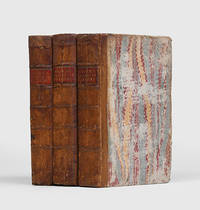
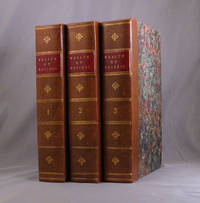
1786173725London: printed for A. Strahan; and T. Cadell 1786. An uncut copy Fourth edition of "the first and greatest classic of modern economic thought" PMM an uncut and partly unopened copy in a contemporary binding a reprint of the third edition of 1784 with minor variations. In his Wealth of Nations Smith "begins with the thought that labour is the source from which a nation derives what is necessary to it. The improvement of the division of labour is the measure of productivity and in it lies the human propensity to barter and exchange The Wealth of Nations ends with a history of economic development a definitive onslaught on the mercantile system and some prophetic speculations on the limits of economic control" PMM. "The Wealth of Nations had no rival in scope or depth when published and is still one of the few works in its field to have achieved classic status meaning simply that it has sustained yet survived repeated reading critical and adulatory long after the circumstances which prompted it have become the object of historical enquiry" ODNB. "The 'Advertisement to the Fourth Edition' announces that no alterations of any kind have been made. Cannan noted some small variations which can be attributed to small misreadings or unauthorised corrections by the printers. The division between volumes is identical to that in the 3rd Edition and Vol. II Bk. IV Ch. 8 is this time included in the Table of Contents" Tribe. Provenance: engraved armorial bookplate of Talbot of Gonvile's Hall in Wymondham Norfolk to each front pastedown; earlier ownership signature of B. C. Hingham dated June 1787 above. Binder's note in ink on front blank endpaper of vol. I: "3 V. 0.18.0 in hf bind." 3 vols octavo 228 x 138 mm pp. Complete with the conjugate blank leaf before title in vol. III the top edge unopened. viii 499 1; vi 518 6; v iv-v 1 465 1 50 index. Contemporary half calf and marbled boards red morocco spine labels. Housed in a brown leather entry slipcase by the Chelsea Bindery. Spines with some surface wear and vertical cracks consolidated at the head one joint partly cracked but sound minimal loss of the marbled paper covering; very occasional light spotting and the odd short marginal tear; a lovely example of a modest provincial binding entirely uncut and partly unopened. Goldsmiths' 13148; Kress B.1129; Tribe 30; Vanderblue p. 3. See Printing and the Mind of Man 221; Loudon J. H. James Scott and William Scott bookbinders Scolar Press 1980. hardcover
178620767London: for A. Strahan and T. Cadell 1786. 3 volumes. An especially early printing the fourth only the second of the octavo editions the last edition with any changes includes a new preface never before printed issued only 10 years after the first 2 vol. quarto edition. 8vo beautiful three-quarter polished calf in fine antique style over marbled paper covered boards red morocco lettering labels gilt the spine in compartments separated by gilt bands gilt central devices in the compartments. viii 499 errata; vi 518 5 Appendix errata; v errata 465 47 index 1 ad pp. A remarkably fine and handsome set the text blocks completely untrimmed and with the original deckled edges as issued from the printer. Bindings in excellent condition. A BEAUTIFUL SET OF THIS EXTRAORDINARY WORK. Smith's classic work was begun at Toulouse in 1763-64 where he had travelled as guardian of Henry Scott the young duke of Buccleuch and in the company of David Hume historian and fellow professor at Glasgow University. The work took shape over the next ten years and was finally published in 1776. At one point during its composition Hume wrote that Smith was "cutting himself off entirely from human society." But his labors however severe his methods yielded the "first and greatest classic of modern economic thought" Printing and the Mind of Man.<br> "It may be said that the WEALTH OF NATIONS certainly operated powerfully through the harmony of its critical side with the tendencies of the half-century which followed its publication to the assertion of personal freedom and 'natural rights.' It discredited the economic policy of the past and promoted the overthrow of institutions which had come down from earlier times but were unsuited to modern society. As a theoretic treatment of social economy and therefore as a guide to social reconstruction and practice in the future it is provisional not definitive. But when the study of its subject comes to be systematized on the basis of a general social philosophy more complete and durable than Smith's no contribution to that final construction will be found so valuable as his" Britannica.<br> The fourth edition contains a special ‘advertisement’ first appearing here in which Smith declares that he is now ‘at liberty to acknowledge my very great obligations to Mr. Henry Hop of Amsterdam. To that gentleman I owe the most distinct as well as liberal information concerning a very interesting and important subject the Bank of Amsterdam’. Eighteenth century editions of Smith’s magnum opus are now becoming very scarce. for A. Strahan and T. Cadell hardcover
177947455Kiøbenhavn Copenhagen 1779-80. 8vo. Two very nice contemporary brown half calf bindings with raised bands gilt ornamentations and gilt leather title- and tome-labels. Volume two with a bit of wear to upper capital. Corners slightly bumped. Pencil annotations to verso of title-page in volume one; title-page in volume two mounted to cover up a small hole caused by the removal of an old owner's name. Internally very clean and bright. All in all a very nice clean fresh and tight copy. Engraved by Weise 1784 armorial book plate to inside of front boards Gregorius Christianus Comes ab Haxthausen. 12 575; 8 775 3 - errata pp. <br/><br/><em>The extremely scarce first Danish edition of Adam Smith's seminal main work "the first and greatest classic of modern economic thought" PMM 221 the main foundational work of the era of liberal free trade. This publication constitutes the first Danish work worth mentioning in the history of economic thought - in spite of the great interest in political economy that dominated Danish political thought in the last quarter of the 18th century. The value of Smith's work was not immediately recognized in Denmark at the time of its appearance and a quarter of a century had to go by for its importance to be acknowledged and for Danish political economy to adapt the revolutionizing theories of Adam Smith. Few copies of the translation were published and sold and the book is now a great scarcity. As opposed to for instance the German translation of the work Smith concerned himself a great deal with this Danish translation. As is evident from preserved correspondence about it he reacted passionately to it and was deeply concerned with the reaction to his work in Scandinavia see "Correspondence of Adam Smith" Oxford University Press 1977.- As an example Smith writes in a letter to Andreas Holt on Oct. 26th 1780: "It gives me the greatest pleasure to hear that Mr. Dreby has done me the distinguished honour of translating my Book into the Danish language. I beg you will present to him my most sincere thanks and most respectful Compliments. I am much concerned that I cannot have the pleasure of reading it in his translation as I am so unfortunate as not to understand the Danish language." The translation was made by Frants Dræby 1740-1814 the son a whiskey distiller in Copenhagen who mastered as a theologian and was then hired by the great Norwegian merchant James Collett as tutor to his son. There can be no doubt that Dræbye's relation to the Collett house had a great impact upon his interest in economics. In the middle of the 1770'ies Dræbye accompanied Collett's son on travels throughout Europe which took them to England in the year 1776 the same year that the "Wealth of Nations" was published for the first time. Through the Colletts Dræbye was introduced to the mercantile environment in England and here became thoroughly acquainted with English economics and politics at the time. It is presumably here that he gets acquainted with Adam Smith's freshly published revolutionary work. When Dræbye returned to Denmark at the end of 1776 he was appointed chief of the Norwegian secretariat of the Board of Economics and Trade. He began the translation of the "Wealth of Nations" that he brought back with him from England immediately after his return."WN i.e. Wealth of Nations was translated into Danish by Frants Dræbye and published in 1779 three years after the first English edition. The translation was initiated by Andreas Holt and Peter Anker who were acquainted with Smith. Dræbye was a Dane who lived mainly in Norway reflecting the fact that Norway was much more British-oriented than Denmark proper Denmark and Norway were united until 1814 when Sweden took Norway away from the Danes; in 1905 Norway became an independent state. Norwegian merchants lived from exporting timber to Britain and tended on the whole to be adherents of a liberal economic policy whereas the absolutist government in Copenhagen was more German-oriented and had economic views similar to those in contemporary Prussia." Cheng-chung Lai edt.: "Adam Smith Across Nations" p. 37. The last quarter of the eighteenth century in Denmark was dominated by a lively discussion of monetary policy and the institutional framework best suited to realize that policy. There was a vital interest in questions of economic concern and contemporary Danish sources refer to the period as "this economic age" and state things such as "never was the world more economically minded" both from "Denmark and Norway's Economic Magazine". During this period Smith's revolutionary ideas did not play a major role however and only at the beginning of the 19th century did Danish politicians and economists come to realize the meaning of Smith's views. "Without exaggeration it can essentially be said that a quarter of a century was to pass from the time of the publication of the book in Denmark before Danish political economy fully made Adam Smith's theories and points of view its own. It took so long a time because the economic conditions as a whole in the years from 1780-1800 did not make desirable or necessary the changing of their concepts. That glorious commercial period had to pass before it was understood that we had altogether too little help in our own natural resources and that a different course was therefore necessary. Only when one had come so far could the new thinking find a nourishing soil so that it could develop strength with which to push aside the old ideas."Hans Degen: "On the Danish Translation of Adam Smith and Contemporary Opinion Concerning It." Translated by Henrietta M. Larson. In: Adam Smith Across Nations p. 51. This first Danish translation is one of the very earliest translations of "Wealth of Nations"; it is only preceded by the German 1776-78 and the extremely scarce French 1778-79. As a comparison the Italian translation does not appear until 1790-91 the Spanish 1792 the Swedish 1800-1804 the Russian 1802 etc.Adam Smith Across Nations: A4 - nr. 1. "All five books were translated; appears to be a complete translation. The long letter from Governor Pownall to Adam Smith 25 Sept. 1776 is added as the Appendix vol. 2 pp. 683 ff."PMM 221 - first edition </em> hardcover
177860523Leipzig Weidmann 1776-78. 8vo. Bound in two nice uniform contemporary half calf bindings with five raised bands black title-label and gilt lettering to spine. Small paper-label to upper compartment Catalogue-number from an estate-library. Light wear to extremities otherwise a very nice set. VIII 632 pp; XII 740 pp. <br/><br/><em>First German edition also being the very first overall translation of Adam Smith's ground-breaking main work the "Inquiry into the Nature and Causes of the Wealth of Nations". This seminal first translation of the work was undertaken by J.F. Schiller who finished the first part of the translation in time for it to appear as soon as 1776 the same year as the original English edition. The second part appeared in 1778 the same year as the exceedingly scarce first French translation. This first German translation has been of the utmost importance to the spreading of Smith's ideas throughout Europe and after the true first this must count as the most important edition of the work."The influence of the Wealth of Nations . in Germany . was so great that 'the whole of political economy might be divided into two parts - before and since Adam Smith; the first part being a prelude and the second a sequel." Backhouse Roger E. The Methodology of Economics: Nineteenth-Century British Contributions Routledge 1997."The first review of the translation which appeared in the Göttingische gelehrte Anzeigen for March 10 1777 by J. G. H. Feder professor of Philosophy at the University of Göttingen was very favorable. In the words of the reviewer: "It is a classic; very estimable both for its thorough not too limited often far-sighted political philosophy and for the numerous frequently discursive historical notes" but the exposition suffers from too much repetition." Lai Cheng-chung. Adam Smith Across Nations: Translations and Receptions of The Wealth of Nations Clarendon Press UK 2000.Until 1797 . the work of Adam Smith received scant attention in Germany. While Frederick II was living Cameralism held undisputed sway in Prussia and the economic change which began with the outbreak of the French Revolution had still not gained sufficient momentum to awake the economic theorists from their dogmatic slumber." Lai Cheng-chung. Adam Smith Across Nations: Translations and Receptions of The Wealth of Nations Clarendon Press UK 2000.Various German economist read the german translations and was inspired by it."Christian Garve . must be considered as among the important contributors to the spread of Smith's views. Himself a popularizer of philosophical doctrines he was early attracted by the Scotch writers and became one of their foremost exponents in Germany." In 1791 Garve began a second translation of the Smith's work and in the introduction to the the translation he wrote: "It Smith's work attracted me as only few books have in the course of my studies through the number of new views which it gave me not only concerning the actual abject of his investigations but concerning all related material from the philosophy of civil and social life". Georg Sartorius August Ferdinand Lueder and perhaps the most important economist of the period Christian Jacob Kraus were all important figures in the spread of Smith's thought. "The most significant of Kraus' works and that also which shows his conception of economic science most clearly is the five-volume work entitled State Economy. The first four volumes of this work are little more than a free paraphrase of the Wealth of Nations". Kraus was: "to a large extent responsible for the economic changes which took place in Prussia after 1807 in so far as they can be ascribed to Smithan influence." Lai Cheng-chung. Adam Smith Across Nations: Translations and Receptions of The Wealth of Nations Clarendon Press UK 2000.Kraus wrote of the present volume: "The world has seen no more important book than that of Adam Smith. Certainly since the times of the New Testament no writing has had more beneficial results than this will have. Smith's doctrines form the only true great beautiful just and beneficial system." Fleischacker Samuel A Third Concept of Liberty Princeton University Press 1999._____________Hailed as the "first and greatest classic of modern thought" PMM 221 Adam Smith's tremendously influential main work has had a profound impact on thought and politics and is considered the main foundation of the era of liberal free trade that dominated the nineteenth century. Adam Smith 1723-1790 is considered the founder of Political Economy in Britain mainly due to his groundbreaking work the "Wealth of Nations" from 1776. The work took him 12 years to write and was probably in contemplation 12 years before that. It was originally published in two volumes in 4to and was published later the same year in Dublin in three volumes in 8vo. The book sold well and the first edition the number of which is unknown sold out within six months which came as a surprise to the publisher and probably also to Smith himself partly because the work "requires much thought and reflection qualities that do not abound among modern readers to peruse to any purpose." Letter from David Hume In: Rae Life of Adam Smith 1895 p. 286 partly because it was hardly reviewed or noticed by magazines or annuals. In spite of this it did evoke immense interest in the learned and the political world and Buckle's words that the work is "in its ultimate results probably the most important book that has ever been written" and that it has "done more towards the happiness of man than has been effected by the united abilities of all the statesmen and legislators of whom history has preserved an authentic account" History of Civilisation 1869 I:214 well describes the opinion of a great part of important thinkers then as well as now. Kress S. 2567Goldsmith 11394Menger 521Not in Einaudi </em> hardcover
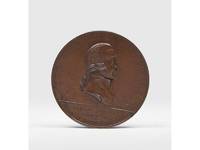
1797179182Scotland: Boog junior des. P. Kempson fecit 1797. A very good example of the one ounce Penny of Scotland commemorating Adam Smith. The portrait of Smith is after the Tassie medallion of 1787 which is described by John M. Gray as follows: 'The head which appears turned in pure profile to the right of the spectator shows a particularly full forehead a full nose slightly aquiline in its curve; a long thin upper lip and a lower lip that protudes a little; and a firm well-shaped chin and jaw. The eyebrow is strongly curved the upper eyelid heavy and drooping the eyeball particularly prominent; and beneath the lower eyelid the skin is loose and wrinkled. A wig is worn tied behind in a bag with ribbons showing small curls in front and two large curls at the side which cover and conceal the ear' quoted in Bonar A Catalogue of the library of Adam Smith 1932 p. xxi. The reverse of the penny entitled 'Wealth of Nations' depicts the various elements of commerce; in the foreground of a harbour scene are a plough and a spinning wheel along with other symbols of agriculture and industry in addition to which there are a wool-pack and a barrel standing on the quayside with two three-masted ships sailing out of the harbour. Penny token cast in bronze 35 mm in diameter with portrait of Adam Smith after Tassie on the obverse and scene entitled 'Wealth of Nations' depicting various elements of commerce on the reverse. Housed in a red leatherette velvet-lined case. In very good condition. Scott Adam Smith as Student and Professor 1937. Dalton and Hamer Fifeshire no. 1. hardcover