Smith Adam.ABAA
1 033 résultats
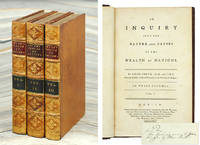
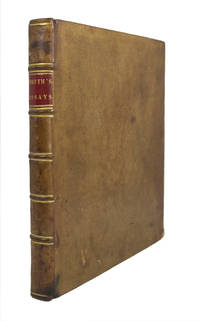
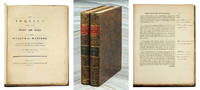
110446London: W. Strahan and T. Cadell 1776. 2 vols. 4to 12 x 9.25 inches or 305 x 240 mm large-paper top edge just trimmed other edges untrimmed; 12 510 pp.; 4 587 588 ads pp. Volume I: A4 a2 B-Z Aa-Zz 3A-3S4 T4 -3T4 blank as usual; Volume II: A2 B-Z Aa-Zz Aaa-Zzz 4A-4E4 4F2. With the usual cancels: M3 Q1 U3 2Z3 3A4 and 3O4 in volume I cancels D1 & 3Z4 in volume II. In vol. 2 p. 288 is misprinted as 289. Old speckled calf recently rebacked edges untrimmed and substantially larger than 2 copies recently sold as in “original boardsâ€. Copious annotations in ink in a neat early hand. Some soiling to a few leaves in the press and occasional spotting or foxing as usual. § First edition the issue without the Edinburgh imprint of W. Creech as copies with his imprint have cancel titles those lacking the Edinburgh imprint such as this probably have priority of "the first and greatest classic of modern economic thought. Where the political aspects of human rights had taken two centuries to explore Smith's achievement was to bring the study of economic aspects to the same point in a single work" PMM. The records of copies at auction and through the trade in the last several years all show copies measuring at least an inch shorter and narrower than this copy -- the Schiff copy alone was almost as tall the Bradley Martin copy an inch shorter. The annotations are “memory aids†clearly written by an attentive reader who wanted to be able to refer back quickly to the key points of interest to him or her; they are not attempts to dispute or correct the text or even comment on it and one might surmise the reader to have been a high-level student or more likely a teacher. The two suggested errata have both been corrected by a different hand. ESTC T96668; Goldsmith 11392; Kress 7621; PMM 221; Rothschild 1897. W. Strahan hardcover books
182134467Paris: Gide fils 1821. 3 volumes text: 2 volumes 8vo 8 x 5 1/2 inches; atlas: folio 18 1/2 x 12 inches. xii 418; 4 531 1pp. 30 engraved plates portrait 9 maps and 20 plates; 2 double-page maps. Uncut. Text in period patterned paper wrappers the atlas bound to style in uniform period panelled wrappers. Housed in black morocco backed boxes.<br/> <br/>First edition in French of Krusenstern's seminal account of the first Russian expedition to circumnavigate the globe: complete with the rare atlas of plates.<br/> <br/>Capt. Ivan von Krusenstern's voyage was one of the most important post-Cook Pacific voyages specifically aimed at obtaining more knowledge of the northern Pacific region establishing diplomatic and commercial relations with Japan and visiting the Russian trading posts in Alaska and on the west coast of America. It comprised the first Russian expedition to circumnavigate the globe under the command of Krusenstern between 1803 and 1806. Sailing in 1803 the expedition touched on Brazil and rounded Cape Horn visiting the Marquesas Islands Hawaii Kamchatka and Japan. In Hawaii the expedition separated with ships under Langsdorff and Lisianski sailing to the Northwest Coast while Krusenstern himself undertook the delicate Japan expedition returning via Macao and the Cape of Good Hope. "The importance of this work stems from its being the official account of the first Russian expedition to circumnavigate the globe and form the discoveries and rectifications of charts that were made especially in the North Pacific and on the northwest coast of America" Hill. First published in St. Petersburg between 1809 and 1814 with issues in both Russian and German that first edition with its folio atlas of 105 plates is a major rarity of travel literature. Dutch English and Italian editions followed although none contained an atlas of plates. The present first edition in French is the first edition following the original publication to include an atlas of plates. The images are re-engraved versions of images in the original and includes a portrait of Krusenstern views and images of natives of the Marquesas Japan Sakhalin Island Kamtchatka etc. as well as nine maps of various Pacific regions visited.<br/> <br/>cf. Lada-Mocarski 62; Sabin 38332; Arctic Bibliography 9377; Howes K272 "c;" Borba de Moraes pp.374-75; Hill 952 ref; cf. Forbes Hawaii 407. Gide fils unknown books
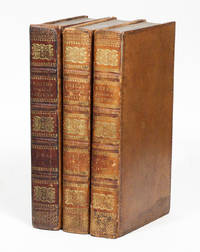
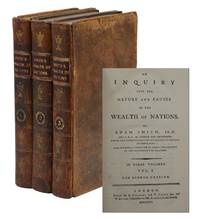
110826Dublin: Printed for Messrs. Whitestone Chamberlaine Watson et al. 1776. 3 vols. 8vo viii 1-391; viii- 1-524 3 ads; iv 1-412 pp. Diced calf with gilt rules recently rebacked. Lady Davy’s bookplate and inscription in each vol. purple ink signature of a later owner upon each bookplate occasional marginal staining closed tear to p.259 of vol. 3. Preserved in an archival clamshell box. § The Adam Smith-John Playfair-Humphry Davy copy an incomparable association. First Dublin edition the only edition printed in the same year as the first London 1776. Lady Davy’s copy with her bookplate and ink inscription in each volume stating the books were given by Adam Smith to John Playfair. As a tangible record of the connections between these three influential Enlightenment figures this book is intriguing. Adam Smith 1723-1790 who established the foundations of modern economics with this book and John Playfair 1748-1819 the mathematician and geologist were friends in later life. They both belonged to the Oyster Club in Edinburgh and each owned copies of the other's books. Smith’s library catalogue lists a presentation copy from Playfair and the sale catalogue 1820 of Playfair’s library includes books by Smith but not this one. Jane Davy formerly Apreece 1780-1855 was a well-known and widely-travelled literary hostess. As a young wealthy widow she rejected a proposal of marriage from John Playfair in favour of Humphry Davy 1778-1829 whom she married in 1812 a few days after he had received his knighthood. The binding style with wove paper endpapers and diced calf boards postdates Smith’s death in 1790. The first volume has the binders ticket ‘Lycett Nelson Street City Road’ and records show that the firm was declared bankrupt in 1829 making it possible that Jane Davy received the book perhaps as a gift from Playfair during their courtship or on his death. Both Playfair and Davy visited London and could have commissioned the binding.This copy is the only evidence we have that Smith owned a copy of this Dublin edition which appeared in the same year as the first and is the only other edition printed in that year but surely Lady Davy's attestation suffices. The copy has a small ink correction to page 368 in vol. 3. This correction was not made to the printed text until the 4th edition. Smith was known to make authorial marginal notes in books; though the hand that made this correction cannot be known it is unlikely that anyone else would have felt emboldened to emend the great man's text. More about the relationships between Adam Smith and John Playfair and John Playfair and Jane Davy remains to be discovered stimulated by the discovery of this extraordinary association copy. A fascinating copy of a great Enlightenment text. PMM 221. Printed for Messrs. Whitestone hardcover books
16881669671688. PERELLE Gabriel Adam and Nicholas. Recueil de Veues des Plus Beaux Lieux de France. Comprised of seven parts in one volume each part with individual title. Illustrated with a total 281 etched and/or engraved plates on 253 leaves comprising 267 views and 14 plans and/or maps 3 being large folding. Oblong folio 295 x 382 mm bound in contemporary French mottled calf with intricate gilt-stamped floral ornaments in spine compartments red leather title label. Paris: Chez Nicolas Langlois ca. 1688. Early impressions of the finest most complete series of etched views to document French gardens and châteaux. A comparable or more authentic portrayal of seventeenth-century French architecture and garden design does not exist. Of the total 267 etched and/or engraved views over 150 concentrate specifically on seventeenth-century French landscapes and garden designs. These views represent the gardens in their original splendour the landscape populated with elegant figures in contemporary costume. Regrettably several of the private châteaux and most of the accompanying gardens no longer exist. The contents of the volume begins with etched views of Parisian edifices city portals fountains gardens and monumental buildings such as the Louvre Palais Royal Palais du Luxembourg L'Hotel de Ville etc. Then a number of the surrounding châteaux and their estates are pictured including Versailles which we see literally rise before our eyes as the plates were executed over a period of several years while the palace and gardens were under construction Vincennes Chantilly St. Cloud and Fontainebleau plus sixteen views of Rome and its environs including the gardens of Pamphili and Tivoli. Most importantly this set is comprised of early Nicolas Langlois 1640-1703 impressions of these grand plates. Gabriel Perelle 1595-1677 studied drawing with Daniel Rabel official artist of the court of Henry III and then Perelle entered the atelier of the French painter Simon Vouet. Perelle had two sons Nicolas Perelle born 1631 and Adam Perelle 1640-1695. The engraved work by the three Perelles is so similar in style that their work is often signed: "Fait par Perelle" as it frequently is in the present album. The majority of impressions are sharp and dark. A few tears repaired a three inch crack to bupper hinge however still strong and perfectly intact. Overall an exceptional copy. Fowler 245. Brunet IV 494. Berlin Katalog 2483. See: Millard I 136 & 137. hardcover books
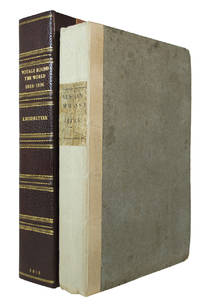
181367660The First Russian Voyage around the World KRUSENSTERN Adam Johann von. Voyage round the World in the Years 1803 1804 1805 & 1806 by order of His Imperial Majesty Alexander the First on board the ships Nadeshda and Neva under the command of Captain A.J. von Krusenstern of the Imperial Navy. In two volumes. Translated from the original German by Richard Belgrave Hoppner Esq. Vol. I. II. London: Printed by C. Roworth for John Murray 1813. First edition in English. Two quarto volumes in one. vii 1 blank 4 contents ix-xxxii 314; 9 1 blank 404 pp. Folding engraved map ìChart of the Northwest Part of the Great Oceanî and two hand-colored aquatint frontispieces for each volume. Original quarter parchment over drab blue boards. Original printed paper spine label. Uncut. Previous owner's light ink signature on title-page. Very light small library stamp to title-page. Leaf a2 with a few closed tears neatly repaired. Original paper label a bit rubbed and unreadable. Boards with some light soiling and bumping. A very clean and handsome copy. Housed in a custom quarter morocco clamshell. Overall an excellent copy. Laid in is a hand-written half-page letter dated March 1815. The identity of the author is unknown. The letter reads: "Capt. Krusenstern of the Russian navy presents his compliments to Dr. Thomsen and takes the liberty to send him a publication of Professor Carrol which Capt. Krusenstern has just received from . He at the same time must make every apology for intruding himself on Dr Thomsen the of Dr Thomsens personal acquaintance. 34 Upper Berkley Street 4 March 1815" Krusenstern 1770-1846 ìappointed to command the first Russian round-the-world expedition had serving with him a brilliant corps of officers including Lisiansky Langsdorff and Kotzebue. The expedition was to attempt to ëopen relations with Nippon and the Sandwich Islands to facilitate trade in South America to examine California for a possible colony and make a thorough study and report of the Northwest coast its trade and its future.Ã.The importance of this work is due to its being the official account of the first Russian expedition to circumnavigate the globe and the discoveries and rectifications of charts that were made especially in the North Pacific and on the northwest coast of America.The introduction is particularly important and interesting because of the information it contains respecting the state of Russian commerce during the eighteenth century the Russian voyages and discoveries in the Northern Ocean and the Russian fur tradeî Hill. A Russian edition was published in 1809-1814 and a German edition from which this English edition was translated in 1810-1814. Abbey Travel 1. Arctic Bibliography 9377. Borba de Moraes pp. 374-5. Hill pp. 167-8. Howes K271. Sabin 38331. HBS 67660. $22500 Printed by C. Roworth...for John Murray hardcover books
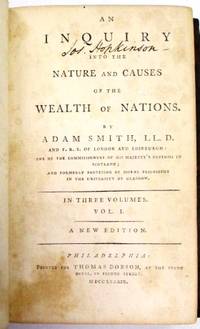
178932679Philadelphia: Thomas Dobson 1789. viii 9-412; vi 7-430; v 1 blank 7-387 55 pp. Volumes I and II with the ownership signature of Joseph Hopkinson prominent Philadelphia and Jersey lawyer who defended Justice Samuel Chase in his impeachment trial and the Whiskey Rebellion defendants; son of the Signer Francis Hopkinson. Volume III with the ownership signature of "J.P. Cilley 1873". The three volumes bound in original calf the first two volumes with gilt borders rebacked with gilt-lettered morocco spine labels. Minor wear clean text Very Good.<br/><br/> The first American edition. 'Printing and the Mind of Man' describes this work as "the first and greatest classic of modern economic thought." <br/>Evans 31196. PM 221 London 1776. Kress 3288. Thomas Dobson unknown books
179566518First Edition In Contemporary Boards Uncut SMITH Adam. Essays on Philosophical Subjects. To Which is Prefixed an Account of the Life and Writings of the Author; by Dugald Stewart. London: Printed for T. Cadell Jun. and W. Davies etc. 1795. First edition. Quarto. xcv 244 pp. Contemporary boards rebacked. Small library stamp on title and verso and on last page a small ink smudge on title previous owner's bookplate. Overall a very good large paper copy totally uncut. A posthumously published collection of essays mainly of scientific and philosophical nature. Smith had instructed his literary editors Joseph Black and James Hutton to destroy almost all of his manuscript material amounting to some sixteen volumes. These essays were exempted because the editors perceived them to "be part of a plan he had once formed for giving a connected history of the liberal sciences and elegant arts" even though Smith had to abandon the plan because it was too extensive. HBS 66518. $10000 Printed for T. Cadell Jun. and W. Davies, etc. hardcover books
179568261Adam SmithÃs Posthumously Published Essays SMITH Adam. Essays on Philosophical Subjects. To Which is Prefixed an Account of the Life and Writings of the Author; by Dugald Stewart.London: Printed for T. Cadell Jun. and W. Davies. 1795. First edition. Quarto 10 3/4 x 8 1/2 inches; 273 x 215 mm. xcv 1 blank 244 pp. Contemporary speckled calf. Board edges ruled in gilt. Spine ruled in gilt. Red morocco spine label lettered in gilt. Edges speckled brown. Green silk page-marker. Board edges a bit rubbed and corners bumped. Previous owner's old ink signature on title-page not affecting text. Occasional minor foxing or staining. Otherwise an excellent copy. A posthumously published collection of essays mainly of a scientific and philosophical nature. Smith had instructed lis literary editors Joseph Black and James Hutton to destroy almost all of his manuscript material amounting to some sixteen volumes. These essays were exempted because the editors perceived them to ìbe part of a plan he had once formed for giving a connected history of the liberal sciences and elegant artsî even though Smith had to abandon the plan because it was too extensive. The essays illustrate the diversity of Adam SmithÃs interests and comprise: ìThe Principles which lead and direct Philosophical Enquiries; illustrated by the History of Astronomy;î ìThe Principles which lead and direct Philosophical Enquiries; History of the Ancient Physics;î ìThe Principles which lead and direct Philosophical Enquiries; History of the Ancient Logics and Metaphysics; ìOf the Nature of that Imitation which takes place in what are called the Imitative Arts;î ìOf the Affinity between Music Dancing and Poetry;î ìOf the Affinity between certain English and Italian Verses;î ìOf the External Senses.î ESTC T33499 . Goldsmiths' 16218. Kress B. 3038. Rothschild 1902. HBS 68261. $9500 Printed for T. Cadell Jun. and W. Davies, etc. unknown books
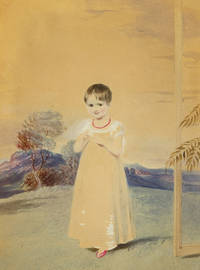
181036285London 1810. Watercolor on card first drawing signed lower right. 1 vols. 10 x 7-1/2 inches images. Framed and glazed. Watercolor on card first drawing signed lower right. 1 vols. 10 x 7-1/2 inches images. "Buck Adam 1758-1833 portrait painter elder son of Jonathan Buck a silversmith of Castle Street Cork was born there in 1759. With a younger brother Frederick he studied art from an early age and acquired some repute in youth in his native city as a painter of miniature portraits in water-colour. Coming to London in 1795 he settled at 174 Piccadilly and soon gained popularity. He not only continued to paint miniature portraits in water-colour but produced many portraits in oil and crayon of larger size. Between 1795 and 1833 the year of his death he exhibited at the academy as many as 171 pictures. He also exhibited ten other works at the British Institution and at the Society of British Artists in Suffolk Street. But the pictures that he exhibited represent a small proportion of his labours. Numerous pictures by him were reproduced in coloured engravings mostly in stipple and had a wide circulation. Of extant coloured engravings after his pictures the originals of as many as forty or fifty are not known to have been exhibited. Among his sitters were the Earl of Cavan the Duke of York Sir Francis Burdett Major Cartwright John Cam Hobhouse and John Burke author of the Peerage' and his family. His portraits were carefully finished although they were stiff in treatment and design.<br/>Buck was at the same time busily employed as a teacher of portrait painting and in 1811 he brought out a volume entitled Paintings on Greek Vases' which contained a hundred designs not only drawn but also engraved by himself. This work which was planned to continue a similar compilation by Sir William Hamilton is now extremely scarce.<br/>In 1807 he moved from Piccadilly to Frith Street Soho and after several changes of residence died at 15 Upper Seymour Street West in 1833. Buck was married and left two sons Alfred and Sidney; the latter followed his father's profession.<br/>A miniature portrait of Buck by himself dated 1804 is in the Sheepshanks gallery of the Victoria and Albert Museum London. " - DNB. unknown books
53216Edited by Aida Craig Truxall for the U. of Pittsburgh Press comprising 44 autograph letters signed by Adam Bright 27 July 1861 - 14 April 1864 and 34 autograph letters signed by Michael Bright 22 October 1861 - 26 July 1863 most of each group to their uncle Emanuel Stotler at home in Alleghany County Pennsylvania; accompanied by the publisher's file of working manuscripts and other material. 8vo. 296 total pages approximately 30000 words; some of the letters with a patriotic letterhead most are addressed to their uncle some to his wife a few to "family" and several are from Adam to Michael most accompanied by mailing envelopes. The following are also included:_1 Truxall's original ribbon typescript for her transcriptions of the letters 4to 148 pages rectos only some pages with editorial markings._2 Truxall's original ribbon typescript of her manuscript for the book including her preface notes to the text and other material as submitted for publication with many corrections additions and deletions by her editor at the University of Pittsburgh Press 4to 152 pages rectos only._3 Truxall's copy of the published book 8vo 96 pp. illustrated cloth and boards dust jacket very good with the signature "Truxall" at the head of the front flap of the dust jacket._4 File of Truxall's notes toward the project genealogical material historical material concerning various Pennsylvania military units serving in the Civil War 1950s-era Civil War battlefield leaflets three topographical maps of the Pittsburgh Pennsylvania area and a few related newspaper clippings._5 Carte-de-visite photograph of Corporal Adam Bright 3 1/2 x 2 1/4 inches mounted on a slightly larger card in uniform sitting in a studio probably from 1864 with the backmark: "R.W. Addis / Photographer / 308 Penna Avenie / Washington D.C." All of the letters folded. Some foxing and a little staining to a few of the letters one repaired with tape the envelopes worn and variously soiled and stained; some postage stamps still affixed. Adam Bright enlisted in the 9th Pennsylvania Infantry in early 1861 and served with his unit in the various campaigns of the Army of the Potomac until the unit was mustered out of service in April 1864; he returned to civilian life in western Pennsylvania. His brother Michael enlisted in the 77th Pennsylvania regiment later in 1861 and served with that unit in the various campaigns of the Army of the Cumberland until killed in action on the first day at Chickamauga in September 1863._"The accounts of camp living the primitive practices of the army the methods of handling the distribution of rations the rumors of the immediate end of the war always erroneous and probably the result of wishful thinking on the part of the soldiers and the enlisted men's evaluations of the generals are all very interesting. But the most fascinating picture that emerges is that of two ordinary young men performing a duty that patriotism required of them in spite of the perils of battlefield and camp life while fighting the silent and lonely battle of homesickness which has always been the bane of soldiers" from Harry R. Beck 's review in The Western Pennsylvania Historical Magazine vol. 46 no. 1 Jan. 1863. <br/><br/> hardcover books
172730277Amsterdam: Michel Charles le Céne 1727. 2 volumes in 1 small folio. 12 1/8 x 7 5/8 inches. Titles printed in red and black. Engraved portrait frontispiece 44 engraved maps plans and views 31 folding 19 in-text engraved illustrations. Contemporary calf spine with raised bands in seven compartments red and green morocco lettering pieces in the second and third the others with a repeat decoration in gilt marbled endpapers and edges.<br/> <br/>A lovely copy of a noted illustrated work on Asia including maps and views of India China and Japan.<br/> <br/>"Johann von Mandelslo was a friend of Adam Olearius and a former page of the Duke of Holstein-Gottorp. Together Mandelslo and Olearius were sent by the Duke on an embassy to the Russian Czar and to the Shah of Persia for the purpose of initiating trade relations with Russia Tartary and Persia. Mandelslo was authorized to leave the embassy in Persia and to continue his travels to the Far East. He went to Surat Agra and Goa in India where he received great kindness from the English merchants and he also visited Ceylon. He gives long accounts of the other parts of the Far East which he did not visit personally. His return was made to England by sea via the Cape of Good Hope which he visited in 1639" Hill. Mandelslo's narrative contains substantial information on the Far East. "Before his death Mandelslo had entrusted his rough notes to Olearius who subsequently published them bound with his numerous official accounts of the embassy" Howgego. Following the first publication Olearius added additional information to subsequent editions. A new edition in French translated by Wicquefort included still more additional material including an account of the travels of Henri de Feynes to China Formosa and Japan. The present edition published in Amsterdam in 1727 is a re-issue of the Van der Aa edition of 1719 published in Leiden; both are celebrated as the best editions being the most complete and with the largest number of illustrations. The plates include views and plans of London Amsterdam Brussels Antwerp Capetown Goa Surat Jedo Tokyo St. Helena Mauritius Madagascar the Canary Islands Java Congo and elsewhere.<br/> <br/>Brunet IV 178; Cordier Japonica 367-368; Cordier Indosinica 883; Cordier Sinica 2076-77; cf. Hill 1073; Howgego M-38; Lust 342. Michel Charles le Céne unknown books
1804011225Oliver D. Cooke 1804. Book. Fine. Full-Leather. 1st Edition. 4to - over 9¾ - 12" tall. 1804 2 Volume EditionNew Edition. Beautiful Contemporary Leather with 6 Raised Bands.Internally Very Fresh.Very Rare Edition.Gorgeous Copy With Red Labels. Oliver D. Cooke Hardcover books
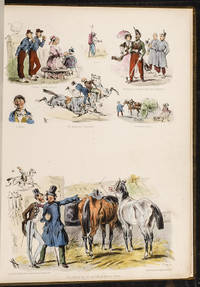
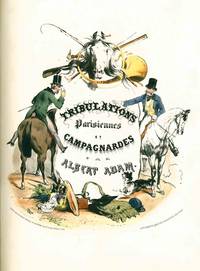
04860Paris: Hautecoeur Frères 1840. Parisian and Country Tribulations<br/>The Humorous Side of Distress Trouble Misery Anguish Agony Grief and Wretchedness.<br/><br/>ADAM Albert illustrator. Tribulations Parisiennes et Campagnardes. Par Albert Adam. Paris: Hautecoeur Frères ca. 1840.<br/><br/>First edition. Folio 12 7/8 x 9 7/8 inches; 328 x 251 mm. Lithographed pictorial title-page and Thirty-two plates hand-colored lithograph plates heightened with gum arabic on sixteen sheets. Several of the plates have more than one image depicted. Tiny piece of lower corner of title-page and plate 10 torn away small piece of lower inner margin of plate 16 torn away - nothing affecting any images. Some light marginal soiling and toning otherwise an excellent copy of this extremely scarce title.<br/><br/>Bound to contemporary style in full dark green straight-grain morocco. Covers elaborately decorated in gilt and blind spine with five raised bands decoratively tooled and lettered in gilt in compartments decorative gilt turn-ins gold marbled end-papers. This is the first time in over fifty years that I have seen this very amusing title which depicts the humorous side of distress trouble misery anguish agony grief and wretchedness. especially plate 12 the top image "Arrcheur de Dents sans douleur" pain-free teeth remover. <br/><br/>The Plates:<br/>1. Un Chien emporté / Culbute à la Marche<br/>2. Désagrément du Macdam / Le Pot de fer et le Pot de terre<br/>3. Une Famille d'Allemands / Touché !!! / Deux blaguers / Il l'aura . il l'aura pas! / Le Repas<br/>4. Ces Messieurs s'amusant. / C'est celle-là ! qui est une bête de premier mérite<br/>5. Une branche de salut / Une belle Famille<br/>6. Un accident imprévu / Marchands d'oranges etc<br/>7. Voiture à l'usage des amateurs de culbutes / Le Dejeuner interrompu<br/>8. Arrosement public et gratis / La Ruade<br/>9. Gentlemans au Bois / Visite désagréable<br/>10. Train de plaisir à l'heure / not titled<br/>11. Départ du Roulage / Position très désagréable<br/>12. Arrcheur de Dents sans douleur / Le bon père de Famille<br/>13. Concurrence monstre. - Route de Passy / Cheval qui a un défaut marquant<br/>14. Une glissade / not titled<br/>15. L'Artiste culbuté / Cheval antropophage<br/>16. Un Mosieur qui n'a pas l'habitude etc / Noouvelle course au Clocher<br/><br/>Very scarce: According to OCLC there are just five copies located in libraries and institutions worldwide Morgan Library NY; UCLA CA; Library of Congress DC; Clark Art Institute MA and Harvard Univ. Houghton Library MA.<br/><br/>Albert ADAM 1833-1900 was the son of Caricaturist and lithographer Jean Victor Adam 1801-1867 whom he often assisted with his commissions. Paris: Hautecoeur Frères, 1840 unknown books
1787000055Göttengen: J. C. Dieterich 1787. Half Calf. Very Good . Folio 39.2 x 24.6 cm Large paper copy bound in later half calf and marble boards. Collation: 2 iii-xlv 1 Err. 1-124 8 pp. 31 3 folding engraved plates. The present half calf binding replaced the original green-paper boards. The new binding has raised bands and gilt decorated panels with brief gilt title and author stamped into red morocco label in upper panel. The boards and corners are in very good condition. There is upper edge paper repair to front free end paper and title page presumably replacing removed early ownership information. The text proper including the half title not mentioned by Sabin is very clean and bright. The personal circular stamp of previous owner Inz. Mgr. M. Kubiak is in the blank area of the fore edge on p. xxxix and the lower right corner of Tab. III. The plates are generally very clean except for Tab XVIII XXVI XXIX and XXXI where there is striking from the printing of the plate or minor spot in center area away from image Tab. XXXI. Plate XXVI has the most striking near the stub area. It is also the only plate that was placed on the stub too high and the upper edge with Tab number was trimmed during the rebinding with number unreadable. The table on pp. xxxviii- xlv lists properties of 21 North American trees with aspects of growth roots base location/habitat bark wood/lumber leaves sex flowering time seeds seed maturity beginning of growth life span propagation and uses of timber. <br/><br/>Each tree illustrated is discussed separately in the text portion of this work. Wangenheim gives the German Latin and English name for each tree along with Latin description and cites authors who have named and described the tree previously. Several of the trees were new and are described by Wangenheim who cites Linneaus Species Plantarum and Gronovius Flora Virginiana for the other trees. This is one of the first systematic treatment of North American trees with illustrations that would be suitable for a climate outside North America other than Catesby's 1763 Hortus britanno-americannus… and predates Michaux's first illustrated work on oakes by 14 years. There was an earlier publication by Wangenheim that was more of a catalog of trees he observed in his travels as an Hessian soldier with the British troops during the War of Independence. All of the plates were made from field drawings done by Wangenheim although none of them is signed. Johnston notes Cleveland Collection p. 537 that Wangenheim returned to "Prussia where he engaged in forestry. This is the first edition of this work on introducing North American trees into Germany. This is the first edition of this work on introducing North American trees into Germany." Cleveland 574; Lib. Arnold Arboretum p. 730; Nissen BBI 2105; Rehder I 304; Sabin 101238 J. C. Dieterich unknown books
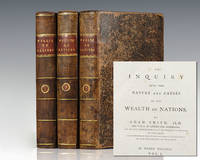
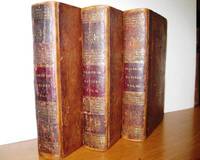
17862442London: A. Strahan and T. Cadell 1786. Fourth edition. Contemporary calf. Very Good. HANDSOME EIGHTEENTH-CENTURY EDITION OF THE "GREATEST CLASSIC OF MODERN ECONOMIC THOUGHT.". This classic work of the Scottish Enlightenment - originally published in the same year as the Declaration of Independence and Gibbon's History of the Decline and Fall of the Roman Empire - is a magisterial study of the sources of national wealth and of the political and institutional arrangements that foster or suppress it. Based on a 2016 analysis of data from Google Scholar The Wealth of Nations is the second only to Marx's Das Kapital as the most-frequently cited among books in the social sciences published before 1950. And while Smith recognized the economic benefits that flow from voluntary transactions between individuals and is as a result sometimes thought of as the apostle of laissez faire capitalism he supported several forms of government intervention in the economy either to create and maintain the necessary conditions for economic growth or to ameliorate the incidental harms that such conditions could create.<br /> <br /> The Wealth of Nations proposed that "no society can surely be flourishing and happy of which the far greater part of the members are poor and miserable. It is but equity besides that they who feed cloath and lodge the whole body of the people should have such a share of the produce of their own labour as to be themselves tolerably well fed cloathed and lodged." WN this edition vol. 1 page 119. Smith believed that this condition of society could be achieved only through the higher productivity that is made possible by the division of labor. As an example of the division of labor Smith offered the example of the "trade of the pin-maker" which he apparently learned about from Diderot and d'Alembert's Encyclopédie in which "one man draws out the wire another straights it a third cuts it a fourth points it a fifth grinds it at the top for receiving the head ." and so forth. WN this edition vol. 1 pages 7-8.<br /> <br /> In a famous passage Smith explains that such arrangements arise naturally from voluntary transactions between individuals based on their common recognition of the benefits that division of labor creates:<br /> <br /> This division of labour from which so many advantages are derived is not originally the effect of any human wisdom which foresees and intends that general opulence to which it gives occasion. It is the necessary though very slow and gradual consequence of a certain propensity in human nature which has in view no such extensive utility; the propensity to truck barter and exchange one thing for another.<br /> <br /> . Man has almost constant occasion for the help of his brethren and it is in vain for him to expect it from their benevolence only. He will be more likely to prevail if he can interest their self-love in his favour and shew them that it is for their own advantage to do for him what he requires of them. Whoever offers to another a bargain of any kind proposes to do this. Give me that which I want and you shall have this which you want is the meaning of every such offer; and it is in this manner that we obtain from one another the far greater part of those good offices which we stand in need of. It is not from the benevolence of the butcher the brewer or the baker that we expect our dinner but from their regard to their own interest. We address ourselves not to their humanity but to their self-love and never talk to them of our own necessities but of their advantages. WN this edition vol. 1 pages 19-21.<br /> <br /> "Throughout the book Smith's 'system of natural liberty and justice' . plays a pervasive role as explanatory model and regulatory ideal though the famous image of an 'invisible hand' appears late and only once in the whole work . It appears at volume 3 page 181 of this edition. A quasi-Newtonian treatment is given to those forces which act like gravity when market price departs from natural price and it always carries with it a normative implication that policies or practices that prevent these forces from acting are detrimental to the public interest. Monopolies special privileges informal combinations by merchants or employers to raise prices and keep down wages import duties export bounties as well as institutions such as apprenticeships and restrictions on labour mobility . are all condemned from this perspective." Dictionary of National Biography.<br /> <br /> Smith was not unmindful of possible deleterious consequences of the division of labor: "The man whose whole life is spent in performing a few simple operations of which the effects too are perhaps always the same or very nearly the same has no occasion to exert his understanding or to exercise his invention in finding out expedients for removing difficulties which never occur. He naturally loses therefore the habit of such exertion and generally becomes as stupid and ignorant as it is possible for a human creature to become." WN this edition vol. 3 pages 182-83. Smith believed that public elementary education would compensate for this tendency.<br /> <br /> Edition: This copy of The Wealth of Nations is the fourth edition 1786 issued ten years after the first. It was the penultimate edition published during Smith's lifetime the last being the fifth edition of 1789. It carried forward the significant changes made in the third edition of 1784 without making any material additional changes of its own as Smith specifically admitted in the prefatory Advertisement to this edition. A detailed collation of the first five editions is provided in Edwin Cannan's 1904 edition of Smith's work.<br /> <br /> Provenance: With the armorial bookplate of Thomas Howitt bearing the motto "Aquila Non Capit Muscas" "Eagles do not catch flies" on the front pastedown of each volume. Howitt may have been the Lancaster physician of that name 1785-1832; see archives of the Royal College of Surgeons of England ref no. GB 0114 MS0092 the entry for Howitt's son also named Thomas Howitt. It is possible that Howitt's son Thomas Jr. 1830-1922 was responsible for the additions to these volumes described below.<br /> <br /> Volume 2 is bound with additional pages at the end on which a prior owner has pasted articles on the California gold rush of 1849 citing a discussion on page 354 of the volume in which Smith argues that "of all those expensive and uncertain projects however which bring bankruptcy upon the greater part of the people who engage in them there is none perhaps more perfectly ruinous than the search after new silver and gold mines." Another extract pasted at the beginning of volume 1 from an unknown source recommends the reduction of taxes.<br /> <br /> London: A. Strahan and T. Cadell 1786. Octavo contemporary full calf with elaborately gilt-decorated spines; vol 1 rebacked with original spine laid-down. Bound without half-titles. Vol 1 spine darker more toned than the other two. Light flaking to spines a little chipping to leather at extremities. Some foxing to title and first few leaves of each volume; otherwise text clean. A lovely early set of Smith's masterpiece. A. Strahan and T. Cadell unknown books
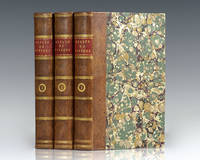
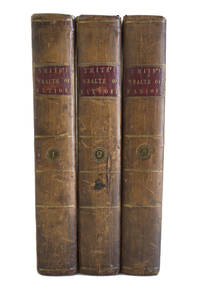
1793124986London: A. Strahan and T. Cadell 1793. Rare 18th century edition of Adam Smith's magnum opus and cornerstone of economic thought. Octavo 3 volumes bound in half calf over marbled boards gilt titles to the spine morocco spine labels. In near fine condition. A very nice set of this classic work. Adam Smith's masterpiece first published in 1776 is the foundation of modern economic thought and remains the single most important account of the rise of and the principles behind modern capitalism. "The history of economic theory up to the end of the nineteenth century consists of two parts: the mercantilist phase which was based not so much on a doctrine as on a system of practice which grew out of social conditions; and the second phase which saw the development of the theory that the individual had the right to be unimpeded in the exercise of economic activity. While it cannot be said that Smith invented the latter theory.his work is the first major expression of it. He begins with the thought that labour is the source from which a nation derives what is necessary to it. The improvement of the division of labour is the measure of productivity and in it lies the human propensity to barter and exchange.Labour represents the three essential elements-wages profit and rent-and these three also constitute income. From the working of the economy Smith passes to its matter -'stock'- which encompasses all that man owns either for his own consumption or for the return which it brings him. The Wealth of Nations ends with a history of economic development a definitive onslaught on the mercantile system and some prophetic speculations on the limits of economic control.The Wealth of Nations is not a system but as a provisional analysis it is complete convincing. The certainty of its criticism and its grasp of human nature have made it the first and greatest classic of modern economic thought" PMM. A. Strahan and T. Cadell hardcover books
1799124769London: A. Strahan and T. Cadell 1799. Rare 18th century edition of Adam Smith's magnum opus and cornerstone of economic thought. Octavo 3 volumes. Bound in full contemporary tree calf gilt titles to the spine morocco spine labels. In very good condition. A very nice set of this classic work. Adam Smith's masterpiece first published in 1776 is the foundation of modern economic thought and remains the single most important account of the rise of and the principles behind modern capitalism. "The history of economic theory up to the end of the nineteenth century consists of two parts: the mercantilist phase which was based not so much on a doctrine as on a system of practice which grew out of social conditions; and the second phase which saw the development of the theory that the individual had the right to be unimpeded in the exercise of economic activity. While it cannot be said that Smith invented the latter theory.his work is the first major expression of it. He begins with the thought that labour is the source from which a nation derives what is necessary to it. The improvement of the division of labour is the measure of productivity and in it lies the human propensity to barter and exchange.Labour represents the three essential elements-wages profit and rent-and these three also constitute income. From the working of the economy Smith passes to its matter -'stock'- which encompasses all that man owns either for his own consumption or for the return which it brings him. The Wealth of Nations ends with a history of economic development a definitive onslaught on the mercantile system and some prophetic speculations on the limits of economic control.The Wealth of Nations is not a system but as a provisional analysis it is complete convincing. The certainty of its criticism and its grasp of human nature have made it the first and greatest classic of modern economic thought" PMM. A. Strahan and T. Cadell unknown books
179630670Philadelphia: Thomas Dobson 1796. 412; 430; 387 1 blank 53 1 blank pp. Contemporary tree calf some chipping rebacked with remnants of original spines laid down. Scattered toning generally light foxing lightly worn. Good. <br/><br/> The second American edition the first having issued in 1789 also published by Dobson. 'Printing and the Mind of Man' describes this work as "the first and greatest classic of modern economic thought." <br/>Evans 31196. PMM 221 London 1776. Kress 3288. Thomas Dobson unknown books
179648831Philadelphia PA: Thomas Dobson 1796. Second American edition. Hardcover. Very good/No jacket issued. Philadelphia PA: Thomas Dobson 1796. 3 vols. Second American edition. 412; 430; 387; Index pp. Hardcover. 12mo. Professionall y rebound in period style full brown calf; spine elaborately decorated in gilt with contrasting lettering labels; front and back covers with central blind-stamped devices. Marbled endpapers. New additional endpapers; interior quite toned throughout. Very good/No jacket issued. Multiple volumes - extra shipping charges apply Insurance required to ship this item. Thomas Dobson hardcover books
179234586London: A. Strahan T. Cadell and others 1792. 2 volumes 8vo. iii-xv 1 488; iii-viii 462pp. Lacks half-titles. Expertly bound to style in half russia and period marbled paper covered boards.<br/> <br/>Eighteenth century edition of Adam Smith's first published work.<br/> <br/>Adam Smith's first published work first printed in 1759 would lay the basis for The Wealth of Nations and establish his reputation as a philosopher of note.<br/> <br/>ESTC T121726; Alston III.829; Goldsmiths 15514. A. Strahan, T. Cadell [and others] unknown books
1796140940161London: A. Strahan; and T. Caddell jun and W. Davies 1796. Eighth Edition. Very Good. The Eighth Edition. Complete in three volumes bound with half-title present by Pigge of Lynne with a small circular binder's label to front pastedown of each volume; in contemporary full tree calf with smooth spines divided into compartments with double gilt rule lettered on new red goatskin labels and numbered in a new small circular green goatskin label with gilt stamped urns of trophies to top compartment. Binding worn at corners and spine ends; outer joints cracked though binding remains firm. Previous owner names at front pages toned occasional crease occasional foxing heaviest at preliminary and terminal pages. Small dampstain to upper corner of last few pages of Volume II. An early set published in the late 18th century in a charming contemporary binding. A. Strahan; and T. Caddell jun and W. Davies unknown books
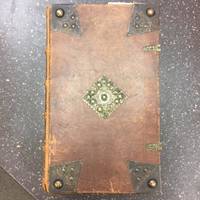
17831277019Augsburg Bavaria Germany: Joseph Wolffischen 1783. Hardcover. folio 750pp. 24pp. index 136pp.; VG; bound in brown leather paneled spine with no lettering; front board decorated with metal in the four corners diamond in the center; remnants of two clasps present two metal hooks on fore edge of front board two torn leather strips bound into rear board; moderate rubbing to boards; newer endpapers; title page has had a strip of paper approximately 1.25 inches 3.5cm. high torn off of the bottom primarily including the entirety of the publication information. It has been repaired with the backing of another sheet on that portion. There is a small tear in the middle of the page that is backed by a piece of paper on the verso and so barely impacts the legibility of the words; complete collation: endpaper title page 2pp. table of contents 4pp. 750pp. 24pp. index title page 6pp. 136pp.; separate title page with separate pagination; page 110 misprinted as 100 160 as 142 217 as 21 271 as 217 523 as 532 524 as 534 554 as 454 732 as 571 only the page number impacted; small repairs on pages 165/166 571/572 633/634 649/650 687/688 701/702 705/706 719/720 1/2; illustrated pages beginning parts two and three on pages 165 and 567. The pagination between pages 566-571 appear to be missing a page as is usual with this edition; ffep partially detached; profusely illustrated with over 800 black and white woodcut illustrations including genre scenes individual plants and animals and distilling apparatus; <br /> <br><br /> <br><br /> Adam Lonicer was a German botanist who studied at Marburg and the University of Mainz obtaining his Magister degree at sixteen years of age. After becoming a Doctor of Medicine in 1554 he became the town physician in Frankfurt am Main. His true interest though was herbs and the study of botany. His first important work on herbs the Kräuterbuch was published in 1557 with a large part dealing with distillation. He married Magdalena Egenolff the daughter of Christian Egenolff his Frankfurt publisher and a printer who specialized in herbals. The work that made his name famous is this popular herbal the Kräuterbuch. Lonicer provides us with one of the early descriptions of local flora as well as being one of the first to differentiate deciduous trees from conifers.<br /> <br /> shelved case 4. 1277019. Shelved Dupont Bookstore. Joseph Wolffischen hardcover books
50400Collection of mostly equestrian-themed caricatures 32 pp. lithographed by the Parisian firm Godard and depicting a variety of incidents such as a dog cart running in front of a horse-drawn buggy a racehorse stopping short and nearly launching its rider into a marsh a horse leaping over a group having a picnic and a bull headbutting an artist into a ravine. A few leaves trimmed slightly affecting page numbers extremely minor soiling. Slim 4to. Modern navy blue 3/4 morocco with marbled boards red gilt spine label. Very slight rubbing or scuffing some uneven fading or sunning to leather. Paris Hautecoeur Frères n.d. circa 1850. Albert Adam published a number of collections of humorous caricatures during his career but is perhaps best known for his views of Paris burning during the Paris Commune of 1871 and his Napoleonic scenes. He got his start working with his father caricaturist and lithographer Jean Victor Adam who he often assisted with his commissions. Quite scarce; as of November 2019 WorldCat locates just five holdings of this title in North American institutions. hardcover books
16699791London: John Starkey and Thomas Basset 1669. 2nd revised English. Half morocco. Very good. Folio. 2 parts in 1 each separately paginated with separate title-pages. Note: in this copy the title page for Mandelslo appears first in error. 6316;2223210pp. Complete with an added engraved title with 5 portraits 2 separate engraved portraits and a total of 6 folding or double-page maps. In this copy the very large folding map of the Volga River found at p. 112 has been divided in two the second half bound at p. 126 with a slight loss at the fold where they were divided. Engraved table of the Ruthenian alphabet in text. 19th century brown morocco spine over old marbled boards rubbed. Small chip at the top of spine otherwise an attractive copy. This is an odd copy quite complete but with certain preliminaries for the first part bound at front of the second part. The second edition revised of the English translation first published in 1662 made from a 1659 version in French. It contains material not found in the original German edition of 1656 and 1658. An important account of Central Asia including Persia and Russia and the East Indies. The Duke of Holstein's embassies were to negotiate trade. See Cox's THE LITERATURE OF TRAVEL Vol. 1 pp. 249 and 271 for more details. Wing O270. John Starkey and Thomas Basset unknown books
179367815ìThe First and Greatest Classic of Modern Economic Thoughtî SMITH Adam. An Inquiry into the Nature and Causes of the Wealth of Nations. In Three volumes. The Seventh Edition. London: Printed for A. Strahan; and T. Cadell 1793. Seventh edition. Three octavo volumes 8 1/4 x 5 1/8 inches; 210 x 130 mm. x 499 1 blank; vi 518 5 appendix 1 blank; v 1 blank 465 1 blank 49 index 1 colophon pp. Full contemporary speckled calf. All board edge stamped in blind. Each volume with a red morocco spine label lettered in gilt and a small green morocco volume number label printed in gilt. Top edges dyed brown others speckled red. Outer hinges of each volume with a few tiny wormholes. Boards a bit rubbed. Inner hinges of volume III a bit cracked but firm. Paper flaw to lower outer margin of leaf T4 of volume III but not affecting text. Overall a very good and internally very clean set. Adam Smith 1723-1790 spent ten years in the writing and perfecting of The Wealth of Nations. ìThe book succeeded at once and the first edition was exhausted in six months.Whether it be true or not as Buckle said that the ëWealth of Nationsà was ëin its ultimate results probably the most important that had ever been writtenÃ.it is probable that no book can be mentioned which so rapidly became an authority both with statesmen and philosophersî D.N.B. ìThe history of economic theory up to the end of the nineteenth century consists of two parts: the mercantilist phase which was based not so much on a doctrine as on a system of practice which grew out of social conditions; and the second phase which saw the development of the theory that the individual had the right to be unimpeded in the exercise of economic activity. While it cannot be said that Smith invented the latter theory . . . his work is the first major expression of it. He begins with the thought that labour is the source from which a nation derives what is necessary to it. The improvement of the division of labour is the measure of productivity and in it lies the human propensity to barter and exchange . . . From the working of the economy Smith passes to its matter -- ëstockà -- which compasses all that man owns either for his own consumption or for the return which it brings him. The Wealth of Nations ends with a history of economic development a definitive onslaught on the mercantile system and some prophetic speculations on the limits of economic control . . . The certainty of its criticism and its grasp of human nature have made it the first and greatest classic of modern economic thoughtî Printing and the Mind of Man. Einaudi. Goldsmiths' 15565. Kress 2618. Printing and the Mind of Man 221. Sabin 82303. HBS 67815. $3000 Printed for A. Strahan; and T. Cadell hardcover books