310 résultats
2005112156<p><i><b>Synaxaristes for all the twelve months of the year written in the 13th ce.</b></i></p><p>Athens: Domos 2005. In Greek. Three hardbound volumes 25 cm 1200 pp.; net weight 4310 gr. ISBN: 9789603531210.</p><p>.</p><p>.</p><p><b>IMPORTANT: The shipping cost is an important parameter of this order; it is NOT included in the price and depends on the actual weight and destination; you will have to approve it after the confirmation of the order. You may ask for an estimate before placing the order at: dem.siatras@gmail.com</p><br /> Domos hardcover
ria9783790810899_inpPaperback. New. New Book; Fast Shipping from UK; Not signed; Not First Edition; N/A paperback
1998x-3790810894Physica-Verlag HD 1998. Paperback. New. 216 pages. German language. 9.25x6.10x0.50 inches. Physica-Verlag HD paperback
Frommann-9783772819377frommann-holzboog Verlag e.K. German Latin. Hardcover. New. 668 p. 172 x 250 cm. Priscianus und Iulius are Frischlins two most well-known dramas. This is the first publication in a modern German translation. The appendixes contain the dedications the prefaces and the afterwords from all of the editions published during Frischlins lifetime also with a German translation. In his work Priscianus first published in Strasbourg in 1580 Frischlin went back to the early years of humanism. In the course of the play Priscianus the old Latin grammarianthe embodiment of classical Latinity meets members of all four faculties who almost torture him to death with their technical jargon. In the end Erasmus and Melanchthon appear as representatives of humanism and cure the mistreated old man of his sufferings by using drastic measures. Praise of the standard which had been reached in imitating ancient Latinity is also a main subject in Iulius first published in Strasbourg in 1580. Caesar and Cicero risen from the underworld admire the splendor of the large German cities the art of war made possible by the German invention of gunpowder and the high level of literary education as well as the art of printing also invented in Germany and useful as a magnificent medium for propagating these. frommann-holzboog Verlag e.K. hardcover
Frommann-9783772819377frommann-holzboog Verlag e.K. German Latin. Hardcover. New. 668 p. 172 x 250 cm. Priscianus und Iulius are Frischlins two most well-known dramas. This is the first publication in a modern German translation. The appendixes contain the dedications the prefaces and the afterwords from all of the editions published during Frischlins lifetime also with a German translation. In his work Priscianus first published in Strasbourg in 1580 Frischlin went back to the early years of humanism. In the course of the play Priscianus the old Latin grammarianthe embodiment of classical Latinity meets members of all four faculties who almost torture him to death with their technical jargon. In the end Erasmus and Melanchthon appear as representatives of humanism and cure the mistreated old man of his sufferings by using drastic measures. Praise of the standard which had been reached in imitating ancient Latinity is also a main subject in Iulius first published in Strasbourg in 1580. Caesar and Cicero risen from the underworld admire the splendor of the large German cities the art of war made possible by the German invention of gunpowder and the high level of literary education as well as the art of printing also invented in Germany and useful as a magnificent medium for propagating these. frommann-holzboog Verlag e.K. hardcover
Frommann-9783772821547frommann-holzboog Verlag e.K. German Latin. Hardcover. New. 423 p. 172 x 250 cm. Phasma 1580 is one of the earliest dramatizations of the Reformation. Frischlin looks at the fragmentation of the Reformation movement from the perspective of the growing confessionalization of the Lutheran church in the second half of the 16th century. It is the volatile polemic which makes Phasma Frischlins most controversial and also most influential play. The plot traces the explosive reactions to Luther shown by Karlstadt Münzer Zwingli the Anabaptists and Schwenckfeld. One of the plays attractions is the animated and historically perceptive depictions of the main figures of the Reformation. As in his other socially conscious dramas Frischlin examines the crises of that time from the perspective of the common people here as well. frommann-holzboog Verlag e.K. hardcover
Frommann-9783772821547frommann-holzboog Verlag e.K. German Latin. Hardcover. New. 423 p. 172 x 250 cm. Phasma 1580 is one of the earliest dramatizations of the Reformation. Frischlin looks at the fragmentation of the Reformation movement from the perspective of the growing confessionalization of the Lutheran church in the second half of the 16th century. It is the volatile polemic which makes Phasma Frischlins most controversial and also most influential play. The plot traces the explosive reactions to Luther shown by Karlstadt Münzer Zwingli the Anabaptists and Schwenckfeld. One of the plays attractions is the animated and historically perceptive depictions of the main figures of the Reformation. As in his other socially conscious dramas Frischlin examines the crises of that time from the perspective of the common people here as well. frommann-holzboog Verlag e.K. hardcover
Frommann-9783772824470frommann-holzboog Verlag e.K. German Latin. Hardcover. New. 255 p. 172 x 250 cm. The introductory parts of this commentary contain information on the history of the origins and the performances on questions of metrics and on history of the material and the subjects which were the sources for the works. This is followed by line by line commentaries with explanations pertaining to the language subject matter and persons and with verification of the other texts which Frischlin adapted in both comedies. This last point refers to the quotes taken from academic texts from all the faculties which were incorporated into the dialogues in the satire Priscianus vapulans which from the viewpoint of late humanism were exposed to ridicule due to their barbaric linguistic form. In Iulius redivivus Frischlin puts mainly quotes from their own works in the mouths of Caesar as well as Cicero both of whom had come from the underworld to visit the Germania of the 16th century. These are accounted for individually with reference to the specifical historical contexts from which they originated. frommann-holzboog Verlag e.K. hardcover
Frommann-9783772824470frommann-holzboog Verlag e.K. German Latin. Hardcover. New. 255 p. 172 x 250 cm. The introductory parts of this commentary contain information on the history of the origins and the performances on questions of metrics and on history of the material and the subjects which were the sources for the works. This is followed by line by line commentaries with explanations pertaining to the language subject matter and persons and with verification of the other texts which Frischlin adapted in both comedies. This last point refers to the quotes taken from academic texts from all the faculties which were incorporated into the dialogues in the satire Priscianus vapulans which from the viewpoint of late humanism were exposed to ridicule due to their barbaric linguistic form. In Iulius redivivus Frischlin puts mainly quotes from their own works in the mouths of Caesar as well as Cicero both of whom had come from the underworld to visit the Germania of the 16th century. These are accounted for individually with reference to the specifical historical contexts from which they originated. frommann-holzboog Verlag e.K. hardcover
Frommann-9783772828041frommann-holzboog Verlag e.K. German. Hardcover. New. 256 p. Frischlin's German poetry occupies a special position in his oeuvre. Frischlin wrote the majority of his texts in Latin the humanist language of education of his time; he regarded German on the other hand as a lowly language of the people and saw its use primarily as a concession to a supposedly uneducated audience. For Frischlin this included not only the common people but also the majority of the nobility. Against this background it is no coincidence that 'Fraw Wendelgard' 1580 Frischlin's only German-language drama published during his lifetime and also one of his best-known works in which he took up historical material was aimed at a courtly audience. In addition to 'Wendelgard' Frischlin also wrote drafts for three biblical comedies 'Hochzeit zu Kana' 'Joseph' 'Ruth' which based on earlier plans were written during his imprisonment at Hohenurach Castle 1590 but remained unfinished and only appeared in print several hundred years later. Frischlin's last vernacular work 'Vom Leben/ Raisen/ Wanderschafften vnd zustand Des Grossen S. Christoffels' 1591 was not published until after his death and although his sole authorship of the text is not entirely certain it is generally regarded as Frischlin's work. As a rhymed satire on the ills of the world 'S. Christoffel' is still an entertaining and amusing read today. In addition to the poetic writings in the narrower sense the volume also contains the 'Kurtze Abfertigunge' 1589 a polemic directed against the Melanchthon supporter Sebastian Gobler in which Frischlin took sides with his friend the theologian Polykarp Leyser. In striking contrast to Frischlin's own disdain for his vernacular productions it was precisely these that contributed significantly to his rediscovery in the 19th century and gave rise to a renewed interest in his work. With the critical edition of the 'German Poems and Drafts' in Volume IV1 of the 'Complete Works' these are thus extended by a body of writings that is of central importance both for the understanding of Frischlin's oeuvre as a whole and its reception. frommann-holzboog Verlag e.K. hardcover
Frommann-9783772828041frommann-holzboog Verlag e.K. German. Hardcover. New. 256 p. Frischlin's German poetry occupies a special position in his oeuvre. Frischlin wrote the majority of his texts in Latin the humanist language of education of his time; he regarded German on the other hand as a lowly language of the people and saw its use primarily as a concession to a supposedly uneducated audience. For Frischlin this included not only the common people but also the majority of the nobility. Against this background it is no coincidence that 'Fraw Wendelgard' 1580 Frischlin's only German-language drama published during his lifetime and also one of his best-known works in which he took up historical material was aimed at a courtly audience. In addition to 'Wendelgard' Frischlin also wrote drafts for three biblical comedies 'Hochzeit zu Kana' 'Joseph' 'Ruth' which based on earlier plans were written during his imprisonment at Hohenurach Castle 1590 but remained unfinished and only appeared in print several hundred years later. Frischlin's last vernacular work 'Vom Leben/ Raisen/ Wanderschafften vnd zustand Des Grossen S. Christoffels' 1591 was not published until after his death and although his sole authorship of the text is not entirely certain it is generally regarded as Frischlin's work. As a rhymed satire on the ills of the world 'S. Christoffel' is still an entertaining and amusing read today. In addition to the poetic writings in the narrower sense the volume also contains the 'Kurtze Abfertigunge' 1589 a polemic directed against the Melanchthon supporter Sebastian Gobler in which Frischlin took sides with his friend the theologian Polykarp Leyser. In striking contrast to Frischlin's own disdain for his vernacular productions it was precisely these that contributed significantly to his rediscovery in the 19th century and gave rise to a renewed interest in his work. With the critical edition of the 'German Poems and Drafts' in Volume IV1 of the 'Complete Works' these are thus extended by a body of writings that is of central importance both for the understanding of Frischlin's oeuvre as a whole and its reception. frommann-holzboog Verlag e.K. hardcover
53833906-nnew. unknown
53833906like new. unknown
Frommann-9783772828058frommann-holzboog Verlag e.K. German Latin. Hardcover. New. 530 p. The first volume of Frischlins lyric poetry contains his occasional works from between 1562 and 1572 i.e. his first wedding and grief poems the very long Stipendium Tubingense and the Monasteria ducatus Wirtembergici both 1569 as well as farewell and congratulatory poems for his fellow students in Tübingen. The mainly Latin texts come with a German translation on the facing page and their textual variants. A commentary volume currently in preparation will provide ample background information. The publication is of interest for scholars of German Neo-Latin and History of the Early Modern Times. frommann-holzboog Verlag e.K. hardcover
Frommann-9783772828058frommann-holzboog Verlag e.K. German Latin. Hardcover. New. 530 p. The first volume of Frischlins lyric poetry contains his occasional works from between 1562 and 1572 i.e. his first wedding and grief poems the very long Stipendium Tubingense and the Monasteria ducatus Wirtembergici both 1569 as well as farewell and congratulatory poems for his fellow students in Tübingen. The mainly Latin texts come with a German translation on the facing page and their textual variants. A commentary volume currently in preparation will provide ample background information. The publication is of interest for scholars of German Neo-Latin and History of the Early Modern Times. frommann-holzboog Verlag e.K. hardcover
1021086606.Ghardcover. Good. Access codes and supplements are not guaranteed with used items. May be an ex-library book. hardcover
1651044733Amsterdam: Ioh. Ianssomium 1651. Later Edition. Hardcover in Slipcase. Very Good Condition. Full contemporary sheep worn at the corners hinges cracked but binding holding; a few marginal pencil marks light foxing small wormtrail in the gutter of the rear half of the book. 303pp with the extra engraved title.<br /> <br /> A collection of Facetiae - humorous anecdotes and stories - by the polymath Frischlin as well as more common ones by Bael and Bracciolini among others. The final section is Henrichmann's Prognostica which was often collected with Babel. <br /> <br /> Size: duodecimo 12mo. Quantity Available: 1. Shipped Weight: Under 1 kilo. Category: Humour; Poetry. Inventory No: 044733. Ioh. Ianssomium hardcover
1019600845.Ghardcover. Good. Access codes and supplements are not guaranteed with used items. May be an ex-library book. hardcover
1021765384.Gpaperback. Good. Access codes and supplements are not guaranteed with used items. May be an ex-library book. paperback
1020241764.Ghardcover. Good. Access codes and supplements are not guaranteed with used items. May be an ex-library book. hardcover
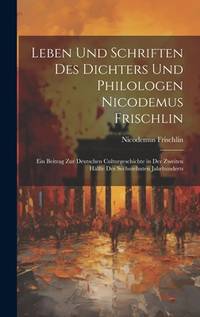
85475Frankfurt J. Rütten 1856. Gr.8° Frontispiz VIII 585 S. Neue Privat-Lwd. Frontispiz u. Titelbl. sowie letzte Blatt oben stockfl. wenige Lagen min. gebräunt sonst tadellos. EA. - «Philipp Nicodemus Frischlin 22. September 1547 in Erzingen heute Ortsteil von Balingen - 29. November 1590 in Urach war ein späthumanistischer Philologe neulateinischer Dramatiker und geadelter Lyriker» Wikipedia. 010 Frankfurt, J. Rütten, 1856 unknown
2026__3772828043Frommann-Holzboog 2026. Hardcover. New. 256 pages. German language. 10.00x1.18x6.77 inches. Frommann-Holzboog hardcover
3772821545.Ghardcover. Good. Access codes and supplements are not guaranteed with used items. May be an ex-library book. hardcover
112075030X.Gpaperback. Good. Access codes and supplements are not guaranteed with used items. May be an ex-library book. paperback
1167053036.Gpaperback. Good. Access codes and supplements are not guaranteed with used items. May be an ex-library book. paperback