by Dorina Maria Buda (Author)Biblio.com

220 résultats
23207941like new. unknown
ria9781138822467_inpHardcover. New. New Book; Fast Shipping from UK; Not signed; Not First Edition; Affective Tourism explores how and in what ways affects emotions and drives are felt and performed in tourism encounters in places of socio-political turmoil such as Jordan Palestine/Israel and Iraq. hardcover
19862092902140900415Kokusho Publishing Association 1986. Soft Cover. Fine. Volume: 1 Kokusho Publishing Association paperback
2110502150903281Not Available N.A. Soft Cover. Fine. Number of books: 1 width Not Available paperback
2023x-1032273135Routledge 2023. Hardcover. New. 332 pages. 9.69x6.88x1.06 inches. Routledge hardcover
DADAX0870403532Brand: Bukkyo Dendo Kyokai 0000-00-00. Revised. hardcover. New. 0.00x0.00x0.00. Buy with confidence. Excellent Customer Service & Return policy. Brand: Bukkyo Dendo Kyokai hardcover
2026x-1032984643Taylor & Francis Ltd 2026. Hardcover. New. 222 pages. 9.18x6.12x9.45 inches. Taylor & Francis Ltd hardcover
2015x-1138822469Routledge 2015. Hardcover. New. 192 pages. 9.25x6.25x0.75 inches. Routledge hardcover
2022x-1032227745Routledge 2022. Hardcover. New. 384 pages. 9.69x6.88x0.87 inches. Routledge hardcover
albfb1109ff35aad646Manual for Russian Language Teachers in Secondary School and for Self-Education. Kazan 1917. Please contact us for details on condition of available copies of the book. SKUalbfb1109ff35aad646. unknown
albd3097fb4eed12cbfThe 3rd edition of Kazan published by M.A. Golubevs Bookshop 1913 48 p. Please contact us for details on condition of available copies of the book. SKUalbd3097fb4eed12cbf unknown
alb0bb3a92afa07ec5aPart One: Etymology. For Secondary Education. Third Edition Revised and Amended. St. Petersburg 1910. 184 p. Please contact us for details on condition of available copies of the book.�SKUalb0bb3a92afa07ec5a. unknown
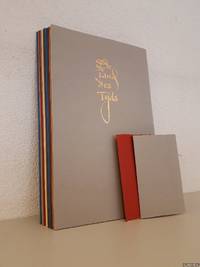
1982393459-MD9Banholt : In de Bonnefant 1982. 1. Softcover. Good. 13 vouwbladen in uniforme mapjes met goudopdruk 1982-1997 gedrukt in zwart met diverse kleuren allen in een oplage vabn 55 genummerde exemplaren dit is telkens nummer 32 4to. Met aanbiedingsbrief van de uitgever en twee reclamefoldertjes voor de reeks. De Tand des Tijds is een twaalfdelige reeks poëziebladen waarvan er dertien in een dozijn gaan: met een vignet van Karina Meister en het omslag verzaorgd door Binderij Phoenix op papier van Wookey Hole 1-6 en Zerkall 7-13 en gedrukt door Hans van Eijk. De reeks bestaat uit: 1 H.H. ter Balkt: Loden Gansje van het Ganzenbord 1982 nummer 32/55; 2 Wiel Kusters: Ballade van de palfrenier 1982 nummer 32/55; 3 Jacques Hamelink: Nieuws uit de tunnel 1983 nummer 32/55; 4 Samuel Beckett: Arènes de Lutèce met een vertaling van Hans Tentije 1983 nummer 32/55; 5 Hans van de Waarsenburg: Het boothuis te Laugharne 1985; 6 Eddy van Vliet: Fritz; Tewaterlating 1985; 7 Frans Budé: Kreeft 1986; 8 Willem van Toorn: De aardse republiek in memoriam H.H.m 1986; 9 Bert Schierbeek: Voor Lucebert zijn verjaardag zijn prijs zijn feest 1988; 10 Manuel Kneepkens: De hagedissen 1989; 11 Rouke van der Hoek: KOmplot van de deuren dag der kasten 1997 12 H.C. ter Berge: De laatste modernist 1997; 13 Hugo Claus: Nenia voor Herman de Coninck 1997. Banholt : In de Bonnefant paperback
BN90892Schlütersche. Atlas der Anatomie des Rindes: Supplement Klinisch-funktionelle Anatomie <br/><br/>Atlas der Anatomie des Rindes: Supplement Klinisch-funktionelle Anatomie Budras Klaus-Dieter and Buda Dr. Silke Schlütersche unknown
19772080502106502916Kikuragesha 1977. Soft Cover. Fine. Number of books: 38 Kikuragesha paperback
19862111902160306836Kokusho Publishing Association 1986. Soft Cover. Fine. Number of pages: 536 433 pages Size: B5 size Number of books: 2 volumes Kokusho Publishing Association paperback
2110502150908513Not Available N.A. Soft Cover. Fine. Number of books: 1 Not Available paperback
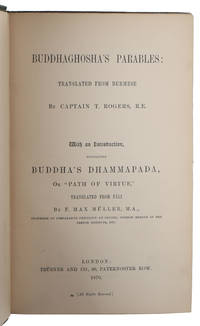
187063105London 1870. 8vo. Original green full cloth with gilt lettering to spine and gilt illustration of Buddha to front board. Spine a little darkened and wear to capitals. Inner front hinge open and partly cracked but still honlding. Inner back hinge weak. Unopened and internally very nice clean and fresh. With the large book plate of Ernest Ridley Debenham to inside of front board and ex Libris of Societatis Divinae Sapientiae to front free end-paper along with old owner's signature. CLXXII 206 24 advertisements pp. <br/><br/><em>Scarce first edition of the highly influential first English translation of the Dhammapada along with Buddhaghosha’s Parables. Excerpts of the Dhammapada had appeared in English in the periodical The Friend printed in Colombo Sri Lanka but a full English translation which is based upon Fausböll’s version from 1855 being the first European edition of a complete Pali-text as well as the first Latin translation of the Dhammapada only appeared in 1870. Today the Dhammapada is probably the most frequently translated Buddhist text in the world. The Dhammapada the extremely influential collection of sayings of the Buddha in verse form constitutes one of the most widely read and best known Buddhist scriptures. The original version of the Dhammapada is in the Khuddaka Nikaya a division of the Pali Canon of Theravada Buddhism. Each saying recorded in the collection was made on a different occasion in response to a unique situation that had arisen in the life of the Buddha and his monastic community. “The Dhammapada is the best known and most widely esteemed text in the Pali Tipitaka the sacred scriptures of Theravada Buddhism. The work is included in the Khuddaka Nikaya "Minor Collection" of the Sutta Pitaka but its popularity has raised it far above the single niche it occupies in the scriptures to the ranks of a world religious classic. Composed in the ancient Pali language this slim anthology of verses constitutes a perfect compendium of the Buddha's teaching comprising between its covers all the essential principles elaborated at length in the forty-odd volumes of the Pali canon.†The Dhammapada. The Buddha's Path of Wisdom. Translated from the Pali by Acharya Buddharakkhita with an Introduction by Bhikkhu Bodhi 1996. Buddhist tradition has it that shortly after the passing away of the Lord Buddha five hundred of his disciples met in council at Rajagaha in order to recall the truths they had received from their spiritual teacher during the previous forty-five years. They wanted these truths about moral and spiritual conduct to live on forever and for Buddha’s message to be available for all future disciples. The followers and Arhat felt the responsibility to convey the teaching and discipline of the Buddhist order as faithfully and truly as possible and having no written texts to rely on they prepared the many discourses for recitation with repetitions in various contexts so that they could be remembered. Like the verses of Homer and other ancient works that were only written down later. “At that time according to the Sinhalese the Dhammapada was orally assembled from the sayings of Gautama given on some three hundred different occasions. Put in verse form the couplets contrast the vanity of hypocrisy false pride heedlessness and selfish desire with the virtues of truthfulness modesty vigilance and self-abnegation. The admonitions are age-old yet they strike home today their austerity of purpose fittingly relieved by gentle humor and earthy simile. Subsequently several renditions of the Dhammapada in the Sanskrit and Chinese languages came into circulation; likewise a number of stanzas are to be found almost verbatim in other texts of the canonical literature testifying to the esteem in which its content was anciently held. Since first collated the Dhammapada has become one of the best loved of Buddhist scriptures recited daily by millions of devotees who chant its verses in Pali or in their native dialect.†Bodhi 1996. “The Dhammapada an anthology of verses attributed to the Buddha has long been recognized as one of the masterpieces of early Buddhist literature. Only more recently have scholars realized that it is also one of the early masterpieces in the Indian tradition of kavya or belles lettres.†The Dhammapada. A Translation. translated from the Pali by Thanissaro Bhikkhu. Buddhaghosha's Parables is a collection of Buddhist stories and moral lessons compiled by the Indian scholar and monk Buddhaghosha in the 5th century CE. The present first English translation includes 50 parables that illustrate various aspects of Buddhist philosophy and ethics. The stories cover a wide range of topics from the importance of mindfulness and the dangers of attachment to the virtues of compassion and the nature of enlightenment. Each parable is accompanied by a commentary that explains its meaning and relevance to Buddhist practice. </em> hardcover
108981 p.l. 38 folding leaves. 8vo 280 x 174 mm. orig. wrappers with cover wrappers old stitching. Thần Xá: An Thái French colonial period.<br /> <BR> <BR> An extremely rare woodcut book printed by nuns in a rural monastery in northern Vietnam. “An eponymous MahÄyÄna sutra that recounts the qualities vows and pure land of the buddha Bhaiá¹£ajyaguru — the Master of Healing also known as the Medicine Buddha or the TathÄgata of Lapis-Lazuli Light. The scripture was most likely written in northern India during the early centuries of the Common Era. In this sutra Bhaiá¹£ajyaguru vowed that his name if merely uttered would cure diseases free prisoners secure food and clothing for the impoverished and produce other similar benefits. He also vowed that his body would be as resplendent as lapis lazuli itself so that it might illuminate the world†Donald Lopez & Robert Buswell The Princeton Dictionary of Buddhism “Bhaiá¹£ajyagurusÅ«traâ€.<br /> <BR> <BR> The Scripture of the Medicine Buddha T. 450 translated from Sanskrit into Chinese by Xuanzang 602–664 in the year 650 C.E. has been a popular text in East Asian and Tibetan Buddhist traditions. In our copy the sutra itself is bookended by a liturgical opening including the “Incense Praise†praises for the Buddha and a “sutra-opening gÄthĆand a final homage to the Medicine Buddha. According to the colophon bound at the beginning of the volume the scripture was printed for a specific occasion by three bhikkhuni or ordained Buddhist nuns affiliated with the An Thái temple 安泰寺 in the Thần Xá village 神èˆæ‘ of the An Lại commune 安賴社 in the Thanh Khê canton 清溪 Äại An district 大安縣 Nam Äịnh province å—å®šçœ of northern Vietnam. <br /> <BR> <BR> Only the names of two of them are fully legible: they are Quảng Thuáºn å»£é † and Quảng Thà nh 廣æˆ. They printed and disseminated this Scripture of the Medicine Buddha with a sincere mind when the statues of three of their masters were completed and placed into stupas. In their colophon they traced the lineage of themselves and their masters to the bhikkhuni An DÆ°Æ¡ng Tháp 安陽塔 dharma name Nguồn Hạnh æºå¹¸ and pseudonym Minh Lâm 明ç³. <br /> <BR> <BR> Despite the country’s long history of Buddhist and Confucian learning woodblock-printed books published within Vietnam itself are far fewer in number than their Chinese or Japanese counterparts. This scarcity is owed to the high cost of domestic production: according to the estimate of Kathlene Baldanza as late as the 19th century “the labor cost of printing in Vietnam was five to ten times higher than in China. Even ink and brushes were more expensive to produce in Vietnam.†Extensive international trade between northern Vietnam and southern China — where plentiful books were printed at very low costs — meant that “it was generally cheaper to purchase books from China than to buy them locally†“Publishing Book Culture and Reading Practices in Vietnam†Journal of Vietnamese Studies 13.3 2018 pp. 10–11. <br /> <BR> <BR> Beyond the limited cases of official and temple-based publishing Vietnamese publishers were pushed toward niche genres such as Sino-Vietnamese dictionaries ritual manuals or morality books. Regardless of genre woodblock-printed books from Vietnam are very difficult to find today outside a few major collections such as the Institute of Sino-Nôm Studies in Hanoi and l’École française d’Extrême-Orient in Paris. We will not focus on the humid climate of the country or the massive destruction of the nation’s cultural heritage during its long war of independence in the post World War II period.<br /> <BR> <BR> The catalogue of materials kept at the Institute of Sino-Nôm Studies mentions two copies VHv.1071 AC.116 of the Scripture of the Medicine Buddha printed in 1911 and it is unclear if those were printed with the same woodblocks as ours. We know for certain however that no material at the Institute of Sino-Nôm Studies gives the An Thái temple as the place of publication despite the large numbers of temples and monasteries listed. This copy being an example of Vietnamese women’s printing in a rural monastery is extremely rare.<br /> <BR> <BR> Fine copy. First leaf a little frayed and the outer wrappers are quite frayed.<br /> <BR> <BR> ⧠Li Guimin æŽè²´æ°‘ “Zaizhi yu bianyi: Yuenan hanchuan fojiao dianji de zhuanhua å†è£½èˆ‡è®Šç•°â€”—越å—漢傳佛教典ç±çš„轉化†Foguang xuebao 佛光å¸å ± 7 No. 1 2021: pp. 111–37. Yuenan Hannan wenxian ziliaoku 越å—漢喃文ç»è³‡æ–™åº« Academia Sinica. unknown
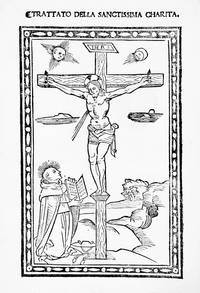
151386<p>4°; cc. 4 180 recte: 170 2 numerosi errori nella numerazione delle carte; segnatura: †â´A-Xâ¸Yâ´. Caratteri gotico e romanico. Al frontespizio <strong>grande silografia a piena pagina</strong> raffigurante l'autore inginocchiato nell'atto di offrire la sua opera a Cristo in Croce; capilettera silografici. <strong>Splendido <em>colophon</em> calligrammatico in forme di Croce</strong>. Legatura del sec. XIX - firmata "M. Lortic" in marocchino rosso armi al centro dei piatti dorso a cinque nervi con titolo impresso in oro e monogramma 'MV' taglî dorati. Accurati piccoli restauri marginali - verosimilmente ottocenteschi - alla prima e ultima carta; alcuni fascicoli leggermente bruniti. Nel complesso copia molto bella discretamente lavata come imponeva il canone collezionistico francese del secondo Ottocento.</p><p>Provenienza: legatura alle armi di Victor Masséna Prince d'Essling 1836-1910; su un foglio di guardia etichetta "Antiquariato Librario Francesco Radaeli" Milano; Christie's 16 Jun 2005 <em>Libri e autografi</em> n. 101.</p><p><em>Editio princeps</em>. Choix 4474; Razzolini 137; Sander 2466.</p><p>Su Simone Nardi F. Jacometti <em>Il primo stampatore senese: Simone di Niccolò di Nardo</em> "La Diana" 1 1926 fasc. III p. 184-202; N. Pallecchi <em>Una tipografia a Siena nel XVI secolo. Bibliografia delle edizioni stampate da Simone di Niccolò Nardi 1502-1539</em> "Bullettino senese di storia patria" CIX 2002 p. 184-233. Su Giovanni Landi C. Bastianoni - G. Catoni <em>Studenti tipografi e librai a Siena fra repubblica e principato</em> in <em>Lo Studio e i testi. Il libro universitario a Siena secoli XII-XVII</em> Siena Biblioteca Comunale 14 settembre - 31 ottobre 1996 catalogo della mostra coordinato da M. Ascheri; con la collaborazione dell'Università degli studi di Siena Siena 1996 pp. 183-90; G. Minnucci - L. Kosuta <em>Lo Studio di Siena nei secoli XIV e XVI. Documenti e notizie biografiche</em> Milano 1989 pp. 390-91 471 521; M. De Gregorio <em>"Ad istantia di Giovanni d'Alessandro libraro". Percorsi editoriali a Siena nel primo Cinquecento</em> in <em>Siena bibliofila. Collezionismo librario a Siena su Siena</em> a cura di G. Borghini D. Danesi M. De Gregorio L. Di Corato Siena 2009 pp. 29-54.</p><p>Inoltre P.F. Gehl <em>The 1615 Statutes of the Sienese Guild of Stationers and Booksellers. Provincial Publishing in Early Modern Tuscany</em> "I Tatti Studies in the Italian Renaissance" VI 1995 pp. 215-53. Si vedano pure C. Bastianoni <em>Libri e librai a Siena nel XVI secolo</em> in <em>Manoscritti editoria e biblioteche dal medioevo all'età contemporanea. Studi offerti a Domenico Maffei per il suo ottantesimo compleanno</em> a cura di M. Ascheri e G. Colli con la collaborazione di P. Maffei indici proanalitici di A. Bartocci "Roma nel Rinascimento" I 2006 pp. 47-85; N. Pallecchi <em>La costruzione del mercato del libro a Siena secoli XVI-XVII: produzione circolazione possesso</em> "Bibliothecae.It" 1 2012 pp. 121-56 https://doi.org/10.6092/issn.2283-9364/5692.</p><p>As its calligrammatic <em>colophon</em> makes clear the <em>Trattato</em> was printed 'at the instance' of the Dominican tertiary nuns of the Monastery of <em>Santa Caterina del Paradiso in Siena</em> founded in 1479 cf. <em>L'oratorio di S. Caterina nella Contrada del Drago. La storia e l'arte</em> a cura di F. Bisogni e L. Bonelli Conenna Siena 1988.</p><p><strong>About the influence of Giovanni Dominici's spirituality on Fra Angelico's painting</strong> cf. I. Maione <em>Fra Giovanni Dominici e beato Angelico</em> "L'Arte" XVII 1914 pp. 281-88 361-68; P. Bargellini <em>Il Beato Dominici S. Antonino e il Beato Angelico</em> "Atti dell'Accademia Nazionale di S. Luca" III 1953-1956 p. 47-51; G. ÂDidi-Huberman <em>La dissemblance des figures selon Fra Angelico</em> "Mélanges de l'école française de Rome" 98-2 1986 pp. 709-802.</p><p>"We learn what we can about Fra Angelico and his conventual life from this: the considerable exegetical culture required of every novice the sermons the prodigiously fruitful use of the 'arts of memory' the mingling of Greek and Latin texts in the library of St Mark's . the enlightened presence of Giovanni Dominici and St Antonino of Florence in the circle of people close to the painter - well all this comes to confirm the hypothesis of a painting virtually proliferating meaning and accentuates the paradox of visual simplicity of his frescoes" Georges Didi-Huberman.</p><p>Cf. L. Tromboni <em>"Bene scrivono i filosofi". La predicazione domenicana e il sapere filosofico a Firenze tra tre e quattrocento: Iacopo Passavanti Giovanni Dominici Girolamo Savonarola</em> in <em>Savoirs profanes dans les ordres mendiants en Italie XIIIe-XVe siècle</em> Rome 2023 pp. 421-43 http://books.openedition.org/efr/50815.</p><p>About the Author cf. https://en.wikipedia.org/wiki/John_Dominici.</p> per Symeone di Nicolò [Nardi] et Gionanni [sic] di Alexandro [Landi] Librai: ad instantia principalmente delle venerabile [sic]