877 résultats
4236Saumane (France), Editions Dharma, 1993 14 x 20, 257 pp., broché, très bon état
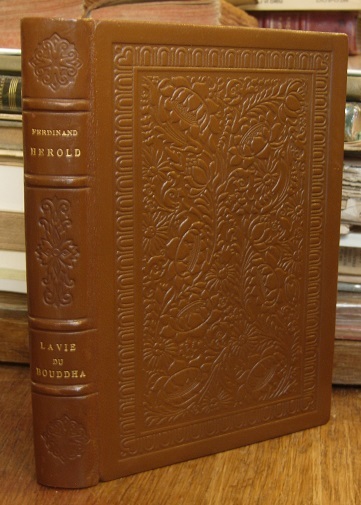
192310278Paris Piazza 1923 Un volume in-8 reliure de l'éditeur en pleine basane noisette, dos à nerfs, titre doré, décor estampé sur le dos et sur les plats, tête dorée, couverture conservée, 257 pp. et table. Ex-libris manuscrit en page de faux-titre, dos légèrement frotté, néanmoins bel exemplaire.
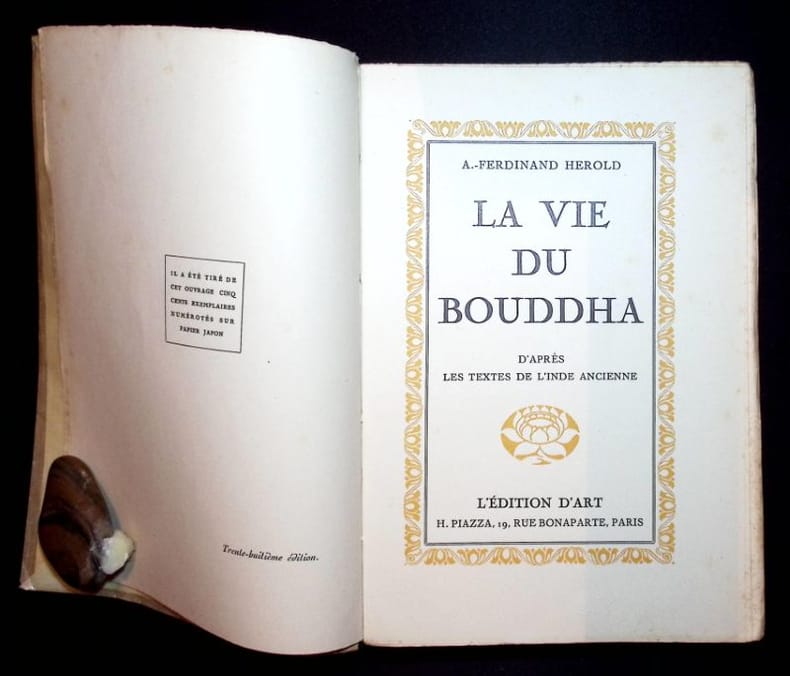
21006Paris, Piazza, l'édition d'art. 1926 ( ment° de 38è. ed.). In-12°, broché, ensemble dense, 257 pp. (2ff). Bon état général, dos fendu sans déficit. Beaux plats. Très propre.
Very Good English Paperback. Pbo. Demy 8vo. (22 x 15 cm). In German. [iv], 115, [2] p.
1976LFA-126749496Un ouvrage de 304 pages, format 140 x 205 mm, illustré, relié simili cuir orné d'une plaque en aluminium sur le premier plat, publié en 1976, Editions Robert Laffont, collection "Les Grands Initiés", bon état
Abundant black and white illustrations and reproductions of photos. Features: Satan - story of a pet monkey in the Ivory Coast; Exploring in Brazil - photo-illustrated account of a sixteen-hundred mile trip up rapid-strewn rivers in a tiny launch through territory almost unknown to Europeans; The "King of the Clearwater" - a man claimed an area in Clearwater country, about sixty miles west of the North Thompson River, as his own and would go to any length to keep out intruders; The Ivory Raiders - Part II - a vivid picture of the dangers and difficulties of suppressing the Swahili ivory-raiders and Turkana warriors of Turkanaland, a wild district of Central Africa bordering on the western shores of Lake Rudolf; An Isle of Unrest - a chatty account of a little tramping holiday in Crete, with nice photos; Aquarium Adventures - remarkable stories of aquarium predicaments related by curators of various institutions; The Cat - Photo-illustrated tale from near Boise, Idaho; In Quest of the Unknown - Part IV - Photo-illustrated account of "Our adventures among the Chucunaque Indians (conclusion); The Second Touch - one of the queerest things that ever happened in Alaska; After a Native Murderer in Rhodesia - A B.S.A. Police trooper's story; On the "Devil's Staircase" - a New Zealand trapper's dangerous experience in a mountain blizzard; The Burmese Buddha - A stolen image of Buddha, stolen from the Shwe Dagon Pagoday, Rangoon, is returned after forty years; My Jungle Jaunts - Part II - An Englishwoman's experiences in Burma, with nice photos (conclusion); A Wild Goose Chase - A sportsman's account of his first experience with a wily Canada goose; and more. 88 pages plus 16 pages of nostalgic ads. Clean and unmarked with moderate wear. A quality copy of this excellent vintage issue. Book
1996LFA-126746005Un ouvrage de 127 pages, format 115 x 175 mm, broché, publié en 1996, P.U.F., collection "Que Sais-je ?", bon état
Very Good English Paperback. Pbo. Roy. 8vo. (24 x 17 cm). In German. 131 p. Buddhismus und Gottesidee. Die buddhistischen Lehren von den überweltlichen Wesen und Machten und ihre religionsgeschichtlichen Paralellen. Akademie der wissenschaften und der Literatur. Abhandlungen der Geistes -und Sozialwissenschaftlichen Klasse, Jahrgang 1954, Nr. 8.
199457473Ratingen : Melina-Verl. 1994. 185 S. : 29 Text- und XXII teils ganzseitige Farbabbildungen; 30 cm, mit Schutzumschlag Pp., gebundene Ausgabe, Hardcover/Pappeinband, Exemplar in sehr gutem Erhaltungszustand
199739785ABBergisch Gladbach, Honos Verlagsgesellschaft, 1997. 22 cm, 560 Seiten, brauner illustrierter Pappband. wenig gebraucht, gut erhalten.
198751123München, Piper Verlag, 1987. "Originalausgabe, in der Reihe ""Serie Piper"" Band 668, ausgewählt u. erläutert von Hellmuth Hecker, übertragen von Karl Eugen Neumann, 535 S., 8°; Kartoniert"
Very Good Turkish, Ottoman (1500-1928) Original manuscript autograph ijazatnama [i.e. License, or diploma for assent] signed by Ali Haydar Gürbüzler written for famous Turkish mevlevi poet Aasf Halet Çelebi, (1907-1958). 18x11,5 cm. In Ottoman script (Turkish with Arabic letters). 8 lines. It starts with "Huve". Dated November 20, 1928. A short qasida on verso signed by 'Mustafa'. Ali Haydar Gürbüzler, known as Ahiskali Ali Haydar Efendi [i.e. Ali Haydar Efendi of Meshketia], the Turkish lawyer, lecturer, professor, clergyman, the mystic is also the last sheikh of the Ismet Efendi Lodge located in the district of Çarsamba, Fatih, in Istanbul. Asaf Halet Çelebi [or, Asef], (1907-1958), was a Turkish mystical poet. Although not very widely known, due to his erudite and often foreign-influenced style, he is considered to be Turkey's first surrealist poet. In his youth Çelebi was still influenced by Ottoman court literature, but starting from 1937 he adopted Western poetic styles and techniques, such as free-form verse. In his poems one finds themes originating in the cultures of Persia and India. As a librarian, Çelebi had a lot of time and opportunity to read, and his readings stood at the base of his poetic work. An often recurring theme of his poems is philosophical ideas which he found, for instance, in Buddhism. From there he took names and terms with vast philosophical connotations, such as Siddhartha and Mara, which, for the non-initiated, created an obstacle in understanding his work, although he did provide explanations in his prose. "Edîb-i Rusen-zamir Asaf Halet bey efendi oglumuza, haz-i viran (?) imtihan(?)-i hayat ve mehatira(?) Mazhar-i ihtiram olduklari daima görülmelidir ki herkes sevke gelsin de onlarin ? olmaga çalissin. Saban (?) Asef Halet bey oglumuzun anane-i(?) ilm u feng(?), Siir ve edebiyat ve musikiye intisabini gördügümde kendisinin feyz ve kemalatinin azadiyatini (?) cenab-i feyyaz görmeden tezrii'(?) ve niyaz ile bu mahalli imza eylerim, fi 7 cemaziyelevvel? Sene 1347 - fi 20 tesrin-i sani sene 1928. El fakir el-hakir'ül-ibad Haydar [i.e. Naqshbandiyya shaykh -Hâlidî shaykh Haydar Efendi of Meshketia -Ahiskali Haydar Efendi)].".
198820018ABMünchen, im Selbstverlag, 1988. 8°, 215 S., illustr. original Kartonage (Paperback), Erstausgabe (Auflage: 500 Exemplare) Besitzervermerk sowie Orts- und Datumsangabe auf Titelseite unten, sonst ein schönes, sauberes Exemplar (Rel2)
51-0257Berkeley: Sky Walker and Ä€rif Press 1974. Folio. 17 x 11.5 inches on thick paper. Drawing on one side and text on the verso.In Buddhism Manjushri is the Bodhisatva Buddha-to-be of Wisdom although he is believed to have the enlightenment of a Buddha. He bestows intelligence wisdom mastery of the Teaching the power of exposition eloquence and memory. He is the principle guardian and patron of astrologers. Revered as the patron of arts and sciences he is traditionally invoked by writers for assistance. Authors often open their books with verses in his honor.Manjushri works with Lord Maitreya. The two are sometimes depicted in a triad with Gautama Buddha in which Manjushri represents the wisdom aspect and Maitreya the Compassion aspect of Buddhist teaching.The Sanskrit name Manjushri means "gentle glory" or "sweet glory." Manjushri is also known as Manjughosha meaning "sweet-voiced-one" or "gentle-voiced-one" and as Vagishvara "Lord of Speech".Manjushri is said to have the power of discriminating wisdom. He can discriminate between correct and incorrect views and between beneficial and non-beneficial actions that must be taken on one's spiritual path. He holds a sword that vanquishes ignorance. Manjushri's sword is also considered a sword of quick detachment and a symbol of enlightened will.In Buddhist art Manjushri is portrayed as a beautiful 16-year-old prince. He often holds in his left hand the stem of a blue lotus blossom. On the blossom rests one of the Prajnaparamita scriptures which deal with the realization of Prajna or wisdom. With his right hand he wields a flaming sword of wisdom to vanquish ignorance.DHIH is the bija or seed syllable of Manjushri. The essence of a cosmic being is concentrated in his bija. Manjushri's mantra can be given to help develop wisdom memory and the understanding of the scriptures.According to one Tibetan tradition the devotee should recite this mantra -OM AH RA PA TSA NA DHIH- 100 21 or at least 7 times. On the last repetition the final syllable DHIH is to be repeated as many times as possible.OM – also written Aum is a sacred and mystical syllable that originates from Hinduism but is now common in Buddhism Hinduism Sikhism Jainism and the Bön tradition. Interestingly it is considered that the Islamic “Amin†and Christian “Amen†are both derived from this syllable.AH – represents the direct understanding of the nature of phenomena.RA – represents the understanding of emptiness from the Hinayana point of view. These profound teachings of the â€Hinayana†emptiness are suitable for those practitioners that have problems in understanding emptiness in its ultimate nature.PA – represents meditation. There are 2 basic types of meditation: the non-conceptual without thinking meditation and the conceptual thinking.TSA – represents the importance of nirvana and samsara. The exact nature of both samsara and nirvana is emptiness. But if we don’t understand the exact nature of samsara it manifests to us in the form of 3 sufferings. It is essential to understand the importance of both nirvana and samsara.NA – represents karma action. In short it signifies that all the suffering we experience is the result of our previous non-virtuous actions negative karma and all our happiness results from our previous virtuous deeds positive karma. There are 2 basic kinds of karma: the collective karma and the individual karma. We need to understand that with each action of our speech body and mind we are sewing the seeds of our future experience.Dhi – represents the bija or seed syllable of Boddhisatva Manjushri. After chanting 108 dhihs envision the dhi on your tongue coming down and absorbing into the dhi on the moon disk at your heart which becomes very brilliant. Immeasurable red-light rays radiate from that seed syllable filling your entire physical body and purifying all negative karma actions sickness and obstacles.In short the view helps us recognize the correct path. Meditation is the actual practice through which we develop an experiential understanding of the path leading to a change in our mind and feelings. Activity combined with wisdom gives us the capacity to help sentient beings in an efficient way at the right time. Fruition is the happiness and courage resulting from accomplishing our virtuous intentions. Berkeley: Sky Walker and Ārif Press, 1974. unknown
19965556CBRheda-Wiedenbrück/Wien, Bertelsmann-Club/Buchgemeinschaft, 1996. kl.4°, 239 S. mit zahlr. Farb- und s/w-Abbildungen, original Pappband (Hardcover) mit original Schutzumschlag, Lizenzausgabe Schutzumschlag vorderseitig oben mit kleiner Knickspur, Schutzumschlag minimal berieben, sonst schönes, sauberes Exemplar (L)
1934LFA-126747676Un ouvrage de 438 pages, format 145 x 225 mm, broché, publié en 1934, Librairie Félix Alcan, collection "Bibliothèque de Philosophie Contemporaine", bon état
Very Good English Original yellow cloth bdg. Cr. 8vo (20 x 14 cm). In German. 327, [2] p. Das Lieblingsvolk Buddhas. Die Burmanen und ihr lebendiger Glaube.
2007151458Düsseldorf: Patmos 2007. 186 Seiten. 8° (17,5-22,5 cm). Orig.-Pappband mit illustriertem Orig.-Schutzumschlag. [Hardcover / fest gebunden].
201038610ABMarburg, diagonal-Verlag (= Schriftenreihe des Raum 1 Forschungsinstituts für Gegenwartskunst Kriftel, Band 3 / auch: RAUM 1), 2010. 8°, 323 S., illustr. original Kartonage (Paperback), Erstausgabe (Auflage: 500 Ex.) sehr schönes, sauberes Exemplar
154Cercle d'art ,état neuf , jaquette , 2002 , 160 p , tres belles photos , 32 x 24 cm
196958939Leiden, E. J. Brill 1969. 148 pages Softcover/Paperback, book in good condition
Nonostante i nostri sforzi per vivere una vita positiva, spesso le nostre reazioni emotive ci trascinano molto spesso verso una negatività ancora maggiore. Gli insegni del Buddha però possono portarci all'illuminazione e a vivere più sereni. In ottime condizioni.
193855287Leipzig : Deichert 1938. 53 S. ; 8°, Broschiert ++ etliche Bemerkungen und Unterstreichungen mit Rotstift und Bleistift. +++ sonst gut
199249242München : Knürr 1992. 315 S. : überwiegend Ill., Kt. ; 24 cm kart., Softcover/Paperback, Exemplar in gutem Erhaltungszustand
1988282862Göttingen, Akademie der Wissenschaften, 1988. 71 Seiten. Originalbroschur. 20 cm