655 résultats
1373648Paris: Stock, 1986 in-8, 208 pages, glossaire. Broché, nom inscrit sur le faux-titre. Collection Judaïsme-israël.
Mm 170x240 Brossura editoriale di pp. 120 con alcune illustrazioni in nero nel testo. Opera in buonissime condizioni. SPEDIZIONE IN 24 ORE DALLA CONFERMA DELL'ORDINE
2006180918G.V.P Editions G.V.P Editions, 2006. In-8 brohcé de 153 pages illustrées. Méthodes pratique d'action et de protection selon les traditions kabbalistiques des sciences magiques juive et arabe. Traces de scotch ancien au verso de la couverture sinon bon état, peu courant
In 8°, br. edit. ill., pp. (2),171,(5); copia molto buona. (zb9) Isbn 2864320215. (La spedizione standard è SEMPRE tracciata con raccomandata - piego di libri, eventuale FATTURA da richiedere all'ordine) (zb9)
Mm 150x225 Sei volumi in brossura editoriale rossa, 2497 pagine complessive. Traduzione di Silvia Cecchini dalla vesione di Jean de Pauly. Codici ISBN: 9798666659038, 9798666666562, 9798667479642, 9798667482529, 9798667608165, 9798667611325. Minimi segni di usura al primo volume, peraltro opera in condizioni pari al nuovo. SPEDIZIONE IN 24 ORE DALLA CONFERMA DELL'ORDINE.
1999LFA-126745513Un ouvrage de 159 pages, format 140 x 200 mm, broché couverture couleurs, publié en 1999, Editions de Vecchi, bon état
Mm 145x215 Collana "Focus Storia" - Brossura editoriale con bandelle, 357 pagine. Opera in condizioni pari al nuovo. SPEDIZIONE IN 24 ORE DALLA CONFERMA DELL'ORDINE.
195424320München-Planegg, Barth, 1954. 128 SS. 12° (10,5 x 7,5 cm), original Leinwand, Deckeltitel geprägt, Rückentitel goldgeprägt. Rücken etwas gebleicht.
200534172gwKöln, Taschen, 2005. Broschur, mit farbiger Deckelillustration, ca. DinA 5, 711 ! Seiten, durchgehend mit SEHR vielen s/w- und farbigen Illustrationen, Einband mit geringen Gebrauchsspuren, minimale Knickspuren zur Falz, minimal berieben und bestoßen, Seiten minimal randgebräunt, gut erhalten / guter Zustand [5 Warenabbildungen]
Mm 170x240 Collana "Un libro di Seth". Con note di Robert Butts. Brossura editoriale di 396 pagine. Esemplare in ottime condizioni. SPEDIZIONE IN 24 ORE DALLA CONFERMA DELL'ORDINE.
Br. ed. di cm. 19,5x9,5; cop. ill.ta, pp. 80, 3 fig. n.t. Ottimo.
196114920Paris, Les Productions de Paris (Hachette), sans date (1961, date du Dépôt légal) ; in-16 (20 cm) ; pleine toile violette, titre en blanc sur le dos et le plat, illustration sur le plat, rhodoïd transparent (reliure de l’éditeur) ; 621, (3) pp., y compris les nombreuses illustrations à pleines pages comprises dans la pagination.
DQO-470Pardes, 1973. In -8, broché, 319 pages. Introduction et traduction par François Secret. Première de couverture partiellement décolorée. Très bon état intérieur.
1519PHO-1100Haguenau, apud Thomas Anshelm, 1519 (M.D.XIX Mense Maio). Pet. in-4, cartonnage postérieur ,titre encadré , LXXIX f.,3ff.n.ch. (R 6),( table et marque d’imprimeur) .Exemplaire très frais, écriture sur le titre .
15094Alteredit, 2004. Format 16x24cm, broche, couverture illustree, 161 pages . Tres bon etat.
22413Paris Librairie Hachette et Cie, sans date 1885 in 12 (18,5x12,5) 1 volume reliure pleine percaline marron de l'éditeur, dos lisse orné de filets à froid, plats orné d'un encadrement estampé à froid, XVIII et 423 pages, rousseurs. Bon exemplaire ( Photographies sur demande / We can send pictures of this book on simple request )
In 8°, brossura edit. ill., pp. 175,(1); copia molto buona. (ZB1/A) Coll. Biblioteca dei Misteri. (ZB1/A)
29036Jerusalem, (1981). Format 15x21 cm, broche, 34 pages.Tres bon etat.
br. Questo libro non è un saggio sulla Qabbalah né uno studio storico sulle sue origini, ma una presentazione sintetica, sotto forma di aforismi-sutra, per poter "comprendere" e "realizzare" l'insegnamento in essa contenuto. L'espressione 'Ehjeh 'Aser 'Ehjeh, che significa "Io sono Colui che è", rappresenta la conoscenza di identità; quindi la Qabbalah, come ogni altra dottrina tradizionale, non costituisce semplice conoscenza eruditiva ma esperienza di vita. Ogni verità ha senso se viene integrata coscienzialmente ed espressa con un'adeguata modalità vitale; ogni "filosofia" ha la sua ragion d'essere se viene assimilata e vissuta. La Qabbalah ha come simbolo l'Albero Sephirotico in cui sono compendiate le indefinite possibilità espressive (Sephiroth) del micro e del macrocosmo, di là dal quale si trova la sfera di Ain Soph Aur (Assoluto) che corrisponde all'Uno-senza-secondo (advaita), al Brahman inqualificato (nirguna) della dottrina vedanta. Così, per far comprendere come la "visione" tradizionale è 'una' con differenti adattamenti spazio-temporali, nel testo vi sono frequenti accostamenti tra il Vedanta advaita e la Qabbalah. Raphael, tenendo conto che la Qabbalah rappresenta un insegnamento completo, ne mette in evidenza soprattutto la sfera metafisica (Ain Soph Aur) e il sentiero che a essa conduce: la "Via del Fuoco". Questa è la "Via" che ogni discepolo, a qualunque Ramo tradizionale appartenga, deve percorrere per realizzare l'identità con la propria Essenza.
brossura Rav Baruch Shalom HaLevi Ashlag (Rabash) ha svolto un ruolo rilevante nella storia della Kabbalah. Ci ha fornito l'ultimo collegamento necessario tra la Saggezza della Kabbalah e la nostra esperienza umana. Suo padre e maestro era il grande Kabalista, Rav Yehuda Leib HaLevi Ashlag, conosciuto come Baal HaSulam per il suo Sulam (La Scala) commentario de "Il Libro dello Zohar". Eppure, se non fosse per i saggi di Rabash, gli sforzi di suo padre per divulgare la Saggezza della Kabbalah a tutti sarebbero stati vani. Senza questi saggi, veramente pochi sarebbero in grado di raggiungere la realizzazione spirituale che Baal HaSulam così disperatamente voleva che noi ottenessimo. Gli scritti in questo libro sono stati raccolti dal suo studente prediletto Michael Laitman PhD, e riportati così come venivano esposti dal Rabash durante le sue lezioni. Il materiale non è solo da leggere; gli articoli sono più come la guida di un utente esperienziale. È molto importante lavorare su di essi per vedere quello che realmente contengono.
1970028307New York 1970 Samuel Weiser Inc. Hardcover Poor
189521609Paris, Chamuel, 1895; in-8, demi-veau prune, dos à nerfs, fleurons et titre dorés, plats en partie restaurés conservés; [6], 173 pp., couverture grise décorée (reliure de l’époque).
199048655München : Beck 1990. 116 S. ; 18 cm kart., Softcover/Paperback, Exemplar in gutem Erhaltungszustand
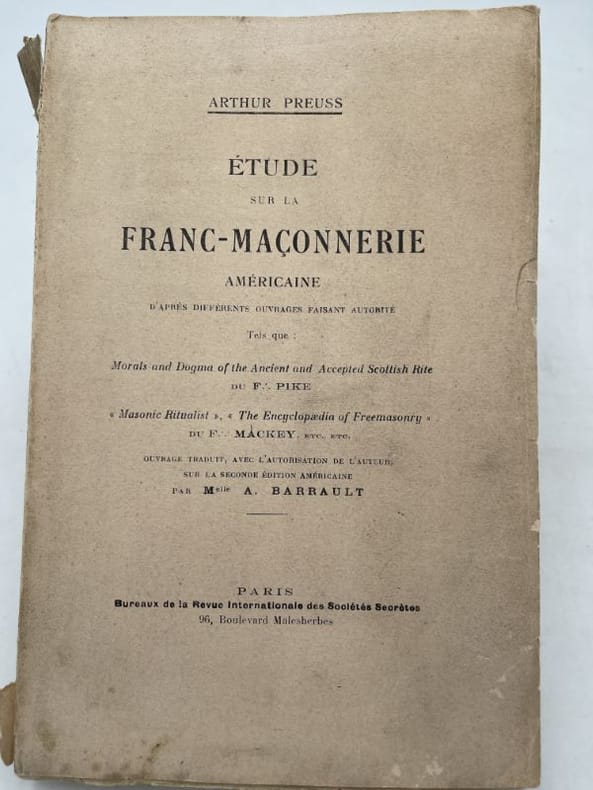
1908182330Bureau de la revue internationale des sociétés secrètes Bureau de la revue internationale des sociétés secrètes, 1908. Grand In-8 broché de XI + 323 pages. La couverture est salie et détachée pour le second plat. D'après les différents ouvrages faisant autorité tels que : Morals and dogma of the ancient and accepted Scottish Rite du F... Pike. Masonic Ritualiste, The encyclopaedia of Freemasonry du F... Mackey, etc. Ouvrage traduit avec l'autorisation de l'auteur, sur la seconde éditeur américaine par Melle A Barrault. Peu courant, en l'état
1st edition thus. Later paper wrappers, 12mo, 24 leaves, 155:90 mm. In Yiddish, with title also transliterated on title page ("Hanoges Odom"). Title translates as, The Book of Man's Leadership: ... How Every Jew Should Conduct Himself All His Days From Early to Evening ... and Many Laws. Proper daily behavior for Jews. Contains Kabbalistic customs and practices based on the teachings of the Ari. The text includes detailed descriptions of the halakhot and customs of the Ari for weekdays, Shabbat and festivals, and daily occasions.Although published anonymously, this appears to be similar to the work of Rabbi Meir ben Judah Leib Poppers (died 1662). He was a kabbalist of Ashkenazi descent who was active in Jerusalem after 1640. A pupil of Rabbi Jacob Zemah, he became the last editor of the Lurianic writings. He divided the mass of Rabbi Vital's different versions of Rabbi Luria's teachings into three parts, Derekh Ez Hayyim, Peri Ez Hayyim, and Nof Ez Hayyim. Rabbi Poppers' version became the one in most widespread use in Poland and Germany. After 1640 he composed a large number of his own kabbalistical writings in the vein of Lurianic Kabbalah. They are said to have comprised 39 books, each of which contained the word or ("light") in its title, the entire corpus being called Kokhevei Or. Several parts have been preserved (Ms. Jerusalem no. 101, Ms. Rabbi Alter of Gur no. 170). They included commentaries on Sefer Bahir, on Nahmanides' Torah commentary, on the Zohar, and on Luria's writings according to his own edition (Ms. Jerusalem no. 102). In the latter manuscript Poppers reports that he had studied Rabbi Luria's writings for 17 years. Only two of these books have been published, this work and Or Zaddikim (Hamburg, 1690), written in Jerusalem in 1643, and later incorporated in Rabbi Moses Katz's compilation, Or ha-Yashar (Amsterdam, 1709); and Me'orei Or, a dictionary of kabbalistic symbolism, published with copious notes by Jacob Vilna and Nathan Neta Mannheim under the title Me'orot Natan (Frankfurt, 1709). In addition, Mesillot Hokhmah, a booklet summarizing Lurianic metaphysics in 32 paragraphs, later published under Rabbi Poppers' name (Shklov, 1785), was first printed anonymously (Wandsbeck, c. 1700). Rabbi Poppers is credited with the authorship of a graphic description and summary of the Lurianic system, in the form of a scroll, published under the title Ilan ha-Gadol (1864). This tree, however, shows the distinct influence of Rabbi Israel Sarug's version of Lurianism, which is not to be found in Poppers' other writings. Part of his homilies on the Torah were published as Tal Orot (1911). He mentions as his teachers one Rabbi Israel Ashkenazi and his father-in-law, Azariah Ze'evi (probably from Hebron). During the 1650s Poppers spent about two years in Constantinople. He died in Jerusalem. (EJ, 2007). SUBJECT(S): Jewish ethics. OCLC: 233362307. OCLC lists only one copy (NLI), which, it is noted is missing the end, after 24 leavesexactly the same as our copy, so possibly as issued??? Some toning and stains. Good Condition, very rare. (YID-42-23)