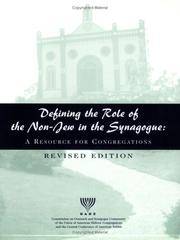
Commission on Outreach and SynagogueBiblio.com
44 résultats
2003G0807408816I4N00URJ Press 2003. Paperback. Very Good. May have limited writing in cover pages. Pages are unmarked. ~ ThriftBooks: Read More Spend Less.Dust jacket quality is not guaranteed. URJ Press paperback
0807409685.Gpaperback. Good. Access codes and supplements are not guaranteed with used items. May be an ex-library book. paperback
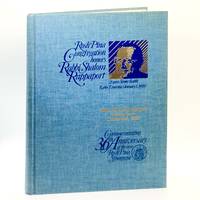
19875877Winnipeg Manitoba: Rosh Pina Synagogue 1987. First Edition First Printing. Hardcover. pp. 219. 4to. measuring 29 cm. Illustrated light-blue cloth over boads gilt and blue lettering to the spine and front board. Richly illustrated with many black-and-white photographs portraits illustrations facsimiles. Many congratulatory messages greetings from prominent individuals within the Jewish community congregants et al. No detectable flaws to the cloth extremities contents equally without blemish with bright clean and unmarked pages and firm sound binding; near fine. See OCLC #70124014. Not found in the University of Manitoba Archives & Special Collections BAC/LAC etc. Text in Hebrew and English. <br/><br/> Rosh Pina Synagogue hardcover
1894294595Richmond: Taylor 1894. Hardcover . Good . 136 pp. Inscribed to Rev F Becker by Koplowitz on fep slight fraying to crown Singerman 4664 Taylor hardcover
73586London 1916 Hardcover. Good London, 1916 hardcover
100-40761Rabbinical Assembly of America and United Synagogue of America. Hardcover. Acceptable. Used acceptable. Liquid marks. Rabbinical Assembly of America and United Synagogue of America hardcover
Box07-12-10-24-034University synagogue. audioCD. Like New. 0x0x0. Still wrapped in original wrap. University synagogue unknown
2012Q-0963095307Wimmer Cookbooks Inc 2012-05-01. Plastic Comb. New. In shrink wrap. Looks like an interesting title! Wimmer Cookbooks, Inc unknown
195083736Newport Rhode Island: Published by The Society of Friends of Touro Synagogue National Historic Shrine Inc 1950. Second printing stated. Wraps. Good. Format is approximately 9.25 inches by 12.25 inches. 55 1 pages. Illustrations Including a fold-out of a letter from George Washington. Decorative cover has some wear and soiling. Table of Contents: Some Notes on the Touro Synagogue by D. de Sola Pool; Peter Harrison by Fiske Kimball; The Jews of Newport R. I. in Pre-Revolutionary Days by Dr. Morris A. Gutstein; A Story of Religious Freedom by Joseph M. Proskauer; In the Early Days by Lee M. Friedman; Judah Touro By Leon Huhner; The Hebrew Cemetery by Henry Wadsworth Longfellow Dana; The Good Future by Carl Van Doren; Touro Synagogue as a National Historic Site by Thomas J. Allen; and Man Doth Not Live by Bread Alone by the Editors. Eleven essays by varied authors discuss every aspect of this wonderful structure and it's community during the colonial and revolutionary war era. Many Illustrations and a fold out facsimile of the Letter George Washington wrote to the Synagogue. Judah Touro June 16 1775 - January 18 1854 was a businessman and philanthropist. He enlisted in Andrew Jackson's army in the War of 1812. He carried ammunition in the Battle of New Orleans in which he was struck on the thigh by a 12-pound shot which tore off a large mass of the flesh. He was saved by Rezin Davis Shepherd a Virginia merchant who helped nurse him back to health and their close friendship continued throughout their lives. Judah Touro's lasting fame however was as a philanthropist. He contributed $40000—an immense sum at the time—to the Jewish cemetery at Newport. He is buried in the that Jewish Cemetery. Among the contributors was Carl Clinton Van Doren September 10 1885 - July 18 1950 was an American critic and biographer. He was the brother of critic and teacher Mark Van Doren and the uncle of Charles Van Doren. He won the 1939 Pulitzer Prize for Biography or Autobiography for Benjamin Franklin. The Touro Synagogue or Congregation Jeshuat Israel is a synagogue built in 1763 in Newport Rhode Island. It is the oldest synagogue building still standing in the United States the only surviving synagogue building in the U.S. dating to the colonial era and the oldest surviving Jewish synagogue building in North America. In 1946 it was declared a National Historic Site. The first congregation was made up of Sephardic Jews who are believed to have come via the West Indies where they participated in the triangular trade along with Dutch and English settlements. They practiced a Spanish and Portuguese Jewish liturgy and ritual. The community purchased and dedicated the Jewish Cemetery at Newport in 1677. In the late eighteenth century when warfare threatened the congregation transferred the deed and Torah scrolls to Congregation Shearith Israel in New York for safekeeping. Since the late 19th century the congregants have been primarily Ashkenazi. Touro Synagogue was designed by Peter Harrison a noted British architect and Rhode Island resident. It is considered his most notable work. The interior is flanked by a series of twelve Ionic columns supporting balconies which signify the twelve tribes of ancient Israel and each column is carved from a single tree. The building is oriented to face east toward Jerusalem. The ark containing the Torah is on the east wall; above it is a mural representing the Ten Commandments in Hebrew which was painted by Newport artist Benjamin Howland. The Touro Synagogue was built from 1759 to 1763 for the Jeshuat Israel congregation in Newport under the leadership of Cantor Chazzan Isaac Touro. The cornerstone was laid by Aaron Lopez a Newport-based philanthropist for Jewish causes who primarily made his fortune through the trading in addition to being involved in the spermaceti candlemaking business and other commercial ventures. The Jeshuat Israel congregation dates to 1658 when 15 Spanish and Portuguese Jewish families arrived probably from the Dutch or British West Indies. The synagogue was formally dedicated 2 December 1763. The Touro congregation annually reads President Washington's letter on religious pluralism and celebrates the occasion with invited speakers. They have included Supreme Court justices Ruth Bader Ginsburg and Elena Kagan; and Brown University presidents Ruth Simmons and Christina Paxson. Published by The Society of Friends of Touro Synagogue National Historic Shrine, Inc paperback
191936908New York December 11 1919. 1919. Very good. - Over 30 words typed on his 6 inch high by 8 inch wide buff "Free Synagogue / New York" stationery. Stephen Samuel Wise is pleased to accept American impresario and lecture agent James B. Pond's invitation to serve on the committee welcoming Maurice Maeterlinck to America. Wise writes "I accept with much pleasure your kind invitation to serve as a member of the Honorary Reception Committee." Signed "Stephen S. Wise". Folded for mailing with a small piece out from the top left corner. Very good. <p>Born in Budapest Stephen Samuel Wise 1874-1949 emigrated to the US when his father accepted service as rabbi of Brooklyn's Congregation Baith Israel Anshei Emes. After completing his studies at Columbia University Wise pursued rabbinical studies under several noted rabbis of the era including Richard J.H. Gottheil Kohut Gersoni Joff and Margolis. He was appointed assistant rabbi of NYC's Congregation B'nai Jeshurun becoming the Congregation's senior rabbi later that year. Taking over as rabbi of Portland Oregon's Congregation Beth Israel he attacked many of the social and political ills facing the country. He soon broke with the traditional reform movement and established his "Free Synagogue" in 1907 launching a movement. Wise was an early supporter of Zionism and laid the groundwork for what became the Zionist Organization of America and served as president of the American Jewish Congress. His good friend Albert Einstein profoundly praised him in a tribute that Einstein presented at the celebration of Wise' 60th birthday. In 1914 Wise co-founded the National Association for the Advancement of Colored People NAACP. Wise early on saw the threat posed by Hitler's rise in Germany and fought to shape U.S. public opinion against the growing German threat leading efforts for a Jewish Boycott of Germany and the creation of the World Jewish Congress.<p>James B. Pond the American impresario and lecture agent who headed the J.B. Pond Lyceum Bureau brought the great Belgian poet Maurice Maeterlinck to America for a series of lectures. The first lecture took place at Carnegie hall on January 2nd 1920. Unfortunately Maeterlinck failed to carry out his intention to lecture in English because of his labored "phonetic" English. He declared his intention to continue his lectures in French and have the translation read by another person. As a result the lecture tour was a failure and lawsuits ensued on both sides. New York, December 11, 1919. unknown
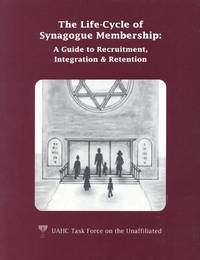
2005202232URJ-CCAR Commission on Outreach and Synagogue Community 2005. Paperback. New. New oversized softcover in printed wraps. 4vo. 10.94 x 8.5 x 0.71 inches Clean text free of marks or underlining. B&W illustrations. Includes supplementary sources and a bibliography. 143 pp.<br /> <br /> Fast shipping in a secure book box mailer with tracking. This idea book has been created to help congregations build their membership through recruitment integration and retention. Because we believe that this is a process and not a matter of programmatic suggestions alone we developed exercises for temple Boards of Directors and membership committees in addition to compiling lists of more practical suggestions for recruitment integration and retention. URJ-CCAR Commission on Outreach and Synagogue Community paperback
86483London 1863 Slim Hardcover. Red Cloth. Good Condition London, 1863 hardcover
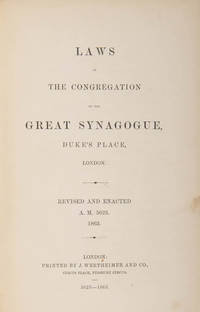
107120London J. Wertheimer and Co. printer 1863. . 8vo red publisher's cloth embossed with gilt title to front spine and corners rubbed. A very good copy. xx 72 pp.<br /> Revised edition published by 'The Wardens of The Great Synagogue' first edition published in 1827.<br /> London, J. Wertheimer and Co. (printer), 1863. hardcover
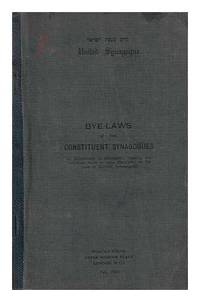
1936389840London : Head office of the United Synagogue 1936. Pre-publication edition. Softcover. Very good paperback copy; edges slightly dust-dulled and nicked. Remains particularly well-preserved overall; tight bright and clean. Pre-publication copy with manuscript and other annotations and revisions. Physical description; xxv 126 pp. ; 24 cm. Notes; On t.p.: ""The present text embodies all additions and other alterations made by the Council prior to 1st July 1936. A supplement is obtainable showing the variations made in these Bye-Laws in the case of District Synagogues"". Subjects; United Synagogue London England. London : Head office of the United Synagogue paperback
24786Israel: NP n/d. vg. Oblong quarto. Bolted blue faux-leather with inlaid b/w reproduction of a photograph of the exterior of the synagogue. Inside of front and back board lined in silk-moire. This unique album was presented to Mr. & Mrs. Harry Burston on occasion of their visit to Israel on October 1971. Printed presentation plates in English and Hebrew on title-page. Verso of title-page with 39 original signatures of guests who attended the reception at the synagogue on Nov. 1 1971. Album contains 14 original 4 1/4" x 6 1/2" glossy b/w photographs inserted on card stock. Each photo protected by tissue guard. One photo shows the exterior the rest is of the interior of the Synagogue and Cultural Center in Tel-Aviv. Photographs with captions in English and Hebrew. "In Eternal Memory: This building was built in Memory of the Jewish Communities in China by Igud Yotzei Sin in Israel. The construction of the building was possible thanks to the Administrator General and Official receiver of the State of Israel who handed over the proceeds received from the sale of the Synagogue in Shanghai and through the generous donations from the former residents of China in Israel and all over the world. The building was set thanks to the great devotion extended by the President of the Building Committee Mr. M. A. Zaigraeff. The inauguration of the skeleton of the building took place on the 20th August 1959. The inauguration of the opening of the building took place on 6th September 1961. Architects & Building plans: Mr. G. Rabinovitch Mr. A. Kahane Aron Kodesh." In 1951 a group of Jewish leaders from several communities of former China residents in Israel founded "Igud Olei Sin" which was later changed to "Igud Yotsei Sin." Small sticker of S. Sanzetti Photo Studio on inside of rear board. Minor age toning on title-page and on margin of card stock. Near fine condition. Unique copy. NP unknown
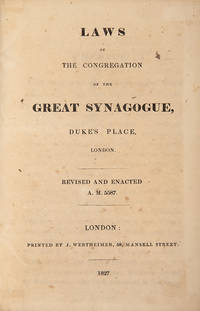
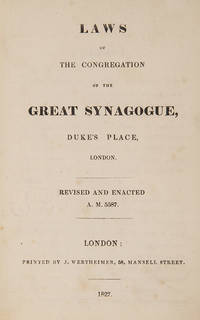
107591London J. Wertheimer printer 1827. . 8vo contemporary brown boards with pastedown text in Hebrew and English very worn. Some pages stained. xvi 82 7 2 81 xi pp.<br /> Scarce edition of the laws of The Great Synagogue.<br /> London, J. Wertheimer (printer), 1827. hardcover
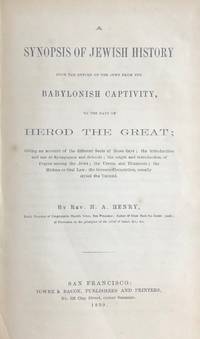
185940801San Francisco: Towne & Bacon 1859. 1st edition. Original gilt-stamped publisher’s cloth 12mo 187 pages. Greenwood California Imprints 1089; Singerman 1577. <br> Rare early San Francisco imprint for use in Synagogues and Jewish schools appearing just following the California Gold Rush. <br> The author was the "Rabbi Preacher of Congregation Sherith Israel San Francisco; Author of Class Book of Discourses on the principles of the belief of Israel &c. &c. " The work concludes with a three-page "Prayer in Behalf of the United States of America" which the author had initially delivered in Cincinnati. Scarce. <br> Congregation Sherith Israel was the first Jewish Congregation in San Francisco and the author Henry A. Henry was Congregation Sherith Israel's first rabbi.<br> A copy sold at auction in 2019 for $750 with buyer's commission. <br> OCLC: 1031393843. <br> Wear to base of spine otherwise Very Good Condition. B/1 KH-9-7-X. San Francisco: Towne & Bacon unknown
107151London J. Wertheimer 1827. . 8vo; text in English and Hebrew leaves slightly toned very occasional spotting; publisher's card boards title printed in black on covers covers detached but present heavy wear to spine corners worn; a fair copy.<br /> Scarce edition of the laws of The Great Synagogue.<br /> London, J. Wertheimer, 1827. hardcover
5221Printing in Hebrew. 23 pages. Small 4to orig. blue boards gilt border round sides contrasting pink endpapers a.e.g. Munich: C. Wolf 1826.<br/> <br/> The extremely rare printed program for the inauguration of the first public synagogue in Munich on 21 April 1826. The impressive neoclassical building on the Westenriederstrasse was designed and erected by Jean Baptiste Métivier for the small but important Munich community of court Jews and state suppliers founded in 1815. The project was supported by King Max I Joseph of Bavaria and his successor Ludwig I attended the ceremony with his wife and members of the nobility. <br/> <br/> Contemporary journals praised the festive character of the event. The inauguration speech was given by Hirsch Aub who became rabbi of the new synagogue through more than four decades. The director of the royal chapel and opera Joseph Hartmann Stunz and the royal intendant Johann Nepomuk von Poissl set prayers psalms and a long hymn to music. The instrumental parts were executed by the King’s musicians. The ceremony ended with the Ha-noten teshu’a a prayer for the welfare of the King and his family and the evening prayers for Sabbath and Pesach. <br/> <br/> Much printing in Hebrew. <br/> <br/> A crisp and large copy on thick paper. In fine condition from the Wittelsbach library of the dukes and kings of Bavaria. unknown