187 résultats
7 fogli (ciascuno di mm 188x235) su carta ritagliata con cura e con colorazione coeva. Si tratta di un teatrino ottico in miniatura con le tavole numerate 50-56+76 sul cartone che funge da camicia; è stato rifilato il margine inferiore che doveva riportare le scritte Cum Priv. S.C. Maj. - Mart. Engelbrecht excud. A.V,". La storia del diorama inizia con una elaborazione delle "vue d'optique" traforando particolari che, illuminando il retro in trasparenza, producevano l'effetto giorno-notte o, la modifica dell'immagine con l'arricchimento di personaggi o con la sostituzione del paesaggio di fondo. Le immagini, una volta modellate con cura a punta di forbice, divenivano delle autentiche "quinte" da inserirsi nell'apposito visore in legno, i cui nomi sono i più diversi: scatola ottica, teatro ottico o dioramico, pantoscopio, mondo nuovo, cosmorama, zoogroscopio, poleorama, aletoscopio. All'interno si potevano ammirare le scene illuminate ad effetto tridimensionale. Accanto a soggetti ispirati al teatro e all'opera appaiono danze, feste in villa, battute di caccia, giochi popolari. La scena, estremamente veritiera, raffigura una piazza di Strasburgo con il mercato ed ha la possibilità di inserire un doppio fondale: o un Teatro con attori che recitano o un'ampia via prospettica con carrozze, personaggi e sullo sfondo una Chiesa. Interessantissimo e non comune soggetto. Esemplare nitidamente colorato e in ottimo stato di conservazione, come raramente reperibile, soprattutto nelle parti ritagliate a punta di forbice.. .
6 fogli (ciascuno di mm 188x235) su carta ritagliata con cura e con colorazione coeva; conservati e montati in sequenza entro scatola di plexiglass. Si tratta di un teatrino ottico in miniatura con le tavole numerate 373-378 nel margine superiore; è stato rifilato il margine inferiore che doveva riportare le scritte Cum Priv. S.C. Maj. - Mart. Engelbrecht excud. A.V,". La storia del diorama inizia con una elaborazione delle "vue d'optique" traforando particolari che, illuminando il retro in trasparenza, producevano l'effetto giorno-notte o, la modifica dell'immagine con l'arricchimento di personaggi o con la sostituzione del paesaggio di fondo. Le immagini, una volta modellate con cura a punta di forbice, divenivano delle autentiche "quinte" da inserirsi nell'apposito visore in legno, i cui nomi sono i più diversi: scatola ottica, teatro ottico o dioramico, pantoscopio, mondo nuovo, cosmorama, zoogroscopio, poleorama, aletoscopio. All'interno si potevano ammirare le scene illuminate ad effetto tridimensionale. Accanto a soggetti ispirati al teatro e all'opera appaiono danze, feste in villa, battute di caccia, giochi popolari. In questa serie risulta di grande effetto l'infilata prospettica con in primo piano la struttura teatrale con simboli della Passione e sullo sfondo ballerini con corone floreali e musicanti . Esemplare nitidamente colorato e in ottimo stato di conservazione, come raramente reperibile, soprattutto nelle parti ritagliate a punta di forbice.. .
7 fogli (ciascuno di mm 188x235) su carta ritagliata con cura e con colorazione coeva . Si tratta di un teatrino ottico in miniatura con le tavole numerate 137-142 nel margine superiore; è stato rifilato il margine inferiore che doveva riportare le scritte Cum Priv. S.C. Maj. - Mart. Engelbrecht excud. A.V,". La storia del diorama inizia con una elaborazione delle "vue d'optique" traforando particolari che, illuminando il retro in trasparenza, producevano l'effetto giorno-notte o, la modifica dell'immagine con l'arricchimento di personaggi o con la sostituzione del paesaggio di fondo. Le immagini, una volta modellate con cura a punta di forbice, divenivano delle autentiche "quinte" da inserirsi nell'apposito visore in legno, i cui nomi sono i più diversi: scatola ottica, teatro ottico o dioramico, pantoscopio, mondo nuovo, cosmorama, zoogroscopio, poleorama, aletoscopio. All'interno si potevano ammirare le scene illuminate ad effetto tridimensionale. Accanto a soggetti ispirati al teatro e all'opera appaiono danze, feste in villa, battute di caccia, giochi popolari. In questa serie risulta di grande effetto l'infilata prospettica e la presenza delle varie maschere, dettagliatamente descritte, inserite in elaborate strutture architettoniche. Esemplare nitidamente colorato e in ottimo stato di conservazione, come raramente reperibile, soprattutto nelle parti ritagliate a punta di forbice.. .
7 fogli (ciascuno di mm 188x235) su carta ritagliata con cura e con colorazione coeva.Si tratta di un teatrino ottico in miniatura con le tavole numerate 113-118+118 nel margine superiore; è stato rifilato il margine inferiore che doveva riportare le scritte Cum Priv. S.C. Maj. - Mart. Engelbrecht excud. A.V,". La storia del diorama inizia con una elaborazione delle "vue d'optique" traforando particolari che, illuminando il retro in trasparenza, producevano l'effetto giorno-notte o, la modifica dell'immagine con l'arricchimento di personaggi o con la sostituzione del paesaggio di fondo. Le immagini, una volta modellate con cura a punta di forbice, divenivano delle autentiche "quinte" da inserirsi nell'apposito visore in legno, i cui nomi sono i più diversi: scatola ottica, teatro ottico o dioramico, pantoscopio, mondo nuovo, cosmorama, zoogroscopio, poleorama, aletoscopio. All'interno si potevano ammirare le scene illuminate ad effetto tridimensionale. Accanto a soggetti ispirati al teatro e all'opera appaiono danze, feste in villa, battute di caccia, giochi popolari. La scena, estremamente veritiera, è incorniciata da torrioni di un castello e presenta curiosamente un doppio fondale con cavalieri in combattimento oppure con le mura di una città che brucia. Interessantissimo e non comune soggetto. Esemplare nitidamente colorato e in ottimo stato di conservazione, come raramente reperibile, soprattutto nelle parti ritagliate a punta di forbice.. .
5221Printing in Hebrew. 23 pages. Small 4to orig. blue boards gilt border round sides contrasting pink endpapers a.e.g. Munich: C. Wolf 1826.<br/> <br/> The extremely rare printed program for the inauguration of the first public synagogue in Munich on 21 April 1826. The impressive neoclassical building on the Westenriederstrasse was designed and erected by Jean Baptiste Métivier for the small but important Munich community of court Jews and state suppliers founded in 1815. The project was supported by King Max I Joseph of Bavaria and his successor Ludwig I attended the ceremony with his wife and members of the nobility. <br/> <br/> Contemporary journals praised the festive character of the event. The inauguration speech was given by Hirsch Aub who became rabbi of the new synagogue through more than four decades. The director of the royal chapel and opera Joseph Hartmann Stunz and the royal intendant Johann Nepomuk von Poissl set prayers psalms and a long hymn to music. The instrumental parts were executed by the King’s musicians. The ceremony ended with the Ha-noten teshu’a a prayer for the welfare of the King and his family and the evening prayers for Sabbath and Pesach. <br/> <br/> Much printing in Hebrew. <br/> <br/> A crisp and large copy on thick paper. In fine condition from the Wittelsbach library of the dukes and kings of Bavaria. unknown
5221Printing in Hebrew. 23 pages. Small 4to orig. blue boards gilt border round sides contrasting pink endpapers a.e.g. Munich: C. Wolf 1826. The extremely rare printed program for the inauguration of the first public synagogue in Munich on 21 April 1826. The impressive neoclassical building on the Westenriederstrasse was designed and erected by Jean Baptiste Métivier for the small but important Munich community of court Jews and state suppliers founded in 1815. The project was supported by King Max I Joseph of Bavaria and his successor Ludwig I attended the ceremony with his wife and members of the nobility. Contemporary journals praised the festive character of the event. The inauguration speech was given by Hirsch Aub who became rabbi of the new synagogue through more than four decades. The director of the royal chapel and opera Joseph Hartmann Stunz and the royal intendant Johann Nepomuk von Poissl set prayers psalms and a long hymn to music. The instrumental parts were executed by the King's musicians. The ceremony ended with the Ha-noten teshu'a a prayer for the welfare of the King and his family and the evening prayers for Sabbath and Pesach. Much printing in Hebrew. A crisp and large copy on thick paper. In fine condition from the Wittelsbach library of the dukes and kings of Bavaria. hardcover books
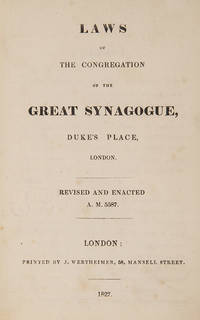
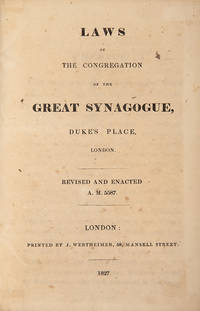
107151London J. Wertheimer 1827. . 8vo; text in English and Hebrew leaves slightly toned very occasional spotting; publisher's card boards title printed in black on covers covers detached but present heavy wear to spine corners worn; a fair copy.<br /> Scarce edition of the laws of The Great Synagogue.<br /> London, J. Wertheimer, 1827. hardcover
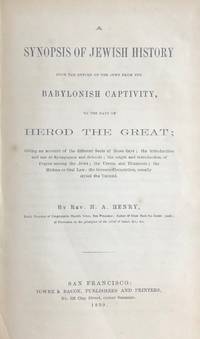
185940801San Francisco: Towne & Bacon 1859. 1st edition. Original gilt-stamped publisher’s cloth 12mo 187 pages. Greenwood California Imprints 1089; Singerman 1577. <br> Rare early San Francisco imprint for use in Synagogues and Jewish schools appearing just following the California Gold Rush. <br> The author was the "Rabbi Preacher of Congregation Sherith Israel San Francisco; Author of Class Book of Discourses on the principles of the belief of Israel &c. &c. " The work concludes with a three-page "Prayer in Behalf of the United States of America" which the author had initially delivered in Cincinnati. Scarce. <br> Congregation Sherith Israel was the first Jewish Congregation in San Francisco and the author Henry A. Henry was Congregation Sherith Israel's first rabbi.<br> A copy sold at auction in 2019 for $750 with buyer's commission. <br> OCLC: 1031393843. <br> Wear to base of spine otherwise Very Good Condition. B/1 KH-9-7-X. San Francisco: Towne & Bacon unknown
188671901886 Paris ED. Monnier, De Brunhoff et cie éditeur 1886 In4 format 32cmX22cm relié pleine toile bleue marine incrustée de bandes de toile beige et papier liège. reliure signée Armelle Guégant 114 pages nombreuses illustrations in et hors texte.
107591London J. Wertheimer printer 1827. . 8vo contemporary brown boards with pastedown text in Hebrew and English very worn. Some pages stained. xvi 82 7 2 81 xi pp.<br /> Scarce edition of the laws of The Great Synagogue.<br /> London, J. Wertheimer (printer), 1827. hardcover
24786Israel: NP n/d. vg. Oblong quarto. Bolted blue faux-leather with inlaid b/w reproduction of a photograph of the exterior of the synagogue. Inside of front and back board lined in silk-moire. This unique album was presented to Mr. & Mrs. Harry Burston on occasion of their visit to Israel on October 1971. Printed presentation plates in English and Hebrew on title-page. Verso of title-page with 39 original signatures of guests who attended the reception at the synagogue on Nov. 1 1971. Album contains 14 original 4 1/4" x 6 1/2" glossy b/w photographs inserted on card stock. Each photo protected by tissue guard. One photo shows the exterior the rest is of the interior of the Synagogue and Cultural Center in Tel-Aviv. Photographs with captions in English and Hebrew. "In Eternal Memory: This building was built in Memory of the Jewish Communities in China by Igud Yotzei Sin in Israel. The construction of the building was possible thanks to the Administrator General and Official receiver of the State of Israel who handed over the proceeds received from the sale of the Synagogue in Shanghai and through the generous donations from the former residents of China in Israel and all over the world. The building was set thanks to the great devotion extended by the President of the Building Committee Mr. M. A. Zaigraeff. The inauguration of the skeleton of the building took place on the 20th August 1959. The inauguration of the opening of the building took place on 6th September 1961. Architects & Building plans: Mr. G. Rabinovitch Mr. A. Kahane Aron Kodesh." In 1951 a group of Jewish leaders from several communities of former China residents in Israel founded "Igud Olei Sin" which was later changed to "Igud Yotsei Sin." Small sticker of S. Sanzetti Photo Studio on inside of rear board. Minor age toning on title-page and on margin of card stock. Near fine condition. Unique copy. NP unknown
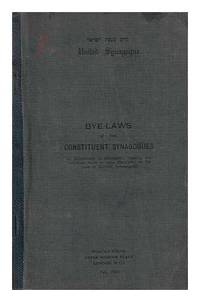
1936389840London : Head office of the United Synagogue 1936. Pre-publication edition. Softcover. Very good paperback copy; edges slightly dust-dulled and nicked. Remains particularly well-preserved overall; tight bright and clean. Pre-publication copy with manuscript and other annotations and revisions. Physical description; xxv 126 pp. ; 24 cm. Notes; On t.p.: ""The present text embodies all additions and other alterations made by the Council prior to 1st July 1936. A supplement is obtainable showing the variations made in these Bye-Laws in the case of District Synagogues"". Subjects; United Synagogue London England. London : Head office of the United Synagogue paperback
No Date (1899) . Cloth; 12mo. 59 pages. Singerman 5648, identifying the date as 1899. Contains six sermons: "Justice and Mercy," "The Day of Memorial " "The Call of Duty," "Repentance, Charity, Prayer," "The Triple Atonement," and "Be Strong " David Philipson (18621949) was a U.S. Reform rabbi .[H]e was one of the first group of rabbis who received their ordination in 1883. After serving as rabbi of Har Sinai Congregation, Baltimore, from 1884 to 1888, Philipson returned to Cincinnati to become rabbi of the B'nai Israel Congregation in 1888, remaining there for the rest of his life. Philipson participated in the conference which drew up the Pittsburgh Platform (1885); he was a rounder of the Central Conference of American Rabbis serving as president in 190709; and he was an influential figure in Hebrew Union College, where he taught for many years, and in the Union of American Hebrew Congregations .He was a member of the board of translators of the Jewish Publication Society for the translation of the Holy Scriptures (1916), an editor of Selected Writings of Isaac M. Wise (1900), and translator of Reminiscences of Isaac M. Wise (1901, 1945). An autobiography, My Life as an American Jew, appeared in 1942 and a volume of occasional writings, Centenary Papers, in 1919. Philipson verbalized and gave a universal dimension to the optimism of the prospering Midwest Jews among whom he lived and, surviving most of its exponents, came to be regarded as a representative spokesman of "classic" Reform Judaism (EJ). SUBJECT(S): Jewish festival-day sermons. OCLC: 9982516. OCLC lists 11 copies worldwide, none at any Ivy League Institution. Cover sunned; some editing marks, mostly in pencil. Bloch & CO. Bookp late affixed to inside front cover. Very good condition. (P-2-61)
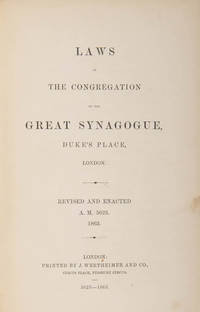
107120London J. Wertheimer and Co. printer 1863. . 8vo red publisher's cloth embossed with gilt title to front spine and corners rubbed. A very good copy. xx 72 pp.<br /> Revised edition published by 'The Wardens of The Great Synagogue' first edition published in 1827.<br /> London, J. Wertheimer and Co. (printer), 1863. hardcover
393 pages. "The first attempt to give a complete and comprehensive study of the Jew of Newport, picturing from the religious, economic, social and political points of view the entire colonial background with which the Jew identified himself." - From Preface. Includes 36 black and white illustrations, 11 appendices, notes, glossary, bibliography and index. Chapters include: The Dim Beginnings; Dawn; Progress; From Inquisition to Freedom; The Synagogue; A Glimpse of Jewish Life; Visitors; The Jew in the Community; Uproar, Dispersion and Decline; Evacuation and Revival; The Close of a Colorful Chapter; Noble Memories; Reconsecration; Adjustment; Immorality. Unmarked. Somewhat above-average wear to blue boards. Lettering worn from spine. Both hinges almost fully open. Tape protects top and bottom of spine. A fragile yet worthy copy of this excellent reference. Book
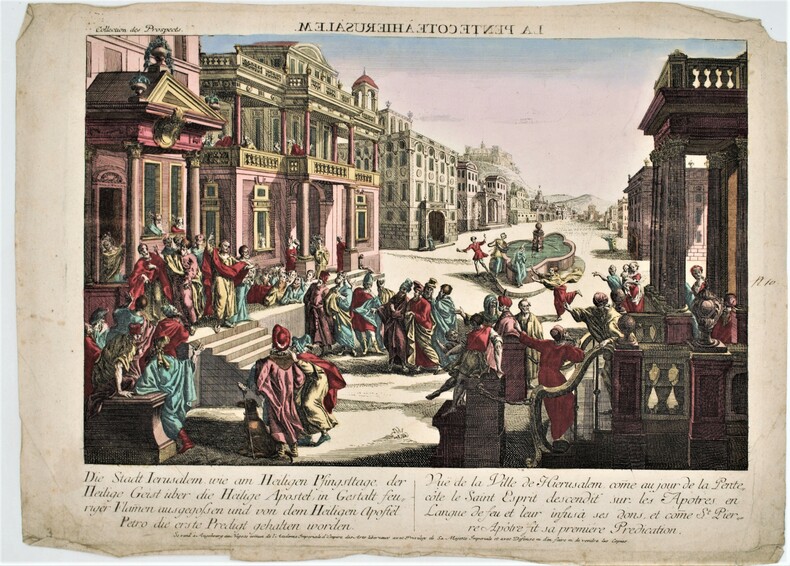
PHO-1302Augsbourg , Académie Impériale des Arts Libéreaux au Négoce commun de l'Académie Impériale d'Empire des Arts Libereaux ,dimension feuille 485x360 et impression 440x315 , verso blanc ,titre en miroir dans la marge supérieure : La Pentecôte a Hierusalem , manque de papier sans atteinte en haut.
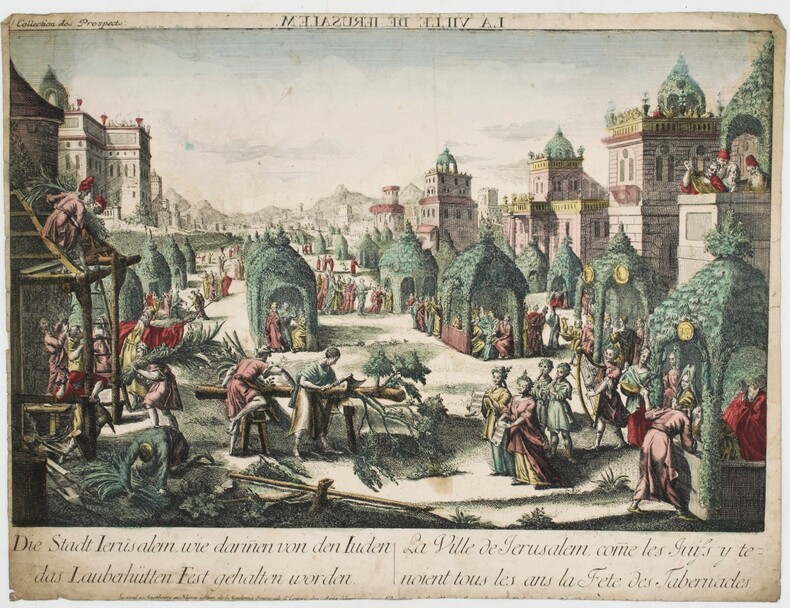
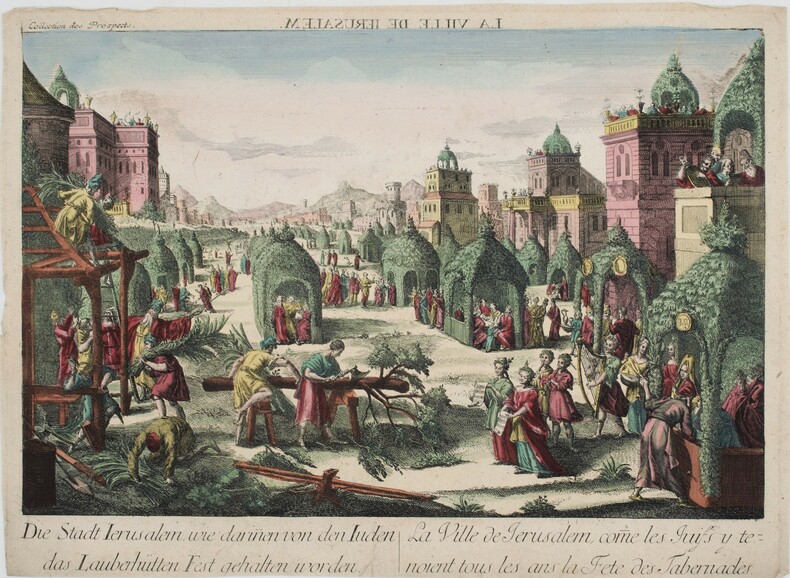
PHO-1301Imprimée à Augsbourg dans la « Collection des Prospects »,430x322mm , gravure en couleurs d’époque , verso blanc . Une belle vue de Jérusalem illustrant Souccot - également connue sous le nom de Fête des Tabernacles ou Fête des Cabanes.
PHO-1300Imprimée à Augsbourg dans la « Collection des Prospects »,430x322mm , gravure en couleurs d’époque , verso blanc, coupes courtes, bords légèrement salis Une belle vue de Jérusalem illustrant Souccot - également connue sous le nom de Fête des Tabernacles ou Fête des Cabanes.
86483London 1863 Slim Hardcover. Red Cloth. Good Condition London, 1863 hardcover
2652Utrecht, Guilielmus, 1698. 10,5x17 cm. 1 frontispice gravé + Préface + 544 pages + Index. Reliure de l'époque en plein parchemin. Dos lisse portant le titre calligraphié à l'encre brune. Reliure en partie désolidarisée du corps de l'ouvrage, cependant cahiers bien cousus entre eux. Petites traces d'usage sur la reliure, sinon ouvrage propre et de présentation agréable.
Signed by Abraham Arnold upon title page. 91 pages. "...A remarkable story and a fine collaboration between artist and historian." - from dust jacket. Contains sixteen wonderful colour illustrations. Light wear to clean and unmarked book. Above-average wear to price-clipped dust jacket which has been touched up and is now preserved in a glossy new archival-grade Brodart cover. Overall a nice copy of this lovely work. Bibliographic reference: Bishop p.1019. Book
18441254621844 Paris, Paul Mellier, Librairie-Editeur - 1844 - In-8 (22x14,5cm), demi-basane, dos lisse avec titre et auteur en doré, filets dorés horizontaux au dos, signet, frontispice, tranches mouchetées - XXXII-575 pages
193321864Paris, Plon, collection Byblis, 1933 ; in-8, chagrin maroquiné prune, dos à nerfs soulignés de filets à froid et dorés, titre doré, filet doré d'encadrement des plats, double filet doré d'intérieur, tête dorée, non rogné, couverture imprimée en orange et noir et dos conservés (rel. de l'époque) ; 208 pp., [4] ff. les 2 derniers blancs, 12 compositions hors-texte en couleurs, avec serpentes, de Manuel Orazi, y compris le frontispice.