311 résultats
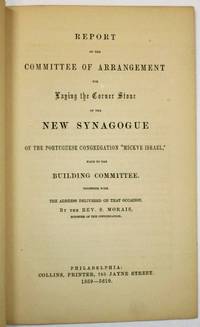
36315Philadelphia: Collins Printer 705 Jayne Street 5619. 15 1 blank pp. Stitched in original printed wrappers blindstamp and 'withdrawn' rubberstamp in blank upper portion of front wrapper. Else Very Good. <br/> <br/> Mickve Israel Hope of Israel one of the oldest Philadelphia synagogues was founded in the 1740s by Sephardic Jews. Known as the 'Synagogue of the American Revolution' its early members included Haym Solomon and the Gratz family. Benjamin Franklin contributed to its first building fund. This was its third building constructed on 7th Street north of Arch. Isaac Leeser presided over the congregation from 1829 to 1850; Sabato Morais succeeded him. Morais was its Rabbi for 46 years. <br/> The list of corner-stone and door-post purchasers included A.S. Wolf who purchased the North door-post of the north door for fifteen dollars in honor of H. Polock. Other luminaries of Philadelphia Jewry participated in the ceremonies. Wolf was treasurer and Gabay of the Congregation. Articles deposited in the cornerstone are listed including newspapers coins and tokens dated 1859 "A gold quarter dollar of California mintage being deposited by Clarence A. Hart aged 9 years." The Committee of Arrangement consisted of Edwd. S. Mawson Joseph L. Moss and Isaac J. Phillips. Rabbi Morais's discourse is printed. Morais an abolitionist and founder of the Jewish Theological Seminary of New York counsels "If there be pride in us if the vanity of exhibiting a more sightly structure than others possess impelled us to designate this place as our future Synagogue.let us then bury first such unholy feelings in the bosom of the earth." Also printed is a prayer in Hebrew composed by Morais. <br/>Singerman 1593. OCLC 21968693 6 U PA JTS Yeshiva U NYPL Hebrew Union Natl Lib. Israel as of October 2019. Collins, Printer, 705 Jayne Street unknown books
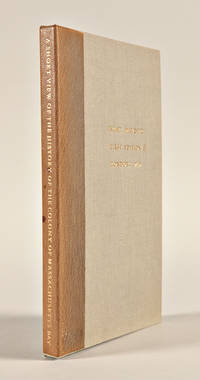
1769WRCAM44566London 1769. 271pp. Lacks the half title. Modern boards printed paper label. Modern bookplate on front pastedown. Internally clean. Very good plus. In a half morocco and cloth folder. First edition. Mauduit who was a Loyalist once the Revolution came firmly believed in the right of the British government to dictate to the colonies in general and Massachusetts in particular. "Strives to prove that this colony's charter was not exempt from Parliamentary authority" - Howes. Mauduit is perhaps best known for his REMARKS UPON GEN. HOWE'S ACCOUNT OF HIS PROCEEDINGS ON LONG-ISLAND IN THE EXTRAORDINARY GAZETTE OF OCTOBER 10 1776 London 1778. Only a handful of copies in ESTC. HOWES M431. AMERICAN CONTROVERSY 68-21a. SABIN 46921. ESTC T100618. hardcover books
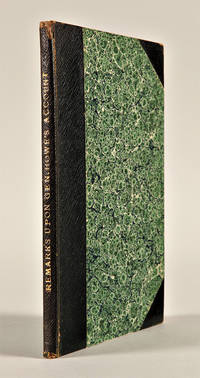
1778WRCAM11173London 1778. 454pp. Lacks the half title. 20th-century three-quarter green morocco and marbled boards spine gilt. Head of spine worn extremities rubbed. Minor foxing. Very good. Criticism of Howe's conduct in the Battle of Long Island wherein he refused to allow the entrenchments at Brooklyn to be attacked because of the element of risk. Mauduit gives a detailed analysis of the battle including the deposition of troops involved. AMERICAN CONTROVERSY 78-69a. HOWES M430 "aa." SABIN 46919. hardcover books
1983252169Paris: Armand and Georges Israel 1983. Limited Edition number 39. Suede. Very Good binding. Raymond Moretti. 16 lithographs by Raymond Moretti and an additional 13 illustrations and text laid in to a cream paper covered portfolio with title blocked in gold on the lid. Housed in a.suede clamshell box with copper plate after a Moretti illustration inset in the lid; title blocked in brown on the lid and gold on the spine. Very Good binding. Armand and Georges Israel unknown books
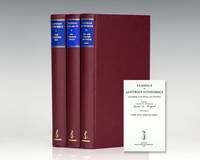
199463007London: William Pickering 1994. First editions of the collected works of the classics of Austrian economics. Octavo original cloth 3 volumes. Each volume is signed by Israel M. Kirzner on the title page. In fine condition. Edited by Israel M. Kirzner. William Pickering hardcover books
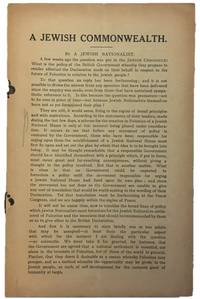
15910Three important writings from the first half of the 20th century on Zionism and the founding of the state of Israel. These documents chronicle some of the earliest support for establishing a Jewish state in Palestine and the growing Zionist movement as anti-Semitism spread in Europe between World War I and II. Includes:<br/><br/>"The Jewish Commonwealth" by Louis J. Gribetz a representative for the New York Zionist Organization c. 1918. Gribetz analyzes the earliest statement in support of Zionism from a major international power: the Balfour Declaration in which the British government issued a statement in support of a Jewish homeland. There are no copies of this document at any institutional collection worldwide as per OCLC Worldcat for this very rare publication. <br/><br/>A signed first edition of "The case for the Jews: An interpretation of their rights under the Balfour declaration and the mandate for Palestine" Louis J. Girbetz. New York: Bloch Publishing Co 1930. "The Case for the Jews" is an indictment of British rule in Palestine. This first edition was inscribed by the author to friend and fellow activist Louis Lipsky then-President of the Zionist Organization of America: "To a keen lucid fearless intelect - Louis Lipsky; whose name and will do honor to a great epoch in our history and will forever thrill and instruct - Louis J. Gribetz." Books signed by Gribetz are uncommon; and this copy's provenance is remarkable for its connection to two important leaders.<br/><br/>"The Jewish Problem a Report By the Executive Committee of the League of Nations Union Together with an Appendix Containing Suggestions Concerning Refugees Generally". London: League of Nations 1943. This final piece examines the fate of international Jewish Refugees during World War II; the report covers Jewish persecution and anti-Semitism in Europe a two-state solution in Palestine general recommendations for international refugee crises and details the "best solution" possible: creating a Jewish national home in Palestine. Minor rust to bindings of booklets. Light wear to extremities. All in good to very good condition. A remarkable collection following the earliest support for the state of Israel to the humanitarian crisis which prompted its founding amongst international support. unknown books
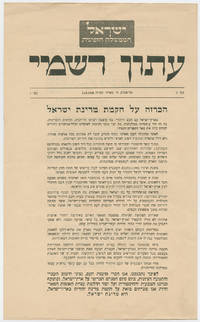
194825671.10<p>The first issue of the <i>Official Gazette</i> of the Israeli provisional government contains the first printing of "The Declaration of the Establishment of the State of Israel" the new nation's Declaration of Independence. The names of the 37 members of the Provisional Government who signed the document headed by David Ben-Gurion 1886-1973 are listed on the second page.</p> <b>ISRAEL.</b>Newspaper. <i>Iton Rishmi</i> <i>Official Gazette</i> May 14 1948. Bulletin. Tel Aviv Israel: Provisional Government of Israel. In Hebrew. 3 pp. 8 x 13 in.<p><b><br /></b></p><p><b>Excerpt:</b></p><p>"<i>WE EXTEND our hand to all neighbouring states and their peoples in an offer of peace and good neighbourliness and appeal to them to establish bonds of cooperation and mutual help with the sovereign Jewish people settled in its own land. The State of Israel is prepared to do its share in a common effort for the advancement of the entire Middle East.</i></p><p>"<i>WE APPEAL to the Jewish people throughout the Diaspora to rally round the Jews of Eretz-Israel in the tasks of immigration and upbuilding and to stand by them in the great struggle for the realization of the age-old dream - the redemption of Israel.</i></p><p>"<i>PLACING OUR TRUST IN THE "ROCK OF ISRAEL" WE AFFIX OUR SIGNATURES TO THIS PROCLAMATION AT THIS SESSION OF THE PROVISIONAL COUNCIL OF STATE ON THE SOIL OF THE HOMELAND IN THE CITY OF TEL-AVIV ON THIS SABBATH EVE THE 5TH DAY OF IYAR 5708 14TH MAY 1948.</i>"</p><p><b>Historical Background</b></p><p>After World War I Britain controlled Palestine by League of Nations mandate. By 1946 Britain was under pressure to withdraw from Palestine because of attacks by Arab militias and armed Zionist groups. A special United Nations committee recommended the immediate partitioning of Palestine into two states one for Arabs and the other for Jews with Jerusalem maintained by the U.N. as an international city. The General Assembly approved the proposal and the British announced they would leave Palestine on May 15 1948.</p><p>Members of the provisional government drafted the Declaration of the Establishment of the State of Israel and the provisional government voted in favor of it on May 12. They settled on final wording and held a Declaration ceremony in the Tel Aviv Museum on May 14. Twenty-five members of the Provisional State Council signed it that day and twelve more added their names later. One was out of the country and the other eleven were trapped in besieged Jerusalem.</p><p>The two rabbis in the provisional government argued for a including the draft phrase "and placing our trust in the Almighty" but a member of the secularist Mapam party strongly opposed it. Rather than including a direct reference to God the Declaration uses the phrase "Rock of Israel" in the final section which could refer either to God or to the land of Israel.</p><p>Other prominent signers include future Prime Minister Moshe Shertok Sharett 1894-1965 future Prime Minister Golda Myerson Meir 1898-1978 first Jewish mayor of Jerusalem Daniel Auster 1893-1963 future President Yitzhak Ben-Zvi 1884-1963 first Minister of the Interior Yitzhak Gruenbaum 1879-1970 first Minister of Finance Eliezer Kaplan 1891-1952 first Minister of Religions Rabbi Yehuda Leib Maimon 1875-1962 first Minister of Transportation David Remez 1886-1951 first Minister of Justice Pinchas Rosen 1887-1978 first Minister of Health and Minister of Immigration Haim-Moshe Shapira 1902-1970 first and longest-serving Minister of Police Bechor-Shalom Sheetrit 1895-1967 Communist Party of Israel leader Meir Vilner 1918-2003 and many other future members of the Knesset.</p><p>At midnight on May 14/15 1948 6 p.m. May 14 in Washington the British Mandate officially ended and David Ben-Gurion declared the establishment of the State of Israel. Eleven minutes later President Harry S. Truman recognized Israel on behalf of the United States. In the next few days Iran the Soviet Union and several other nations recognized Israel. Over the next few days after the declaration armies of Egypt Trans-Jordan Iraq and Syria engaged Israeli troops starting the 1948 Arab-Israeli War which ended ten months later with a substantial increase in the area governed by Israel.</p><p><b>Condition</b></p><p>Fine.</p> Provisional Government of Israel books
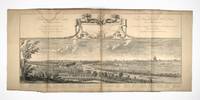
291568An assembled portfolio of eighteen 17th and 18th century engraved plans and plates relating to Paris. ~A true rarity in the portfolio is Israel Silvestre's 17th century "Vue General de Paris en Deux Feuilles". It is a magnificent panoramic view of Paris from the hill of Chaillot in two sheets. There is a third sheet with an elaborate cartouche and with flanking texts in Latin and in French. The "Vue General" in its two leaves is approximately 142 x 41 cm. to which the third sheet with cartouche adds an additional 15 cm. or so.~~This comment about Silvestre's "Vue General de Paris" is loosely translated from the Bulletin de la Societe d'Archaeologie de Lorraine Tome VI; Nancy: A. Lepage 1856; p. 135:~~Regarding the first sheet: "We see the Tuileries in the background of the first sheet; towards the middle the faubourg St. Honore and then the heights of Montmartre. In the foreground on the left there are three men two seated with the third who is without a hat leaning on a stick. In the middle of the print at the front are the houses of Chaillot and on the right the Seine."~~Of the second sheet: "In the background towards the middle we see the Invalides; on the left are the bell towers of Saint Germain des Pres Notre Dame and several other churches. The Observatory is on the right at the bottom. There Seine and land surrounding it are in the foreground." "It is a general view of Paris taken from the heights of Chaillot and drawn by Silvestre from the terrace of his house some time before his death. This view of Paris is very rare."~~At the bottom of the two sheets there are 45 numbered sites and buildings identified in Latin and French.~~There are two dampstains to the top sheet at the fold. ~Silvestre died in Paris in 1691. His Vue General is c. 1690.~~~~There is a complete set of Ten Plans of the City of Paris engraved by Coquart Nicolas de Fer and Delagrive and intended to illustrate Nicolas Delamare's Treaty of Police. The first eight plans accompanied Volume I in 1705. The last two are plans by Delagrive and accompanied the fourth volume of the Treaty of Police published after the death of Delamare in 1738.~It is uncommon to find all of the ten plans assembled together. Together they show the continuous growth of Paris from the Caesar's time Lutece to the beginning of the 18th century.~~Three plates follow: 1. L'Hostel de la Ville de Paris and 2. Statue of Louis XIV in Roman armor; engraved by Jean Frosne 1630-1676and 3. The Reception of Louis XIV at the Hotel de la Ville by Sebastian Leclerc 1637-1714.~~Four smaller plates mounted two to a leaf follow. They are engraved by Ballieul L'Aine mid-18th century.~The plates are: 1. Vue Geometrale de L'Illumination; 2. Vue Perspective de L'Ilumination de l Rue de la Ferronerie; 3. Decoration du Throne Eleve; and 4. Decoration du Salon Compose de Tranparents.~~The elephant folio is bound in marbled boards expertly rebacked with a new spine. There are several dampstains generally at the corners or folds. The binding is 64 x 42 cm. The largest of the plans of Paris is the Delagrive's elegant 1737 Neuvieme Plan de Paris 63 x 83 cm. unknown books
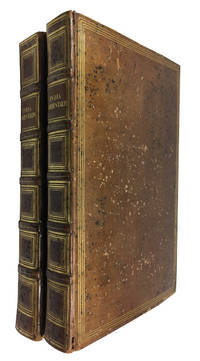
160690901Francofurti Pars Quarta Quinta et Septima. Francofurti ad Moenum Pars VI: Apud Matthaeum Becker Pars Quarta et Quinta Ex officina Wolfgang Richteri Pars VI Typis Wolffgangi Richteri Pars Septima 1606. 1st eds. Hardcover. Fair because of all the repairs trimming and reconstruction. 4 parts or volumes now bound in 2 volumes of the 12 parts or volumes which constitute de Bry's "Petits Voyages" on travels mostly to the East Indies and elsewhere in Asia Africa and the Middle East all of which were published between 1598 and 1628. Later leather probably 19th or early 20th century with joint tender and the appearance of shallow pitting. Armorial bookplate Henry Howard of Graystoke in both volumes as well as a later small nameplate "EHH" mounted on both bookplates. At some point the text and plates in these volumes were carefully and painstakingly repaired and reconstructed leaf by leaf from a damaged copy. A large percentage of the leaves have been trimmed mounted remargined etc. with some loss of text or portions of illustrations. The result is a serviceable copy with all illustrations and text appearing to be there often with some loss though not enough to say that anything is completely missing. Pencil notes on verso of free endpaper in first volume indicate that these volumes were purchased by our former owner from Blackwell's in Oxford in 1968. Latin text. <br/><br/> Apud Matthaeum Becker [Pars Quarta et Quinta], Ex officina Wolfgang Richteri [Pars VI], Typis Wolffgangi Richteri [Pars Septima hardcover books
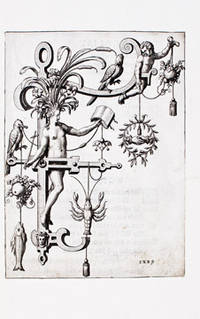
15751483181575. DE BRY Johann Theodor and J. I. DE BRY. Nova Alphati Effictio histories ad singulas literas correspondentibus et toreumate Bryanaeo artificiose in aes incises illustrate . Engraved title-page 24 elaborately engraved plates of letters all with grotesque Mannerist ornamentation. 4to. 325 x 212 mm bound by Rivière in full crushed brown morocco triple gilt fillet on covers floral gilt ornaments in corners spine with intricate floral tooling in compartments a.e.g. Frankfurt: De Bry 1595. First Edition of this celebrated and rare Renaissance Alphabet Book. "Elles représentent un grand Alphabet majuscule dont les lettres sont formées par découpures mouvementées ornées de figures de trophées d'oiseaux de fleurs et de fruits" Guilmard Les Maîtres Ornemanistes p. 368. The letters appear in uppercase and are embedded within elaborate ornamentation consisting of Biblical figures nymphs fauns musical instruments cherubs lovers insects fruits birds trophies fish lobsters flowers splendid entrelacs and luxurious arabesques. These extravagant illustrations are characterized by a disintegration of reality in which the forms have been redistributed in accordance with the fantasy of the De Bry brothers. The mixture of grotesque classical and symbolic imagery executed with supreme artistic bravado elevates this work to the pinnacle of published ornamental alphabet books. Each engraving is accompanied by a letterpress text in German and Latin on the verso where the subject matter is identified. The engravings are individually "signed" with "J.T.B. fe." A second edition of the work appeared at Cologne in 1613. The rarity of this first edition is attested by the recent facsimile of it Ravensburg 1997. No copies sold at auction as listed by ABPC; OCLC lists 7 copies in America at Houghton Morgan Library NYPL Walters Art Gallery RISD Newberry and the University of Virginia. There are also 7 copies listed in European institutions. This copy had the engravings cut out and mounted during the nineteenth century on large papier Hollande in a folio format. However the size of the cut-out sheets 195 x 150 mm remains fully intact; the folio sheets measure 325 x 212 mm. Some insignificant spots to interleaved sheets binding with minor rubbing to extremities. This copy lacks the two dedication leaves which includes the text to the letter A on the verso of the second leaf. A desirable copy nonetheless. PROVENANCE: Sir John Stirling Maxwell 1818-1878 with his private ex-libris his sale Christie's London 1958 Lot 59 and with the Nether Pollok "Arts of Design" ex-libris. Berlin Katalog 5281. Guimard Les Maîtres Ornemanistes p. 368 No. 38. Bonacini 292 "estremamente rara". Brunet I 1309. BMC German 161. See: Becker The Practice of Letters The Hofer Collection of Writing Manuals 1514-1800 for the 1596 German edition of Alphabeten. unknown books
161319332Frankfurt 1613. 10 parts in three volumes small folio. Collations below. A few plates shaved along the foredge. Contemporary calf the covers ruled and tooled in gilt spines gilt with raised bands and gilt morocco labels some wear to covers. Bookplates on front pastedowns an occasional blindstamp see below<br/> <br/>Provenance: Earls of Macclesfield<br/> <br/>The fine Macclesfield set of De Bry's 'Petit Voyages' in a contemporary binding. This work is essential to any serious collection of travel books.<br/> <br/>A complete set of the first ten parts of the first Latin edition of the Petit Voyages of De Bry one of the grandest collections of voyages published in the Age of Discovery with all of the hundreds of maps and plates as detailed below. This series of voyages devoted mainly but not entirely to the East Indies was issued concurrently with the same publishers' Grand Voyages which are primarily devoted to the Americas. The present set is without Part XI and XII the latter so rare that even Church lacked much of the text and the appendix to Part I also a legendary rarity. Both of these parts were issued by a different publisher in 1625 and 1628 long after the rest of the series. Almost all sets lack some plates and maps and assembling complete copies has been a passion of collectors since the beginning of the collecting of voyages in the early 19th century. A number of the maps and plates are also highly prized individually which has contributed to parts being disassembled. The Petit Voyages comprise probably the greatest single collection of material on early voyages to the East Indies and are unique in their extraordinary wealth of cartographical and visual material on Africa India the Spice Islands and South Asia. The De Brys' intention as publishers to present an illustrated record sets them apart from other textual voyage collections such as Ramusio or Hakluyt. Their works are a cornerstone of any serious library of travels and voyages. The collations of the parts in the present set agree with those given in Church for the first Latin editions of each part with parts III and IX being the second issues of the first edition. Full titles and bibliographical details can be found in Church. A summary of the parts and their contents follow: Part I Vera Descriptio Regni Africani 1598. First edition. Fourteen plates and two maps on three sheets. Fillipo Pigafetta's description of the Congo describing Odoardo Lopez' voyage there in 1578 probably the most important early description of central Africa. Church 205. Part II Pars Indiae Orientalis in qua Johan. Hugonis Linscotani navagatio in Orientem 1599. First edition. Thirty-nine plates three maps and portrait of Linschoten at the head of the preface. Linschoten's famous voyages to the East of 1583-92 were published by De Bry the year after they first appeared as a separate book. Church 207. Part III Tertia Pars Indiae Orientalis. 1601. First edition second issue without the map of Nova Zembla on the verso of plate 58. Sixty plates and three maps. In this copy the plates are bound before the text. The large folding map "Descriptio Hydrographica" shows the eastern hemisphere and the routes to the east around Africa. This is a highly important piece of cartography. The rest of Linschoten Cornelius de Houtman's pioneering voyage to the East Indies of 1595-97 instrumental in opening the spice trade to the Dutch and Gerit de Veer's voyage in search of a northeast passage in 1594-96 are included. The plates show scenes in the East as well as Veer's tragic experiences in Spitzbergen where his expedition was attacked by polar bears. Church 209. Part IV Pars Quarta Indiae Orientalis. 1601. First edition. Twenty-one plates image in plate 20 printed upside down. Linschoten and Houtman's voyages concluded and the voyage of Jacob von Neck and Wybrandt van Warwijck to the East Indies in 1598-99. As in the two previous parts most of the plates are scenes in the East Indies. Church 211. Part V Quinta Pars Indiae Orientalis. 1601. Sole edition first issue.Twenty plates. More material on Von Neck and the establishment of Dutch power in Bantam. Church 212. Part VI Indiae Orientalis Pars VI. 1604. Sole edition first issue. Twenty-six plates. Pieter de Maree's description of Guinea in 1600 and other early voyages to Guinea by the Portuguese Dutch and French. This whole section therefore relates to the Gold and Slave coasts of Africa and the growing European trading presence there which laid the foundation for the trans-Atlantic slave trade. Church 213. Part VII Indiae Orientalis Pars Septima. 1606. Sole edition first issue. Twenty-two plates. Joris von Spilbergen's voyage to Ceylon in 1601-4 and Gasparo Balbi's voyage to Pegu via Syria in 1579-88. This part is mainly devoted to India and Ceylon with excellent plates of the latter. Church 216. Part VIII Indiae Orientalis Pars Octava. 1607. Sole edition first issue. Eighteen plates. A collection of five Dutch voyages to the East Indies 1600-6 including trips to China and the Spice Islands all illustrating the rising Dutch power in the East. The plates show various military encounters and a famous double-page plate of Macao. Note that in this copy plate 13 a double-page plate is bound in between plates 11 and 12 i.e. on the verso of plate 11 and on the conjoined leaf. Church 218. Part IX Indiae Orientalis Pars Nona. 1612. First edition second issue. Seventeen plates. A world map appears on the supplementary title to the extra plates section. This part describes the voyage of Admiral Pieter Willemsz to the Spice Islands to seize them from the Portuguese written by one of the officers on the expedition. Church 221. Part X Indiae Orientalis Pars X. 1613. First edition. Three plates and three maps. This part is important on several accounts. The first section gives one of the first published accounts of Hudson Bay describing the explorations of Henry Hudson. The most important of these is the map showing Henry Hudson's explorations which was first published the year before by Hessel Gerritsz in Amsterdam. It is the first map of Hudson Bay and the adjacent country and is present here in a slightly reduced version of Gerritsz's map with the name of the island "Frisland" clearly engraved see Burden. The double-page map shows Hudson's Bay in the west and stretches all the way east to include Ireland and Iceland. Befitting Hudson's extensive explorations the coast line of Hudson Bay is quite detailed and accurate place names are noted and islands in the bay are shown. Hudson did make mistakes however in his charting of the southern part of the bay in a rectangular shape. "This map serves as the foundation piece to Canada's basic economic history. It served as the only functional chart to the northern regions of Canada for several decades and enabled the successful establishment of the Hudson Bay Company which was to dominate trade exploration and the economic development of Canada for a long time" - Kershaw. The second section of Part X of De Bry describes other voyages to the North by Linschoten while the third section relates to De Quiros and his supposed discovery of a new continent "Terra Australis Incognita." The other two maps relate to a search for a Northeast passage. Church 222. A rare opportunity to acquire one of the great monuments of early travel literature.<br/> <br/>Church as cited above. For the Hudson map: Burden 162; Kershaw Early Printed Maps of Canada 53b & pp.55-58; Schwartz & Ehrenberg p.94; Verner & Stuart-Stubbs The Northpart of America 29. unknown books