LIGNY (François de).Livre Rare Book
455 résultats
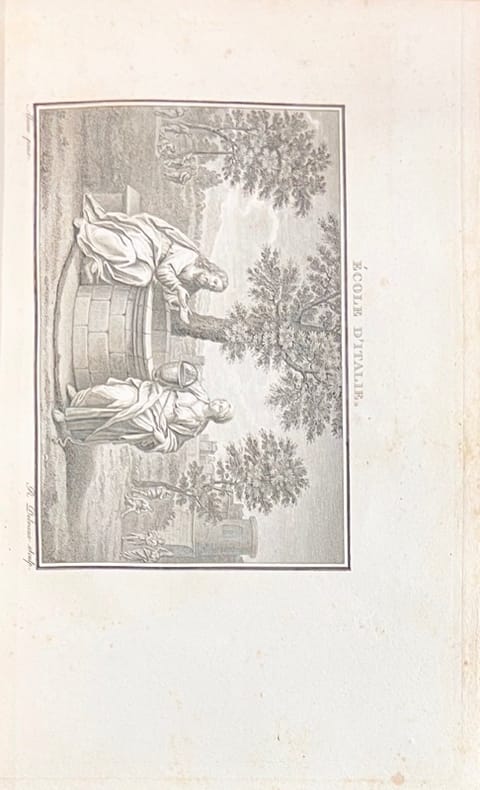
180412547A Paris, Imprimerie de Crapelet, 1804. 2 vol. in-4 de (4)-VIII-514 pp. 1 frontispice et 38 planches ; (4)-534 pp., 1 carte gravée dépliante, 1 frontispice et 34 planches, maroquin rouge à grains longs, dos à cinq nerfs minces orné de pointillés et feuilles, cadre à une roulette aux volutes florales sur les plats, filet strié sur les coupes et les coiffes, doublures et gardes de tabis bleu, tranches dorées (Rel. P. Bozerian jeune).
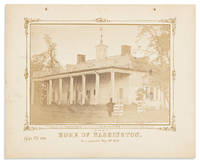
185932820595<p>Salted paper print 5 ¼ x 7 ½ in. on publisher's 8 ¼ x 10 ¼ inch mount with gold lithograph captions and decorative border. Neat punch holes in upper margin ½ inch adhesion at lower right faint pencil note in lower corner. Very good.</p><p><b>The earliest dated photograph of Mount Vernon this is one of the very earliest known photographs of George Washington's home.</b></p><p>By this time Mount Vernon was badly dilapidated. This view from the northeast shows ship masts propping up the portico's sagging roof where several columns had rotted away. A man wearing a dark suit and top hat stands in the foreground his arm on a white painted fence protecting a small tree.</p><p>The Mount Vernon Ladies' Association formed in 1853 purchased the mansion and estate from Washington's descendant John Augustine Washington III for $200000. After an intensive fund raising effort and protracted negotiations the organization took possession on February 22 1860 nearly one year after this photograph was made. Extensive renovations were soon made. As a result this image shows a number of architectural and landscape elements differing from those seen in photographs of the 1860s.</p><p><b>Rare. The other known examples are at the Fred W. Smith National Library at Mount Vernon and at the Getty Museum.</b></p> H.E. Hoyt & Co.
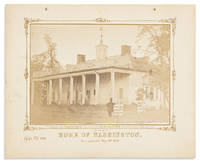
185932820670<br /><br /><br /><p><b>The earliest dated photograph of Mount Vernon this is one of the very earliest known photographs of George Washington's home.</b></p><p>By this time Mount Vernon was badly dilapidated. This view from the northeast shows ship masts propping up the portico's sagging roof where several columns had rotted away. A man wearing a dark suit and top hat stands in the foreground his arm on a white painted fence protecting a small tree.</p><p>The Mount Vernon Ladies' Association formed in 1853 purchased the mansion and estate from Washington's descendant John Augustine Washington III for $200000. After an intensive fund raising effort and protracted negotiations the organization took possession on February 22 1860 nearly one year after this photograph was made. Extensive renovations were soon made. As a result this image shows a number of architectural and landscape elements differing from those seen in photographs of the 1860s.</p><p><b>Rare. The other known examples are at the Fred W. Smith National Library at Mount Vernon and at the Getty Museum.</b></p>Salted paper print 5 ¼ x 7 ½ in. on publisher's 8 ¼ x 10 ¼ inch mount with gold lithograph captions and decorative border. Neat punch holes in upper margin ½ inch adhesion at lower right faint pencil note in lower corner. Very good.<br /> H.E. Hoyt & Co.
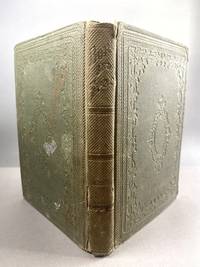
186110077<p>Extraordinary copy owned by another previously enslaved American who found his way to freedom.</p><p>Israel Campbell born in Kentucky in 1815 spent the first decades of his life as property of several owners before after several attempts escaping slavery to Canada. He later spent twenty-four years in Texas where he became known as the <em>"</em><em>Father of Black Texas Baptists" </em>having reorganized the African Baptist Church at Galveston the first completely independent black Baptist congregation in Texas. Campbell self-published this book to raise funds to free his three children from slavery:<em> "Three</em><em> of my children are yet in the land treading the wine-press and making bricks without straw. And as time rolls on I see the oppressor's rod becoming heavier and the shackles becoming tighter and tighter around them and my heart yearns for them and my prayers are often and earnest for their liberation"</em> iii. He mentioned the risks of attempting to liberate them<em>".few know the danger the suffering or the peril of such a course until they have passed through its experiences"</em> iv while also believing it would not be the moral way of gaining freedom. Campbell discusses trying to work and save up enough money without financial help<em>: </em><em>"I might by hard labor in some mechanical occupation gain after many years enough to buy their freedom. should I have</em> preferred <em>the former plan their hairs might become gray while I was trying.</em><em>"</em>iv. Campbell's intention of writing this book is to not only tell the story of his life honestly without elaboration <em>"Let facts speak for themselves.</em><em>"</em> but to primarily raise enough funds to buy his children out of slavery: "<em>I expect to devote the proceeds of the sale of this book; by which I consider that I am not only gaining their liberty but am placing before the world the truest picture of the South and its institutions- both the dark and the bright side"</em> VI.</p><p>Most likely the copy of George W. Price Jr. with the signature <em>"</em><em>Geo. W. Price"</em>in pencil to front fly & with <em>G. W. PRICE</em> stamped in purple ink below. An additional <em>Price</em> stamp to rear of frontis & an erased visible only under high magnification "Geo. W. Price's Book / cost $1.00" to top of title page see image 7.</p><p>In 1862 Price Jr. 1843-1901 escaped slavery and joined the United States Navy. After emancipation he served in the North Carolina legislature from 1869 to 1872 first in the House of Representatives 1869-1870 and then in the Senate 1870-1872. He and his father George W. Price Sr. 1810-1882 were leading ornamental plasterers in Wilmington North Carolina having both learned their trade as enslaved artisans and worked on buildings such as the Bellamy Mansion. After the Civil War Price jr. continued to practice his trades as well as working in politics.</p><p>Green pebbled cloth. Wear to head and tail of spine with some loss of cloth to the top and bottom of hinges; occasional staining and thumbing; gatherings at pages 163 to 206 standing a little proud nonetheless an exceptional copy.</p><p>Unaccountably scarce with no auction records & with but three original copies v-a-v multiple later held in institutions. The Library of Congress does not have a copy.</p><p>5.25 x 7.25 in 13.5 x 18.5 cm</p> Published by the Author hardcover
18499341London, Moon, 1842 - 1849. 6 Bde. 3 Bll., 30 S., 21 Bll.; 23 Bll.; 2 S., 18 Bll.; 2 Bll., 8 S., 21 Bll.; 22 Bll.; 24 Bll. mit 120 Textabb. 3 Frontisp., 6 Titel, 1 Porträt, 118 Tafeln (alles in getönter bzw. farbig getönter Lithographie von Louis Hague), 2 Kupferkarten. Gr.-Fol. OHLdr. (restauriert, fleckig, Rücken mit ergänzten Fehlstellen).