107 résultats
18211015808vo leather spine label gilt lines on spine 184 pp. Top hinge cracked some minor wear to extremities volume slightly bent small hole through pages 7 and 8 some slight foxing but internally generally bright and clean. This is a collection of short biographies of notable Quakers who passed away between 1783 and 1820.While much of the text appears to talk about the personal challenges these people faced some comments are directed at their works with others including native Americans. Solomon W. Conrad,
1821090QSolomon W. Conrad Philadelphia: 1821. 1821 184 p. Text damp stained and aged. Sm. 8vo. Disbound. Early manuscript ownership of John Lester. PA 60 Rt Stk Language: eng. No Binding. Good. Solomon W. Conrad, Philadelphia: 1821. unknown
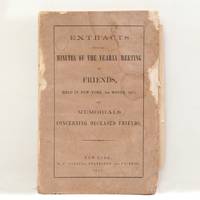
185228314New York: R. Craighead Printer 1852. 26 pp. 1 vols. 8vo. Original green printed wrappers. Some soiling and staining of wrappers light spotting and marginal staining of text some gnawing of edges else very good. 26 pp. 1 vols. 8vo. From the collection of the Seaman family of Glen Cove and Westbury Long Island and Woodbury Falls New York who were longtime members of the Society of Friends. <br/><br/> R. Craighead Printer unknown
1781003539Dublin: Robert Jackson 1781. Hardcover. Very Good. xxiv 186 p.; 17 cm. Signatures: A-H12 I6 K4 -K4 12mo. Contemporary full speckled calf; six spine compartments between raised bands. Gilt-tooled leather label in second compartment with title "Gough's Life." Small paper label in first compartment with number "17." Blind-tooled decoration on board edges. Printed label on front fixed endpaper for Aimwell School Library. In 1796 the Society for the Free Instruction of Female Children was established in Philadelphia by three Quaker women. The name Aimwell School was adopted in 1807. The first edition of the memoirs of the English Quaker schoolmaster and author James Gough 1712-1780. Includes the author's An Epistle to Friends in All Parts of Ireland p. 159-184. In Very Good Condition: edges rubbed; minor loss at head of spine; old dampstaining to fore-edges; light foxing throughout; otherwise clean and tight. Robert Jackson hardcover
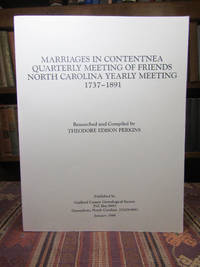
1988049389Greensboro North Carolina: Guilford County Genealogical Society 1988. First Edition First Printing . Soft cover. Very Good. 4to - over 9¾ - 12" tall. Quarto. 561 pages. Soft cover bound in grey wrappers. Light wear to the binding; the spine has the title hand-written on it. A sound copy and clean within. <br/> <br/> Guilford County Genealogical Society paperback
1988045426Greensboro North Carolina: Guilford County Genealogical Society 1988. First Edition First Printing . Hardcover. Near Fine. 4to - over 9¾ - 12" tall. 4to. 561 pages. Hardcover bound in black buckram with original tan wrappers bound in. Light wear to the binding. A sound copy and clean within. <br/> <br/> Guilford County Genealogical Society hardcover
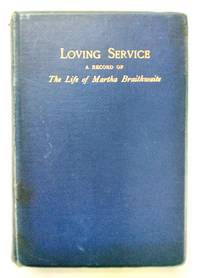
18961723<p>8vo Good Gilt Titles on Front Page Blue Boards HB No DJ. Edges turned in Pages Foxed Marks to Back Cover Watermark to endpapers with previous owner sig and inscription. Tissue transparency on title page. 296pp</p> Headley Brothers hardcover
1797004161New York: Isaac Collins 1797. Hardcover. Very Good -. xii 2 360 p.; 18 cm. Contemporary full calf with six spine compartments between gilt rules; leather label in second compartment with gilt-tooled title "Journal of Job Scott." Early American Imprints ser. 1 Evans 32810. Howes S-228. Old inscription running vertically on front board. Inscriptions on endpapers and blank adjacent leaves containing family records for former owner Samuel Davis 1766-1809 his wife Sarah Leedom Davis 1764-1806 Ruth Anna Davis 1801-1846 presumably their daughter her husband William Chandler 1787-1878 and their 10 children. Burials are noted as being "at the Valley" at Kennett Square and at Union Hill. Written in upper part of title page: "Friends' Boarding Haus Kennet Square Pa." Job Scott 1751-1793 was an American Quaker travelling minister. In Very Good- Condition: leather is rubbed; minor loss at spine ends; light soiling throughout; some page corners creased; a solid copy. Isaac Collins hardcover
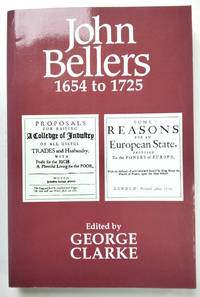
19931672<p>VG Softback volume featuring the life times and writings of the Quaker visionary. 293pp with index ISBN 185072136x ~ 16.00 ~ John BellersThe Improvement of Physicik Quakers Society Of Friends Immorality Raising a College Of Industry ~ Religion</p> Sessions Book Trust paperback
19311696<p>A biography of the life of the early Quaker preacher and member of the Valiant Sixty whose deathbed statement many of the Society Of Friends have today taken to heart. Rare volume Good 8vo Browwn Boards HB previous owner sig on endpapers No DJ. Pages foxed and ends indent but good for its age. 323pp with index ~ 115.00 ~ George Fox James Nayler Valiant Sixty Quakers Society Of Friends ~ Religion</p> Ernest Benn hardcover
181863305Catskill & Newburgh NY: J.S. Lewis and Co. U.C. Lewis Printer 1818.` 12mo. xii 13-144 pp. Contemporary mottled calf gilt ruling on spine wear scuffing to spine fore-edges some at joints light uniform interior toning w/o flyleaves front & back still VG- copy w/ ownership of Elias W. Price Elizabethtown NY w/ note on rear pastedown to “bring this home when you get done the piece you are writing.†Second American edition with 20 additional pages of material of this combination teacher’s edition and instructional volume following up his very popular “English Reader†and “English Grammar†originally written in the 1790’s for a local Friends’ School for Girls in York England. Before the Revolutionary War Murray 1745-1826 maintained a successful legal practice and although having grown up amongst Quaker communities in Pennsylvania North Carolina and New York his grammars and readers proved wildly popular in both Great Britain and the United States although this Catskill NY imprint is quite uncommon. Worldcat locates only microfilm and computer file online copies of this American edition. J.S. Lewis, and Co., U.C. Lewis, Printer, unknown
1828415545Richmond Indiana: no publisher 1828. Softcover. Very Good. First edition. Octavo. 26pp. Stitched self-wrappers. Age-toned light dampstain and creases at the edges of some of the leaves near very good. Quaker's report including sections of the care of Native Americans and freed Africans. no publisher] unknown
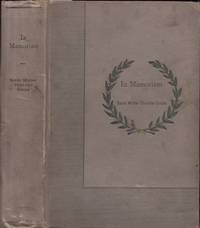
189936486Kansas City: Hudson-Kimberly 1899. Hardcover. Fair. Octavo. 191 pages. Illustrated with photographs. Gray cloth hardcover with title and illustrated wreath on the front cover. Title on the spine. Some shelf wear and light soil to the binding. Both hinges were broken and glued. Text block is secure untrimmed and not shaken. Interior contents are clean. Fair only. <br /> <br /> Inscribed by the editor on the right front flyleaf "For Mr. and Mrs. Larsney With Kind regards. Laura Coates Reed. John Lindley Coates. Arthur Chandler Coates. May 1899 all names written in same hand." Underneath the inscription is a pencil bame of Mitchell Behen. Located ihe upper left corner of the front paste down is a small label "Library of Mitchell Behen." Folling the title page is a tipped card "Compls. of Mr. Homer Reed."<br /> <br /> Contents include moving from Pennsylvania the Civil War a trip out west and more. From find a grave:<br /> <br /> Social Reformer. Headed a local Woman’s Suffrage Club for several years and was a personal friend of Susan B. Anthony. She served on many boards and helped found a group that became the Missouri Federation of Women’s Clubs. She was born in Pennsylvania. Her husband Kersey Coates was also born in Pennsylvania and practiced law there. He moved to the area that became Kansas City Missouri about 1854 where he was a director of a railroad partner in a bank and a real estate investor. He developed the bluffs on the west side the area that became known as "Quality Hill". During the civil war he was with a Pennsylvania unit of the Union Army. Union troops in Kansas City stabled their horses in what was the foundation of the coming Coates House Hotel that had been boarded over. His hotel opened about 1868. In January 1978 there was a large fire in the building killing 16 people. It was very cold at the time and the water being used accumulated on a hook and ladder truck causing the frame to break from the weight. The building was restored and still stands today at the corner of 10th & Broadway in downtown Kansas City Missouri. Hudson-Kimberly hardcover
0953970604.Gpaperback. Good. Access codes and supplements are not guaranteed with used items. May be an ex-library book. paperback
1390660311.Gpaperback. Good. Access codes and supplements are not guaranteed with used items. May be an ex-library book. paperback
186135341Philadelphia: William W. Moore 1861. Hardcover. Fair. Quarto. 1 viii 832 pages. Marbled paper covered boards with leather corners. Leather spine with title. The boards are very worn. Most of the paper on the back cover is missing. Leather spine is rotted dried and cracked. Light toning and scattered foxing to the contents. Last few pages are damp stained and soiled. Fair only. <br /> <br /> Contents include 52 issues covering parts of 1860 and 1861. Article headings include Africans in Key West recaptured from the Slavers; Cotton Spinning; The Slave Trade; A Journal of the Life of John Gratton; Thoughts on Emigration; Origin and Introduction of Railroads Into America; Slave Statistics; and much more. William W. Moore hardcover
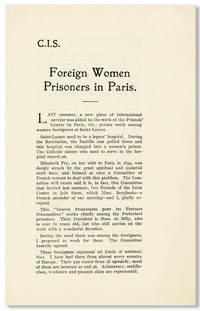
192526813London: Friends' Council for International Service 1925. Offprint. Octavo 20.5cm.; bifolium. Fine. <br /> <br /> "The efforts for pressing reforms in the women's prisons of Paris to which Garda Kappenburg has devoted all her time have at last been crowned with success. A committee has been formed of which the Dean of The Faculty of Law Monsieur Barthelemy is Honorary President and Mr. Donnedieu de Vabre Professor of Criminology actual President. A well known lawyer and a woman barrister are secretaries. The scheme of reform worked out at the instance of Garda Kappenburg and afterwards in the course of several personal interviews submitted to the Minister for Justice Pierre Laval seems to have met with complete success." 1925 Annual Report of The American Friends Service Committee. Article first published in the World Outlook Section of The Friend March 1925. Gerda Kappenburg De Hass's dedication to prison reform and the reduction of criminal behaviour through attacking root causes like poverty and lack of social mobility clearly knew no bounds and her unique determination achieved considerable results. Currently there is only a single institutional holding in a US institution NYPL. Friends' Council for International Service unknown
2009044728Philadelphia PA: Quaker Pr of Friends General 2009. First Edition First Printing . Hardcover. Near Fine/Very Good. 8vo - over 7¾ - 9¾" tall. 8vo. 548 pages indexed. Hardcover in blue dust jacket. Light wear to the jacket. The text is clean. Contains some illustrations. <br/> <br/> Quaker Pr of Friends General hardcover
189528317Philadelphia: Published for the Yearly Meeting 1895. 127 pp. 1 vols. 8vo. Original printed wrappers stapled postmark on upper cover. Some light soiling and wear to wrappers and edges else very good. 127 pp. 1 vols. 8vo. From the collection of the Seaman family of Glen Cove and Westbury Long Island and Woodbury Falls New York who were longtime members of the Society of Friends. <br/><br/> Published for the Yearly Meeting unknown
185728319New York: B. F. Corlies Stationer and Printer 1857. 31 pp. 1 vols. 8vo. Original printed wrappers. Spine and fore-edge damaged some gatherings loose marginal tear on p. 15 affecting only a letter or so some soiling and staining of wrappers and text generally light else very good. 31 pp. 1 vols. 8vo. From the collection of the Seaman family of Glen Cove and Westbury Long Island and Woodbury Falls New York who were longtime members of the Society of Friends. <br/><br/> B. F. Corlies, Stationer and Printer unknown
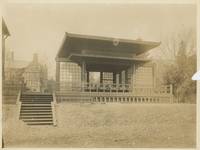
1910List2847Bryn Mawr Pennsylvania; and others 1910. Eleven photographs approximately 7 x 9 ½ inch and smaller. With stamps for Brown Brothers Illustrations Bureau and E.J. Reily verso; most with captions verso. Most with chipping and wear at edges; overall good. Open-air schools became popular in the United States in the early 20th century in response to public health crises including tuberculosis.1 Conducting lessons in open-air classrooms reduced the transmission of diseases which allowed many children to attend school despite their often chronic illnesses. Offered here are eleven photographs of open-air schools three of which are identified as the Phebe Anna Thorne Model School at Bryn Mawr.<br /> <br /> The Phebe Anna Thorne Model School opened in 1913 under the direction of the College’s president Carey Thomas using funds donated by Samuel Thorne in memory of his sister Phebe Anna.2 The Thornes were an affluent New York Quaker family; Phebe Anna 1828–1909 was the only daughter to survive to adulthood and was a philanthropist and supporter of progressive social causes.3 <br /> <br /> The school was part of Bryn Mawr’s Department of Education which trained its students in teaching younger pupils rather than those of highschool or college age – the students in most of these photos are probably in about 4th or 5th grade.3 It also allowed testing of more cutting-edge pedagogical practices: the structure of the school was quite experimental including open-air classrooms outdoor naptime a flexible curriculum and less formal assessment. <br /> <br /> Of interest to scholars of the history of education especially experimental pedagogy.<br /> <br /> 1 Sherman C. Kingsley & F.B. Dresslar “Open-Air Schools†Department of the Interior Bureau of Education Bulletin 23 1916.<br /> 2 Cornelia Meigs What Makes a College A History of Bryn Mawr The MacMillan Company 1956.<br /> 3 Olive Floyd Phebe Anna Thorne: Quakeress Privately Printed in Rye New York 1958. unknown
20041648<p>VG/FINE Softback Volume a new edition of the 1973 volume collecting a multitude of Quaker sources together to illustrate the relationship of early Friends with God. 622pp with index ~ 71.50 ~ George Fox Quakers Society Of Friends Pendle Hill Swarthmoor Margaret Fell ~ Religion</p> Pendle Hill Publications paperback
1871000472London Eng: F. Bowyer Kitto 1871. First Edition. Very Good -. London: F. Bowyer Kitto; Carlisle: Chas. Thurnam and Sons. vii 3 208 p.; 20 cm. Reddish-brown pebble-grain cloth with gilt-stamped spine title and black-stamped decoration of both boards. Pale yellow endpapers. Binder's label on back fixed endpaper for Westleys & Co. London. Front free endpaper bears the names of two former owners: Thomas Drewry 1871 and Jesse Darbyshire 1901. A third name was erased at the head of that endpaper. The author states that about one third of these biographical sketches of early English Quakers first appeared in the Carlisle Journal. This is the first edition in book form. The appendix contains relevant excerpts from Besse's Sufferings. In Very Good- Condition: spine sunned; somewhat cocked; cover is slightly soiled; edges lightly rubbed; pp. 1-16 partially detached; pp. 154-55 have a shadow in the gutter from former newspaper bookmark; a few pencilled marginialia and occasional soiling in the margins. F. Bowyer Kitto unknown
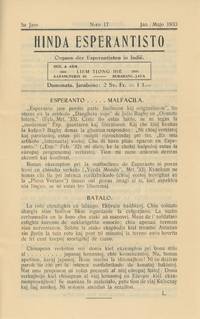
1947List2844Austria; Java Indonesia; London England; and Los Angeles California 1947. Sixteen pieces: two “Friends’ Esperanto Society†bulletins 8 x 12 ½ inch each; two letters 8 ½ x 11 inch each; seven “Hinda Esperantisto†pamphlets 5 ½ x 8 inch four pages each; two “Declaration†forms 4 x 6 inches; one BES pamphlet 4 ½ x 6 inches eight pages; one set of tickets for membership information 2 x 5 inches missing one tear-off ticket and one “Universala Ligo†membership card for 1947 3 x 4 ½ inches. Folded; some chipping and tearing at edges. Overall excellent to near fine. Esperanto is an artificial language created by Polish physician Ludwik Zamenhof 1859–1917 in 1887. Zamenhof intended Esperanto to be a universal second language; his experiences growing up Jewish in the Russian Empire among Russian Polish German and Yiddish speakers—all of whom regarded each other at best with suspicion—led him to believe that an easily-learned neutral second language could by contrast inspire unity between all people. Offered here is a small collection of materials related to various Esperanto societies: the “BES†a Czech group the Universal Esperanto Association the Friends’ Esperanto Society the Esperanto Club of Los Angeles and Hinda Esperantisto – “Indian Esperantist†based in Java Indonesia.<br /> <br /> These materials written largely in Esperanto note that most quotes herein are translated are mostly typical club bulletins advertising events announcing members’ news and reminding the reader of upcoming fees. The BES pamphlet besides advertising its Adresaro member directory solicits donations for a “living monument to Esperantoâ€â€”a headquarters—to be built in PotÅ¡tejn in Czechia<br /> <br /> “in the shape of a five-pointed star which would become a real home for all those who love goodness beauty health truth and progress. The stone-like majestic white building will shine brightly in a beautiful circle from a moderate slope and the fragrant forest behind it will form a charming background.†1932<br /> <br /> This utopian vision was likely prevented at least in part by the Nazi occupation of the country. Esperanto speakers including Zamenhof’s family in particular were among their many targets. The effort to purge the universal language from Europe was clearly not successful; a postwar letter from a language teacher in Austria to a gentleman in California included in this collection notes that the Californian’s address had been printed “in the magazine ‘Die Weltsprache’†– that is “The World Language†February 14 1947.<br /> <br /> Esperanto’s egalitarian and pacifist aims form a large part of its appeal to Quakers. It is unclear whether the Friends’ Esperanto Society which authored two of the items in this collection is the same as the Kvakera Esperanto-Societo which was founded in 1921 and is still active. The March 1935 bulletin announces the F.E.S.’s annual meeting at Friends House in London the headquarters of the Religious Society of Friends in Britain. An obituary for Wilson Henry Sturge the Society’s Vice President remarks on “his desire for international friendship and understanding through Esperanto†March 1935. The January 1936 bulletin calls members to petition their local Registrar of Education for Esperanto to be taught in high schools a request echoed by the Universala Esperanto-Asocio’s declaration form calling on the United Nations to “help to spread the use of this language in every possible way†including supporting its teaching in schools in order “to facilitate communication between the peoples of the world and to promote social progress.â€<br /> <br /> George R. Thompson’s letter to the Los Angeles Esperanto Club as its President strikes a similarly idealistic tone. He gives Club members his “Decalogue†finishing with an exhortation to: “10. Fix our eyes directly on our dear goal the universal brotherhood of humanity and global peace – through linguistic mutual understanding†August 1 1933.<br /> <br /> “Hinda Esperantisto†written by Liem Tjong Hie is somewhat more polemical. Its announcements include news from the Manchurian Federation of Esperantists who proposed to make Esperanto the region’s official language and “to abolish the English language†Jan-May 1933. It criticizes “the European progressive writers†especially the Hungarian Esperantist Kálmán Kalocsay for making the language more difficult for learners. Liem also writes mysteriously:<br /> <br /> “The world does not know that the Belgian Esperanto Institute dir. Frans Schoofs Antwerp is a physically rotting company. The shamelessness of the leaders is shown by the fact that they are so heroic in victimizing distant people knowing that they cannot do anything against them. A black mark to the apparent reputation of the leaders!â€<br /> <br /> These pamphlets also include side-by-side Indonesian and Esperanto blurbs including a review of a new book for Malaysian Esperanto learners – Esperanto caught on quickly in Asia where it still enjoys widespread popularity. <br /> <br /> Of interest to Esperantistoj and historians of Esperanto. unknown
191028312New York 1910. 1 vols. 4to. Grey printed board string for hanging at top. Some soiling and wear to corners else very good 2. 1 vols. 4to. From the collection of the Seaman family of Glen Cove and Westbury Long Island and Woodbury Falls NY who were longtime members of the Society of Friends. ¶ Accompanied by an illustration showing the FRIENDS' MEETING HOUSE IN NEW YORK & Seminary ca. 1910 some spotting and light soiling.¶ Also accompanied by two issues of the "FRIENDS' INTELLIGENCER" dated 28 March 1903 and 30 March 1921. <br/><br/> unknown