IBN BATOUTAH , DEFRÉMERY , SANGUINETTILivre Rare Book
322 résultats
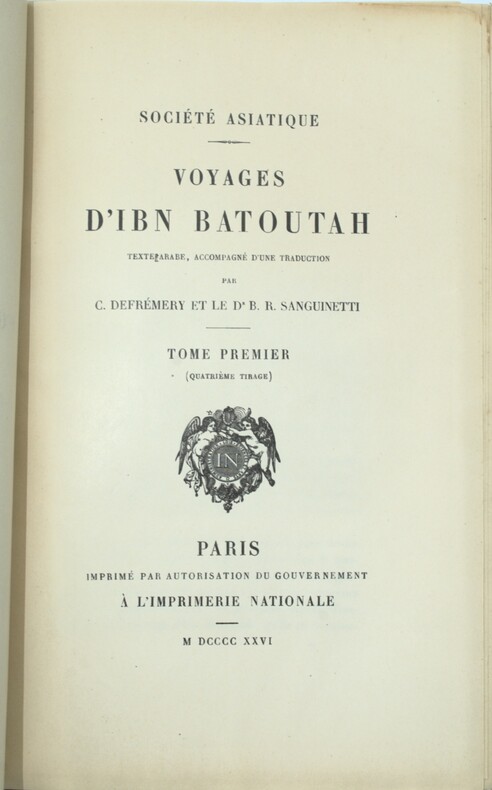
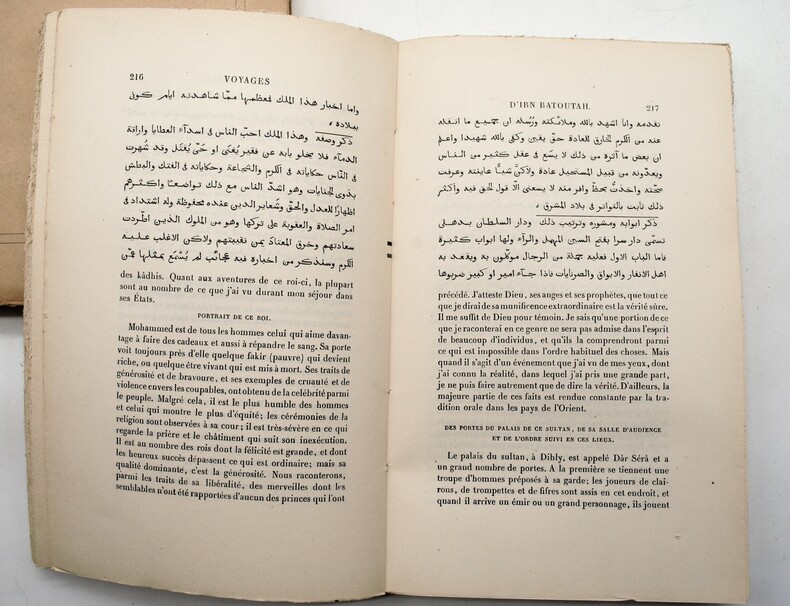
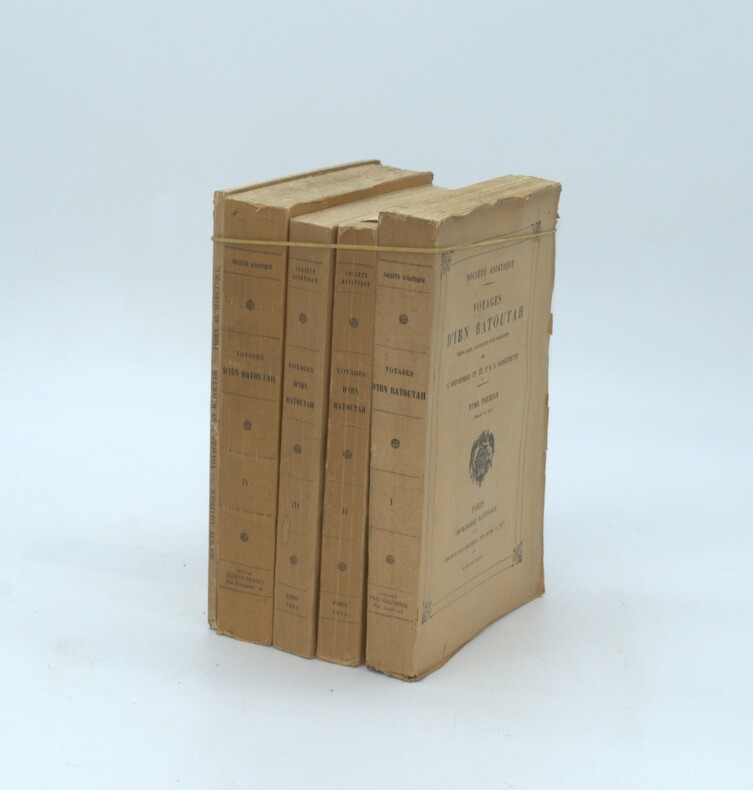
PHO-1451A l'Imprimerie Nationale, Paris, Ernest Leroux et Paul Geuthner Éditeur, 1922-1949. . Édition bilingue: Texte arabe avec traduction française en regard. 5 volumes In-8° de: Tome I (4e tirage,1927) 2ff-XLVI & 443pp. Tome II (5e tirage,1949), XIV & 465 pp. Tome III (5e tirage, 1949), XXVI & 476 pp. Tome IV (4e tirage, 1922), 479 pp. Le Tome V, constitue l'index ,(3e tirage , 1927) 91 pp.. Broché avec couverture éditeur ,non coupé .
1824PHO-2191Paris, Everat, 1824, in-4 (260x210mm), 2ff-LIV-568pp-1ff , avec en fin d’ouvrage la liste des membres de la Société de Géographie, relié demi toile, dos lisse avec étiquette de titre, éditeur et tomaison, frottements aux plats et étiquette usée, vieille mouillure claire en coin, piqures.
1826PHO-1339Paris, Imprimerie Royale, 1826-1827. 2 volumes grand In-8°(sur 3 , manque tome 1), de VII, 577pp. ; VIII, 596 pp. , demi-chagrin , dos ornés avec auteur ,titre et tomaison , initiale en pied , plat frottés , coins usés , pages de garde brunies , tache au titre (tome 2).
1921148161921. Unpublished sepia-toned photograph of pilgrims journeying to Mecca circa 1921 documents the material and spatial realities of the Hajj in the early twentieth century during a period of geopolitical transition in the Arabian Peninsula following the First World War. The image captures a vast encampment of white tents set against a rugged and mountainous landscape outside Mecca visually conveying the scale of pilgrimage infrastructure prior to modern urban expansion. Created during the years immediately preceding the establishment of the Kingdom of Saudi Arabia in 1932 the photograph supports research in Islamic religious practice the history of pilgrimage logistics and British imperial observation of the Hejaz during the inter war period.<br /> <br /> Photograph. Circa 1921. Approximately 3.5 x 5 inches. Sepia-toned silver gelatin print. The composition presents thousands of white tents clustered across uneven terrain forming a temporary city of pilgrims undertaking the religious journey to Mecca. The mountainous backdrop situates the encampment geographically within the arid environment surrounding the holy city. The photograph originates from the album of a British naval officer who traveled in the region between 1920 and 1923 providing contemporaneous visual documentation from a foreign observer during a time of shifting political authority in the Hejaz following the collapse of Ottoman control. The image appears unpublished and retains the intimate scale characteristic of personal travel albums.<br /> <br /> As a visual record predating large-scale modernization of pilgrimage facilities the photograph preserves evidence of early twentieth-century Hajj organization material culture and environmental conditions. The presence of an extensive tent city underscores both the enduring continuity of Islamic ritual practice and the logistical complexity of pilgrimage prior to the oil-era transformation of the region. Light age-related curling; minor chipping at lower edge not affecting the image area; surface otherwise clean with strong tonal range. Overall good condition. A historically significant early twentieth-century photograph documenting the lived landscape of pilgrimage to Mecca during a pivotal moment in Arabian political history. unknown
14816Unpublished original sepia toned photograph of pilgrims journeying to Mecca circa 1921. Measures 3.5x5". The original photograph depicts the rugged and mountainous landscape outside of Mecca where thousands of white tents form an encampment of pilgrims making their religious journey. The photo comes from the album of a British naval officer who traveled the region between 1920-1923 and witnessed these events. Photo has some age related curling and some chipping to the bottom that does not affect the image. In overall good condition. unknown books
14571Antique engraving of the Kaaba and Masjid Haram in Mecca titled: "View Of The Temple of Mecca" accompanied by "Plan Of The Temple of Mecca" circa 18th century. Size: 8" x 12." The engraving illustrates at its center the Kaaba and the surrounding domed structures as it was in 1700's. There are 2 images on this foldout plate the first is an aerial plan of Mecca and the second is a view of the Kaaba with 100 Muslims praying in the outside court. Unmounted and unframed with traces of original fold. This image is different from the above plate and was included in 18th century books including the Al Coran de Mahomet of Du Ryer. With some aged related toning and folds present. An important print in very good condition. unknown books
1922PHO-1362A l'Imprimerie Nationale, Paris, Ernest Leroux et Paul Geuthner Éditeur, 1922-1949. . Édition bilingue: Texte arabe avec traduction française en regard. 5 volumes In-8° de: Tome I (4e tirage,1927) 2ff-XLVI & 443pp. Tome II (4e tirage,1914), XIV & 465 pp. Tome III (4e tirage, 1914), XXVI & 476 pp. Tome IV (4e tirage, 1922), 479 pp. Le Tome V, constitue l'index ,(3e tirage , 1927) 91 pp.. Broché avec couverture éditeur ,tome 1,4 et annexe non coupé , étiquettes au dos et cachets (tome 2 et 3) , manque au dos tome 3.
1922PHO-1091A l'Imprimerie Nationale, Paris, Ernest Leroux et Paul Geuthner Éditeur, 1922-1949. . Édition bilingue: Texte arabe avec traduction française en regard. 5 volumes In-8° de: Tome I (4e tirage,1927) 2ff-XLVI & 443pp. Tome II (5e tirage,1949), XIV & 465 pp. Tome III (5e tirage, 1949), XXVI & 476 pp. Tome IV (4e tirage, 1922), 479 pp. Le Tome V, constitue l'index ,(3e tirage , 1927) 91 pp.. Broché avec couverture éditeur .
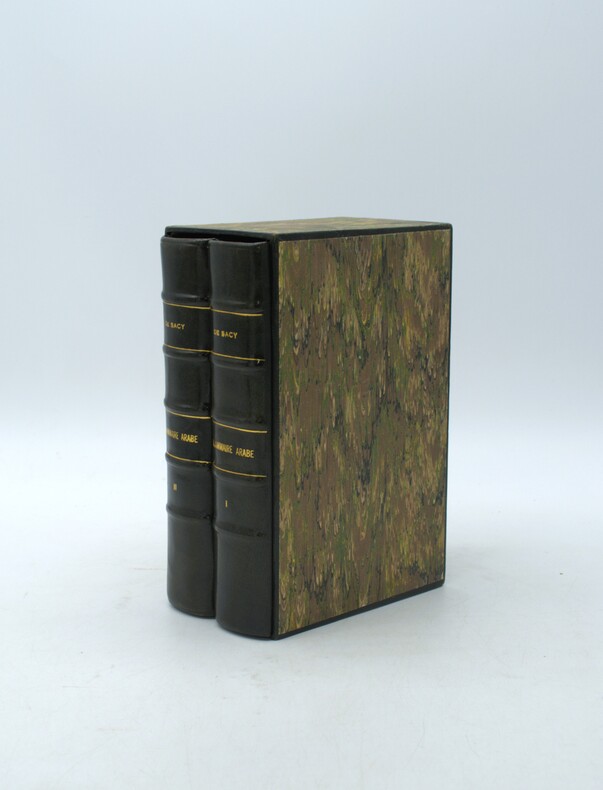
1810PHO-2229Paris, Imprimerie impériale, 1810, 2 volumes in-8 (22,5x15,5cm), xxvi-434pp.-1f (catalogue), x-473pp.-1f (catalogue suite). Demi chagrin et coins moderne dans un coffret, dos à nerfs avec auteur, titre et tomaison, brunissures sur les premières et dernières pages, travail de vers sur les 3 premiers feuillets de chaque tome renforcé, petit travail de ver en pied. Complet de ses 10 tableaux dont 9 dépliants, manque les 8 gravures de lettres arabes
39703Paris,Desaint & Saillant.Amsterdam.1754. In-12 dans une reliure de l'époque.Avertissement et 215 pages. Reliure en veau moucheté avec dos orné de caissons fleuris et pièce de titre.Bon exemplaire.Coiffe supérieure accidentée avec mors légèrement fendus.Mors inférieur avec trou de vers.Tranches rouges.
1829PHO-1340Paris, 1829 , imprimerie Royale , in-8 , X-519 pp.-164 pp. ,catalogue in fine, relié demi cuir époque , dos lisse avec auteur et titre , initiales en pied , coins et coupes usés , frottements aux plats , quelques rousseurs , pages de garde bruni.
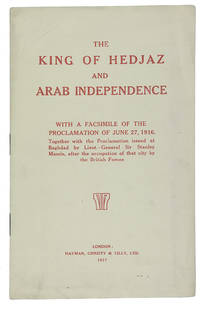
1917F14GSQ01U79OLondon: Hayman Christy and Lilly Ltd. 1917. Original stapled wrappers with red lettering on front wrapper. 8vo. With a photographic portrait of Hussein bin Ali for frontispiece and a folding facsimile proclamation 38 x 28 cm. British pamphlet advertising the independence of Hedjaz from Ottoman rule. The pamphlet includes a facsimile of the proclamation in Arabic pronouncing the Arab peoples free from Turkish domination an introduction about allied involvement the Monroe Doctrine and its role in the region and more basic history behind the eventual writing of the proclamation.Some minor traces of use. In very good condition. Hayman, Christy and Lilly Ltd., unknown
Very Good Turkish, Ottoman (1500-1928) Original wrappers. Foolscap 8vo. (17 x 12 cm). In Ottoman script (Old Turkish with Arabic letters). 152 p. Roumi: 1324 = Gregorian: 1906. Taken from a volume including multiple books. Spine is restored. A very good copy. First and only edition of this early and extensively rare book including a first-hand account of the topography and descriptions of Hejaz, Mecca, and other parts of Arabian Peninsula such as Taif and Yemen by Sadiq Sherif, who was the first person to take photographs of Mecca, Medina, and the Hajj in 1880 and 1881 as well. Sadiq Sherif was the grandson of Serif Abdulmuttalib, the Emîr of Mecca. This book written by Sherif was dedicated to 'the Progress and Union Society' [i.e. Ittihad ve Terakki Cemiyeti]. The book describes the way of administration and territorial division of Hejaz after giving some information of its geography, borders, tribes and natives, mountains, rivers, crops and products, and animals of this Ottoman 'vilâyat' [i.e. province]. Sherif gives detailed information on how and when the Ottoman Empire ruled Hejaz, the location of Mecca city, its borders, physical and social geography, crops in Mecca and around, its flora, fauna, demographic structure, 'nahiyes', Kâba's construction, and its history, sacred places around, Masjid-i Haram and other masjids, cemeteries, mountains, gifts by Ottoman caliphs to Kaba, 'Taif' area, people who were 'Emîr' of Mecca from the period of Mohammad, Wahhabism and its birth, etc. At the last, Sherif gives place to his personal letter (layihâ) including 49 articles. The letter was about the reforms that Hejaz needs and it was sent to the Ottoman 'sadâret' [i.e. prime ministry]. (Source: History of geographical literature during the Ottoman Empire, Edited by Ihsanoglu). Muhammad Sadiq Sherif Bey was the first person to take photographs of Mecca, Medina, and the Hajj in 1880 and 1881. Sadiq Bey trained as a military engineer after completing his studies in Cairo and at the École Polytechnique in Paris. It is not known when, or from whom, Sadiq Bey learned to take photographs but it was most probably through one of the resident photographers in Egypt. In 1861, prompted by the need to carry out more extensive military land surveys of the area between Wajh and Medina, Sadiq Bey made his first journey to Arabia. He took a camera along with his surveying equipment and took his very first photographs of Medina. In a series of articles published in the Egyptian Military Gazette in 1877, he refers to his early photography at Medina describing the use of a 'photographia'. Sadly, however, none of the photographs from this first journey has survived. In 1880 he was appointed as the treasurer of the Mahmal, the ornate cloth to cover the Ka'ba brought each year on a special litter to Mecca. He accompanied the Mahmal to Medina and Mecca from September 1880 until January 1881. Again equipped with his camera, he succeeded in producing the series of photographs that are now considered some of the earliest known photographs of the region, those of the Ka'ba, taken under great secrecy. Sadiq Bey published various accounts of his travels in Arabia in military journals, through the Emiry Grand Press in Cairo, but the 1880/81 series of photographs appear to have been issued separately for wider distribution through the Société Khédiviale de Géographie. The society's secretary, Dr. Frederic Bonola, advertised sets of photographs for sale. In January and April 1880 Sadiq Bey gave a talk and report to the society on his earlier 1861 expedition, and on 20 May 1881 he presented a report on his recent journey to Mecca; detailed accounts were published in the society's bulletins, numbers 9/10 and 12. (Source: Christie's). Özege 11888.; Karatay, TM II: 695.; MKAHTBK, II: 991.; OCLC 248374684 / 4082352.
Very Good Turkish, Ottoman (1500-1928) In contemporary fine black 1/3 leather bdg. Decorated gilt to spine. Roy. 8vo. (23 x 16 cm). In Ottoman script (Old Turkish with Arabic letters). 112 p. Extremely rare first edition of this Nabi's first-hand account of Mecca, Medina and the Hejaz during his pilgrimage in the late 17th century. This is the most celebrated literary pilgrimage narrative written in Ottoman Turkish. Nabi (1642-1712) was one of the prominent Ottoman poets and is considered a foremost exponent of the didactic trend (hikem-i tarz) in Ottoman Turkish literature. Nabi, whose given name was Yusuf, was born in Urfa (then known as Ruha) in 1052/1642. In 1082/1671 he took part in the Ottoman military campaign in Poland, in the retinue of Müsahib Pasha, (1640-1686). Having spent thirteen years in Istanbul, Nabi desired to go on a pilgrimage to Mecca. He was personally ready to undertake a journey to the Hijaz and to set down an eloquent account of his journey, the experience of his lifetime. Accordingly, having achieved a position of good standing with his patrons, Müsahib Mustafa Pasha and Mehmed IV, Nabi revived his longstanding desire to perform the hajj. In 1089/1678, at around 37 years of age, he set out in a small private caravan from Istanbul, passing through Konya, Urfa, Damascus, Jerusalem and Cairo, where he joined the main Egyptian pilgrimage caravan. The work, which is one of the most successful examples of Ottoman insa (artistic prose), includes historical, sociological, geographical and autobiographical information. In his preliminary remarks, Nabi indicates that he had received governmental help for his journey. He relates that he first obtained leave for the hajj from his patron Musahib Mustafa Pasha, and then submitted a qasida to Mehmed IV, describing the sacred places. The sultan provided Nabi a letter of recommendation addressed to Abdurrahman Pasha (d. 1691), governor of Egypt, ordering him to enable Nabi to make a comfortable journey. Nabi traveled in a small private caravan, since the caravan extended its route to Nabi's homeland, Urfa, and spent about fifty days there. It appears that he generally followed the usual route of the pilgrimage caravan from Istanbul to Damascus, passing through Scutari, Kartal, Gebze, Hersek, Iznik, Eskisehir, Seyitgazi, Aksehir, Ilgin, Ladik, Konia, Eregli, Adana, Misis bridge, Payas, Antioche, Aleppo (with a long detour to Urfa (Edessa) and back to Aleppo via Aintab), Hama, Hims and the Kuteyfe strait. He was fascinated with the splendid architecture of the buildings, the bazaars and the mosques built side by side by Kurdish and Circassian rulers and the Nile when he arrived in Cairo. Nabi gives a general description of the city of Cairo, the Nile, the two reservoirs of the city, parklands, the Ahram hills and the immediate neighborhood of the city. In Mecca, Nabi visited the sacred sites enthusiastically and performed the hajj on 77 January 1679. He gives a moving account of his experience as a pious emotional pilgrim. It appears that Nabi stayed in Mecca for more than twenty days. Immediately after 1 Muharrem 1090/12 February 1679, he set out for Medina, presumably in the Damascus caravan. While in Medina, Nabi served at the tomb of the Prophet by lighting the candles since his name was on the honorary list of attendants who were determined by the central government to serve the sanctuaries in Mecca and Medina. Nabi regards these services as a testimony to the legitimacy of Ottoman rule. He summarizes his journey of return from Medina to Damascus and to Istanbul in a few general words. Özege 21267.; Not in OCLC.
Very Good Turkish, Ottoman (1500-1928) Contemporary 1/3 leather bdg. with cloth spine. Leather boards. Restored. Demy 8vo. (22 x 15 cm). In Arabic. [138] p. Slightly chipped extremities of papers. Occasionally stained on pages, wear on binding. Text is fine. Including 'kataba'. The routine, predictable, yet exhaustive nature of the journey Ottoman pilgrims endured may have discouraged them from recording their journeys. The route was relatively well-defined, and the caravan orderly and well-protected. Moreover, Ottoman pilgrims, unlike Christian travelers, were traveling across the lands of the same state, thus seeing people of the same Muslim culture, without needing to speak different languages, use different currencies, or negotiate borders between states. The uniqueness and peculiarity of a journey would motivate the traveler to record it and the result would be of interest to an audience. As for the Ottomans, if the texts which were composed to help future pilgrims with practical information are excluded, the majority of known narratives, are written by those authors such as Ahmed Fakih, Fevri, Evliya Çelebi, Nabi, and Shaikh Sinan er-Rûmî who undertook at least some parts of their journeys independently of the official caravan. Texts which seem to have been intended simply to provide practical information either on the stations or on the rites of the hajj or on both are defined as guidebooks. These texts appear not to be based on a particular pilgrimage journey, regardless of the fact that their authors might have performed the hajj. This manuscript starts with 'Bayân al-Menâzil Beyt Al-Sam wa al-Qabah' [i.e. Descriptions and stations from Damascus to Mecca] including a very detailed routes' list with their times hour by hour. 40 routes and hours probably by mounts and/or walking between Damascus and Mecca, Qaba. Other chapters of the text include rites and routes like "Farziyyat of Hajj, Ihram, Mukhrima, entry to Mecca-i Muqarrama, tawaf, Sa'y between Safa and Marwa, Arafat in Mecca, Muzdalifa from Arafat, Ef'al in Mina, Umra, Taawaf al-Vedâ, Qabr-i Sharif in Medina al-Munawwara, etc. Sheikh Sinan Al-Roumi's manasik al-hajj is one of the most important and famous ones in the hajj literature of the Islamic world. It was a mostly used reference book among Muslim pilgrims, especially in the Ottoman world. Calligrapher and copied by Ahmed b. Muhammed b. Suleyman. Text in black ink and important headings in red ink on paper with 'ahar'. A fine paper suitable for calligraphy. A very good example from the first half of the 18th century.
In-8°, (30 cc) compreso ritratto, antiporta e frontespizio, pp. 272, 4 carte ripiegate, legatura in pelle con titolo al dorso. Prima edizione. La prima parte di questo lavoro, intitolata Compendium theologiae mohammedicae arabice et latine, è un'edizione in arabo, con traduzione, di una piccola opera simile al Mukhtasar di Abû Suj ed è probabilmente la prima edizione stampata di un'opera islamica così essenziale in Occidente . La seconda parte è il contributo più importante di Reelant per una migliore comprensione dell'Islam in cui si propone di correggere molte credenze popolari con citazioni dal Corano e da altre fonti arabe. In-8°, (30 cc) including portrait, frontispice and title page, pp. 272, 4 engraved folded plates, binding in calf with title at the spine. First edition.The first part of this work, entitled Compendium theologiae mohammedicae arabice et latine is an edition in Arabic, with translation, of a small work similar to Abû Sujâ s Mukhtasar and is probably the first printed edition of such an essential Islamic work in the West. The second part is Reelant’ s most important contribution towards a better understanding of Islam in which he sets out to rectify many popular misbeliefs with quotations from the Coran and other Arabic sources.
1810PHO-1119Paris, Crapart, 1810. In-8, demi-basane bleu, dos lisse avec titre et date en pied, tranches jaunes (reliure postérieure). 4ff-viii-222pp-2ff
1896056105Mecca: Hicâz Vilâyet Matbaasi Mecca AH 1314 CE 1896/97. 1896. 1st Edition . Hardcover. Very Good. 8vo - over 7¾ - 9¾" tall. Contemporary quarter purple cloth. 4to. 28 x 20 cm. In Ottoman Turkish and Arabic with sporadic Persian verses. 1 blank page 3 222 p. A label on spine slight wear to spine single leaf of index is loosely inserted. Else a very good and collectible copy "Al-Matba'a al-Miriyya" seal on colophon as a common practice of preventing counterfeits in the period. An exceptionally rare first Mecca edition of a single-volume work containing two celebrated texts representing the final nineteenth-century Turkish commentaries on the Qasîda-i Burda. Authored by Necib Bey of Antioch an Ottoman official who served in the Hijaz the volume was printed at the first press established in the region by Osman Nuri Pasha. The Qasîda-i Burda is a thirteenth-century ode of praise to Muhammad composed by the Egyptian Shadhili mystic al-Bûsîrî. The first two pages of the work are devoted to complimentary letters written for the book by the then Governor of the Hijaz Ahmed Ratib Pasha 1846-1913 and by the Arab scholars Abd al-Jalil Burade and Arif Khan Tashkendi. One of the letters is in Arabic the other in Ottoman Turkish. The final Turkish commentary on the Qasîda-i Burda produced in the nineteenth century belongs to Necib Bey of Antioch d. after 1319/1902 who served as an official in the Hijaz region. Necib Bey held administrative posts at both institutions known as al-Tekiyyât al-Miriyya The Egyptian Tekke charitable imarets established by Mehmed Ali Pasha of Kavala the Khedive of Egypt d. 1265/1849 one in Mecca and the other in Medina. As he himself states in his commentary Necib Bey received his education in Western Anatolia and travelled extensively across a wide geographical area including regions beyond Ottoman territory such as Europe and Russia marking him as a Turkish traveller and scholar of broad experience. In addition to these qualities he was also active as an educator and is known to have tutored members of the elite including Khedive Abbas Hilmi II of Egypt d. 1944 and his brother Mehmed Ali Pasha. Two works by Necib Bey are known both of which are Turkish commentaries on the Qasida-i Burda poems of Ka'b b. Zuhayr and al-Bûsîrî. The first bears the title Is'âd: Shar-i Bânet Su'âd and the second Mukhtaar Tawassul: Shar-i Qasîda-i Burda. These two works were published together in a single bound volume in 1896/97 at the Hijaz Provincial Printing House. The title Mukhtaar Tawassul derives from the fact that this work is an abridgement of the commentary entitled Tawassul by Mekkî Mehmed Efendi d. 1212/1797. The commentary entitled Is'âd takes its name from the Arabic commentary Is'âd 'alâ Bânet Su'âd written by the Egyptian scholar Ibrâhîm b. Muammad al-Bâjûrî d. 1277/1860. The commentator explains this choice of title with the statement: "This commentary being in the nature of a translation of Bâjûrî's commentary has therefore been named Is'âd after its original title." However the diversity of sources evident in the work the inclusion of autobiographical details Sufi narratives poetic examples in three languages and several critical remarks directed at the primary source clearly demonstrate that the text stands much closer to an original composition ta'lîf than to a mere translation tarjama. Gürler. ON THE FIRST PRINTING HOUSE IN THE HIJAZ: The distinctive cultural character of Meccan society as a centre for learning intellectual exchange and scholarly debate was a decisive factor in the introduction of printing to Mecca. This development was welcomed by both scholars and the local population and materialized in 1882 under the auspices of the Ottoman governor of the Hijaz Osman Nuri Pasha. Although the Ottoman government had established the first printing press in the Arabian Peninsula earlier in Sana'a in 1877 1295 AH Mecca became acquainted with printing shortly thereafter in 1300 AH 1882-83 with the founding of an official government press. The Meccan pres <br/> <br/> Hicâz Vilâyet Matbaasi, Mecca, AH 1314 [CE 1896/97]. hardcover
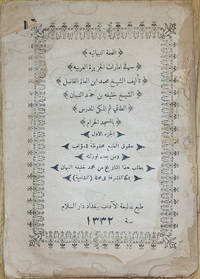
1914000555<p>Bagdad: Dar us Salam press 1914 Book. Good. No Binding. 1st Edition. 12mo - over 6¾ - 7¾" tall. Printed on weak paper. The first and only part printed in Bagdad of 3 parts by the author later printed together in Cairo. Very rare printed book in Bagdad during the world war about the political and military history of Bahrain and al-Khalifa. 144 p. Arabic text with one photographic plate of the author. Scarce.</p> Dar us Salam press
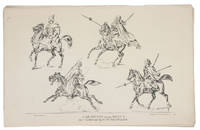
1855GA1LWVIQL20BVienna 1855. Oblong folio 25 x 40 cm. Matthias Trentsensky printed by E. Sieger Loose leaves in a later paper folder. With 19 of 24 numbered leaves containing about 135 lithographic pen-drawings of people animals equipment & gear and goods from a caravan travelling to Mecca each drawing including a base so that one can cut them out paste them on card stock stand them up and arrange them in three-dimensional scenes. Lacking leaves 1-5. ll. 6-24 of 24. All but the first five leaves of a very rare lithographic print series issued in parts. Most copies were probably cut up and perhaps coloured by children and destroyed in play. The human figures to be cut out include Turkish Arabic African and Near Eastern men and women black and white in Islamic clothing some of the men with a variety of firearms spears daggers pipes prayer rugs and other gear and goods. There are also camels horses and donkeys often with their gear for riding or for carrying loads. The wild animals include wolves a hyena and an ostrich. Inanimate objects include containers for water an incense burner baskets chests barrels camel saddles and much more. The series must have provided many children and adults with their first notion of Islamic society and culture and is rich in authentic details.With an occasional pencil mark. Lacking leaves 1-5 but otherwise in remarkable good condition. The whole is slightly browned and the edges somewhat tattered.l Kleine Welt des Bilderbogens: der Wiener Verlag Trentsensky 1977 111; Siefert ed. Paläste Panzer Pop-up-Bücher 2009 with a chapter Die Carawane nach Mecca pp. 31-38; not in KVK; WorldCat. hardcover
1885000419<p>Istanbul: Adolphe Braham 1885 Book. Very Good. Hardcover. 8vo - over 7¾ - 9¾" tall. 64 PP FRENCH REPORT. Chapitre 1: djeddah- ses environs- son importance commerciale- eaux- climat- Autorites Turque- Coutumes- Esclavage- Maladies. Chapitre 2: Itineraire de Djeddah a la Mecque- La Mecque- Ses anvironns- Ceremonie du Haram el Cherif- Description de la ville Sainte- Cherif actuel Cherif Abd El Moutaleb. Chapitre 3: Du Pelerinage son origine- Description de cette ceremonie- conditions pour que le Pelerinage soit valable- Pelerinage de 1882. Chapitre 4: Cholera- Congregations religieuses. Together with: Les Russes en Asie Mineure 1723-1877 Par M. Maxime Legrand Paris Imprimerie et Librairie Militaires 1878. 50 pp. bound together in contemporary ornamented hard cover spine slightly chipped.</p> Adolphe Braham hardcover
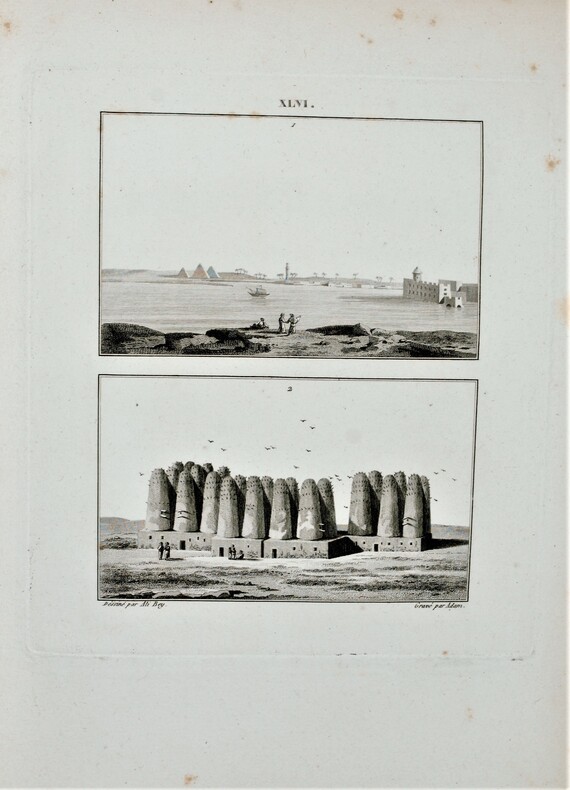
1814PHO-1225Paris , imprimerie Didot l’ainé , 1814 , 4 volumes composé de 3 tome de texte et un Atlas. TEXTE , 3 vol. in-8 (210x135) , relié demi maroquin et coins ,dos lisse avec auteur , titre et tomaison ,tranches marbrées, portrait de l’auteur en frontispice ,xix-395pp-1f (errata), 2ff-464pp-1f (errata),2ff-410pp-1f (errata) , dos et gardes refaits , cachets répétés , premiers feuillets brunis , quelques rousseurs , dos insolés. ATLAS , in-4 (330 x 260) Relié demi basane époque Portrait frontispice XIV-pp-texte 90 planches, dont 14 dépliantes ou sur double page, 5 grandes cartes d après les dessins de l auteur , les cartes Chypre, Maroc, Afrique du Nord, Cote d Arabie, El Cassaba ou le château de Tanger, Temple. Mission d Ali Bey à Tripoli. quelques rousseurs ,Pas de déchirures, coins usés, salissures , les gravures sont de Adam d’après les dessins de l’auteur. Très rare avec le texte