Messie, Pierre, Du Verdier AntoineAntiquariat.de

5 résultats
15803-0-145Paris, Gruget, 1580. 12°(12x8cm), je ein Exlibri, 620 Bll., 11 Bll. (Register), Pappeinbände
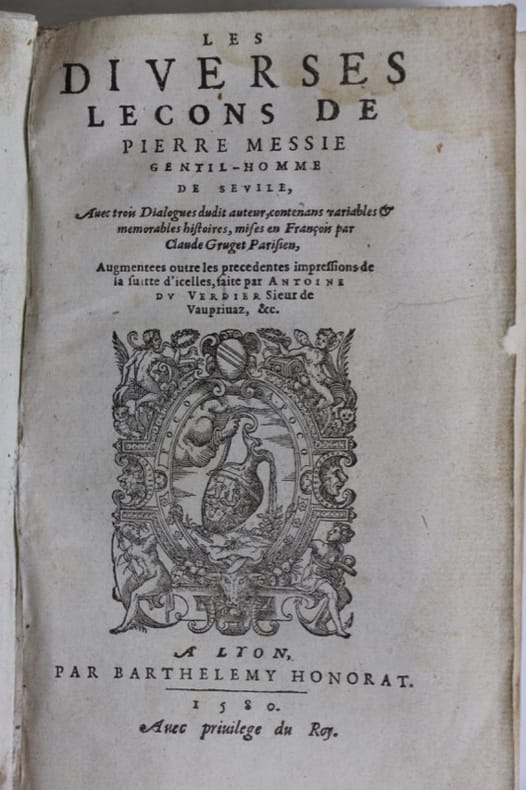
158054567Lyon, Barthelemy Honorat 1580 In-12, plein parchemin muet, 661- 11 pp. Titre gravé, bandeaux et lettrines. Hum. marginale en tête sur les 25 premiers ff. Par ailleurs frais.
1584626811584 Lyon, Bathelemy Honorat,1584, In huit ( 11 x 17 cm ) ,661 pp, reliure d'époque en plein veau ,tranches rouge ,triple filet d'encadrement sur les plats ,dos à cinq nerfs page de titre et les cent premières pages marquées par des traces ,sinon bon état général,
157700376MARIE DE COTTEBLANCHE TRANSLATES SCIENCE --- 3 5-661 11; 20 422 22 p. 8vo a-z8 A-T8; 8 2 a-z8 A-D8 E6 168 x 106 mm --- An early French translation of the Spanish humanist's encyclopedic collection of essays <i>Silva de varia lección</i> popular throughout Europe here with the first edition of Du Verdier's continuation and imitation. Both are without any real order or structure reminiscent of Aulus Gellius's <i>Attic Nights</i> and cover topics ranging from the Amazons to snow to the end of the world. While the two works are often cataloged separately the title of the former clearly suggests the latter was meant to accompany it. USTC 51616 records a 1576 Du Verdier whose reported existence appears to stem from Brunet's citation. Baudrier however has this to say: "Du Verdier cites among his own works Du Verdier himself was a bibliographer under the date 1576 <i>Les diverses leçons</i>. The dedication being dated 11 March 1577 we believe it's an error of the bibliographer." Du Verdier's privilege is only dated 5 October 1576. While theoretically possible some copies might have escaped with 1576 titles before the dedication was ready we haven't found any. ¶ Gruget's translation of the Mexía collection debuted in 1552. But he based it on Roseo da Fabriano's 1544 Italian translation not the Spanish original and so his French translation includes fourteen chapters that Fabriano wrote himself here comprising the entire fourth part of the book. Closing this edition p. 625-661 are a "Dialogue du soleil" "Dialogue de la terre" and "Dialogue des meteores" excerpted from Mexía's six C<i>oloquios o dialogos</i>. ¶ Instead of translating these scientific dialogues himself Gruget appropriated those published by Marie de Cotteblanche in 1566. These three dialogues represent the Parisian woman's only published work. "Marie might have wished to translate these three dialogues for several reasons: the author was renowned in astrology and mathematics; the genre the Ciceronian dialogue was well adapted to the vulgarization of knowledge a major humanist preoccupation; and the scientific content allowed the scholar to show her mastery of the subjects discussed and to meet the expectations of numerous learned court ladies and the upper urban classes who were fascinated by astronomical studies" Larsen. She worked not only from the Spanish original but also an Italian translation the two providing a suitable platform to showcase her linguistic prowess. Her standalone editions included marginal explanations of her translation decisions though Gruget appears to have cut those here. At front is a verse encomium for Gruget that at least pretends to have been written by a woman too if not in fact: "Une damoiselle Parisienne aux lecteurs." ¶ The last standalone edition of Cotteblanche's translation at auction was in 1981 and we confirm her work present in only one <i>Diverses leçons</i> earlier than ours at auction since then a 1576 edition in 2011. --- CONDITION: Eighteenth-century mottled leather. Last leaf is blank. ¶ Mexía's work lacking the title page and with loss to the upper corner of the next leaf crudely filled with some loss of text; worming to lower corner of several gatherings not touching any text; upper margins of Verdier text shaved close just grazing some headlines; moderate dampstaining throughout. A little loss at the spine ends; some leather surface insect-eaten; front paste-down released showing the board attachment. --- REFERENCES: USTC 5994 Mexía 9633 Du Verdier ¶ Jacque-Charles Brunet <i>Manuel du libraire</i> 1861 v. 2 col. 928; Henri-Louis Baudrier <i>Bibliographie Lyonnaise</i> 1899 4th series p. 133; Roger Chartier <i>The Author's Hand and the Printer's Mind</i> Polity 2014 p. 102 on Gruget's use of Fabriano; "<i>Silva de varia lección </i>was both a 'best seller' and a steady seller throughout Europe"; Arthur Tilley <i>The Literature of the French Renaissance</i> Cambridge University 1904 v. 1 p. 50 on the Mexía collection: "It is as the title implies a compilation from various sources; the subjects are equally various and there is a fair proportion of anecdote historical and otherwise"; Anne R. Larsen "Marie de Cotteblanche" Société international pour l'etude des femmes de l'Ancien régime online: http://siefar.org/dictionnaire/en/Marie_de_Cotteblanche; Anne R. Larsen "Cotteblanche Marie de ca. 1520-ca. 1580" <i>Encyclopedia of Women in the Renaissance</i> ABC CLIO 2007 p. 101 "Her choice of a scientific subject matter was not an unusual one for a woman of the elite classes. Many learned women of the nobility and upper gentry were well read in the sciences."; <i>The Biographical Dictionary of Women in Science</i> Routledge 2000 v. 1 p. 295 on Cotteblanche: "skilled in medicine physics and mathematics"; Hervé Campangne and E. Campangne "Savoir économie et société dans les Diverses leçons d'Antoine du Verdier" <i>Bibliotheque d'humanisme et renaissance</i> 57.3 1995 p. 624 in Du Verdier's <i>Diverse leçons</i> "the textual economy meets the ambient economy the themes addressed and the values established are the reflection of the socioeconomic changes of a civilization in full swing" Barthélemy Honorat hardcover
155746401476In Venetia, , Plinio Pietrasanta, , 1557 ; in-4 , cartonnage demi - vélin ancien, papiers des plats changés au XIX e s. 4 ff.n.ch., 125 pp., 5 ff.n.ch. "EDITION ORIGINALE de la traduction italienne des 7 dialogues de Pedro Mexia , parus d'abord à Séville en 1547 sous le titre: Los dialogos o coloquios . Ils roulent sur la médecine et les médecins, les disputes des philosophes, les astres et les éléments. Deux dialogues concernent la table et l'alimentation. Les interlocuteurs devisent des coutumes de table anciennes et modernes, de l'origine du mot ""convivium"" , des grands festins romains, des décors de table, des agencements des cuisines, des mets, avec de nombreuses références aux auteurs anciens; on y trouve aussi les enseignements des Pères de l'Eglise concernant la table et les banquets. Le second dialogue concerne plus précisément les mets, le vin, l'origine de la vigne, Bacchus, l'ivrognerie, avec des considérations gastronomiques, médicales et de nombreuses anecdotes historiques. Pedro Mexia dont on francise le nom en Pierre Messie fut l'historien de Charles Quint. Il naquit à Séville à la fin du XV e siècle et mourut en 1552. Westbury 148- Bagnasco 1297- Paleari-Henssler p. 493. Annotations marginales anciennes. "