Harris, JohnBiblio.com
117 résultats
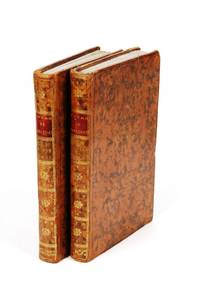
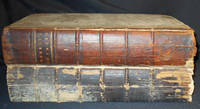
1744007220London: T. Woodward 1744. Hardcover. Good. 2 volumes: vol. 1: 8 xvi 8 984 p. 16 leaves of plates; vol. 2: 10 1056 22 p. frontispiece and 21 leaves of plates: tables; 44 cm. Contemporary half calf with seven compartments between raised bands. Gilt-tooled title in second compartment of vol. 1: Harris's Voyages. Plain light grey paper over boards. Leaves are untrimmed. Title pages in red and black. Vol. 1 imprint: Printed for T. Woodward A. Ward S. Birt D. Browne T. Longman R. Hett C. Hitch H. Whitridge S. Austen J. Hodges J. Robinson B. Dod T. Harris J. Hinton and J. Rivington. Vol. 2 imprint the same except for omission of A. Ward. The dedication to George II with royal crest and signed by Carteret appears opposite the title page in vol. 1. A second dedication "To the merchants of Great-Britain" signed "The author" follows the title page. Index and "List of Charts Maps and Cutts in this Work" follow text in vol. 2. Woodcut head pieces tail-pieces and initial letters. Bookplate of the Museum Library of the University of Pennsylvania on each front fixed endpaper stamped " No longer the property of the University Museum Library." A heavy set; for international shipping they will have to be sent by priority international. Lacking maps except plans of Lima and Canton in v.1 and Peking in v.2 and some other leaves of plates 38 plates present of 61 called for; otherwise in Good Condition: front boards detached but present; lacking most of leather from vol. 2 spine; text blocks are solid; clean and bright. T. Woodward hardcover
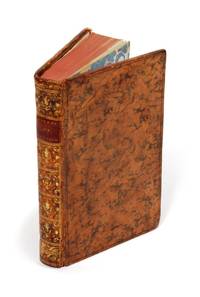
177419257Amsterdam Rotterdam E. van Harrevelt Henry Beman 1774. 4to. Bound in 4 cont. full mottled calf. 6 raised bands gilt titlelabels. Backs a little rubbed some cracking to leather along hinges but covers not detached. Corners bumped. Ocasionally somewhat brownspotted a few tears in plates no loss. A few corners dampstained. With all 4 halftitles. 8XXXII388 - 6536 - 6394 - VIII3673 pp. and 52 engraved plates mostly large and folded among these are 28 folded maps. all. <br/><br/><em> First French edition of Cooke's first travel a title-issue identical with the Paris-edition from the same year only with a different title-page and a printed Privilege in Dutch for the Dutch publisher. It is the 4to-edition not one of the 8vo -editions published the same year. - Sabin 30941. </em> hardcover
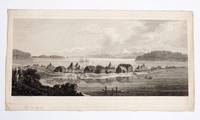
17843611651London 1784. Engraving 253 x 533 mm. to plate mark paper size 290 x 540 mm.; a little light old creasing at right side; in fine condition. <p><p>Rare proof impression of one of the most atmospheric views made by Webber to illustrate Cook's third voyage: the St Peter and Paul ostrog as seen during the expedition's first visit to Avacha Bay.</p> <p>This wonderful panorama of St Peter and St Paul with Cook's ships at anchor in the bay would later appear as plate 74 in the atlas to the official account of the third voyage. Webber's image depicts the small Kamchatkan settlement with its inhabitants fishing in front of their distinctive dwellings all in an untouched landscape with wooded coastline and distant snow-covered mountains. It offers an arcadian vision of the place wildly at variance with what it would become: modern Petropavlovsk-Kamchatsky now a major commercial port and the home of Russia's nuclear submarine fleet. It was at St Peter and St Paul that the battered vessels called in late April 1779 and here that Major Behm agreed to take the news of Cook's death overland to St. Petersburg.</p> <p>This is an early state of the print before letters. The temporary credits here scratched into the plate are differently worded to the final version that would appear in the publication: here there is no caption identifying the view and the image is identified as "Drawn from Nature by J. Webber" and "Engraved by B.T. Pouncy". In the finished version these would be differently expressed as "J. Webber del." and "B.T. Pouncy sc.". The proof engraving is printed on a noticeably different paper and its inking is distinctly finer than the examples of the finished version with which we have compared it. The result is a greater tonal quality.</p> <p>Joppien and Smith discuss the Kamchatkan visit at some length in both text and catalogue volumes of their study of the art of Cook's third voyage. In their description of the related watercolour view now in the Dixson Library in Sydney they note that the original version has probably been lost and that the Dixson watercolour is probably related to the engraving process. </p> <p>This is a desirable and rare version of one of Webber's most successful images from Cook's third voyage. `</p> </p> . unknown
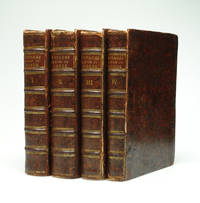
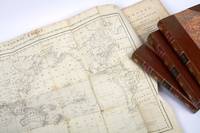
17843712595London: Stockdale Scatcherd and Whitaker Fielding & Hardy 1784. A few spots and stains but a good set. Four volumes octavo with two folding maps and 49 plates in a smart modern binding of polished half calf with gilt labels edges rough-trimmed only with the often discarded half-titles present. <p><p>First octavo edition of the third voyage account with a large chart of the world as discovered by Captain Cook and a finely engraved folding map of the Hawaiian Islands. Intense public interest in the fabulous discoveries of the third voyage and widespread consternation over the death of England's beloved mariner resulted in copies of the quarto edition selling out quickly. The demand prompted two London octavo editions of 1784-1785 including this set printed for John Stockdale and a group of entrepreneurial publishers. The text was abridged omitting some technical and navigation details and as a result reads more like an adventure than the official quarto edition. The list of subscribers is considerable indicating the fervent public interest and a modest price considerably reduced from that of the expensive quarto edition.</p> <p>In addition to the two impressive maps the plates have been re-engraved for the smaller format. Aside from the large chart accompanying the first volume showing the progress of the expedition the two folding plates are noteworthy. The first depicts the death of Cook and was engraved after the original by Dodd. It ignominiously depicts the last moments of the great navigator here shown lying face down and clutching the shore whilst dragged by the calves by a Hawaiian warrior in a tapa cape. The second folding plate is a map of the Hawaiian Islands with a separate chart of Karakakooa Bay marked with soundings details of native villages and areas under cultivation - and the location 'Here Capt. Cook was killed' duly noted.</p> <p>This edition was originally issued in weekly parts with printed wrappers; half-titles for this edition seem to be usually absent though this set includes those for volumes 2 to 4 none is called for in volume 1. The title pages are dated 1784 although the span of publication passed into the following year.</p> </p> . Stockdale, Scatcherd and Whitaker, Fielding, & Hardy unknown
1773388<p>J. Nourse Bookseller to His Majesty 1773. First Edition. Calf. Good Condition/No Dust Jacket. 1st Edition; viii 254 pages 3 folding engraved maps incl. frontispiece 12 folding engraved plates. numerous tables 11 folding leaf of directions to the binder. All edges gilt. Original full marbled calf spine gilt in compartments with red morocco title label lettered in gold gilt binding edges. Top of spine softening and small parts missing. Text block tight. Official account written by Captain Phipps later Lord Mulgrave. The expedition of the Racehorse and Carcass undertaken for the purpose of discovering a route to India through the northern polar regions was blocked by pack ice of Spitsbergen. The valuable appendix gives geographical and meteorological observations zoological and botanical records accounts of the distillation of fresh water from the sea and astronomical observations. The voyage is perhaps best remembered for the presence of young Horatio Nelson as midshipsman aboard the Carcass and his encounter with a polar bear' Hill 1351. Phipps's narrative of his voyage was of considerable scientific interest and was the beginning of modern efforts to reach the North Pole. It also made an important addition to the knowledge of the natural productions of Spitsbergen. - The first British attempt to reach the North Pole since 1615. Today the expedition is chiefly remembered because among the midshipmen was one Horatio Nelson and during the voyage he had his famous encounter with the bear the skin of which young Horatio wished to carry to his father. Nelson was fortunate that Captain Lutwidge saw the danger he was in and scared the animal off by firing one of his cannon. The midshipman received a severe reprimand and in later years when Nelson had become a celebrated admiral the story was re-told by his early biographers as an example of his courage displayed at such a tender age – although clearly the engravers of the day had never seen a polar bear for themselves. Quantity Available: 1. Shipped Weight: Under 5 kilogram. Category: Arctic & Antarctic; Exploration. Pictures of this item not already displayed here available upon request. Inventory No: 388. . This book is heavy and may involve extra shipping charges to some countries.</p> J. Nourse, Bookseller to His Majesty
17973807772Paris: De l'Imprimerie de Guillaume 1797. A few leaves a little foxed; a very good copy. Two volumes octavo six folding engraved plates after Parkinson a handsome set in contemporary French mottled calf flat spines gilt double red and tan morocco labels. <p><p>First French edition first issue: the artist's account of Cook's first voyage and the discovery of eastern Australia. Translated by C. Henri from the 1784 English edition it also contains material from later voyagers updating the account including the experiences of the Forsters on the second voyage. This is the octavo issue noted by Kroepelien as preceding the otherwise identical quarto of the same year.</p> <p>Parkinson had been employed in 1767 by Sir Joseph Banks who thought so highly of his work that he arranged for the young man to join him on Cook's first voyage. When the expedition's draughtsman Alexander Buchan died at Tahiti Parkinson was called on to take over all of the topographical work completing some 1300 sketches quite apart from compiling vocabularies in Tahiti and New Holland. At the end of the voyage en route from Batavia to the Cape of Good Hope he died of a fever and after the return of the Endeavour ownership of his manuscripts and drawings was disputed: Banks considered that they were his while Parkinson's brother Stanfield claimed them under the provisions of his brother's will. When Hawkesworth learned of the impending English publication of this work he got an injunction to delay its appearance until some time after his official account and despite having used Parkinson's work extensively retaliated by deliberately omitting Parkinson's name from the narrative: even the botanical illustrations in the official account have no credit to the artist.</p> <p>Some of the bibliographical history of this work is quite complex. An extended note by Rolf du Rietz in the Kroepelien catalogue explains that this octavo issue although textually identical to a quarto issue published the same year by the same publisher is actually the genuine first issue du Rietz demonstrates from an error in the signatures that the quarto was re-imposed. Du Rietz knew the octavo only from the copy in the University of Oslo although no complete census of the two issues has been attempted. A note in O'Reilly-Reitman suggests - as if we needed more complexity - that the number of plates is uncertain as they examined copies with any number between five and eight; nonetheless six plates is the standard collation.</p> </p> . De l'Imprimerie de Guillaume unknown
17723812970Paris: Saillant & Nyon 1772. Very slight rubbing to joints but a fine tall copy with good margin. Octavo blind-stamped ex-libris to half title; contemporary French marbled calf flat spine gilt in compartments red morocco label. <p><p>A fine copy of the first French account of Cook's Endeavour voyage and the first French book on the east coast of Australia. Fréville translates the text now considered to be by Magra which - published in English in 1771 - was the unauthorised and earliest account of the progress of the Endeavour voyage. This is one of two probably simultaneous issues this one having the "Supplément" title-page; in this form the publishers intended the book to complement the octavo edition of Bougainville's voyage. The work also includes some material that did not appear in the original London edition including a 'Lettre de M. de Commerson' the famed naturalist from Bougainville's circumnavigation who remained behind at Mauritius to continue his research. </p> <p>The second supplement is equally important: the 'Lettre de M. le B. de G.' is a learned treatise on the possibility of a northwest passage written at Königsberg modern Kaliningrad and quoting from experts on the region such as Gmelin Muller and Engel. Although the identity of this scholar remains hazy it is surprising that such an interesting - and relatively early - report on the northwest passage has been largely ignored. Continuing the parade of famous explorers included in this short work the Commerson letter is said to have been conveyed to France by none other than Kerguelen promoter of the "Terre Australe".</p> <p>Rolf du Rietz in the Kroepelien catalogue further notes that a letter from Sir Joseph Banks to the Académie des Sciences is also quoted in the introduction said to have first been published in the Journal des Savans. Despite his best efforts to distance himself from Magra's work including having the false dedication in the London edition removed it appears that his unwilling association with the work continued on the continent. Indeed one of the attractive aspects of this copy is not only the fine contemporary French binding but the spine label which reads 'Voyage de Solander': it was not unusual for Banks to be given top-billing in the excitement of the return of the Endeavour but there cannot be too many examples that plump for Solander.</p> </p> . Saillant & Nyon unknown
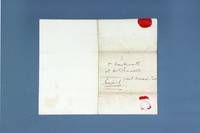
17716000068London 1771. Quarto autograph manuscript in ink; single page on a bifolium with address panel; on paper watermarked "LVG" <p><p>Amusing original letter from Sandwich to John Hawkesworth ghostwriter of the official account of Cook's first voyage. Sandwich writes: "That I may be certain whether you are alive or dead I shall be obliged to you if you will either come yourself or send your ghost to dine with me tomorrow. I am most sincerely yours Sandwich." This witty communication dates from the period when Hawkesworth was preparing the Cook account during Sandwich's third term as First Lord of Admiralty 1771-82; of course it was during this appointment that James Cook discovered Hawaii on his third voyage and named them the Sandwich Islands in his honour. The letter probably dates from late 1771 while Hawkesworth was at work on the journal. He died in November 1773 not long after the book's publication. </p> <p>Hawkesworth was introduced to Sandwich by Charles Burney in September 1771 when "the First Lord was casting around for someone to 'write the voyage' - that is to take Cook's journal and put it into a form suitable for the reading of the polite world; and not only Cook's journal but those of the three other circumnavigators Byron Wallis and Carteret. Cook and Banks we remember were patriotically anxious that this should be done as soon as possible and it was all the more important to get something authentic on the market. Burney recommended his friend Dr John Hawkesworth who had time and could do with the money." Beaglehole. </p> <p>Fanny Burney recorded in her diary for 15 September 1771 that "My father has had a happy opportunity of extremely obliging Dr. Hawkesworth. During his stay in Norfolk he waited upon Lord Orford who had always been particularly friendly to him. He there among others met with Lord Sandwich. His Lordship was speaking of the late voyage round the world and mentioned his having the papers of it in his possession; for he is First Lord of the Admiralty; and said that they were not arranged but mere rough draughts and said that he should be much obliged to any one who could recommend a proper person to write the Voyage. My father directly named Dr. Hawkesworth and his Lordship did him the honour to accept his recommendation. I cannot but be amazed that a man of Lord Sandwich's power &ca. should be so in ignorance of men of learning and merit as to apply to an almost stranger.".</p> <p>The money was decent: Hawkesworth earned a substantial £6000 from the publishers Strahan and Cadell and completed the first two volumes in just four months. A landmark publication this would help to cement Cook's reputation in the eyes of the public serving Sandwich's official purpose.</p> </p> . unknown
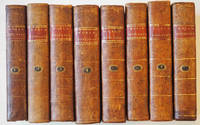
17965000964Philadelphia: Dobelbower Key and Simpson 1796. Rather age-toned and spotted a few small tears and chips but a good sound set. Eight volumes octavo engraved title pages 49 plates a couple closely trimmed includes list of subscribers in the final volume; contemporary marbled sheep bindings spines ruled in gilt and with red leather lettering and blue oval numbering pieces. <p><p>A good complete set of this early collection of voyage accounts rare when complete and in reasonable condition as here. This is the first American edition of these collected voyages from the Great Age of Exploration extensively illustrated. "The Philadelphia edition generally follows the text of the London edition published by T. Carman and F. Newbery 1769-1790 20 vols. though much abridged in content" Forbes. Individual volumes appear for sale but complete runs of the work are the exception rather than the rule.</p> <p>The first volume is devoted to the early discovery of America from Columbus to Pizarro; the second English French and Dutch settlements in America and the circumnavigations of Schouten and Le Maire and Dampier's voyages. The third volume is almost entirely East Indian voyages while the fourth includes an account of the Rogeveen voyage in search of Terra Australis Thomas James' and the Ellis voyages in search of the North West passage and voyages to the Middle East including the Thevenot voyage to the Levant. Volumes five to seven include voyages to East Asia Africa the Middle East Europe and Scandinavia. </p> <p>The final volume is dedicated to Cook's Third and final voyage to the Pacific including A Chart of the Southern Hemisphere Shewing the Tract of Capt. Cooks Last Voyage a finely engraved map filled with comments describing important details such as the northernmost position of the expedition before their progress was blocked by ice and some amusing yet less important notations pointing out the location of floating tree trunks and seaweed clusters. </p> <p>This was just the second map of the Pacific Ocean printed in America the first having been the extremely rare map which accompanied a very few copies of John Ledyard's Journal 1793 and on which it may have been based though some details suggest that it was also made in consultation with the "General Chart" from the official voyage account. Despite its title it shows all of the Pacific Ocean from 70° south to 70° north and from China in the East to the coast of North America in the West. The South Pacific and its islands are represented in detail as are the Alaskan and Asian coasts with Cook's route traced. It includes an early notice of Hawaii with the note 'Owhyhee here Capt Cook was killed 1779'.</p> <p>An additional six nicely engraved views are also featured including The Death of Captain Cook and several portraits of native inhabitants of the Sandwich Islands. </p> <p>---</p> <p>An interesting point is that unlike a set described some years ago which had 26 pages of subscribers listed the present set has specific subscribers' lists for Baltimore and New York the pages of which are numbered from 27 to 38. </p> <p>Not in the catalogue of the Hill collection.</p> </p> . Provenance: New York merchant and subscriber Charles Watkins' copy with his signature; Daniel Sylvester Tuttle 1837-1923 Bishop of Montana with his manuscript inscription in the final volume "Daniel S. Tuttle 1886". Dobelbower, Key, and Simpson unknown
1789g9518London: John Stockdale and George Goulding. G : in good condition. Cover lightly rubbed with some edge wear. Respined with tape reinforcements at inner hinges. Offsetting from engravings. Tear at page 99. Final plate missing. Occasional light foxing otherwise contents VG. 1789. First Edition. Brown hardback half-leather marbled board cover. 310mm x 240mm 12" x 9". xii 384pp; xl. 19 of 20 engravings including 6 fold out charts. Heavy item - shipping supplement may apply for overseas. . John Stockdale and George Goulding hardcover
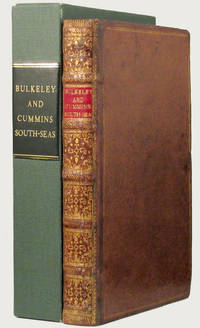
174331681London: Printed for Jacob Robinson 1743. First edition the first of the two issues of 1743 being the issue printed by Robinson with the author's names stated. With a number of attractive woodcut headpieces and initials. 8vo 190 x 120 mm especially well bound in very handsome contemporary full polished brown calf the boards framed with double-ruled gilt edges hatched in blind the spine finely gilt decorated with elaborate detailed tooling in five compartments between wide gilt ruled and hatched raised bands a sixth compartment with red morocco label ruled and lettered in gilt additional gilt at the tips and along the joints. With the engraved bookplate of Lord de Saumarez an admiral of the British Royal Navy notable for his victory at the Second Battle of Algeciras. Saumarez is one of the true historical figures to appear in C. S. Forester's Hornblower novels being celebrated in two of the novels. Saumarez's fictional alter-ego also plays a role in two of the Aubrey-Maturin novels by Patrick O'Brian. Now housed in a handsome green cloth clamshell box with morocco label gilt. xx 220 pp. A very handsome and well preserved copy the text clean crisp and unpressed the handsome binding solid and sturdy with a some expert and accomplished restoration along the joints and a bit of touching up to the corners. In all a fine copy with excellent Naval provenance. RARE AND TRUE FIRST EDITION FIRST ISSUE WITH FINE MARITIME PROVENANCE OF ONE OF THE PRINCIPAL ACCOUNTS OF THE LOSS OF H.M.S. WAGER; ONE OF THE MOST COMPELLING NAVAL ACCOUNTS OF THE EIGHTEENTH CENTURY.<br> This narrative is the exciting mutineers' side of the story of the loss of the Wager to inhospitable climate on one of the world's most remote and dangerous coastlines beyond the Straits of Magellan. When Commodore Anson set out for the Pacific in 1740 to attack the Spanish ships on the Chilean coast he took eight ships with him. The Wager was effectively a transport ship carrying stores and a force of marines; as the squadron rounded Cape Horn in fearsome weather she was unable to keep up with the rest of them and with her gear wrecked by the storm was driven ashore on the Patagonian coast. This tale of mutiny hardship and tenacity that ensued was told by the survivors especially John Bulkeley leader of those who repudiated the captain's authority. Bulkeley the ship's carpenter and Cummins led their small group of survivors until their landing at Rio de Janeiro and finally England concluding a voyage that had lasted almost two years. Another narrative was published by John Byron then a midshipman who remained with Captain Cheap. Of Cheap's group only three members Cheap Byron and one other eventually reached home but by a different overland route.<br> This voyage was the basis for Patrick O'Brian's historical work 'The Unknown Shore' written before he embarked on the Jack Aubrey/Stephen Maturin novels. Printed for Jacob Robinson hardcover
17854401834Paris: Hôtel de Thou 1785. Fine. Five quarto volumes including the final atlas volume containing a total of 88 engraved maps and plates; uniform full calf armorial bindings of the period. <p><p>A superb set of the desirable first French edition of the official account of Cook's third voyage in outstanding contemporary French bindings bearing the arms of the Ruolz Montchal family and the motto "Toujours pret". A smaller edition in octavo was published at the same time but this larger and handsome version is or course greatly preferred. It is illustrated in the manner of the English publication and has a version of the famous "Death of Cook" plate based on the original drawing by John Webber not all copies of the French quarto edition include this plate. Furthermore the fourth and final volume of the text is complete with all seven appendices including the folding vocabulary table.</p> <p>The full story of Cook's great third voyage and his eventual murder while revisiting the Hawaiian Islands that he had discovered earlier during the voyage was almost as eagerly awaited by the European as by the English public: the approximately forty ediitns that appeared befpre 1800 included vesion sin Fench Dutch Geman ruswsian Swedish and Italiqan. This French version is th emost handsome of all the 4editiins ager the English official account.</p> <p>Bligh Burney Colnett Vancouver and Riou - all later to command important voyages of their own - were all members of the expedition which set out to return Omai to Tahiti and to search for a northwest passage. They called at Kerguelen Island Tasmania the Cook Tonga and Society Islands turned north and discovered Christmas Island and the Hawaiian Islands and went on to chart the northwest coast of America from Northern California to 70o 44' where they were stopped by pack ice. On their retrn to Hawaii Cook was killed.</p> <p>The official artist on the voyage was John Webber and his romantic views of the islands of the Pacific published here remain the most evocative portrayals of the islands - helping to create the notion of an island paradise that so affected the public eagerly reading the voyages of discovery being published in the eighteenth century.</p> <p>The Ruolz-Montchal family derived from the Ardèche. but moved in the 18th century to the Lyon area where they held the property of Le Chatelard in Francheville until the early 20th century. Their most famous member was Henri-Catherine-Camille de Ruolz-Montchal 1808-1887 the French industrial chemist composer and comte a friend of both Balzac and Alexandre Dumas.</p> </p> . Provenance: Ruolz Montchal family large gilt coat-of arms on all covers. Hôtel de Thou unknown
17835001095Hartford Connecticut: Nathaniel Patten 1783. Small octavo lacking the map as do virtually all known copies top four lines of title-page in well prepared facsimile; as always a little browned throughout but generally in rather better condition than most copies; in the original dark calf binding. <p><p>Highly important personal account of Cook's third voyage: the first American account of Cook's third voyage and thus the very earliest American account of the discovery of the Hawaiian Islands later to become the fiftieth state of America. This rare and significant book is notoriously hard to find in good shape. </p> <p>Ledyard one of several Americans on the voyage and the only one to publish an account of the expedition sailed as a corporal of marines. It is now generally acknowledged that he got hold of a copy of Rickman's narrative which he used to help him compile this account after his return to America. He himself describes the sealing of all diaries drawings memorandums and charts of all officers and crew aboard ship at Canton. However the narrative contains considerable information not available elsewhere including the first published description of the Russian presence on Unalaska the first permanent Russian settlement in northwest America only Ledyard Samwell and Edgar visited the settlement. The chart supposed to have been issued with the book which seems to have been an almost direct copy of the Rickman map is missing in almost every copy known and in view of the erratic nature of American eighteenth-century publishing it is nowadays accepted that it was not generally issued.</p> <p>Ledyard's description of his stay at Hawaii his expedition inland and the death of Cook occupies sixty-four pages of the text. The account of New Zealand and Australia is short but includes his observation that 'the island of New-Holland for its boundaries are now ascertained is by much the largest known and most eligably sic situated on the map of nature. even the Empress of Russia might be gratified with such a portion'.</p> </p> . Nathaniel Patten unknown
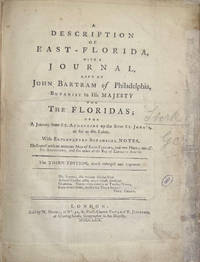
1771008201London in the Strand. and London: at No. 51 St. Paul's Church Yard; and T. JEFFERIES at Charing-Cross: T. BECKET and PA De HONDT. and NICOLL W. 1771. 1st Edition 1st Printing. Hardcover. Very Good. 4to - over 9¾ - 12" tall. JEFFERYS Thomas. The First Published Account of Cook's First Voyage to the Pacific complete with Dedication Leaf. A cornerstone of any Cook collection. Two works in one bound in modern to style half calf over marbled boards some blind edge tooling spine with raised bands gilt tooling gilt titles to red calf labels. Internally Journal of a Voyage 1771 First Edition First Issue with the Dedication and printers instructions plus the two 'Otahitee Vocabulary' leaves bound in at end. BOUND AFTER: Description of East-Florida 1769 Third Edition much enlarged 2 parts in one 3 folding engraved maps title with small library ink-stamp & repair to fore margin small ink correction to C3v professional repairs to maps some loss to the first occasional small stain some soiling and light browning scattered spotting. 281214 mm. Folding map frontis 2 title & dedication 1 ii-viii; Stork - Description of East Florida 1 2-40 1 folding map; Bartrams Journal 1 xii 35 pp 1 errata & binders list1 folding map; Magra's Voyage 1 title 2 dedication 1 2-130 pp 3 Vocabulary of the Language of the Otahitee. The 3 folding maps engraved by T. Jefferys are: 1.East Florida. 2.St. Augustine the Capital of East Florida. 3.The Bay of Espiritu Santo in East Florida. Signatures: East-Florida - 2ff b-b4 B-G1. G-G2 2ff H-M4. Voyage round the World - 2ff B-S1 2ff Vocab. Public appetite for a detailed narrative encouraged a publishing race of which this work published less than three months after the expedition's return to England and almost two years prior to Hawkesworth's authorised version was the winner. This first issue containing the dedication leaf was swiftly withdrawn following the publicly advertised consternation of the dedicatees the Admiralty Joseph Banks and Daniel Solander. Published anonymously the work is generally attributed to James Magra an American mid-shipman aboard. Hill II:1066without dedication leaf; Hocken p9; Holmes 3; O'Rielly-Reitman 362; Sabin 4246 & 16242; DuRietz-catalogue of the Kroepelien Collection p215; Frost Life of James Mario Matra: Voyager with Cook 1995; Beddie 693/4; STC T29207. The work is a short but interesting narrative of Cook's first voyage which relates his visits to Tahiti New Zealand Australia New Guinea Batavia and Rio de Janeiro. The author is noteworthy because he is one of the few to criticize Cook in any meaningful way. Despite problems with the accuracy of the text this work will always hold the place of being the first account of that voyage and the first account in print of the Australian coast. in translation it also gave the French their first account of that voyage. <br/> <br/> T. BECKET and PA De HONDT. and NICOLL W. hardcover
1789184162Mostly at sea: 8 June 1786 - 31 March 1789. The last surviving crew member of Cook's Endeavour A window onto the later career of Isaac Manley 1755-1837 mourned on his death as the last remaining participant in Cook's historic first voyage. Manley joined Cook's crew aged only 13 and was promoted to midshipman on 5 February 1771 during the journey home. He rose to the rank of admiral of the red becoming one of the fifteen most senior officers in the Royal Navy. On the Endeavour Manley acted as servant to the master Robert Molineux. The ravages of disease in the later part of the voyage offered opportunities for advancement. Molineux died off Cape Town in April 1771 and Manley was promoted a day either side of the deaths of midshipmen John Bootie and Jonathan Monkhouse. "The Muster Rolls show Isaac being charged £3.13.2 for slops at this time and £15.18.6 for dead men's clothes presumably he was buying the dead middies' uniforms. And his tobacco charge which began at 19/- in September 1769 also increased to £1.8.6" Hill. Writing to the First Secretary of the Admiralty on his return to England Cook gave Manley his endorsement in typically reserved fashion: "Midshipmen Mr Isaac Smith and Mr Isaac Manly both too young for the preferment yet their behaviour merits the best recommendation" quoted by Hill. Manley signed up for Cook's second voyage but was discharged for still unknown reasons in April 1772 before the Resolution sailed. He was commissioned lieutenant in May 1777 serving with the Channel Fleet and in North America and the West Indies and fought in the Battle of the Saintes. In 1786 at the rank of commander he was appointed to HMS Fairy - the service covered by this log - and ended his active duties in 1790. While living the life of a landed gentleman he continued to earn promotion reaching flag rank in 1809. He was promoted to admiral of the red a few months before his death. The daily log commences on 8 June 1786: "Came on board and took the command of Her Majesty's Sloop Fairy by virtue of a commission dated the 17th May 1786." The ship is tasked with patrolling the Channel and cracking down on smugglers seizing spirits tobacco and other contraband. There are also references to punishing sailors for drunkenness and mutinous behaviour. In late 1787 Manley was also occupied with naval impressment and was ruthlessly effective recording ships stopped and men pressed-ganged. In 1788 the ship is ordered to Africa the log ending in media res on 31 March 1789 near the equator. a By family descent; b Sold at Sotheby's London "Atlases Maps Topographical Prints and Travel Books" 2 May 1985 Lot 220 buyer: Quaritch; c Sold by Quaritch c.1987 to Cecil George Whitmont 1912-1991 Australian collector with his bookplate and a selection of paperwork formerly in an improvised acetate rear pocket. Quarto 245 x 195 mm. With 182 leaves all but 3 pages filled in neat manuscript. Original quarter calf parchment sides. Housed in custom green cloth solander box green spine label. Wear from shipboard use contents clean: very good. Anthony Hill "Isaac Manley - Servant on Endeavour to Admiral" Captain Cook Society. hardcover
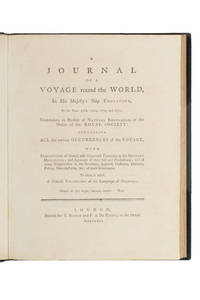
17715000651London: Printed for T. Becket and P.A. De Hondt in the Strand 1771. A fine copy. Quarto; a fine copy in a Sangorski-style binding of half green morocco spine panelled in gilt between raised bands. <p><p>First edition of the earliest published account of Cook's first voyage to the Pacific: the rare first issue with the leaf of dedication to "The Right Honourable Lords of the Admiralty and to Mr. Banks and Dr. Solander" inserted by the publishers to add authenticity. This copy also has the first state of p. 90 recently identified and to be distinguished from an amended state where text begins "quantities.".</p> <p>This was the first of a series of so-called "surreptitious accounts" of Cook's various voyages to appear in print: the Admiralty found it practically impossible to enforce their ruling that no unofficial publications should pre-empt the official and lengthier accounts of the voyages naturally much slower in the press. In this case however legal action was taken against the publisher for using an unauthorised dedication forcing removal of the leaf during publication. "It is accordingly of the greatest rarity and copies of the book containing the dedication are far more valuable than those without it." Davidson. In this large copy the offending leaf has generous margins and retains its printed instruction to the binder "Place this next the title" which also interestingly indicates that the leaf was printed quite separately from the rest of the work.</p> <p>The British public's eagerness for news of the voyage needed more than newspaper accounts while the officially sanctioned narrative would be a long time coming. Published anonymously some two months after the return of the Endeavour and nearly two years before Hawkesworth's official account the Cook scholar Beaglehole demonstrated that the sailor James Magra was the author. His illicit sale of his journal to the publishers might well have confirmed Cook's opinion of him: 'one of those gentlemen frequently found on board Kings Ships that can very well be spared or to speake more planer good for nothing.'. He was a New Yorker and a loyalist. Whatever his skipper and the authorities may have thought of him it was Magra who got the first description of the voyage into print - the earliest printed account of the east coast of Australia published even before acceptance of the name Botany Bay here called Sting-ray Bay as Cook originally christened it.</p> <p>Magra later changed his name to Matra to claim a family inheritance. As Alan Frost has shown "The Precarious Life of James Mario Matra: Voyager with Cook; American Loyalist; Servant of Empire" 1995 Matra used his experiences on the east coast of Australia to draft his 1783 proposal for a penal colony at Botany Bay. Never shy in self-promotion he announced his hope of being made Governor. His plan like Sir Joseph Banks's before and George Young's after him had its effect on the planners of the First Fleet and he was called as an expert witness to the committee in charge of solving the question of transportation see Frost pp.113-122. His life has prompted a considerable literature with multiple studies of his career and importance including those by G.B. Barton George Anthony Wood James Watson who christened him the "Father of Australia" an accolade more often awarded to Joseph Banks and more recently Antonio Giordano who has him as "Australia's Spiritual Father" and Andrew Tink.</p> </p> . Printed for T. Becket and P.A. De Hondt, in the Strand unknown
17875001042London: Alexander Shaw 1787. Quarto eight pages printed text followed by original blank leaves separating the 36 actual cloth specimens several full page as well as many smaller; original calf binding neatly lettered and decorated spine. <p><p>This rare and exotic publication of original Pacific artefacts is the most remarkable of the whole Cook canon: with a brief but significant letterpress introduction it mainly consists of actual specimens of eighteenth-century tapa cloth collected in the Pacific islands particularly Hawaii Tahiti and Tonga. </p> <p>In modern times the publication has become one of the great rarities of eighteenth-century Pacific exploration. This is an example of the first issue of the book with the strictly contemporary bookplate of Sir Corbet D'Avenant 1752-1823 Baronet of Stoke and Adderley. Donald Kerrr speculates in his census that D'Avenant was likely an original subscriber on first publication. </p> <p>Published only a few years after the return of the ships from Cook's third voyage it is not recorded how many of the cloth-books were prepared and up until the recent detective work of Erica Ryan at the NLA very little was known about the publisher Alexander Shaw either. However the limited supplies of the actual cloth must have dictated a very small edition - the most recent census of known copies by Donald Kerr stood at the tiny figure of 66 recently revised by us to 68 of which 57 were held by international libraries. This count of course includes the later issues of the book which continued to be sold often with dramatically varying contents as late as 1806. </p> <p>There has in effect never been a standard collation of the book - the fascinating dedication addressed to an unnamed "Sir" is genuinely vague on numbers - not least because it is obvious that Shaw was simultaneously selling individual samples and "fine specimens of the tree with the bark" at his shop in the Strand. </p> <p>Indeed as Forbes shows in some detail in the Hawaiian National Biography and others including Ian Morrison Maryanne Larkin Erica Ryan and Donald Kerr have all confirmed in more detail no two copies of the work are identical meaning that a precise collation is needed every time. Thus while 39 different samples are listed in Shaw's introductory list and "40" are mentioned at another point in the dedication many copies have quite different collations not least because the Jamaican sample perhaps the most surprising addition was apparently dropped in the course of publication. </p> <p>In short the present example has a total of 36 separate samples including particularly fine full-page examples of many of the more famous sheets. Almost none of the sheets have been particularly affected by the late-Georgian and Victorian practice of clipping: it is well-known that many collectors constructed what have become known as 'snippet books' of the Cook tapa cloths by cutting pieces from copies of Shaw's volume and pasting them into separate books or albums. </p> <p>As a result of this clipping habit copies of the original Shaw book survive in various states of completeness sometimes with only very small fragments of the once full-page specimens remaining. In this copy with its original blank leaves in place it is quite clear that the specimens have essentially retained their original shape with only four or perhaps five showing evidence of very minor clipping as can be shown from the ancient offsetting onto the adjoining blanks. </p> <p>The production of this book reflects the genuine curiosity aroused by tapa a fascination that drove competition between collectors of 'artificial curiosities' and generated an active market for the sheets brought home by Cook's men. The preface of the book contains descriptions of bark cloth manufacture by Cook Anderson Forster and an anonymous officer titled 'one of the navigators' and is followed by the list of the specimens compiled by Shaw. The list is indeed rich in fascinating details; for example we learn that the various uses of the tapa: 'wore sic by the people in the rainy season' or 'used at the human sacrifice'. Some of the notes in the list are longer and doubtless arise from tales told by the mariners who collected the tapa in the first place as boasted on the title page. </p> <p>Each island group used designs unique to its culture and the interest of Europeans in this material equalled the passion aroused by the extraordinary wood-carvings and exotic shells brought back by Cook. </p> <p>The Shaw Catalogue is of great significance as a repository of unique original tapa but it also speaks of the time when Cook's sailors were spreading their stories of the alluring South Seas while drawing-room chatter throughout the land luxuriated in descriptions of the new exotic. The publication forms a tangible link between these narratives the indigenous cultures of the South Pacific and Hawaiian islands the myriad personal and trading relationships that developed between the islanders and mariners and the genteel world of gentleman collectors and their cabinets of curiosities.</p> </p> . Provenance: Norton J. Whitmont collection; Kelton Foundation Los Angeles; original owner Sir Corbet D'Avenant 1752-1823 Baronet of Stoke and Adderley with armorial bookplate. Corbet d'Avenant was the son of Anne Corbet daughter of Sir Robert Corbet c.1670-1740 4th Bt of Stoke upon Tern. Upon the death of Anne's brother rector of Adderley from 1735 Sir Henry Corbet the seventh baronet on 7 May 1750 the baronetcy became extinct and the family estates passed to his nephew Corbet D'Avenant who assumed the name of Corbet and was created a baronet on 27 June 1786. Upon his death on 31 March 1823 the second baronetcy also became extinct. Alexander Shaw unknown