911 résultats
18000008<p><strong>printed leaf</strong> <strong>10 lines in Ottoman Turkish</strong>. Undated and without place of printing but apparently printed at the <strong>Imprimerie Nationale Cairo</strong> during the <strong>French Expedition to Egypt</strong>.</p><p>The document is a <strong>proclamation</strong> concerning <strong>Napoleon Bonaparte's reply</strong> to a letter from the Ottoman Sultan <strong>Selim III</strong> stating that <strong>Napoleon and Selim are allies</strong> that <strong>no force can disturb their alliance</strong> and that <strong>all victories on both sides are the result of this alliance</strong>.</p> Divan du Caire (the Napoleonic committee in Cairo)
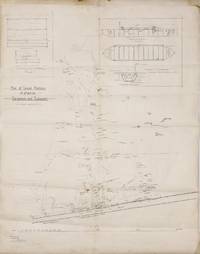
114959A detailed map of the battleground of the failed attempt by Turkish troops to invade Egypt on 3 February 1915. At the head of the map are large sketches of 'Frame of Kerosene Tin Raft in Turkish Attack' and 'Sketch of Turkish Pontoons captured at Toussoum-Serapeum 4.2.1915'. The Australian War Memorial has one of the 24 pontoons used by the 4th Turkish Army in their attempt to cross the Suez Canal in its collection. In fact the AWM records that 'The action in which it was captured was the first in which a unit of the AIF 3 Field Company Australian Engineers was engaged and as such this trophy was the first captured by the army in the First World War. by May 1918 the Australian War Records Section was lobbying for an example to be brought back to Australia noting that while Australian involvement by 3 Field Company Engineers was small it was important'. <p>Both Charles Bean 'The Official History of Australia in the War of 1914-18' Volume 1 Chapter VIII: 'The Turkish Expedition against Egypt' pages 140-165 and the AWM have much to say on this attack. After Turkey entered the war on 31 October 1914 one of the first objectives of both the Germans and Turks was to strike a blow against Britain in Egypt. By January 1915 a 'Turkish force of an estimated 10000 had travelled from Jerusalem to Kantara on the Suez Canal a distance of 200 miles. The force was composed of 5 percent Germans 10 percent Turks and 85 percent Bedouins and was aimed at raising anti-British feeling within the protectorate of Egypt inciting a Jihad and denying use of the canal to Allied forces. This potential threat forced the British to base up to 70000 troops in Egypt 30000 of them defending the Canal. Initially the Turks had three options: to attack from the Jordan-Mediterranean coast to Kantara through the Sinai from Beersheeba to Ismalia or from the south to Suez. Thus the British were obliged to keep options open defending all three zones along the 159 km of canal until it became obvious the Turks were marching south-west from Beersheeba heading for the central zone at Ismalia straight across the Sinai Desert. Despite being initially unconvinced that the Turks could actually organise such a crossing the British were aware of the intent; they decided to base their forces on the West Bank of the Suez using the canal as part of the defence bolstered by Royal Navy ships. This essentially meant giving up the Sinai. The force opposing the Turks mainly comprised of the 10th and 11th Divisions Indian Army. The New Zealand Wellington and Otago Battalions however assisted in the defence. The 3rd Field Company Engineers AIF were detached to operate searchlights and the Ismalia powerhouse but no other Australians were involved directly in the defence. The majority of defenders were hidden by high spoil banks thrown up on the west bank during construction of the Suez Canal. Small parties of Turks were spotted by a French seaplane on 15 January - but they missed most of the force heading out of Beersheeba and across the Sinai. This move was unexpected as most armies had moved along the coast. The Turks sent smaller parties to the southern & northern routes as a diversion and to keep the British guessing. The central party physically dragged their pontoons on wagons and artillery across the desert. Early on the morning of 3 February about 3:30 am movements and sounds were noticed by the defenders on the eastern bank and the Indian sentries started shooting. After dying down more sounds were noted a kilometre south. A Turkish pontoon landed on the west bank loaded with 25 Turks. This was charged by Punjabis and all the occupants were killed; a second crossed under fire but landed with only 10 survivors - four were captured in the morning. Pontoons were raked with shrapnel and machine gun fire killing all aboard. Many more were targeted on the east bank as their crews attempted to launch them with heavy casualties. Witnesses noted ten or eleven damaged pontoons drifting full of dead. Survivors tried to hide behind pontoons and make a dash for safety - many of these killed as well. Orders were given for Torpedo Boat 43 to blow up remaining intact pontoons. At the same time unaware of the disaster and hearing that some pontoons had already crossed the Turkish commander sent up thousands of reinforcements. The British Territorial artillery spotted them and started shooting as did the guns of the French battleship "Requin". An Indian counter-attack across the Canal took 250 prisoners and the attack ceased. The British had lost just on 160 men - the Turkish toll was ten times higher. The Turks retreated back across the desert. The Turkish performance at the Canal may have coloured Australian British and Indian attitudes to Turkish fighting ability which they brought to Gallipoli to their cost' AWM. <p>Bean provides more and pertinent details: 'Early in January the 3rd Field Company of Australian Engineers . had been sent down to construct trenches and floating bridges at the Canal. The British authorities at once began to discover in this company men experienced in almost any work which was needed. Within a week some were detached to manipulate searchlights others had taken over the power-house at Ismailia sic others were surveying for artillery ranges or for maps while the main body was making bridgeheads at Serapeum Ismailia and Kantara and also a floating bridge for Ismailia ferry-post'. <p>Bean's last words are also telling: 'There was a heavy fall in the current estimate of the fighting value of the Turkish Army. This was not without its influence on future events'. Those events which commenced on 25 April 1915 and reverberate to this day may go a long way to explaining why this extraordinary map appears to have been unrecorded. Bean was certainly unaware of it when he wrote his history; the AWM makes no reference to it; and Trove locates no examples. In the overall history of the First World War it may be a sideshow completely overshadowed by the Allied invasion of Turkey at Gallipoli: everything went according to the script of this dress rehearsal except the roles were reversed. unknown
1954000369Cairo: The government press 1954 Book. Very Good. Hardcover. Signed by Authors. 8vo - over 7¾ - 9¾" tall. PRIVATELY BOUND AS PRESENTATION COPY IN 29-5-1954 TO "OUR SON MR. ABDUL HAMID IBRAHIM ABD UR RAHMAN" FROM GENERAL MUHAMMAD NAGUIB. FRONTIS OF M. NAGUIB SIGNING THE TREATY OF SUDAN 12 FEB. 1953. TITLE PAGE WITH MANUSCRIPT DEDICATION SIGNED BY M. NAGUIB THE FIRST PRESEDENT OF EGYPT AFTER THE REVOLUTION OF 1952. FRONTIS OF M. NAGUIB WHEN HE WAS IN KHARTUM IN 1921 IN HIS MILITARY UNIFORM. ERRATA PREFACE BY AHMAD ATIYYATULLAH 96PP OF ARABIC TEXT WITH 7 FINE PHOTOGRAPHIC PLATES AND 1 PLAN. 1 PHOTOGRAPHIC PLATE OF GENERAL M. NAGUIB PRESEDENT IN 20-2-1954. THE BRITISH POLICY AND OCCUPATION IN SUDAN AND THE QUESTION OF SEPARATING DARFUR. ONE OF FOUR BOOKS BY PRESEDENT MUHAMMAD NAGUIB. SCARCE SIGNED COPY. The government press hardcover
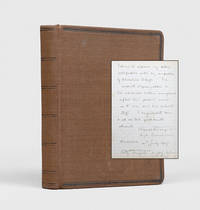
1653136102Alexandria: 1916-53. Politics power and position under empire A rich document of empire pageantry and elite education in British Egypt bearing some 150 dated signatures of leading political military and cultural figures from the first half of the 20th century. Among them are successive British High Commissioners - McMahon Wingate and Allenby - alongside royalty senior officials diplomats and figures from commerce and the press reflecting Victoria College's status as a focal point of imperial authority and social power. Founded in 1902 with the backing of Sir Evelyn Baring Lord Cromer Victoria College educated the sons of the Anglo-Egyptian elite and staged annual speech days that became ritualized displays of British rule. Before the Second World War when British influence was at its height the college was regularly visited by high commissioners and their entourages even during wartime. Early entries include Sultan Hussein Kamal's visit of June 1916 followed by Sir Henry McMahon and senior military and diplomatic figures connected to Kitchener and the Cairo administration. McMahon's successor Reginald Wingate contributed a full-page endorsement of the school in 1917 and Prince Arthur Duke of Connaught visited in 1918 during Allenby's Egyptian campaign. In the interwar years Victoria remained a symbol of British cultural power despite Egypt's formal independence. Edmund Allenby signed repeatedly between 1919 and 1922 later joined by his successors George Lloyd and Percy Loraine often alongside Egyptian ministers. The book also records visits connected to major political developments including members of the Milner Mission in 1920 Gilbert Clayton Sultan Fuad I and George Antonius a former pupil and later a key Arab nationalist intellectual. Other signatories range from the Sultan of Zanzibar to senior churchmen naval officers journalists artists publishers and statesmen underscoring the college's place at the intersection of British and Middle Eastern elites. The final entries chart the end of the imperial era. A 1949 inscription by Said Taha Bey marked "Visit of the Hero of Faluja" poignantly closes this compendium - a compact first-hand chronicle of shifting power personalities and allegiances in modern Middle Eastern history. Quarto. Original brown buckram ledger spine and covers ruled in black grey-green endpapers joints lined with green linen tape as issued marbled and rounded edges pages with printed blue rules approximately 65 pages with one or more signatures nearly all in ink remaining pages blank. Binding sturdy boards and contents soiled in places leaves with light foxing and browning signatures well preserved: an excellent example. Samir Raafat "Victoria College - Educating the Elite 1902-1956" Egyptian Mail 30 March 1996 available online hardcover
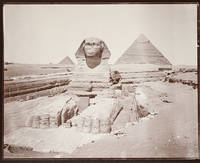
1895ABC_475631895. Oblong folio 28 x 39 cm. Contemporary gold-tooled black morocco gilt edges. With 58 photograph prints ca. 21 x 25.5 to 13.5 x 20 cm. Mounted on both sides of the leaves in the album. 60 pp. The album contains 15 silver albumen photographs of Melbourne taken mainly from the series C. Rudd's new views of Melbourne 1886-1887 by Charles Rudd 1849-1901. They show Collins Street Melbourne town hall the public library Parliament House the Court of Law Government House and various other buildings and infrastructure as well as botanical gardens such as Fitzroy Gardens. The photographs of Sydney were the work of the renowned Australian photographer Henry King 1855-1923 born in England in 1855 who emigrated to Australia with his family in 1856. He worked as a photographer at J. Hubert Newman's studio in Sydney before opening his own studio in 1880. King gained recognition for his photographic studies of Australian Aboriginal people and his scenic views of Sydney. He died in 1923 leaving behind his wife son and three daughters. His glass negatives were acquired by J.R. Tyrrell after his death and are now held by the Powerhouse Museum. King is one of Australia's most significant early photographers. The album contains seventeen of Kings photographs of the harbour including Farm Cove and the Circular Quay Government House and interior and exterior photographs of the town hall King and George Street the Mutual Life Association Building the General Post Office and the Ferner Botanical Garden. Rural New South Was appears in nine photographs including images of Illawarra National Park the Hawkesbury River and a series of outdoor photographs taken along the coast at Blackwall and dated July 1895.This curious album of 58 photographs from France Egypt and most importantly Australia opens with a section with six photos from Marseille showing street views the city harbour the Avenue du Prado and the castles.The ten photographs from Egypt depict both the cultural highlights of the country such as the Pyramids the Sphinx the Citadel of Cairo and the Palace of Gizeh as well as ordinary Arabian villages and street scenes. They stemmed from the ateliers of the Abdullah brothers of Constantinople. The Abdullah Frères namely Viçen 1820-1902 Hovsep 1830-1908 and Kevork 1839-1918 Abdullahyan were three Ottoman brothers of Armenian heritage who gained international fame as photographers during the late Ottoman Empire. Some evidence suggests that he may have collaborated with the Zangaki Brothers and he may have been the official photographer for the Universal Company of the Suez Canal. Later he worked in partnership with the British-Italian photographer Antonio Beato.With an owners inscription in pencil "a appartenu Alfred Schmid" some photographs are captioned in black ink or pencil detailing the places. With a small label from the bookshop that sold the album: "Papeterie Sauwen-Jehotte" in Antwerp. The edges are somewhat bumped and some browning and foxing throughout. Otherwise in good condition. unknown
1889ABC_49512Yemen Egypt and other places 1889. Contemporary burgundy/auburn gold- and blindstamped calf lozenge-patterned blindstamping. Re-backed with the original back strip laid down. Gold-stamped turn-ins white watered silk endpapers gilt edges. Oblong folio 37.8 x 28 cm. An album containing 25 albumen prints ca. 20 x 27 cm including 1 double page mounted on thick card leaves many captioned in English. Photographic record of a journey begun in Australia and taken via Aden through the Suez canal and to the Mediterranean and then on to England. While the first image shows the steamship R.M.S. Ormuz in the port of Sydney three images including a double-page spread show the port of Aden in Yemen the famous water tanks and a native of the Southern Arabian region in a studio portrait. The majority of the album is dedicated to Egypt showing Arabs on their camels the Khedive's Ismailia Palace the Suez Canal Port Said and members the local population as well as the famous pyramids. The last few photographs show the final leg of the journey Naples and ultimately Gibraltar. Among the studios identified in the photographs are those of Hippolyte Arnoux and the Zangaki brothers based at Port Said.With a near-contemporary manuscript inscription in blue ink on the verso of the first flyleaf: "Edith Elkington or Elrington Aunt Ediths voyage home - to England about 1889". Foxed throughout slightly water stained but the prints are largely clean and clear some paper repairs in the margins the last flyleaf is lacking the final leaf is nearly detached. unknown
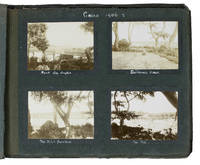
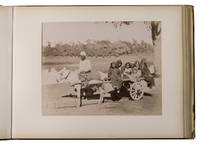
1906ABC_456561906. With: 2 LEHNERT & LANDROCK. Souvenir of Cairo. 12 real artistic photos. Serie A.Egypt late 1920s. Envelope containing 12 silver gelatin prints 12 x 9 cm.3 PHOTOGRAPHY - SINGAPORE. Photograph of a woman and a baby sitting in a rickshaw with a child in front and the rickshaw puller.Singapore late 1920s. Silver gelatin print 7.5 x 12.5 cm. A four-volume photo album compiled by an unknown British woman who also seems to have taken most of the photographs illustrating travels through Egypt Italy Wales and the Isle of Wight. Although the specific background to the album is unknown a photograph of a woman holding a camera is captioned " snapshotted" suggesting that she was the compiler of the album and probably took most of the photographs herself.The first volume starts in 1906 with several photographs showing the interior and exterior of a "summer house" near the "Pont des Anglais" now called the Evacuation bridge a Cairo neighbourhood containing many riverside villas. The final part of the second volume is devoted to the Tanta fair: Egypt's largest fair which normally attracted half a million visitors. Afterwards the party visited the village of Toukh north of Cairo.The third volume opens in May 1907 with a railway visit to the village of "El-Rico" near Hosh Essa also in the Nile delta but nearer to Alexandria. Photographs depict the travelling party as well as local agriculture another wedding and a visit to the weekly market at Abou El Matamer. The final part of the album shows a visit to the Isle of Wight in August 1908.With two photographs in volume IV Cairo on the Nile torn out. Bindings slightly worn spines damaged and volume III without a spine. A few photographs somewhat worn at the edges and with a few spots but otherwise in very good condition. An extensive and remarkable photo album especially for Egypt 1906-1908.l For the excavation at Deir-el-Bahari: Naville The XIth dynasty temple at Deir el-Bahari. Part II. unknown
1992100744Chicago: The Oriental Institute of The University of Chicago 1992. No. 4 one of 200 copies. 3 vols. Folio. 30 photographic prints from original glass plate negatives each print mounted 16 x 20 inches. viii pp. booklet with explanatory text and list of plates for each volume text by Peter F. Dorman John Coleman Darnell and Susan Lezon. Housed in three cloth clamshell boxes by Claudia Cohen. Small dampstain to volumes II & III box with some staining in vol. III to mounts and booklet confined to margin some fading to clamshell boxes prints fine with extraordinary detail and tonal gradation. A portfolio of limited edition photographic prints from the Epigraphic Survey's archive of over eight hundred large-format glass plate negatives taken in Egypt between 1880 and 1930 for the tourist trade by photographers such as Antonio Beato and the Zangaki brothers. Printed at Chicago House the field headquarters of the Survey in Luxor. "Unlike other methods of reproduction in which an artificial light source is used on a mass-production basis the glass negatives have been exposed individually to direct sunlight on printing-out-paper resulting in minuscule differences among the prints. Each print was then toned in a gold chloride solution. Great care has been taken to produce prints that would have resembled closely those that one might have purchased while journeying through Egypt in the nineteenth century" p. vi. Images include ruins of ancient monuments details of carved and painted temple walls fleets of feluccas palm groves and formal salon poses and ethnographic portraits of Egyptians and Nubians. The three volumes retailed at $2000 each when published in 1992. The Oriental Institute of The University of Chicago hardcover
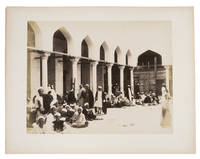
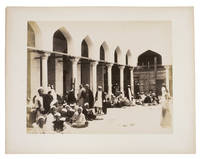
1888ABC_47975Cairo 1888. 34 albumen prints ca. 22 x 27 cm mounted on cream cardstock ca. 28 x 35.5 cm. Remarkable collection of 34 stunning photographic prints of Egypt all numbered titled and signed in the negative by photographer Jean Pascal Sébah 1872-1947 who owned the leading studio for Orientalist photography. He was even named the official photographer of the Sultan of Turkey together with his business partner Polycarpe Joailllier 1848-1904. The majority of the images in the present collection show streets and buildings from lesser known Egyptian cities and scenes of daily life. Larger collections of Sébah's work are relatively rare on the market.Sébah continued the business of his father Pascal Sébah 1823-1886 one of the first photographers working in Egypt. Pascal rose to prominence because of his well-organized compositions careful lighting and quality of his prints. The majority of his photographs are of tourist destinations and locals. Jean Pascal inherited his father's good eye but was more interested in depicting lesser known locations. His photos of people also appear more spontaneous. The present collection includes photographs of El-Souroughieh street and the Khalig canal in Cairo the Virgin Mary's tree in Matariya a local with a buffalo a group of seated men in a mosque a sugarcane market locals working on a sugarcane field a group of boys fishing and the hustle and bustle along the Nile.With a small purple ownership stamp of an anchor in mirror image and the letters "S A" near the top edge of one of the photographs of the Nile. The cardstock is very slightly foxed and yellowed and has somewhat warped from past temperature fluctuations. The prints have somewhat yellowed around the edges but are otherwise in good condition.l Cf. Saretzky The history of photography online. unknown
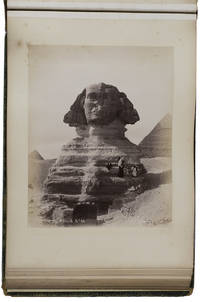
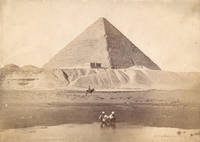
1891ABC_47521Egypt: Zangaki brothers 1891. Original gold-stamped bubble-grained maroon cloth over boards modern maroon cloth spine and leather corners. Gold stamped title and year on the front white watered silk endpapers. Oblong album 31.5 x 41 cm. With 34 large albumen prints mounted on heavy cardstock leaves. Most of the photographs are numbered and captioned in French in the negative and signed 'Zangaki'. The last one is signed Sebah & Joallier. The Zangaki prints measure 22.5 x 28.5 cm; the Sebah & Joallier one is 20.5 x 26.5 cm. A large German album with 34 albumen prints of Egypt. The Greek brothers G. and C. Zangaki were photographers who worked in Egypt in the second half of the 19th century. Due to increased tourism to this region after the opening of the Suez Canal there was a large demand for souvenir photographs. Photographers like the Zangaki brothers as well as Sebah & Joallier catered to this. The Zangakis were among the first commercial photographers to produce large-scale images of Egypt. They travelled through the country with a portable darkroom to capture high-quality images of famous monuments and daily life though the latter were usually posed. These images were then printed and sold to tourists either separately or compiled into albums. According to John Hannavy the brothers "produced some of the finest images of late Victorian Egypt". The 34 photographs include: the great pyramid Cairo and the Nile dervishes and other exotic looking locals Egyptians standing on top of the sphinx obeliscs the Ramesseum Karnak temple the temple of Dendera the Great Pyramid Egyptians climbing the pyramid the mosque and tomb of Muhammad Ali Saqqara and many others.With two small library stamps on the first page not affecting the photograph. The book has been rebacked. The left side of the front board has faded and the corners are worn. Minor browning around the edges of the leaves. Back flyleaf loose. The photos are crisp and clear and the book is otherwise in good condition.l Erdem Views of Egypt by Georgios and Constantinos Zangaki: Examining a late nineteenth-century photographic album at the Art Gallery of Ontario thesis 2006; Hannavy Encyclopedia of Nineteenth Century Photography pp. 1036 1093 & 1521. Zangaki brothers, hardcover
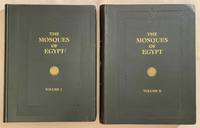
M7019dRare complete set of 2 volumes. Edition limited to 1200 sets. Ordnance Survey Giza 1949-54. First edition. Large folio original cloth containing 243 plates showing mosques and architectural and decorative details 27 in colour: 216 in photogravure with sepia ink 2 in photogravure with chromolithographed colour 3 chromolithographed and 22 in halftone offset lithography after paintings by Al-Husain Fawzy. Further with about 100 offset lithographic line illustrations on the integral leaves many full-page. Vol. I: 68 pages 93 plates 2 maps and index. Vol. II: pages 69-133 plates 94-243. In the introduction Creswell writes: "Cairo possesses a most remarkable series of Muslim monuments running unbroken from the ninth to the nineteenth centuries. In the latter respect it is unique. . we need have no hesitation in saying that these two volumes constitute the finest piece of book production achieved in Egypt". Language: English. This set ships from Europe shipping costs will be updated accordingly BPF. Relevant subjects: Egypt: Medieval & Modern Egypt. unknown
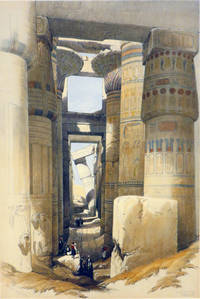
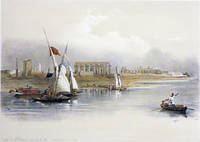
184726557London: F.G. Moon and Co. 1847. From the Standard Folio First Edition limited to 500 sets only. A single original hand-coloured lithographic plate drawn on stone by Louis Haghe after David Roberts' paintings done on location in 1838. Printed on a single folio sheet 24" x 17" the captioned image is 19" x 12.75" now presented in cream mounting boards 30" x 24" glazed behind clear mylar. Beautifully hand-coloured to the highest standards of the time. An example in excellent condition clean fresh beautifully preserved. FROM One of the most desirable of all travel and COLOURplate books. We have a good number of impressive images from the Standard Folio Edition of this classic work available for purchase. As well as many views of Egypt we also have available views of Nubia Petra Sinai the Jordan Tyre Sidon and Baalbec. Please inquire for further details.<br> In the course of two and a half months in 1838 traveling some 800 miles south from Cairo Roberts recorded the monumental temple sites along the Nile in more than a hundred sketches. As the first British artist to sketch the monuments of Ancient Egypt set on "Plains so vast.that until you come near them you have no idea of their magnificence" Roberts was well aware of the stir his drawings would create in London. According to John Ruskin writing in PRAETERITA Roberts's drawings "were the first studies ever made conscientiously by an English painter not to exhibit his own skill but to give true portraiture of scenes of historical and religious interest. F.G. Moon and Co. hardcover
184826556London: F.G. Moon and Co. 1848. From the Standard Folio First Edition limited to 500 sets only. A single original hand-coloured lithographic plate drawn on stone by Louis Haghe after David Roberts' paintings done on location in 1838. Printed on a single folio sheet 23.5" x 17" the captioned image is 19.75" x 13.75" now presented in cream mounting boards 30" x 24" glazed behind clear mylar. Beautifully hand-coloured to the highest standards of the time. An example in excellent condition clean fresh beautifully preserved. FROM One of the most desirable of all travel and COLOURplate books. We have a good number of impressive images from the Standard Folio Edition of this classic work available for purchase. As well as many views of Egypt we also have available views of Nubia Petra Sinai the Jordan Tyre Sidon and Baalbec. Please inquire for further details.<br> In the course of two and a half months in 1838 traveling some 800 miles south from Cairo Roberts recorded the monumental temple sites along the Nile in more than a hundred sketches. As the first British artist to sketch the monuments of Ancient Egypt set on "Plains so vast.that until you come near them you have no idea of their magnificence" Roberts was well aware of the stir his drawings would create in London. According to John Ruskin writing in PRAETERITA Roberts's drawings "were the first studies ever made conscientiously by an English painter not to exhibit his own skill but to give true portraiture of scenes of historical and religious interest. F.G. Moon and Co. hardcover
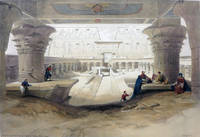
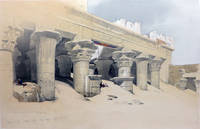
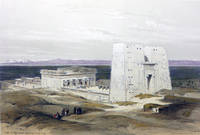
184726862London: F.G. Moon and Co. 1847. From the Standard Folio First Edition limited to 500 sets only. A single original hand-coloured lithographic plate drawn on stone by Louis Haghe after David Roberts' paintings done on location in 1838. Printed on a single folio sheet 23" x 17.5" the captioned image is 19.25" x 13" now presented in cream mounting boards 30" x 24" glazed behind clear mylar. Beautifully hand-coloured to the highest standards of the time. An example in excellent condition clean fresh beautifully preserved. FROM One of the most desirable of all travel and COLOURplate books. This is an especially attractive plate showing one of the best preserved temples in Egypt. The temple dedicated to the falcon god Horus was built in the Ptolemaic period between 237 and 57 BC. The temple is located on the west bank of the Nile in the city of Edfu which was known in Greco-Roman times as Apollonopolis Magna after the chief god Horus-Apollo. The temple of Edfu is the largest temple dedicated to Horus.<br> We have a good number of impressive images from the Standard Folio Edition of this classic work available for purchase. As well as many views of Egypt there are also views available of Tyre Nubia Petra Sinai the Jordan Sidon and Baalbec. Please inquire for further details.<br> In the course of two and a half months in 1838 traveling some 800 miles south from Cairo Roberts recorded the monumental temple sites along the Nile in more than a hundred sketches. As the first British artist to sketch the monuments of Ancient Egypt set on "Plains so vast.that until you come near them you have no idea of their magnificence" Roberts was well aware of the stir his drawings would create in London. According to John Ruskin writing in PRAETERITA Roberts's drawings "were the first studies ever made conscientiously by an English painter not to exhibit his own skill but to give true portraiture of scenes of historical and religious interest. F.G. Moon and Co. hardcover
2112323Loose original gelatin silver photos measuring c. 11 x 16 cm mounted on card measuring c. 20 x 27. All photos with period pencil or ink captions in French on recto or verso of the mounts; most photos with period ink or pencil numbers on the mounts; two photos dated ""1905"" on the mounts. Several images mildly faded or with mild silvering several mounts with minor creases small tears or chipping on the extremities but overall a very good collection of interesting and unusual photos.Original large vernacular not commercial as more often encountered photos of Egypt taken by a French traveller in the early 20th century. Unlike most collections of Egyptian travel photos from this period these ones don't cover ancient temples and sites but instead focus on the life of contemporary Arabic Egypt. An unusual collection showing everyday life of Egypt with evocative street scenes in the early 20th century.Twenty-one photos depict Cairo and environs showing the Nile with feluccas and buildings on the banks narrow streets and shops of old Cairo the gate to the Delta Barrage Al-Rifa'I Mosque mausoleums and tombs of the Mamluks in Cairo Necropolis mud-brick buildings in Cairo environs and scenes with the local people. Four photos show native mud-brick houses in Memphis and local people; two photos depict Muslim inhabitants of Ismailia and their huts made of dried grass. Eight depict the beach at Attaka modern-day Suez Governorate of Egypt the Red Sea and steamers coming in or out of the Suez Canal and a native camel rider portrayed near Attaka. unknown
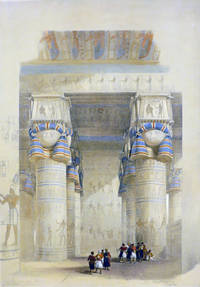
184626865London: F.G. Moon and Co. 1846. From the Standard Folio First Edition limited to 500 sets only. A single original hand-coloured lithographic plate drawn on stone by Louis Haghe after David Roberts' paintings done on location in 1838. Printed on a single folio sheet 24" x 17" the captioned image is 20" x 13" now presented in cream mounting boards 30" x 24" glazed behind clear mylar. Beautifully hand-coloured to the highest standards of the time. An example in excellent condition clean fresh beautifully preserved. FROM One of the most desirable of all travel and COLOURplate books. This is an especially attractive plate showing the northern portico of one of the best preserved temples in Egypt at a time when most of the portico was still buried beneath shifting desert sand. Three winged sun disc are visible above the opening the lower of which is brightly painted. The temple dedicated to the falcon god Horus was built in the Ptolemaic period between 237 and 57 BC. A group of brightly dressed visitors appearing tiny between the massive columns lend an excellent sense of scale to this fine image.<br> We have a good number of impressive images from the Standard Folio Edition of this classic work available for purchase. As well as many views of Egypt there are also views available of Tyre Nubia Petra Sinai the Jordan Sidon and Baalbec. Please inquire for further details.<br> In the course of two and a half months in 1838 traveling some 800 miles south from Cairo Roberts recorded the monumental temple sites along the Nile in more than a hundred sketches. As the first British artist to sketch the monuments of Ancient Egypt set on "Plains so vast.that until you come near them you have no idea of their magnificence" Roberts was well aware of the stir his drawings would create in London. According to John Ruskin writing in PRAETERITA Roberts's drawings "were the first studies ever made conscientiously by an English painter not to exhibit his own skill but to give true portraiture of scenes of historical and religious interest. F.G. Moon and Co. hardcover
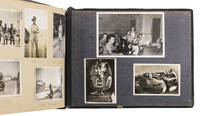
1940ABC_484251940. Contemporary embossed brown calf with flowers on the front and back board and an aluminium view of David's Tower and Jerusalem's old city wall embedded in the front board. Oblong album 30 x 20 cm. With 128 gelatin silver prints most ca. 6.5 x 9.5 cm. Beautiful album with 128 photographs of Egypt and Palestine present day Israel and the West Bank during the British Mandate. It was likely compiled by a British soldier who was stationed in the Middle East during the 1940s. Some of the photographs are numbered in the negative and may have been made by important photographers active in the area at the time like G. Eric Matson and his wife Edith the founders of the Matson Photo Service. The images show Cairo and various locations in Palestine including Jerusalem Bethlehem Nazareth Tiberias Sea of Galilee Nathanya Tel Aviv the Jordan river Haifa Beirut and the Dead Sea. Other than important locations like churches and gates the photographs also show many locals including for example street barbers in Cairo shepherds and farmers in Palestine and beautifully dressed women in Haifa. In the back of the work a few dried leaves from local plants have been mounted namely orange lemon fig eucalyptus grapevine and mulberry. The eucalyptus leaf still retains some of its scent.The edges and vorners of the boards are somewhat scuffed with some loss of material at the head and foot of the spine and around the edges of the embedded aluminium plate. The photographs mounted on the inside of the front board are slightly stained the fig leaf mounted on one of the final pages is damaged and the cyprus leaf is missing. Otherwise in good condition. unknown
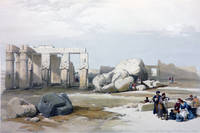
184726863London: F.G. Moon and Co. 1847. From the Standard Folio First Edition limited to 500 sets only. A single original hand-coloured lithographic plate drawn on stone by Louis Haghe after David Roberts' paintings done on location in 1838. Printed on a single folio sheet 23" x 17.5" the captioned image is 19.25" x 13" now presented in cream mounting boards 30" x 24" glazed behind clear mylar. Beautifully hand-coloured to the highest standards of the time. An example in excellent condition clean fresh beautifully preserved. FROM One of the most desirable of all travel and COLOURplate books. This is an especially attractive plate showing the Ramesseum near Luxor the funeral temple of Ramses II. Prominent in the view is the huge fallen Ozymandias colossus which if not broken would rival the Colossi of Memnon. Colourfully dressed visitors stand near the Colossus while others stand in the foreground. The Osirid statues and what is commonly referred to as "the other head" are also in the view. <br> We have a good number of impressive images from the Standard Folio Edition of this classic work available for purchase. As well as many views of Egypt there are also views available of Tyre Nubia Petra Sinai the Jordan Sidon and Baalbec. Please inquire for further details.<br> In the course of two and a half months in 1838 traveling some 800 miles south from Cairo Roberts recorded the monumental temple sites along the Nile in more than a hundred sketches. As the first British artist to sketch the monuments of Ancient Egypt set on "Plains so vast.that until you come near them you have no idea of their magnificence" Roberts was well aware of the stir his drawings would create in London. According to John Ruskin writing in PRAETERITA Roberts's drawings "were the first studies ever made conscientiously by an English painter not to exhibit his own skill but to give true portraiture of scenes of historical and religious interest. F.G. Moon and Co. hardcover
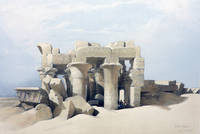
184626864London: F.G. Moon and Co. 1846. From the Standard Folio First Edition limited to 500 sets only. A single original hand-coloured lithographic plate drawn on stone by Louis Haghe after David Roberts' paintings done on location in 1838. Printed on a single folio sheet 17" x 23" the captioned image is 12.75" x 19.25" now presented in cream mounting boards 30" x 24" glazed behind clear mylar. Beautifully hand-coloured to the highest standards of the time. An example in excellent condition clean fresh beautifully preserved. FROM One of the most desirable of all travel and COLOURplate books. A very interesting image of the Temple at Kom Omboan unusual double temple built during the Ptolemaic dynasty 180-47 BC. This was painted prior to the temple's restoration by by Jacques de Morgan in 1893 and in the image most of the temple remains hidden beneath the shifting desert sand. A group of locals standing beside one of the columns provides an excellent sense of scale. <br> We have a good number of impressive images from the Standard Folio Edition of this classic work available for purchase. As well as many views of Egypt we also have available views of Nubia Petra Sinai the Jordan Tyre Sidon and Baalbec. Please inquire for further details.<br> In the course of two and a half months in 1838 traveling some 800 miles south from Cairo Roberts recorded the monumental temple sites along the Nile in more than a hundred sketches. As the first British artist to sketch the monuments of Ancient Egypt set on "Plains so vast.that until you come near them you have no idea of their magnificence" Roberts was well aware of the stir his drawings would create in London. According to John Ruskin writing in PRAETERITA Roberts's drawings "were the first studies ever made conscientiously by an English painter not to exhibit his own skill but to give true portraiture of scenes of historical and religious interest. F.G. Moon and Co. hardcover
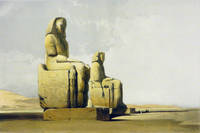
184626562London: F.G. Moon and Co. 1846. From the Standard Folio First Edition limited to 500 sets only. A single original hand-coloured lithographic plate drawn on stone by Louis Haghe after David Roberts' paintings done on location in 1838. Printed on a single folio sheet 24" x 16.5" the captioned image is 19.5" x 13" now presented in cream mounting boards 30" x 24" glazed behind clear mylar. Beautifully hand-coloured to the highest standards of the time. An example in excellent condition clean fresh beautifully preserved. FROM One of the most desirable of all travel and COLOURplate books. A very famous and iconic image being the Colossi of Memnon the two massive stone statues of Pharaoh Amenhotep III which for the past 3400 years have stood in the Theban necropolis west of the River Nile near the modern city of Luxor.<br> We have a good number of impressive images from the Standard Folio Edition of this classic work available for purchase. As well as many views of Egypt we also have available views of Nubia Petra Sinai the Jordan Tyre Sidon and Baalbec. Please inquire for further details.<br> In the course of two and a half months in 1838 traveling some 800 miles south from Cairo Roberts recorded the monumental temple sites along the Nile in more than a hundred sketches. As the first British artist to sketch the monuments of Ancient Egypt set on "Plains so vast.that until you come near them you have no idea of their magnificence" Roberts was well aware of the stir his drawings would create in London. According to John Ruskin writing in PRAETERITA Roberts's drawings "were the first studies ever made conscientiously by an English painter not to exhibit his own skill but to give true portraiture of scenes of historical and religious interest. F.G. Moon and Co. hardcover
184626518London: F.G. Moon and Co. 1846. From the Standard Folio First Edition limited to 500 sets only. A single original hand-coloured lithographic plate drawn on stone by Louis Haghe after David Roberts' paintings done on location in 1838. Printed on a single folio sheet 23.25" x 16.25" the captioned image is 19.75" x 13.75" now presented in cream mounting boards 30" x 24" glazed behind clear mylar. Beautifully hand-painted to the highest standards of the time. An example in excellent condition clean fresh beautifully preserved. FROM One of the most desirable of all travel and COLOURplate books. We have a good number of impressive images from the Standard Folio Edition of this classic work available for purchase. As well as many views of Egypt we also have available views of Nubia Petra Sinai the Jordan Tyre Sidon and Baalbec. Please inquire for further details.<br> In the course of two and a half months in 1838 traveling some 800 miles south from Cairo Roberts recorded the monumental temple sites along the Nile in more than a hundred sketches. As the first British artist to sketch the monuments of Ancient Egypt set on "Plains so vast.that until you come near them you have no idea of their magnificence" Roberts was well aware of the stir his drawings would create in London. According to John Ruskin writing in PRAETERITA Roberts's drawings "were the first studies ever made conscientiously by an English painter not to exhibit his own skill but to give true portraiture of scenes of historical and religious interest. F.G. Moon and Co. hardcover
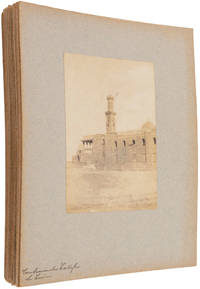
188033358Probably Cairo: Probably Maison Bonfils ca. 1880. With 56 full page albumen photographs mounted on board and with descriptions lettered by hand on the boards beneath the images. 210 x 270 mm. the mounted photographic images approximately 195 x 250 mm. the photographs are housed in a folding protective binder of brown calf the covers with triple gilt fillet rules the spine and upper cover with dark brown lettering labels gilt the inner portions of the foldover binding are decorated with patterned papers of red green and cream. 56 photographs on 28 boards the photographs in sepia. A very well preserved set with normal age and fading. A FINE COLLECTION OF PHOTOGRAPHS OF EGYPT including street scenes landscapes architecture photographs of mosques and tombs of the pyramids and ancient monuments and of people gathered in groups in Cairo and of Bedouin Arabs in gatherings and alone. Maison Bonfils was a French family-run company producing and selling photography and photographic products from Beirut then in Ottoman Syria now in Lebanon from 1867 until 1918 from 1878 on renamed "F. Bonfils et Cie". The Bonfils ran the first and in their time most successful photographic studio in the city. Maison Bonfils produced studio portraits staged biblical scenes landscapes and panoramic photographs. <br> Félix Bonfils a French photographer married Marie-Lydie Cabanis in 1857. The couple together with their son Adrien moved to Beirut in 1867 where they opened a photographic studio called "Maison Bonfils" on what later became rue Georges-Picot. Maison Bonfils produced thousands of photographs of the Middle East. Bonfils worked with both his wife and his son. They photographed landscapes portraits scenes with subjects dressed in Middle Eastern regalia and also stories from the Bible.<br> Félix Bonfils took photographs in Ottoman Syria in today's Lebanon Syria Israel & Palestine the Khedivate of Egypt Greece and Constantinople producing the vast majority of his work while his wife and son were also involved in photography produced by the studio. As few are signed it is difficult to identify who is responsible for individual photographs. Lydie is thought to have taken some of the studio portraits especially those of Middle Eastern women who were more inclined to pose for a female photographer. In 1876 Félix returned to AlÄs to have compiled collections of their photographs published.<br> In 1878 when the name of the studio was changed to "F. Bonfils et Cie" Adrien was back in Beirut after completing his studies in France and took more responsibility for photography including landscape. Félix again travelled to AlÄs to establish a collotype printing factory in 1880 and died there in 1885. Probably Maison Bonfils hardcover
184726861London: F.G. Moon and Co. 1847. From the Standard Folio First Edition limited to 500 sets only. A single original hand-coloured lithographic plate drawn on stone by Louis Haghe after David Roberts' paintings done on location in 1838. Printed on a single folio sheet 23" x 17.5" the captioned image is 19.25" x 13" now presented in cream mounting boards 30" x 24" glazed behind clear mylar. Beautifully hand-coloured to the highest standards of the time. An example in excellent condition clean fresh beautifully preserved. FROM ONE OF THE MOST DESIRABLE OF ALL TRAVEL AND COLOURPLATE BOOKS. This is an especially attractive plate showing one of the best preserved temples in Egypt. The temple dedicated to the falcon god Horus was built in the Ptolemaic period between 237 and 57 BC. The temple is located on the west bank of the Nile in the city of Edfu which was known in Greco-Roman times as Apollonopolis Magna after the chief god Horus-Apollo. The temple of Edfu is the largest temple dedicated to Horus.<br> We have a good number of impressive images from the Standard Folio Edition of this classic work available for purchase. As well as many views of Egypt there are also views available of Tyre Nubia Petra Sinai the Jordan Sidon and Baalbec. Please inquire for further details.<br> In the course of two and a half months in 1838 traveling some 800 miles south from Cairo Roberts recorded the monumental temple sites along the Nile in more than a hundred sketches. As the first British artist to sketch the monuments of Ancient Egypt set on "Plains so vast.that until you come near them you have no idea of their magnificence" Roberts was well aware of the stir his drawings would create in London. According to John Ruskin writing in PRAETERITA Roberts's drawings "were the first studies ever made conscientiously by an English painter not to exhibit his own skill but to give true portraiture of scenes of historical and religious interest. F.G. Moon and Co. hardcover
19033864Egypt: various dates 1903. Various sizes. Twenty-nine printed menus with specific offerings printed or in manuscript. On various papers some with chromolithograph illustrations; some with embossed debossed or die-cut elements; some with edges beveled and gilt. Texts in Arabic French German and English. An unusual group of Egyptian menus from a moment when the British Germans and Austro-Hungarians were jockeying for Power in the region and the last of the Khedive rulers was in power. The collection includes menus from Palais Ismaïlia; Palais D’Abdine; Savoy Hotel Cairo; Ziftah Barrage; Hotel Angst; Unter den Belten bei den Chalifen-Gräbern Kairo under the straights at the Khalifa Tombs Cairo; and Ghésireh Palace Hotel. ~ Four of the menus are from the Palais D'Abdine in November and December of 1902 and bear the coat of arms of Abbas Helmi II Khedive of Egypt the last to serve as King of Egypt before being deposed by the British in 1914. One of these menus is labeled for S.E. El-Lewn F. Thurneyssen Pacha ecuyer riding instructor to the King and one of many Austro-Hungarians close the Khedive court much to the consternation of the British. A second menu from this group is labeled in Arabic which we have been unable to translate. Additionally two menus hail from the Palais Ismaila and record dinners on consecutive evenings March 3 and March 4 1903. Each of bears the hand-lettered names of the guests: Moustapha Fehmi Pasha who had served as 7th Prime Minster of Egypt; and Hr. Van der Does de Villebois the Dutch Consul General later posted to Constantinople. Perhaps some light soiling or a bumped corner to a few menus otherwise condition throughout is very good. various dates unknown