19 171 résultats
Very Good Arabic Early edition of this critical edition of Saad Zagloul's memoirs prepared by Mustafa al-Nahhas Jabr Pasha. Zaghloul was an Egyptian revolutionary and statesman, who was the leader of Egypt's nationalist Wafd Party. He served as Prime Minister of Egypt from 26 January 1924 to 24 November 1924. By working as a Europeanized lawyer, Zaghloul gained both wealth and status in a traditional framework of upward mobility. Despite this, Zaghloul success can equally be attributed to his familiarity with the Egyptian countryside and its many idioms. In 1918, he became politically active, as the founding leader of the Wafd Party, for which he was later arrested. Zaghloul became increasingly active in nationalist movements, and in 1919 he led an official Egyptian delegation (or wafd, the name of the political party he would later form) to the Paris Peace Conference demanding that the United Kingdom formally recognize the independence and unity of Egypt and Sudan (which had been united as one country under Muhammad Ali Pasha). The British in turn demanded that Zaghloul end his political agitation. When he refused, they exiled him to Malta, and later to Seychelles. In 1922, he was moved from Seychelles and was taken to Gibraltar due to ill health arriving there onboard HMS Curlew and he was released in 1923. Zaghloul's absence caused disturbances in Egypt, ultimately leading to the Egyptian Revolution of 1919. Upon his return from exile, Zaghloul led the Egyptian nationalist forces. Mu??afâ al-Nahhâs Pasha, (1879-1965), a statesman who, as the leader of the nationalist Wafd party, was a dominant figure in Egyptian politics until the revolution of 1952. A lawyer by profession, Na??âs was appointed a judge in the National Court at ?an?â in 1914. Soon after World War I he joined the recently formed Wafd; he was exiled with Sa'd Zaghlul in the early 1920s, and assumed the chairmanship upon Zaghlul's death in 1927. An imitation leather bdg., Arabic lettered gilt on front board. Foolscap 8vo. (18 x 12 cm). In Arabic. 280, [2] p., a portrait of Zaghloul, b/w ills. Offset lithography. OCLC 23485313, 784459538, 1044672960.
Very Good Turkish, Ottoman (1500-1928) In modern aesthetic full leather bdg. in Ottoman style. Roy. 8vo. (24 x 17 cm). In Ottoman script (Old Turkish with Arabic letters). 184 p., numerous b/w plates. First and only edition of this scarce travelogue which was planned for fifteen days on January 19, 1909, but took about forty days, containing a first-hand travel account of Egypt in 1909, an Islamic country that began to modernize at the beginning of the 20th century, written by an Ottoman intellectual, one year after the Second Constitutional Regime. This rare book contains early descriptions of the Egyptian municipality, the Red Crescent, gardens and parks, urbanism, zoo, and botanic gardens, tramps, bridges, social life, folkloric customs, Mahmil Alays, cemeteries, music and history of art, hotels, Nile and many historical heritages, architecture, etc. Agop [or Agob] Matyosyan was one of the first Armenian printers to apply during the inspections of printing houses that were done in accordance with the Nizam-name-i Cedid (Jareeda-i Mahakim, No. 429 (13 Jamazia al-awwal 1305) in the late Imperial Ottoman period. Hegira: 1327 = Gregorian: 1910. Özege: 14459. OCLC: 476243661 / 16347814.
Very Good Turkish, Ottoman (1500-1928) n original cloth bdg. Large roy. 8vo. (25 x 17 cm). In Ottoman script. 90 p. Hegira: 1260 = Gregorian: 144. First, only and extremely rare Ottoman Turkish translation and 'Bulaq Edition' of this account of Napoleon described as 'Extrait du Memorial de Sainte-Helene. The Bulaq or El-Amiriya Press is the first official and governmental printing press to be established in Egypt, and function according to industrial printing basis, causing not just a qualitative but also a quantitative and knowledgeable leap in science throughout the Arab region. The Bulaq Press was part of Mohamed Aly's inclusive development plans for the modernization of Egypt. The Khedive first initiated his plans by establishing a strong Egyptian army; one that is capable of strengthening his grip on the country. It thus became essential that this army be provided with the necessary instructive and educational books and material, by which to learn military plans and techniques, as well as the different types of artillery and laws that define a soldier's duties and rights. A pressing need eventually developed for establishing a governmental press; one that should provide such material. By 1815 CE., Mohamed Aly initiated the process of bringing the art of printing to Egypt by sending the first official delegation, headed by Nicole El Masabki, to Milan in Italy, to learn the principles of printing. The same delegation was later able to return and establish the first official press in Egypt. This rare and unusual book published and printed in Bulaq Press shortly after the foundation of the printing house. After his final defeat at Waterloo and his subsequent second exile, Napoleon Bonaparte spent 10 weeks on board the HMS Northumberland as it sailed him to the far-flung reaches of the South Atlantic. His destination was St. Helena, a small and windswept island under British control. Almost 2000 kilometers west of Africa, St. Helena measured only 122 square kilometers (47 square miles) - half the size of his former home-in-exile, Elba. His intended home, Longwood, was not finished by the time he arrived and so Bonaparte stayed with a British family - the Balcombes- at their residence The Briars. He made a great friend of the family's younger daughter Betsy and the pair got on famously. Napoleon was given very few privileges. Once he met a slave and desired to free him, the English government denied his request on the grounds that he was trying to align with the slaves and start an insurrection. Napoleon spent most of his days dictating his memoirs to his generals, reading plays, novels, and the latest books from Europe that his captors would allow him. He spent six years there, though there are really only anecdotes to describe his life at the time, which, for the most part, carry expressions of loneliness and boredom. Extremely rare. Only six paper copies found in OCLC: 777091409. Cairo FKT 185.; Özege 10976. First Edition.
Very Good Arabic First book of three of the first edition of this early set on Egyptian working class and Arabian labour, printed in Cairo by one of the pioneer intellectual Amin Izz al-Din, (1921-2001). This rare book includes the formative period of the Egyptian working class especially between the years 1882-1919, from the British occupation of Egypt in 1882 which was crystallized many of the economic trends which had been maturing since the era of Muhammad Ali Pasha of Kavala (1769-1849), to Tawra [i.e. The Egyptian Revolution of 1919] which was a countrywide revolution against the British occupation of Egypt and Sudan. It was carried out by Egyptians from different walks of life in the wake of the British-ordered exile of the revolutionary Egyptian Nationalist leader Saad Zaghlul, and other members of the Wafd Party in 1919. Before the Revolution, by 1914 foreign capital represented 70 per cent of the total capital invested in Egypt. According to Izz al-Din, from 1899 to 1903 at least eight workers' associations were formed, mainly under Greek, Italian and Armenian leadership. But the steady expansion of capitalist relations of production in Egypt and the continuing British occupation provided the conditions which soon led to the appearance of native Egyptian working-class organization and leadership. The crash of 1907 produced a sharp rise in the cost of living and provided the economic incentive for another round of working-class struggle. At the same time, the Egyptian national movement was about to assert itself as a significant new political force. The conjuncture of these factors was the basis for sustained struggle and organization of native Egyptian workers. [.] The strike wave led to the formation of new and more soundly organized unions. There were 43 trade unions functioning in 1919-1920: 19 in Cairo, 18 in Alexandria, and 6 in Port Said, Damietta, Damanhour and Mahalla al-Kubra. [.] In the mid-1920s many enterprises fired workers and attempted, with some success, to disregard or revise agreements reached with trade unions in the first years after the 1919 uprising. There were series of strikes in 1927 in response to these actions - the Alexandria Water Company, Alexandria Tram Company, railway porters, silk weavers, Cairo cigarette workers and Suez Canal workers at Port Said. But by 1927 the number of trade unions had dropped to 62 with a total membership of somewhat more than 21,000. (Source: Formation of the Egyptian Working Class / MERIP). Amin Izz al-Din was a thinker and historian of the Egyptian trade union movement and a prominent historian of the Egyptian labour movement. He was one of the most prominent popular and labour leaders, and he has spent his life serving this movement. Izz al-Din held various leadership positions in the interest of workers and social security, as well as political organizations, as he previously worked in the Office of Arab Affairs at the Presidency of the Republic, and contributed to drafting labour legislation in 1970 and laying the foundations on which the Federation of Egyptian Workers was based. Bachelor of Arts from Cairo University, and a Masters degree from Oxford University British Labour Studies: A number of books have been written, foremost of which is "The History of the Egyptian Working Class", in 3 parts. Half leather bound in Egyptian style raised six bands to spine, Arabic lettered gilt in second and fourth. 'Abdelzehar Bnding' stamp on back endpaper. Demy 8vo. (21 x 14 cm). In Arabic. 213, [1] p. OCLC 23517320.
Very Good Turkish, Ottoman (1500-1928) First and only edition of this rare book on the history of Egyptian kings (pharaohs) by an Ottoman statesman and one of the most famous painting collectors in history. Halil Serif was educated in France, where his studies have primarily been on the realm of political science. Following his return to Egypt, he became for a brief period the second secretary of Abbas Pasha, the governor (1848-1854), and a member of the Council of Justice (Ahkam-i Misriye). Thereafter, he became the Director of the Office of Translation and of the Bureau of Correspondence within the body of Egyptian foreign affairs administration for five years -approximately between 1850 and 1855. Said Pasha (1854-1863), the successor of Abbas as governor of Egypt, then appointed Halil Serif as the commissioner in charge of Egyptian exhibits sent to Paris for the international exposition of 1855. Also known for his own great painting collection, Halil Serif must have stayed in Paris for about a year. He was still there in February and March, 1856, when the Congress of Paris had met to institute peace after the Crimean War. The Ottoman Empire was represented at that Congress by its Grand Vizier, Mehmed Emin Ali Pasha. While Halil Bey was in St. Petersburg, an article on Egyptian history which he had written appeared in Mecmua-i Fünun (the journal of the newly founded Cemiyet-i Ilmiye-i Osmaniye), which began its publication in 1862. 'Kudema-i mülûk-i Misriye Tarihi' (History of the Ancient Egyptian Kings) was published serially in volumes of 1 and 2. Later on, the articles were published by Ebüzziya's press in the form of a book. These articles also brought Halil Bey to the notice of Europeans. (Source: Halil Serif Pasha: Ottoman diplomat and statesman, by DAVISON, Roderic H.).
Very Good Turkish Original grey cloth bdg. Roy. 8vo. (25 x 17 cm). In Turkish. [xxviii], [4], [4], 1112 p., 2 full-page color maps. First map is the most famous one showing the Nile and the second one shows the Mediterranean shores and cities of Egypt. Rare first edition of the 10th, and the last volume of the Evliya's travel corpus including his descriptions of Egypt, Sudan, and Ethiopia in the late 17th century. This legendary travel account was published between 1896-1938 respectively in ten volumes. "Book X lands him in Egypt and takes him up the Nile to the Sudan and Ethiopia. When Evliya reaches Ibrim on the Nile, the southernmost limit of the Ottoman Empire, he remarks on the intense heat of the place; contrasting it with the intense cold he experienced at the northernmost limit, Azov; and with the mild climates at the eastern and western frontiers, Baghdad on the one hand, and Istolnibelgrad on the other. Apparently, Egypt suited him best, and he found Cairo a worthy counterpart to Istanbul; for he settled there to work up his memoirs of forty-one years of travel. He died around 1683, and there is controversy over whether a certain cryptic passage refers to the Ottoman defeat at Vienna.". (Evliya Çelebi's book of travels. 2. Evliya Çelebi in Bitlis). Evliya Çelebi visited Suakin during one of his journeys across Egypt, Sudan, Ethiopia, Somalia, Djibouti and Tanzania. He describes this territory under the title "The characteristics of old throne center Suakin" as "we stayed in this city for 12 days, trading with all kinds of people with camel trains. I sold 40 dromedaries in return for 500 piasters and also disburdened, sold 50 tusks for 500 piasters. Then we started to wander around the city. The Suez Sea is to the north of the island, and it takes 12 hours to reach Mecca from the island. Therefore, the direction of Mecca from this city is to the north. Suakin is a little island stretching three miles from east to west. (Afyoncu, Daily Sabah). Further travels in the 1670s took him to western and southwestern Anatolia and Syria. He completed the Hajj again and appears to have settled in Egypt for several years. He traveled in Upper Egypt, Sudan, and Ethiopia searching for the sources of the River Nile, before settling down to compile his great travel book. OCLC 630428224 (with four copies).
Very Good Arabic Half leather bound in Egyptian style raised six bands to spine, Arabic lettered gilt in second and fourth. 'Abdelzehar Binding' stamp on back endpaper. Roy. 8vo. (24 x 17 cm). In Arabic. 179, [1] p. First Arabic edition of Kartun's 'Africa! Africa! A continent rises to its feet' which describes the struggle for freedom in British colonial Africa in the face of horrible pressures. ABOUT THE AUTHOR: Kartun was the improbable combination of a leftist activist, a captain of industry, a Daily Worker journalist and an author of spy thrillers. Kartun was the son of a Russian-French father and a Polish-English mother. He was born into the world of the cultured bourgeoisie, his uncle being the pianist and conductor Léon Kartun. His father had left Paris Conservatoire when he realized that he would not be one of the great violinists of his generation, and went on to become a successful designer and trader of jewelry. He was sent to England for his schooling, first to a prep school in Redhill, where the combination of being bookish, Jewish, and French proved a hindrance to popularity, and then to St Paul's, where he instead flourished and claimed to be the school's first Jewish boy. As what should have been his sixth form years coincided with a temporary reversal of his father's fortunes, and he was set to work in an advertising agency, later on finding himself working a job on writing scripts for B movies for MGM, where he met Claude Cockburn (see separate entry). Becoming a contributor to Cockburn's scurrilous newssheet The Week merely led him into the Communist Party for the next two decades of his life. Bad eyesight confined him to civilian duties during the war but he wrote several books while in the Communist Party, including Tito's plot against Europe: The story of the Raik Conspiracy (1949), This is America (1947), and Africa, Africa! (1954). He became foreign editor of The Daily Worker, writing for the Party on a wide range of allied themes. He contributed a piece on the French political scene in April 1946 for Raji Dutt's Labour Monthly, when he replaced his brother, Clemens Dutt in March 1945 and joined the staff of the Daily Worker for the first time as its European correspondent, based in Paris. He was initially expelled from France by the Ministry of the Interior only a few hours after arriving! Kartun later covered the birth of the state of Israel, being present during the Siege of Jerusalem in April 1948. (Source: Independent - Obituary: Derek Kartun). [FIRST ARABIC EDITION OF 'AFRICA! AFRICA!' BY EDITOR OF THE DAILY WORKER] Ifriqiyah! Ifriqiyah! Qarat taqif ali qidmihâ. [i.e. Africa! Africa! A continent rises to its feet]. Translated by Ahmed Fouad Balbaa; Review by Hassan Lotfi Al-Manfalouti. ???????-??????? ???? ??? ??? ?????? One copy located in OCLC: 949535161 (Fondation du Roi Abdul-Aziz Al Saoud pour les Etudes Islamiques et les Sciences Humaines / King Abdul-Aziz Al Saoud Foundation for Islamic Studies and Human Sciences - Casablanca).
Very Good Arabic Early Arabic translation and the first Egyptian edition of "Une E?te? africain" novel by Dib, printed in 1959 firstly in French, translated by Egyptian translator Mohammad Bukhârî. An African summer is an early novel about his childhood and youth by Dib and it retains the realistic mode of expression in his description of a people in revolt. Mohammed Dib was an Algerian author, playwriter, and intellectual who was a member of the Generation of '52 - a group of Algerian writers which included Albert Camus and Mouloud Feraoun. In 1959, he was expelled from Algeria by the French authorities for his support for Algerian independence, and also because of the success of his novels (which depicted the reality of life in colonial Algeria for most Algerians). Instead of moving to Cairo as many Algerian nationalists had, he decided to live in France, where he was allowed to stay after various writers (including Camus) lobbied the French government. In contemporary full red imitation leather bdg. Arabic letter gilt on front board. 12mo. (16,5 x 12,5 cm). In Arabic. 172, [4] p., two b/w plates. Chipping on imprint page, overall a very good copy. Copy with no date and press details. First Edition, thus. OCLC 77732316. OCLC shows another Arabic copy printed in "Al-Sûrî" in 196? titled 'Sayf Ifrîqî'.
197925298Hildesheim, New York : Olms, 1979. Nachdr. d. Ausg. Göttingen 1845. 142, 70 S. ; 22 cm; Org.-Broschur
1979163798Hildesheim, New York : Olms, 1979. 142, 70 S. ; 22 cm OKarton
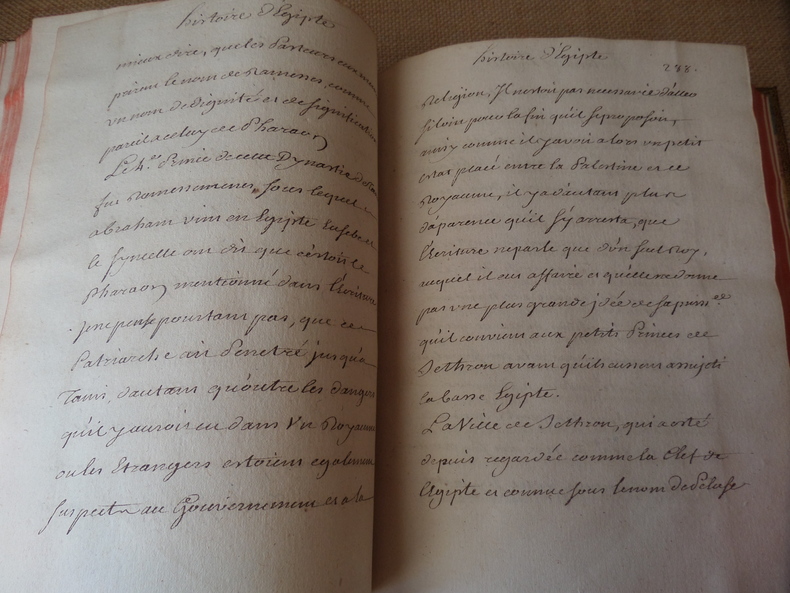
7819manuscrit sans date (début XVIIIe), reliure plein veau d'époque, dos à 5 nerfs, titres et fleurons dorés, roulette dorées sur chasses et champs, tranches rouges, 19,5x24 cm, pagination par feuilles, TOME I, partie 2 (251 à 474) : Histoire d'Egypte, 216 pages( 251 à 358) ; Histoire des Patriarches, 228 pages (359 à 472), table de l'histoire des Patriarches jusqu'à l'exode, 4 pages (473-474). TOME II, partie 1 (1 à 291) : Histoire de l'ancienne Grèce, 70 pages (2 à 36) ; Histoire d'Argos, 76 pages (37 à74) ; Histoire d'Athènes, 274 pages, (75 à 211) ; Histoire de Thèbes, 154 pages (215 à 291). TOME II, partie 2 (293 à 557) : Histoire de Lacedemone, d'Arcadie et de Troye en particulier : Histoire de Lacedemone, 48 pages (293 à 316), Histoire d'Arcadie, 10 pages (317 à 321), Histoire de Troye, 70 pages (323 à 357) ; Histoire de l'ancienne Italie, 154 pages (360 à 436) ; Histoire ancienne de la Sicile, 62 pages (437 à 467) ; Histoire ancienne de l'Affrique, des Isles de la mer méditeranée et des parties de l'Europe qui confinent à l'océan : Histoire ancienne de l'Affrique, 28 pages (469 à 482), Histoire ancienne de l'Espagne, 60 pages (483 à 512), Histoire ancienne de la Sardaigne, 8 pages (513 à 517), Histoire ancienne de la Corse, 3 pages (518 à 519), Histoire ancienne des Isles Baleaires, Majorique, Minorique et Irique, 2 pages (520), Histoire ancienne de l'Isle de Malthe, 3 pages (521 à 522) , Histoire ancienne de l'Europe, 12 pages (523 à 533) ; Histoire ancienne de la gaule, 30 pages (534 à548) ; Histoire ancienne de l'Angleterre, 16 pages (549 à 557).
Very Good English This rare blue-toned lithographed city map showing Nile shores on the south, Tombs of the Khalifs on the north, Railway Central Station on the west. It's folded in its publisher's wrappers. "Most interesting places in Cairo" list on the right side of the paper, up to the Oriental Philatelic House address and advertisement. On verso of the map, Oriental Philatelic House's illustrated collectible postage stamps list including completely Middle Eastern stamps like Egypt, Congress, and Commemorative Stams, Egyptian Sudanese stamps, Arabia-Hedjaz (Cradle and Home of Mohammedanism), Nejd (Wahhabi Regime), Palestine, Iraq, Packets, Transjordan, Great Libanon, and Syria. Original city map of Cairo in original publisher's wrappers. Cr. 8vo. (19 x 11 cm). In English. Oblong folio. (As open: 37 x 52 cm).
1840007517Paris, Ducollet 1840-1841, 1840. XII, 456; 612 S. Dekorative rote Lederbände der Zeit mit goldgeprägten Stehkanten, dreiseitig marmoriertem Schnitt sowie blindgeprägten Deckeln. Die 35 Briefe des französischen Reiseschriftstellers Baptistin Poujoulat (1809-1864) aus den Jahren 1836-37 schildern in der Hauptsache Kleinasien und Syrien, geben einen Abriß der türkisch-kurdischen Kriege und eine längere Beschreibung von Palmyra. Brunet 19979; "Poujoulat is a very interesting and penetrating observer" (Blackmer, p.282). Ein gut erhaltenes Exemplar mit nur leichten Gebrauchsspuren.
1887012779Wien, Alfred Hölder, 1887. XV, 172 S. Orig.-Halbleinenband mit dreiseitigem rotem Farbschnitt. "Gräfin von Hohenembs" war das Pseudonym, dessen sich Kaiserin Elisabeth ("Sissi") bediente, wenn sie - vermeintlich inkognito - auf Reisen ging. Die hier dokumentierte Rundreise hatte von Triest durch die Adria, durch die damals osmanische Ägäis über Rhodos und Cypern nach Ägypten und wieder zurück geführt. Beiliegt die Heliogravüre einer Porträtfotografie des Wiener Photographen Viktor Angerer, die Kronprinz Rudolf, den Sohn der Kaiserin, stehend mit Pelzmantel und Zigarette vor Staffage zeigt, Mit kleinem, altem Namenszug und der Vorderdeckel etwas fleckig, sonst jedoch noch schönes, gut erhaltenes Exemplar mit nur leichten Gebrauchsspuren.
1898004303Weinheim, Ackermann ohne Jahr [1898], 1898. VIII, 334 S. Orig.-Leinenband. Der Arzt und Erzähler Adam Karrillon (1853-1938) berichtet hier von der ersten seiner Reisen als Schiffsarzt, die ihn 1896 von Triest über die Adria durch Griechenland, schließlich nach Konstantinopel, Smyrna und Beirut, den Libanon nach Damaskus, Palästina und Ägypten führte. Mit altem Namensstempel und papierbedingt etwas gebräunt, sonst gut erhaltenes Exemplar mit nur leichten Gebrauchsspuren.
1985000057Frankfurt am Main, Insel, 1985. 421 S. Orig.-Leinenband mit Schutzumschlag. Der Fußschnitt mit Stempel "Mängelexemplar", sonst gut erhaltenes Exemplar mit nur leichten Gebrauchsspuren. Erste Ausgabe.
Very Good English Fine and attractive original panoramic photograph of Constantinople, Istanbul, printing-out paper, 4-part, buildings captioned and credits in negatives in French. 70x9 cm. A dark print. This panoramic photograph was taken by Gülmez Freres inside Robert College. Robert College was founded in Bebek by Christopher Robert, a wealthy American philanthropist, and Cyrus Hamlin, a missionary devoted to education in 1863. The Gülmez Frères were three brothers, of Armenian origin, who established a photography studio in Istanbul, Turkey in 1870. A short time later, they took photos for the Ottoman court and Sultan Abdulhamid II.
1372448Namur: Pères blancs d'Afrique, 1962 in-4, 68 pages, illustrations. Agrafé.
1373109Paris: Musée de l'Homme, Museum National d'Histoire Naturelle, 1966 in-4, nombreuses illustrations. Broché, cachet, bon état. Sommaire: Nadia KOSSIAKOV, Un répertoire-modèle de tatouage égyptien. - Marie-José TUBIANA, Danses zaghawa. - Christian MERLO et Pierre VIDAUD, Le symbolisme dahoméen, du Serpent queue-en-gueule. - Solange PINTON et Robert JAULIN, Organisation politique des Indiens Bari. - Louis CARLOZ, Poterie néo-calédonienne.
Very Good Turkish, Ottoman (1500-1928) Paperback. Folio. (33 x 24 cm). In Ottoman script (Turkish with Arabic letters), and bilingual text in French and Ottoman Turkish on the cover. [4] p. Paul Lange was a German musician, teacher, orchestra, and choir leader living and working in Istanbul. Lange "Europeanized" Turkish military music and was one of the pioneers to bring German and European classical music to the Ottoman capital in the years between 1880 and 1920. Lange was born in Kartzow, Prussia, the descendant of an old Prussian teacher family. He was trained at the teacher's college in Neuruppin to become a school teacher. He graduated from that college in 1879 with honors. Because of his high musical skills, he was then admitted to the "Royal Academic Institute for Church Music" in Berlin, where he received training as a church organist. In 1880, Lange moved to Constantinople, where he assumed a position as a music teacher at the German School (Alman Lisesi) as well as organist of the Chapel of the German Embassy. Subsequently, Lange also became a music teacher at various other institutes of higher education in Constantinople, including several Greek and Armenian high schools (lycées) as well as American colleges such as Robert College and American College for Girls. Lange became a successful piano teacher and subsequently also formed his private conservatory, which however had to declare bankruptcy after two years. He transformed an existing Italian orchestra into a large German-style symphony orchestra with which he conducted the first performances ever of Beethoven symphonies and Wagner operas in the Ottoman Empire, with enormous success. Finally, during his visit to Constantinople in 1898, Kaiser Wilhelm II, who had already appointed him a "Kaiserlicher Musikdirektor" in 1894, became aware of Lange and helped him gain a position as head of a naval military orchestra of the Ottoman Navy. Subsequently, he took over several other military ensembles, before finally being appointed Director of the Sultan's music after the revolution in 1908. Since then Lange carried the Ottoman Court title "Bey". As a member of the Ottoman court, Lange was allowed to stay in Istanbul by the Allied Military Administration when all other Germans and Austrians were deported from the city. When Lange died in Üsküdar, Ottoman Empire, in December 1919, he received a state funeral, and the British Embassy chaplain performed the funeral at Feriköy Protestant Cemetery. However, his widow and his youngest daughter, who had stayed with him in Istanbul, were deported to Germany only a few months later in May 1920. The German-American conductor Hans Lange (assistant of Arturo Toscanini in New York City, later conductor at the Chicago Symphony Orchestra, best known for numerous recordings with the Wagner soprano Kirsten Flagstad) was the oldest son of Paul Lange. Paul Lange was a close friend of fellow German lecturer, Dr. Friedrich Schrader, also a faculty member at Robert College in the 1890s.
Very Good Turkish, Ottoman (1500-1928) Paperback. Folio. (33 x 24 cm). In Ottoman script (Turkish with Arabic letters), and bilingual text in French and Ottoman Turkish on the cover. [4] p. Görög was a Hungarian composer of Hidîv [i.e. Khedive] Abbas Hilmi Pasha Anthem in Buselik, which was played in Egypt between 1892-1914. Not in OCLC. Extremely rare.
Very Good Arabic Original sheet music. Folio. (32 x 25 cm). In Arabic and French. 4, [1] p. Illustrated cover. Stamp on cover by 'Hanna George'. Second page has personal stamp of Messih (Publisher). [SHEET MUSIC] Mohamad Labis Seifou pour piano par Mathilde Abdel Messih.= Mohammad Labis Saife bagmat al-hejaz mousiki waz' Matilde Abdalmesih. No. 35. Printed in Egypt.
Very Good Arabic Original sheet music. Folio. (32,5 x 25 cm). In Arabic and French. 4, [1] p. Illustrated cover. [SHEET MUSIC] Ya taleh el-Saad Ifrahli Musique pour piano et instruments Arabes.
Very Good English Original bdg. HC. Oblong 4to. (21,5 x 28 cm). In English. [48] p., fully ills. First and only edition of this scarce and attractive souvenir album including 24 photogravures of general views, streets, architectural buildings, natives, and social life of Cairo, photographed, edited and published by German photograph studio of Cairo "Lehnert & Landrock". Lehnert & Landrock was a photographic studio run by Rudolf Franz Lehnert (1878-1948) and Ernst Heinrich Landrock (1878-1966) active in Tunisia and Egypt in the early 20th century, noted for producing Orientalist images. Rudolf Franz Lehnert and Ernst Heinrich Landrock produced images of North African people, landscapes, and architecture for a primarily European audience. These images were mainly distributed in monographs, though also as original prints, photogravures, and lithographic postcards. (Source: Wikipedia).
Very Good French Original wrappers. Oblong: 9x15 cm. In French. Very rare souvenir album of Cairo in French, consisting of 12 attractive lithograph postcards showing Cairo's streets, social life in the city, architectural buildings, the Caliph tombs, The Nile river, etc., edited by Middle Eastern photographer and postcard editors "Behar & Fils". No copy in OCLC.