25 résultats
16194155AG1619. Kupferstich von Boetius-Adams Bolswest nach Abraham Bloemert, 8,9 x 14,7 (incl. Titel), Bll. 17 x 22,8; auf Rückseite lat. Text über S. Abraham; beiliegend: Kopie des zugehörigen Textes. Auf Wunsch Digitalaufnahme in jpg-Format erhältlich- photo in jpg-format available. Je nach Versandart können die Portokosten bis zu 2 ? weniger als angegeben betragen.+
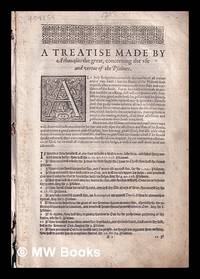
1650434134N.I. : N.I. 1650. N.I. Softcover. Poor copy in aniline-calf board only back board remaining. Spine cracked and torn cover bumped nicked and rubbed as with age. Foxing browning and creasing to the pages. Estimated year of publication. Physical description; first few pages missing b&w text. Subjects; A treatise made by Athanasius the Great concerning the vse and vertue of the Psalmes. N.I. : N.I. paperback
1682PW1341London:: Printed by M. Flesher for Thomas Fickus 1682. 1682. 8vo. 54 166 pp. Original calf boards rebacked with calf new endleaves; small tear to lower corner of p. 165 far from text block. Signed by Alfred Keene 1839. First English edition. This is one of the first books Norris published. "Norris John 1657–1712 Church of England clergyman and philosopher was born on 2 January 1657 at Collingbourne Kingston Wiltshire the third surviving child of John Norris bap. 1614 d. 1682 and his wife Elizabeth d. 1696. His father was vicar of Collingbourne Kingston under the Commonwealth and he moved to the living of Aldbourne Wiltshire in 1660. Norris was educated at Winchester College and entered Exeter College Oxford in 1676. A keen student at both Winchester and Oxford he early abandoned his inherited Calvinism and concentrated his reading on Platonist authors. On graduating BA in 1680 he was appointed a fellow of All Souls by Archbishop Sancroft on the recommendation of Thomas Jeames the warden during a dispute with the fellows over the filling of the vacancies in the college. Norris always retained a great esteem for All Souls and the college in turn erected a bust of h His early writings show him to have been at that time a strong tory and high-churchman but also show that he deliberately turned aside from political involvement. All the writings that he considered to be worth preserving were included in A Collection of Miscellanies which appeared in 1687. im in the Codrington Library when this was built in the following century. . . . Norris's writings have tended to be neglected by historians of philosophy partly perhaps because of Locke's dismissive attitude and partly because many of his theories are so close to those of Malebranche that it is difficult to disentangle their influence. He has been better treated by historians of literature who see his poetry much of which continues to be republished as marking especially clearly the transition from the spirit of the Renaissance to that of modern times. Much of Norris's poetry which has its roots in the metaphysical tradition is somewhat laboured. At his best however he has a lyrical spirit . . . In private life Norris seems to have been a kindly person a devoted parish clergyman and the friend and supporter of several of the learned ladies of his time. In the history of English thought he is a transitional figure. In contrast to the Cambridge Platonists he adopted wholeheartedly the Cartesian dualism of mind and matter. His theory of knowledge was a Cartesian Platonism similar to that of Malebranche to whose more developed theories he was at times too inclined to defer. In the history of English philosophy religion and literature he deserves to be remembered." – DNB. Lowndes The Bibliographer's Manual of English Literature vol. 3 p. 928. See: W. J. Mander The Philosophy of John Norris. Printed by M. Flesher, for Thomas Fickus, 1682. hardcover
1682PW1341London:: Printed by M. Flesher for Thomas Fickus 1682. 1682. 8vo. 54 166 pp. Original calf boards rebacked with calf new endleaves; small tear to lower corner of p. 165 far from text block. Signed by Alfred Keene 1839. First English edition. This is one of the first books Norris published. "Norris John 1657–1712 Church of England clergyman and philosopher was born on 2 January 1657 at Collingbourne Kingston Wiltshire the third surviving child of John Norris bap. 1614 d. 1682 and his wife Elizabeth d. 1696. His father was vicar of Collingbourne Kingston under the Commonwealth and he moved to the living of Aldbourne Wiltshire in 1660. Norris was educated at Winchester College and entered Exeter College Oxford in 1676. A keen student at both Winchester and Oxford he early abandoned his inherited Calvinism and concentrated his reading on Platonist authors. On graduating BA in 1680 he was appointed a fellow of All Souls by Archbishop Sancroft on the recommendation of Thomas Jeames the warden during a dispute with the fellows over the filling of the vacancies in the college. Norris always retained a great esteem for All Souls and the college in turn erected a bust of h His early writings show him to have been at that time a strong tory and high-churchman but also show that he deliberately turned aside from political involvement. All the writings that he considered to be worth preserving were included in A Collection of Miscellanies which appeared in 1687. im in the Codrington Library when this was built in the following century. . . . Norris's writings have tended to be neglected by historians of philosophy partly perhaps because of Locke's dismissive attitude and partly because many of his theories are so close to those of Malebranche that it is difficult to disentangle their influence. He has been better treated by historians of literature who see his poetry much of which continues to be republished as marking especially clearly the transition from the spirit of the Renaissance to that of modern times. Much of Norris's poetry which has its roots in the metaphysical tradition is somewhat laboured. At his best however he has a lyrical spirit . . . In private life Norris seems to have been a kindly person a devoted parish clergyman and the friend and supporter of several of the learned ladies of his time. In the history of English thought he is a transitional figure. In contrast to the Cambridge Platonists he adopted wholeheartedly the Cartesian dualism of mind and matter. His theory of knowledge was a Cartesian Platonism similar to that of Malebranche to whose more developed theories he was at times too inclined to defer. In the history of English philosophy religion and literature he deserves to be remembered." – DNB. Lowndes The Bibliographer's Manual of English Literature vol. 3 p. 928. See: W. J. Mander The Philosophy of John Norris. Printed by M. Flesher, for Thomas Fickus, 1682. hardcover books
16961396587Lipsiæ Leipzig: Sumptibus Hæredum M. G. Weidmanni & IOH 1696. Hardcover. Large quarto 82 455 1 362 pages. In Good condition. Bound in full brown leather. Paneled spine with faded gilt ornamentation and lettering with moderate chipping and cracking. Loss of leather along the spine head/tail edges. Boards have significant age toning along the front head edge with chipping to leather stains rubbing wear and cracking to joints. Significant bumping to corners resulting in exposed board. Textblock has a tear along the tail hinge corner of the front pastedown and worming along the end papers. Front free end page has an open tear residual of a label and pen inscription. Library stamps on the half-title and title page. Significant age toning offsetting and foxing throughout a tear along the tail fore corner of page 193 not impacting text. Text in Greek and Latin. Shelved in Room A. VD17 23:296885A. 1396587. Special Collections. Sumptibus Hæredum M. G. Weidmanni & IOH hardcover
169145401Lugdunum Batavorum (Leiden), Danielem à Gaesbeek, 1691. Small8vo. Contemp. full vellum. Spine gone and frontcover detached. Some soiling to covers. Wood-cut printers device on titlepage. (24),468 pp. and many diagrams in the text. A few scattered brownspots and a few quires with light browning.
169145401Lugdunum Batavorum Leiden Danielem à Gaesbeek 1691. Small8vo. Contemp. full vellum. Spine gone and frontcover detached. Some soiling to covers. Wood-cut printers device on titlepage. 24468 pp. and many diagrams in the text. A few scattered brownspots and a few quires with light browning. <br/><br/><em>First edition of Heinrich Coetsius' translation of the six first books of Euclid.Riccardi 1691 7 - Max Steck p. 109 1691. </em> hardcover
1617201280<p>Coloniae / Cologne: Sumptibus Antonii Hierat 1617. folio. Hardcover. Very Good. Full contemporary vellum 14.75" x 9.75" foredge yapped 12 541 83 pp. decorative head & tailpieces to text. Ownership ex-libris inscription dated 1666 on title page; another annotation dated 1729 of the Heidelbergre Society of Jesus. Large woodcut device to title page; t.p. printed in red & black. The works of Athanasius is one of the earliest Church fathers writing at the time when so much theology & dogma were being fiercely debated. Extra postage required for international or expedited shipping.</p> Sumptibus Antonii Hierat hardcover
16174700Cologne: Sumptibus Antonii Hierat. 1617. Folio 15" x 10". 1254183pp. Double column text. Indices. Title printed in red & black with a large woodcut device. Cont. vellum soiled. Cont. ownership signature on title dated 1666. The Patron Saint of Alexandria Athanasius died in 373. Sumptibus Antonii Hierat. hardcover books
16739774London: Printed by J.R. for J.Williams. and are to be sold by Henry Dickinson of Cambridge 1673. 8vo. 2 parts in 1 volume pp. xxxii 433 lxvii 271 i. Greek text with Latin facing some very light spotting and toning. Contemporary gilt-ruled calf rebacked preserving original fully gilt spine headcaps renewed. Faint ecclesiatical ink stamp to title possibly a convent of Discalced Carmelites. Commentary on the Golden Verses of the Pythagoreans composed by the Neoplatonist philospher Hierocles in the fifth-century. The translation is by the 16th century Parisian scholar Joannes Curterius possibly Jean Courtier and Theodore Marcile and our edition also features notes and commentaries by Meric Casaubon son of the renowned classical scholar and philologist Isaac and John Pearson Bishop of Chester. Book Printed by J.R. for J.Williams... and are to be sold by Henry Dickinson of Cambridge, unknown
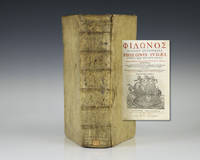
164135424Lutetiae Parisiorum: Typis Regiis 1641. Tall folio 32.7 cm 12.9". 28 854 74 lacking 7579 index pp. some pagination erratic; 823/24 repeated. <br><br>Works of the second-century Greek theologian Clement of Alexandria ca. 150215 reissued from the 1616 Patius printing and here handsomely printed by the French Royal Press. This edition was apparently also issued with the title-page in a different state sporting the imprint as "Apud Matthaeum Guillemot via Iacobaea sub signo Bibliothecae."<br>Â Â Â Â Set forth is Heinsius's edition of the text with Greek and Latin in parallel columns additionally offering the earlier revisions and alternate readings by Friedrich Sylburg; the title-page is printed in red and black with an impressive sailing ship publisher's device while the main text pages are ornamented with head- and tailpieces and decorative capitals.<br>Â Â Â Â Provenance: Title-page with inked inscription "J.D. Michaeli" presumably Orientalist biblical scholar and Göttingen professor Johann David Michaelis 171791. Later manuscript notes as below in the hand of the early 19th-century scholar August Neander; his library sold to the Colgate Rochester Crozer Divinity School properly deaccessioned.<br>Â Â Â Â Evidence of readership: Three pages completely covered in Neander's hand with annotations in Greek and Latin tipped in at the front; pencilled marks of emphasis inked underlining and inked marginal annotations in what appear to be two different early hands. <br>Â Â Â Â <br>Â Â Â Â Brunet II 93. Period-style quarter speckled calf and marbled papercovered sides spine with raised bands and gilt-stamped leather title-label all edges red; final three index leaves only lacking. Trimmed closely in some instances touching headers and often the marginalia; approximately 30 leaves with a finger's-breadth portion of upper edge chewed affecting headers but never text; several leaves with repaired tears or reinforced margins; one leaf with flaw in outer margin touching three letters. Markings as above; occasional small areas of light staining or inkblots one small burn hole and two pages with dripped red wax. => A solid and very readable copy in an attractive recent binding with provenance worthy of note. Typis Regiis hardcover books
167914487Lyon, Claude La Roche, 1679 ; petit in-8 ; demi-basane fauve, titre doré (reliure du XIXe) ; (16), 497, (15) pp.
164018000Paris: Lutetiae Parisiorum 1640. Folio contemporary blind-stamped vellum. Greek and Latin text in parallel. Moderate wear to the binding from the library of the Bishop of Vermont generally sound otherwise. The Opera of the Hellenistic Jewish Biblical philosopher Philo Judaeus 20 BC-50 AD who blended Greek philosophy and Judaism. Philo used philosophical allegory to attempt to fuse and harmonize Greek philosophy with Jewish philosophy. His method followed the practices of both Jewish exegesis and Stoic philosophy. His allegorical exegesis was important for several Christian Church Fathers but he has barely any reception history within Rabbinic Judaism. He believed that literal interpretations of the Hebrew Bible would stifle humanity's view and perception of a God too complex and marvelous to be understood in literal human terms. "In the Diaspora Judaism was forced to come to terms with Hellenism in a manner that could be avoided in Palestine itself. There was a movement within Judaism that sought to show the compatibility between the ancient faith and the best of Hellenistic culture. The high point of this entire tradition was Philo of Alexandria. who sought to show that the best of pagan philosophy agreed with the Hebrew Scriptures" Gonzalez I:13. According to Charles Duke Yonge who translated this volume into English in the 19th century these treatises prove Philo "deeply versed in Greek literature of every age and description and of considerable skill in the sciences of music geometry and astronomy. It is impossible to deny him the praise of acuteness and ingenuity set off to their best advantage by neatness of language and felicity of expression." French scholar-printer Adrian Turnebe who was both Royal Reader in Greek and directory of the Imprimerie Royale uncovered a trio of Greek manuscripts in the king's library that he used to compile this volume. Lutetiae Parisiorum hardcover books
168649724Coloniae: Mauritii Georgii Weidmanni 1686. 2 vols. Original vellum hardcovers. With blind stamped decoration. xxviii portrait 10878 pp. & 704138139 pp.; 36.6x26 cm. Text in Latin. - hinges vellum bit cracked paper seriously browned and with spots Although still very good see picture. More pictures on request Mauritii Georgii Weidmanni hardcover
1647179140Bologna: Per Carlo Zenero 1647. Hardcover. VG overall wear and staining to the temporary white boards text/illustrations/diagrams are very clean and clear with light age toning as expected with age. Has been temporarily rebound by an astute amateur most would likely prefer this to be rebound by a more seasoned hand. Bound in simple white boards utility binding only bw illustrated title page 8 103 8 pages bw illustrations and diagrams throughout. Text in Italian. " Aggiontoui dal medesimo Quattro theoremi non men belli. Et il modo con che si fà artificiosamente salir vn canale d'acqua viua ò morta in cima d'ogn'alta torre." - title page translated: Added by the same Quattro theoremi non less belli. And the way in which it is artificially made to rise in a channel of water is dead on top of every high tower. The "Quattro theoremi" p. 87-103--has special title page. Per Carlo Zenero hardcover
1660990F21London: B. Mills and J. Robinson c1660 . First edition. Cloth. Very Good. 8" by 5". None. A bright example of James Bellamy's very scarce first English language translation of Origen's 'Contra Celsum' offering an impassioned defence of Christianity. The very scarce first English language translation of this work translated from the original Latin of Origen of Alexandria by James Bellamy.Written around 248 AD this is a major apologetics work by Origen of Alexandria which counters the work of pagan philosopher and controversialist Celsus who had written an attack of Christianity in 'The True Word'.Rebound in cloth with endpapers renewed. Library bookplates of the General Theological Seminary to pastedowns with stamps to title page and final leaf.ESTC R32215Retaining half title. With a divisional half title and separate pagination but with continuous register as called for.2 A-2C8 2D6. Collated complete. Undated; dated circa 1660 via the majority of institutions such as the London Library and by Wing STC.Origen wrote this work 'Contra Celsum' at the request of his patron a wealthy Christian named Ambrose who insisted that a Christian needed a response to Celsus. Rebound in cloth with endpapers renewed. Externally fine. Library bookplates to front and rear pastedown. Internally firmly bound. Library stamp to verso of final leaf and title page. Pages lightly age toned but generally clean and bright. Small loss to fore edge of half title. Very Good B. Mills and J. Robinson hardcover
161937801Pisavri (Pesaro), Typis Flaminij Concordiæ, 1619. Folio. Contemp. hcalf. Fronthinge nearly broken, but still holding. Titlepage in red a. black. (8) of 10 leaves, lacking first leaf of the foreword and last leaf of Index. Text complete. 255 leaves with many figures in the text. First 16 leaves with some browning and foxing in lower right corners. 5 leaves mended, no loss of text and 8 with smaller repairs, no loss. A few annotations in margins in old hand.
161937801Pisavri Pesaro Typis Flaminij Concordiæ 1619. Folio. Contemp. hcalf. Fronthinge nearly broken but still holding. Titlepage in red a. black. 8 of 10 leaves lacking first leaf of the foreword and last leaf of Index. Text complete. 255 leaves with many figures in the text. First 16 leaves with some browning and foxing in lower right corners. 5 leaves mended no loss of text and 8 with smaller repairs no loss. A few annotations in margins in old hand. <br/><br/><em>Scarce second expanded edition of Federico Commandino's importent translation of the Elements. Commandino's first translation was published in 1572 and this translation was made use of by subsequent editors for centuries. The first Italian translation was also done from the Latin text of Commandino. - Riccardi 16192. - Max Steck: IV 19. </em> unknown
1647179140Bologna: Per Carlo Zenero 1647. Hardcover. VG overall wear and staining to the white boards text/illustrations/diagrams are very clean and clear with light age toning as expected with age. Bound in simple white boards utility binding only bw illustrated title page 8 103 8 pages bw illustrations and diagrams throughout. Text in Italian. " Aggiontoui dal medesimo Quattro theoremi non men belli. Et il modo con che si fà artificiosamente salir vn canale d'acqua viua ò morta in cima d'ogn'alta torre." - title page translated: Added by the same Quattro theoremi non less belli. And the way in which it is artificially made to rise in a channel of water is dead on top of every high tower. The "Quattro theoremi" p. 87-103--has special title page. Per Carlo Zenero hardcover books
163734701Uppsala, Eschillus Matthiæ, 1637. Small 4to. Cont. full vellum over wood. Spine ends worn, tears to hinges, but not broken, lower edges of boards with old repairs. Some old ink annotations on boards. Inside frontcover and on title many old owner names, small wholes cut in titel without loss of letters. First ab. 20 leaves with a faint dampstain in upper margin, inkspots on last page. Internally clean. (24),350,(2) pp., numerous geometrical diagrams in the text.
163734701Uppsala Eschillus Matthiæ 1637. Small 4to. Cont. full vellum over wood. Spine ends worn tears to hinges but not broken lower edges of boards with old repairs. Some old ink annotations on boards. Inside frontcover and on title many old owner names small wholes cut in titel without loss of letters. First ab. 20 leaves with a faint dampstain in upper margin inkspots on last page. Internally clean. 243502 pp. numerous geometrical diagrams in the text. <br/><br/><em>Scarce first edition of the first Swedish edition of Euclid's Elements Book I-VI with Gestrinius' commentaries to the axioms and porpositions and with his attempt of a proof of the "Parallel-axiom" The Fifth Postulate. In the preface he discusses the use of plane-geometry in the theories of Aristoteles Eudoxus Ptolemy and Kepler. - Gastrinius 1594-1648 became professor of mathematics in Uppsala in 1621 after studies in Greifswald.Collijn 1600-Talet I:310. - Riccardi p. 436 16372 - Poggendorff I:889. - Not in Max Steck. </em> hardcover
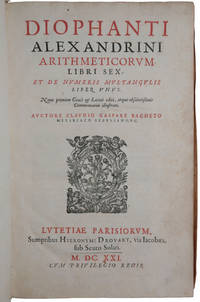
16216237Paris: Hieronymus Drouart 1621. First edition. <p>First edition of the Greek text extremely rare large-paper copy of the foundational work of algebra - the edition that Pierre de Fermat acquired in the mid-1630s and annotated with the forty-eight marginal observations that are the founding documents of modern number theory. Fermat's copy is lost; these are the sheets from the same Paris setting that he had in front of him. Claude Gaspard Bachet de Méziriac a country gentleman of Bas-Quercy whose entry into number theory had come through his 1612 Problèmes plaisants spent several years establishing a corrected Greek text improving Xylander's 1575 Latin translation filling the lacunae correcting errors and generalising Diophantus's procedures; his edition remained standard until Tannery's Teubner text of 1893-1895. Against Problem II.8 at page 85 - on the decomposition of a square into two squares - Fermat wrote the proposition now known as Fermat's Last Theorem closed by Andrew Wiles in 1995 three hundred and fifty-eight years after the margin.</p>. Editio Princeps of the First Systematic Treatise on Algebra. <p>First edition of the Greek text extremely rare large-paper copy of the foundational work of algebra and the book in whose margins Pierre de Fermat wrote the most celebrated annotations in the history of mathematics. Before this volume appeared from the Paris press of Hieronymus Drouart in 1621 the Arithmetica of Diophantus of Alexandria existed in print only in Latin: in Wilhelm Holzmann's pioneering but rough 1575 Basel translation - its translator who hellenized his name as Xylander was a humanist who had taken up algebra as a hobby - and in the partial adaptations Rafael Bombelli had incorporated into his 1572 Algebra after reading a Greek manuscript in the Vatican Library. Claude Gaspard Bachet de Méziriac a country gentleman of Bas-Quercy extraction with classical tastes and no professional mathematical training had come to number theory through mathematical recreations - the puzzles of the Greek Anthology and the Renaissance tradition of mathematical amusement that he had collected in his Problèmes plaisants et délectables qui se font par les nombres Lyon 1612 - and from there to Diophantus. He spent several years before 1621 establishing a corrected Greek text improving Xylander's Latin translation where Xylander had failed to understand his source filling the lacunae of the defective archetype from which all surviving manuscripts descend identifying and correcting numerical errors generalising Diophantus's procedures and appending three books of his own Porismata. The result is both the editio princeps of the Greek text and the standard scholarly edition unsurpassed until Paul Tannery's Teubner Diophantus of 1893-1895 and the single most consequential textual achievement in the early-modern reception of Greek mathematics.</p> <br /> <br /> <p>The copy offered here preserves the edition in its most ambitious form. Ordinary copies of the 1621 Bachet measure approximately 337 by 218 millimetres; this copy measures 353 by 225 placing it squarely within the small large-paper issue that Drouart ran alongside the ordinary impression. It is bound in its original yapped vellum the overhanging edges still intact and flexible; the edges of the text block are sprinkled red in the French manner of the early seventeenth century; the spine carries a handwritten manuscript title in Greek and Latin - Diophanti Alexandreos Arithmetikon kai peri polygonon arithmon bibl. followed by cum Commentariis Cl. Gasp. Bacheti - in a plainly contemporary hand the vellum itself serving as the label. The sheets are fresh crisp and unpressed. The title page printed in red and black carries a fine engraved vignette of a flowering thistle within an oval frame a cherub at either side of the cartouche and two satyrs at the base among fruits and foliage surrounded by the dividing mottoes si frote patere aut and ne tan abstine. Two imprints of the 1621 edition were issued simultaneously one under the name of Hieronymus Drouart sub Scuto Solari and one under the name of Sébastien Cramoisy identical in every other respect; the sheets are from the same setting and no priority between the two has been established. The present copy is the Drouart imprint.</p> <br /> <br /> <p>The Arithmetica itself is the foundational work of Greek algebra. Of the thirteen books that Diophantus's introduction - addressed to one Dionysius arguably Saint Dionysius of Alexandria - promises the Byzantine tradition preserved six in Greek and those are the books printed here. A ninth-century Arabic translation by QustÄ ibn LÅ«qÄ supplying four further books was discovered by Jacques Sesiano in the Astan-i Quds library at Meshed Iran in 1968 - one of the great manuscript finds of the twentieth century. The consensus that has emerged from Sesiano's edition is that the Arabic books correspond to Diophantus's original Books IV through VII and that the six preserved Greek books must be renumbered as Books I through III and after a lacuna Books VIII through X; Books XI through XIII are irretrievably lost. What Bachet had before him in 1621 and what Fermat in his turn would read and annotate was therefore the Byzantine six-book corpus: 189 problems in indeterminate analysis closing with a fragment on the theory of polygonal numbers cast in the older geometrical idiom.</p> <br /> <br /> <p>The introduction explains Diophantus's symbolism which is the first and only occurrence of algebraic notation anywhere in surviving Greek mathematics. He uses abbreviated signs for the unknown quantity corresponding to the modern x and for its powers up to the sixth for subtraction and for equality. The symbols are scribal abbreviations rather than arbitrary conventions but they function as an effective algebraic language intermediate between the purely verbal mathematics of his Greek predecessors and the fully symbolic algebra that would emerge in the sixteenth century with Viète and in the seventeenth with Descartes. Diophantus teaches the multiplication of positive and negative terms and the reduction of an equation to one with only positive terms - the standard form preferred in antiquity which treats negative coefficients as impermissible answers to be moved across the equals sign rather than as legitimate quantities in their own right. Throughout the work he uses the word arithmos rendered by Bachet as numerus to mean what would now be called a positive rational; negative and irrational solutions are never acknowledged.</p> <br /> <br /> <p>The Arithmetica is a collection of approximately two hundred and sixty problems in what is now called indeterminate analysis - the search for rational solutions to polynomial equations that have more unknowns than equations and that therefore admit in general infinitely many solutions to be found by ingenuity rather than algorithm. The problems of Book I are mostly simple illustrations of the algebraic reckoning that Diophantus has just established. The distinctive features of his method emerge in Books II and III which became the seedbed of modern number theory. In three problems of Book II - the first of them the celebrated Problem II.8 on dividing a given square into two squares whose rational solutions are the Pythagorean triples - Diophantus shows how to represent any given square as a sum of two rational squares; any given non-square that is itself the sum of two known squares as a sum of two other squares; and any given rational number as the difference of two squares. The second of these problems presupposes knowledge of one decomposition hinting that not every integer admits such a decomposition - a question Diophantus later addresses by giving the correct necessary condition: the number must not contain a prime factor of the form 4n 3 raised to an odd power. Diophantus states this condition without proof. It was taken up by Fermat proved by Euler and generalised by Gauss into the representation theory that occupies more than half of the Disquisitiones Arithmeticae.</p> <br /> <br /> <p>The Arabic books although not available to Bachet confirm the architecture of Diophantus's project as Bachet had intuited it. Their prefaces state that their purpose is to provide the reader with experience and skill and they extend the basic methods of Books I through III to problems of higher degree reducible to binomial equations. The former Greek Books IV and V now Books VIII and IX solve more demanding problems: one decomposes a given integer into two squares arbitrarily close to each other; another decomposes an integer into three squares excluding the impossible case of integers of the form 8n 7 - a result Diophantus asserts but does not prove and that would not be proved until the eighteenth century. The former Book VI now Book X treats right-angled triangles with rational sides subject to various further conditions. The work closes with a fragment of a separate treatise on polygonal numbers - those that can be arranged as regular polygons of dots: triangular numbers nn 1/2 the squares the pentagonals n3n − 1/2 and so on - differentiated from the Arithmetica proper by its use of geometrical proofs rather than algebraic methods and breaking off in the middle of an investigation of how many ways a given integer can be a polygonal number.</p> <br /> <br /> <p>The textual transmission of the Arithmetica is itself a chapter in the history of the book. In Byzantium where the Greek archetype was preserved Michael Psellus in the eleventh century saw what was perhaps the only surviving copy; Georgius Pachymeres 1240-1310 wrote a paraphrase of Book I; Maximus Planudes c. 1255-1310 wrote a commentary on Books I and II. Cardinal Bessarion rescued the manuscript from Constantinople before its fall in 1453 and Regiomontanus discovered it at Venice about 1463 proposing to make a Latin translation that he never produced. For a century thereafter nothing further was heard of Diophantus. He was rediscovered by Rafael Bombelli 1526-1572 the engineer from Bologna whose day job was draining the Chiana marshes and who read a Greek manuscript of the Arithmetica in the Vatican Library about 1570 translated most of it into Italian for his own use and incorporated one hundred and forty-seven of its problems eighty-one with the same numerical values into his Algebra of 1572 - the book that introduced complex numbers into European mathematics and that Bombelli substantially revised before publication as a consequence of his encounter with Diophantus. Three years later the first complete Latin translation by Wilhelm Xylander appeared at Basel; it was the basis for a free French rendering of the first four books by Simon Stevin 1585. Viète drew thirty-four problems from Diophantus for his Zetetica of 1593 restricting himself to those that did not violate his principle of homogeneity of dimension.</p> <br /> <br /> <p>Bachet's 1621 edition superseded every one of these earlier engagements. He studied the text with a thoroughness that no mere philologist could have equalled: Xylander had all too often failed to make sense of corrupt passages where Bachet succeeded because Bachet could read the mathematics as well as the Greek. He filled lacunae identified and corrected the numerical errors that earlier scribes and Xylander after them had introduced generalised the procedures and devised new problems continuing Diophantus's programme. His great critic and admirer André Weil whose Number Theory: An Approach through History from Hammurapi to Legendre Birkhäuser 1984 remains the standard scholarly account observed that Samuel Fermat's praise of Bachet in the preface to the 1670 reprint was by no means excessive and that Bachet's apparent disadvantage - his imperfect grasp of the new symbolic algebra of Viète - may actually have benefited number theory in the end. Because he could not readily translate Diophantus into the algebraic language then emerging Bachet laid emphasis on those aspects of the text that were most properly arithmetical and prominently among these on questions regarding the decomposition of integers into sums of squares. It was Bachet who asked for the conditions under which an integer is a sum of two or of three squares and who extracted from Diophantus the conjecture that every integer is a sum of four squares and asked for a proof. The questions passed directly to Fermat and through Fermat to Euler Lagrange and Gauss.</p> <br /> <br /> <p>Fermat acquired his copy of the Bachet Diophantus in the mid-1630s probably through the circle of Carcavi and Mersenne in Paris. Over the course of his long judicial career at Toulouse and Castres he annotated it with forty-eight marginal observations each written against a particular problem in Bachet's text that together constitute the founding documents of modern number theory. They include the two-square theorem which states that every prime congruent to one modulo four is the sum of two squares in essentially one way; the conjecture later proved by Lagrange that every integer is the sum of four squares; Fermat's Little Theorem that for any prime p and any integer a not divisible by p the quantity a raised to the power p − 1 is congruent to one modulo p; the method of infinite descent as a rigorous technique for negative existence proofs; and - written in the margin of Problem II.8 at page 85 of this edition adjacent to Diophantus's treatment of the decomposition of a square into two squares - the claim that no cube can be decomposed into two cubes no fourth power into two fourth powers and in general no power higher than the second into two powers of the same kind together with the famous remark that he had discovered a truly marvellous proof of this proposition which the narrowness of the margin could not contain. The proposition is Fermat's Last Theorem. It resisted proof for three hundred and fifty-eight years until Andrew Wiles closed it in a one-hundred-page paper in the Annals of Mathematics in 1995 using techniques - the theory of modular forms the arithmetic of semistable elliptic curves the Galois representations emerging from the Langlands programme - that Fermat could not have envisaged. Fermat's annotated copy the physical object on which he wrote those forty-eight notes has been lost for over three centuries; its contents survive because Clément-Samuel de Fermat working from his father's papers in the years after the elder Fermat's death in 1665 transcribed the observations and printed each at the appropriate point in Bachet's text in the 1670 Toulouse reprint the companion item in the present catalogue. Every surviving copy of the 1621 Bachet therefore bears in a material sense the weight of Fermat's missing copy: these are the sheets from the same setting of the same edition in the same Greek and Latin and with the same commentary against which Fermat was reading and writing.</p> <br /> <br /> <p>The decisive turn in the reception of Fermat's programme came a century after his death when Leonhard Euler produced the proof of the Last Theorem for exponent three in 1770 invoking the method of descent Fermat had developed for other purposes. Sophie Germain in the first decade of the nineteenth century opened a substantial class of exponents; Dirichlet and Legendre settled exponent five in 1825; Kummer's introduction of ideal numbers in the 1840s addressed to the failure of unique factorisation in the relevant cyclotomic integers founded algebraic number theory and proved Fermat's proposition for all regular primes. By the late nineteenth century the Last Theorem had become the most celebrated unsolved problem in mathematics and the whole of twentieth-century algebraic number theory and arithmetic geometry can be read as a cumulative response to the challenge Fermat set down in the margin of a page that is printed in this very edition. The two-square theorem the four-square theorem the little theorem and the sum of three triangular numbers all passed through similar cycles of Fermat's claim delayed demonstration and subsequent theoretical elaboration - and each of them like the Last Theorem itself began its public life as a marginal note in Fermat's copy of Bachet's 1621 Diophantus.</p> <br /> <br /> <p>The Arab reception of Diophantus although largely lost is documented by bibliographical sources that Bachet could not have known. Al-NadÄ«m's Fihrist of 987/988 records that QustÄ ibn LÅ«qÄ c. 900 wrote a commentary on three and a half books of the Arithmetica and that AbÅ«'l-WafÄ' 940-998 wrote both a commentary and a book of proofs of the propositions Diophantus had used; a commentary by Ibn al-Haytham with marginal notations by Ibn YÅ«nus is also attested but has not survived. The most substantial surviving witness to the Arab Diophantus is the algebra of al-KarajÄ« in early eleventh-century Baghdad which absorbed a third of the problems from Diophantus's Book I all the problems from Book II beginning with II.8 and almost all of Book III. In the Latin West problems of Diophantine type first appeared in Leonardo of Pisa's Liber Abbaci of 1202 transmitted from Arabic sources during Leonardo's journeys around the Mediterranean. The long chain from the lost Greek archetype through Byzantium Venice Rome Basel and Paris to the copies of Bachet's 1621 edition that passed into the working libraries of seventeenth-century mathematicians is reconstructed here in a single volume.</p> <br /> <br /> <p>Bachet himself having seen the Arithmetica through the press in 1621 retired to his country estate married and apparently gave up all mathematical activity beyond a second edition of his Problèmes plaisants that incorporated material originally intended for a treatise on arithmetic which he never wrote. He died in 1638 three years before his election to the Académie française and a generation before his work would reach its full consequence through Fermat's marginalia. Almost nothing is known about the life of Diophantus himself. He quotes Hypsicles fl. c. 150 BC and is quoted by Theon of Alexandria c. AD 364 and a date around AD 250 is generally accepted; that would place him in late Hellenistic Alexandria at the chronological edge of the tradition of Greek mathematical creativity that had begun with Thales. The Byzantine epigram that gives his age at death as eighty-four extrapolated from a series of Diophantine conditions on the years of his boyhood youth marriage and the birth and death of his son is textually reliable but biographically useless. What survives of him is the mathematics.</p> <br /> <br /> <p>The book's working life in the seventeenth and early eighteenth centuries can be measured by the hands through which it passed. Isaac Newton owned a copy Harrison 524 now at Trinity College Cambridge and referred to Diophantus in his mathematical notebooks. Leibniz studied the work. Euler began his revival of Fermat's number-theoretic programme in the 1730s by working through the Observationes in the 1670 reprint of precisely this edition. The continuous research that culminated in Gauss's Disquisitiones Arithmeticae of 1801 and from there in the whole nineteenth-century elaboration of algebraic and analytic number theory runs back through Euler and Lagrange to Fermat's marginalia and through Fermat's marginalia to Bachet's 1621 printing of the Greek text. Large-paper copies such as the one offered here were produced in small numbers - probably as presentation copies for Bachet's dedicatees and for purchase by serious mathematicians who wanted the generous margins for their own annotations. The sheets of this copy are unpressed and the state of preservation exceptional; the contemporary yapped vellum binding with its handwritten Greek and Latin spine title in a seventeenth-century hand is the same working binding in which the volume left the Paris trade in 1621.</p> <br /> <br /> <p>References: Honeyman 891 - Smith Rara Arithmetica pp. 348 and 368 - Brunet II 702 - Weil Number Theory: An Approach through History from Hammurapi to Legendre Birkhäuser 1984 chapters I-III - Heath Diophantus of Alexandria: A Study in the History of Greek Algebra Cambridge second edition 1910; Dover reprint 1964 - Sesiano Books IV to VII of Diophantus' Arithmetica in the Arabic Translation attributed to QustÄ ibn LÅ«qÄ Springer 1982 - Bashmakova Diophantus and Diophantine Equations Mathematical Association of America 1997 - Mahoney The Mathematical Career of Pierre de Fermat Princeton University Press second edition 1994 - Goldstein Un théorème de Fermat et ses lecteurs Presses Universitaires de Vincennes 1995 - Singh Fermat's Enigma Fourth Estate 1997 - Wiles 'Modular elliptic curves and Fermat's Last Theorem' Annals of Mathematics 141 1995 pp. 443-551.</p> <br /> <br/> <br/> <br /> <p>Folio 353 × 225 × 40 mm pp. 12 32 451 1 blank 58 2 errata. Title printed in red and black with large engraved allegorical vignette flowering thistle within oval cartouche cherubs above and satyrs below mottoes si frote patere aut and ne tan abstine. Greek and Latin in parallel columns throughout the Arithmetica. Woodcut historiated initials. Book headings in large capitals Greek capitals for the Greek heads. Separate signatures and pagination for Bachet's Porismatum libri tres pp. 1-32 and for the polygonal numbers fragment pp. 1-58 at the end followed by two leaves of errata. Contemporary yapped vellum the overhanging edges intact edges of the text block sprinkled red handwritten manuscript title on the spine in Greek and Latin in a period hand directly on the vellum. A fine crisp fresh unpressed copy with the full generous margins of the large-paper issue. The Drouart imprint; the Cramoisy imprint issued simultaneously from the same sheets differs only in the bookseller's name on the title page and no priority between the two has been established.</p> . Hieronymus Drouart unknown
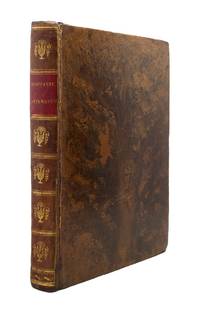
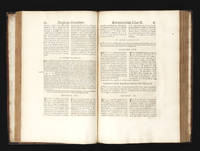
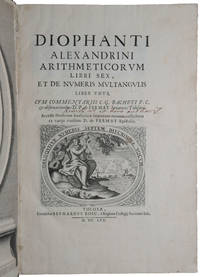
167069414Toulouse: Bernard Bosc 1670. Full Description:<br> <br> DIOPHANTUS OF ALEXANDRIA. Diophanti Alexandrini Arithmeticorum libri sex et De numeris multangulis liber unus. Cum commentariis C.G. Bachet V.C. et observationibus D.P. de Fermata . accessit Doctrinae analyticae inventum novum Toulouse: Bernard Bosc 1670.<br> <br> First edition of Fermat's notes and second edition of Bachet's Diophantus. Quarto 13 x 8 1/4 inches; 330 x 215 mm. xii 64 341ie 343 1 blank 48 pp. Bound without the scarce errata at the end also not present in the Norman copy. Pages 55/56 bound after page 57/58 in the preliminaries. Two leaves are both numbered 335/336 but collation is correct and text is complete. Leaf fii is bound after fiii in the final section. Latin Xylander's translation and Greek text in parallel columns. Separate pagination for De Numeris multangulis. Allegorical engraved title vignette featuring Orpheus playing the lyre. Handsome engraved headpieces and historiated initials. Numerous woodcut illustrations and ornaments.<br> <br> Contemporary tree calf. Spine stamped and ruled in gilt. Red morocco spine label lettered in gilt. Board edges tooled in gilt. All edges marbled. Marbled endpapers. Outer hinge of front cover repaired. Some slight rubbing to boards. Leaves sporadically toned and slightly foxed. Some minor light pencil marginalia. Signature A trimmed about 3 mm short on bottom margin but does not look supplied. A small paper flaw tear to inner margin of leaves Aaiii-Cciv not much larger than a pencil point and not affecting text. Evidence of a removed bookplate on front pastedown. Overall a very attractive and tall copy.<br> <br> This publication contains the first edition of Fermat's number theorems edited partially from his letters after his death in 1665. "Fermat was the first European to make extensive contributions to the theory of numbers taking up the challenge in number theory posed in Diophantus' Arithmetica. Fermat owned a copy f the editio princeps of Diophantus's work 1621 edited by Bachet de Mériziac and published with Xylander's Latin translation. Fermat took issue with Bachet's statements writing his own results for the most part in the margins of his copy. Five years after Fermat's death his son Claude Samuel published a second edition of Bachet's Diophantus adding to it his father's marginal notes. The remainder of Fermat's notes contained a large number of theorems on the theory of numbers only one of which he proved himself; the rest were proven in the eighteenth century" Norman.<br> <br> Diophantus of Alexandria fl 250 AD was the first mathematician to introduce symbolism into Greek algebra. The French scholar Bachet de Méziriac first published his edition of the Arithmetica of Diophantus in 1621 and it was the chief source of the many books on mathematical recreations issued during the seventeenth century.<br> <br> Norman I; 777. Honeyman 893.<br> <br> HBS 69414.<br> <br> $35000. Bernard Bosc unknown
1670105031670. Cum Commentariis C.G. Bacheti…& observationibus D.P. de Fermat…Accessit Doctrinae Analyticae inventum novum collectum ex variis eiusdem D. de Fermat Epistolis. Large engraved vignette on title several finely engraved headpieces & initials & a few woodcut diagrams in the text. 6 p.l. 64 341 48 pp. one leaf of errata. Folio cont. speckled calf carefully rebacked with the orig. spine laid-down light browning as usual two corners discretely repaired spine richly gilt. Toulouse: B. Bosc 1670.<br/> <br/> First edition and a very fine and fresh copy. This edition is the first to contain Fermat’s observations on the Arithmetica of Diophantus the first systematic treatise on algebra; it also contains on H3r the first statement of the celebrated “Last Theorem†which Fermat originally wrote by hand in the margins of his copy of Bachet’s edition of Diophantus 1620. This theorem is the most famous problem in mathematics and remained unsolved for over 325 years until its recent solution by Andrew Wiles. But it should be remembered that Wiles was able to resort to sophisticated 20th-century techniques not available to Fermat. The exact form of Fermat’s proof if indeed he had a genuine one thus remains one of the great unsolved puzzles of mathematics. <br/> <br/> The 1670 edition was published posthumously by Fermat’s son Clement Samuel. It is based on his father’s annotated copy of the Bachet edition of 1621 and contains a major part of Fermat’s work on number theory a branch of mathematics that he virtually created. <br/> <br/> A nice copy with the extremely rare errata leaf. <br/> <br/> ⧠Smith Rara Arithmetica p. 348. unknown
16706238Toulouse: Bernard Bosc 1670. First edition. <p>First edition large-paper issue with the rare engraved portrait of Pierre de Fermat by François Poilly - rare in this edition - and with the editor's presentation inscription on the title page: de Molieres ex dono authoris placing this copy with Louis de Molières Pierre de Fermat's brother-in-law and trésorier de France at Montauban in the year of publication. Prepared by Clément-Samuel de Fermat from his father's marginalia on Bachet's Diophantus the volume prints Fermat's forty-eight number-theoretic observations among them at page 61 the editio princeps of Fermat's Last Theorem - the marginal claim that no power above the second decomposes into two like powers and that a marvellous proof exists which the margin cannot contain. The theorem held for three hundred and fifty-eight years generating algebraic number theory the arithmetic of elliptic curves and modular forms in the course of the search for its proof until Wiles closed it in 1995. A contemporary hand has attempted corrections to Fermat's observation on cube differences at page 135.</p>. Box: 378 x 264 x45 mm. The First Printing of Fermat's Last Theorem. <p>First edition large-paper issue with the engraved portrait of Pierre de Fermat by François Poilly on the leaf facing the title - rarely found in copies of this edition - and with the editor's presentation inscription on the title page. The portrait a fine oval bust set above Fermat's family arms on a chevron three eagles and in base a crescent for the Fermats of Bas-Quercy is the work of one of the leading Parisian printmakers of the second half of the seventeenth century; most copies of the 1670 Diophantus lack it and its presence here together with the generous margins of the large-paper sheets and the inscription immediately below marks the volume as one of the small number of copies Clément-Samuel reserved for the inner circle of the Fermat family and their Toulouse connections. Beneath the printed line naming Pierre de Fermat as Senatoris Tolosani a period hand has added six Latin words: de Molieres ex dono authoris - "to de Molières from the gift of the author." The recipient is Louis de Molières 1610-1687 born at Cahors into the noblesse de robe of Bas-Quercy and established as trésorier de France at the Montauban bureau des finances a post he would hold for forty-two years. His first marriage in 1646 had been to Louise de Fermat c. 1613-c. 1650 Pierre de Fermat's younger sister. Louise had been dead twenty years by the time this copy left the press; Louis had long since remarried a demoiselle de Marqueyret; but the connection between the two robe families of the lower Garonne ran too deep for that to matter. The author named in the inscription is not Pierre - who had died in January 1665 - but Pierre's eldest son Clément-Samuel de Fermat c. 1632-1697 the lawyer and conseiller au parlement who had inherited his father's offices had spent the five years since his father's death transcribing the elder Fermat's mathematical marginalia into publishable form and who oversaw the volume through the Toulouse press of Bernard Bosc in 1670. By sending a large-paper copy to his late aunt's widower - the senior surviving link to his father's family in the generation above his own - Clément-Samuel placed his father's posthumous monument where it most properly belonged.</p> <br /> <br /> <p>The volume is the second edition of Bachet de Méziriac's 1621 Greek-and-Latin Arithmetica of Diophantus of Alexandria expanded by Clément-Samuel with his father's forty-eight mathematical observations and completed by the Doctrinae analyticae inventum novum of the Jesuit Jacques de Billy - a summary account of Fermat's analytical method drawn from the correspondence Billy had maintained with Fermat in the last years. The Arithmetica itself is the foundational work of Greek algebra and of Diophantine analysis setting out 189 problems in indeterminate analysis that had occupied mathematicians from Regiomontanus and Bombelli through Viète and Bachet. Fermat had annotated his personal copy of the 1621 Bachet edition - the copy he acquired in 1636 or 1637 probably through the circle of Carcavi and Mersenne - with marginal notes responding to individual Diophantine problems and in many cases generalising them into new theorems. That original annotated copy is lost. Its contents survive because Clément-Samuel working from his father's papers and almost certainly with the copy itself in hand transcribed the forty-eight observations and printed each at the appropriate point in the Diophantine text. The result is a conflation of the Bachet edition with Fermat's marginalia: Greek and Latin in parallel columns for the Diophantus with Bachet's commentary and Fermat's observation intervening at the relevant problems.</p> <br /> <br /> <p>At its centre - literally and historically - stands the single most consequential marginal note in mathematics. On page 61 of this volume as a commentary on Diophantus Book II Problem VIII the problem of dividing a given square into two smaller squares sits Fermat's observation in nine lines of italic Latin. Against the proposition that every square decomposes into two squares - the problem whose rational solutions are the Pythagorean triples - Fermat remarks that no cube decomposes into two cubes no fourth power into two fourth powers and in general no power higher than the second can be decomposed into two powers of the same kind. He has discovered he adds a truly marvellous proof of this proposition; the narrowness of the margin cannot contain it. This is Fermat's Last Theorem. It is printed here for the first time. The original 1621 Bachet that Fermat annotated no longer exists so the 1670 printing is the sole testimony to how Fermat actually wrote the proposition and the sole source for the evocative remark about the margin.</p> <br /> <br /> <p>The theorem held. For three hundred and fifty-eight years Fermat's claim resisted verification. Leonhard Euler produced the proof for exponent three in 1770 invoking the method of infinite descent that Fermat had set out in other contexts. Sophie Germain in the first decade of the nineteenth century opened a substantial class of exponents - the class of primes now called Sophie Germain primes. Dirichlet and Legendre settled exponent five in 1825. Gabriel Lamé reached exponent seven in 1839 and briefly claimed the full theorem a claim Liouville corrected within weeks by pointing to a failure of unique factorisation in the relevant cyclotomic integers. Ernst Kummer in 1847 working precisely on that failure introduced the ideal numbers that would become the foundation of algebraic number theory and proved Fermat's proposition for all regular primes. By the late nineteenth century Fermat's Last Theorem stood as a celebrated challenge and Paul Wolfskehl's 1908 bequest of a hundred-thousand-mark prize for a valid demonstration kept thousands of amateur attempts flowing to the University of Göttingen through the First World War and the Weimar collapse. The decisive modern move came in 1986 when Gerhard Frey suggested that any counterexample to the Fermat equation would produce a semistable elliptic curve whose properties must contradict the Taniyama-Shimura-Weil conjecture on modular forms. Kenneth Ribet proved the Frey implication the same year. Andrew Wiles working almost alone at Princeton announced a proof of the relevant portion of the modularity conjecture at Cambridge in June 1993; referee Nick Katz identified a subtle error; Wiles and Richard Taylor together closed the gap over fourteen further months; and the finished paper appeared in the Annals of Mathematics in May 1995. Fermat was right.</p> <br /> <br /> <p>The three and a half centuries between statement and proof generated a disproportionate share of modern number theory. Kummer's ideal numbers founded algebraic number theory. The theory of cyclotomic fields the arithmetic of elliptic curves and the whole modern apparatus of modular forms and Galois representations - together forming the present-day Langlands programme - all derive directly or by consanguinity from the long search for Fermat's proof. Wiles's demonstration runs past a hundred pages and invokes techniques Fermat could not have envisaged; the opinion of most specialists is that whatever proof Fermat believed he had was probably in error most likely a descent argument of the kind that works for exponents three and four but cannot be extended. Fermat himself in a 1659 letter to Carcavi set out his method of infinite descent in some detail and applied it to prove that the area of a rational right triangle can never be a square number - a proposition that by a short chain of reasoning implies his Last Theorem for exponent four. Whether that technique could be stretched to the general case is the question to which the answer three hundred and thirty-six years later was Wiles's hundred pages.</p> <br /> <br /> <p>Fermat's engagement with Diophantus ranged far beyond the single marginal note at page 61. Forty-seven further observations thread through the volume responding to Diophantine problems on rational squares Pythagorean right triangles the representation of integers as sums of squares and the arithmetic of cubes. Several of these observations announce theorems of comparable depth. The two-square theorem - that every prime congruent to one modulo four is the sum of two squares in essentially one way - sits among them as do the germ of the four-square theorem later proved by Lagrange the statement that every number is the sum of three triangular numbers and the generalised Fermat equation x2 − Ay2 = 1 the Pell equation which Fermat correctly recognised as always solvable in integers for non-square A. The observation at page 135 - headed OBSERVATIO D.P.F. and placed after Diophantus Book IV Question III - displays Fermat's characteristic fusion of correction and extension. Bachet had offered a partial treatment of the problem of finding two cubes whose difference equals a given number; Fermat shows that Bachet missed an entire further family of solutions which follow from his own method by continued iteration in infinitely many cases. Given the two cubes 8 and 1 whose difference is 7 Fermat produces a second pair of rational cubes with the same difference. His printed solution gives the sides 1265/183 and 1256/183 yielding the cubes 2024284625/6128487 and 1981385216/6128487. The verification is clean: the difference of these two new cubes reduces exactly to 7.</p> <br /> <br /> <p>Across the printed denominators on this page however a contemporary hand has drawn firm lines and written substitutions above the print: 61 in place of 183 for the sides and 226981 in place of 6128487 for the cubes. The substitution is not arbitrary - 183 is three times 61 and 6128487 is twenty-seven times 226981 which is itself 61 cubed. The annotator has evidently noticed that Fermat's fractions appear to contain a common factor of the cube of three and has tried to simplify them by cancelling it. But the correction does not preserve the answer. The revised sides 1265/61 and 1256/61 are each three times larger than their printed counterparts; the revised cubes are each twenty-seven times larger; and the difference of the revised cubes becomes 189 rather than 7. The substitution would solve a scaled version of Fermat's problem - one in which the given cubes were 216 and 27 rather than 8 and 1 - but it does not solve the problem as Fermat poses it on this page. The correction is the work of a contemporary reader who followed Fermat's argument closely enough to recognise the internal structure of the solution and who carried enough confidence to intervene in a freshly printed Toulouse folio but who stopped short of the final verification that would have caught the scaling error. That degree of engagement is itself worth marking. Fermat's observation on Book IV Question III was considered obscure even among the professional mathematicians of the period; the appearance of contemporary manuscript attention to its numerical detail in a copy that left the editor's hands in 1670 places this volume inside the very narrow circle of readers who took Fermat's more technical observations seriously from the moment of publication.</p> <br /> <br /> <p>Two further inserted slips of paper at pages 61 and 197 carry contemporary but more elementary annotations placing this copy plainly in the hands of a seventeenth-century reader working through the mathematics of the volume rather than merely its production. The slip at page 197 - facing the large printed table of eighty-one integer solutions to a Diophantine problem in four variables from Book V - carries calculations in a reader's hand involving the quantities eight hundred and ten thousand a cubic variable and a squared variable in a working attempt at the problem treated above. A later eighteenth-century English hand has added a note on the flyleaf framed as a dismissive verdict on Fermat's mathematical claims. A discreet twentieth-century dealer's mark on page 9 identifies the code of Lucien Scheler 1902-1999 the Parisian antiquarian bookseller and poet whose handling of the book places its modern provenance within a narrow compass of known trade hands.</p> <br /> <br /> <p>The recipient of the 1670 inscription belongs to a world of parliamentary offices and extended family connection that the inscription itself records in six Latin words. Louis de Molières born at Cahors in 1610 served forty-two years as trésorier de France at the Montauban bureau des finances one of the senior royal financial posts in lower Languedoc. His first marriage in 1646 was to Louise de Fermat daughter of Dominique de Fermat - the consul and leather merchant of Beaumont-de-Lomagne - and therefore sister of Pierre and paternal aunt of Clément-Samuel. Louise died in the late 1640s. Louis remarried a demoiselle de Marqueyret and continued as head of one of the prominent parliamentary families of Bas-Quercy until his death in 1687. His son by the second marriage Armand de Molières later served as second président of the Cour des aides at Montauban - the Armand whose name has occasionally been conflated with his father's in later bibliographic sources producing the hybrid 'Louis-Armand' that appears in some modern descriptions. The present inscription is addressed to Louis senior Pierre's brother-in-law and Clément-Samuel's uncle by marriage a man whose household at Montauban sat fifty kilometres north of Pierre's at Toulouse and who by 1670 was the senior family member in the generation linking back to Pierre's parents at Beaumont.</p> <br /> <br /> <p>Pierre de Fermat's reputation does not rest on the Last Theorem alone. A conseiller at the parlement of Toulouse and a magistrate of the Chambre de l'Édit at Castres he was an amateur mathematician in the technical sense only - an amateur who corresponded with Mersenne Pascal Descartes Huygens Wallis Carcavi and Roberval on terms of complete intellectual equality and who made fundamental discoveries in four distinct branches of mathematics. In number theory beyond the Last Theorem he discovered the theorem now called Fermat's Little that for any prime p and integer a not divisible by p the quantity a raised to the power p minus one is congruent to one modulo p stated and used the two-square theorem developed the method of infinite descent as a rigorous technique for negative existence proofs and extended the theory of amicable numbers well beyond the pair 220 and 284 known since antiquity. In analytic geometry his Ad locos planos et solidos isagoge - which he sent in manuscript to Carcavi and Mersenne in 1636 - predated Descartes's Géométrie in composition though not in print. In the calculus of variations his method of adequality supplied a systematic technique for locating maxima minima and tangents that Newton and Leibniz both later acknowledged as precursor. In the summer of 1654 in the correspondence with Pascal that Carcavi preserved he worked out with Pascal the foundations of the mathematical theory of probability solving the problem of the division of stakes in interrupted games of chance. In optics he enunciated the principle of least time - Fermat's principle - which furnished the first variational formulation in physics and served as direct ancestor to the principle of least action and the whole edifice of Lagrangian and Hamiltonian mechanics. Any one of these contributions would secure a reputation; that a sitting magistrate of the Toulouse parlement pursuing mathematics in stolen evening hours made all four is the condition Clément-Samuel set himself to commemorate in this volume.</p> <br /> <br /> <p>Of those four strands the 1670 Diophantus captures chiefly the number-theoretic Fermat and within that only the portion he wrote as marginalia on Bachet. His analytic geometry and his general method of maxima et minima appeared in 1679 as Varia Opera Mathematica again at Toulouse edited again by Clément-Samuel. His complete correspondence and further manuscripts were assembled definitively only in the late nineteenth century by Paul Tannery and Charles Henry whose four-volume Œuvres de Fermat 1891-1912 with a supplementary fifth volume by Cornelis de Waard in 1922 remains the standard scholarly edition. But the 1670 edition is the book in which Fermat's Last Theorem first entered print the book through which Fermat's name reached the working mathematicians of the late seventeenth and eighteenth centuries and the book Euler and Gauss both studied and built on. Its place in the foundational history of number theory is not in dispute. What is less often remarked - and what this particular copy preserves - is the presence in 1670 of readers who took Fermat's more technical observations seriously enough to attempt corrections in the margins even when as at page 135 those corrections did not finally succeed.</p> <br /> <br /> <p>References: Honeyman 885 - Norman 771 - Smith Rara Arithmetica pp. 348-349 - Brunet II 702 - Roberts & Trent Bibliotheca Mechanica p. 108 - Hoffmann 1242 - Weil Number Theory: An Approach through History from Hammurapi to Legendre Birkhäuser 1984 chapters II-IV - Mahoney The Mathematical Career of Pierre de Fermat Princeton University Press second edition 1994 - Goldstein Un théorème de Fermat et ses lecteurs Presses Universitaires de Vincennes 1995 - Singh Fermat's Enigma Fourth Estate 1997 - Wiles 'Modular elliptic curves and Fermat's Last Theorem' Annals of Mathematics 141 1995 pp. 443-551 - Taylor and Wiles 'Ring theoretic properties of certain Hecke algebras' Annals of Mathematics 141 1995 pp. 553-572.</p> <br /> <br/> <br/> <br /> <p>Folio 365 × 246 mm pp. xii 341; 48. Engraved portrait of Pierre de Fermat by François Poilly on the leaf facing the title Fermat in scholarly dress within an oval frame his arms below on the plinth - rarely found in copies of this edition. Engraved allegorical vignette on the title page Orpheus with the lyre encircled by the Virgilian motto obloquitur numeris septem discrimina vocum. Numerous woodcut diagrams in the text. Greek and Latin in parallel columns throughout the Diophantus. Separate pagination for the Inventum novum. Light browning. Contemporary calf gilt fillet on covers spine richly gilt in compartments with gilt-tooled lettering DIOPHANTI / FERMAT edges speckled red binding slightly rubbed. A fine copy.</p> . Bernard Bosc unknown