[PHOTOGRAPHY - ALGERIA - TUNISIA]Biblio.com
2 889 résultats
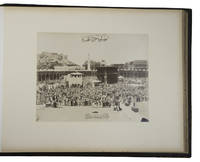
1890ABC_46444Tunis: Photographie Garrigues 1890. Half black leather red buckram sides blind-stamped boards and gold-stamped spine title in gold lettering on front board marbled endpapers. Oblong album 32 x 41 cm. Album with 50 photographic prints of various sizes 13.5 x 9.5 to 29 x 21.5 cm each pasted on thick paperboard. Album with 50 late-nineteenth-century photographic probably albumen prints of scenes in Algeria and Tunisia made by an unknown photographer. Most of the photographs have a caption naming the place photographed but only 5 indicate place of production or publication of the photos. These were all produced in Tunis at least some by the French photographer J. Garrigues printed and published at his studio. Notable photographs in this album are the first showing a veiled woman a barber at work in the streets riders on their horses camels with riders and luggage the Notre Dame d'Afrique in Algiers. Other subjects include city views fairly candid photos of people in the streets landscapes and the exterior and interior of a mosque.The most remarkable print in this album actually does not fit in with the other images of places in North Africa. It is a photograph of pilgrims before the Great Mosque and Kaaba in Mecca modern day Saudi Arabia with a caption in Arabic. This photograph was taken by the first Arab photographer Al-Sayyid Abd al-Gaffar ca. 1887 making it one of the first photographs of Mecca. The present album contains this picture in its original form including the Arabic caption. An edited version of the photograph in which remnants of the Arabic caption are visible can be found in Hurgronje's Bilder aus Mekka.With a small Antwerp booksellers ticket on the front paste-down". The binding shows some signs of wear slight foxing/browning of the outer edges of the paper boards not affecting the photographic prints some prints have slightly faded edges which does not interfere with the actual image. This album with photographic prints of Algeria Tunisia and remarkably 1 of the Great Mosque and Kaaba in Mecca is overall in good condition. Photographie Garrigues, hardcover
Very Good Arabic Original autograph document/letter sealed by Ahmad I of Tunisia. 54x42 cm. 1 p. 6 long lines. The letter includes full of poetic praise. It must be sent after successful diplomatic intercourse with Naples. Ferdinand II (Ferdinando Carlo) was King of the Two Sicilies from 1830 until his early death in 1859. It starts with 'Thank God alone', and goes on 'From poor Ahmad Pasha to Lord Almighty Field Marshal Amîr [ruler]. Sealed by the seal of Ahmad Basha Beg including an impressive qasidah in Arabic. Ahmed I (ibn Mustafa), born 2 December 1805 in Tunis died May 1855 at La Goulette, was the tenth Husainid Bey of Tunis, ruling from 1837 until his death. He was responsible for the abolition of slavery in Tunisia in 1846. He succeeded his father Mustafa Bey on 10 October 1837. He had grand ambitions - to expand his army and create a modern navy; to build a new royal residence, a mint and modern institutions of education but neither he nor his brother-in-law the young Mustapha Khaznadar who served as his finance minister, had a clear idea of what such initiatives would cost. As a result, many of his projects became expensive failures which damaged the financial health of the country. Soon after his accession, Ahmad Bey received the traditional Firman from the Sublime Porte which formally invested him with authority to rule from the Ottoman Empire and furnished him with the insignia of office. The Ottoman envoy, Osman Bey, arrived in la Goulette on 15 May 1838 onboard a frigate. The following day, Osman Bey made his official entry into Tunis on horseback, preceded by all the ministers of the beylical cabinet who went before him until he was two leagues from the city. Before he were carried the sword of honor and the caftan to be presented to the Bey. He was escorted by spahis and followed by a large contingent of regular troops an Arab cavalry. Three days after his official entry into the city, the envoy presented himself at the Bardo Palace to formally invest Ahmad Bey with his insignia of office and present gifts. Named as a Divisional General in the Ottoman army in May 1838, he was later promoted by the Sultan to the rank of Marshal on 14 August 1840. This was the first time that a Bey of Tunis had held a rank higher than Divisional General. The purpose of these honors was to emphasize the supremacy of the Ottoman Empire over the Regency of Tunis. Under a treaty with France signed in 1830 by Hussein Bey, a piece of land in Carthage had been ceded to allow the erection of a monument to Louis IX of France who had died there during the Eighth Crusade. On 25 August 1840, the first stone was laid in the cathedral of Carthage. Ahmad Bey also permitted the Christian community of Tunis, consisting mainly of European merchants, to enlarge their small church near the Bab el Bhar. In June and July 1846 the Duke of Montpensier, son of King Louis Philippe of France visited Tunis and Carthage. He was received with great solemnity by Ahmad Bey. According to the Tunisian historian Mohamed Bayram V, Bey's reforms were focused on state structures, the army, and education. He established a modern structure of government and gave his high officials the title of 'minister'. His senior ministers were his Grand Vizier Mustafa Sahib at-Taba'a, Mustapha Khaznadar, Minister of Finance and of the Interior, Mustafa Agha as Minister of War, Mahmoud Khodja as Minister of the Navy and Giuseppe Raffo as Foreign Minister. At certain times Mahmoud Ben Ayed also served as Trade Minister, Kuchuk Muhammad in the honorific post of Minister in charge of the security home of Ahmad Bey's reforms wasted money, such as the large frigate built at La Goulette that could not make it through the channel to the sea. of Tunis and Mohamed Lasram IV as Minister of the Pen. The historian Ibn Abi Dhiaf was the Bey's private secretary. Among Ahmad Bey's successes may be counted as the abolition of slavery in January 1846. To this may be added the formation of the military academy at...
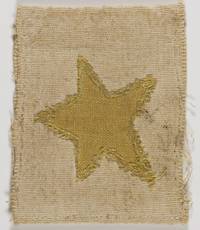
194353630Tunisia 1943. Nearly Fine. Five-pointed yellow cloth star sewn onto plain beige cloth 7.3 by 9 cm. Yellow dye somewhat faded else in fine state of preservation.<br /> <br /> Specimen of the yellow star imposed on the Jewish population of Tunisia in March 1943 as a mark of the slave laboror. Tunisia was the only Islamic country to come under Nazi rule at first indirectly through the Vichy regime in France between 1940 and its liberation by Allied forces on May 7 1943. In response to the Allied invasion of Algeria and Morocco German and Italian forces invaded Tunisia on November 9 1942. By the end of November the Germans took the first anti-Jewish move by arresting four of the community leaders including Moïse Borgel the president of the Jewish congregation. "In addition to the governor-general's sympathetic attitude -- and in some degree to the pro-Jewish attitude of Bey Sidi Mohammed al-Mounsaf -- the Italians also in practice interfered with the application of the anti-Jewish laws" E.H. The dignitaries were released after a week following the intervention of the mayor of Tunis and the Italian consul. Because of objections by the Italians the edict to wear the star does not appear to have been generally enforced with rigor and was only formally imposed in two cities Sfax and Tunis. While 5000 Jews had originally been put on forced labor in thirty locations and camps along the front line "at the time of the collapse and surrenter in early May 1943 only sixteen hundred Jews were employed on forced labor" E.H. Given the relatively small labor force and the lack of zeal in imposing the anti-Jewish ordinances it is clear why so few of these yellow badges have survived. References: I. Gutman ed. Encyclopedia of the Holocaust vol. 4 pp. 1521-23. unknown
38x27cm.,[48p.] Album contenente 100 fotografie originali di Giorgio Sommer e Gorrigues, in bianco e nero, di dimensioni 20x25cm e 8 di 9.5x13cm. Presenta paesaggi e ritratti. Volume in ottimo stato. Nota sul volume: questo album di fotografie è un classico esempio di "album ricordo", oggetti che gli esponenti delle classi agiate straniere facevano comporre al fine di mantenere un vivo ricordo del loro viaggio. Album de 100 photographies anciennes (tirages albuminés) de paysages et portraits de Giorgio Sommer et Gorrigues, de dimensions 20x25 cm et 8 de 9,5x13cm. Volume en très bon état.
1920246931920 1 Pastel signé, titré et annoté monté sur chassis, (1920), 58 x 45 cm.
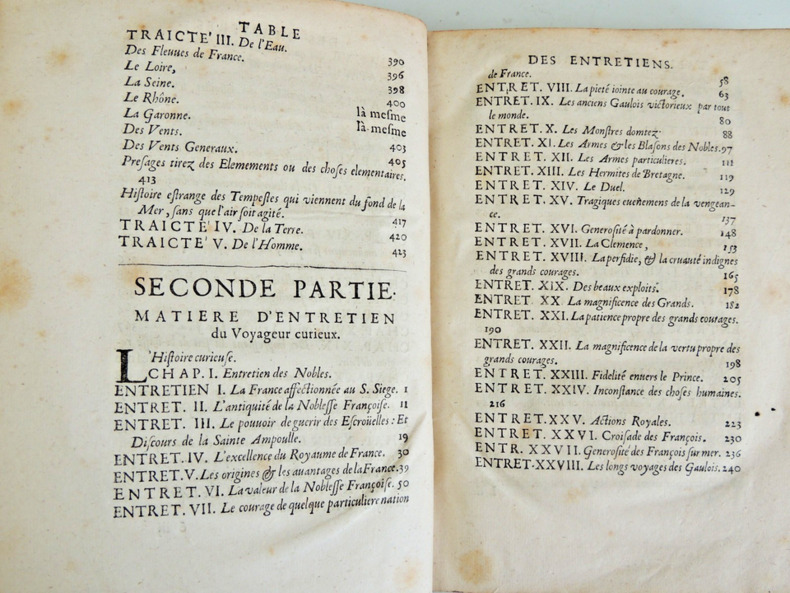
1664CZC-13844volume in4, pleine basane époque, 24x19cm, accros à la coiffe, coins usés, 2 parties en un vol. in-4, (8) ff., 424 pp. ; 360 pp, bel état intérieur, brulure en page de titre. Rare. A Paris, chez François Closier, MDCLXIV ( 1664)
1664CZC-13844volume in4, pleine basane époque, 24x19cm, accros à la coiffe, coins usés, 2 parties en un vol. in-4, (8) ff., 424 pp. ; 360 pp, bel état intérieur, brulure en page de titre. Rare. A Paris, chez François Closier, MDCLXIV ( 1664)
71808The contemporary album 270 × 220 mm is bound in half leather and stippled cloth; mounted on both sides of the first 25 leaves are a total of 82 vintage gelatin silver photographs. There are 16 credited to Albert or C. Albert likely Charles Albert active at various locations in North Africa from the 1890s to the 1930s; these are 170 × 120 mm or the reverse and are mainly captioned occupational or genre images. There are 26 large-format prints 180 × 260 mm or the reverse one credited to Albert and several credited to Soler Francisco Soler active from the 1890s. Soler may be responsible for most of these views of impressive buildings streetscapes and rural scenes. <p>There are also 40 private snapshots 85 × 85 mm; internal evidence suggests they were taken by an Edwardian English family in Tunisia. Whether they were merely on holiday or long-term residents there is difficult to say but the small group of original sketches loosely inserted makes us favour the latter. There are nine watercolours and two uncoloured ink drawings mainly 150 × 200 mm with one larger one smaller; they appear to be done by a capable child possibly one of the girls featured in the last four snapshots in the album. We purchased this album in Adelaide nearly 20 years ago; unfortunately the vendor didn't know the back-story then and we are none the wiser now. Apart from a little wear to the extremities the album is in excellent condition; the contents are in uniformly fine condition. unknown
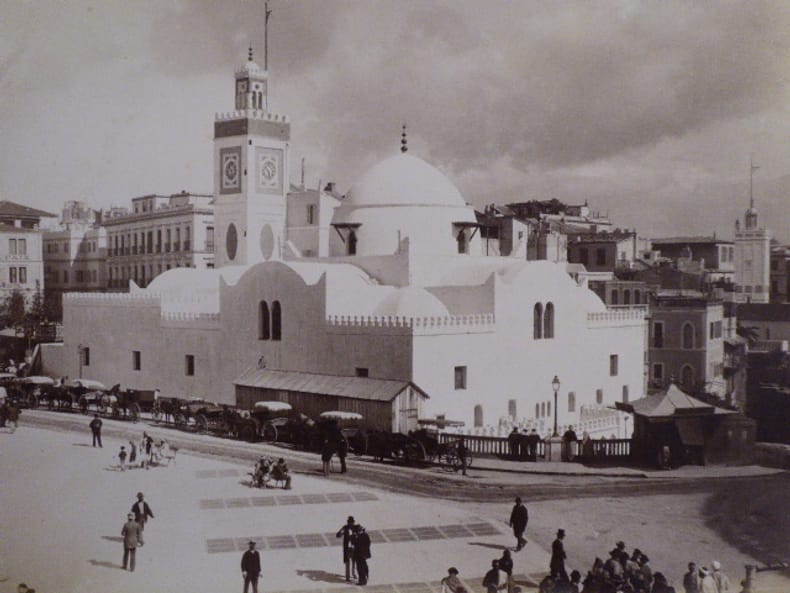
528537S.N. S.L. (Alger - Tunis) 1880-1890 Album de photographies in-8 oblong "à l'italienne" ( 260 X 345 mm ), demi-basane bronze à coins, dos lisse orné de filets dorés, plats de percaline chagrinée verte contenant 67 photographies en tirage albuminé vers 1880-1890 de formats divers contrecollées sur feuillets de papier fort montés sur onglets.Bel album de voyage, les photographies sont parfois légendées au crayon sur le carton de montage, parfois dans la photographie, parfois muettes. Les photographies d'Alger sont - pour certaines - attribuables à Alexandre LEROUX et Hippolyte LAZERGES.Détail des photographies:- ALGERIE. 24 photographies essentiellement de format 21,0 X 26,5 cm. Plusieurs vues des anciennes rues de la Casbah d'Alger.- TUNISIE. 37 photographies essentiellement de format 18,0 X 24,0 cm. et 6 photographies de petit format montées sur le même carton.
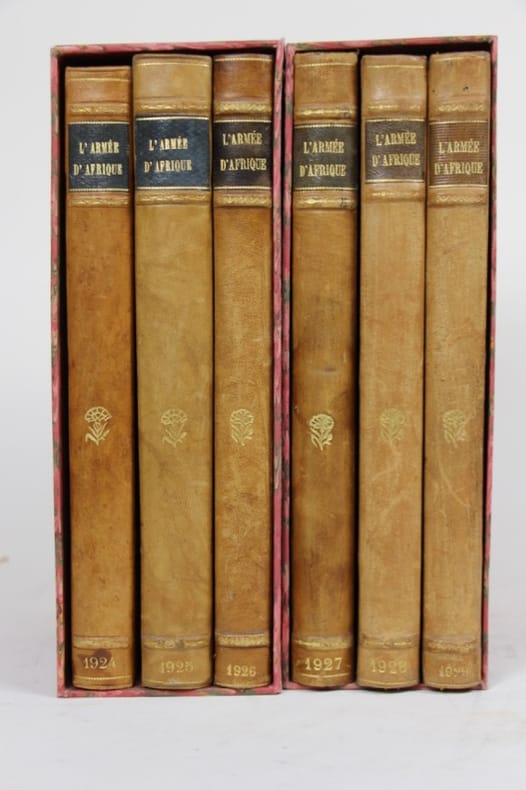
1929476221924, 1929 1929 6 volumes grand in-8, demi-basane fauve, dos à nerfs, dentelles et fleuron dorés, 448- 436- 92- 439- 492- 454- 392 pp. Très nombreuses ill. in & hors-texte, cartes repliées en noir et couleurs. Petit accroc de papier en pied au 2 derniers ff. du quatrième vol, sans atteinte au texte. Quelques coins lég. émoussés. Très bon exemplaire sous 2 étuis.
1 vol. grand in-8 reliure postérieure demi-basane verte, dos à 4 nerfs orné, Imprimerie de Jules-Gme Fick, Genève, 1858, 3 ff., 261 pp. et 1 f. blanc Rare exemplaire de l'édition originale, de "cet ouvrage qui n'a pas été mis dans le commerce" (Demarsy, Essai de bibliographie tunisienne, 5), rédigé par le célèbre fondateur de la Croix-Rouge. Avec un ex-dono d'époque en garde : "A notre jeune ami Monsieur Georges Bousquet, Souvenir de Grange-Canal 28 mars 1858" signé Aé Jehr. Grange-Canal est un hameau genevois de la commune de Chesne-Bougeries. Etat très satisfaisant (dos frotté avec petites épidermures, bon état intérieur). Français
99203LYON, Imprimerie WALTENER & Cie, 1904, un volume, in-8 de 230x140 mm environ, de 175 pages, demi-reliure à coins en maroquin vieux rose, signée Maison L. Magnin, dos lisse orné et portant une pièce de titre en maroquin vert, filets dorés sur les plats soulignant le cuir, double garde, la première doublée de soie rose pâle, couvertures conservées, tête dorée. Relation tirée à petit nombre et illustrée de 36 clichés photographiques originaux, et enrichie d'un poème manuscrit signé Blin (L. Blin). Cuir très légèrement décoloré par endroits, sinon bon état. Rarissime.
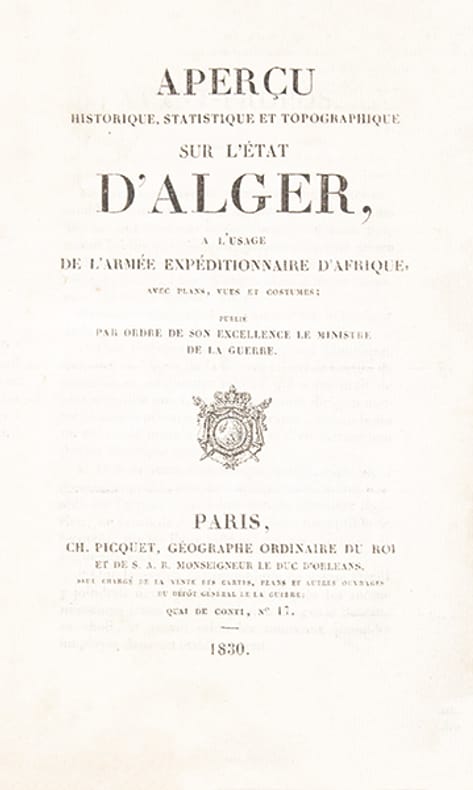
388922 volumes: un volume de texte in-12 (180 x 110 mm), broché, couverture imprimée, (4), xiii, 256 p. et un volume d'atlas in-folio oblong (265 x 347 mm), 6 cartes et plans dépliants et 11 planches. Paris, Charles Picquet géographe du roi (), 1830.
58282Divers Divers 1880-1894 Album de photographies in-8 oblong "à l'italienne" ( 280 X 380 mm ), demi-chagrin vert, dos à nerfs janséniste, plats de percaline chagrinée de la même teinte contenant 48 photographies en tirage albuminé vers 1880-1894 de formats divers contrecollées sur feuillets de papier fort montés sur onglets.Bel album de voyage, les photographies sont parfois légendées au crayon sur le carton de montage, parfois dans la photographie, parfois muettes. Nous relevons la signature des photographes suivants: Hippolyte ARNOUX, ZANGARI, Félix BONFILS ( pour les photographies d'Egypte ).Détail des photographies:- TONKIN. 25 photographies essentiellement de format 17 X 22,5 cm. Hanoï, Pêcheurs, Charpentiers -Sculpteurs, Barbiers, Ecole Franco-Anamite, Comédiens, Fabrication du papier, Chanteurs, Porteurs d'eau....- OBOCK-DJIBOUTI. 3 photographies de format 220 X 260 cm.- EGYPTE: 9 photographies essentiellement de format 220 X 280 cm.- TUNISIE: 9 photographies essentiellement de format 130 X 170 cm.A la suite sont contrecollés 33 documents divers: cartes-postales, vignettes, photographies etc... de France.
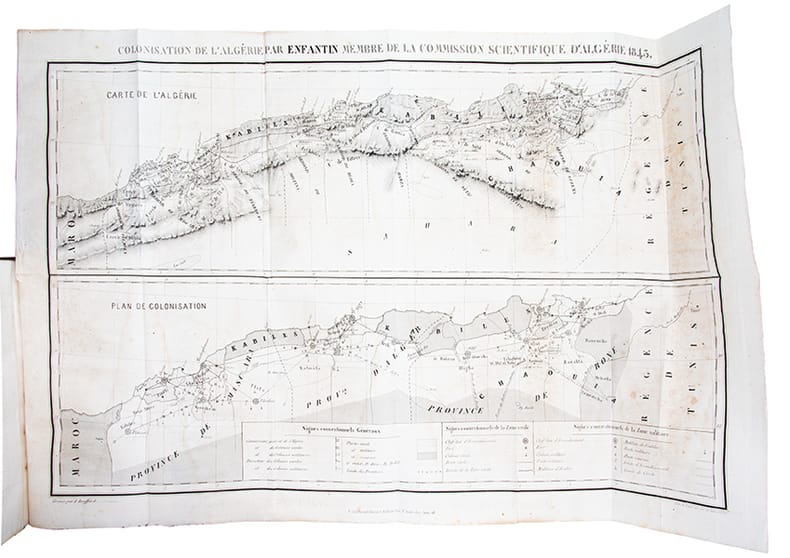
39394In-8 (225 x 142 mm), demi-chagrin bordeaux, pièce de titre de veau bronze (rel. moderne), (4), 542 pages, 4 pages de catalogue, grande carte (42 x 66 cm) et tableau statistique dépliants. Paris, P. Bertrand, 1843.
Directeurs gérants Mahmoud Allas, Henri Pajaud, 1 vol. fort in-4 reliure demie-toile rouge, Direction de l'Edition et de l'Imprimerie, 46 rue d'Isly, Alger, Siège Social : Casablanca, Afric-Orient, société chérifienne AFL au capital de 1000000 de francs, avec onglets : Algérie - Maroc - Tunisie - Egypte, Syrie, Liban Rare exemplaire de cet important annuaire commercial et industriel. Bon état (manque en première garde volante, bon exemplaire par ailleurs, bien complet du marque-page argenté d'Air-France) pour cette remarquable source de renseignement sur le Maghreb mais aussi l'Egypte, la Syrie et le Liban au lendemain de la Seconde Guerre Mondiale. Français
156469409Parisiis, Apud Gul. Morellium, in Graecis typographum Regium 1564 In-4, plein veau havane, dos à nerfs, caissons ornés de fers dorés, 24-483-36 pp., lettrines ornées, notes, index. Reliure sensiblement frottée, premier mors fendillée, notes manuscrites sur la page de titre, intérieur assez frais.
18935592, , 1893. 2 vol. in-8 oblongs manuscrits à pagination continue de 248 pp., titre manuscrit sur le premier plat, cartonnages décorés de l'époque, tranches dorées.
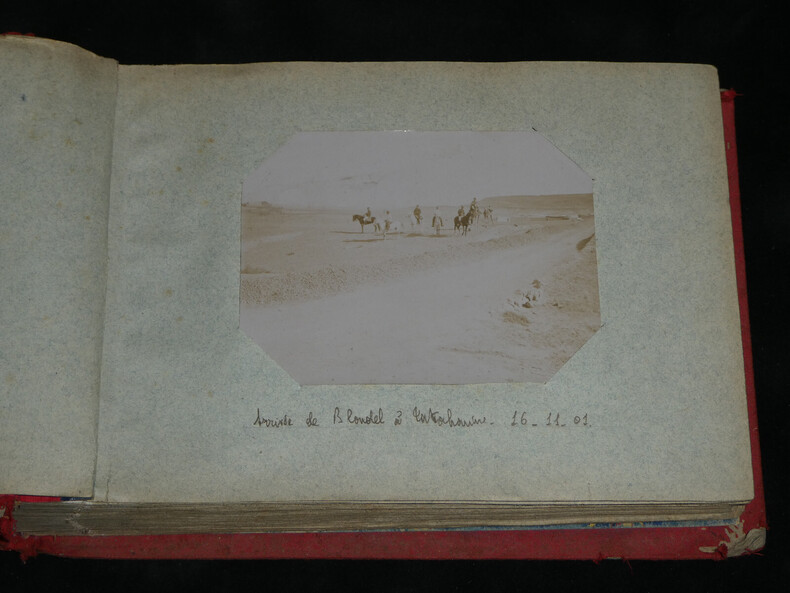
1901boz_002221Album de 84 photographies d'époque, Tunisie, notamment des villes de Tatahouine et Médénine, datées entre 1901 et 1902. Plusieurs photographies de militaires. Dimensions : 24 x 16,5 cm (album) État : Photographies très insolées.
16126Genève, imprimerie de Jules-Gme Fick, 1858. In-4, [6]-261 pp., demi-chagrin écrasé vert, plats de percaline chagrinée, dos lisse, filets à froid, titre et auteur dorés au dos (frottements, quelques rousseurs).
13968080Courbevoie: Presses du Théâtre Typographique, 1986 in-folio de 24 pages, illustrations en couleurs + 1 feuillet in-8 de présentation. Emboîtage (carton et plexiglas) conçu par Ng. B. Ahn. Un des 150 exemplaires numérotés. Très bel exemplaire. EDITION ORIGINALE.
1543GITa719Lugduni apud Seb Gryphium 1543. 2 tomes en 1vol in-8 16ff n ch 1-395pp 6ff n ch et 1f n ch 3-422pp 4ff n ch. Plein maroquin rouge, dos à 5 nerfs rehaussés d'un filet perlé, compartiments dorés aux petits fers, plats encadrés d'un triple filet doré, coupes filetées, belle dentelle dorée sur bordure intérieure, tranches dorées sur marbrure, relié v1850 (Auguste Petit). Belle marque typographique des Gryphe sur la page de titre des deux tomes et sur le dernier feuillet du dernier, jolies lettrines.
208628Paris, J.-B. Baillière et fils, Alger, Adolphe Jourdan, Madrid, Carlos Bailly-Baillière, 1880 grand in-8, XX-596 pp., avec une carte dépliante en couleurs, demi-chagrin brun, dos à nerfs (reliure de l'époque). Dos et mors un peu frottés. Cachet (annulé).
188019253AB1880. Tunis Garrigues ca. 1880 21 : 26 cm. 11 Albumin-prints all pasted on thick cardboard. 11 Albumen prints by Garrigues Photographe actif à Tunis de 1860 jusque dans les années 1890. - Studios à Tunis au 9 avenue de France et au 2 rue de Bône. - Succursale à Vichy. - Photographe de S. A. Le Bey de Tunis. The following photographs are present: Tunis et fort Sidi ben Hassen - Acien port de Carthago - Cisterne de la Mala pre Tunis April 1897 - Bedouin riche Tunis 1897 - Carthago Cathedrale Chap. S. Louis - Carthago Cisternen 97 - Carthago Roman theatre - Campement - Grosse négresse - Jeane fille juive - Stalle des psychés Dar- el - Bey. - Some photographs with identification on the reverse side cardboards with a few stains images are fine. hardcover
1858525021 vol. grand in-8 reliure postérieure demi-basane verte, dos à 4 nerfs orné, Imprimerie de Jules-Gme Fick, Genève, 1858, 3 ff., 261 pp. et 1 f. blanc