ABUBAKR EFFENDI, (1814-1880).MareMagnum
[ALGÉRIE].Livre Rare Book
[Forêts de chênes-liège].
233598Paris et Constantine, 1859 - 1872 8 pièces in-4 ou in-8, brochées.

Librairie Historique Fabrice Teissèdre · Sauve, France300,00 €
12 363 résultats
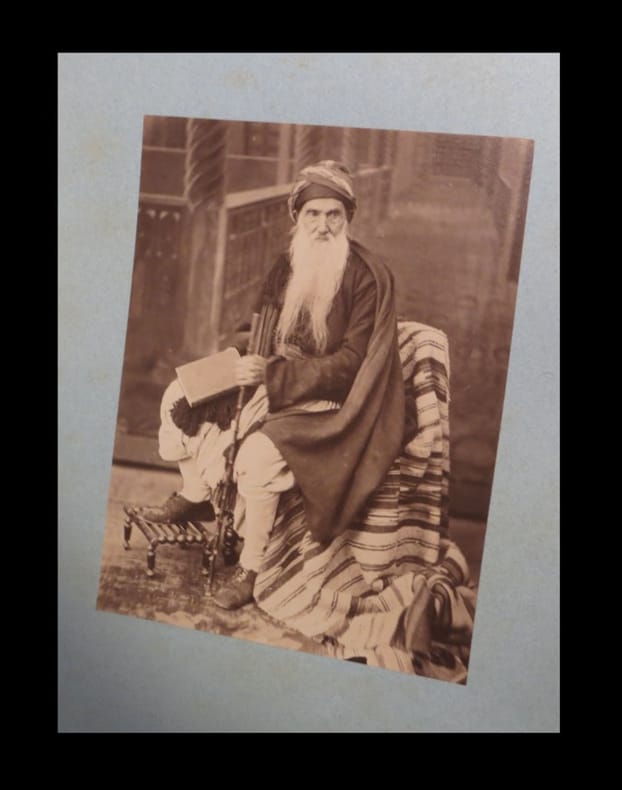
Very Good Turkish, Ottoman (1500-1928) Original wrappers. Foolscap 8vo. (18 x 13 cm). In Ottoman script (Old Turkish with Arabic letters). 112 p. On the first page, written 'copies without seals are fake', and this copy is with a seal. Slightly faded and chipped on extremities. Foxing on first pages. Uncut marginal extremities Otherwise a good copy. Exceedingly rare first edition of the first Ottoman voyage to Cape of Good Hope and first-hand travel account of the Ottoman qadi Abubakr Effendi (1814-1880) of South Africa and Mozambique, who was sent in 1862 by Sultan Abdulaziz at the British Queen Victoria's request in order to teach and assist the Muslim community of the Cape Malays. The presence of the Muslim population in South Africa dates back to the 16th century, South Africa and the Cape of Hope have become a colony of Western countries such as Portugal, the Netherlands, and the United Kingdom. The Ottoman Empire was interested in the Far East, Javanese, and South African regions in the 16th century and then tried to establish a relationship. The direct relationship between the Ottoman Empire and South Africa in the 19th century, upon the request of the Muslim people and England, was formed through Abubakr Effendi. The Muslims in conflict with various religious issues have found the remedy by consulting a scholar from the Ottoman Empire through England. After all, Abubakr Effendi reached Cape Town in 1862 and tried to resolve the conflicts among the Muslim people. (Abubakr Effendi: An Ottoman Scholar in South Africa in the Nineteenth Century: Yilmaz, Yusuf). "Abubakr Efendi was sent to Cape Town by Ottoman Sultan Abdulaziz. When chaos reigned in the Islamic society because of the imams who declared themselves as leaders in the region, Muslim leaders in Cape of Good Hope conveyed their letters to the Queen of England in 1862 declaring that they needed a religious leader. Since they had not been educated for years, they had forgotten their Java language and could not read their own books. They sent a letter to the Queen of England, informing them that help could be sought from the Ottoman court, the center of Muslim countries in the period. The issue was refused in the Parliament and the Ottoman Ambassador Musurus Pasha was offered it to the Ottoman Sultan. Abubakr Effendi's mission was to prevent Muslims in Cape of Good Hope to clash with each other and teaching them authentic Islamic knowledge free of superstition. Although Abubakr Efendi had some Arabic translators in his service, he still learned English and African languages in a short time and wrote books in order to benefit the Muslims there. On the fifteenth day he set foot on the continent, he opened a madrasah called the "Ottoman School" and enrolled three hundred students in twenty days. He traveled to Mauritius and Mozambique. He wrote his famous book 'Bayan al-Din' (a sort of catechism) in Afrikaan in Arabic letters. Then he married Rukiye Hanim, but they divorced after a while since they had to communicate by using an English and Arabic dictionary. Then he married James Cook's nephew Tahota Saban Cook. In his memoir, Ömer Lütfi wrote down all the travels of Abubakr Efendi for two years. Abubakr Efendi stayed in South Africa for 22 years and died there." (140 yillik miras: Güney Afrika'da Osmanlilar: Uçar, Ahmet). Abubakr Efendi first traveled to London and then to South Africa by a ship with his assistant Omar Lutfi. He established the first Ottoman School in Cape Town and then wrote his work Bayan Al-Din in Afrikaans with Arabic letters and distributed it to the Muslim population of South Africa. Four printed copies in OCLC: 427674106 (Three copies); 635151131 (One copy). Özege 22397. First Edition. Extremely rare.
233598Paris et Constantine, 1859 - 1872 8 pièces in-4 ou in-8, brochées.
Fine French Original wrappers. Roy. 8vo. (24 x 17 cm). In French. 10 p., 2 unnumbered b/w plates. Extremely rare early brief French edition of "Kitâb tu?fat al-zâ'ir fî târîkh al-Jazâ'ir wa-al-Amir 'Abd al-Qâdir" by Amir Abd al-Qadir's eldest son Mohammad Pasha, originally in Arabic in 1903 in 2 volumes, published for "the benefit of the national subscription of the Ottoman Fleet", including a brief biography of Abd al-Qadir, was an Algerian religious and military leader who led a struggle against the French colonial invasion of Algiers in the early 19th century. This pamphlet including Amir Abd al-Qadir's biography written by his eldest son Mohammad Pasha has two b/w plates showing a photograph of al-Qadir and his medal that the municipality of Paris had struck in 1862, in memory of the banquet offered on behalf of the Parisian population to the Emir Abd-el-Kader. Abd al-Qadir al-Jazairi (1808-1883), known as the Emir Abdelkader, Abdelkader ibn Muhieddine or Abdelkader El Hassani El Djazairi, was an Algerian religious and military leader who led a struggle against the French colonial invasion of Algiers in the early 19th century. As an Islamic scholar and Sufi who unexpectedly found himself leading a military campaign, he built up a collection of Algerian tribesmen that for many years successfully held out against one of the most advanced armies in Europe. His consistent regard for what would now be called "human rights", especially as regards his Christian opponents, drew widespread admiration, and a crucial intervention to save the Christian community of Damascus from a massacre in 1860 brought honors and awards from around the world. Within Algeria, his efforts to unite the country against French invaders saw him hailed as the "modern Jugurtha", and his ability to combine religious and political authority has led to his being acclaimed as the "Saint among the Princes, the Prince among the Saints". Amir Abd al-Qadir (Emir Abdelkader or Abdelkader El Hassani El Djazairi), (1808-1883), was a venerated Algerian Islamic scholar and a military leader who led a collective resistance against the mid-nineteenth century French colonial invasion of Algeria. He is remembered today as one of the nineteenth century's most inspiring leaders for his humane treatment of Christian opponents during Algeria's anti-colonial struggle and for leading an intervention to rescue the Christian community in Damascus from certain massacres in the midst of sectarian riots in 1860. Raised in his father's zawiya, he excelled as a student, memorizing the Qur'an by the age of 14, and studying the Islamic religious sciences as well as subjects such as philosophy, medicine, and mathematics. He was especially known as a gifted orator who outshone his peers in the recitation of poetry and in delivering religious talks. His father, a notable spiritual leader affiliated with the Qadiriyya order, recognized his son's precociousness and cast a leadership role upon him shortly after the invasion of Algeria by France in 1830. After his father, citing his old age, declined to lead a tribal campaign against the French in 1832, Abd al-Qadir found himself elected Emir, or Commander of the Faithful, to organize a resistance that, within a year under his leadership, would unite Algeria's western tribes. Emir Abd al-Qadir commenced a fifteen-year military struggle during which he often kept the French forces-which boasted one of the world's most advanced armies-at bay through skillful guerilla tactics, strategic negotiation and treaties, and visionary state-building. All the while, he demonstrated chivalry and compassion toward his opponents and allies alike, taking care, for instance, to respect the individual religious beliefs of his prisoners of war and also purposefully integrating Jews and Christians into his new state. At one point, he released his French prisoners because he did not have the means to feed them adequately. But, by 1847, partly due to ruthless scor
Good Turkish, Ottoman (1500-1928) Full modern morocco in Ottoman style. Demy 8vo. (21 x 14 cm). In Ottoman script (Old Turkish with Arabic letters). [5], [7], 142 p. First three pages were repaired in its contemporary period. Foxing on paper, some chippings on extremities. A good / fair copy. Hegira-Hijri: 1293 = Gregorian: 1876. Extremely rare first edition of this unusual travel and military account of Algeria by Ali Riza Pasha (?-1876), which is inspired by his father's book with the same title, published in 1833 by Imprimerie Goetschy publishing house in Paris. Ali Riza Pasha's father (Hamdan Efendi) was an Ottoman scholar who wrote his book in Arabic during the French occupation years, with contributions from Hassuna Dayi of Tripoli, who was the last Dey [i.e. a kind of administrator of Turkish origin] of the Deylik of Algiers [i.e. The Regency of Algiers was a state in North Africa lasting from 1516 to 1830 until it was occupied by the French]. Ali Riza Pasha also wrote this presented book, which is also in Arabic with the same name, by taking advantage of his father's work and other French history books as well. This book includes a first-hand and eyewitness account of historically important events in Algeria, soon after the French occupation, which took place between 1830 and 1903, printed in Istanbul as translated by Ali Sevki. Ali Riza Pasha, a former governor of Bursa city (Hüdavendigâr), was the son of Hamdan Hodja (1773-1842), a wealthy man and one of the leading scholars and statesmen of Algeria during the French occupation. Özege 13756. Kursun, p.172.
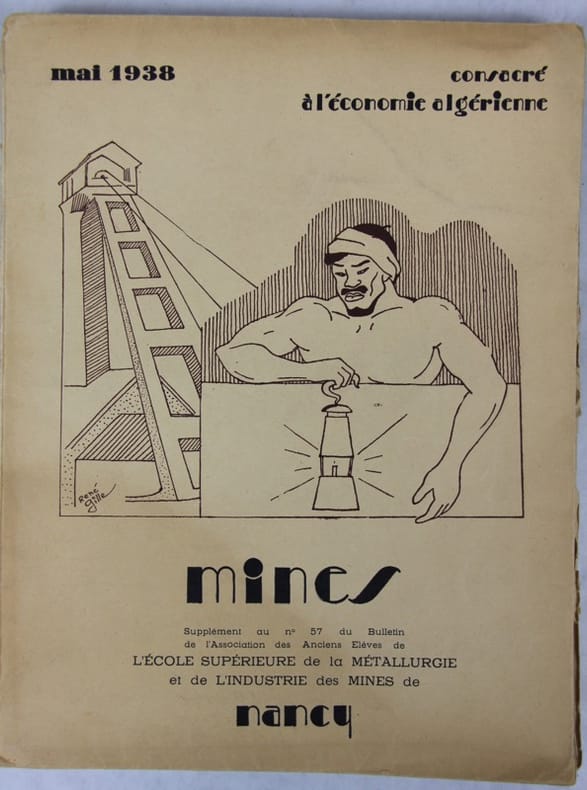
193837366Alger, F. Fontana, sd (1938) 1938 In-4 broché, couverture ill., 100 pp. & cahiers publ. 22 & 22 pp., 14 planches photo. hors-texte, figures et tableaux dans le texte. Couv. lég. fanée. Bon exemplaire.
1373114Paris: Musée de l'Homme, Museum National d'Histoire Naturelle, 1970 in-4, nombreuses illustrations. Broché. Bon état, cachet. Sommaire: Marie-Rose RABATE, Les jeux de l'Achoura dans la vallée du Dra (Sud Marocain). - Jean-Paul LEBEUF, Broderie et symbolisme chez les Kanouri et les Kotoko. - Françoise GIRARD, Grand mât sculpté érigé pour la commémoration des victimes de la chasse aux têtes par les Asmat de la Nouvelle Guinée indonésienne. - Henri LHOTE, Gravures rupestres du Djebel Mélias, Annexe de Beni-Ounif, Sud Oranais (Algérie). - Solange THIERRY, Japon, théâtre millénaire vivant. - Ethnomusicologie.
1371775Paris: Musée de l'Homme, Museum National d'Histoire Naturelle, 1971 in-4, nombreuses illustrations. Broché, très bon état. Sommaire: Lucienne A. ROUBIN, Les vignerons danseurs de la Saint Tryphon. - Jean BIAGINI et Roland MOURER, La poterie au Cambodge. - Hugo ZEMP, Un orgue éolien de Guadalcanal. - Hennri LHOTE, Ronde-bosse néolithique du Tassili. - Robert GESSAIN, Sénégal oriental 1970. - Mireille SIMONI-ABBAT, Pour que vivent nos collections. - Ethnomusicologie.
1371777Paris: Musée de l'Homme, Museum National d'Histoire Naturelle, 1973 in-4, nombreuses illustrations. Broché, cachet, très bon état. Sommaire: A. BHATTACHARYYA. Substrat anthropologique des danses chhau de Purulia. - Thomas F. JOHNSON. Musical instruments and dance uniforms in Southern Africa. - Martine QUENTRIC. Notes sur les coutumes vestimentaires des Kalash du Pakistan. - Henri LHOTE. Dalle gravée de la chaîne des Ergab (Algérie). - Jean-Paul ROUX. Turquie d'hier et d'aujourd'hui. - Solange THIERRY. Présence de la Turquie. Arts et traditions populaires d'Anatolie. - Elie VERNIER. Une pièce rare de Madagascar.
188029731Alger, Famin et Cie, s.d. [circa 1880]. 21 photographies et une planche imprimée, réunies sous une chemise de plein cartonnage cerise à l'imitation de chagrin, filets gras et maigres à froid encadrant les plats, lesquels s'ornent en outre de larges fleurons angulaires à froid, titre frappé or au premier, dos lisse.
2260Gouvernement général de lAlgérie 1950
197298470Paris Robert Laffont, coll. "Vécu" 1972 1 vol. broché in-8, broché, couverture illustrée d'un portrait, 466 pp., 16 planches hors-texte. Bel envoi de l'auteur à Jean Mauriac, "qui comprendra mieux que quiconque les rêves, les espoirs, les luttes, les joies et les peines de cette chevalerie dont l'honneur aura été d'être aux côtés du Général de Gaulle du premier au dernier jour".
197298470Paris Robert Laffont, coll. "Vécu" 1972 1 vol. broché in-8, broché, couverture illustrée d'un portrait, 466 pp., 16 planches hors-texte. Bel envoi de l'auteur à Jean Mauriac, "qui comprendra mieux que quiconque les rêves, les espoirs, les luttes, les joies et les peines de cette chevalerie dont l'honneur aura été d'être aux côtés du Général de Gaulle du premier au dernier jour".
197427973Couverture souple. Broché. 125 pages.
QWA-2637Bouchène, 2000, 196 p., in-8 br., bon état
QWA-20918Alger, Louis Chaix, 1939, in-8 br. (15 x 20,5), 86 p., E.O. tirée à 505 exemplaires numérotés, couverture rempliée, très bon état.
QWA-21645Eugène Figuières, 1930, in-12 br. (12x 19), 218 p., 1ère édition, couverture passée, intérieur propre, bon état.
c5043Paris, Collection Hetzel, J. Hetzel Libraire-Editeur, sans date (1863) ; volume in-18°, demi-toile noire, plats de papier marbré noir et jaune, étiquette manuscrite à l'encre au dos ( reliure fin XIXe ) ; 2ff.nch.,375pp.,1f.nch.(table).Modeste reliure, mais très correcte, dernier feuillet jauni, sinon quelques piqûres.
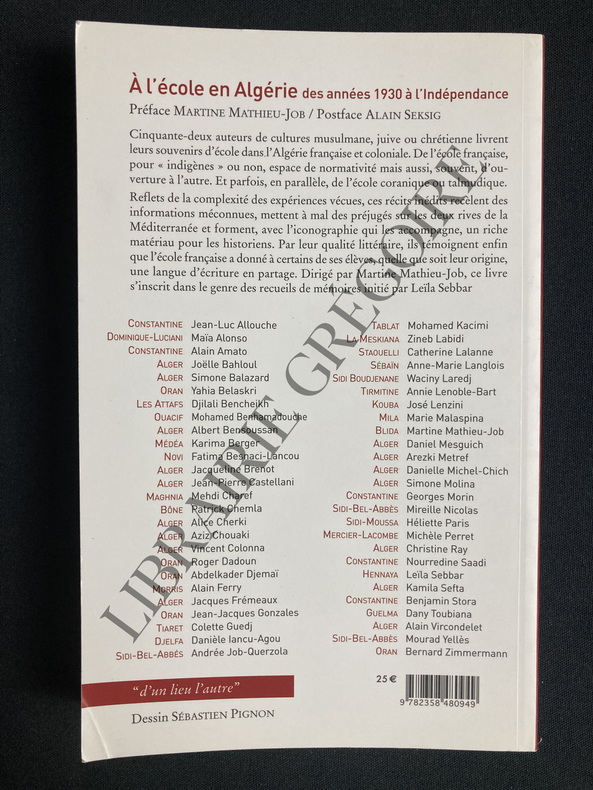
2018ABE-1671069474489POSTACE PAR ALAIN SEKSIG-IN 8-368 PAGES-NOMBREUSES PHOTOGRAPHIES-(22A)
2005167335Syllepse Syllepse, 2005. In-8 broché de 242 pages. Très bon état
Syllepse 2005, In-8 broché, 242 pages. Très bon état
16710,Paris, Plon 1949, III-507 pp., 1 vol. in 8 br.
579967Saint-Didier Haute Marne 1925 In-8 ( 230 X 140 ) de 218 pages, broché sous couverture illustrée. Illustrations dans et hors-texte. Bon exemplaire.
Brulliard, 1925. In-8 broché de 218 pages. Planches hors-texte. Petite déchirure sans manque sur le haut du dos sinon Bon état.