BESANCENOT (Jean)Livre Rare Book
5 489 résultats
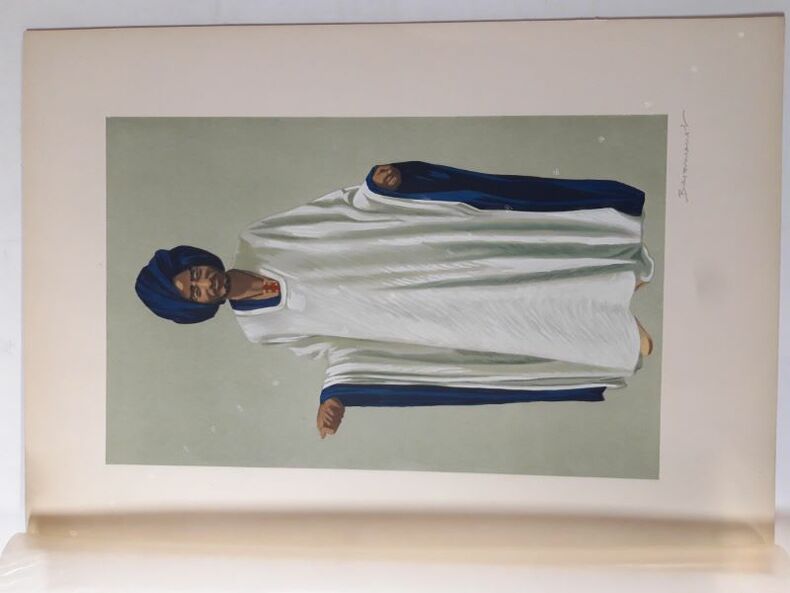
194247689[Horizons de France 1942] 1942 51 planches in-folio 47 x 34 cm sous serpente légendées, 26 signées par l’artiste, 13 en couleurs, 37 en camaïeu de noir. Une serpente déchirée, la première et la dernière planche très lég. fanée. Bel état par ailleurs.
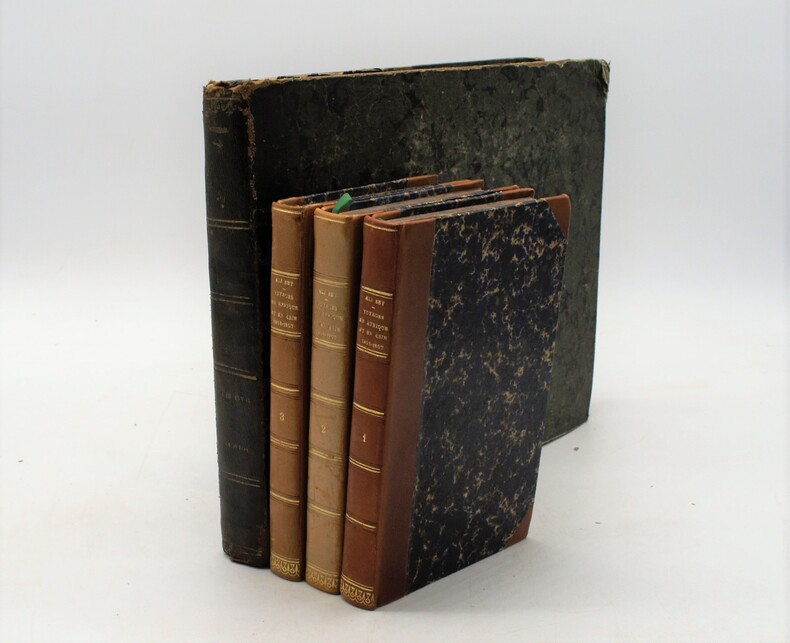
1814PHO-1225Paris , imprimerie Didot l’ainé , 1814 , 4 volumes composé de 3 tome de texte et un Atlas. TEXTE , 3 vol. in-8 (210x135) , relié demi maroquin et coins ,dos lisse avec auteur , titre et tomaison ,tranches marbrées, portrait de l’auteur en frontispice ,xix-395pp-1f (errata), 2ff-464pp-1f (errata),2ff-410pp-1f (errata) , dos et gardes refaits , cachets répétés , premiers feuillets brunis , quelques rousseurs , dos insolés. ATLAS , in-4 (330 x 260) Relié demi basane époque Portrait frontispice XIV-pp-texte 90 planches, dont 14 dépliantes ou sur double page, 5 grandes cartes d après les dessins de l auteur , les cartes Chypre, Maroc, Afrique du Nord, Cote d Arabie, El Cassaba ou le château de Tanger, Temple. Mission d Ali Bey à Tripoli. quelques rousseurs ,Pas de déchirures, coins usés, salissures , les gravures sont de Adam d’après les dessins de l’auteur. Très rare avec le texte
47659Horizons de France.1942.Ex.106/300.51 pages de texte non coupées.8 planches en noir.1 carte du Maroc.60 planches de costumes dont 20 en couleurs,légendées sur les serpentes.In folio en feuilles sous étui fermé par 4 lacets. Bon exemplaire.Rares rousseurs en marges.Carte et planches parfaites.Coffret restauré en parfait état,avec étiquette d'origine sur le 1er plat.
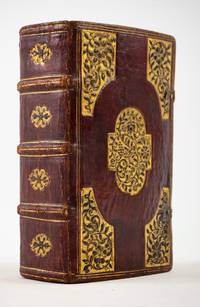
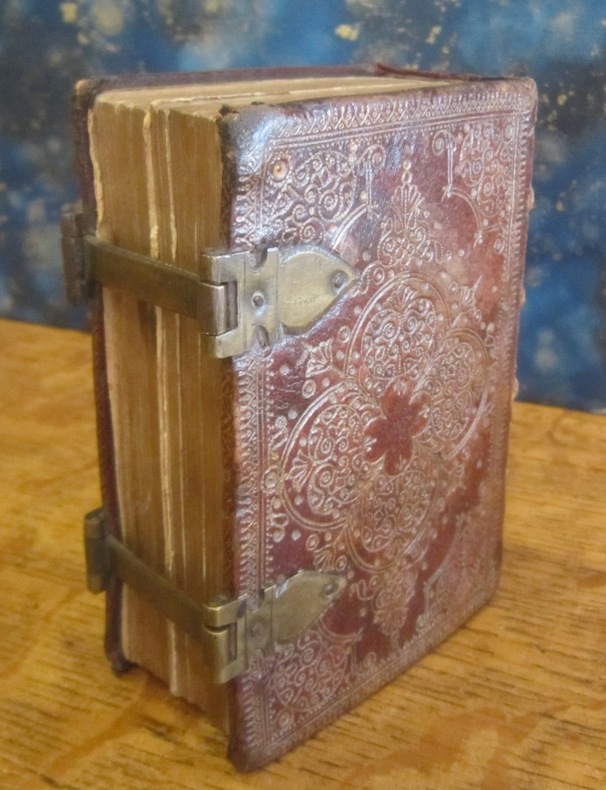
1622ST20888Munich: N. Henricus 1622. First Edition in German. 160 x 100 mm. 6 1/4 x 4". 16 p.l. 699 3 pp. Translated from the Latin by Sebastian Äntzenhover. <br/> UNUSUAL AND QUITE BEAUTIFUL CONTEMPORARY GERMAN DARK RED MOROCCO GILT covers with gilt fillet border central panel with onlaid corner pieces and centerpiece of black morocco stamped in relief to an Ottoman-inspired design of flowering vines raised bands spine panels with gilt centerpiece two leather straps with silver clasps and catches all edges gilt. Title page with engraving of the Tower of Babel. Top half inch of title page cut away to remove owner inscription. VD17 12:103845E; USTC 2019170. A touch of bowing to boards spine a little crackled joints and extremities a bit rubbed occasional small round marginal marks apparently made with wax! and presumably meant to indicate textual importance other trivial imperfections but an excellent copy clean and fresh in an unrestored binding with lustrous boards glistening with gilt.<br/> <br/> This rare work on sinning through the use of wicked words is offered here in a lovely binding that is quite out of the ordinary for its time and place and that may well have a very noble provenance. "Spiritual Tongues: That is a Salutary Treatise Concerning the Poisonous Tongue of Man--How to Guard Against and Remedy It" is an examination of the sins committed through speaking written by Munich Jesuit Johannes Pelecyus 1545–1623 and first printed in Latin in 1620. Pelecyus addresses the evils of gossip slander indiscretion cursing mocking and other injurious speech. The first part of the work is a general overview of the topic from a theological standpoint while the second part is a more practical guide to types of harmful speech and specific remedies for avoiding and correcting these offenses. Pelecyus concludes with a poem "The Devil's Disease and its Remedy." The binding here is remarkable in terms of its material makeup and the conjectural origin of its design. In the first part of the 17th century morocco was not commonly used by German binders who preferred sturdier pigskin particularly for treatises like this which could be expected to see much use poisonous tongues have long been a fact of life and in need of being frequently read about. Morocco was generally reserved for presentation copies or ceremonial liturgical works. In addition to the material the decoration here is unusually lavish for a text of this sort with onlays gilt adornment and silver clasps that required time and skill from the artisan and considerable expense for the patron. Significantly the lovely relief centerpiece design on the boards here also appears on the covers of a Book of Hours originally created for Holy Roman Emperor Maximilian I 1459-1519. That volume was later acquired by another similarly named owner Duke Maximilian I of Bavaria and is now to be found in the Bavarian State Library: shelfmark BSB 2 L.impr.membr. 64. It is certainly well within the realm of possibility that our later Maximilian 1573-1651 could have owned the present poisoned tongue volume and had it dressed in its elaborate morocco attire in imitation of the original binding design on the emperor’s prayer book. Whoever was responsible for the binding they surely did extremely fine work and no doubt for an elite clientele. One other curious feature of this volume is the series of round wax dollops made in the margins which an owner the fastidious second Maximilian has used to mark passages of interest in the text. While they don't materially affect the value of the volume they are intriguing in that they inevitably call up images for us of a careful early reader systematically marking with some kind of unknown implement the parts of the text that seemed important. "Spiritual Tongues" is a rare work: USTC and OCLC find just four copies outside Germany none of them in North America and we could trace just one copy sold at auction. N. Henricus unknown
1839001064Paris Imprimerie Royale 1839
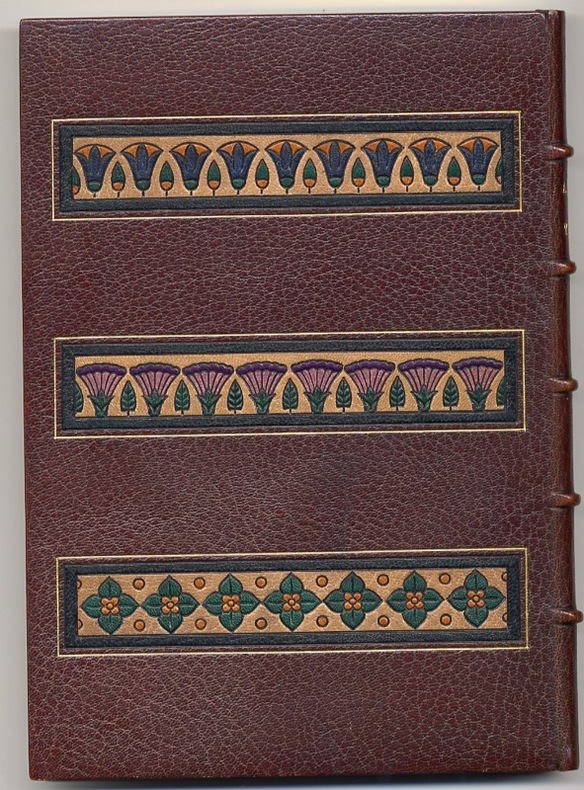
19248546Paris, Les Cent Bibliophiles, 1924 ; in-4 ; plein maroquin aubergine, dos à cinq nerfs, plats décorés et mosaïqués de trois larges compositions horizontales de fleurs stylisées "à l'égyptienne" : celle du haut, sur fond de maroquin mastic, succession de petites et grandes fleurs de maroquin mandarine, bleu-nuit et vert-sapin encadrée d'un listel vert foncé et d'un filet doré ; celle du milieu, alternance de fleurs et feuilles de couleurs violet, parme et vert-sapin, interrompue en son centre par un grand cercle de maroquin mastic dans lequel sont mosaïquées les lettres du titre en vert foncé, qui se chevauchent, le tout entouré d'un listel vert foncé et filet doré ; enfin, celle du bas présente une série de fleurs et feuilles à plat, soulignée d'une double rangée de points mandarine, toujours sur le même fond mastic et encadrée du même listel vert foncé et filet doré.Le décor du second plat, à l'identique mais sans le cercle-titre ; double filet doré sur les coupes, tranches ébarbées et dorées ; contreplats doublés de maroquin havane orné, en encadrement, d'un listel de maroquin aubergine entrecoupé de carrés dorés, triple filet doré, gardes de brocard de soie pourpre, couverture et dos conservés, étui bordé (reliure de Noulhac d'après une maquette de Madeleine Noulhac) ; (8) ff. (3 blancs, justification du tirage, faux-titre au verso frontispice, titre, faux-titre au verso, gravure hors-texte, gravure hors-texte), 215 pp., (8) ff. (table, achevé d'imprimer, Les Cent Bibliophiles, 2 bl.). ; 147 bois dessinés et gravés en couleurs de Louis Jou dont 9 hors-texte et 3 lettrines.
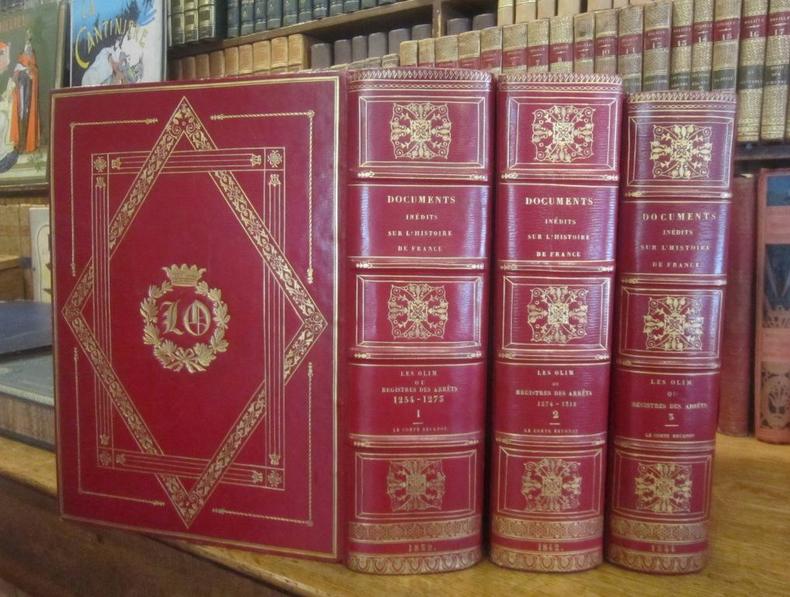
17263094Paris, Rollain, Quillau, Desaint, 1726 ; quatre tomes in-4 ; plein maroquin rouge cerise à grain long, dos à nerfs ornés, titre doré, triple filet doré d'encadrement des plats, filet doré et fleurons décoratifs en écoinçons, roulette décorative dorée sur les coupes et en intérieur, toutes tranches dorées (Thouvenin, relieur de 1813 à 1834) ; (6) ff., 696 pp. ; (1) f., 719 pp. ; (1) f., 552, 4 pp., (1) f. ; (1) f., 240, 408, 221, XX pp. et en tout, portrait gravé de l'auteur en frontispice, 6 cartes et plans et 70 portraits gravés blasonnés hors-texte et 4 vignettes.
1775ST17825Paris: Joseph-Gérard Barbou rue Mathurins 1775. 163 x 96 mm. 6 3/8 x 3 3/4". Seven volumes. Edited by J. N. Lallemand; preface by Jean Baptiste Louis Crévier. <br/> EXTREMELY ATTRACTIVE CONTEMPORARY GREEN ARMORIAL MOROCCO perhaps by Derome covers with triple gilt rule border central gilt coat of arms of the Blanche family featuring a seated fox with one paw raised above it a row of three five-pointed stars smooth spine divided into compartments containing a gilt lyre surrounded by stars and dots floral sprigs at corners volume number within a laurel wreath gilt lettering marbled endpapers all edges gilt. With printer's two-swans device on title pages volume I with frontispiece portrait engraved by L. J. Cathelin after J. C. Philips. With pencilled note on front flyleaf attributing the binding to Derome. Brunet III 1108 "Edition estimée"; Dibdin II 171. For the binding: Olivier Pl. 2279. ◆Spines slightly and uniformly sunned very light shelf wear to bindings occasional faint foxing in volume IV but A SUPERB SET almost entirely absent of any signs of use.<br/> <br/> This is a fine-paper copy in a binding both charming and handsome of what Dibdin deems "a truly beautiful and accurate edition" of Livy's Roman history. Brunet called it an "esteemed edition" and notes that fine paper copies like the present set sold for twice what regular copies cost. First printed by Sweynheym and Pannartz in 1469 the "Histories" of Titius Livius Patavani 59 B.C. - 17 A.D. follow the rise of Rome from the founding of the city through its triumphs in the Punic Wars and up through the reign of the author's contemporary emperor Augustus. His account is notable for its emphasis on the glorious triumphs and accounts of heroism of the Romans stemming in his eyes from their virtue; his history is intended not just to inform but also to elevate the reader. The present edition according to Dibdin builds on the fine editions edited by Crevier and Drakenborch incorporating their useful notes and additions. It was beautifully printed by Joseph-Gérard Barbou 1723-90 scion of a family that had begun printing in Lyon in 1529 moving to Paris in 1540. Joseph apparently specialized in Latin classics producing editions of Cicero Lucretius Pliny Caesar and Martial among others. The fine binding here does not have Derome's ticket but is well executed enough to make the attribution written in at front plausible. There were no fewer than 18 members of the Derome family not to mention workshop associates who made their livings as binders in Paris from the middle of the 17th century until the first quarter of the 19th. Our binding is tasteful--perfect for a scholarly edition of a classic--and conceivably the work of one of the Deromes or of an extremely competent associate. Olivier attributes our armorial stamp to the 18th century Blanche family of Burgundy and he finds it on a copy of Barbou's 1771 Sallust in the library of Madame la Comtesse de Cossé. The "country house" condition of the present set suggests an aristocratic owner more concerned with owning fine books than with reading them. [Joseph-Gérard] Barbou, rue Mathurins unknown
1830PHO-21101830, à Paris, Imprimerie Royale, 3 volumes in-8° et 1 atlas ,1 portrait-frontispice ,5 planches et 1 carte et itinéraire dépliante (900x 650mm). 3 fnch-xii-475pp,426pp,404pp., Très rare et complet- très bel exemplaire sans rousseurs, relié plein cuir orange, imitation écailles, dos lisse avec pièce d’auteur et titre, tomaison (frottements aux pièces). Dans l’Atlas : 5 planches et 1 grande carte repliée par Jomard (Gay. 243 Numa Broc Afrique pp 64-65).
1806001310Paris Imprimerie de P. Didot l'Aîné 1806
1772ST18628bBirminghamiae: Typis Joannis Baskerville 1772. First Baskerville Edition. 310 x 260 mm. 11 7/8 x 9 3/4". 1 p.l. 200 221-372 pp. but complete. <br/> SUPERB CONTEMPORARY RED MOROCCO LAVISHLY GILT IN THE STYLE OF DEROME covers with wide dentelle frame composed of botanical elements and many small tools raised bands spines gilt in compartments with central floral sprig surrounded by acorns flowers stars and dots volute cornerpieces green morocco labels gilt turn-ins marbled endpapers all edges gilt. Front pastedowns with engraved bookplate of P. Dupont and with morocco heraldic book label. Gaskell 44. ◆A breath of rubbing to extremities title page a little browned final page a bit foxed other trivial imperfections but AN EXCEPTIONALLY FINE COPY internally clean smooth and bright and in a sparkling binding.<br/> <br/> This is the impressive quarto edition of a trio of great Roman love poets in a premier binding befitting the elegant printing. In a sheet dated 1760 which Baskerville issued appended to a specimen of his folio Bible the printer discusses his proposed "Baskerville Classics": "Many gentlemen" he says "have wished to see a sett of the Classicks . . . in the Manner Letter and Paper of the 'Virgil' already published" and he vows to print the same with the poetical classics first. The present items are from what turned out to be seven Baskerville quarto printings of the classics mostly done late in the printer's career but according to Reed bearing "the marks of unabated genius." These volumes says Reed would "suffice had Baskerville printed nothing else to distinguish him as the first typographer of his time." In the present works the stately typography the luxurious paper textured but feeling rather like vellum and the spacious design combine to give the reader a particularly gratifying feeling of strength and serenity. The extraordinarily smooth surface of our leaves provides a tactile experience not available from any other 18th century printer Bodoni included. The beautiful binding here is unsigned but is clearly the product of a first-rate workshop; while it is not uncommon to see a volume from the Baskerville quartos in a decorative contemporary binding the present one would have a place in the front row of any assemblage. Typis Joannis Baskerville unknown
397044to. 15 5/16 x 10 1/4 inches. 90 leaves of 18th-century watermarked glazed paper. 18th-century French red morocco boards with elaborate gilt borders spine gilt in six compartments four silk ties at board edges all edges gilt.<br/> <br/> Provenance: Edgard Stern bookplate<br/> <br/> 90 blank sheets of laid paper with the watermark of a French/Dutch papermaker in a beautiful red morocco binding.<br/> <br/> This watermark originates from the mills of Jean Villadary or Villedary a French papermaker in Angoumois Vraichamp Beauvais or La Couronne. From 1668 to 1758 the firm was active in France and afterwards they owned a paper mill in Hattem Gelderland in the Netherlands until 1812. A law passed in 1688 regulating paper manufacturing ruled that the initials and name of papermarks had to be added to the watermark on every sheet of paper made. The name or initials VI or IV can be found over a period of 150 years during which they became known as a hallmark of excellence.<br/> <br/> Churchill W.A. Watermarks in Paper in Holland England France etc. in the XVII and XVIII Centuries and Their Interconnection 1865-1947 Amsterdam: 1935. unknown
397044to. 15 5/16 x 10 1/4 inches. 90 leaves of 18th-century watermarked glazed paper. 18th-century French red morocco boards with elaborate gilt borders spine gilt in six compartments four silk ties at board edges all edges gilt.<br/> <br/>Provenance: Edgard Stern bookplate<br/> <br/>90 blank sheets of laid paper with the watermark of a French/Dutch papermaker in a beautiful red morocco binding.<br/> <br/>This watermark originates from the mills of Jean Villadary or Villedary a French papermaker in Angoumois Vraichamp Beauvais or La Couronne. From 1668 to 1758 the firm was active in France and afterwards they owned a paper mill in Hattem Gelderland in the Netherlands until 1812. A law passed in 1688 regulating paper manufacturing ruled that the initials and name of papermarks had to be added to the watermark on every sheet of paper made. The name or initials VI or IV can be found over a period of 150 years during which they became known as a hallmark of excellence.<br/> <br/>Churchill W.A. Watermarks in Paper in Holland England France etc. in the XVII and XVIII Centuries and Their Interconnection 1865-1947 Amsterdam: 1935. unknown books
15950044291595 [Anvers], Ortelius, 1595. Deux cartes (51 X 39 cm) et (50 X 33 cm) sous cadres en pichepin.
1830PHO-17051830, à Paris, imprimerie royale, 3 volumes in-8°et 1 atlas ,1 portrait-frontispice ,5 planches et 1 carte et itinéraire dépliante (900x 650mm). 3 fnch-xii-475pp,426pp, 404pp..Très rare et complet- très bel exemplaire, relié plein buffle rouge, dos lisse avec auteur et titre, tomaison, atlas, titre au plat, couvertures conservées Dans l’Atlas : 5 planches et 1 grande carte repliée par Jomard
1787002012Paris Imprimerie de Didot l'Aîné 1787
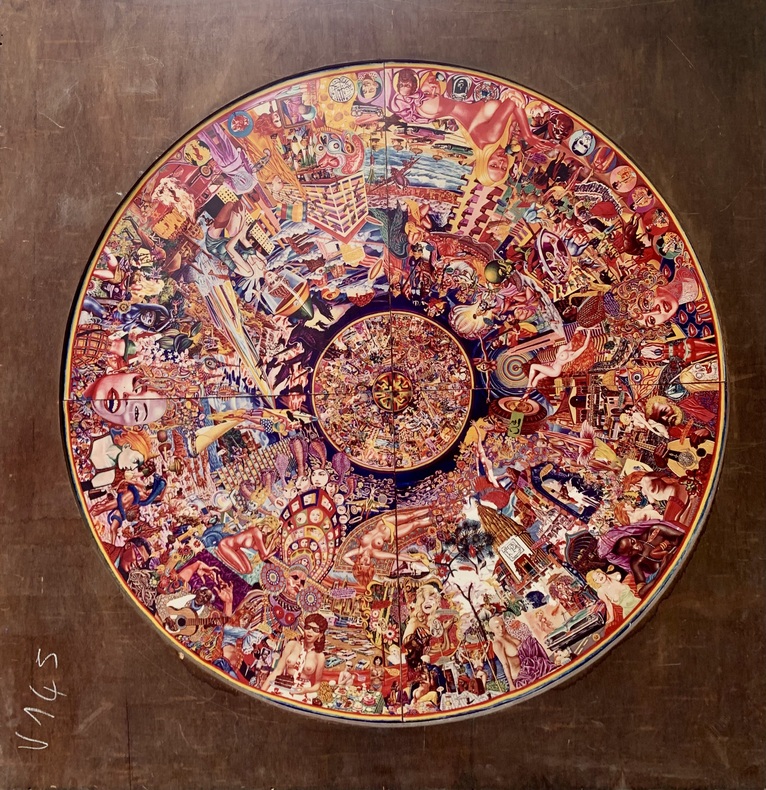
awd-1157Important tirage photographique en couleurs monté dans un encadrement carré en bois, ajouré en cercle au centre. Très rare épreuve, peut-être tirée pour un essai de couleurs lors de la commercialisation d’une affiche en 1969. Mentions Mati Klarwein, Grain of Sand, Robert Crandall Assoc., 1968 sur le côté avec échelles chromatiques, petits manques de pigmentation dans la partie basse (111,5/117,2 cm dans un cadre de 122/122 cm).
168815851Thomas Amaulry Lyon 1688 4 vol. 4 volumes in-12 de 10 ff.n.ch. (titre, épitre et préface) 536 pp. 8 ff.n.ch. (table), 1 f.n.ch. (titre) 576 pp. 10 ff.n.ch. (table et privilège), 1 f.n.ch. (titre) 576 pp. 10 ff.n.ch. (table) et 1 f.n.ch. (titre) 706 pp. 8 ff.n.ch. (table et privilège),, veau brun de l'époque, dos à nerfs orné, pièces de titre, tranches jaspées (épidermures sur certains plats, accrocs à certaines coiffes, quelques coins usés).
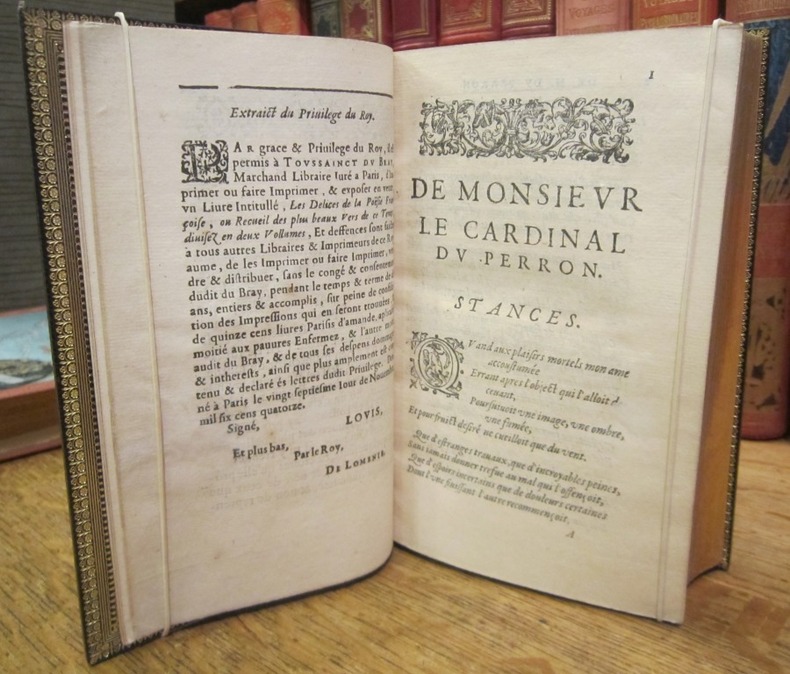
1615002850Paris, Chez Toussainct du Bray, 1615
003235Mornay, 1932
1733001899Londres Jacob Tonson 1733
51512Paris.Chalamel.1888.2 vols.in-folio en percaline verte,reliure éditeur, avec caractères noirs et dorés.Texte de 495 p.4 photogravures.101 dessins. de l'Auteur. Atlas de 20 cartes doubles ,1 carte d'assemblage au début, et in fine 1 carte rempliée en couleurs. Grande fraîcheur.Pratiquement sans défaut malgré coiffe supérieure du Texte,,légèrement déchirée.
1646000266Paris 1646
1676000160Amstelodami (Amsterdam) Danielem Elzevirium 1676
1724000220Paris Imprimerie d'Antoine Urbain Coustelier 1724