New Guinea Indigenous PeoplesBiblio.com
167 résultats
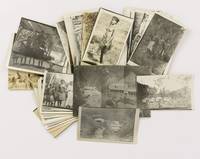
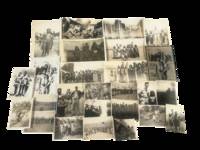
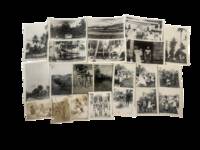
1910230071910. New Guinea photo archive group of 22 photographs dating to the early twentieth century documenting Indigenous communities and the colonial environments imposed around them. The material captures village life family groups communal activity and built spaces associated with missionary and administrative expansion providing direct visual evidence of how Indigenous people in New Guinea were photographed during a period of accelerating colonial intervention. These images are historically significant for the study of Indigenous life under colonial rule especially where domestic ceremonial and communal scenes appear alongside roads chapels and other introduced structures.<br /> <br /> Twenty-two black-and-white photographs including real photo postcards and original prints depicting Indigenous men women and children in both portrait and wider landscape formats. The archive includes captioned views such as "Native Huts New Guinea" "A Chapel in New Guinea" "One of Many New Guinea Highways" and "A Native Family of New Guinea." Several images focus on Indigenous dwellings family groupings and village settings while others show larger gatherings outdoor performances or dances communal scenes domestic labor and construction activity. A second grouping centers on colonial-built environments including palm-lined roads formal structures mission buildings and organized settlements. Closer portraits emphasize bodily presentation hairstyle adornment posture and dress while broader views show the spatial relationship between Indigenous communities and the altered colonial landscape. Sizes vary with the group consisting of postcard-format and similarly sized original photographs.<br /> <br /> Produced during a period of intensified missionary presence road building and colonial administration in New Guinea these photographs document the coexistence of Indigenous continuity and imposed colonial systems. The images show how photography was used to record classify and circulate views of Indigenous people and colonial development while also preserving visual evidence of community structure and daily life under conditions of outside control. The archive supports research into Indigenous history colonial visual culture missionary activity and the transformation of built and social environments in the Pacific. Minor handling wear and light edge wear; overall very good condition. A cohesive visual record of Indigenous life and colonial transformation in early twentieth-century New Guinea. unknown
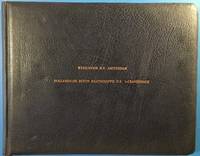
195426605The Hague: N.V. Nederlandsche Nieuw Guinee Petroleum Maatschappij 1954. Very good condition modest wear to corners of spine. Oblong 14" x 11" padded artificial leather gilt title on front cover. Site map with legend pasted in Twenty stiff pages with 82 black-and-white photographs tipped in with captions with fancy spiderweb patterned separating tissue guards. One additional site photo laid-in. Photo-record featuring in chronology the so-called Moetoeri-Project the construction of a pressure oil pipeline in the former territory of Dutch New Guinea taking place from October 1952-August 1954 from Wasian via Mogoi-Temboeni; further to Moetoeri Terminal with Gravity loading. Introduction supplies extensive technical information on materials applied. Construction carried-out by Werkspoor Ltd. Amsterdam and Hollandsche Beton Maatschappij Ltd. The Hague by order of the Dutch New Guinea Petroleum Company Ltd. N.V. Nederlandsche Nieuw Guinee Petroleum Maatschappij unknown
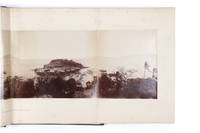
140780Very Good. Original gelatin silver photographs 33 postcard-format approximately 88 × 145 mm or the reverse and three smaller prints that overlap to form a panoramic view of Block 10 Gold Mine on Misima Island 127 × 190 mm. The majority have inscriptions on the verso see below; 11 have identifying captions six have routine messages to family members. Only a handful appear to be commercially-produced postcards. Undated but probably 1920s. Minimal signs of age and use; overall in excellent condition. The majority of the photographs form a near-complete series bearing a manuscript number and the initials 'W.D.W' in ink on the verso. There are 30 items numbered 2-13 15-24 26-29 32 and 34-36. We have established the initials are those of W.D. Wilson a builder and contractor and that he lived in suburban Adelaide at Largs Bay in the 1920s and Semaphore in the 1930s. The messages are to four of his children Rita Florrie Merle and an unidentified boy: curiously some of the names are scratched out of these messages; these tend to be on photographs taken in Rabaul. <p>The subject matter and captions of some of the photographs suggest he may have been working on the island possibly at Block 10 Misima Gold Mine at Umuna. The three-panel panorama and two other photographs feature the mine site with its 'crushing mills cyaniding vats sawmill black-smiths' and carpenters' shops electric lighting staff accommodation . and . tramway' Hank Nelson: 'Black White and Gold: Goldmining in Papua New Guinea 1878-1930' ANU Press 2016 now available online. Chapter 3 'Misima: warlike and civilised' is most informative. Other captions relating to Misima Island include 'Three Awaikivas Orokaivas'; 'Native hut Lappapai'; 'Ocean going Canoe with outrigger. Lappapai'; 'Shell hunting on the Coral. Lappapai'; and 'Bwagoia' one of the main villages. 36 items. unknown
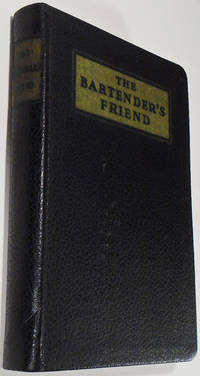
193335486New York: Jarmor Publishing Co 1933. First Edition. Original printed faux leather over boards octavo 170 pages plus blank note pages. Large formatted cocktail recipe guide book published immediately after the demise of prohibition. WorldCat locates six library holdings. The anonymous author's collaborator Patrick W. Guinee is described on title page as being "formerly of the Old Iroquois Bar Plainfield New Jersey and one of the best Mixers in the days when drinks were Drinks." Very Good attractive volume Jarmor Publishing Co hardcover
MA06C-03562Jarmor Pub. Co. Collectible - Good. New York: Jarmor Publishing Co. 1933. 1st edition. 8vo hardcover. Black leather. 170pp. Illustrations. Complimentary copy from Fidelity Wine & Liquor Co. Good book. Some soiling on boards worn at joints. Gilt worn off. Foxed. Pencil notation on one page of memoranda at rear. Bartending Liquors Cocktails Inquire if you need further information. Jarmor Pub. Co hardcover
1960153973London: Contemporary Films 1960. Eight vintage double weight studio still photographs from the 1960s UK re-release of the 1934 French film. Manuscript ink annotations identifying scenes on the versos. <br /> <br /> From the archive of film historian and author Joel Finler. <br /> <br /> A classic of French cinema Jean Vigo's only theatrical feature a film that in the minds of many including Francois Truffaut predicted and even helped define the French New Wave that would come 20 years later. <br /> <br /> Shot on location in Paris Yvelines and Seine-Maritime France. <br /> <br /> 10 x 8 inches. Four Near Fine four Very Good plus with faint dampstains to the bottom edges.<br /> <br /> Ebert I. Rosenbaum 1000. Contemporary Films unknown
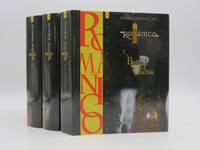
201418944Fundación Santa María La Real Centro De Estudios Del Románico. Near Fine in Very Good dust jacket. 2014. Hardcover. Volumes 1 2 and 3. Maroon cloth covers are rubbed at corners othewise pristine. Boards and spines are straight. Bindings are tight. Pages are clean and pristine. Books have never been cracked open. Dust jackets have modest wear to the extremities and scuffing and volume 2 has a 3/4" tear but clean bright and very good please note the photography lights created glare on dust jackets which creates the appearance of whitish discoloration on the dust jackets but isn't actually present. DJs protected by a brand new clear acid-free mylar cover. We add mylar covers to all books with DJs to preserve the DJs and add luster to magnify their beauty. If pictured shown without the mylar cover for an accurate representation of dust jacket. . Fundación Santa María La Real Centro De Estudios Del Románico hardcover
200918943Fundación Santa María La Real Centro De Estudios Del Románico. Near Fine in Very Good dust jacket. 2009. Hardcover. Volumes 1 2 and 3 of a 4 volume set. Maroon cloth covers are rubbed at corners othewise pristine. Boards and spines are straight. Bindings are tight. Pages are clean and pristine. Books have never been cracked open. Dust jackets have modest wear to the extremities but clean bright and very good please note the photography lights created glare on dust jackets which creates the appearance of whitish discoloration on the dust jackets but isn't actually present. DJs protected by a brand new clear acid-free mylar cover. We add mylar covers to all books with DJs to preserve the DJs and add luster to magnify their beauty. If pictured shown without the mylar cover for an accurate representation of dust jacket. . Fundación Santa María La Real Centro De Estudios Del Románico hardcover
182256812Kbh. 1822. 8vo. Senere blått kartonasjebind. Ubeskåret. XXVIII 382 2 s. Trykt hos Andreas Seidelin. Dansk. <br/><br/><em>Materien noe gulplettet. </em> unknown
193057796Paris: Société d'Éditions Géographiques Maritimes et Coloniales 1930. First edition. Folding map. 114 pp plates 350 pp. 1 vols. 4to. Original wrappers. Bottom third of spine missing else Near Fine. First edition. Folding map. 114 pp plates 350 pp. 1 vols. 4to. Société d'Éditions Géographiques, Maritimes et Coloniales unknown
2002Adhya-9781402002281Springer 2002. Paperback. New. Springer paperback
2002Adhya-9781402002281Springer 2002. Paperback. New. Springer paperback
1940230081940. Photographs of Indigenous communities in New Guinea during World War II document direct encounters between local populations and United States military personnel as Allied forces established operational infrastructure across the island beginning in 1942. Taken in the early to mid 1940s these images record the presence of Indigenous men women and children alongside uniformed servicemen situating them within a major Pacific theater of war where military expansion reshaped local environments and social conditions. The archive supports research into Indigenous history wartime contact zones and the impact of global conflict on colonial territories.<br /> <br /> Archive consists of 26 original black and white photographic prints likely silver gelatin depicting group portraits staged encounters and environmental views in New Guinea. Multiple images show Indigenous individuals arranged in lines or clusters often positioned with U.S. servicemen standing behind or among them indicating organized or facilitated photographic documentation. Dress and adornment vary with women wearing traditional skirts and beadwork and men and children appearing in customary attire. Several photographs include visible military infrastructure including aircraft fuselages transport planes and trucks suggesting proximity to airstrips supply depots or forward bases. A group of images captures a ceremonial dance or ritual with participants wearing elaborate headdresses and woven garments photographed in mid action.<br /> <br /> These photographs were produced during a period when New Guinea became a strategic center of Allied military operations in the Pacific bringing new systems of transportation labor demands and administrative control into Indigenous regions. Wartime conditions altered patterns of daily life through the introduction of foreign personnel the construction of military facilities and the expansion of colonial oversight. Visual documentation of these encounters reflects both the logistical realities of military presence and the asymmetrical relationships between Indigenous communities and external authority. Minor handling wear and edge wear with occasional fading; overall very good condition. This archive provides primary visual documentation of wartime contact between Indigenous populations and Allied forces in New Guinea during World War II. unknown
1936230101936. Neuendettelsau Mission publisher. Bilder aus der Neuguinea Mission late 1920s-mid 1930s documents German Protestant missionary activity and Indigenous life in New Guinea during the interwar period following the end of formal German colonial rule. Produced as a cigarette card album with printed German captions the work records village life subsistence practices missionary institutions and ceremonial activity situating Indigenous communities within a visual framework shaped by religious and colonial perspectives. The album supports research into Pacific history missionary networks and the role of photography in documenting and interpreting Indigenous societies under colonial influence.<br /> <br /> Oblong album containing a substantial series of mounted photographic cigarette cards on captioned leaves with printed German text throughout. The cover title reads "Bilder aus der Neuguinea-Mission" and includes a commemorative image captioned "Gedenkt des 50 jährigen Jubiläums der Neuendettelsauer Mission auf Neuguinea!" depicting three Indigenous men in traditional dress with spears. The album includes numerous images of daily life in coastal New Guinea including fishing hunting boat building village environments and ceremonial gatherings with captions such as "Mit Pfeil und Bogen" and "Mit dem Jagenetz" describing subsistence practices. Additional images depict mission infrastructure including churches schools workshops and settlements alongside scenes of education labor and communal activity. Photographs are systematically arranged and mounted presenting both ethnographic subjects and missionary-built environments within a unified visual sequence.<br /> <br /> The album was produced during a transitional period when German missionary societies continued operations in New Guinea under Australian administration after World War I maintaining institutional presence despite the loss of formal colonial control. The Neuendettelsau Mission founded in Bavaria in the nineteenth century had established networks of religious and educational institutions in the region contributing to broader systems of cultural transformation and documentation. The images reflect both local practices and the interpretive framework imposed by missionary observers revealing how photography functioned within colonial and religious contexts to classify record and disseminate knowledge about Indigenous populations. Mild toning foxing and edge wear to covers and pages; cards remain securely mounted with images largely clean and crisp; overall very good condition. This album provides sustained visual documentation of missionary activity and Indigenous life in New Guinea during the interwar period. unknown
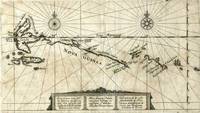
161918935Frankfurt: Blaeu 1619. Scarce copper engraved map of the northwest coastline of New Guinea and Moluccas showing the track of the Dutch explorers Le Maire and Schouten in 1616 in the ships Eendracht and Hoorn. The two explorers made the third complete circumnavigation and were the first to round Cape Horn from the east a more efficient way to get to the East Indies and thus a significant threat to the monopoly held by the Dutch East India Company. The expedition was headed for Batavia which it reached in October of 1616. The Dutch governor there obliged them by confiscating their cargo and sending them back to Holland but Schouten published his journals and now the word on the Drake Passage was out. With title cartouche in Dutch Latin and French. With two compass rose and sailing ship. From Schouten's account of his and Le Maire's first rounding of Cape Horn. Slightly toned otherwise very good condition. Blaeu unknown
18854504633Sydney: Thomas Richards Government Printer 1885. Slight rubbing to binding in handsome & original condition; interior lightly foxed in places; map with repaired tear; images all bright and crisp. Large square folio with a folding map three coloured lithograph plates 33 original silver albumen photographs 283 x 212 mm mounted on card with printed captions and borders and two superb panoramas one of them double-page 240 x 553 mm and the other on four sheets 242 x 1053 mm; original dark blue grained morocco binding bevelled edges spine banded and sides with multiple borders in gilt front cover lettered in gilt all edges gilded. <p><p>This rare and sumptuous album published in very small numbers and illustrated with actual photographs has been called the first example of Australian photo-journalism: 'the most magnificent example of an Australian work in this genre the high point in relation to which all other examples can be considered' Holden. It is most impressive as an ethnographic album one of the first such produced in the South Pacific. A special copy was delivered to Her Majesty the Queen as "a keen supporter of photography." </p> <p>The photographs all date from the 1884 expedition when Commodore Erskine proclaimed a British protectorate over the south coast of New Guinea. Although unattributed at the time all images were made by the New South Wales Government Printing Office and were chiefly the work of Augustine Dyer 1873-1923. Principally intended as a visual record the album shows the importance of the Hood Lagoon area of Papua New Guinea in British and Australian ambitions with six depictions of the region effectively a sixth of the finished work.</p> <p>The superb series of ethnographic and exploration photographs commemorating the 1884 expedition was printed and the albums assembled in Sydney in a small edition for presentation. Sir James Erskine R.N. 1838-1911 in 1885 was Private Secretary to Lord Northbrook the first Lord of the Admiralty and became Commodore of the Australian Station in January 1882. Erskine leased "Carthona" the grand Gothic-revival house built on Darling Point in 1841 for the explorer Sir Thomas Mitchell. In the 1880s it was owned by the solicitor Arthur Mansfield Allen but he was offering it to be let fully furnished in June 1884 and Erskine is known to have been resident there soon after.</p> <p>It is a piece of photo-reportage unmatched by any other work of this time and place. Through the positioning of images of the official ceremonies alongside topographical views of the surrounding areas the photographs themselves become a true part of the narrative: the first photographic images of the meeting between Imperial forces and Hood Bay chiefs. One of the remarkable images is a scene on board HMS Nelson as Erskine addressed some of the assembled tribal elders 'Commodore addressing Chiefs on board HMS Nelson Hood Bay' one seen grasping an ebony staff. Erskine had handed out a number of the staffs to local chiefs as "an emblem of authority in the form of an ebony stick with a florin let in at the top the Queen's Head being uppermost and encircled by a band of silver" Lyne New Guinea pp. 13 114-118.</p> <p>The motivation for the Australian Squadron's to New Guinea expedition under Erskine's command was imperialistic: "The Imperial Government. decided to take steps to establish a Protectorate over that part of the southern shores of new Guinea to the east of the territory claimed by the Netherlands with the double object of preventing any foreign occupation of the country and of protecting the inhabitants from aggression.". This declaration of the expedition's objective belies the tone of much of Erskine's Narrative which reads more like a travelogue than an official account. "Picturesque" is the most often used descriptive term along with such passages as "the striking variety and beauty of the colour in the adjacent water were enchanting and struck the beholder with wonder and admiration." Similarly Erskine's own speech considered for many years as a "Declaration of Rights" for New Guinea contrasts strongly with the text of the Proclamation itself. The latter is couched in formal imperial language whereas the former looks ahead in more open terms to the real benefits that the tribesmen might expect and is very specific regarding the protection offered by Her Majesty Queen Victoria: "look upon white persons whom the Queen permits to reside amongst you as your friends .". </p> <p>A full list of the images can be seen at hordern.com.</p> <p>The photographs are: 1 "Port Moresby from the Mission Station." Four-sheet panorama. 2 "H.M.S. 'Nelson' at Port Moresby S.W." 3 "General View of Settlement at Port Moresby N.N.E." 4 "Commodore shaking hands with Native Chief 'OBE Vagi' on board H.M.S. 'Nelson' at Port Moresby." 5 "Native Village Port Moresby W." 6 "Ethel Island and landing-place at Native Village Port Moresby S.W." 7 "Native Houses Port Moresby." 8 "Native Village Port Moresby S." 9 "Native Village Port Moresby N.W." 10 "Hoisting Flag at Port Moresby N.W." 11 "Yule Island from Delena Hall Sound N.W." 12 "Landing-place at Delena Hall Sound N." 13 "Hoisting flag at Delena Hall Sound." 14 "Koloka the Queen of the Lolo Tribe at Delena." 15 "Landing at Motumotu." 16 "Landing at Motumotu." 17 "Firing the Feu de joie Motumotu." 18 "New Guinea Chief Motumotu." 19 "Native Village Kerepunu Hood Lagoon S.W." 20 "Commodore reading Proclamation at Kerepunu Hood Lagoon W." 21 "H.M.S. 'Espiegle' saluting Flag Hood Lagoon." 22 "Scene near Kerepunu Hood Lagoon N.E." 23 "A Chief's House Kerepunu Hood Lagoon S.W." 24 "Commodore addressing Chiefs on board H.M.S. 'Nelson' Hood Bay." 25 "Argyll Bay W.N.W." Two-sheet panorama. 26 "Commodore reading Proclamation at Argyll Bay N.W." 27 "H.M.S. 'Nelson' saluting Flag at Mission Station Suau Stacey Island South Cape." 28 "View from Stacey Island N." 29 "Native Village Suau S.W." 30 "Native House at Suau." 31 "View from Dinner Island China Strait - H.M. Ships 'Nelson' and 'Espiegle' at anchor N.W." 32 "View from Dinner Island S.W." 33 "Natives on board H.M.S. 'Nelson' at Dinner Island." 34 "View from Anchorage N. side of Teste Island W. by N." 35 "West end of Teste Island from Anchorage S.W."</p> </p> . Provenance: A Paré "Elgin" Durban Rd. Wynberg South Africa pencil inscription on front flyleaf. Thomas Richards, Government Printer unknown