167 résultats
195266-F42R-KD6F1952. Hardcover. Good. Routledge Kegan Paul 1952 printing. No jacket. Some external staining rubbing to extremities a little fraying to spine tips. Internally VG with clean yellowed pages firm binding. hardcover
19-4H0399239642<p>BRAND NEW. Excellent condition. DJ has very slight edge-wear. Never read or opened. No remainder mark. First Printing. 19-4H0399239642</p> Philomel

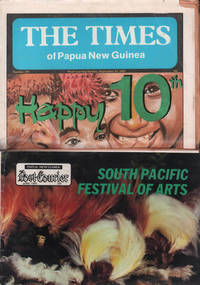
1980222469Port Moresby.: Post-Courier and The Times of Papua New Guinea. 1980& 1985. Two PNG newspapers. Post-Courier June 1980: 45pp. The Times of Papua New Guinea No. 299 September 15 1985: 48pp. Both issues: Black and white photographic illustrations. 43.5 x 30.5cm. Leaves evenly browned horizontal crease from folding some light wear in original colour pictorial wrappers. . Post-Courier and The Times of Papua New Guinea. unknown
000643Harper Collins 1983 Book. As New. F. As New. First Edition. Advanced Reading Copy ARC. 8vo - over 7¾" - 9¾" tall. ISBN:0-06-205032-X. Harper Collins, 1983 unknown
1919026754BOSTON MA: HOUGHTON MIFFLIN CO. FLAT SIGNED BY AUTHOR OWNER'S NAME PHILIP P. WELLS. . VG. Hardcover. First Edition. 1919. HOUGHTON MIFFLIN CO. hardcover
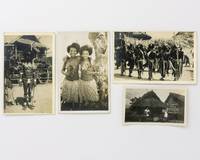
1930128061New Guinea: Unknown Photographer 1930. Very Good. New Guinea Unknown Photographer circa 1930s. Postcard-format gelatin silver photographs 140 × 89 mm or the reverse one on Kodak Post Card stock the others on plain stock. One bottom margin unevenly trimmed; minor silvering-out and trifling signs of handling; in excellent condition. Two photographs show ornately decorated men in a village. The other one features two young girls in grass skirts holding posies or something similar; the word 'lusious sic' is written in ink on the verso. A fourth snapshot 64 × 108 mm on 'Velox' paper with the words 'Native Huts' written on the verso is included: a small group of people including two white men and two local women are shown at the front of one of the dwellings. 4 items. Unknown Photographer unknown
1025082370.Ghardcover. Good. Access codes and supplements are not guaranteed with used items. May be an ex-library book. hardcover
1249584345.Gpaperback. Good. Access codes and supplements are not guaranteed with used items. May be an ex-library book. paperback
3639733711.Gpaperback. Good. Access codes and supplements are not guaranteed with used items. May be an ex-library book. paperback
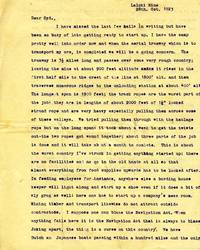
202912 page TLS describing in great detail the difficulties in setting up a mining operation in New Guinea. The author H. Edward Clayton is attempting to set up an aerial tramway to transport the ore. It is 3 1/2 miles long and passes over very rough country - the difficulty in hauling the cable is palpable. Clearly having been engaged in mining in other parts of the world before he speaks of Papua NG as "the worst country I've struck in getting anything started up" with no facilities the necessity of setting up your own company mess where as in the past "anywhere else a bording sic house keeper will light along and start up a show even if it does a bit of sly grog as well". He blames the "Navigation Act" which he calls "a curse on this country". "We have Dutch and Japanese boats passing within a hundred miles and the only ones allowed to call here are the little island boats of B.P's; the work is too much for them and the result is high fares and feights sic and infrequent service." <br /> <br /> Several other people are mentioned. There is a reference to "Bill Horsburgh" who is the assayer on this mine married with three children one of them was hospitalized for rheumatic fever in Port Moresby. "Bill has changed a good deal- as quiet as can be until he has a few in and the crust cracks." This could be a reference to William Horsburgh born in Queensland and married to Frances Stella Clayton. W.W. Horsburgh was an assayer and worked with the Dubuna and Laloki Mines of the New Guinea Copper Mines until at least 1927. It's possible that the author of the letter is related in some way to Horsburgh's wife. Clayton also asks after a George Osborne. <br /> <br /> We presume that the Laloki Mine is part of the Astrolabe mineral field near Port Moresby a massive copper mine that ran from 1907 to 1926 at the Laloki and Dubuna Mines and transported by light rail and aerial ropeway to a smelter near the Tahira Inlet wharf. Geology & Mining Potential of New Guinea by Wiliamson and Hancock 2005. <br /> <br /> 2 pp 8x10" signed H. Edward Clayton. Old folds very good condition overall. unknown
19702080502106505845Japan Ceramic Society 1970. Soft Cover. Fine. Volume: 1 Japan Ceramic Society paperback
3659481521.Gpaperback. Good. Access codes and supplements are not guaranteed with used items. May be an ex-library book. paperback
20131-3659449466LAP LAMBERT Academic Publishing 2013. Paperback. New. 260 pages. 8.66x5.91x0.59 inches. LAP LAMBERT Academic Publishing paperback
20132-1629481548Nova Science Pub Inc 2013. Hardcover. New. 1st edition. 285 pages. 10.00x7.00x0.75 inches. Nova Science Pub Inc hardcover
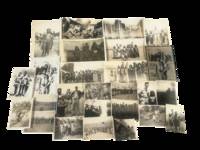
1940230081940. Photographs of Indigenous communities in New Guinea during World War II document direct encounters between local populations and United States military personnel as Allied forces established operational infrastructure across the island beginning in 1942. Taken in the early to mid 1940s these images record the presence of Indigenous men women and children alongside uniformed servicemen situating them within a major Pacific theater of war where military expansion reshaped local environments and social conditions. The archive supports research into Indigenous history wartime contact zones and the impact of global conflict on colonial territories.<br /> <br /> Archive consists of 26 original black and white photographic prints likely silver gelatin depicting group portraits staged encounters and environmental views in New Guinea. Multiple images show Indigenous individuals arranged in lines or clusters often positioned with U.S. servicemen standing behind or among them indicating organized or facilitated photographic documentation. Dress and adornment vary with women wearing traditional skirts and beadwork and men and children appearing in customary attire. Several photographs include visible military infrastructure including aircraft fuselages transport planes and trucks suggesting proximity to airstrips supply depots or forward bases. A group of images captures a ceremonial dance or ritual with participants wearing elaborate headdresses and woven garments photographed in mid action.<br /> <br /> These photographs were produced during a period when New Guinea became a strategic center of Allied military operations in the Pacific bringing new systems of transportation labor demands and administrative control into Indigenous regions. Wartime conditions altered patterns of daily life through the introduction of foreign personnel the construction of military facilities and the expansion of colonial oversight. Visual documentation of these encounters reflects both the logistical realities of military presence and the asymmetrical relationships between Indigenous communities and external authority. Minor handling wear and edge wear with occasional fading; overall very good condition. This archive provides primary visual documentation of wartime contact between Indigenous populations and Allied forces in New Guinea during World War II. unknown
19972111902160901453Nagano Prefecture New Guinea Association 1997. Soft Cover. Fine. Number of pages: 318p Nagano Prefecture New Guinea Association paperback
2012Alibris.0030226The Bible Society of Papua New Guinea. 2012. 2nd ed. Trade paperback. Very good. small chip on front cover corner. The Bible Society of Papua New Guinea paperback