TILHO JeanLivre Rare Book
445 résultats
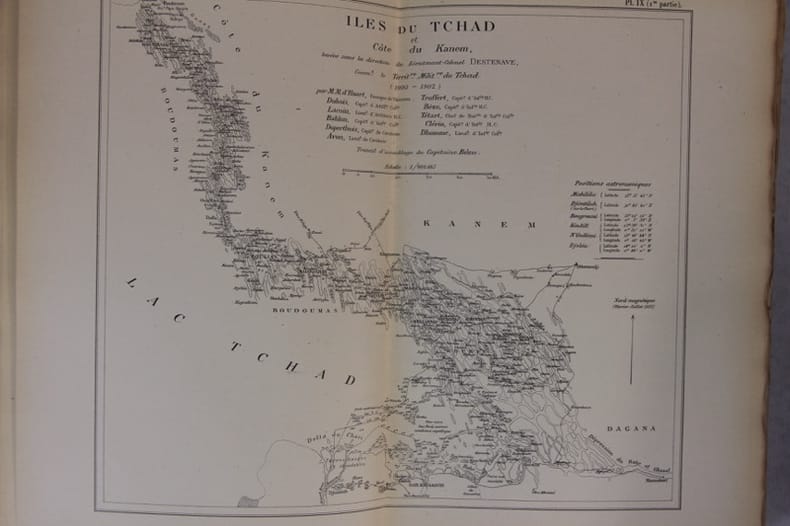
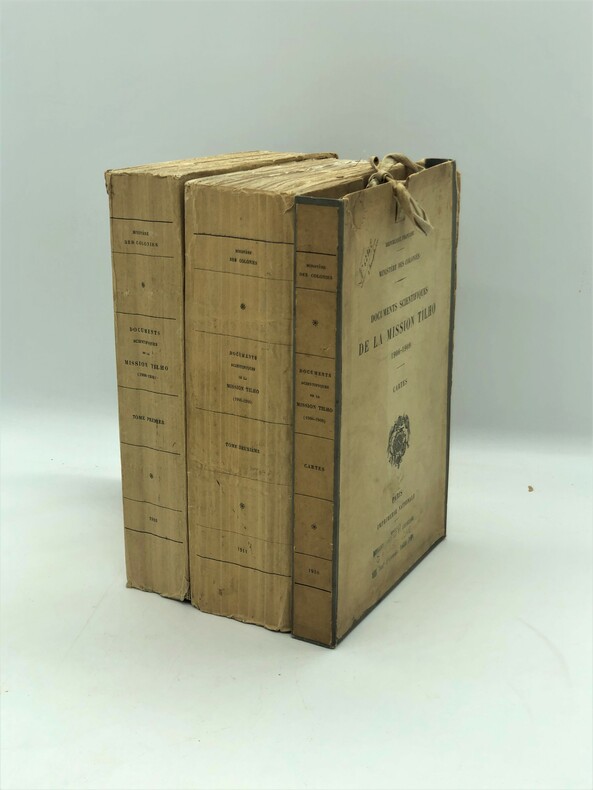
1910PHO-659Paris, Imprimerie Nationale, 1910-1911, in-4, 2 fort volumes brochés et un étui LX-412 pages et 76 planches et cartes (dont plusieurs dépliantes) + VIII-631-[1] pages, 131 planches et cartes ; 9 cartes(2 en double, manque la carte du Aïr), sous étui cartonné à rubans de l'éditeur, Unique édition, très rare avec les cartes. Ouvrage fondamental pour la connaissance des régions du Tchad et du Niger. Bon exemplaire, non coupé.
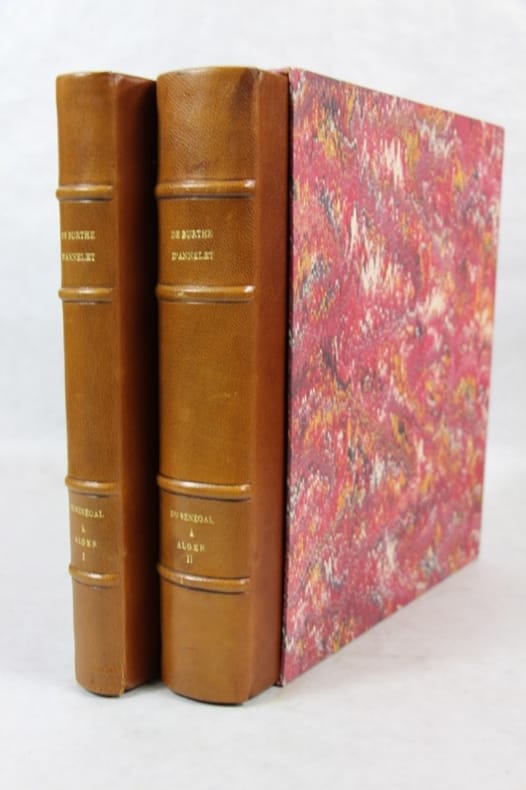
193243495Pierre Roger 1932 2 volumes in-4, demi-maroquin fauve, dos à nerfs, couvertures ill. cons., étui, 448- 843 pp. 6 cartes dépliantes hors-texte, nombreux plans, croquis, dessins, photographies et cartes dans le texte. Infimes rousseurs. Bel exemplaire.
245033Paris, Bohné, Bruxelles, Lacroix, 1860-1861 4 tomes en 2 vol. in-8, portr., 4 front. couleurs, 92 fig. en 58 planches, carte dépl. en couleurs, demi-basane bleu nuit, dos à nerfs (reliure moderne). Rousseurs aux premières pages du tome 1
057482Paris 1829 in 8 (22,5x14,5) 1 volume reliure demi basane verte de l'époque renfermant une grande carte gravée et entoilée à l'époque de format 95 cx 65 cms, pliée, des rousseurs éparses. Carte éditée pour le : Journal d'un voyage à Tembouctou et à Jenné dans l'Afrique centrale, précédé d'observations faites chez les maures Brakna, les Nalous et d'autres peuples pendant les années 1824, 1825, 1826, 1827, 1828 ( Paris, imprimerie royale, 1830 ). René Caillié, Mauzé-sur-le-Mignon (Deux-Sèvres) 1799 - La Gripperie-Saint-Symphorien (Charente-Maritime) 1838, explorateur français, premier occidental à entrer dans la ville de Tombouctou en 1828. Bon exemplaire
1798PHO-2264Paris, Tavernier, An VI [1798)]. In-8° de [4], 343 pp. 3 cartes dépliantes & Paris, Directeurs de l'Imprimerie du Cercle Social, 1792, l'an premier de la République Française. 171 pp. Basane fauve racinée, dos long orné, p. de t. en maroquin rouge, filet doré sur les coupes, tranches citron (Reliure de l'époque). Annotations anciennes dans les marges. Accident à la coiffe de tête, usure aux coins, frottements au dos.
1911132592Paris, Imprimerie Nationale 1911 3 volumes, 2 de texte et 1 de cartes sous étui. Deux fort volumes brochés, LX-412 pages et 76 planches et cartes dont plusieurs dépliantes + VIII-631-[1] pages, 131 planches et cartes. Dos cassé pour l’un, fendillé fragile pour le second. Sept cartes repliées sous étui sans la 8ème carte annoncée : Air, mais enrichie de 2 grands cartes en couleurs au 1/1000000 : Tibesti & Borkou-Ennedi 1925. Un troisième volume de texte sera publié en 1914.
1840AQ24366London: s.n. 1840. 6pp. Docket title to verso of final leaf. A trifle creased some very short tears to margins. A rare survival ordered to be printed by the House of Commons of copies of correspondence concerning the setting up of a British expedition to Niger to attempt to repress the foreign slave trade. The expedition organised by the Society for the Extinction of the Slave Trade and for the Civilization of Africa was ultimately mounted in 1841 using three British iron steam vessels to travel to Lokoja at the confluence of the Niger River and Benue River where treaties against the slave trade where achieved - despite significant casualties from illness amongst members of the expedition - with the cities of Aboh and Idah. OCLC records copies at four locations Florida Harvard NYPL and Oxford; COPAC adds no further. . First edition. Folio. [s.n.] unknown
193220781932 Paris, A. Calavas, Librairie des Arts décoratifs, sd [1932]. 33,5 x 26 cm, 2 ff. n. ch. (titre et préface) - 54 planches de photographies en noir tirées en héliogravure - 4 ff. n. ch. (table des planches), en feuilles sous chemise rigide de demi-toile écru à rubans, titre en creux au premier plat et imprimé au dos, rhodoïd.
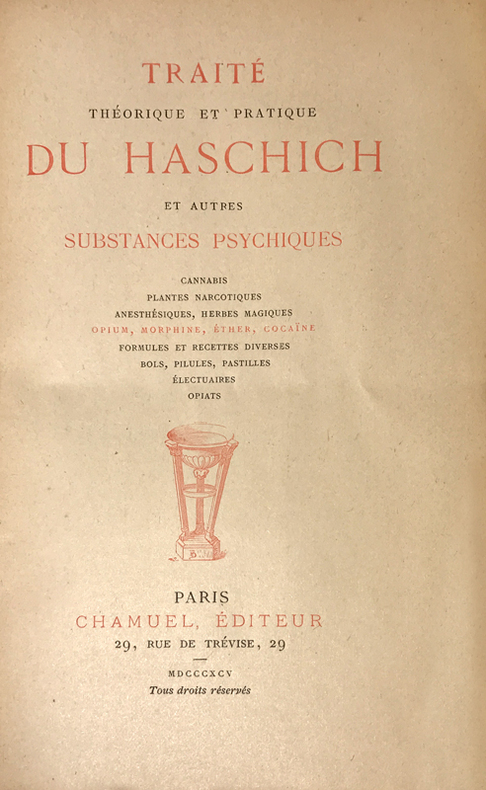
189515352Paris, Chamuel, 1895 ; in-12, broché ; 177 pp., (1 bl.), (2) pp. de catalogue, couverture crème rempliée, illustrée, imprimée en vieux-rose et noir, petites figures.
207223Paris, Challamel aîné, 1884; 2 vol. in-8, [2] ff. n. ch., 455 pp., avec un frontispice sous serpente ; [2] ff. n. ch., 22 planches, dont 6 cartes dépliantes et 16 plans sur 15 dépliants, un f. n. ch. de table, toile Bradel bouteille, pièce de titre cerise, tête mouchetée [texte] ; broché, première couverture détachée [atlas], (reliure moderne). Rousseurs.
214409Paris, Bohné, Bruxelles, Lacroix, 1860-1861 4 tomes en 2 vol. in-8, portr., 4 front. couleurs, 92 fig. en 58 planches, carte dépl. en couleurs, demi-basane blonde, dos à nerfs, filets et pointillés dorés (rel. de l'époque). Travail de ver sur les nerfs et les plats.
182643512A. Bertrand 1826 3 volumes in-8 et un atlas grand in-4. Texte : Plein basane fauve marbrée, dos lisse, caissons ornés, 366- 378- 428 pp. Rares rousseurs. Etui. Atlas : cart. ép., titre, expl. des planches, 19 pl. dont 5 carte, la dernière repl. Rousseurs, hum. à partir de la 13 pl. Bon exemplaire.
25524S.N. S.L. S.D. (vers 1880) Album de photographies in-8 oblong "à l'italienne" ( 240 X 325 mm ), demi-basane framboise, dos lisse muet, plats de percaline chagrinée de la même teinte contenant 9 photographies en tirage albuminé vers 1880 de format 170 X 225 mm contrecollées sur feuillets de papier fort montés sur onglets. Vues de TOMBOUCTOU, Du fleuve NIGER, de colons...Toutes les photographies sont légendées à l'encre à l'époque. Menus défauts aux photographies, taches, éclaircissement...Documentation fort rare...
191058679Paris, Imprimerie Nationale, 1910-1911, in-4, 2 fort volumes brochés, LX-412 pages et 76 planches et cartes (dont plusieurs dépliantes) + VIII-631-[1] pages, 131 planches et cartes ; 7 cartes (sur 8), sous étui cartonné à rubans de l'éditeur, Unique édition, très rare avec les cartes. Le troisième volume, publié en 1914 est manquant. Ouvrage fondamental pour la connaissance géographique de l'hydrographie, de la climatologie, de l'histoire, de l'anthropologie, de la faune, de la flore, et de l'ethnographie des régions du Tchad et du Niger. Bon exemplaire, non coupé. Couvertures défraichies et un peu dentelées, mouillure sur le plat supérieur de l'étui cartonné. Couverture rigide
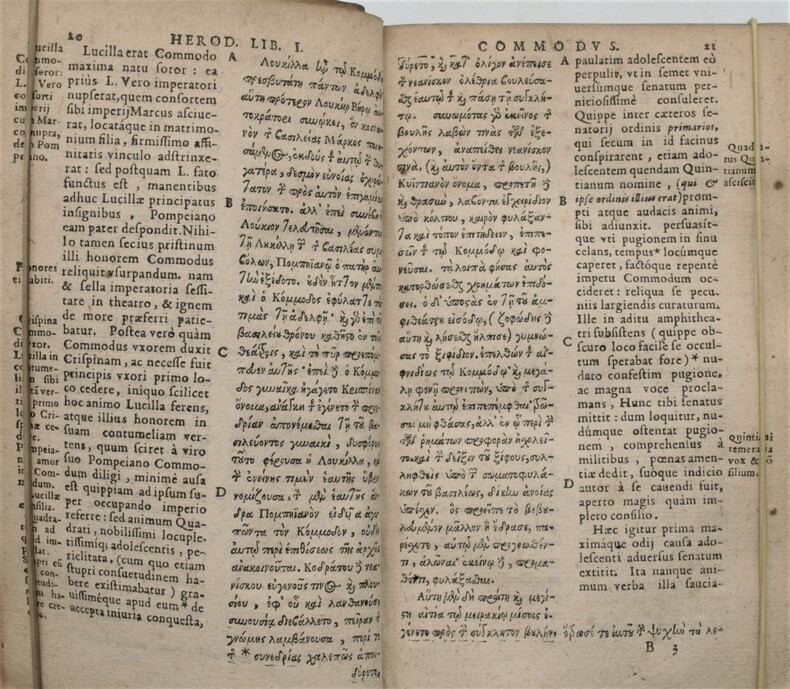
1611P1-2E-4Lyon, Antoine de Harsy, 1611. In-8 (172x103mm), reliure d’époque, plein velin, titre manuscrit au dos, texte en latin et Grec sur 2 colonnes, 7ff.n.c.-470pp.-36ff. index. Bon état.
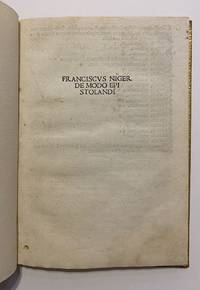
15084421Venice: Ioannes Rubeus Vercellensis 1508. Very good. Small 4to. 32 ff. some stains and repairs. Later inscriptions in Italian on final blank page. Bound in 20th-century French crushed niger morocco five raised bands on spine title lettered direct in the second compartment turn-ins gilt marbled pastedowns and endpapers edges plain. An attractive copy. A FOUNDATIONAL TEXT IN HUMANIST EDUCATION AND "ONE OF THE MOST POPULAR AND DISTINGUISHED GUIDES" TO LETTER WRITING WITH MODELS AND DETAILED INSTRUCTIONS FOR SECRETARIES ON HOW NOT TO WRITE A LETTER. <br /> <br /> Burckhardt "Civilization of the Renaissance" emphasizes the importance of epistolography as an achievement of the true humanist: "To maintain a faultless style under all circumstances was a rule of good breeding and a result of habit." The present pamphlet reached Europe-wide fame and was published in 43 editions in the fifteenth century alone.<br /> <br /> Salloch describing the need of humanists for exacting manuals for letter-writing states: "One of the most popular and most distinguished of these guides was Franciscus Niger's published first in 1488 recte: 1487. He gives a review of the different kinds of letters from 'Epistola Commendaticia' to amatoria gratulatoria invectiva jocosa etc. furnishes examples of perfect letters from classical as well as contemporary sources and combines them with concise practical rules. Faultless Latin and a select use of the principles of rhetoric seem to be the characteristic features" Salloch Catalogue 234 no. 973.<br /> <br /> Venetian grammarian Francesco Negri 1452-1523 was a teacher at the Hungarian court of Hippolito d'Este who had attracted a number of distinguished scholars in his Italian retinue. See Farkas Gabor Kiss "Renaissance humanism in the age of the Jagiellonian kings in Hungary 1490-1526" in: Hungarian Studies Volume 36 issue 5 uploaded 2022. See also: Giovanni Mercati "Francesco Pescennio Negro Veneto protonotario Apostolico" in: Ultimi contributi alla storia degli umanisti Vatican City 1939 III 24-109 1-75. <br /> <br /> Ours is the earliest of the two copies currently on the market; the other was published 35 years later in 1543. <br /> <br /> EDIT16 CNCE 61805 locating five copies. Inexplicably omitted from Erdmann's massive 771-page "Ars Epistolica" catalogue 2014. Ioannes Rubeus Vercellensis unknown
155957672Frankfurt a. M., Christian Egenolff Erben, 1559. 8°. Titel in Rot u. Schwarz. Mit 60 Textholzschnitten von Hans Sebald Beham, Hans Schäufelin u.a. 12 nn., 279 num. Bll. - Angeb. - Niger, Antonius. Consilium de tuenda valetudine. Leipzig, Valentin Bapst Erben, 1558. 48 nn. Bll. (das letzte weiß), Ldr. d. Zt. m. goldgepr. Deckelbordüren- u. -vignetten, Initialen u. Jahreszahl (1560) auf beiden Deckeln.
153292961532 Basileae, excudebat Henricus Petrus, [mense augusto, anno 1532]. [23]+[1bl]+405(recte 407)+[1bl] pages, marque dimprimeur au titre et au colophon.(Relié avec) Terentianus Maurus. De literis, syllabis et metris. Francofortiae, apud Christianum Egenolphum, [mense februario, anno 1532]. 95+[1bl] pages sans numéros, signatures A-M4, marque dimprimeur au titre. (Relié avec): Callimachi Cyrenaei hymni, cum scholiis nunc primum aeditis. Sententia ex diversis poëtis oratoribusque ac philosophis collectae, non ante excusae. Froben [Hieronimus Froben & Nicolaus Episcopius], Basileae, [calendis junii] anno 1532. Epître dédicatoire en latin et texte en grec. [8]+9-245+[1]+[1bl]+[1] pages, marques dimprimeur au titre et en dernière page, un feuillet de table des matières manuscrite ancien inséré entre les pages 8 et 9. Le tout en un volume in-4° (160 x 205 mm), sous belle reliure de lépoque en veau havane aux plats estampés à froid avec traces dattaches, dos à nerfs orné à froid. Dos et gardes anciennement remplacés, menue épidermure au niveau du premier nerf. Ex-libris manuscrit au haut de la première page de titre: «Collegii Soc[ietatis] Jesu Antwerp[iae] 1599». TRES BELLES EDITIONS DE TEXTES RARES.
1517132° mm 270x194; cc. 18 211 <i>recte</i>: 210 14. Carattere romano con numerose citazioni in carattere greco. Legatura settecentesca in pergamena rigida; dorso a scomparti con titolo e autore in oro su etichetta in marocchino. <b>Bellissimo esemplare dai margini pressoché intonsi<br /></b><br />Provenienza: Biblioteca Archinto <i>ex-libris</i> araldico.<br /><br /><i>Editio princeps. <br /></i><br />In testa al volume si trovano legati<i> </i>con segnature indipendenti aa-bb8-cc4 due altri testi del medesimo Autore: la <i>Consolatoria oratio ad Apolliniu</i><i>m</i> e il <i>De Fraterna benevolentia opusculum</i> verosimilmente estratti dall'edizione degli <i>Opuscula</i> di Plutarco pubblicati a Basilea nel 1530 'In Officina And. Cratandri'. <br /><br /><b>Negri's work is introduced by a dedicatory epistle to Jean Grolier de Servières</b> 1479-1565 General Treasurer of France and famous bibliophile on whose association cf. A. Hobson <i>Renaissance book collecting: Jean Grolier and Diego Hurtado de Mendoza. Their books and bindings</i> Cambridge 1999 pp. 28-30. <br /><br />The <i>Dialogus</i> printed after Philostratus's <i>Heroica</i> finds its philological fulcrum in a commentary on the <i>Periegesis</i> of Pausanias still essential today: "<b>the extraordinary Latin paraphrase of the </b><i><b>Periegesis</b></i><b> in the form of a dialogue published by Stefano Negri in 1517 only a year after the publication of the </b><i><b>editio princeps</b></i>. In his introduction Negri extols the didactic value of the text: the literary journey upon which Pausanias takes the reader can in Negri's view go some way toward replicating the illumination from actual travel to antique lands an experience that was no longer available to the young Philhellenes of Renaissance Europe" W.E. Hutton.<p>"Livre excellent et très rare qui conserve encore une haute reputation" Brunet III 519.</p><p>Stefano Negri allievo di Demetrio Chalcondylas fu professore di Greco a Milano dapprima presso la scuola dell'Ospedale Maggiore fondata grazie al lascito di Costantino Lascaris in seguito al Collegio dei Giovani Greci che Giano Lascaris fece finanziare da Francesco I cfr. <i>Storia di Milano</i> VIII 437. <br /></p> in officina Minutiana
15574307507Basle: Heinrich Petrus 1557. Marginal dampstains to first 25 leaves preface and index an excellent copy in contemporary binding small portions of the pigskin worn in two places revealing oak boards beneath. Folio woodcut printer's device to title and verso of final leaf woodcut historiated initials; original white pigskin binding over wooden boards blind-tooled to a panelled design roll-tooled borders including one with images of the psalmist and evangelists another with humanist medallion portraits including those of Erasmus Luther and Melanchthon spine with four raised bands later paper label at head giving title in places. <p><p>First edition: a handsome copy in contemporary monastic pigskin binding of this mid-sixteenth century compendium of geographical knowledge by the Venetian writer Dominicus Marius Niger edited by Wolfgang Wissenburg. In the tradition of the great classical geographer Strabo Niger provides a description of the principal regions of the earth together with accounts of the habits customs and laws of its various peoples. The first eleven chapters describe the geography of Europe; four chapters deal with Africa and are followed by eleven concerning Asia. This edition also contains the Geographia of Laurentius Corvinus and an epitome of Strabo by Hieronymus Gemuseus first published in 1539. Hakluyt would later produce ten arguments to prove that the Northwest Passage had been successfully sailed: the first century BC writer Cornelius Nepos can't have been wrong he says " And for the better proof that the same authority of Cornelius Nepos is not by me wrested to prove my opinion of the North-West Passage you shall find the same affirmed more plainly in that behalf by the excellent geographer Dominicus Marius Niger who showeth how many ways the Indian sea stretcheth itself making in that place recital of certain Indians that were likewise driven through the north seas from India upon the coasts of Germany by great tempest as they were sailing in trade of merchandise".</p> <p>Adams records only two copies at Cambridge CUL and John's while OCLC identifies about 15 library copies but this is a rare work on the market with no copy appearing at auction in the last fifty years. No copy is held in an Australian library.</p> <p>---</p> <p>Ralegh's interest in Niger's work is noted by Nicholas Popper Walter Ralegh's History of the World and the Historical Culture of the Late Renaissance 2014 who references ". the notes Ralegh took while reading the work of Marius Niger. Very little is known about Niger beyond the fact that he also edited a 1518 edition of Ovid's Amores but after the Petri printing house's 1557 edition of his Geographiae he enjoyed a wide readership in Elizabethan England. Wolfgang Wissenburg the editor of this edition explained in his preface that the manuscript version of the work was "tarnished both by neglect and by worms but it also had been polluted and depraved by a certain corruptor into whose hands it unfortunately had come." Correcting the manuscript had taken significant labor as Wissenburg explained: "if not for repeated intense reading of the ancients I would not have been able to understand the genuine sense and mind of the author and restore his places and meanings. Correcting Niger's commentaries against ancient texts might have been a suspect method for a travel narrative but it ably reconstructed his method of compilation. Niger had constructed the text by synthesizing ancient geographical and historical works into an experiential narrative and his information on Bactria and Sogdiana was cribbed almost entirely from Ptolemy's material with periodic additions from Plutarch Quintus Curtius and others. Thus Wissenburg's technique of correction imitated Niger's method of composition. Ralegh often cited Niger regarding the geography of Asia both in the notebook and in the History and he relied heavily on Niger for Bactria and Sogdiana. Niger's descriptions of these areas appeared both in Ralegh's notes and on the maps themselves.".</p> </p> . Provenance: From the Fürstliche Fürstenbergische Hofbibliothek at Donaueschingen the great German aristocratic library contents dispersed between 1980 and 2000. Heinrich Petrus unknown