768 résultats
1947015999Paris - Drouot Etude Bellier 1947 plaquette in-8 Agrafé, couverture illustrée
193232287Editions du Comité de l'Afrique Française, 1932. In-8 relié de pleine toile rouge brique (21 x 13,7 cm), couverture imprimée conservée, 324 pages, orné de 18 photographies dont 16 de Georges bruel, et 3 cartes. En guise de préface : Alfred Fourneau, l'un des "premiers cent" du Congo par Auguste Terrier.- Annotations de Georges Bruel.- 450g.- Pas de rousseurs, reliure en très bon état. EDITION ORIGINALE.
1912C97247Bruxelles, Touring Club de Belgique s.d. [ca. 1912] Série complète de 8 tomes, 12pp. par tome, chaque tome contient 2 pages de texte et 10 pages d'illustrations (avec ca. 90 photos en n/bl : vues de nature, des batiments, et des indigènes congolais), soit un total de ca. 96 pages avec plus de 720 illustrations, in oblong (31x42cm.), peu de taches occassionnelles, brochures originales illustrées, le tout en bon état sauf les défauts suivants: premier tome (brochure avec qqs. défauts et déchirure de 5cm. au milieu inférieure des pages, qqs. vagues taches) et tome 8: coin inférieur détaché de la p.9-10 (avec perte de ca. 1cm. carré d'une ill.), bien rare, C97247
1946235061946. Congolese ceremonial and colonial encounter photo archive showing indigenous ceremonial dance dress and culture uniformed troops and Belgian officials in the Belgian Congo during the late 1940s and early 1950s. Key scenes are tied to the 1947 visit of Prince Regent Charles to Paulis. Belgium ruled the Congo from 1908 until independence on June 30 1960 after the Belgian parliament took over King Leopold II's Congo Free State following international exposure of forced labor and mass abuses. Several captions appear to place the photographs during the governorship of Eugène Jungers Governor General of the Belgian Congo from December 31 1946 to January 1 1952 a period when Belgian rule promoted "paternal" administration while Congolese political pressure and demands for advancement were growing. The strongest scenes center Congolese public ceremony rather than colonial officials alone: men dancing in lines drummers seated before large instruments children gathered for viewing and performers facing crowds in open fields and palm-lined roads. Chief Tongolo and his daughter appear among colonial representatives during the Prince Regent's visit giving the archive a named Indigenous presence within a public ceremony shaped by Belgian authority.<br /> <br /> Photo archive of 24 silver gelatin photographs measuring approximately 3" x 4" each Belgian Congo 1940s-1950s. Several French captions can be translated; "Governor General Jungers"; "the regiment's standard at the cemetery"; "parade of the veterans"; and "Congolo gives his speech." Congolese men dance in feathered or fiber headdresses body ornaments patterned waist cloths shields and drums sometimes advancing across open ground before lines of onlookers. Belgian men in white suits and pith helmets stand with Congolese adults and children outside official buildings and in outdoor assembly areas while other scenes show African soldiers in formation a ceremony near railroad tracks a colonial cemetery observance and a station or compound with crowds gathered along walls and platforms.<br /> <br /> After the Second World War Belgium's Congo policy remained formally paternalist while urbanization war service missionary education and wage labor created new Congolese claims to political recognition that colonial rule could not contain;within thirteen years of Prince Regent Charles's 1947 visit the Congo gained it's independence and became Republic of the Congo. Light handling wear toning and minor curling; captions remain legible on several versos images remain clean and clear. Overall in very good condition. The archive records Congolese ceremonial life at the point where public dance veteran commemoration colonial ceremony military display and Belgian administrative power occupied the same public spaces. unknown
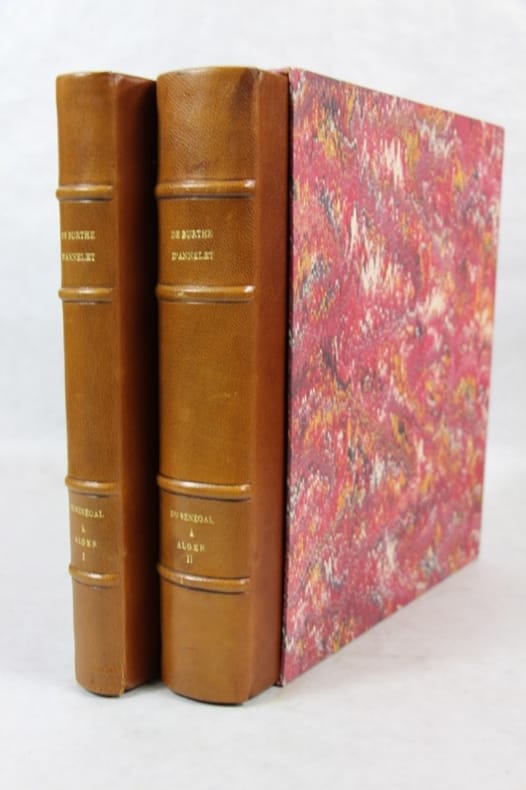
193243495Pierre Roger 1932 2 volumes in-4, demi-maroquin fauve, dos à nerfs, couvertures ill. cons., étui, 448- 843 pp. 6 cartes dépliantes hors-texte, nombreux plans, croquis, dessins, photographies et cartes dans le texte. Infimes rousseurs. Bel exemplaire.
1977010545Repulblique du Zaire 1977 Division des relations publiques de la gécamines Hardcover As New 1st Edition Signed by Author(s)
1948C99915Tervuren, Museum van Belgisch Congo 1948-1960 Complete series of 10 parts, bound in 4 volumes: viii,562 + 350 + 521 + 574pp., with numerous bl/w pictures and maps in text, text in Dutch, 36cm., in the series "Annales du Musée royal du Congo belge. C: Zoologie, série IV" (vol.2 fasc.1-3, vol.3 fasc.1-2, vol.4 fasc.1-2 & vol.5 fasc.1-3), 4 uniform hardcover bindings in good condition, spines in blue cloth with gilt lettering, few stamps on title pages, text clean and bright, Good condition, [Content: Volume I (fasc.1-3): Struthioniformes, Colymbiformes, Procellariiformes, Pelecaniformes, Ciconiiformes, Phoenicopteriformes, Anseriformes, Falconiformes, Galliformes, Turniciformes, Ralliformes, Gruiformes, Charadriiformes, Lariformes, Columbiformes, Cuculiformes, Psittaciformes // Volume II (fasc.4-5): Coraciiformes, Strigiformes, Caprimulgiformes, Cypseliformes // Volume III (fasc.6-7): Passeriformes // Volume IV (fasc.8-10): Passeriformes], weight: 13kg., C99915
1909310760Bruxelles: Albert de Wit . Institute International de Bibliographie 1909. First edition. With 8 plates from photographs with multiple images; folding map; folding plan. xx 376 pp. Preface by Cyrille van Overbergh. 8bo. Later red cloth with original printed rose wrapper mounted to front cover. Light soiling to wrapper toning to text. First edition. With 8 plates from photographs with multiple images; folding map; folding plan. xx 376 pp. Preface by Cyrille van Overbergh. 8bo. An ethnographic description of the Warega or Lega people of what is now the Democratic Republic of the Congo published shortly after the creation of the Belgian Congo; volume 5 in the Collection de Monographies ethnographiques published by Cyrille Van Overbergh. A short biographical footnote on p. viii describes the author as a reserve officer in the Belgian army. Albert de Wit ... Institute International de Bibliographie unknown
1946232341946. Belgian Congo photo archive documenting colonialism and segregated settlement in Paulis Jadotville and at Kiubo Falls in 1946-1947 while Belgian rule expanded displacing Congolese communities from political power and control over local resources. Made by an unidentified traveler or colonial observer the group moves between industrial sites river traffic town streets waterfalls village compounds and posed encounters with Congolese residents placing daily life beside the infrastructure of empire. Jadotville in Katanga had been built within the orbit of Union Minière du Haut-Katanga and the copper economy that tied the Congo to European industry; Paulis belonged to the northeastern colonial administrative network that extended surveillance mission activity and commercial penetration into local societies. By the later 1940s these systems were producing wealth for Belgium and foreign markets through forced and controlled labor regimes.<br /> Photo archive of 36 black and white silver gelatin photographs various sizes ranging from 2.5" x 3.5" to 5" x 7" Belgian Congo 1946-1947. Nine photographs are identified to the Paulis region in 1946 including versos inscribed in French with "Habitations Européens à Paulis" "Pavillon de l'hotel" and "Le Kigoma sur le fleuve." These images show European-style houses set among palms a large riverside or lakeside steamer a broad colonial street with automobiles and low commercial buildings thatched structures and Congolese figures posed near village compounds and along a tree-lined road. The remaining photographs from Jadotville and Kiubo Falls in 1947 include multiple views of the falls from overlooks and near the waterline several repeated compositions of cascades and riverbanks a dense electrical installation with transformers and steel framing public crowd scenes dugout canoes on calm water groups standing beside temporary camp structures and additional views of thatched settlements large shade trees and Congolese men women and children positioned before houses or in open clearings. Several photographs set European-built environments against Congolese dwellings and occupied landscapes making the colonial dichotomy apparent within this grouping.<br /> Waterfalls river steamers electric infrastructure and ordered streets mark the channels through which copper labor and administrative authority moved outward to Belgian and international markets while the photographs of Congolese settlements and residents show the populations who bore that reorganization of land and economy. In the late colonial Congo extraction and transport depended on African labor under coercive conditions and urban growth in places such as Jadotville advanced through racially unequal housing wage structures and civic access leaving Congolese people concentrated in subordinate quarters or rural zones even when their work sustained the entire system. Light wear and occasional creasing; several versos inscribed in French; overall very good condition. An intimate look into Belgian colonial rule at the point where industrial wealth infrastructure and local displacement met on the ground. unknown
1909310760Bruxelles: Albert de Wit . Institute International de Bibliographie 1909. First edition. With 8 plates from photographs with multiple images; folding map; folding plan. xx 376 pp. Preface by Cyrille van Overbergh. 8bo. Later red cloth with original printed rose wrapper mounted to front cover. Light soiling to wrapper toning to text. First edition. With 8 plates from photographs with multiple images; folding map; folding plan. xx 376 pp. Preface by Cyrille van Overbergh. 8bo. An ethnographic description of the Warega or Lega people of what is now the Democratic Republic of the Congo published shortly after the creation of the Belgian Congo; volume 5 in the Collection de Monographies ethnographiques published by Cyrille Van Overbergh. A short biographical footnote on p. viii describes the author as a reserve officer in the Belgian army. Albert de Wit ... Institute International de Bibliographie unknown books
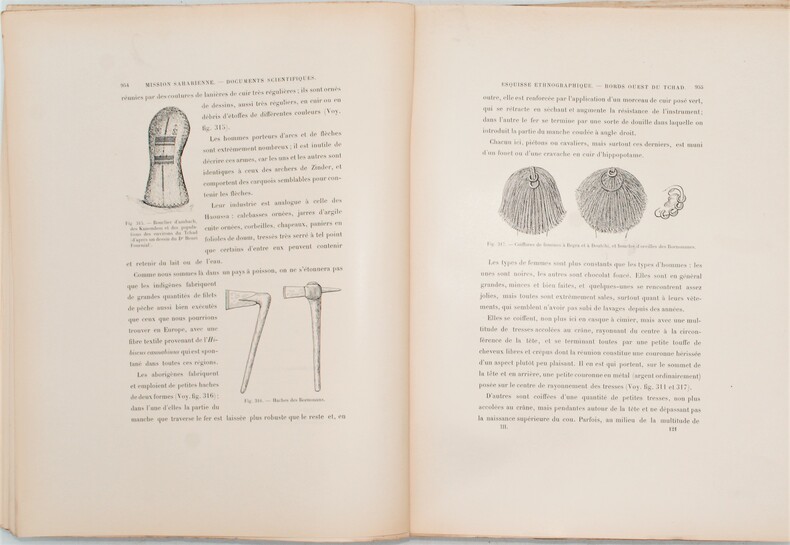
1903PHO-1294Masson, 1905. 4 vol. in-4 . Texte : broché (dos très usés avec manques et plats détachés au tome III, avec des défauts aux autres tomes); IV- 1210 pp. 428 reproductions photographiques dans le texte, 30 planches num. in & hors-texte, 2 pl. hors-t. n. ch. Atlas : cartonnage vert éditeur (frotté et tâché, bords des cartes un peu piqués et poussiéreux). 16 planches en couleurs contenant l'itinéraire général de la mission entre Ouargla et Bangui à l'échelle de 1/400.000e avec un levé détaillé du cours du Chari aux basses eaux entre Fort-Lamy et Fort-Archambault, à l'échelle de 1/100.000e.
192875946Bolenge Congo: Disciple's of Christ Cono Mission 1928. Seventh edition. Octavo. 118 pp. All in Bogangi. Original flexible red cloth. Very good.Mainly comprised of Christian hymns in Bobangi. It must have been quite popular to make it to the seventh edition but we can find no copies on OCLC. Disciple's of Christ Cono Mission hardcover
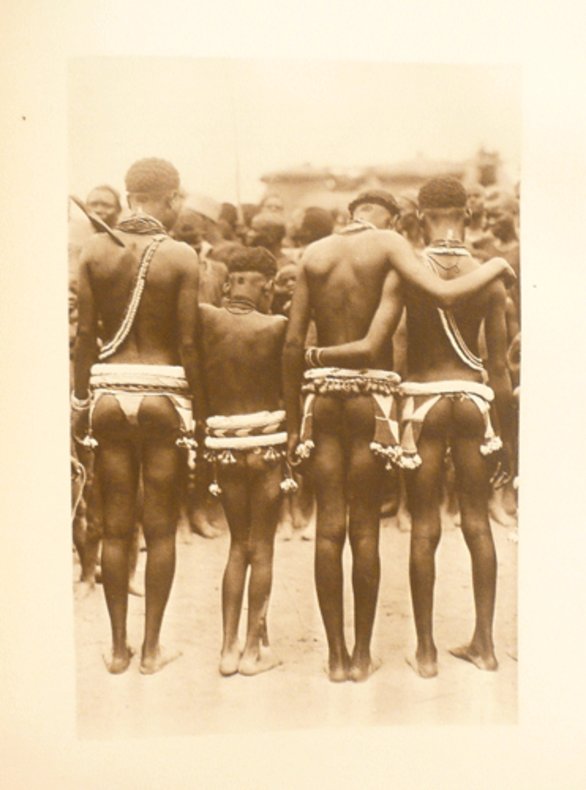
19294216DBParis, Gallimard, 1929. Gross-4°. 4 Blatt, 304 Seiten, 5 Blatt, 64 ganzseitige Heligravüren von Marc Allégret, 4 geographische Karten. Mit Kopfgoldschnitt. Halblederband mit marmorierten Deckeln.
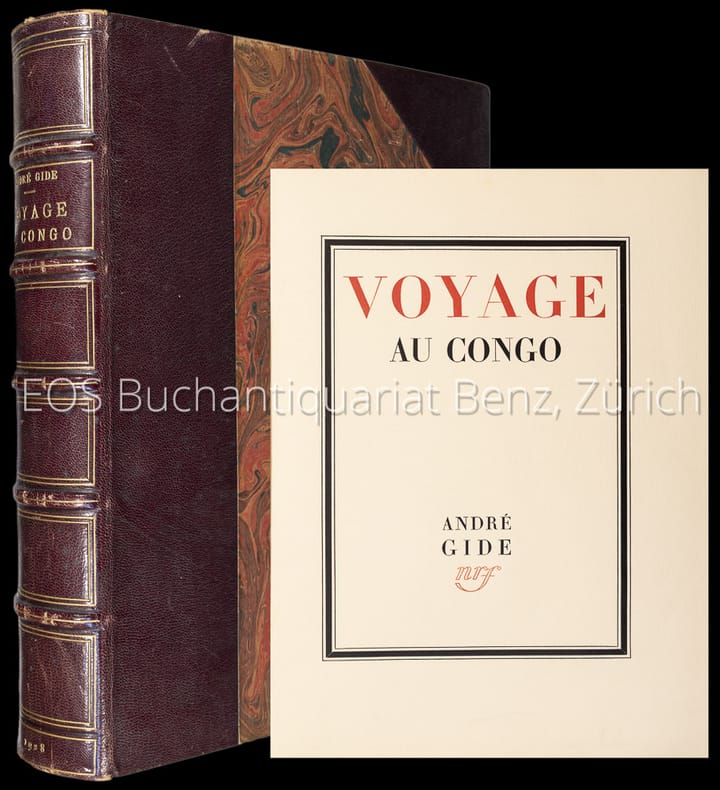
19290000491929 Paris, Librairie Gallimard, sans date [1929]. Fort in-quarto demi-chagrin poli havane, dos cinq nerfs sertis de filets à froid, auteur et titre dorés, date en queue, plats et dos de la couverture conservés (reliure moderne) ; 307 pages, 63/64 planches hors-texte et 4 cartes hors-texte.
19294216DBParis, Gallimard, 1929. Gross-4°. 4 Blatt, 304 Seiten, 5 Blatt, 64 ganzseitige Heligravüren von Marc Allégret, 4 geographische Karten. Mit Kopfgoldschnitt. Halblederband mit marmorierten Deckeln. + Wichtig: Für unsere Kunden in der EU erfolgt der Versand alle 14 Tage verzollt ab Deutschland / Postbank-Konto in Deutschland vorhanden +, A|B|C
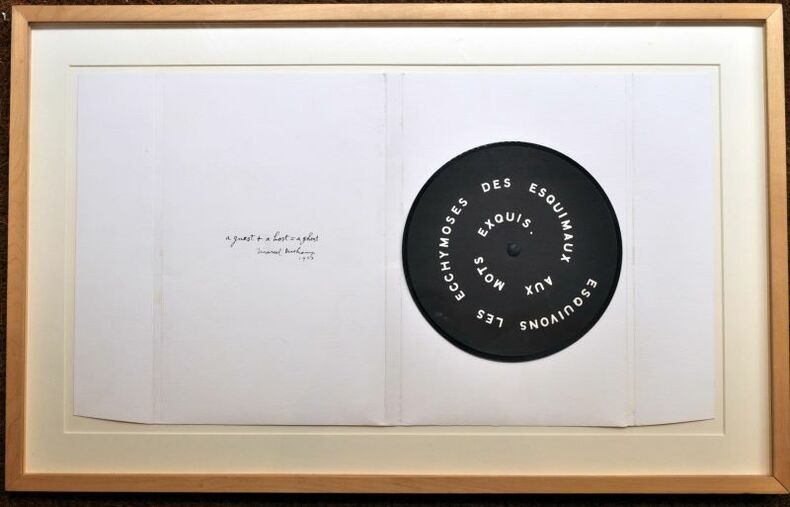
1960014528Paris Galerie Iris Clert 1960 In-8 à l'italienne Broché
1968100144New York The Letter Edged in Black Press, 1968. 1968 6 17.8 x 27.9 cm. New York, The Letter Edged in Black Press, 1968. Six portefeuilles 178 x 279 mm, présentés dans leurs emballages postaux d’origine, contenant chacun un sommaire, pour un total de 73 multiples originaux.
1901100107AG1901. Laeken / Brussels Château de Laeken Palace of Laeken 1901 - 1906. 16 pages of MLS Manuscript Letters signed on 10 leaves of Leopold's official stationery "Château de Laeken" and "Palais de Bruxelles". The leaves with different sizes 135 cm x 9 cm and 18 cm x 115 cm. Excellent condition. Unsigned. Tremendously rare to find original letters by Leopold II on the open market in which the Colonial Free State and the protection against inquisitive visitors is discussed in such clear and instructive fashion. Leopold's correspondence with Adolphe de Cuvelier shows how he is very much trying to still protect and influence the narrative of his Colonial Slavery Outpost even in the final years of his life. Adolphe de Cuvelier 1860-1931 Secretary General of the Ministry of Foreign Affairs of the Congo Free State President of the Syndicate for Studies and Enterprises in Congo. He was given the title of knight in 1893 and baron in 1908 each transferable at first birth. Wikipedia _______________________________ Leopold II French: Léopold Louis Philippe Marie Victor; 9 April 1835 17 December 1909 was the second King of the Belgians from 1865 to 1909 and through his own efforts the owner and absolute ruler of the Congo Free State from 1885 to 1908. Born in Brussels as the second but eldest surviving son of Leopold I and Louise of Orléans he succeeded his father to the Belgian throne in 1865 and reigned for exactly 44 years until his deaththe longest reign of any Belgian monarch. He died without surviving legitimate sons. The current Belgian king descends from his nephew and successor Albert I. Leopold was the founder and sole owner of the Congo Free State a private project undertaken on his own behalf as a personal union with Belgium. He used Henry Morton Stanley to help him lay claim to the Congo the present-day Democratic Republic of the Congo. At the Berlin Conference of 18841885 the colonial nations of Europe authorized his claim and committed the Congo Free State to him. Leopold ran the Congo using the mercenary Force Publique for his personal gain. He extracted a fortune from the territory initially by the collection of ivory and after a rise in the price of natural rubber in the 1890s by forced labour from the native population to harvest and process rubber. Leopold's administration of the Congo Free State was characterised by atrocities and systematic brutality including torture murder and the amputation of the hands of men women and children when the quota of rubber was not met. In 1890 George Washington Williams used the term "crimes against humanity" to describe the practices of Leopold II of Belgium's administration of the Congo Free State. Colonial accounts typically emphasized Leopold's modernizing changes in the Congo and not the mass death he facilitated. These and other facts were established at the time by eyewitness testimony on-site inspection by an international commission of inquiry and the 1904 Casement Report. Modern estimates range from 1 million to 15 million Congolese deaths with a consensus growing around 10 million. Some historians argue against these figures citing the lack of reliable censuses the enormous mortality caused by smallpox and African trypanosomiasis and the fact that there were only 175 administrative agents in charge of rubber exploitation. In 1908 the reports of deaths and abuse and pressure from the Congo Reform Association and other international groups induced the Belgian government to take over the administration of the Congo from Leopold as a new territory Belgian Congo. Wikipedia unknown