ETHIOPIABiblio.com
7 résultats
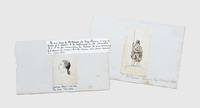
1863162461Ethiopia: c. 1863. A duplicitous envoy at the heart of the Abyssinian court Two sketches attributed to M. Bardel a French diplomat who befriended Emperor Tewodros II in the build-up to the Abyssinia Expedition. They show an Ethiopian's head in profile as a mock-up for a cannon engraving and Bardel dressed in the emperor's armour. When Charles Cameron British consul to Abyssinia arrived in the country in 1862 he was accompanied by one Bardel a Frenchman who was assumed to be his secretary. A dispute led the the two to part ways after which Bardel entered the service of the emperor. Keen to deepen his European connections Tewodros entrusted Bardel to carry a letter to Napoleon III. However the Frenchman never received an audience and returned with a likely forged reply telling Tewodros that Napoleon did not approve of his erratic and often violent actions. He also informed Tewodros of uncomplimentary journal entries written by the Anglican missionary Henry Aaron Stern. This combined with the emperor's growing mistrust of Europeans and anger at being snubbed by their royal houses led him to order the arrest and torture of Cameron Stern and all other Europeans in 1864. The treatment of the prisoners resulted in the 1868 British expedition to Abyssinia led by Charles Napier. The captions on the first sketch read "Abyssian sic Head & the way they part their hair" and "This was done by Mr. Bardel for King Theodore & was a design of a warrior to be engraved on the celebrated big gun as per instructions in French he was rewarded by a present of 10 cows but the design was never carried out - June 1868". There are reports that Tewodros had the words "Theodore the Scourge of the Peverse" inscribed on his cannon. The captions on the second sketch read "Abyssian sic native prisoner being led to execution" and "Mr Bardel dressed in King Theodore's armour". Two ink sketches with brown watercolour on paper 89 x 65 mm and 133 x 70 mm each mounted on larger sheet 145 x 255 mm and 172 x 253 mm. Contemporary ink and pencil captions paper slip with contemporary manuscript ink caption affixed onto one sheet. Foxing and toning larger sheets chipped along one edge: very good. unknown
1900K3ME5C11OCGBLondon: Harrison and sons 1900. Bound as sewn. Folio. With a folding lithographed map with some coloured details. Diplomatic document presented to the Houses of Parliament on the trade of the Ethiopian cities Addis Ababa and Harar. It includes many letterpress tables showing imported and exported tradeware its quantities prices and origin occasionally with some other remarks. The maps shows various trade routes from the two cities to other cities towns and ports. In very good condition. Harrison and sons, unknown
185034981ABHildburghausen, Bibliographisches Institut, 1850. Blattgröße Querformat, ca. 37 x 46,5 cm. Grenzcolorierte Stahlstichkarte.
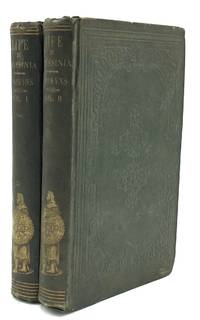
1854h24140New York: D. Appleton 1854. First American Printing. Hardcover. Very good. 2 volumes 8vo 8 x 5.25 inches publisher’s embossed dark green cloth stamped in gilt on spines very good light wear to bindings light occasional foxing and soil to contents last 30 pp. of the second volume show light tide marks from old waterstains and moderate occasional foxing. Total of 13 engraved plates. The first volume describes the journey from the coast to the capital and Parkyns's visit to the northern provinces encounters with others learning local languages and gaining new experiences. The second volume describes Abyssinian manners and customs natural history and Parkyns' route from Adoua to Abou Kharraz on the Blue Nile. Parkyns was particularly interested in learning more about the Abyssinian customs but he also enjoyed exploring more about natural history. He especially liked to observe various birds that he had never seen before in Europe. He believed that by identifying himself with the natives he could attain the best results thus as he left Massawa he decided that he would not try to preserve any European comforts. Throughout his time in Abyssinia Parkyns wore only Abyssinian clothes walked barefoot had an Abyssinian hairstyle and ate whatever was offered to him. In the book he also described his experiences of working as a silversmith for a year in Abyssinia and offered detailed descriptions of amongst other things Abyssinian manners and customs habits personal appearance dress births and marriages deaths and funerals religion superstitions. D. Appleton hardcover
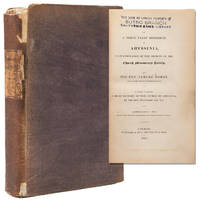
1834339031London: Hatchard & Son; and Seeley & Sons 1834. First edition. pp. xxii 371 xiv illustrated with a engraved fold-out map of Abyssinia 8 1/2 by 10 inches; image size circa 8 by 7 inches. 8vo. original cloth printed paper spine labelEx-library copy with de-accession rubberstamp in upper margin of title page partially obscuring first word in printed title; no other library markings. Moderate wear and fading on spine and extremities of covers half-inch chip to cloth at crown of spine few thin chips on edge of spine spine label is browned and nicked few soil marks to endpapers the engraved fold-out map has a three-inch closed tear at inner margin with early archival paper-tape mend on verso else a good to very good copy. First edition. pp. xxii 371 xiv illustrated with a engraved fold-out map of Abyssinia 8 1/2 by 10 inches; image size circa 8 by 7 inches. 8vo. "Gobat a Swiss Protestant missionary came to Ethiopia in 1829 and left in 1832. His travels took him from Massawa via Adegrat to Gondar. The author who participated in numerous disputations with Ethiopian priests gives a good description of life in Gondar and Adwa and interesting accounts of religious matters including. social customs. An introductory section contains extracts from the journal of Gobat's companion and fellow missionary Christian Kugler." Pankhurst 14. Pankhurst 14 Hatchard & Son; and Seeley & Sons unknown
186051461ABCöln, J.M. Heberle, 1860. Ca. 22 x 13 cm. LI S., (5) Seiten, 280 Seiten, mit 47 Holzschnittillustrationen. Halbleinenband des 20. Jhdts. mit Rückenschild.
181460635London: Printed for F. C. and J. Rivington by W. Bulmer and Co 1814. First Edition. First printing. Quarto 32cm. Rebound in modern half marbled calf and marbled paper over boards titled in gilt on red leather spine label; modern brown endpapers; iii-xvi506lxxv1pp; 7 maps 5 folding one also hand-colored engraved by A. MacPherson after drawings by J. Outhett 27 plates and two in-text vignettes engraved by C. Heath after drawings by H. Salt and occasional relief diagrams. Errata to p.xvi. Former owner T. Bateman's stamp to title page. Lacking the half-title and the chart of Annesley Bay otherwise complete. A sturdy copy board edges gently rubbed slight dustiness to plate edges very occasional spots of foxing generally bright and fresh: Very Good. <br /> <br /> A handsome account of exploration in Ethiopia including depictions of notable nobles archaeological discoveries and hippopotamus hunting. Salt accompanied George Annesley on a tour of Egypt Ethiopia and India in 1802-06; following that he toured Ethiopia in 1809-1810 "as a quasi-official envoy under Canning's sponsorship marching from the Red Sea coast with an escort of 160 bearers to explore trade and diplomatic links with the Ethiopian emperor Wolde Selassie. Britain fearing a French alliance with Egypt wished to secure a port on the Red Sea. Salt carried out a little archaeology discovering at Aksum three large limestone tablets engraved with ancient Ethiopian inscriptions. Little came of the mission for the government but Salt earned over £1000 for the first edition of this book" HOWGEGO II S6. LOWNDES p.2180. Printed for F. C. and J. Rivington by W. Bulmer and Co unknown