3 911 résultats
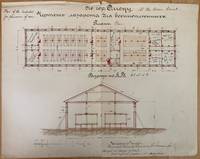
1916List1025Siberia Petrograd et al. 1916. First Edition. Various documents and letters most legal format roughly 200 pages in total with three publications and several newspapers on the subject and thirteen hand drawn architectural plans for a new camp at Omsk measuring between 25 x 17 and 13 x 8 inches. During World War One a staggering number of prisoners - roughly 2.4 of the five million in total who were sent to the Eastern Front - ended up as prisoners of war in Russia. Of that number roughly two million were from Austria-Hungary. Though often neglected by historians due to the attention given to the Russian Civil War and the atrocities of World War Two the subject has drawn increased historical interest with the historian Gerald H. Davis and others calling attention to its importance in the 1980s. Davis and others have written on the relationship between the large prisoner population and the dissolution of their nations as well as the abhorrent conditions many were forced to endure partially due to hierarchical structure of treatment due to differing attitudes by their Russian hosts toward different nations and ethnicities and partially due to the lack of appropriate infrastructure and resources to support such a large prisoner population. <br /> <br /> Offered here are the papers of Herbert H.D. Pierce the Special Aide to Embassador George T. Marye in Petrograd containing a substantial amount of firsthand accounts of prison conditions from the early years of the war as well as a striking series of manuscript architectural plans for a new prison camp that was built in Omsk. Pierce a diplomat who was most famously involved with a case involving seal fishing in the Berings Strait was appointed as a Special Aide out of his retirement and served until his death in 1916. It is possible that he was assigned the task of dealing with the prisoner of war situation as nearly all of his papers that we recovered from his estate from this period deal with the subject. Pierce was involved specifically with the disbursal of relief funds received from the German and Austro-Hungarian governments that were to be disbursed to their citizens. <br /> <br /> The highlight of the collection is a series of hand drawn architectural plans for a series of POW camp structures in Omsk bearing the signature of a N. Alexandrow architect. It is unclear what Pierce's exact relationship was to this project. The plans are translated into English in ink. Of particular interest are the separate officers' barracks plans as one of the violations of POW laws in Russia was the varying levels of treatment given to different prisoners in particular in their recognition of German and Austro-Hungarian ranking officers. There were twenty-eight prison camps in Omsk this one is not identified specifically. The Siberian camps often held up to 35000 prisoners this one shows plans for 10000. There were 128 camps in the Moscow region where camps typically housed 2000-5000 prisoners. The conditions of the camps were generally abysmal with camp capacities routinely exceeded by roughly 50-100%. Frequent disease outbreaks killed thousands of prisoners during the conflict in Omsk Novo-Nikolaevsk Sretensk and Totskoe specifically. <br /> <br /> The group includes letters written to Marye describing conditions in the camps as well as reports of the Americans' own observations in Siberia Moscow and elsewhere. Most are in English though several original documents in German are included. Also included are Pierce's working copies of the Second Hague Convention guidelines of 1907 Order 697 of the War Department that established the regulations regarding prisoners of war in 1914 and a copy of the agreement made between Germany and Russia in August of 1914 which allowed for all women and all men over 45 years and younger than 17 to leave the country unheeded. Some of the letters document violations of this agreement for example a fifty-five year old Austrian man writing to the embassy stating that he had been detained. The authorship of some of the reports is often unclear - one report is credited to "A Russian Lady" another from Krasnaya-Ratchka near Khabaraovsk is an uncredited 18 page description of prisoner conditions. One uncredited report nineteen pages long on the conditions of prisoners in the Moscow Circuit may have been written by Pierce himself and is addressed to Marye. Another 44 page report on Siberian prison conditions is uncredited and likely produced by the embassy itself. A portion - perhaps 25% or so - of the reports are incomplete or unclear in origin though there is much to glean from them regardless. <br /> <br /> Also included are three printed publications. The first is entitled Rapport du Conseiller Prive E.G. Chinkevitch Membre du Comte special de secours aux prisonniers de guerre sur la visite des camps des prissoniers Austro-Hongrois dans l'arrondissement militair d'Omsk printed in 1915. OCLC locates a single copy in France. The report outlines the observed conditions and includes twenty-six photographs of prisoners. The second is a forty-three page report addressed to James Gerard the American ambassador in Berlin by an unidentified author which outlines the prisoner of war conditions in England written in February of 1915. The third is a scarce map of Russian prisoner of war camps printed by L. Friederichsen in Hamburg in 1915 entitled Karte vom Europäischen und Asiatischen Russland mit Angabe der hauptsächlichsten Orte in denen sich Kriegsgefangene und zurückgehaltene Zivilpersonen befinden sowie mit Bestimmungen über den Postverkehr nach diesen Orten. The map shows locations of prison camps throughout the Russian Empire and also shows the mail routes. It is in fine condition overall and we locate six copies in OCLC. <br /> <br /> Overall a scarce survival of primary source material on a somewhat overlooked but important period in Russian history with relevance to diplomatic historians as well worthy of further study. <br /> <br /> Works cited: <br /> <br /> Grekov N. V.: Germanskie i avstriiskie plennye v Sibiri 1914-1917 German and Austrian prisoners in Siberia 1914-1917 in: Vibe P. P. ed.: Nemtsy. Rossiia. Sibir' Germans. Russia. Siberia Omsk 1997 p. 159.<br /> <br /> Nachtigal Reinhard: Seuchen unter militärischer Aufsicht in Rußland. Das Lager Tockoe als Beispiel für die Behandlung der Kriegsgefangenen 1915/16 in: Jahrbücher für Geschichte Osteuropas 48/3 2000 pp. 367-368; Brändström Kriegsgefangenen 1922 pp. 41-48.<br /> <br /> Nachtigal Reinhard; Radauer Lena: Prisoners of War Russian Empire. In: 1914-1918 Online. https://encyclopedia.1914-1918-online.net/article/prisoners_of_war_russian_empire Accessed 5/21. unknown books
1960475Marc Chagall B. 1887 VITEBSK RUSSIA; D. 1985 SAINT-PAUL-DE-VENCE FRANCE DRAWINGS FOR THE BIBLE as published for Verve.<br /> Verve Vol. X no. 37/38. 1960. Text by Gaston Bachelard. Folio. With 24 original lithographs in color including the cover by Chagall and 96 reproductions in black and white. Complete as issued. Verve hardcover
1960475Marc Chagall B. 1887 VITEBSK RUSSIA; D. 1985 SAINT-PAUL-DE-VENCE FRANCE DRAWINGS FOR THE BIBLE as published for Verve.<br /> Verve Vol. X no. 37/38. 1960. Text by Gaston Bachelard. Folio. With 24 original lithographs in color including the cover by Chagall and 96 reproductions in black and white. Complete as issued. Verve hardcover books
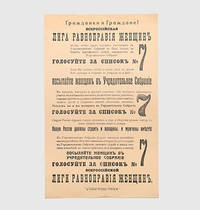
1917134554Petrograd: Tsentr. Tipograf 1917. A new Russia should be built by women and men together A remarkable survival of a flyer printed by the All-Russian League of Equal Rights for Women for their political campaign for the election to the Constituent Assembly in November 1917. The League participated in elections as its own party under the number 7. In English the flyer text reads: ''Female Citizens and male citizens! The League of Equality for Women wishing that the right of women to participate in the Constituent Assembly was not only on paper expose its candidates to the Constituent Assembly. Vote for the list number 7. If you want our children not to grow up without a home and the old people to not die on the street - send women to the Constituent Assembly. In America Australia and other countries where women take part in the drafting of laws the number of schools is multiplied prisons are empty debauchery and drunkenness noticeably diminish the protection of children and the elderly is fully secured by law. Let's send women to the Constituent Assembly too. The old Russia was built only by men and the grief and misfortunes of the motherland were always shared with them by mothers wives and daughters. A new Russia should be built by women and men together! The most important Russian laws will be written in the Constituent Assembly. From the laws that will be created in the Constituent Assembly the fate and life of many generations depends not only on men but also on women and so send women to the Constituent Assembly.''. The campaign for women's political rights in Russia termed the ''women's liberation movement'' became possible only with the beginning of the revolution in 1905 when the question of the democratization of the political system arose. The oldest women's association in Russia the All-Russian Women's Mutual Charity Society established in 1895 was actively involved and new organizations were created: the Union for the Equality of Women 1905 Women's Progressive Party 1905 and the All-Russian League of Equal Rights for Women 1907. The most influential organization was the first the Union which had 48 offices in various cities across Russia and actively conducted agitation among women workers and peasants. After its disintegration the League of Equal Rights for Women became its successor. Members of the League deliberately abandoned the broad political programme and focused their attention only on suffragist demands practising agitation tours through the provinces Orel Saratov Rostov-on-Don Kremenets Tomsk Kiev Simferopol and Narva. As a result branches of the League emerged in many cities including Moscow 1910 Kharkov 1912 Tomsk 1914 and Yekaterinburg 1914. This included the establishment of the following departments: a reading room for street children with a view to preventing child prostitution; a publishing committee that printed cheap pamphlets and books on women's issues; and an editorial commission that published the proceedings of the congress. Every day reports were given on the issues of women's equality in the League's premises. After the February Revolution delegates from the League repeatedly met with the leaders of the Soviet of Workers' and Soldiers' Deputies on the issue of women's suffrage. Despite initial promises of support they refused to immediately act on granting political rights to women. In response the League organized the famous mass march on 20 March 1917 which brought together about 40000 women. To that date it was the most numerous and memorable stand by the Russian women's movement and resulted in the adoption by the Provisional Government of a decree on universal suffrage which was passed on 20 July 1917. Single-sided flyer 365 x 220 mm. In near-fine condition. unknown
1919223031919. Photographs measuring 6 x 4 inches and smaller. 1 vols. Oblong 8vo 8 3/4 x 6 1/2 inches. Contemporary gray cloth ms. title to upper board upper joint wearing but holding nicely. Photographs measuring 6 x 4 inches and smaller. 1 vols. Oblong 8vo 8 3/4 x 6 1/2 inches. A rare survival from a distinguished World War One veteran. Born in India Nightingale was educated at Rugby and Sandhurst and joined the Royal Fusiliers in 1910. He survived the landing on V beach Cape Helles Gallipoli April 25th 1915 and the following year he was awarded both the Military Cross and the Legion D'Honneur for his services. <br /> Nightingale subsequently served with the 46th Battalion Royal Fusiliers in the North Russian Relief Force part of the invasion of Russia by the English Irish and the Americans. The operation was conducted under the command of General H. de V. Sadleir-Jackson.<br /> Arriving in Archangel on 5 June 1919 the 46th proceeded along the Dvina River to Osinova where preparations were made for an attack on rail and river transport. The objective was to repel the Red Army from their established positions and generally improve the position of the White Russian forces. The hope was that the NRRF would be able to subsequently withdraw without significant casualties. In addition smaller raids on Red Army positions were carried out to the south partly to destabilize them partly as reconnaissance. Nightingale was in command of the Borok Column on the right bank of the Dvina River for the August 10 offensive.<br /> The first photos are of the H.M.T. "War Summit" & H.M.T. "Pretorian" chugging through the Arctic Ocean and White Sea in Midsummer June 1919 on its way to Archangel. They were billeted at Troitsa and among the many images of the town and its surroundings is one of where the mutiny of Dyer's Battalion took place. Equally there are shots of Russian batteries Allied defenses company headquarters and regimental aid posts as well as images of the Dvina River Yaroslovskoe and Selso. A page is devoted to "Col. Davies Headquarters at Commencement of Action Aug 10th" and shows how the British troops organized themselves in the Selmenga Forest namely with three shots of "Piccadilly Circus Selmenga Forest with Shaftesbury Avenue and Regent Street."<br /> The attack commenced at noon and despite the difficulty of the terrain was successful. We know that Borok Nightingale's objective was reported captured along with 80 POWs by eleven o'clock that evening. Nightingale was evacuated in late September.<br /> This is not only a record of the battle but includes many poignant personal touches too. Namely there are several shots of men with whom he served and the Russians with whom he stayed. The captions not only name the men in each photograph but in many cases reveal their fate: "Lt Taylor killed Aug 10th Lt Grant wounded Aug 1st Capt. Driver killed Aug 10th."<br /> The album also includes a typed order - dated September 9 1919 - which is a reminder that despite the success of the August attack the Russian Civil War was ongoing and would ultimately be won by the Bolsheviks. "You will send one platoon to SELMENGA to hold the SELMENGA BRIDGE and the beach road to GORODOK. The enemy are known to be in force in the vicinity of BOROK and GORODOK and may attempt an outflanking movement . The platoon remain in position there and will withdraw when Captain de Miremont with the GORODOK Infantry comes through there tonight . The Platoon should form a right flank guard to Captain de Miremont from SALMENGA to PLESS."<br /> The photographs of Russia occupy the first half of the album the rest is devoted to Nightingale's time in Ireland with the 7th Cadet Battalion. Despite his distinguished service in the military Nightingale's fate was a melancholy one. He died in 1935 reportedly either by suicide using his own revolver of from alcoholism. unknown
1919223031919. Photographs measuring 6 x 4 inches and smaller. 1 vols. Oblong 8vo 8 3/4 x 6 1/2 inches. Contemporary gray cloth ms. title to upper board upper joint wearing but holding nicely. Photographs measuring 6 x 4 inches and smaller. 1 vols. Oblong 8vo 8 3/4 x 6 1/2 inches. RARE PHOTOGRAPHS OF THE NORTH RUSSIAN RELIEF FORCE 1919. A rare survival from a distinguished World War One veteran. Born in India Nightingale was educated at Rugby and Sandhurst and joined the Royal Fusiliers in 1910. He survived the landing on V beach Cape Helles Gallipoli April 25th 1915 and the following year he was awarded both the Military Cross and the Legion D'Honneur for his services. <br/>Nightingale subsequently served with the 46th Battalion Royal Fusiliers in the North Russian Relief Force part of the invasion of Russia by the English Irish and the Americans. The operation was conducted under the command of General H. de V. Sadleir-Jackson.<br/>Arriving in Archangel on 5 June 1919 the 46th proceeded along the Dvina River to Osinova where preparations were made for an attack on rail and river transport. The objective was to repel the Red Army from their established positions and generally improve the position of the White Russian forces. The hope was that the NRRF would be able to subsequently withdraw without significant casualties. In addition smaller raids on Red Army positions were carried out to the south partly to destabilize them partly as reconnaissance. Nightingale was in command of the Borok Column on the right bank of the Dvina River for the August 10 offensive.<br/>The first photos are of the H.M.T. "War Summit" & H.M.T. "Pretorian" chugging through the Arctic Ocean and White Sea in Midsummer June 1919 on its way to Archangel. They were billeted at Troitsa and among the many images of the town and its surroundings is one of where the mutiny of Dyer's Battalion took place. Equally there are shots of Russian batteries Allied defenses company headquarters and regimental aid posts as well as images of the Dvina River Yaroslovskoe and Selso. A page is devoted to "Col. Davies Headquarters at Commencement of Action Aug 10th" and shows how the British troops organized themselves in the Selmenga Forest namely with three shots of "Piccadilly Circus Selmenga Forest with Shaftesbury Avenue and Regent Street."<br/>The attack commenced at noon and despite the difficulty of the terrain was successful. We know that Borok Nightingale's objective was reported captured along with 80 POWs by eleven o'clock that evening. Nightingale was evacuated in late September.<br/>This is not only a record of the battle but includes many poignant personal touches too. Namely there are several shots of men with whom he served and the Russians with whom he stayed. The captions not only name the men in each photograph but in many cases reveal their fate: "Lt Taylor killed Aug 10th Lt Grant wounded Aug 1st Capt. Driver killed Aug 10th."<br/>The album also includes a typed order - dated September 9 1919 - which is a reminder that despite the success of the August attack the Russian Civil War was ongoing and would ultimately be won by the Bolsheviks. "You will send one platoon to SELMENGA to hold the SELMENGA BRIDGE and the beach road to GORODOK. The enemy are known to be in force in the vicinity of BOROK and GORODOK and may attempt an outflanking movement . The platoon remain in position there and will withdraw when Captain de Miremont with the GORODOK Infantry comes through there tonight . The Platoon should form a right flank guard to Captain de Miremont from SALMENGA to PLESS."<br/>The photographs of Russia occupy the first half of the album the rest is devoted to Nightingale's time in Ireland with the 7th Cadet Battalion. Despite his distinguished service in the military Nightingale's fate was a melancholy one. He died in 1935 reportedly either by suicide using his own revolver of from alcoholism. unknown books
1999BIBLIO-45059M. Moleiro Editor Barcelona limited edition facsimile 1999 and commentary. Limited edition of 987 numbered copies. 2 vols facsimile: original blind-stamped calf folio 31 cm; commentary: cloth 4to. facsimile: 298 pages and 115 miniatures most heightened in gold commentary: 4961 pp ills. A superb high-quality facsimile of and separate commentary on 'The book of Treasures' which is an encyclopaedia by Brunetto Latini circa 1230-1294 a Florentine politician poet historian and philosopher teacher and friend of Dante's written in French during the author's exile in France 1260-1267. From the publisher's description: " It consists of three books: the first begins with the biblical history the history of Troy Rome and the Middle Ages followed by a natural history: a comprehensive compilation of information about astronomy and geography. It also addresses certain animal and bird species in depth. The second book concerns ethics: it features the thinking of modern and classical moralists and studies the vices and virtues that characterise humanity. The third book the most original part of this work deals with matters related to politics and the art of government which is according to the author the most important and noblest of all sciences. The miniatures in this codex are extremely rich and varied. The artist's boundless imagination fills the margins of the 18 folios with countless arabesques and drolleries which constitute one of the most highly developed most interesting and earliest series of this genre in the history of the European miniature. There are also countless beasts grotesque and peculiar figures dwarves up to all sorts of tricks acrobats doing balancing acts and juggling musicians playing trumpets flutes violas tambourines organs and bagpipes. Birds hares fawns lions and hounds hunting boars and even the creation of Eve are depicted too." The commentary volume includes in both English and Spanish: Foreword by V.N. Zaitsev Director of the National Library of Russia St Petersburg; Codicological and palaeographic study of Li Livres dou Tresor by Brunetto Latini by L.I. Kisseleva National Library of Russia St Petersburg; Artistic and iconographical traits of the St Petersburg manuscript by I.P. Mokretsova State Research Institute for Restoration GosNIIR; The animal chapters in the Saint Petersburg Li Livres dou Tresor by W.B. Clark Marlboro College; and Technical research and manuscript restoration; by I.P. Mokretsova G.Z. Bykova V.N. Kiréyeva State Research Institute for Restoration GosNIIR. Copy No. 80. . A Fine set in the publisher's leather box which has the leather booklabel of Robert M. Wilson on the inside face. M. Moleiro Editor, Barcelona, limited edition facsimile, 1999 and commentary hardcover
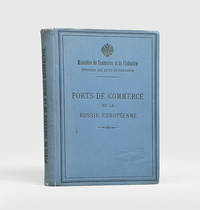
1908189307St- Petersburg: R. Golicke & A. Willborg for the Ministère du Commerce et de l'industrie 1908. Havens for Tsarist maritime commerce First and only edition. Officially sanctioned painstaking survey of the Russian ports of Europe recorded at the height of their influence. Rare WorldCat locates a single copy in the University of Genoa. Altogether sixty-five ports are described in great detail accompanied by photographs plans and engineer's sections for aspects of their construction. This sort of close scrutiny would very soon be confined behind a wall of Soviet state secrecy. The report covers the White Sea Black Sea Baltic Sea and Sea of Azov; more than a half of the ports analyzed are now located outside of Russia in the Baltic states Ukraine and Georgia. This volume was never intended for general distribution but rather was passed through official channels a presentation of the ports as a manifestation of the of Russian Empire's influence on European maritime commerce. Finely produced the presswork was carried out by R. Golicke & A. Willborg a house known for its involvement in Russian livres d'artiste and other fine editions the binding was commissioned from the workshop of M. Uleman small gilt on white ticket to the front pastedown. Two pre-Revolutionary ink stamps to the title page one repeated on the front cover. Crossed out on the title is of that of the Imperial Library of the Central Statistical Committee of Ministry of Internal Affairs the repeated stamp is for "Professor Emeritus of the St Petersburg Institute of Communication Routes Vsevolod Evgenievich Timonov". Timonov 1862-1936 was a hydraulic engineer hydrologist and transportation engineer typical of the intended constituency for the volume. From 1886 to 1895 he served in the Ministry of Railways working on the Commission for the Construction of Commercial Ports. During this time Timonov supervised the first work on the construction of stone block breakwaters for ports on the Baltic 1887 organized and implemented the initial marine dredging works there 1889 explored the mouths of the Dnieper Don and Volga rivers 1890 selecting the branches for development drew up a project for improving the rapids on the Dnieper carrying out exploratory work on one section 1894 explored the shores of the Pacific Ocean to assist in the selection Vladivostok as the location for the Pacific port terminal of the Siberian railway and explored the rivers of the Amur region developing measures to increase navigability 1895. Octavo 280 203 mm. pp. 24 33 94 128 91 vii. Printed throughout on coated paper numerous half-tone illustrations maps and plans to the text large folding three-colour printed map 695 x 560 mm retained by a band at the rear endpaper. Original light greenish blue cloth lettered in black on the spine and front cover French fillet panel to both covers in black to the front in blind on the back light greenish grey endpapers. Slightly rubbed and a little bumped some short splits to head and tail of the spine endpapers a touch browned at the edges; text-block marginally toned but clean and sound; very good. hardcover
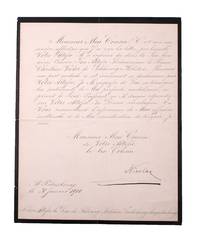
1901346384St. Petersburg 1901. One-page secretarial letter in French on mourning stationery with a secretarial copy marked in ink Copie . signé Nicolas. 1 vols. 10 x 8 inches. Old folds generally fine. With transcription and translation. One-page secretarial letter in French on mourning stationery with a secretarial copy marked in ink Copie . signé Nicolas. 1 vols. 10 x 8 inches. A formal note of condolence from Nicholas II Emperor of all the Russias styled "le bon Cousin" in the closing addressed to Ernst Gunther II 1863-1921 third Duke of Schleswig-Holstein "Monsieur Mon Cousin!" after learning of the death of Prince Christian Victor of Schleswig-Holstein a grandson of Queen Victoria and British officer who died of malaria in Pretoria on 29 October 1900.<br /> <br /> A somber and attractive autograph documenting the close connections between the royal and imperial household of prewar Europe. Provenance: Dr. Herbert Ernest Klingelhofer 1915-2015 collector and former President of the Manuscript Society bought from Karl Faber 1957 unknown
1923105690BBMünchen, Orchis-Verlag, o. J. (1923). 8°. 11 (!) Orig.-Holzschnitte (20 x 15 cm.). Marmorierte Orig.-Flügelmappe mit Deckelschild. [10 Warenabbildungen]
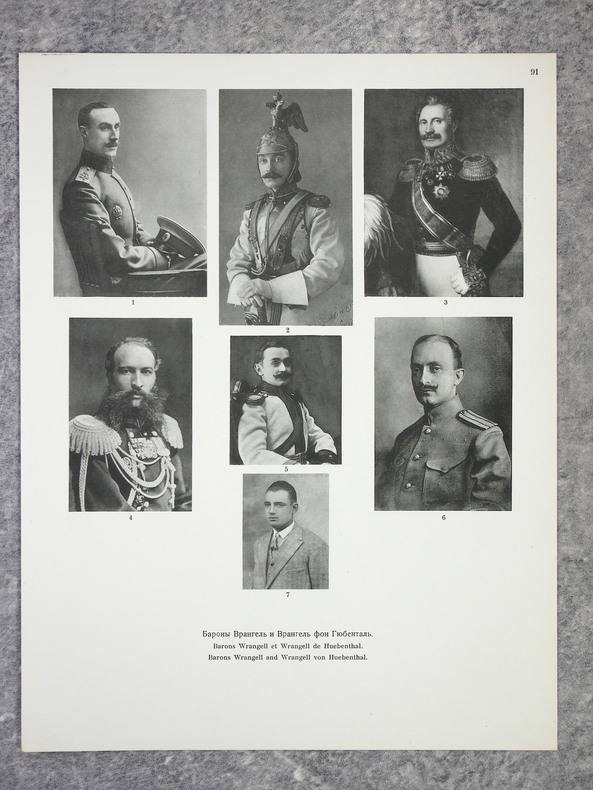
19611523(PARIS). PRINCE BELOSSELSKY-BELOZERSKY. 1961. 13 VOLUMES GRAND IN-4, 12 VOLUMES DE PLANCHES SOUS CHEMISES REMPLIEES ET UN VOLUME DE TEXTE BROCHE, LE TOUT SOUS EMBOITAGE TOILE NOIR DE L’EDITEUR (27 X 34 X 7,5 CENTIMETRES ENVIRON), PLAT SUPERIEUR ILLUSTRE D’UNE GRANDE COMPOSITION EN COULEURS A L’AIGLE BICEPHALE PAR ZWORIKINE. TEXTE TRILINGUE: RUSSE-FRANCAIS-ANGLAIS. ILLUSTRE DE 244 PLANCHES HORS TEXTE, 198 EN NOIR ET 46 EN COULEURS EDITION ORIGINALE. TIRAGE LIMITE A 300 EXEMPLAIRES NUMEROTES, NON MIS DANS LE COMMERCE, CELUI-CI PORTANT LE NUMERO 236. COMPREND:- TEXTE. HISTOIRE DU REGIMENT DE LA GARDE A CHEVAL. (6) + 39 ET (1) PAGES. BIEN COMPLET DE SON FEUILLET D’ERRATA.- I. UNIFORMES DU REGIMENT. 25 PLANCHES, DONT 12 EN COULEURS.- II. MEMBRES DE LA FAMILLE IMPERIALE, CHEFS ET OFFICIERS DE LA GARDE IMPERIALE. 47 PLANCHES, DONT 21 EN COULEURS.- III. PALAIS IMPERIAUX ET EDIFICES HISTORIQUES. 23 PLANCHES, DONT 1 EN COULEURS.- IV. JOURNEES MEMORABLES DANS LA VIE DES OFFICIERS DE LA GARDE A CHEVAL. 16 PLANCHES, DONT 8 EN COULEURS.- V. PORTRAITS D’OFFICIERS DE LA GARDE A CHEVAL. 25 PLANCHES, DONT 1 EN COULEURS.- VI. ANCIENNES FAMILLES DES GARDES A CHEVAL. 14 PLANCHES EN NOIR.- VII. OBJETS D’ART AYANT RAPPORT A LA GARDE A CHEVAL. 11 PLANCHES, DONT 1 EN COULEURS.- VIII. CHATEAUX ET DOMAINES DES OFFICIERS DE LA GARDE A CHEVAL. 19 PLANCHES, DONT 1 EN COULEURS.- IX. LES CASERNES DU REGIMENT. 18 PLANCHES EN NOIR.- X. LE REGIMENT DE LA GARDE A CHEVAL EN TEMPS DE PAIX. 22 PLANCHES EN NOIR.- XI. LE REGIMENT DE LA GARDE A CHEVAL PENDANT LA GUERRE. 17 PLANCHES, DONT 1 PLANCHE EN COULEURS.- XII. LES ANCIENS DE LA GARDE A CHEVAL DANS L’EMIGRATION. PLANCHES SUPPLEMENTAIRES. 7 PLANCHES EN NOIR.PETITE FENTE A L’EMBOITAGE, QUELQUES FINES ROUSSEURS EPARSES SUR LA PREMIERE PLANCHE DE CHAQUE POCHETTE, SINON BON EXEMPLAIRE DE CETTE MONUMENTALE EDITION.
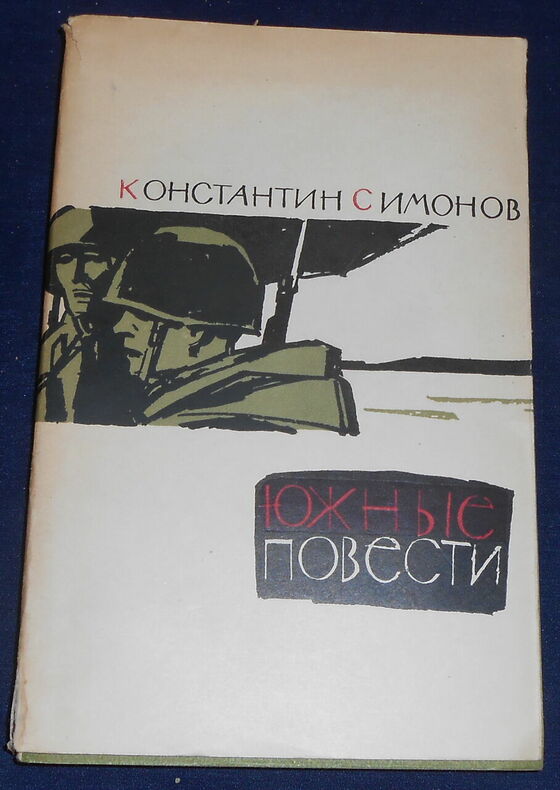
1943100073656Moscou. 13 cm x 20 cm. 1943. Broché. 155 pages. Moscou Les Ecrivains Soviétiques 1943 - Broché bien complet de la jaquette 13 cm x 20 cm 155 pages - Textes de Constantin Simonov - Bon état
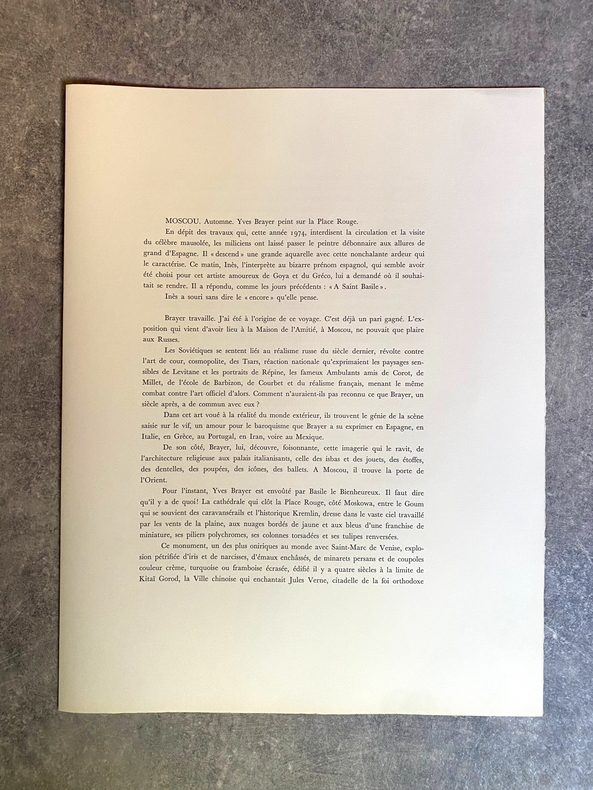
19762115PARIS. EDITIONS CERCLE D’ART. 1976. GRAND IN-PLANO EN FEUILLES (53 X 69 X 3,5 CENTIMETRES ENVIRON) DE (8) PAGES ET 12 LITHOGRAPHIES EN COULEURS SUR VELIN D’ARCHES (50 X 65 CENTIMETRES ENVIRON), SOUS EMBOITAGE TOILE GREGE DE L'EDITEUR. CHAQUE LITHOGRAPHIE SIGNEE ET NUMEROTEE 69/185 PAR YVES BRAYER. PREMIER TIRAGE LIMITE A 185 EXEMPLAIRES NUMEROTES, UN DES 170 SUR VELIN D’ARCHES, CELUI-CI PORTANT LE NUMERO 69. BEL ETAT POUR CET ENSEMBLE DEVENU RARE, DE NOMBREUX EXEMPLAIRES AYANT ETE VENDUS A LA PLANCHE.
1934011033Moscow Russia: Academia 1934. Elephant folio. 49 3pp. Uncut. Original cloth overlaid with Palekh style illustration. The cover is designed like a ceiling fresco seen from below. Illustrated endpapers.This volume contains the old Russian text of "Slovo o Polku Igoreve Host of Igors Lay one of the greatest literary masterpieces not only of Russia but the world." It explains that the illustrator Ivan Golikov works "in the old artistic manner of the Palekh School. Chromolithographed title page. Decorative head- tailpieces and initials. Ribbon marker. Magnificent edition of this anonymous epic poem originally written in the Old East Slavic language. The title is occasionally translated as The Song of Igor's Campaign The Lay of Igor's Campaign and The Lay of the Host of Igor. The poem gives an account of a failed raid of Igor Svyatoslavich 1202 against the Polovtsians of the Don River region. While some have disputed the authenticity of the poem the current scholarly consensus is that the poem is authentic and dates to the medieval period late 12th century. The Tale of Igor's Campaign was adapted by Alexander Borodin and became one of the great classics of Russian opera. This edition is lavishly illustrated with 10 mounted Palekh illustrations by Golikov each within a chromolithographed border. Some rubbing on covers with slight abrasion on front cover and heavy abrasion on back cover. Text in old Russian. Binding in overall good interior in near fine to fine condition. The Palekh school works are painted in an ornate style that usually utilized bright primary colors especially red against a shiny black background to decorate lacquer boxes with fairy tale motifs. A clean beautiful rare volume. 1st Edition. Glossy Hard Cover/Boards. Near Fine/No Jacket - Issued. Illus. by Golikov Ivan. Folio - over 12" - 15" tall. Academia Hardcover
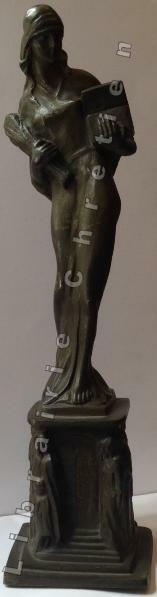
1930210491930 Sculpture en bronze signée sur la terrasse, (1930), 46 x 12.2 x 11.5 cm.
191417923Leipzig: Karl Baedeker. 1914. Hardcover. Very Good in Good dust jacket. DJ browned as usual and chipped. DJ spine laid-in book. Top DJ professionally repaired. Former owner's address on front endpaper. ; 1st and only edition. One of the most scarce and precious titles of the Baedeker series. A description of the country before the revolution. 40 fold out maps in color and 78 plans. A very well preserved copy - especially rare with DJ. Marbled edges nicely preserved - this is the best copy we have ever seen ; 16mo 6" - 7" tall; 590 pages . Karl Baedeker hardcover
1907653411907. The First Edition of the Nakaz Published in the Twentieth Century Catherine II 1762-1796 Empress of Russia. Chechulin Nikolai Dmitrevich 1863-1927 Editor. Nakaz Imperatritsy Ekateriny II Dannyi Kommissii o Sochinenii Proekta Novago Ulozheniia. St. Petersburg: Izd. Iurid. Knizhnago Sklada "Pravo" 1907. ii cliv 174 pp. Three folding plates of facsimile manuscript leaves. Text of Nakaz in Russian with parallel French translation. Contemporary pebbled cloth light rubbing to extremities with minor wear to spine ends and corners which are bumped. Light toning to text a few leaves have carefully repaired tears. Early inscription and owner inkstamp to title page interior otherwise clean. $1250. The first edition published in the twentieth century. Title two in the series Pamiatniki Russkago Zakonodatel'stva 1649-1832. The Nakaz or Instruction is a statement of legal principles written by Catherine II between 1764 and 1766. It was among her most ambitious and significant undertakings. Infused with the ideas of the French Enlightenment and copied mostly from the work of Voltaire Montesquieu and Beccaria it was compiled as a guide for the All- Russia Legislative Commission convened by the Empress in 1767 to create a new code to replace the 1649 Muscovite Code. Revised in consultation with Frederick the Great and Voltaire the Instruction proclaimed the equality of all men before the law and denounced torture and the death penalty. Unfortunately her proposed code was never completed. The first two editions one with parallel texts in Russian and German were published in 1767. Our 1907 edition may have been inspired by a spirit of reform fired by the Russian Revolution of 1905. OCLC locates 1 copy in a North American law library Columbia. Another copy located at Harvard Law School. Butler The Nakaz of Catherine the Great 526 Entry 19. unknown
1907653411907. The First Edition of the Nakaz Published in the Twentieth Century Catherine II 1762-1796 Empress of Russia. Chechulin Nikolai Dmitrevich 1863-1927 Editor. Nakaz Imperatritsy Ekateriny II Dannyi Kommissii o Sochinenii Proekta Novago Ulozheniia. St. Petersburg: Izd. Iurid. Knizhnago Sklada "Pravo" 1907. ii cliv 174 pp. Three folding plates of facsimile manuscript leaves. Text of Nakaz in Russian with parallel French translation. Contemporary pebbled cloth light rubbing to extremities with minor wear to spine ends and corners which are bumped. Light toning to text a few leaves have carefully repaired tears. Early inscription and owner inkstamp to title page interior otherwise clean. $1250. The first edition published in the twentieth century. Title two in the series Pamiatniki Russkago Zakonodatel'stva 1649-1832. The Nakaz or Instruction is a statement of legal principles written by Catherine II between 1764 and 1766. It was among her most ambitious and significant undertakings. Infused with the ideas of the French Enlightenment and copied mostly from the work of Voltaire Montesquieu and Beccaria it was compiled as a guide for the All- Russia Legislative Commission convened by the Empress in 1767 to create a new code to replace the 1649 Muscovite Code. Revised in consultation with Frederick the Great and Voltaire the Instruction proclaimed the equality of all men before the law and denounced torture and the death penalty. Unfortunately her proposed code was never completed. The first two editions one with parallel texts in Russian and German were published in 1767. Our 1907 edition may have been inspired by a spirit of reform fired by the Russian Revolution of 1905. OCLC locates 1 copy in a North American law library Columbia. Another copy located at Harvard Law School. Butler The Nakaz of Catherine the Great 526 Entry 19. unknown books
1929505546Paris: Editions J. Oliven 1929. Book. Good / État Satisfaisant. Soft cover. Signed and inscribed by the Author. Inscribed to previous owner and signed in English by the Grand Duke Alexander of Russia. Text in French. A good copy. . Editions J. Oliven Paperback
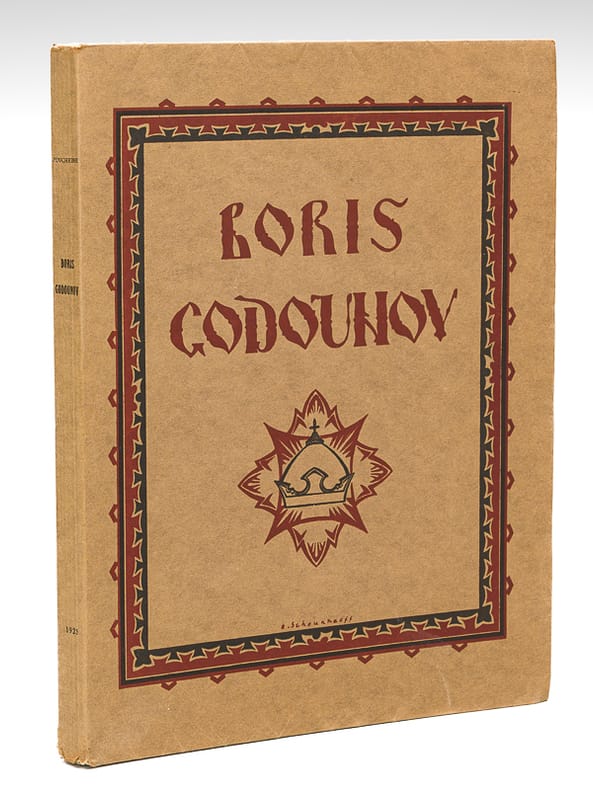
192561652Un des 390 exemplaires sur vergé à la forme des manufactures Blanchet Frères et Kléber numérotés de 41 à 430 (n° 416 paraphé par J. Schiffrin), Illustrations de V. Choukhaeff, traduction de J. Schiffrin, 1 vol. in-4 br. sous couv. rempliée, Editions de la Pléiade, Paris, 1925, 124 pp. et 2 ff. avec 18 planches hors texte (y compris le frontispice) en couleurs sous serpente
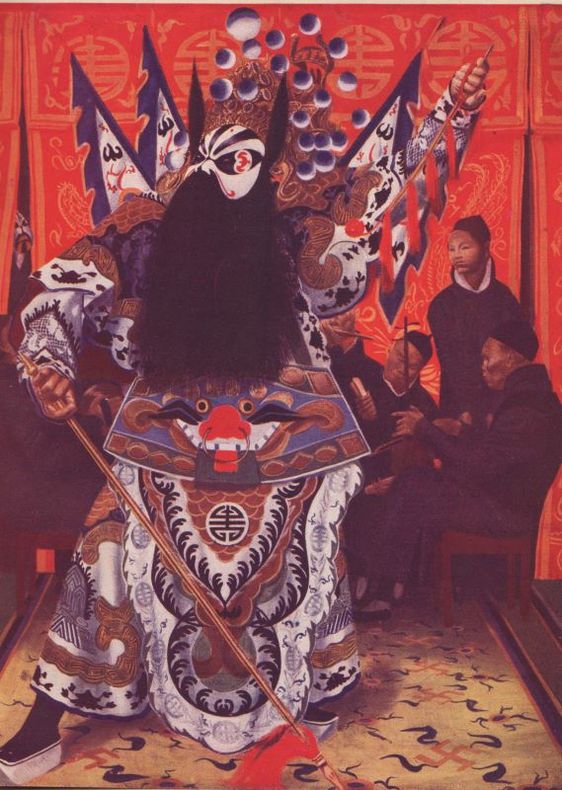
192218955Paris M. DE BRUNHOFF 1922 1 Peintures, sanguines et croquis d'Alexandre IACOVLEFF. Texte de TCHOU-KIA-KIEN. Paris, M. de Brunhoff, 1922, in-4., broché, couverture cartonnée ornée d'une figure contrecollée, 30 pages, 6 planches titrées "Les Images populaires théâtrales", ornées de 10 figures.
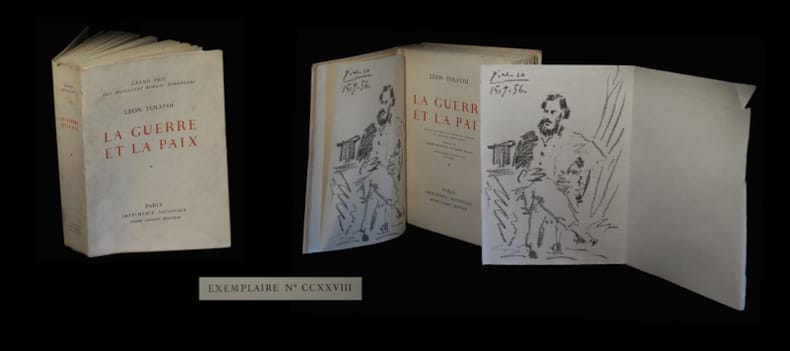
195626540Paris, Imprimerie nationale / André Sauret, (1956). Un fort vol. au format gd in-8 (224 x 167 mm) de 558 pp., broché, sous couvertures à rabats rempliés.
1966ZB1278337London Math Soc 1966. Russian Mathematical Surveys. v. 21; 22; 25; 27; 32; 33; 34; 35 including postage to Germany. - If you are reading this this item is actually physically in our stock and ready for shipment once ordered. We are not bookjackers. Buyer is responsible for any additional duties taxes or fees required by recipient's country. Photos available upon request. London Math Soc unknown
1952183941London: Ordnance Survey 1952. Later editions marked "restricted" revised from those produced by the War Office in 1919 and 1916 with isogonals correct to 1953. These maps were issued in the early years of the Cold War only a decade after the region was ravaged in the Battle of Stalingrad. Stepnoy now Elista was renamed only five years after this map's publication. In the early years of the Cold War the CIA attempted to gather information on the Soviet Union through aerial spying missions flown with the co-operation of the British government. "The RAF formed a top-secret reconnaissance outfit in the spring of 1951. Churchill approved the RAF overflight program knowing that if one of the planes came down on Russian territory Labour MPs in an embarrassed and angered House of Commons undoubtedly would force a vote of confidence to bring down his government. But he balanced that possibility against the desperate need for radar pictures of Soviet military targets that would held SAC and RAF bombers in the event of war" Burrows pp. 131-33. In 1952 John Crampton flew a high-speed high-altitude test run over the Berlin corridor which Bomber Command followed with three simultaneous sorties reaching as far as Moscow itself. After a ten-hour mission that triggered the Soviet air defences "All three planes made it back to Sculthorpe with their radar imagery and without a scratch" Burrows p. 134 angering the Kremlin and prompting a review of the nation's air warning systems. The map of Stalingrad is the fourth edition and the map of Stepnoy is the fifth. Single sheet of cloth 605 x 554 mm colour maps with key on each side pale border on Stalingrad side lettered in red blue and black. Map bright sometime folded and creased edges a little frayed: a very good copy. William Burrows By Any Means Necessary: America's secret air war in the Cold War 2001. hardcover
19990008049Boulder CO: Westview Press 1999. First English language edition. Hardcover. As New/issued without. 8vos; xxxiv 562; ix 389 pages maroon cloth in original shrinkwrap. Not x-library. Scarce. O.P. <br/><br/>This English translation contains an autobiography by Mironov which was not in the Russian edition. It details his anti-Marxism philosophy while a student in Leningrad. "The author has assimilated a large body of foreign scholarship primarily "new social history" produced by Anglo-American authors along with a sprinkling of more broadly European economic and demographic history from the 1970s and 1980s which is effectively incorporated into his own very deep empirical knowledge. . The reader does not find in this extensively researched account the standard Soviet answers to specific historical questions. Mironov has abandoned most Soviet cliches though he still assumes that laws of Russian history can be identified based on social science theory and quantitative analysis Elise Kimerling Wirtschafter." "This is a massterful work that provides other scholars with a wealth of useful information while confrontimg them with an argument that compels a response - William G. Wagner." Maps. Westview Press hardcover