RIMSKY KORSAKOVABAA
3 résultats
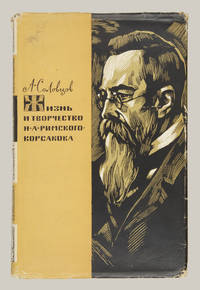
196930776Moscow: Izdatel'stvo "Muzyka 1969. Solovtsov Anatolii Aleksandrovich 1898-1965. 2 volumes. Octavo. Full dark green cloth with titling gilt. 686 i; 668 i pp.<br/><br/>Dustjackets slightly worn. In the series Klassiki mirovoi muzykal'noi kul'tury Classics of the musical culture of the world. Izdatel'stvo "Muzyka unknown books
190830788St. Petersburg. Moscow: V. Bessel & Co 1908. Findeizen Nikolai Fëdorovich 1868-1928. Octavo. Original publisher's light gray printed wrappers. 95 i vii pp. Illustrated. <br/><br/>Series title: Biografiia russkikh i inostrannykh kompozitorov I Biographies of Russian and foreign composers I.<br/><br/>Wrappers somewhat worn and foxed; torn at spine; small annotation in ink to recto of lower wrapper with minor offsetting to verso of final leaf. Several leaves browned. First Edition.<br/><br/>The first biography of Rimsky-Korsakov written just after his death by one of the leading music historians in Russia at the time. V. Bessel & Co unknown books
29694Benois Alexandre 1870-1960. Watercolour and pencil on laid paper with partial watermark "MBM." 320 x 240 mm. Signed by the artist with initials and dated 1932 in pencil at lower left. With pencilled notes in Benois's hand. <br/><br/>Very slightly soiled; 35 mm. tear to blank right margin repaired; remnants of mounting paper to upper corners of verso. Possibly a preparatory drawing for the Tsaritsa's costume. <br/><br/>Rimsky-Korsakov's last opera Coq d'Or The Golden Cockerel was first performed in Moscow at the Solodovnikov Theatre Sergey Ivanovich Zimin's private opera company on September 24/October 7 1909. It is in a prologue three acts and an epilogue by Nikolay Andreyevich Rimsky-Korsakov to a libretto by Vladimir Nikolayevich Bel'sky after the eponymous imitation folk tale in verse by Alexander Sergeyevich Pushkin based in turn on 'The House of the Weathercock' and 'Legend of the Arabian Astrologer' from The Alhambra by Washington Irving.<br/><br/>"The Golden Cockerel is the only one of Rimsky- Korsakov's 15 operas to have achieved repertory status beyond Russia. This was Dyagilev's doing. At the prompting of the artist Alexandre Benois the great impresario staged the opera in Paris and London in 1914 under the title Le coq d'or which has stuck to it in the West with the singers seated in rows at the sides of the stage accompanying the movements of dancers and mimes who enacted the plot according to the conventions of ballet d'action choreography by Fokin. It also set an important precedent for Stravinsky whose opera The Nightingale not to mention such later stage works as Renard The Wedding and Pulcinella to a greater or lesser extent embodied the same split between singing and movement. It was an important stage in the modernist dismantling of the Gesamtkunstwerk." Richard Taruskin in Grove Music Online.<br/><br/>Benois is considered a seminal influence on modern ballet set and costume design. "In 1901 he was appointed scenic director of the Mariinsky Theatre in Saint Petersburg the performance space for the Imperial Russian Ballet. He moved to Paris in 1905 and thereafter devoted most of his time to stage design and decor. During these years his work with Diaghilev's Ballets Russes was groundbreaking. His sets and costumes for the productions of Les Sylphides 1909 Giselle 1910 and Petrushka 1911 are counted among his greatest triumphs. Although Benois worked primarily with the Ballets Russes he also collaborated with the Moscow Art Theatre and other notable theatres of Europe." Wikipedia. unknown books

