79 résultats
40527showing him head and shoulders in military uniform with medals and fringed epaulettes 6½" x 4¼" no place In the years 1876-1879 he was circumnavigating the Pacific on the Gaydamak Clipper. From 1880-1888 he was an adjutant to the Grand Duke Konstantin Nikolaevich. In the late 1880s - early 1890s he was a naval agent in Franc commanded various ships was a member of the temporary branch of the Kronstadt port in St. Petersburg and an expert in the St. Petersburg District Court. From 1898-1901 he commanded the Imperial yacht Standart. In 1900 he became a Rear Admiral. This photo is probably on one of the preliminary tours for the future Tsar Nicholas II and his brother George to the Far East. In 1890 Nicholas his younger brother George and their cousin Prince George of Greece set out on a world tour. As it was unusual to send so many members of the family abroad together they sent ahead to ensure their safety. In fact the tour was cut short when in April 1891 in the city of tsu Japan Nicholas was attacked by a deranged Japanese police officer. unknown
106366Moscow P. Yurgenson 1908. . First edition 4to; 206pp music score with text in French and Russian preface by Belsky contemporary gift inscription in Russian to the Russian title-page stamp for the Russian Musical Publishing House on the French title-page Art Nouveau style patterned endpapers contemporary Russian bookseller's stamp and ink notations to lower pastedown margins trimmed; near contemporary beige cloth title in black to spine original chromolithographed upper wrapper designed by Bilibin pasted to the cover some small losses to edges corners bumped internally very fresh a very good copy.<br /> An attractive and scarce music score for Rimsky-Korsakov's opera The Golden Cockerel with the text in French and Russian. After Russia's defeat against Japan in 1905 Rimsky-Korsakov decided to create a satirical work which would expose the ineptitude of the disastrous Tsarist regime. He chose Pushkin's 1834 poem The Golden Cockerel as the basis for his libretto and it was ready to pass to the censor in 1907 after a year of work. It was immediately banned by the Palace presumably due to the resemblance between the Tsar and the foolish King Dodon was too close. Rimsky-Korsakov's failing health meant that he never got to see the production of his work dying two days before the 1909 premiere at the Solodovnikov Theatre. Bilibin designed the set for the premiere as well as the wonderful wrappers for this score.<br /> Moscow, P. Yurgenson, [1908]. hardcover
29694Benois Alexandre 1870-1960. Watercolour and pencil on laid paper with partial watermark "MBM." 320 x 240 mm. Signed by the artist with initials and dated 1932 in pencil at lower left. With pencilled notes in Benois's hand. <br /> <br /> Very slightly soiled; 35 mm. tear to blank right margin repaired; remnants of mounting paper to upper corners of verso. Possibly a preparatory drawing for the Tsaritsa's costume. <br /> <br /> Rimsky-Korsakov's last opera Coq d'Or The Golden Cockerel was first performed in Moscow at the Solodovnikov Theatre Sergey Ivanovich Zimin's private opera company on September 24/October 7 1909. It is in a prologue three acts and an epilogue by Nikolay Andreyevich Rimsky-Korsakov to a libretto by Vladimir Nikolayevich Bel'sky after the eponymous imitation folk tale in verse by Alexander Sergeyevich Pushkin based in turn on 'The House of the Weathercock' and 'Legend of the Arabian Astrologer' from The Alhambra by Washington Irving.<br /> <br /> "The Golden Cockerel is the only one of Rimsky- Korsakov's 15 operas to have achieved repertory status beyond Russia. This was Dyagilev's doing. At the prompting of the artist Alexandre Benois the great impresario staged the opera in Paris and London in 1914 under the title Le coq d'or which has stuck to it in the West with the singers seated in rows at the sides of the stage accompanying the movements of dancers and mimes who enacted the plot according to the conventions of ballet d'action choreography by Fokin. It also set an important precedent for Stravinsky whose opera The Nightingale not to mention such later stage works as Renard The Wedding and Pulcinella to a greater or lesser extent embodied the same split between singing and movement. It was an important stage in the modernist dismantling of the Gesamtkunstwerk." Richard Taruskin in Grove Music Online.<br /> <br /> Benois is considered a seminal influence on modern ballet set and costume design. "In 1901 he was appointed scenic director of the Mariinsky Theatre in Saint Petersburg the performance space for the Imperial Russian Ballet. He moved to Paris in 1905 and thereafter devoted most of his time to stage design and decor. During these years his work with Diaghilev's Ballets Russes was groundbreaking. His sets and costumes for the productions of Les Sylphides 1909 Giselle 1910 and Petrushka 1911 are counted among his greatest triumphs. Although Benois worked primarily with the Ballets Russes he also collaborated with the Moscow Art Theatre and other notable theatres of Europe." Wikipedia. unknown
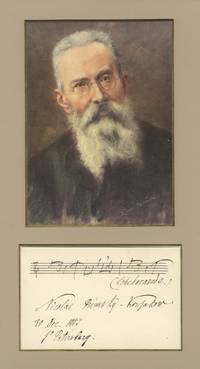
39488Three measures from the second theme of the second movement. Notated in black ink on ivory card stock with autograph titling and date of 30 December 1907 St. Petersburg. Small oblong octavo 70 x 108 mm.<br /> <br /> Mounted on a taupe mat on heavy gray silk-bordered cardboard below a bust-length color reproduction painting of the composer. Overall size 260 x 150 mm. Composed in 1888 Sheherazade Rimsky-Korsakov's characteristically colorful orchestral work was inspired by the fantastical One Thousand and One Nights The Arabian Nights a collection of Middle Eastern folk tales in Arabic compiled during the Islamic Golden Age the 8th-13th centuries and first translated into English in ca. 1706-21. <br /> <br /> "Russian orientalism received its best-known expression in Sheherazade 1888. The work is based on A Thousand and One Nights the story of the sultana Sheherazade who keeps her husband the sultan Shakriar from his intention of killing her by telling him stories for one thousand and one nights. The encounter between barbarous despotism and feminine seduction . - a contrast that Rimsky-Korsavkov's work emphasizes from the start - renders the story an oriental paradigm par excellence." Maas: A History of Russian Music p. 175.<br /> <br /> The work was adapted for ballet by Diaghilev's Ballets Russes premiering in Paris at the Opéra Garnier on 4 June 1910 to Rimsky-Korsakov's music with dramatic choreography by Michel Fokine striking sets and costumes by Léon Bakst and iconic dancers Vaslav Nijinsky and Ida Rubinstein. <br /> <br /> A fine example from one of the composer's most popular works and the one with which he is most closely identified penned just under six months before he died on 21 June 1908. unknown