79 résultats
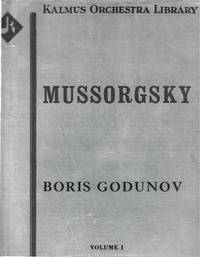
1968MSC1866New York : Edwin F. Kalmus 1968. Reprint Edition . Soft cover. Good. 4to - over 9¾ - 12" tall. This is the exceedingly rare Rimsky-Korsakov orchestral conductor's version reprinted by Kalmus from its 1896 or 1908 Russian publication later associated with composer-conductior Ippolitov-Ivanov's late-1920s Bolshoi revival version in which he re-orchestrated the scene at Blazhenny Cathedral. CONTENTS: See accompanying scan image of the Table of Contents. it is only in Russian-Cyrillic language throughout the two-volume score - 391 & 416 pages. CONDITION: I've graded these as GOOD since both volumes are unmarked with the score pages all clearly legible. Rescued from a composer's long-term storage there are several shortcomings: VOL.I - is missing its original Kalmus green covers but I have fashioned sturdy card-stock replacements. The pages are unmarked and uncreased with a few having instances of light discoloration in the margins. This GOOD PLUS volume is securely-bound. VOL.II - shows the page-rippling of long-past water incursion and though securely bound in its original covers there is a bit of spine-lean. The pages are unmarked but several show previous creasing. As with Vol.I Vol.II has some spine reinforcing with library hinge-tape. Nevertheless these are quite respectable and useful copies. NOTE: Due to this item's size and weight ca.5.75 pounds securely packed an additional shipping fee must be charged for international shipping and domestic USA Priority mail. NO additional charge will be assessed for domestic Media Mail. <br/> <br/> Edwin F. Kalmus paperback
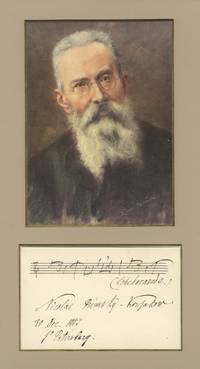
39488Three measures from the second theme of the second movement. Notated in black ink on ivory card stock with autograph titling and date of 30 December 1907 St. Petersburg. Small oblong octavo 70 x 108 mm.<br /> <br /> Mounted on a taupe mat on heavy gray silk-bordered cardboard below a bust-length color reproduction painting of the composer. Overall size 260 x 150 mm. Composed in 1888 Sheherazade Rimsky-Korsakov's characteristically colorful orchestral work was inspired by the fantastical One Thousand and One Nights The Arabian Nights a collection of Middle Eastern folk tales in Arabic compiled during the Islamic Golden Age the 8th-13th centuries and first translated into English in ca. 1706-21. <br /> <br /> "Russian orientalism received its best-known expression in Sheherazade 1888. The work is based on A Thousand and One Nights the story of the sultana Sheherazade who keeps her husband the sultan Shakriar from his intention of killing her by telling him stories for one thousand and one nights. The encounter between barbarous despotism and feminine seduction . - a contrast that Rimsky-Korsavkov's work emphasizes from the start - renders the story an oriental paradigm par excellence." Maas: A History of Russian Music p. 175.<br /> <br /> The work was adapted for ballet by Diaghilev's Ballets Russes premiering in Paris at the Opéra Garnier on 4 June 1910 to Rimsky-Korsakov's music with dramatic choreography by Michel Fokine striking sets and costumes by Léon Bakst and iconic dancers Vaslav Nijinsky and Ida Rubinstein. <br /> <br /> A fine example from one of the composer's most popular works and the one with which he is most closely identified penned just under six months before he died on 21 June 1908. unknown
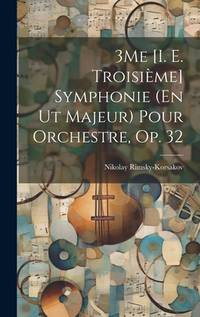
46539629like new. unknown
1021068551.Ghardcover. Good. Access codes and supplements are not guaranteed with used items. May be an ex-library book. hardcover