(caucasus)Biblio.com
Le CaucaseBiblio.com
Impressions de Voyage
1390057585.Gpaperback. Good. Access codes and supplements are not guaranteed with used items. May be an ex-library book. paperback

Bonita · États-Unis55,46 $US≈ 46,92 €
11 résultats
a108883Moscow 1969. In Russian. Hardcover. large octavo. 198p. A few photo illustrations. Text lightly evenly toned. Some writing in Russian on front end paper. near VG. binding secure. . hardcover
1976QB-3S97-X52F1976. Hardcover. Very Good. Little Brown 1976. Jacket is Good with some wear nicks and scratches. Book is VG with moderate wear pages lightly yellowed with an occasional bit of foxing binding firm. hardcover
1390057585.Gpaperback. Good. Access codes and supplements are not guaranteed with used items. May be an ex-library book. paperback
0666069670.Gpaperback. Good. Access codes and supplements are not guaranteed with used items. May be an ex-library book. paperback
036453561X.Ghardcover. Good. Access codes and supplements are not guaranteed with used items. May be an ex-library book. hardcover
2003x-1402011237Kluwer Academic Pub 2003. Hardcover. New. 1st edition. 204 pages. 9.25x6.50x0.75 inches. Kluwer Academic Pub hardcover
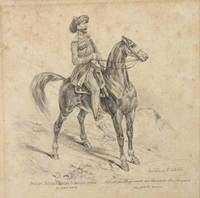
89624Mailand Milan am 8. Juli 1852. . Pencil drawing captioned in Russian and French below 15.5 x 16 cm. 6 1/8 x 6 1/4 in some spotting in contemporary mount.<br /> Fine detailed pencil drawing of a mounted officer from the Caucasus Line Cossack Host. Apparently drawn in Milan it is strongly reminiscent of the military plates published in Vienna by Matthäus Trentsenskiy or the costume drawings of François Hippolyte Lalaisse. The Caucasus Linear Cossack Army was established in 1832 in the Northern Caucasus. Along with the Black Sea Cossack army it defended the Caucasus fortified line from the mouth of the Terek River to the mouth of the Kuban. y 1860 following the end of the Caucasus War it had divided into the Kuban and Terek troops.<br /> Mailand [Milan], am 8. Juli 1852. unknown
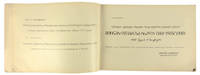
78911Tbilisi Ekspeditsii turisticheskogo otdela geogr. obshschestva SSR Gruzii 1928. . Landscape 8vo 17 x 24.5 cm 56 pp. illustrated with 25 plates text in Georgian with French and Russian epitome; original printed wrappers small tear to lower cover minor rubbing to edges.<br /> Fine example of the first-hand account of the expedition to the peak of the mount Kazbek undertaken in November 1927 by a group of eleven mountaineers headed by Simon Dzhaparidze 1897-1929. The group started the ascending at the Gergeti glacier bypassed the cone of the peak from the west and reaching its saddle climbed to the top. Subsequently this path was named after Japaridze.<br /><br />Aslanishvili 1891-1957 the author of the account and a participant of the ascending was the Honoured Physician of the Georgian Republic a scientist and mountaineer. <br />The main text is in Georgian accompanied by a summary in Russian and French.<br /> Tbilisi, Ekspeditsii turisticheskogo otdela geogr. obshschestva SSR Gruzii, 1928. unknown
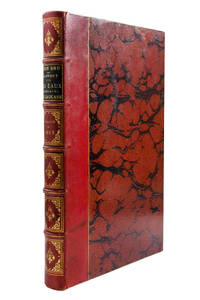
103088Paris Chamerot 1884. . First edition; folio 38.5 x 16 cm; 111p. 55 partly coloured lithographed plates some double page large geological coloured map; contemporary quarter red morocco over marbled boards label and gilt tooling to spine a fine copy. <br /> A rare and interesting work on the spa towns of the Caucasus. The plates show plans for fountains bathing houses and pumping stations of in Piatigorsk Zheleznovodsk Yessentuki and Kislovodsk all of which were popular destinations for 19th century Russians to visit. Aristocracy musicians and artists were drawn to these four towns due to the famous healing powers of the mineral waters.<br /> Paris, Chamerot, 1884. hardcover
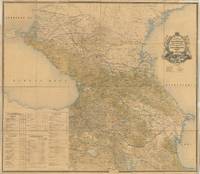
65574Tbilisi: Compiled and Lithographed at the Military Topographical Department of the Caucasus Military District 1870 with corrections to August 1896. Original large-format colour-lithographed map of the Caucasus 132 x 151 cm dissected into 24 panels and backed onto linen text in Cyrillic script folding down to 33.5 x 27 cm. With an extensive key decorative title cartouche and table showing the divisions of the Caucasus. The linen backing is in places dust-soiled and stained some tiny holes in the edges from former wall mounting that have been repaired somewhat browned overall and with a few minor brown spots a few small marginal tears not affecting map repaired with contemporary strips of paper linen edges are slightly frayed in places withal a very good example of this scarce and impressive map. A rare and large-format wall map of the Caucasus region in Russian. The map covers the modern territories of Armenia Georgia Azerbaijan Dagestan Chechnya Kalmykia etc. The map extends south to Tehran and north to Astrakhan. The eastern Black Sea is on the left and the western Caspian Sea is on the right. Beneath the title is a depiction of a railway winding through the mountains and opposite it a galloping horse with a cart crossing the mountains. Later editions were published at least until 1883 and 1903. The later edition is mentioned in 20th-century works dealing with international border disputes in the Caucasus. At the time of its creation it was almost certainly the finest map of the Caucasus produced in the Russian Empire. Tbilisi: Compiled and Lithographed at the Military Topographical Department of the Caucasus Military District, 1870 (with correc unknown
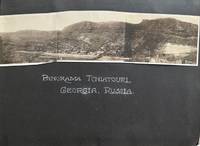
192558598Tchiatouri Georgia & Wallace ID: Georgian Manganese Mining Co. Day Mining Co. ca. 1925-1929. Thick oblong 4to. 11.75 x 8.25 x 2.25 in. 168 pp unpaginated. on thick black paper stock. With 635 silver gelatin photographs sized from 2 x 3 in. up to 8 x 10 in. with the majority sized 3.25 x 5.25 in. nearly all annotated below in neat white ink lettering some w/ annotations somew/in negative indicating negative number those partially lifed from black paper have ink & pencil annotations on versos matching the white ink captions some are RPPC’s w/ captions w/in the negatives at lower fore-edges of image and also present is an 8 page folded manuscript inventory documenting about 400 of the photos closely matching most of the captions. Contemporary flexible black calf Badger post-binder black enamel coated screw-posts a few leaves loose others proud some photos overlapping occasional closed tears a few inner joints neatly repaired at gutter still an outstanding exemplar. This exceptional album provides an essential documentary record of the Soviet era Caucasus of Georgia Azerbaijan Armenia and Abkhazia just a few years after the 11th Red Army invaded Georgia and after a one-week offensive Georgian Bolsheviks took over the country. The album opens with a composite panoramic photo of Tchiatouri notably without the rusting overhead tramways installed by Stalin during the 1950’s. Following the formation of Georgia SSR Tchiatouri and the surrounding regions held some of the largest metallurgical grade manganese in the World and in the 1920’s the Georgian Manganese Company. The subsequent photos depict several of the homes occupied by mine personnel the surrounding region and the main company offices. Many of the photos focus on the local peasants bazaars markets Georgian families fruit markets animal markets and more. Additional photos depict the foreign ex-patriot life in Batum Batumi Adjara with birds-eye views of the city Orthodox churches converted at the time to a Men’s Club as well as tea and banana plantations. Still more photos show Armenian refugees Jewish cigarette boys wine merchants carrying wine in pig skins ox carts horse-drawn street cars village blacksmiths gypsy fortune tellers trained bears and even the local kerosene vendor wagon. Mining operations in Seminoff and Karuto are shown with ore being hauled by ox cart loaded onto rail cars ore crushing mill as well as views of Perevisi Chokruti Shukrut and other ore bearing plateaus their Karuto house. Of additional interest are the photos of the Tchiatouri Monastery a cliffside still functioning convent known as the Mgviemevi Convent featuring a 13th-Century two-nave basilica native village and connecting ore tramways. A series of photos is also devoted to the old Sachakari Modinakhe Castle ruins both inside and out fortifications and local cave dwellings all much more severely damaged decades later in the 1991 earthquake. The compiler has also included photos of the market homes and street scenes in Tiflis as well as the old Roman Walls the local prison Kurdish homes and camel herds along the railway to Moscow scenes along the railroad line between Tiflis & Baku and the Caspian sea port of Russian caviar at Petrovsk. The Harriman Georgian Manganese Co. maintained offices in Moscow and in fact W. Averell Harriman 1891-1986 himself negotiated with Leon Trotsky prior to Lenin’s death and the rise of Stalin forcing him into exile in 1929 for the Manganese mining rights. Many of the photos reveal an extended winter trip through Moscow with a visit to the Kremlin the newly built Lenin’s tomb Red Square the Bolshoi Grand Theater and even a visit to the Polish & Russian Border. After a short trip through France in the midst of rebuilding and Great Britain the couple voyage to Greece Turkey and Palestine. Photos depict Turkish sailboats mosques and street views in Samsun Turkey Constantinople from the Bosphorus the Galata Bridge the Sultan’s palace and Seraglio the Hagia Sophia as well as the old walls. While traveling by rail through Syria and Palestine a series of photos is captioned that the railroad was “made famous by Lawrence in the Revolt of the Desert these pictures taken between Damascus and Tiberius.†The visit through Palestine shows farms Jerusalem the Dome of the Rock Wailing Wall street scenes and the Church of the Nativity. This is followed by tour down the Nile visits to the Pyramids as well as later stops in Somalia Sri Lanka Singapore Saigon Indo-China Hong Kong and Japan. The album is unsigned without ownership markings and has been attributed to Jack Powers and his wife Ruth Fitzgerald Powers 1895-1967 by an unrelated family who held the album. In addition at the rear of the album there are numerous photos of the Day-Hale Co. hunting trips on the Locksaw River in Idaho which included Henry Day Jack Powers E.L. Hale and Dr. Max Smith with Powers clearly identified and closely matching several of the photos depicted in the other parts of the album. Powers began working as a machinist and mechanic with an auto dealership before World War I but by the early 1920’s was actively working as machinery trouble-shooter for Tamarack Custer Mining Co. ad Day Mining Co. subsidiary and also worked as a specialist on compressors. Harriman and his younger brother Roland owned mining operations in Soviet Georgia copper mines in Silesia oil fields in Iran and even a power plant in Poland but after the stock market crash in 1929 they merged with their biggest competitor to become Brown Brothers Harriman & Co. He is perhaps best remembered for development of the Sun Valley Lodge and ski resort in Ketchum Idaho. See: Strishkov & Levine The Manganese Industry of the U.S.S.R. 1986 pp. 7-10; Day Mines Inc. Manuscript Group 306 Records 1921-1985 Univ. of Idaho Special Collections & Archives; Rudy Abramson Spanning the Century: The life of W. Averell Harriman 1891-1986 1992. Georgian Manganese Mining Co., Day Mining Co., unknown