Stravinsky, IgorBiblio.com
461 résultats
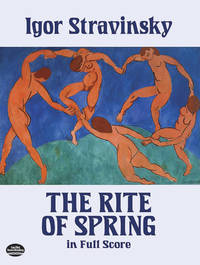
2000Q-0486414035Dover Publications 2000-09-08. Paperback. New. In shrink wrap. Looks like an interesting title! Dover Publications paperback
2006Q-048644953XDover Publications 2006-02-09. Paperback. New. In shrink wrap. Looks like an interesting title! Dover Publications paperback
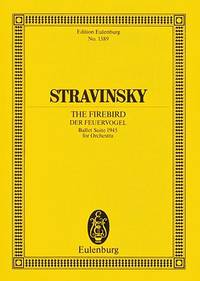
1983Q-3795762383Eulenburg 1983-03-01. Paperback. New. In shrink wrap. Looks like an interesting title! Eulenburg paperback
2023__178454809XBOOSEY 2023. New. 368 pages. 8.11x0.87x11.57 inches. BOOSEY unknown
G-959-452PREMIERES LOGES. Paperback. Very Good. Former library book. Ammareal gives back up to 15% of this item's net price to charity organizations. PREMIERES LOGES paperback
BN315301PREMIERES LOGES. Softcover. The Rake's Progress <br/><br/>The Rake's Progress STRAVINSKY Igor PREMIERES LOGES paperback
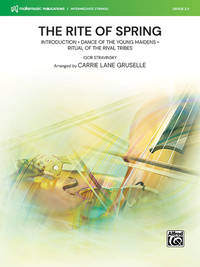
2024__1470669145Alfred Music Co 2024. Paperback. New. 999 pages. 14.02x12.40x0.71 inches. Alfred Music Co paperback
1969207821N.P. London: Boosey & Hawkes 1969. First Edition. With the typical splitting to the joints that affects this awkwardly bound publication; few marks; a very good copy in the original cloth slipcase. 4to 139pp; cloth. A nicely printed facsimile edition with a separately printed 48 booklet of commentary inserted in a pocket at the inside rear cover. A nicer-than-usual copy. Boosey & Hawkes unknown
1989Q-0486258572Dover Publications 1989-01-01. Paperback. New. In shrink wrap. Looks like an interesting title! Dover Publications paperback
2000Q-0486411745Dover Publications 2000-07-28. Paperback. New. In shrink wrap. Looks like an interesting title! Dover Publications paperback
2011Q-0486445399Dover Publications 2011-05-19. Paperback. New. New. In shrink wrap. Looks like an interesting title! Dover Publications paperback
20071-1423424026Boosey & Hawkes 2007. Paperback. New. 171 pages. 11.50x8.75x0.50 inches. Boosey & Hawkes paperback
0571083080.Ghardcover. Good. Access codes and supplements are not guaranteed with used items. May be an ex-library book. hardcover
1995Q-0793544254G. Schirmer Inc 1995-05-01. Paperback. New. In shrink wrap. Looks like an interesting title! G. Schirmer, Inc paperback
1985Q-0769258131Alfred Music 1985-03-01. Paperback. New. New. In shrink wrap. Looks like an interesting title! Alfred Music paperback
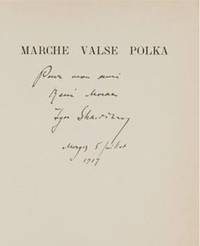
16-4192Genève: Edition Ad. Henn 1917. . Oblong 4to. 19.5 x 27.3 cm. 2 8pp. Original wraps. . Signed at Morges Switzerland and dated 5 Juillet 1917 and inscribed .The poet and playwright René Morax founded his Théâtre du Jorat near Mézières Switzerland in 1903. Made entirely of wood so as to be integrated into the barns of the surrounding countryside it was described this way in an early account: “A theater decidedly unlike any other. A sort of vast chalet a kind of huge barn smelling of resin dried hay fresh fruit and on days when there was a performance Sunday clothes but retaining the rustic dignity of a shrine. A large stage descending in broad steps toward the orchestra pit …â€The theater was closed for several years during the Great War and Morax conceived a drama on the subject of King David to reopen it in 1921. When he turned to his wealthy friend Werner Reinhart who incidentally had recently funded the creation of Stravinsky’s Soldier’s Tale telling him that he was taking inspiration from Hindu theater for this work his patron offered to lend rare Hindu drums in addition to financial assistance. The text is drawn from the Hebrew Bible I and II Samuel I Kings in addition to the Huguenot Psalter which includes poetry by Clément Marot. The poet’s brother Jean Morax set to work designing costumes and sets. After several more established composers turned him down René on the advice of Stravinsky and the distinguished conductor Ernest Ansermet chose the then unknown twenty-eight year old Arthur Honegger. “When Swiss poet Rene Morax 1873-1963 was looking for a composer for his new King David libretto Stravinsky recommended the twenty-nine-year-old Arthur Honegger a composer who just six years later creating the film score for Abel Gance’s Napoleon would reveal himself as a master of music’s ability to translate epics into sweeping evocative sound. In 1921 right on the cusp of his first successes Honegger wrote the David score in a flush of creative energy.â€. Provenance from the estate of René Morax. Expertise by Claire PIGUET Geneva Genève: Edition Ad. Henn, 1917. paperback
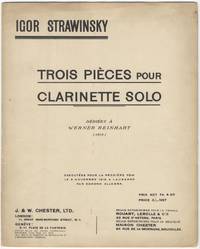
192539219London Genève Paris Bruxelles: J. & W. Chester Ltd.; Rouart Lerolle & Cie.; Maison Chester PN J.W.C. 15521 1925. Quarto. Ivory wrappers with upper printed in black. 3 i blank pp. <br /> <br /> Wrappers worn and slightly soiled with minor tears and creasing to edges and corners. Browned. A re-issue of the first edition. Kirchmeyer 33-2. J. & W. Chester, Ltd.; Rouart, Lerolle & Cie.; Maison Chester [PN J.W.C. 15521] unknown
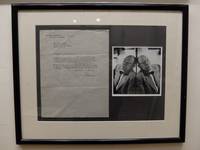
1962293971Hollywood 1962. framed. very good. Fine content T.L.S. 4to 1 page Hollywood California December 12th 1962 to singer Jerry McLain attempting to give him musical advice without hurting his feelings in full: "I would be certainly glad yo give you advice but never hearing you singing and not knowing how far you are in the knowledge of works in general their spirit and technique I am in difficulty if not in impossibility to help you. The transposition of the Shakespearean songs in a higher or lower key is a ruin of my instrumentation and the piano reduction of them is not for a concert performance only for the study of the music." Placed into a white matte with a black background with two openings - whereby the letter is actually floated while the second opening accommodates a photograph by Weegie of the composer leaning against a mirror that gives the illusion of a double exposure and set into a black acrylic frame to 21.5" x 18.5". Excellent condition.<br/> <br/> Russian composer pianist and conductor widely considered one of the most important composers of the twentieth century.<br/> <br/> unknown
1940244796Cambridge 1940. One page typewritten signed in black ink. 1 vols. 4to. Old folds. Fine with original typed mailing envelope typed name "Igor Strawinsky" above printed return address. One page typewritten signed in black ink. 1 vols. 4to. "Stravinsky began his stay in the United States at Harvard University delivering six Charles Eliot Norton lectures on musical poetics during the 1939-1940 academic year" ADNB.<br /> <br /> In this brief formal letter Stravinsky acknowledges receipt of an edition of the Russian legend retold and illustrated by Donald E. Cooke. It was Stravinsky's 1910 score of The Firebird for the Ballets Russes that first brought him international notice. The New York Times obituary of Stravinsky published on 6 April 1971 noted "He also was not pleased that 'The Firebird' remained his most popular composition."<br /> <br /> Uncommon document from early in Stravinsky's residence in the U.S. when he still spelt his surname with "w" in his signature and return address. unknown
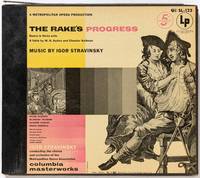
1953564101New York: Columbia 1953. Hardcover. Very Good. Original 33 1/3 rpm vinyl album. Three records in paper sleeves along with four pages of text bound into a box with a hinged lid. Some scratches and light wear that may partially affect playback but overall still very good or better in a very good box with rubbing and edgewear including a small bit of the top of the lid missing. Laid in are two programs from performances of The Rake's Progress: "Metropolitan Opera Thursday Evening February 19 1953" and "Carnegie Hall American Opera Society Opening Evening November 20 1962. Columbia hardcover
19652111902154608465David company 1965. Soft Cover. Fine. The book is in fine condition. David company paperback
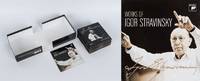
200729874AB2007. Holland Sony Classical Music 2007. CD Size. Booklet and 22 CD's. Original Hardcover Cardboard-Box. Besides some minor bumping to the box this rare set of 22 CD's is in excellent condition. Sony Classical. Stravinsky dirigiert Stravinsky - auf 22 CDs dokumentiert diese Edition zum Sonderpreis ein in der Musikgeschichte einmaliges Ereignis: eine umfassende authentische Interpretation der eigenen Werke durch einen Komponisten selbst. So kann diese Edition ein Schlüssel zum Verstehen von Igor Strawinskys musikalischem Schaffen werden. Die frühesten Aufnahmen stammen aus den dreißiger Jahren die letzten Einspielungen wurden da Stravinsky selbst nicht mehr dazu in der Lage war unter seiner Aufsicht von Robert Craft dirigiert der Jahrzehnte mit ihm musikalisch zusammengearbeitet hatte. Um das Komponisten-Porträt auch im Bereich Klaviermusik und Kammermusik abzurunden wurde die Edition zusätzlich mit Einspielungen anderer renommierter Künstler ergänzt. Die 22CD-Box enthält ein Booklet mit einem dreisprachigen Einführungstext und sämtlichen Produktionsangaben. Igor Fyodorovich Stravinsky 17 June O.S. 5 June 1882 6 April 1971 was a Russian composer pianist and conductor later of French from 1934 and American from 1945 citizenship. He is widely considered one of the most important and influential composers of the 20th century. Stravinsky's compositional career was notable for its stylistic diversity. He first achieved international fame with three ballets commissioned by the impresario Sergei Diaghilev and first performed in Paris by Diaghilev's Ballets Russes: The Firebird 1910 Petrushka 1911 and The Rite of Spring 1913. The last transformed the way in which subsequent composers thought about rhythmic structure and was largely responsible for Stravinsky's enduring reputation as a revolutionary who pushed the boundaries of musical design. His "Russian phase" which continued with works such as Renard L'Histoire du soldat and Les noces was followed in the 1920s by a period in which he turned to neoclassicism. The works from this period tended to make use of traditional musical forms concerto grosso fugue and symphony and drew from earlier styles especially those of the 18th century. In the 1950s Stravinsky adopted serial procedures. His compositions of this period shared traits with examples of his earlier output: rhythmic energy the construction of extended melodic ideas out of a few two- or three-note cells and clarity of form and instrumentation. Wikipedia hardcover
198545350NY: Knopf 1985. First American edn. 8vo pp. x 543. Appendices index. Illustrated with photogrpahs. Edges little soiled remainder mark on bottom o/w a VG tight copy in scuffed and little chipped dj. Knopf unknown books
19361988New York: Simon & Schuster 1936. Paperback. Very Good/good . Dust jacket torn/chipped. Minimal neat ink underlining here & there. <br/><br/>Presentation copy to Leon Machau dated 1937. Simon & Schuster paperback books
1962847621962. Single page typed signed letter with notes in Stravinsky's hand. Typed signed letter from 1962 to Igor Styravinsky from Carl Haverlin pioneer in radio broadcasting and longtime president of Broadcast Music Inc. The letter is on Broadcast Music Inc. stationary and Haverlin writes to inquire about some illustrations which Dulac had made for Stravinsky's Firebird Ballet. He writes: "I.take the liberty of asking you if your memory will bring forth any background on the sketches." In the margin adjacent to this sentence Stravinsky writes "Not at all!" in red pen. Haverlin closes the letter with: "Photostats of the sketchbook pages are enclosed." Beneath this Stravinsky writes along with his signature "I find it unfortunately very bad." Matted and framed opposite a photograph of Stravinsky. The entire piece measures 26.5 inches by 19.25 inches. Igor Stravinsky was a Russian-born composer pianist and conductor. He is widely considered one of the most important and influential composers of the 20th century. Stravinsky's compositional career was notable for its stylistic diversity. He first achieved international fame with three ballets commissioned by the impresario Serge Diaghilev and first performed in Paris by Diaghilev's Ballets Russes: The Firebird 1910 Petrushka 1911 and The Rite of Spring 1913. The last of these transformed the way in which subsequent composers thought about rhythmic structure and was largely responsible for Stravinsky's enduring reputation as a musical revolutionary who pushed the boundaries of musical design. His "Russian phase" which continued with works such as Renard the Soldier's Tale and Les Noces was followed in the 1920s by a period in which he turned to neoclassical music. The works from this period tended to make use of traditional musical forms concerto grosso fugue and symphony drawing on earlier styles especially from the 18th century. In the 1950s Stravinsky adopted serial procedures. His compositions of this period shared traits with examples of his earlier output: rhythmic energy the construction of extended melodic ideas out of a few two- or three-note cells and clarity of form and of instrumentation. unknown books