Stravinsky, Igor (1882-1971)Biblio.com
258 résultats
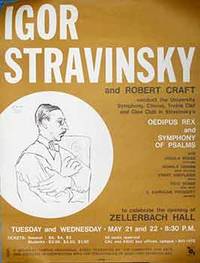
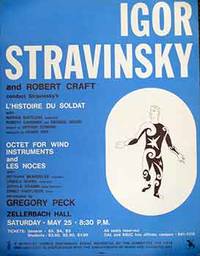
51-3548Berkeley: UC Zellerbach Hall Mya 1968. Poster in blue and black. 22.75 x 17 inches. Very good with small closed tear at lower margin."It was May of 1968 in Berkeley and Zellerbach Hall was soon to open its spacious glass doors for the first time. The program to be played: Igor Stravinsky’s “Symphony of Psalms†and “Oedipus Rex†conducted by Robert Craft and the celebrated composer himself. Unfortunately Stravinsky had fallen ill and was unable to conduct. But he did still attend this inaugural performance at UC Berkeley’s famous music hall — legend has it that the distracted audience was more enraptured by Stravinsky’s reaction to the music than by the actual performance itself." Berkeley: UC Zellerbach Hall, Mya 1968. unknown
51-3549Berkeley: UC Zellerbach Hall May 1968. Poster in ochre and black. 22.75 x 17 inches. Very good."It was May of 1968 in Berkeley and Zellerbach Hall was soon to open its spacious glass doors for the first time. The program to be played: Igor Stravinsky’s “Symphony of Psalms†and “Oedipus Rex†conducted by Robert Craft and the celebrated composer himself. Unfortunately Stravinsky had fallen ill and was unable to conduct. But he did still attend this inaugural performance at UC Berkeley’s famous music hall — legend has it that the distracted audience was more enraptured by Stravinsky’s reaction to the music than by the actual performance itself." Berkeley: UC Zellerbach Hall, May 1968. unknown
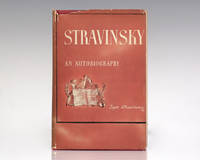
1936141339New York: Simon & Schuster 1936. First edition of the composer's classic autobiography. Octavo original cloth. Near fine in a very good dust jacket bookplate owner name. Jacket design by George Salter. Rare in the original jacket. An Autobiography chronicles the first half-century of Stravinsky's life all the while offering his opinions and "abhorrences." A Parsifal performance at Bayreuth "At the end of a quarter of an hour I could bear no more." Nijinsky "The poor boy knew nothing of music." Spanish folk music "Endless preliminary chords of guitar playing." Simon & Schuster hardcover
1969207821N.P. London: Boosey & Hawkes 1969. First Edition. With the typical splitting to the joints that affects this awkwardly bound publication; few marks; a very good copy in the original cloth slipcase. 4to 139pp; cloth. A nicely printed facsimile edition with a separately printed 48 booklet of commentary inserted in a pocket at the inside rear cover. A nicer-than-usual copy. Boosey & Hawkes unknown
1974469666Northampton Massachusetts: Lisa Kaufman / Smith College Press 1974. Hardcover. Near Fine. First edition. Illustrated with 10 hand-colored photo-etchings by Lisa Kaufman. Quarto. vi 39 pp. Text in French. Cover with some faint discoloration trifle cocked and very lightly worn at the corners and spine ends near fine. Copy 6 of 20 copies set in 18-point Bulmer and printed on Arches paper Signed by artist and printer Lisa Kaufman on the limitation page.<br /> <br /> The 1918 French text of C.F. Ramuz's libretto for Stravinsky's "L'Histoire du Soldat" printed by Smith College student Lisa Kaufman with hand-colored "photo-etchings" made from her drawings. Kaufman was possibly a student in Leonard Baskin's final printmaking class at Smith College. OCLC lists a single holding for this publication at Smith College. A very nice production. Lisa Kaufman / Smith College Press hardcover
1967101601Lion and Unicorn Press 1967. First Edition. Hardcover. Collectable - Very Good Condition. VG 1st ed Lion and Unicorn hardback with original binding Errata slip loosely laid in to first page one of only 450 copies with the plastic grip style spine. Minor stain mark to top edge of fly-leaf page previous owner name label to inside lower front cover tight and unmarked with a little rubbing to boards in places only. Elegantly produced high quality volume more related books available. Quantity Available: 1. Shipped Weight: Under 3kg. Category: Art & Design; ISBN/EAN: B01DKOXM0W. 84cxrarebooks is the trading name of Cambridge-based bookseller Marino Guida with 25 years experience in the trade. We guarantee the condition of all our books. Further images or a short video presentation of any book can be arranged on request. We send tax-free and tariff-free to EU US/Canada and Australia/NZ with insurance included for peace of mind. Inventory No: 101601. B01DKOXM0W Lion and Unicorn Press hardcover
1940244796Cambridge 1940. One page typewritten signed in black ink. 1 vols. 4to. Old folds. Fine with original typed mailing envelope typed name "Igor Strawinsky" above printed return address. One page typewritten signed in black ink. 1 vols. 4to. "Stravinsky began his stay in the United States at Harvard University delivering six Charles Eliot Norton lectures on musical poetics during the 1939-1940 academic year" ADNB.<br /> <br /> In this brief formal letter Stravinsky acknowledges receipt of an edition of the Russian legend retold and illustrated by Donald E. Cooke. It was Stravinsky's 1910 score of The Firebird for the Ballets Russes that first brought him international notice. The New York Times obituary of Stravinsky published on 6 April 1971 noted "He also was not pleased that 'The Firebird' remained his most popular composition."<br /> <br /> Uncommon document from early in Stravinsky's residence in the U.S. when he still spelt his surname with "w" in his signature and return address. unknown
107899London John Lehmann 1947. . First edition first impression dedication copy from the author to his wife; 8vo; publisher's tan cloth titles to spine gilt on a black ground black topstain with the dust jacket in the particularly good dust-jacket.<br /> The non plus ultra example being the copy inscribed by the author to his wife to whom the book is formally dedicated 'TO MY WIFE'. With White signed presentation inscription to the front free endpaper ' To Dodo without whose sympathy encouragement and judgement this book cd never have been written Eric 1947'. <br /><br />Eric Walter White's first foray into the critical study of Stravinsky about whom he would go on to write a compendious history. Through these two works White became the great composer's most important biographer. Eric and Dodo white married in 1939.<br /> London, John Lehmann, 1947. hardcover
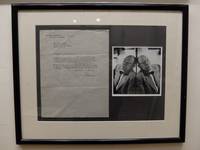
1962293971Hollywood 1962. framed. very good. Fine content T.L.S. 4to 1 page Hollywood California December 12th 1962 to singer Jerry McLain attempting to give him musical advice without hurting his feelings in full: "I would be certainly glad yo give you advice but never hearing you singing and not knowing how far you are in the knowledge of works in general their spirit and technique I am in difficulty if not in impossibility to help you. The transposition of the Shakespearean songs in a higher or lower key is a ruin of my instrumentation and the piano reduction of them is not for a concert performance only for the study of the music." Placed into a white matte with a black background with two openings - whereby the letter is actually floated while the second opening accommodates a photograph by Weegie of the composer leaning against a mirror that gives the illusion of a double exposure and set into a black acrylic frame to 21.5" x 18.5". Excellent condition.<br/> <br/> Russian composer pianist and conductor widely considered one of the most important composers of the twentieth century.<br/> <br/> unknown
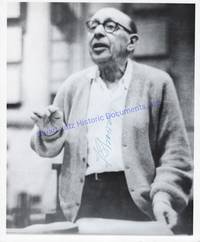
6573IGOR STRAVINSKY 1882-1971. Stravinsky was a Russian composer best remembered for The Firebird and The Rite Of Spring. He is considered one of the greatest composers of the Twentieth Century.PS. 8 x 10. No date. No place. A black and white photograph signed I Stravinsky in blue ballpoint ink across his torso. The image shows an older man with his right arm raised perhaps conducting. The blue ink has great contrast with his white shirt and it is in very fine condition. unknown
1969256031New York: Alfred A Knopf 1969. First edition. ix i 350 xi pp. 8vo. Publisher's green cloth faded at edges in very good edge-worn dustjacket. First edition. ix i 350 xi pp. 8vo. Signed on the flyleaf "Igor Stravinksy / 1.30.70" and inscribed by co-author Robert Craft. The recipient was Miranda "Mirandi" Massoco Levy 1914-2011 the doyenne of Sante Fe cultural life instumental in the success of the Sante Fe Opera and a close friend of Stravinsky. Alfred A Knopf unknown
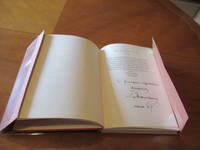
16-4195Genève: Edition Ad. Henn 1917. . Oblong 4to. 19.8 25.7 cm. 28pp. Original wraps loose as issued. Signed at Morges Switzerland and dated Noel 1917 and inscribed .The poet and playwright René Morax founded his Théâtre du Jorat near Mézières Switzerland in 1903. Made entirely of wood so as to be integrated into the barns of the surrounding countryside it was described this way in an early account: “A theater decidedly unlike any other. A sort of vast chalet a kind of huge barn smelling of resin dried hay fresh fruit and on days when there was a performance Sunday clothes but retaining the rustic dignity of a shrine. A large stage descending in broad steps toward the orchestra pit …â€The theater was closed for several years during the Great War and Morax conceived a drama on the subject of King David to reopen it in 1921. When he turned to his wealthy friend Werner Reinhart who incidentally had recently funded the creation of Stravinsky’s Soldier’s Tale telling him that he was taking inspiration from Hindu theater for this work his patron offered to lend rare Hindu drums in addition to financial assistance. The text is drawn from the Hebrew Bible I and II Samuel I Kings in addition to the Huguenot Psalter which includes poetry by Clément Marot. The poet’s brother Jean Morax set to work designing costumes and sets. After several more established composers turned him down René on the advice of Stravinsky and the distinguished conductor Ernest Ansermet chose the then unknown twenty-eight year old Arthur Honegger. “When Swiss poet Rene Morax 1873-1963 was looking for a composer for his new King David libretto Stravinsky recommended the twenty-nine-year-old Arthur Honegger a composer who just six years later creating the film score for Abel Gance’s Napoleon would reveal himself as a master of music’s ability to translate epics into sweeping evocative sound. In 1921 right on the cusp of his first successes Honegger wrote the David score in a flush of creative energy.â€. Provenance from the estate of René Morax. Expertise by Claire PIGUET Geneva Genève: Edition Ad. Henn, 1917. paperback
16-4194Genève: Edition Ad. Henn 1917. . 24 x 31.5 cm. 4 20pp. Original wraps. Front cover stained along edges. . Signed and dated 28 viii 17 and inscribed .The poet and playwright René Morax founded his Théâtre du Jorat near Mézières Switzerland in 1903. Made entirely of wood so as to be integrated into the barns of the surrounding countryside it was described this way in an early account: “A theater decidedly unlike any other. A sort of vast chalet a kind of huge barn smelling of resin dried hay fresh fruit and on days when there was a performance Sunday clothes but retaining the rustic dignity of a shrine. A large stage descending in broad steps toward the orchestra pit …â€The theater was closed for several years during the Great War and Morax conceived a drama on the subject of King David to reopen it in 1921. When he turned to his wealthy friend Werner Reinhart who incidentally had recently funded the creation of Stravinsky’s Soldier’s Tale telling him that he was taking inspiration from Hindu theater for this work his patron offered to lend rare Hindu drums in addition to financial assistance. The text is drawn from the Hebrew Bible I and II Samuel I Kings in addition to the Huguenot Psalter which includes poetry by Clément Marot. The poet’s brother Jean Morax set to work designing costumes and sets. After several more established composers turned him down René on the advice of Stravinsky and the distinguished conductor Ernest Ansermet chose the then unknown twenty-eight year old Arthur Honegger. “When Swiss poet Rene Morax 1873-1963 was looking for a composer for his new King David libretto Stravinsky recommended the twenty-nine-year-old Arthur Honegger a composer who just six years later creating the film score for Abel Gance’s Napoleon would reveal himself as a master of music’s ability to translate epics into sweeping evocative sound. In 1921 right on the cusp of his first successes Honegger wrote the David score in a flush of creative energy.â€. Provenance from the estate of René Morax. Expertise by Claire PIGUET Geneva Genève: Edition Ad. Henn, 1917. paperback
1966951091966. Rare autograph letter signed by Russian-born composer Igor Stravinsky. One page type-written dated December 21st 1966 and addressed to John McClure at Columbia Records the letter reads "Dear John Please answer this Mercury Record letter for me telling them that they can have the permission though they can have it I think without asking me in any case. I have been ordered to rest -- no conducting at all -- after Chicago. This postpones our January plans I greatly regret to say and not only for me as I realize bu can't help. Happy New Year to you and your wife. Igor Stravinsky." The recipient John McClure was an American recording producer at Columbia Records throughout the 1950s and later operated in a freelance capacity. He worked on over 30 recordings with Stravinsky 200 with Leonard Bernstein and oversaw recordings by the Boston Pops Orchestra under John Williams. Double matted and framed with a black and white portrait of Stravinsky. The entire piece measures 19.5 inches by 14.5 inches. In fine condition. Stravinsky found recordings a practical and useful tool in preserving his thoughts on the interpretation of his music. As a conductor of his own music he recorded primarily for Columbia Records beginning in 1928 with a performance of the original suite from The Firebird and concluding in 1967 with the 1945 suite from the same ballet. Although most of his recordings were made with studio musicians he also worked with the Chicago Symphony Orchestra the Cleveland Orchestra the CBC Symphony Orchestra the New York Philharmonic Orchestra the Royal Philharmonic Orchestra and the Bavarian Broadcasting Symphony Orchestra. unknown
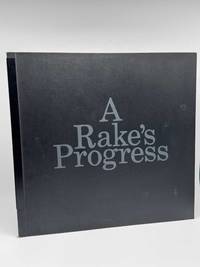
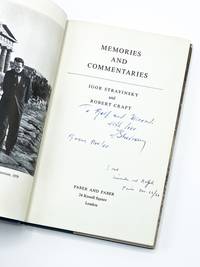
196045960London: Faber and Faber 1960. First edition. Very good in very good jacket. First printing of this collection of conversations with the iconic composer inscribed in the year of publication to his well-connected friends Miranda and Ralph Levy. Igor Stravinsky's storied career spanned from Russia to France and finally to the US where his innovative style caused ripples throughout the music world. MEMORIES AND COMMENTARIES finds the composer reflecting on his many influences friends and colleagues and was compiled with the help of his frequent collaborator and confidant Robert Craft. <br /> This copy features an inscription from Stravinsky to "Ralph and Miranda Levy" a television pioneer and well-known jewelry designer respectively. Miranda Levy was noted in her obituary as "the woman who jump-started the Santa Fe Opera" by introducing its founding director to Stravinsky Roberts. Stravinsky supervised the opera house's opening production of his "A Rake's Progress" in 1957 and subsequently returned to Santa Fe every summer after that until 1963. A warm association between arguably the 20th century's most important composer and two significant supporters. 8.5'' x 5.25''. Original blue cloth binding. Original unclipped 25s pictorial dust jacket. Black-and-white frontispiece with 21 black-and-white illustrations. 184 pages including index. Inscribed by Stravinsky "To Ralph and Miranda" Levy dated November 1960 in Rome. With the Levy's subsequent gift inscription below. Jacket with light edgewear slight chipping to corners and spine ends. Binding with mild edgewear and bumping to spine ends; faint damping close inspection only. Faber and Faber unknown
16-4193Genève: Edition Ad. Henn 1917. . Oblong 4to. 19 x 27.7 cm. 2 14pp. Original wraps. . Signed at Morges Switzerland and dated 21 Nov. 1917 and inscribed .The poet and playwright René Morax founded his Théâtre du Jorat near Mézières Switzerland in 1903. Made entirely of wood so as to be integrated into the barns of the surrounding countryside it was described this way in an early account: “A theater decidedly unlike any other. A sort of vast chalet a kind of huge barn smelling of resin dried hay fresh fruit and on days when there was a performance Sunday clothes but retaining the rustic dignity of a shrine. A large stage descending in broad steps toward the orchestra pit …â€The theater was closed for several years during the Great War and Morax conceived a drama on the subject of King David to reopen it in 1921. When he turned to his wealthy friend Werner Reinhart who incidentally had recently funded the creation of Stravinsky’s Soldier’s Tale telling him that he was taking inspiration from Hindu theater for this work his patron offered to lend rare Hindu drums in addition to financial assistance. The text is drawn from the Hebrew Bible I and II Samuel I Kings in addition to the Huguenot Psalter which includes poetry by Clément Marot. The poet’s brother Jean Morax set to work designing costumes and sets. After several more established composers turned him down René on the advice of Stravinsky and the distinguished conductor Ernest Ansermet chose the then unknown twenty-eight year old Arthur Honegger. “When Swiss poet Rene Morax 1873-1963 was looking for a composer for his new King David libretto Stravinsky recommended the twenty-nine-year-old Arthur Honegger a composer who just six years later creating the film score for Abel Gance’s Napoleon would reveal himself as a master of music’s ability to translate epics into sweeping evocative sound. In 1921 right on the cusp of his first successes Honegger wrote the David score in a flush of creative energy.â€. Provenance from the estate of René Morax. Expertise by Claire PIGUET Geneva Genève: Edition Ad. Henn, 1917. paperback
16-4191Genève Edition Ad. Henn 1917. . 4to. 28 x 19.8 cm. 8 64pp. Original wraps. Front cover mainly detached. Signed at Morges Switzerland and dated 1918 and inscribed .The poet and playwright René Morax founded his Théâtre du Jorat near Mézières Switzerland in 1903. Made entirely of wood so as to be integrated into the barns of the surrounding countryside it was described this way in an early account: “A theater decidedly unlike any other. A sort of vast chalet a kind of huge barn smelling of resin dried hay fresh fruit and on days when there was a performance Sunday clothes but retaining the rustic dignity of a shrine. A large stage descending in broad steps toward the orchestra pit …â€The theater was closed for several years during the Great War and Morax conceived a drama on the subject of King David to reopen it in 1921. When he turned to his wealthy friend Werner Reinhart who incidentally had recently funded the creation of Stravinsky’s Soldier’s Tale telling him that he was taking inspiration from Hindu theater for this work his patron offered to lend rare Hindu drums in addition to financial assistance. The text is drawn from the Hebrew Bible I and II Samuel I Kings in addition to the Huguenot Psalter which includes poetry by Clément Marot. The poet’s brother Jean Morax set to work designing costumes and sets. After several more established composers turned him down René on the advice of Stravinsky and the distinguished conductor Ernest Ansermet chose the then unknown twenty-eight year old Arthur Honegger. “When Swiss poet Rene Morax 1873-1963 was looking for a composer for his new King David libretto Stravinsky recommended the twenty-nine-year-old Arthur Honegger a composer who just six years later creating the film score for Abel Gance’s Napoleon would reveal himself as a master of music’s ability to translate epics into sweeping evocative sound. In 1921 right on the cusp of his first successes Honegger wrote the David score in a flush of creative energy.â€. Provenance from the estate of René Morax. Expertise by Claire PIGUET Geneva Genève, Edition Ad. Henn, 1917. paperback
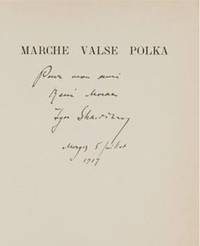
16-4192Genève: Edition Ad. Henn 1917. . Oblong 4to. 19.5 x 27.3 cm. 2 8pp. Original wraps. . Signed at Morges Switzerland and dated 5 Juillet 1917 and inscribed .The poet and playwright René Morax founded his Théâtre du Jorat near Mézières Switzerland in 1903. Made entirely of wood so as to be integrated into the barns of the surrounding countryside it was described this way in an early account: “A theater decidedly unlike any other. A sort of vast chalet a kind of huge barn smelling of resin dried hay fresh fruit and on days when there was a performance Sunday clothes but retaining the rustic dignity of a shrine. A large stage descending in broad steps toward the orchestra pit …â€The theater was closed for several years during the Great War and Morax conceived a drama on the subject of King David to reopen it in 1921. When he turned to his wealthy friend Werner Reinhart who incidentally had recently funded the creation of Stravinsky’s Soldier’s Tale telling him that he was taking inspiration from Hindu theater for this work his patron offered to lend rare Hindu drums in addition to financial assistance. The text is drawn from the Hebrew Bible I and II Samuel I Kings in addition to the Huguenot Psalter which includes poetry by Clément Marot. The poet’s brother Jean Morax set to work designing costumes and sets. After several more established composers turned him down René on the advice of Stravinsky and the distinguished conductor Ernest Ansermet chose the then unknown twenty-eight year old Arthur Honegger. “When Swiss poet Rene Morax 1873-1963 was looking for a composer for his new King David libretto Stravinsky recommended the twenty-nine-year-old Arthur Honegger a composer who just six years later creating the film score for Abel Gance’s Napoleon would reveal himself as a master of music’s ability to translate epics into sweeping evocative sound. In 1921 right on the cusp of his first successes Honegger wrote the David score in a flush of creative energy.â€. Provenance from the estate of René Morax. Expertise by Claire PIGUET Geneva Genève: Edition Ad. Henn, 1917. paperback
1962847621962. Single page typed signed letter with notes in Stravinsky's hand. Typed signed letter from 1962 to Igor Styravinsky from Carl Haverlin pioneer in radio broadcasting and longtime president of Broadcast Music Inc. The letter is on Broadcast Music Inc. stationary and Haverlin writes to inquire about some illustrations which Dulac had made for Stravinsky's Firebird Ballet. He writes: "I.take the liberty of asking you if your memory will bring forth any background on the sketches." In the margin adjacent to this sentence Stravinsky writes "Not at all!" in red pen. Haverlin closes the letter with: "Photostats of the sketchbook pages are enclosed." Beneath this Stravinsky writes along with his signature "I find it unfortunately very bad." Matted and framed opposite a photograph of Stravinsky. The entire piece measures 26.5 inches by 19.25 inches. Igor Stravinsky was a Russian-born composer pianist and conductor. He is widely considered one of the most important and influential composers of the 20th century. Stravinsky's compositional career was notable for its stylistic diversity. He first achieved international fame with three ballets commissioned by the impresario Serge Diaghilev and first performed in Paris by Diaghilev's Ballets Russes: The Firebird 1910 Petrushka 1911 and The Rite of Spring 1913. The last of these transformed the way in which subsequent composers thought about rhythmic structure and was largely responsible for Stravinsky's enduring reputation as a musical revolutionary who pushed the boundaries of musical design. His "Russian phase" which continued with works such as Renard the Soldier's Tale and Les Noces was followed in the 1920s by a period in which he turned to neoclassical music. The works from this period tended to make use of traditional musical forms concerto grosso fugue and symphony drawing on earlier styles especially from the 18th century. In the 1950s Stravinsky adopted serial procedures. His compositions of this period shared traits with examples of his earlier output: rhythmic energy the construction of extended melodic ideas out of a few two- or three-note cells and clarity of form and of instrumentation. unknown
1936028516New York: G. Schirmer 1936. 1st Edition 1st Printing. Hardcover. Fine/Fair DJ. 158 Pp. A Compilation Of Articles With New Articles By Goosens Komroff Danz Rodriguez And Armitage Written For This Book. The Book Is Fine No Wear And Inscribed By Stravinsky To Pasquale Giovanni Napolitano Who Illustrated This Book "To Giovanni Napolitano Sincerely I Strawinsky March 37". With The Scarce Pink Dj Worn And Chipped With Very Large Piece Missing At Bottom Of Front Panel And Spine Leaving Title And Editor's Name On Spine But Removing Some Of Descriptive Text At Bottom Of Front Panel Flaps Intact Tape Reinforcement Inside Of Dj. <br/> <br/> G. Schirmer hardcover
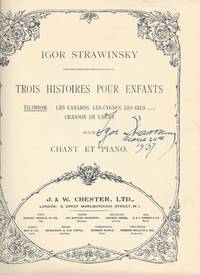
1927838London: J. & W. Chester Ltd 1927. Signed and dated by Stravinsky in March 1937. Plate no. 3830.1. In publisher’s printed brown wrappers. Torn at head of spine. A small blot on front cover. Trace of creasing to lower corner. Overall in fine condition. Signed and dated by Stravinsky in March 1937. Plate no. 3830.1. In publisher’s printed brown wrappers. 7 1 p. <p><br /> Composed in 1917 in Morges and first published in 1923 by J. & W. Chester. <br /> <p><p><br /> Tilimbom is a piece wherein Stravinsky continues his exploration of the animal world it tells the story of a fire in a farmyard.<br /> <p>. J. & W. Chester, Ltd unknown
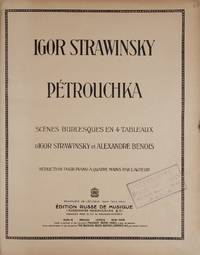
191241390Berlin Moscou Leipzig New-York: Édition Russe de Musique PN R.M.V. 150 1912. Folio. Contemporary half black calf with marbled boards label of the Parisian music rental firm Rouart-Lerolle to upper marbled endpapers. 1f. recto title verso blank i named cast list referring to first production of 1911 in French i synopsis in Russian and French i "general remarks" in Russian and French i blank i dedication to A. Benois i blank 7-84 ii blank pp. Photographic transfer from engraved plates. With "ROME MAI 1911" and printer's note "Imp. C. G. Röder Leipzig." to lower outer corner of p. 84.<br /> <br /> Rouart Lerolle and "5" handstamps to title and first four leaves.<br /> <br /> Binding worn rubbed bumped and abraded; hinges split; small label with "143" in manuscript to upper board. First Edition first issue. Kirchmeyer 12-4. De Lerma P17. Crawford p. 533.<br /> <br /> Distinguishing imprint to title below crest found in the first issue is as follows:<br /> <br /> PROPRIÉTÉ DE L'ÉDITEUR POUR TOUS PAYS / ÉDITION RUSSE DE MUSIQUE / RUSSISCHER MUSIKVERLAG G.M. above BH below/ FONDÉE PAR S. ET N. KOUSSEWITZKY / BERLIN MOSCOU LEIPZIG NEW-YORK / POUR LA FRANCE ET SES COLONIES: MUSIQUE RUSSE PARIS 3 RUE DE MOSCOU / POUR L'ANGLETERRE ET SES COLONIES; THE RUSSIAN MUSIC AGENCY LONDRES W.I 34 PERCY STREET<br /> <br /> "The emergence of Stravinsky as a modernist with an individual manner unlike any other can be dated with some precision to his early work on Petrushka. In March 1910 during the later stages of composing The Firebird he had experienced the famous 'fleeting vision' out of which The Rite of Spring was to grow. But when Diaghilev and Nijinsky visited him in Lausanne in September 1910 they found him at work on something quite different a concert piece for piano and orchestra called 'Petrushka's Cry'. Together with a 'Russian Dance' composed soon afterwards this music was to form the basis of the ballet which Diaghilev instinctively urged him to write instead. . <br /> <br /> It is from the systematic attempt to render the particular flavour of traditional Russian life into music that Petrushka derives many of its freshest and most original qualities. . <br /> <br /> Looked at in general terms the opening sequence of Petrushka is a prototype of later Stravinskian form. Its underlying rhythmic design may not be complex in the same way as that of The Rite of Spring or the later Russian works but its intricacy of rhythmic detailing and its mixture of a highly fluid pattern of melodic stress with an inert background harmony laid the groundwork for a technique which through many changes of superficial style was to serve him for the rest of his life." Walsh: The Music of Stravinsky pp. 24-29. <br /> <br /> "Petroushka proved just as successful with the public and critics as The Firebird had been; but it was undoubtedly a more original work. In the first place Stravinsky had been able to play a leading part in the construction of the scenario which had not been the case with The Firebird. Secondly whereas the music of The Firebird showed that the pupil had learnt all that his master had had to teach him in Petrushka for the first time the authentic voice of the new master is heard." TNG Vol. 18 pp. 244-245. <br /> <br /> Petrushka one of Stravinsky's best-known and loved works represents the essence of Diaghilev's monumental Ballets Russes era. The ballet received its first performance with the incomparable Nijinsky in the title role at the Théâtre du Châtelet on 13 June 1911 conducted by Pierre Monteux with choreography by Fokine and designs by Alexandre Benois. Édition Russe de Musique [PN R.M.V. 150] unknown
19501084781950. Signed. STRAVINSKY Igor. Photograph inscribed. No place 1950. Black-and-white postcard portrait measuring 3-1/2 by 5-1/2 inches; matted and framed entire piece measures 9-1/2 by 12 inches. $2200.Postcard photograph of Igor Stravinsky inscribed Pour Monsieur Maurice Dubois avec mes meilleurs compliments Igor Stravinsky 1950.""Few 20th-century composers enjoyed international influence and importance equal to that of Stravinsky. This influence exists in the materials of his music and in his rigorous search for an individual sound For many years he was with Schoenberg one of the two unofficial poles of Western music"" ANB. The postcard portrait is dated September 1948 and is attractively matted and framed with a page of music from Stravinsky's Four Etudes. An attractive inscribed and signed framed piece in fine condition. unknown
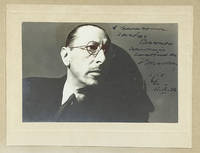
1203A vintage gelatin silver print photograph head and shoulders portrait in part profile with shadow by George Hoyningen-Huene 1934 inscribed and signed in blue ink on the upper right-hand area of the photograph 85x135 cm original mount framed and glazed. <br /> This original vintage photograph of Igor Stravinsky 1882 - 1971 was taken in Paris on November 16 1934 by the famous fashion photographer George Hoyningen-Huene 1900 - 1968.<br /> This is likely to be the second collaboration between the composer and the photographer as Igor Stravinsky's print taken by Hoyningen-Huene first appeared in the 1927 November issue of Vanity Fair. At the time both Stravinsky and Huene resided in France where their second collaboration took place. After their departure from the Russian Empire at the outbreak of WWI the Stravinskys first settled in Switzerland and then in France where they lived up until 1939. Although during the French era Igor created some of his most famous pieces notably Concerto for Two Pianos - 1935 and even managed to find his second love Vera de Bosset 1889 - 1982 the composer later described the Parisian period as the most unhappy time in his life: in 1938 Stravinsky lost his daughter Lyudmila in 1939 - died his wife and mother. The 1934 photograph one of a series was taken shortly after Stravinsky acquired French citizenship and together with his wife Ekaterina moved from Voreppe to Paris. During that period Stravinsky mainly focused on writing music and his autobiography book Chronicle of My Life. Less than a year and a half following the November encounter with George Hoyningen Stravinsky and his son Soulima embarked upon their first voyage to South America during which Igor inscribed this photograph. In the period from April to June 1936 the two visited Buenos Aires Montevideo and Rio de Janeiro. Stravinsky's tour in South America was not only arranged but also largely underwritten by his friend Victoria Ocampo 1890-1979 a wealthy Argentine author and publisher of the literary periodical Sur. After giving a series of concerts in Argentina and while passing through Rio de Janeiro Stravinsky had stopped for a few days in order to perform at the Municipal Theater the presentation of his melodrama Persephone with Victoria Ocampo declaiming on June 5 and 12. The event was mostly attended by music critics artists journalists and intellectuals. Stravinsky got extremely upset when the small number of spectators applauded him on the night of the show. When embarking for Europe he declared to journalists: Brazil is still too green for my music. Maybe in fifty years it will understand. The composer signed this photograph a day before his second performance at the Municipal Theater. Shortly after the photograph was taken both Stravinsky in 1939 and Huene in 1935 permanently moved to the United States where their careers continued to blossom. unknown
19621004541962. First Edition. Signed. STRAVINSKY Igor. CRAFT Robert. Expositions and Developments. Garden City New York: Doubleday 1962. Octavo original black cloth original dust jacket. $2500.First edition warmly inscribed on the half title to neighbor and longtime friend Miranda Levy ""To my dear Miranda with love and kisses from I Stravinsky Nov /63.""""Few 20th-century composers enjoyed international influence and importance equal to that of Stravinsky. This influence exists in the materials of his music and in his rigorous search for an individual sound For many years he was with Schoenberg one of the two unofficial poles of Western music"" ANB. In these conversations with his protégé conductor Robert Craft who coauthored seven books with him Stravinsky discusses his childhood in St. Petersburg Russia; recalls such musical luminaries as Tchaikovsky and Rimsky-Korsakov; reflects on the intersection of music and modern recording technology; and discusses scores including The Firebird The Rite of Spring and his then-new work The Flood. Illustrated with eight pages of black-and-white photographs. Inscribed to Miranda Levy a founding member of the Santa Fe Opera and wife of pioneering television director Ralph Levy whose credits include directing the original I Love Lucy pilot episode. Miranda ""met Stravinsky at the Aspen Colorado Music Festival in 1950 then hosted him on a New Mexico visit When the composer let it be known he was interested in D.H. Lawrence Miranda introduced Stravinsky to Lawrence's widow Miranda and Ralph Levy moved to Los Angeles and bought a house less than a block from Stravinsky's Just as she had once kept Santa Feans up to date on the latest news and gossip she now regaled Igor and Vera Stravinsky with daily updates on movie studio gossip"" Albuquerque Journal.Dust jacket with light rubbing to spine ends and edges. A very nearly fine inscribed presentation/association copy. hardcover