Stravinsky IgorABAA

56 résultats
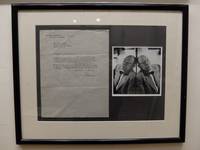
1966951091966. Rare autograph letter signed by Russian-born composer Igor Stravinsky. One page type-written dated December 21st 1966 and addressed to John McClure at Columbia Records the letter reads "Dear John Please answer this Mercury Record letter for me telling them that they can have the permission though they can have it I think without asking me in any case. I have been ordered to rest -- no conducting at all -- after Chicago. This postpones our January plans I greatly regret to say and not only for me as I realize bu can't help. Happy New Year to you and your wife. Igor Stravinsky." The recipient John McClure was an American recording producer at Columbia Records throughout the 1950s and later operated in a freelance capacity. He worked on over 30 recordings with Stravinsky 200 with Leonard Bernstein and oversaw recordings by the Boston Pops Orchestra under John Williams. Double matted and framed with a black and white portrait of Stravinsky. The entire piece measures 19.5 inches by 14.5 inches. In fine condition. Stravinsky found recordings a practical and useful tool in preserving his thoughts on the interpretation of his music. As a conductor of his own music he recorded primarily for Columbia Records beginning in 1928 with a performance of the original suite from The Firebird and concluding in 1967 with the 1945 suite from the same ballet. Although most of his recordings were made with studio musicians he also worked with the Chicago Symphony Orchestra the Cleveland Orchestra the CBC Symphony Orchestra the New York Philharmonic Orchestra the Royal Philharmonic Orchestra and the Bavarian Broadcasting Symphony Orchestra. unknown books
307827London et al: Boosey & Hawkes n.d. Revised 1952 edition. Hawkes Pocket Scores No. 630. 4 40 pp. 12mo. Original printed wrappers. Fine. Revised 1952 edition. Hawkes Pocket Scores No. 630. 4 40 pp. 12mo. Signed by Igor and Vera Stravinsky with an account of the signing. Signed by the composer on the front cover "Stravinsky" with "and Vera" added below by the composer's wife. A two page typed note laid-into the book by one Lili Yuri Sasaki dated March 16 1964 explains the circumstances of the book's signing at the opening night of an exhibition of Vera Stravinsky's paintings in Cincinnati Ohio. Sasaki describes the impression created by the arrival of the Stravinskys at the exhibition and explains that she'd been given two items by her husband to have autographed by Stravinsky--a pirated edition of "L'histoire du Soldat;" and should the composer be reluctant to sign the piracy the present pocket score. Sure enough on looking over the piracy and noticing the imprint Stravinsky "suddenly looked disgusted and said 'they have no right -- I gave them no permission -- I will not sign this one' and handed it back much to the curiosity of the crowd. Then I handed him the Boosey & Hawkes Octet for wind instruments. He again looked it over closely.then turned the pages.looked pleased and signed saying; 'Yes I will sign this one.' and he did with a flourish!.beamed and returned the book. BLESS HIM.Vera later added 'and Vera.'" In addition to the note a printed invitation to the event on a 2 1/2 x 3 1/2 inch card and a promotional brochure for the exhibition are laid in. Boosey & Hawkes unknown books
14512Used; Like New/Used; Like New. Typed letter signed from the great composer to Ray Smith manager of the Hollywood Bowl Association agreeing to conduct the Hollywood Bowl Orchestra on August 12 1952. Together with the final page of the contract for the engagement signed by both Stravinsky and Smith and retained copies of the term sheets for the engagement. Dated April 19 1952. Stravinsky confirms his engagement as conductor "on Tuesday evening August 12 1952 at a fee of $1500 -- with two rehearsals Monday and Tuesday of that week of 2 1/2 hours each" and goes on to mention that his son Soulima Stravinsky will also be able to appear as piano soloist in the concert. Folding creases.<br>Stravinsky conducted his son Soulima an accomplished pianist though overshadowed by his father in a performance of his Cappriccio for piano and orchestra. The program also included the Firebird suite. unknown books
1962847621962. Single page typed signed letter with notes in Stravinsky's hand. Typed signed letter from 1962 to Igor Styravinsky from Carl Haverlin pioneer in radio broadcasting and longtime president of Broadcast Music Inc. The letter is on Broadcast Music Inc. stationary and Haverlin writes to inquire about some illustrations which Dulac had made for Stravinsky's Firebird Ballet. He writes: "I.take the liberty of asking you if your memory will bring forth any background on the sketches." In the margin adjacent to this sentence Stravinsky writes "Not at all!" in red pen. Haverlin closes the letter with: "Photostats of the sketchbook pages are enclosed." Beneath this Stravinsky writes along with his signature "I find it unfortunately very bad." Matted and framed opposite a photograph of Stravinsky. The entire piece measures 26.5 inches by 19.25 inches. Igor Stravinsky was a Russian-born composer pianist and conductor. He is widely considered one of the most important and influential composers of the 20th century. Stravinsky's compositional career was notable for its stylistic diversity. He first achieved international fame with three ballets commissioned by the impresario Serge Diaghilev and first performed in Paris by Diaghilev's Ballets Russes: The Firebird 1910 Petrushka 1911 and The Rite of Spring 1913. The last of these transformed the way in which subsequent composers thought about rhythmic structure and was largely responsible for Stravinsky's enduring reputation as a musical revolutionary who pushed the boundaries of musical design. His "Russian phase" which continued with works such as Renard the Soldier's Tale and Les Noces was followed in the 1920s by a period in which he turned to neoclassical music. The works from this period tended to make use of traditional musical forms concerto grosso fugue and symphony drawing on earlier styles especially from the 18th century. In the 1950s Stravinsky adopted serial procedures. His compositions of this period shared traits with examples of his earlier output: rhythmic energy the construction of extended melodic ideas out of a few two- or three-note cells and clarity of form and of instrumentation. unknown books
1962293971Hollywood 1962. unbound. very good. Fine content T.L.S. 4to 1 page Hollywood California December 12th 1962 to singer Jerry McLain attempting to give him musical advice without hurting his feelings in full: "I would be certainly glad yo give you advice but never hearing you singing and not knowing how far you are in the knowledge of works in general their spirit and technique I am in difficulty if not in impossibility to help you. The transposition of the Shakespearean songs in a higher or lower key is a ruin of my instrumentation and the piano reduction of them is not for a concert performance only for the study of the music." Placed into a white matte with a black background with two openings - whereby the letter is actually floated while the second opening accommodates a photograph by Weegie of the composer leaning against a mirror that gives the illusion of a double exposure and set into a black acrylic frame to 21.5" x 18.5". Excellent condition.<br/><br/> Russian composer pianist and conductor widely considered one of the most important composers of the twentieth century.<br/><br/> unknown books
1936255987London: Gollancz 1936. First English edition. Illustrated. 286 pp. 1 vols. 8vo. Publisher's black cloth repaired at head of spine in yellow printed dust jacket spine darkened and chipped with some loss to title small book ticket to spine. First English edition. Illustrated. 286 pp. 1 vols. 8vo. Inscribed to Violinist Samuel Dushkin. Inscribed on the ffep "A Sam & Louise Dushkin. Leur ami I Stravinsky. Paris 30.3.36."<br/>Samuel Dushkin 1891-1976 was a concert violinist who worked closely with Stravinsky on the composition of the latter's Violin Concerto 1931 his first major work for the instrument. Dushkin premiered the work in concert with Stravinsky conducting the Berlin Symphony Orchestra. Stravinsky recounts his collaboration with Dushkin on pp. 268-278 of his memoir. "I was very glad to find in him besides his remarkable gifts as a born violinist a musical culture a delicate understanding and - in the exercise of his profession - an abnegation that is very rare" p. 270. Stravinksy was inspired by his success with the Violin Concerto to compose a sonata for violin and piano which he took on tour with Dushkin to Europe and America ". a deeper knowledge of the violin and close collaboration with a technician like Dushkin had revealed possibilities which I longed to explore" p. 275.<br/>An important association marking a milestone in the expansion of Stravinksy's evolution as a composer. Gollancz unknown books