461 résultats
Q-0486263428Dover Pubns. paperback. New. New. In shrink wrap. Looks like an interesting title! Dover Pubns paperback
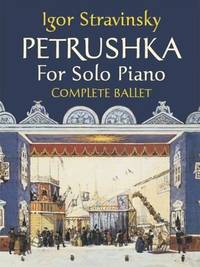
1988Q-0486256804Dover Publications 1988-06-30. paperback. New. New. In shrink wrap. Looks like an interesting title! Dover Publications paperback
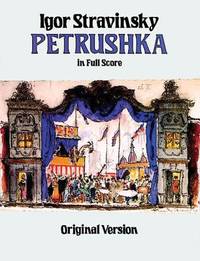
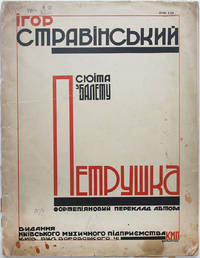
1927503Kiev: Muzgiz 1927. 35 pp. 34x25.5 cm. Some tears and stains on the wrappers and lower margin otherwise very good.<br /> <br /> First Ukrainian edition. Rare.<br /> <br /> This is a piano transcription of Igor Stravinsky's early composition 'Petrushka'. He began to create the ballet in Ukrainian town Ustyluh in 1907. Performed for the first time in 1911 the composition has been one of the most popular Ballets Russes. Its piano version presented not mere piano reduction of the composition but an attractive independent work that is now known as ''Trois mouvements de Petrouchka''. Stravinsky created piano version of the suite in 1921 for his friend pianist Arthur Rubinstein. He was the only musician who made Stravinsky believe in the soft sounds of piano performance. This is one of the early publications of the music.<br /> <br /> The edition is designed by Grygory Berkovitch 1905-1976 a Soviet artist and designer from Kharkiv.<br /> <br /> Not in the Worldcat. Muzgiz unknown
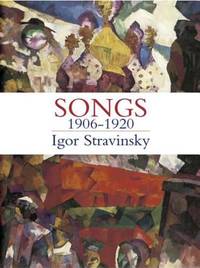
2006SONG0486449459Dover Publications 2006-01-27. paperback. Used: Good. 8.75x0.25x11.50. Buy with confidence. Excellent Customer Service & Return policy. Dover Publications paperback
19501084781950. Signed. STRAVINSKY Igor. Photograph inscribed. No place 1950. Black-and-white postcard portrait measuring 3-1/2 by 5-1/2 inches; matted and framed entire piece measures 9-1/2 by 12 inches. $2200.Postcard photograph of Igor Stravinsky inscribed Pour Monsieur Maurice Dubois avec mes meilleurs compliments Igor Stravinsky 1950.""Few 20th-century composers enjoyed international influence and importance equal to that of Stravinsky. This influence exists in the materials of his music and in his rigorous search for an individual sound For many years he was with Schoenberg one of the two unofficial poles of Western music"" ANB. The postcard portrait is dated September 1948 and is attractively matted and framed with a page of music from Stravinsky's Four Etudes. An attractive inscribed and signed framed piece in fine condition. unknown
0674678559.Ghardcover. Good. Access codes and supplements are not guaranteed with used items. May be an ex-library book. hardcover
Q-0674678567Harvard University Press. paperback. New. New. In shrink wrap. Looks like an interesting title! Harvard University Press paperback
1947004697Cambridge: Harvard University Press 1947. First Edition. Original Cloth. Very Good. Harvard University Press Hardcover
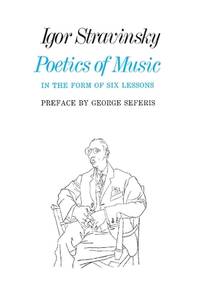
200344016AB2003. Cambridge Massachusetts / London Harvard University Press 2003. 12.5 cm x 18 cm. XIII 142 pages. Original softcover. Excellent as new condition with only very minor signs of external wear. Includes the following chapters:- Getting Acquainted / The Phenomenon of Music / The Composition of Music / Musical Typology / The Avatars of Russian Music / The Performance of Music etc. "One of the greatest of contemporary composers has here set down in delightfully personal fashion his general ideas about music and some accounts of his own experience as a composer. Every concert-goer and lover of music will take keen pleasure in his notes about the essential features of music the process of musical composition inspiration musical types and musical execution. Throughout the volume are to he found trenchant comments on such subjects as Wagnerism the operas of Verdi musical taste musical snobbery the influence of political ideas on Russian music under the Soviets musical improvisation as opposed to musical construction the nature of melody and the function of the critic of music. Musical people of every sort will welcome this first presentation in English of an unusually interesting book". Amazon. paperback
1970DADAX0674678567Harvard University Press 1970-02-26. Revised ed. paperback. New. 5.00x0.50x7.25. Buy with confidence. Excellent Customer Service & Return policy. Harvard University Press paperback
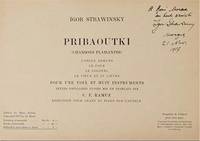
16-4193Genève: Edition Ad. Henn 1917. . Oblong 4to. 19 x 27.7 cm. 2 14pp. Original wraps. . Signed at Morges Switzerland and dated 21 Nov. 1917 and inscribed .The poet and playwright René Morax founded his Théâtre du Jorat near Mézières Switzerland in 1903. Made entirely of wood so as to be integrated into the barns of the surrounding countryside it was described this way in an early account: “A theater decidedly unlike any other. A sort of vast chalet a kind of huge barn smelling of resin dried hay fresh fruit and on days when there was a performance Sunday clothes but retaining the rustic dignity of a shrine. A large stage descending in broad steps toward the orchestra pit …â€The theater was closed for several years during the Great War and Morax conceived a drama on the subject of King David to reopen it in 1921. When he turned to his wealthy friend Werner Reinhart who incidentally had recently funded the creation of Stravinsky’s Soldier’s Tale telling him that he was taking inspiration from Hindu theater for this work his patron offered to lend rare Hindu drums in addition to financial assistance. The text is drawn from the Hebrew Bible I and II Samuel I Kings in addition to the Huguenot Psalter which includes poetry by Clément Marot. The poet’s brother Jean Morax set to work designing costumes and sets. After several more established composers turned him down René on the advice of Stravinsky and the distinguished conductor Ernest Ansermet chose the then unknown twenty-eight year old Arthur Honegger. “When Swiss poet Rene Morax 1873-1963 was looking for a composer for his new King David libretto Stravinsky recommended the twenty-nine-year-old Arthur Honegger a composer who just six years later creating the film score for Abel Gance’s Napoleon would reveal himself as a master of music’s ability to translate epics into sweeping evocative sound. In 1921 right on the cusp of his first successes Honegger wrote the David score in a flush of creative energy.â€. Provenance from the estate of René Morax. Expertise by Claire PIGUET Geneva Genève: Edition Ad. Henn, 1917. paperback
20221-1638875030Alfred Pub Co 2022. Paperback. New. spiral-bound edition. 95 pages. 12.25x9.50x0.50 inches. Alfred Pub Co paperback
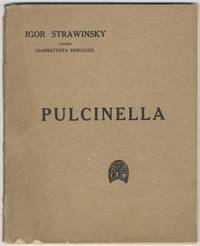
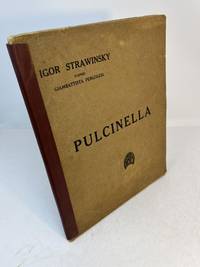
192041305London Genève: J. & W. Chester Ltd. PN J. & W. C. 9707 1920. Folio. Original publisher's printed dark ivory wrappers with decorative device to upper and publisher's details within decorative border to lower. 1f. recto title verso printed notice regarding first performance with named cast list and scenario 86 pp.<br /> <br /> Named cast includes Massine Pulcinella Thamar Karsavina Pimpinella Tchernicheva Prudenza Nemtchinova Rosetta Novac Fourbo Idzikowky Caviello Zverew Florindo Cecchetti Il Dottore Kostetsky Tartaglia and Bourman Okimowsky Micholaitchik and Loukin Petits Pulcinella.<br /> <br /> Wrappers somewhat worn and soiled; torn at spine with minor loss; partially detached. Minor internal wear; two small chips to blank lower margin of title and upper wrapper. First Edition. Scarce. Kirchmeyer 34-1. White p. 282. De Lerma P60. CPM Vol. 54 p. 440.<br /> <br /> Pulcinella commissioned by the Russian impresario and founder of the Ballets Russes Sergei Diaghilev 1872-1929 was first performed in Paris at the Opéra on 15 May 1920 with Ernest Ansermet conducting. The libretto and choreography were by Léonide Massine with costumes and sets designed by Pablo Picasso. J. & W. Chester, Ltd. [PN J. & W. C. 9707] unknown
1920CE236960London: J & W Chester Ltd 1920. 1st ed. thus. Paperback. Good. large quarto tan wraps 1st thus 1920 86 pages text in French. Spine covered with maroon cloth tape Exterior lightly soiled & edgeworn bumped corners owners names inside one is Reba Paeff; text clean / unmarked but slight soil / edgewear to final page. SHEET MUSIC.- Piano - vocal. J & W Chester, Ltd paperback
1019567791.Ghardcover. Good. Access codes and supplements are not guaranteed with used items. May be an ex-library book. hardcover
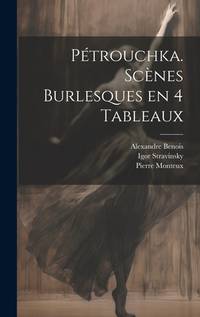
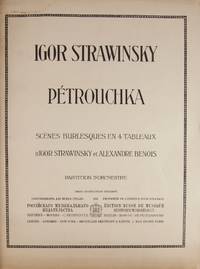
191241313Berlin Moscou St. Pétersbourg .: Édition Russe de Musique PN R.M.V. 127 1912. Folio. Newly bound in quarter dark green cloth with mid-brown paper boards dark red title label gilt to upper and spine. 1f. recto title verso blank i named cast list ii synopsis i orchestration i recto dedication "À Alexandre Benois" verso blank 7-156 pp. 1f. errata tipped in to rear pastedown. With text in Russian and French.<br /> <br /> Named cast for the first performance by Diaghilev's Ballets Russes at the Théâtre du Chatelet in Paris on 13 June 1911 includes Tamar Karsavina Le Ballerine Vaslav Nijinsky Petrushka Orlow Le Maure and Enrico Ceccheti Le vieux Charlatan; the performance was conducted by Monteux with maître du ballet Fokine and sets and costumes designed by Benois and executed by Anisfeld sets and Caffi and Worobiew costumes.<br /> <br /> Small area of faint dampstaining and minor cockling to upper inner margins. <br /> <br /> An attractive copy. First Edition first issue. Rare. Kirchmeyer 12-1. Hirsch II 905. De Lerma P15. White p. 193. Crawford p. 533. <br /> <br /> "The emergence of Stravinsky as a modernist with an individual manner unlike any other can be dated with some precision to his early work on Petrushka. In March 1910 during the later stages of composing The Firebird he had experienced the famous 'fleeting vision' out of which The Rite of Spring was to grow. But when Diaghilev and Nijinsky visited him in Lausanne in September 1910 they found him at work on something quite different a concert piece for piano and orchestra called 'Petrushka's Cry'. Together with a 'Russian Dance' composed soon afterwards this music was to form the basis of the ballet which Diaghilev instinctively urged him to write instead. . <br /> <br /> It is from the systematic attempt to render the particular flavour of traditional Russian life into music that Petrushka derives many of its freshest and most original qualities. . <br /> <br /> Looked at in general terms the opening sequence of Petrushka is a prototype of later Stravinskian form. Its underlying rhythmic design may not be complex in the same way as that of The Rite of Spring or the later Russian works but its intricacy of rhythmic detailing and its mixture of a highly fluid pattern of melodic stress with an inert background harmony laid the groundwork for a technique which through many changes of superficial style was to serve him for the rest of his life." Walsh: The Music of Stravinsky pp. 24-29. <br /> <br /> "Petroushka proved just as successful with the public and critics as The Firebird had been; but it was undoubtedly a more original work. In the first place Stravinsky had been able to play a leading part in the construction of the scenario which had not been the case with The Firebird. Secondly whereas the music of The Firebird showed that the pupil had learnt all that his master had had to teach him in Petrushka for the first time the authentic voice of the new master is heard." TNG Vol. 18 pp. 244-245. <br /> <br /> The rare first edition first issue of Stravinsky's colorful and well-loved ballet inspired by the St. Petersburg Shrove-tide Fair. Édition Russe de Musique [PN R.M.V. 127] unknown
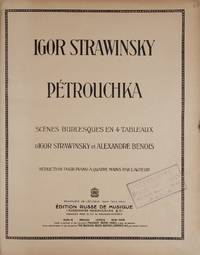
191241390Berlin Moscou Leipzig New-York: Édition Russe de Musique PN R.M.V. 150 1912. Folio. Contemporary half black calf with marbled boards label of the Parisian music rental firm Rouart-Lerolle to upper marbled endpapers. 1f. recto title verso blank i named cast list referring to first production of 1911 in French i synopsis in Russian and French i "general remarks" in Russian and French i blank i dedication to A. Benois i blank 7-84 ii blank pp. Photographic transfer from engraved plates. With "ROME MAI 1911" and printer's note "Imp. C. G. Röder Leipzig." to lower outer corner of p. 84.<br /> <br /> Rouart Lerolle and "5" handstamps to title and first four leaves.<br /> <br /> Binding worn rubbed bumped and abraded; hinges split; small label with "143" in manuscript to upper board. First Edition first issue. Kirchmeyer 12-4. De Lerma P17. Crawford p. 533.<br /> <br /> Distinguishing imprint to title below crest found in the first issue is as follows:<br /> <br /> PROPRIÉTÉ DE L'ÉDITEUR POUR TOUS PAYS / ÉDITION RUSSE DE MUSIQUE / RUSSISCHER MUSIKVERLAG G.M. above BH below/ FONDÉE PAR S. ET N. KOUSSEWITZKY / BERLIN MOSCOU LEIPZIG NEW-YORK / POUR LA FRANCE ET SES COLONIES: MUSIQUE RUSSE PARIS 3 RUE DE MOSCOU / POUR L'ANGLETERRE ET SES COLONIES; THE RUSSIAN MUSIC AGENCY LONDRES W.I 34 PERCY STREET<br /> <br /> "The emergence of Stravinsky as a modernist with an individual manner unlike any other can be dated with some precision to his early work on Petrushka. In March 1910 during the later stages of composing The Firebird he had experienced the famous 'fleeting vision' out of which The Rite of Spring was to grow. But when Diaghilev and Nijinsky visited him in Lausanne in September 1910 they found him at work on something quite different a concert piece for piano and orchestra called 'Petrushka's Cry'. Together with a 'Russian Dance' composed soon afterwards this music was to form the basis of the ballet which Diaghilev instinctively urged him to write instead. . <br /> <br /> It is from the systematic attempt to render the particular flavour of traditional Russian life into music that Petrushka derives many of its freshest and most original qualities. . <br /> <br /> Looked at in general terms the opening sequence of Petrushka is a prototype of later Stravinskian form. Its underlying rhythmic design may not be complex in the same way as that of The Rite of Spring or the later Russian works but its intricacy of rhythmic detailing and its mixture of a highly fluid pattern of melodic stress with an inert background harmony laid the groundwork for a technique which through many changes of superficial style was to serve him for the rest of his life." Walsh: The Music of Stravinsky pp. 24-29. <br /> <br /> "Petroushka proved just as successful with the public and critics as The Firebird had been; but it was undoubtedly a more original work. In the first place Stravinsky had been able to play a leading part in the construction of the scenario which had not been the case with The Firebird. Secondly whereas the music of The Firebird showed that the pupil had learnt all that his master had had to teach him in Petrushka for the first time the authentic voice of the new master is heard." TNG Vol. 18 pp. 244-245. <br /> <br /> Petrushka one of Stravinsky's best-known and loved works represents the essence of Diaghilev's monumental Ballets Russes era. The ballet received its first performance with the incomparable Nijinsky in the title role at the Théâtre du Châtelet on 13 June 1911 conducted by Pierre Monteux with choreography by Fokine and designs by Alexandre Benois. Édition Russe de Musique [PN R.M.V. 150] unknown
2005Q-0060559594Harper Paperbacks 2005-03-15. Paperback. New. In shrink wrap. Looks like an interesting title! Harper Paperbacks paperback
16-4191Genève Edition Ad. Henn 1917. . 4to. 28 x 19.8 cm. 8 64pp. Original wraps. Front cover mainly detached. Signed at Morges Switzerland and dated 1918 and inscribed .The poet and playwright René Morax founded his Théâtre du Jorat near Mézières Switzerland in 1903. Made entirely of wood so as to be integrated into the barns of the surrounding countryside it was described this way in an early account: “A theater decidedly unlike any other. A sort of vast chalet a kind of huge barn smelling of resin dried hay fresh fruit and on days when there was a performance Sunday clothes but retaining the rustic dignity of a shrine. A large stage descending in broad steps toward the orchestra pit …â€The theater was closed for several years during the Great War and Morax conceived a drama on the subject of King David to reopen it in 1921. When he turned to his wealthy friend Werner Reinhart who incidentally had recently funded the creation of Stravinsky’s Soldier’s Tale telling him that he was taking inspiration from Hindu theater for this work his patron offered to lend rare Hindu drums in addition to financial assistance. The text is drawn from the Hebrew Bible I and II Samuel I Kings in addition to the Huguenot Psalter which includes poetry by Clément Marot. The poet’s brother Jean Morax set to work designing costumes and sets. After several more established composers turned him down René on the advice of Stravinsky and the distinguished conductor Ernest Ansermet chose the then unknown twenty-eight year old Arthur Honegger. “When Swiss poet Rene Morax 1873-1963 was looking for a composer for his new King David libretto Stravinsky recommended the twenty-nine-year-old Arthur Honegger a composer who just six years later creating the film score for Abel Gance’s Napoleon would reveal himself as a master of music’s ability to translate epics into sweeping evocative sound. In 1921 right on the cusp of his first successes Honegger wrote the David score in a flush of creative energy.â€. Provenance from the estate of René Morax. Expertise by Claire PIGUET Geneva Genève, Edition Ad. Henn, 1917. paperback
1969256031New York: Alfred A Knopf 1969. First edition. ix i 350 xi pp. 8vo. Publisher's green cloth faded at edges in very good edge-worn dustjacket. First edition. ix i 350 xi pp. 8vo. Signed on the flyleaf "Igor Stravinksy / 1.30.70" and inscribed by co-author Robert Craft. The recipient was Miranda "Mirandi" Massoco Levy 1914-2011 the doyenne of Sante Fe cultural life instumental in the success of the Sante Fe Opera and a close friend of Stravinsky. Alfred A Knopf unknown
19971-0851621910Boosey & Hawkes Music Pub Ltd 1997. Paperback. New. new edition. 168 pages. 12.00x9.00x0.40 inches. Boosey & Hawkes Music Pub Ltd paperback
1997754181997. First Edition; First Printing. Softcover. Very Good in wrappers. Text is in Italian. ; 4to - over 9¾" - 12" tall. unknown
048643821X.Gpaperback. Good. Access codes and supplements are not guaranteed with used items. May be an ex-library book. paperback
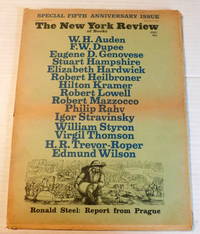
196899602<p>New York: September 26 1968. 1968. Very good. - Folio 15 inches high by 11-3/4 inches wide. Softcover unbound signatures laid into printed green self-wraps. Once folded horizontally the edges and center of the covers are faded to tan. A tear along the front edge has been reinforced with clear document tape from the verso. There is chipping to the top edges of the covers and along the spine. 80 pages of newsprint including the wrappers illustrated by David Levine and Grandville. There are tiny holes to the front border of the last few leaves. Very good.</p><p>RARE First edition.</p><p>Among the contents of this issue Igor Stravinsky in reviewing a book on the Beethoven string quartets offers his own impressions of them. Elizabeth Hardwick posts a powerful description of Mayor Daley and the notorious Chicago convention. Her article is illustrated with a David Levine caricature. William Styron offers his impressions of the same event in his article "In the Jungle" also illustrated with a Levine caricature. Ronald Steel reports from Prague "Up Against the Wall in Prague". F.W. Dupee writes of "The Uprising at Columbia". H.R. Trevor-Roper writes on "Hitler's Last Minute". Virgil Thomson discusses Pierre Boulez in his article "The Genius Type". Three poems are published in this issue: "Forty Years On" by W.H. Auden "Those Older" by Robert Lowell and "Barbara" by Robert Mazzocco.</p> New York: September 26, 1968. paperback
1998C5890Vanguard Classics 1998-06-23. Audio CD. Like New. CD case and liner all in Excellent condition. Vanguard Classics unknown