Themes and Episodes
1972276420London: Faber & Faber 1972. hardcover. near fine/fine. Photo Illus. 8vo red cloth d.w. London: Faber and Faber 1972. Near Fine<br/><br/> Faber & Faber unknown books

Argosy Book Store · États-Unis16,88 $US≈ 14,28 €
56 résultats
196647652NY: Knopf 1966. First Edition. 8vo pp. x 352 xiii. Indexes. Black cloth printed in purple and gilt. A VG tight copy in chipped price-clipped and somewhat insect-damaged dj. Short writings by Stravinsky and diary entries by Craft regarding I. S. Knopf unknown books
1972276420London: Faber & Faber 1972. hardcover. near fine/fine. Photo Illus. 8vo red cloth d.w. London: Faber and Faber 1972. Near Fine<br/><br/> Faber & Faber unknown books
19599591New York 1959. TLS by Igor Stravinsky addressed in ink to "Dear Merle Armitage" on Stravinsky's printed 1/2 sheet notepaper 5-1/2" x 11". The note is typed: "Back from Japan I receive your word of May 15. I certainly will be glad to have a copy of the Siohan's book I heard about it and thank you for offering it to me. Flying the 20th to Copenhagen for a few days and will send you your copy with my signature as soon as I will receive it hoping before my trip. All best cordially your. I. Stravinsky" signed in ink. Fine. Merle Armitage and Stravinsky were close friends. Armitage edited the first book on Stravinsky in 1936 and a second book in 1949 and they collaborated on many programs at the Hollywood Bowl over the years. The "Siohan's book" referred to is a biography of Stravinsky published in 1959 written by Robert Siohan. unknown books
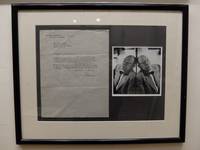
1962293971Hollywood 1962. unbound. very good. Fine content T.L.S. 4to 1 page Hollywood California December 12th 1962 to singer Jerry McLain attempting to give him musical advice without hurting his feelings in full: "I would be certainly glad yo give you advice but never hearing you singing and not knowing how far you are in the knowledge of works in general their spirit and technique I am in difficulty if not in impossibility to help you. The transposition of the Shakespearean songs in a higher or lower key is a ruin of my instrumentation and the piano reduction of them is not for a concert performance only for the study of the music." Placed into a white matte with a black background with two openings - whereby the letter is actually floated while the second opening accommodates a photograph by Weegie of the composer leaning against a mirror that gives the illusion of a double exposure and set into a black acrylic frame to 21.5" x 18.5". Excellent condition.<br/><br/> Russian composer pianist and conductor widely considered one of the most important composers of the twentieth century.<br/><br/> unknown books
1940244796Cambridge 1940. One page typewritten signed in black ink. 1 vols. 4to. Old folds. Fine with original typed mailing envelope typed name "Igor Strawinsky" above printed return address. One page typewritten signed in black ink. 1 vols. 4to. Stravinsky at Harvard on the "Firebird" "Stravinsky began his stay in the United States at Harvard University delivering six Charles Eliot Norton lectures on musical poetics during the 1939-1940 academic year" ADNB.<br/><br/>In this brief formal letter Stravinsky acknowledges receipt of an edition of the Russian legend retold and illustrated by Donald E. Cooke. It was Stravinsky's 1910 score of The Firebird for the Ballets Russes that first brought him international notice. The New York Times obituary of Stravinsky published on 6 April 1971 noted "He also was not pleased that 'The Firebird' remained his most popular composition."<br/><br/>Uncommon document from early in Stravinsky's residence in the U.S. when he still spelt his surname with "w" in his signature and return address. unknown books
16350November 11 1967 Hollywood one page 4to on Stravinsky's imprinted stationery: "This letter is a pledge to help discharge Mr.Robert Craft's $10903.44 debt to CBS. As both Mr. Craft and CBS apparently are in precarious financial circumstances I herewith request and authorize the attachment and application of my own royalties." He concludes with a dig at the "richly ungrammatical note" from CBS's law firm. Signed in full. Fine condition. The works of Stravinsky 1882-1971 spanning from the romantic into the modern era revolutionized twentieth-century music. While The Firebird his first commission for Diaghilev's Ballets Russes reflects the rich orchestral coloring of Rimsky-Korsakov his dissonant third ballet The Rite of Spring caused a critical riot in 1913 Paris and still sounds barbarous today. Stravinsky met the young American conductor Robert Craft in 1948; Craft gradually became his Boswell and was instrumental in persuading the composer to adopt the twelve-tone scale. <br/><br/> unknown books