Prokofiev, S.Livre Rare Book
430 résultats
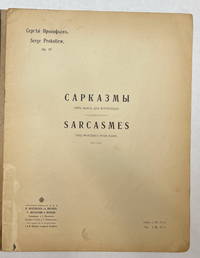
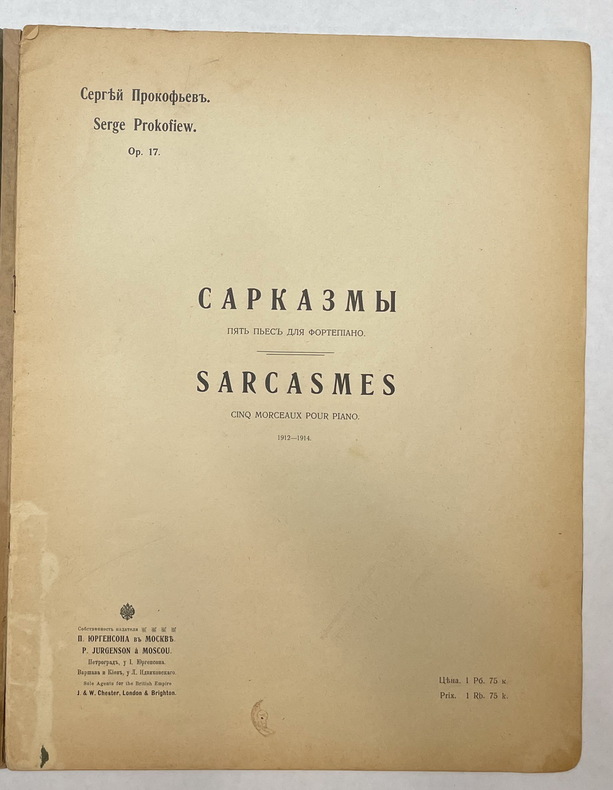
lom-MS100036In English/Russian. Short description: Prokofiev, Sergei, Sarcasms, Op. 17. [Cikl ?Sarkazmy? (op. 17)] Moscow: P. Jurgenson, 1912. The cycle ?Sarcasms? (Op. 17), written in 1912?1914, consists of five contrasting pieces: Tempestoso, Allegro rubato, Allegro precipitato, Smanioso, and Precipitosissimo. The publication by the Moscow publisher P. Jurgenson in 1916 is of particular historical importance as the first lifetime edition, preserving the composer?s original intention. Please feel free to contact us for a detailed description of the copies available. SKU lom-MS100036
lom-MS100036In English/Russian. Short description: Prokofiev Sergei Sarcasms Op. 17. Cikl Sarkazmy op. 17 Moscow: P. Jurgenson 1912. The cycle Sarcasms Op. 17 written in 19121914 consists of five contrasting pieces: Tempestoso Allegro rubato Allegro precipitato Smanioso and Precipitosissimo. The publication by the Moscow publisher P. Jurgenson in 1916 is of particular historical importance as the first lifetime edition preserving the composers original intention. Please feel free to contact us for a detailed description of the copies available. SKU lom-MS100036 unknown
43309with several bars of music from his "5th Concerto" on a card 4½" x 3½" no place As the creator of acknowledged masterpieces across numerous music genres he is regarded as one of the major composers of the 20th century. His works include such widely heard pieces as the March from The Love for Three Oranges the suite Lieutenant Kijé the ballet Romeo and Julietfrom which "Dance of the Knights" is takenand Peter and the Wolf. Of the established forms and genres in which he worked he createdexcluding juveniliaseven completed operas seven symphonies eight ballets five piano concertos two violin concertos a cello concerto a symphony-concerto for cello and orchestra and nine completed piano sonatas. unknown
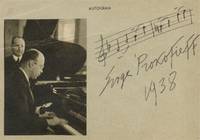
396772 measures from the second theme of the 3rd movement of the suite. Notated in black ink on light gray paper and dated 1938. With "Autogram" printed at head and photographic reproduction of Prokofiev at the piano laid down to left.<br /> <br /> Verso with annotations in pencil and printed identification laid down.<br /> <br /> Very slightly creased. "Sergei Prokofiev's Lieutenant Kijé Поручик Киже Poruchik Kizhe . was originally written to accompany the film of the same name produced by the Belgoskino film studios in Leningrad in 1933-34 and released in March 1934. It was Prokofiev's first attempt at film music and his first commission.<br /> <br /> In the early days of sound cinema among the various distinguished composers ready to try their hand at film music Prokofiev was not an obvious choice for the commission. Based in Paris for almost a decade he had a reputation for experimentation and dissonance characteristics at odds with the cultural norms of the Soviet Union. By early 1933 however Prokofiev was anxious to return to his homeland and saw the film commission as an opportunity to write music in a more popular and accessible style.<br /> <br /> After the film's successful release the five-movement Kijé suite was first performed in December 1934 and quickly became part of the international concert repertoire. It has remained one of the composer's best-known and most frequently recorded works. Elements of the suite's score have been used in several later films and in two popular songs of the Cold War era." Wikipedia<br /> <br /> Prokofiev was a noted Russian composer and pianist born in Ukraine. "A large number of the works that are free from political professions have a firm place in the international repertory and he is rightly counted one of the major composers of the 20th century. He was not a great influence on younger generations of composers unlike Schoenberg Berg and Webern Stravinsky Bartók and Messiaen - except in the Soviet Union where Soviet-trained musicians of a whole generation took their guidelines from either Shostakovich or Prokofiev raising the achievement of one or the other to the status of a philosophy of life and passed on their stylistic features to those who followed." Dorothea Redepenning in Grove Music Online. unknown
193916425JMoscow: Goskinoisdat 1939. First Edition. Text and inscription in Russian. Signed and inscribed by film director Sergei Eisenstein to film sound engineer Boris Alexeivich Volsky inscribed in Russian which translated reads: “To the former “remarkable’ sound engineer page 25 who took care of Alexander Nevsky ‘with shining mastery page 28 with love Sergei Eisenstein Moscow June 14 1940â€. Eisenstein praises Volsky in the printed text of the two pages he has indicated. Additionally the book is signed again in pencil with Eisenstein using his cursive Arabic handwriting siganture while the signature in the inscription to Volsky is his Cyrillic Russian signature. Original green cloth. Very good. Boris Volsky recorded the sound for Eisenstein’s Alexander Nevsky 1938 Ivan the Terrible Part One 1948 and Ivan the Terrible Part Two 1958. Eisenstein’s autograph is a legendary rarity. Goskinoisdat hardcover